
How PSEi member stocks performed — July 16, 2025

Here’s a quick glance at how PSEi stocks fared on Wednesday, July 16, 2025.


Here’s a quick glance at how PSEi stocks fared on Wednesday, July 16, 2025.
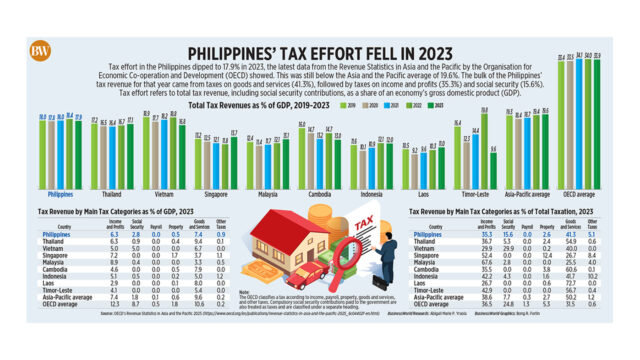
Tax effort in the Philippines dipped to 17.9% in 2023, the latest data from the Revenue Statistics in Asia and the Pacific by the Organisation for Economic Co-operation and Development (OECD) showed. This was still below the Asia and the Pacific average of 19.6%. The bulk of the Philippines’ tax revenue for that year came from taxes on goods and services (41.3%), followed by taxes on income and profits (35.3%) and social security (15.6%). Tax effort refers to total tax revenue, including social security contributions, as a share of an economy’s gross domestic product (GDP).


PHILIPPINE SHARES slid further on Wednesday, dragging the main index back to the 6,300 level, as investor sentiment was soured by inflation concerns in the United States, which could affect the Federal Reserve’s rate-cut cycle.
The bellwether Philippine Stock Exchange index (PSEi) sank by 1.88% or 121.99 points to 6,337.48, while the broader all shares index dropped by 1.55% or 59.02 points to 3,748.25.
This was the PSEi’s lowest close in three weeks or since it finished at 6,330.65 on June 26.
“The local market plunged this Wednesday as investors dealt with the rise in the US’ inflation last June and its implications on the Federal Reserve’s policy outlook. The US latest inflation print may cause the Fed to prolong their pause in their policy rate adjustments,” Philstocks Financial Inc. Research Manager Japhet Louis O. Tantiangco said in a Viber message.
“Philippine shares succumbed to profit taking as investors digested hotter-than-expected June inflation data (in the US),” Regina Capital Development Corp. Head of Sales Luis A. Limlingan said in a Viber message.
US consumer prices increased by the most in five months in June amid higher costs for some goods, suggesting tariffs were starting to have an impact on inflation and potentially keeping the Federal Reserve on the sidelines until September, Reuters reported.
The consumer price index (CPI) increased 0.3% last month after edging up 0.1% in May, the Labor Department’s Bureau of Labor Statistics said on Tuesday. That gain was the largest since January, and also reflected higher rental costs.
In the 12 months through June, the CPI advanced 2.7% after rising 2.4% in May. Economists polled by Reuters had forecast the CPI would climb 0.3% and rise 2.6% on a year-over-year basis.
Economists generally expect the tariff-induced rise in inflation to become more evident in the July and August CPI reports, arguing that businesses were still selling merchandise accumulated before President Donald J. Trump announced sweeping import duties in April. Mr. Trump last week announced higher duties would come into effect on Aug. 1 for imports from a range of countries, including Mexico, Japan, Canada and Brazil, and the European Union.
All sectoral indices closed lower on Wednesday. Mining and oil sank by 2.64% or 255.59 points to 9,396.37; holding firms plunged by 2.5% or 141.35 points to 5,494.93; property decreased by 2.28% or 55.61 points to 2,378.79; financials went down by 1.79% or 40.21 points to 2,195.62; services fell by 1.69% or 37.06 points to 2,149.75; and industrials declined by 1.52% or 141.03 points to 9,093.46.
Value turnover surged to P20.78 billion on Wednesday with 3.43 billion shares traded from the P5.9 billion with 1.65 billion shares exchanged on Tuesday.
Decliners bested advancers, 122 versus 67, while 59 names were unchanged.
Net foreign selling increased to P3.47 billion on Wednesday from P322.36 million on Tuesday. — Revin Mikhael D. Ochave with Reuters

By Justine Irish D. Tabile, Reporter
PHILIPPINE EXPORTS to the US, especially garments and textiles, will face stiffer competition after Indonesia obtained a 19% tariff rate, according to an industry group.
Foreign Buyers Association of the Philippines President Robert M. Young called the Indonesia-US deal a “big blow.”
“This is again a big blow to the Philippines, particularly to the exports of garments, textiles, and apparel, because we are now at 20% and they are on 19%,” he told BusinessWorld by phone.
“To start with, they are much bigger in terms of exports to the US. Indonesia right now is shipping something like almost $5 billion worth of garments and textiles to the US, while the Philippines is still fighting for $1 billion,” he added.
US President Donald J. Trump said on his Truth Social platform that he finalized a deal with Indonesia on Tuesday that reduced the US tariff on Indonesian goods to 19%, much lower than the 32%. Mr. Trump assigned to Indonesia in a tariff letter last week.
Aside from opening the Indonesian market to the US, Mr. Trump said that Indonesia also committed to purchasing energy, agricultural products, and Boeing airliners from the US.
“For the first time ever, our ranchers, farmers, and fishermen will have complete and total access to the Indonesian market of over 280 million people,” Mr. Trump said.
“In addition, Indonesia will pay the US a 19% tariff on all goods they export to us, while US exports to Indonesia are to be tariff and non-tariff barrier free,” he added.
Mr. Young said the outlook for Philippine tariff negotiations is dimming as other countries’ negotiations with the US are weighted towards more geopolitical considerations.
“We really don’t know because actually in the past we have already offered everything in terms of military assistance and benefits. It was all exhausted by the Philippines, having been laid on a silver platter to the US,” he said.
“On trade, we are not at the level of the other countries to offer this kind of concession. As you know, we are a small player. It will be a difficult situation for the Philippines. I wish the team of negotiators good luck, but it seems like it will be a dim chance,” he added.
The government sent its negotiators to Washington this week to seek a lower tariff, with President Ferdinand R. Marcos, Jr. expected to arrive later this month.
Mr. Young said that he does not think the Philippines can offer a zero rate on US imports to match Indonesia.
“I don’t know if we can afford it. We are also relying on the taxes for our revenue. The other thing is, of course, this will be a Presidential action. But, in the Philippines, we have (to contend with) all kinds of legalities here and there,” he said.
“It has to go through the Congress. We really don’t know how we can manage. But we have so little to offer, so I don’t know if it will be attractive enough to the US. This is what we have been trying to say,” he added.
However, he said Secretary Frederick D. Go, the special assistant to the President for investment and economic affairs has hinted that the Philippines still “has some bullets.”
“I do not know what kind of bullets he is talking about, but that is what he said,” he added.
Aside from garment and textile exports, he said that Indonesia’s lower tariff can also impact other Philippine exports, including agricultural and mineral products.
“I’m not very familiar with the figures of agri and other minerals. But all of that can be affected because it’s a competition,” he said, noting that Indonesia already sells more because of its lower costs.
Meanwhile, he said that the garment and textile industries are still not giving up and seeking other markets to survive.
“We are not waving the white flag. We are fighting. We are looking for other markets; Russia is there,” he said.
“We are in survival mode,” he added.

THE Philippine Health Insurance Corp. (PhilHealth) said on Wednesday that member contribution rates will not rise because they are fixed by law, adding that it will seek to offset the loss of government subsidies through operational efficiencies.
PhilHealth President and Chief Executive Officer Edwin M. Mercado said the efficiencies will come in the form of streamlined collections.
“Right now, (rates are) set by law. The maximum (premium contribution rate) is 5% of basic pay. At this point, it’s more about our efficiency in collecting from the paying sectors and direct members,” Mr. Mercado told reporters on the sidelines of the Management Association of the Philippines (MAP) general membership meeting.
The health insurer, however, is considering adjusting the cap on members’ basic monthly salary or income, which currently stands at P100,000.
“What’s being considered is a so-called progressive rate — those who can afford it might be able to contribute more. That’s what we’re currently studying,” Mr. Mercado said.
“Our economy is growing and the per capita income of Filipinos is also increasing, so that’s something we will look into. It’s not about raising the percentage, but rather adjusting the cap,” he added.
Under the Universal Health Care Act, PhilHealth charges its members a premium of 5% of their monthly basic salary or declared income, subject to a P10,000 salary floor and a P100,000 ceiling.
Last year, the government discontinued its subsidies for the health insurer, citing its large reserve funds.
Mr. Mercado said PhilHealth has about P480 billion in cash from retained earnings, which he said remain adequate to fund existing and planned benefit packages.
However, Mr. Mercado said PhilHealth is seeking additional funding for 2026 from the General Appropriations Act to support the planned upgrades to collection efficiency, as well as planned new benefit packages.
“Last week, the Department of Health and PhilHealth, had a meeting, and based on the benefit payments we expect for next year, we really had to request additional funding,” he said, noting that the extra funding to be requested is not yet final.
“We are also reviewing the benefit packages we have lined up. And if those get approval, there will be corresponding additional budget requirements. But… a large portion of what we will spend on benefit payments next year will also depend on our collection efficiency,” he added.
Earlier this year, PhilHealth introduced a set of expanded benefits, including coverage for ischemic heart disease — acute myocardial infarction, peritoneal dialysis, kidney transplants, preventive oral health services, and an outpatient emergency care benefit.
Mr. Mercado said PhilHealth is also investing more in primary care, including preventive measures such as screenings and early treatment. — Katherine K. Chan

THE Department of Energy (DoE) said it expects no disruptions to its green energy auction (GEA) timetable, despite extensive personnel turnover in the agency responsible for setting ceiling prices.
Assistant Secretary Mylene C. Capongcol said that the DoE does not expect delay since the green energy auction reserve (GEAR) price for the fourth round of GEA (GEA-4) has been released and work on GEA-5 is ongoing.
“There are directors and other commissioners who are familiar with the GEAR pricing, the process is ongoing, but the final decision has to wait for the Commission to be complete,” Ms. Capongcol told reporters on Tuesday.
The DoE has launched two auctions, offering 10,478 megawatts (MW) of renewable energy capacity under GEA-4 and 3,300 MW of capacity under GEA-5.
GEA-4, which covers integrated renewable energy and energy storage systems as well as onshore wind, is scheduled for Sept. 2.
Meanwhile, GEA-5 for offshore wind has gone through public consultations on the terms of reference. It is currently working on the GEAR price to guide potential bidders.
The Energy Regulatory Commission (ERC) determines the GEAR price, or the maximum price in pesos per kilowatt-hour that will serve as the ceiling price for the auction.
ERC Chairperson and Chief Executive Officer Monalisa C. Dimalanta submitted her “irrevocable resignation” on July 10 to the Office of the President (OP).
Her resignation coincides with the concurrent end of term for two ERC’s commissioners on July 9, raising concerns that this would deprive the commission of a quorum to perform its regulatory functions.
“I doubt it will be paralyzed because there are still units within the ERC that are active and continuously performing their mandate under the GEA and other regulations,” Ms. Capongcol said.
At a Palace briefing on Tuesday, newly appointed Energy Secretary Sharon S. Garin believes that the OP will immediately appoint a new ERC chair and replacements for the two commissioners.
“ERC is not under the DoE, it’s our regulator. It’s under the OP. There will be complications now that she’s gone because the number of commissioners will now only be two, no quorum. I think the OP will act swiftly to address that,” Ms. Garin said.
“Unfortunately, I don’t want the stakeholders to think that there’s a major overhaul of the energy industry… We will continue with the policies that are effective. We will do away with policies that are not helpful to the country,” she added.
Ms. Dimalanta left four years earlier than the end of her seven-year term.
“I’m glad I’m leaving at a point when I know I have done all I could for the reforms needed at ERC and I have not done anything I would regret,” she said via Viber.
Ms. Dimalanta said her irrevocable resignation “does not put the appointing authority in a possibly legally tenuous position. At the same time, we protect the agency by not setting a precedent on courtesy resignations or Cabinet reshuffles affecting an independent institution like the ERC.” — Sheldeen Joy Talavera

THE Economy and Development Council has approved the P229.32-billion operations and maintenance (O&M) contract for the North-South Commuter Railway (NSCR) project.
The council, chaired by President Ferdinand R. Marcos, Jr., issued the decision at its July 15 meeting, the Department of Economy, Planning, and Development (DEPDev) said in a statement on Wednesday.
The 147-kilometer elevated railway line seeks to ease travel across three regions Central Luzon, Metro Manila, and Calabarzon — composed of Cavite, Laguna, Batangas, Rizal, and Quezon.
“The North-South Commuter Railway Project is a major step toward faster, greener, and more connected transportation as the system will also be integrated with the Metro Manila Subway. At the same time, it will promote green and commercial development along its corridors,” Economy Secretary Arsenio M. Balisacan said.
DEPDev said the railway will have 35 stations, including 31 elevated, three at-grade, and one underground.
Depots will be located in Clark, Valenzuela, and Calamba to support maintenance and operations, it said.
The project provides two types of train services.
The commuter line has 51 trainsets, each with a passenger capacity of 2,242. The Limited Express service will have seven trainsets of 386 passengers each.
These services are meant to improve travel speeds, with trains operating at 120 to 130 kilometers per hour, exceeding the current average commuter rail speeds of 20 to 40 kilometers per hour.
In addition, the DEPDev said the pre-operations phase of the project will run between March 2026 and July 2027.
“The concession period for the partial operations of Phase 1, which stretches from Clark International Airport (CIA) to Valenzuela (13 stations), will commence in December 2027 and continue until September 2028,” it said.
The concession period for the partial operations of Phase 2, which extends service to Nichols with an additional segment from Alabang to Calamba, will run between October 2028 and December 2031.
Full operations are anticipated to start in January 2032.
At the same meeting, DEPDev kicked off the updating process of its mid-term progress assessment ahead of the necessary adjustments to targets and interventions.
“We have learned a lot of lessons from our past experiences and many of these have been reflected in our recent efforts. We will continue to stay on course to sustain our momentum for the second half of this administration,” Mr. Balisacan said.
DEPDev will solicit comments from the various agencies before finalizing the updated plan, which will be issued by the end of July. — Aubrey Rose A. Inosante
THE Board of Investments (BoI) said it endorsed a P30-billion heavy-section mill in Candelaria, Quezon, to the One Stop Action Center for Strategic Investments (OSACSI) for green-lane treatment.
In a statement on Wednesday, the BoI said that SteelAsia Manufacturing Corp.’s (SAMC) mill and scrap recycling project in Quezon Province has been awarded green lane certification, which will entitle it to streamlined permitting.
Expected to begin operations by July 2027, the project is expected to create 655 in-plant jobs and 3,000 indirect jobs.
“The project involves the construction of a state-of-the-art facility that will employ Electric Arc Furnace (EAF) technology, prioritizing sustainability by using locally sourced recycled scrap metal instead of imported raw materials,” BoI said.
“According to SAMC, this recycling process reduces carbon dioxide emissions by a minimum of 70% compared to traditional blast furnace methods, offering a more environmentally responsible approach to steel production,” it added.
The plant has the capacity to produce one million metric tons of heavy steel sections annually, which is expected to help reduce reliance on steel imports.
“The Candelaria steel mill will complement SAMC’s pioneering medium-section mill in Lemery, Batangas, which was also endorsed for green lane certification by OSACSI in 2023,” the BoI said.
“The Lemery facility, currently under construction, will produce medium sections and merchant bars — products that are currently 100% imported,” it added.
Together, the two plants are expected to supply the Bataan-Cavite Interlink Bridge Project.
“(They will) help close critical gaps in domestic steel production, support fabrication shops, and boost the country’s industrial competitiveness across Southeast Asia,” the BoI said.
Between February 2023 and June, the BoI endorsed 222 projects for green-lane treatment, which have a total project cost of P5.748 trillion. — Justine Irish D. Tabile

THE PHILIPPINES joins a select group of growing economies that will drive expanding meat consumption over the next decade or so, the Food and Agriculture Organization (FAO) and the Organisation for Economic Cooperation and Development (OECD) said.
In their agricultural outlook for 2025-2034, the FAO and the OECD said global poultry, sheep meat, beef, and pork consumption are projected to grow 21%, 16%, 13%, and 5%, respectively, by 2034.
“Due to rapid consumption and income growth, 45% of global growth will be located in upper middle-income countries,” it said, noting that meat consumption growth, aside from China and India because of their substantial populations, is expected to be greatest in the Philippines, Brazil, Indonesia, the US, and Vietnam.
Global meat production was estimated to have risen by 1.3% to 365 million metric tons (MMT) in 2024, driven by poultry, “with beef output increases,” it said. Pig and sheep meat production remained stable.
Significant growth in meat production occurred in Australia, Brazil, the European Union, and the US.
Brazil, the Philippines’ largest source of meat imports, recorded the “most significant expansion” across all major meat categories, “driven by strong global demand, supported by higher net returns due to a favorable exchange rate and lower feed costs as well as continued disease-free status.”
Global meat exports recovered in 2024, rising 2% to 40.2 MMT after two years of decline, due in large part to expanded imports by the Philippines, the United Arab Emirates, and Mexico.
The report also said the Philippines, Brazil, Egypt, Mexico, and the US, will account for a significant segment of global poultry consumption, which is expected to hit 173 MMT on a ready-to-cook basis by 2034.
By that year, poultry meat is expected to account for 45% of the protein consumed from all meat sources, it said.
The increase in poultry consumption in the last decade was driven by China, India, Indonesia, Pakistan and Vietnam.
“The global increase in protein from poultry meat consumption as a share of total protein from meat has been the main feature of the growth in meat consumption for decades, and this trend is expected to continue,” the report found.
It cited poultry’s low cost and favorable nutritional profile, specifically a high protein-to-fat ratio compared to other meats.
“Environmental considerations also contribute to the shift towards poultry meat, as the production of red meat is more resource-intensive and leads to higher greenhouse gas emissions,” it added. “Poultry is, therefore, more appealing to sustainability-conscious consumers.”
The FAO said in most high-income countries, which accounted for 35% of global meat consumption but only 17% of the world’s population in 2024, growth in per capita meat consumption will continue to slow, with consumers shifting preferences — “often reducing meats like beef and pork in favor of poultry.”
“Higher-income consumers are increasingly attentive to the animal welfare, environmental, and health attributes of food, which in some places is leading to stagnating or even declining per capita meat consumption,” it added.
Philippine meat imports in the first quarter rose to 344.59 million kilograms (kg), from 273.64 million a year earlier.
Pork accounted for 53.2% or 70.45 million kg of all meat entering the country in the first quarter, against 128.5 million a year earlier.
It was followed by chicken at 111.36 million kg or 32.3% of first-quarter meat imports.
Beef imports in the first quarter rose 24.2% to 43.9 million kg or 12.7% of all meat imports. — Kyle Aristophere T. Atienza

THE Department of Agriculture (DA) said value-added salt products are expected to expand opportunities for traditional producers in coastal communities.
The salt products developed by the National Fisheries Development Center of the Bureau of Fisheries and Aquatic Resources are fortified with iodine and infused with lemongrass, ginger, and garlic.
“Designed to address public health concerns such as iodine deficiency disorders, they also offer a platform for micro, small, and medium enterprises (MSMEs) to thrive, especially in rural and coastal communities with rich salt-making traditions,” the DA said.
The value-added salt products include lemongrass-flavored tanglasin, a citrusy finishing salt ideal for seafood, poultry and tropical dishes; ginger-flavored ginsin for broths, rice porridge, and stir-fries; malunggay-flavored salt; and garlic-flavored salt.
The products also include varieties with oregano, basil, and thyme; pepper salt; and chili-flake salt.
“For many years, the salt industry has faced significant challenges such as insufficient support services, the impact of climate change, urbanization, and intensifying market competition,” the DA said. — Kyle Aristophere T. Atienza

THE Department of Tourism (DoT) said on Wednesday that it launched a loan program targeted at tourism micro, small, and medium enterprises (MSMEs) seeking to scale up and improve service quality.
In a statement, the DoT said the Turismo Asenso multipurpose loan program follows the signing of a memorandum of agreement with the Department of Trade and Industry (DTI).
“With tourism contributing 8.9% to our GDP and providing jobs to over 6.75 million, our approach has always been to grow it as a powerful economic driver,” Tourism Secretary Christina G. Frasco said.
“The Turismo Asenso loan program is part of this vision — giving our tourism MSMEs the capital they need to expand, hire more people, and improve services. This is real, accessible support for the entrepreneurs at the heart of our tourism economy,” she added.
The DTI’s financing arm, the Small Business Corp. (SBCorp.), the loan program will allow MSMEs to borrow up to P20 million.
“For non-collateral loans, new borrowers may access up to P3 million, while existing borrowers may qualify for loans of up to P5 million. Flexible repayment terms of up to five years are also available,” the DoT said.
To avail of the loan, the applicant must have a Filipino-owned registered business or a business with at least 60% Filipino ownership.
The business must also have a track record of at least one year, hold assets not exceeding P100 million excluding land, and be free of past-due accounts in any SBCorp. programs and other major negative credit findings. — Justine Irish D. Tabile

Digital services have become essential in today’s fast-paced world. For businesses, companies increasingly rely on cloud-based tools or enterprise software to enhance efficiency and aid in data-driven decision making, despite the significant investment these technologies often require. Multinational companies (MNCs) often contract with digital service providers (DSPs) at a global level, through their parent entities or regional headquarters and allocate or recharge the corresponding costs to their subsidiaries or affiliates based on consumption, including those in the Philippines. This leverages purchasing power to secure better deals, reduce costs, and maintain consistent service quality across all members of the group, even those located in other countries.
With the signing of Republic Act No. 12023, or the VAT on Digital Services Act, digital services provided by non-resident digital service providers (NDSPs) for Philippine consumers are now subject to 12% VAT. “Digital service” is defined as any service that is supplied over the internet or other electronic network with the use of information technology and where the supply of the service is essentially automated.
While there are still ongoing discussions around what exactly qualifies as “supplied over the internet” and “essentially automated,” the intention of the law is clear — to subject digital services consumed in the Philippines to 12% VAT, regardless of the residence of the service provider. However, questions may arise when these services are charged through cost allocations or recharges from a non-resident parent or affiliate. Should VAT still apply when the Philippine entity is not the direct contracting party of the NDSP, but simply bears its share of costs initially paid by its non-resident parent or affiliate? More importantly, which foreign entity would be reported as the actual NDSP and would bear the obligation of registering for and reporting the VAT?
The answer to the first question is quite straightforward since the VAT is imposed on consumption by a Philippine customer. In Q&A No. 30 of Revenue Memorandum Circular (RMC) No. 47-2025, the Bureau of Internal Revenue (BIR) confirmed that if the contracting party of the NDSP is outside the Philippines, for instance a non-resident parent or affiliate, and the costs are shared with different markets including Philippine subsidiaries, the allocated costs or recharges are to be subject to 12% VAT if these pertain to digital services consumed in the Philippines. The RMC reiterated that the VAT on Digital Services is based on consumption, not on the physical presence of the service provider in the Philippines. Accordingly, in these Business-to-Business (B2B) transactions, the Philippine subsidiary is responsible for withholding and remitting the VAT on the allocated costs attributable to the digital services it utilizes locally.
However, the RMC did not clearly discuss how this would be implemented. In particular, will a shared cost arrangement require the non-resident parent or affiliate to register as the NDSP in the Philippines, even if it merely passes on the cost and does not perform any digital services? Based on the language and objective of the law, I believe the registration requirement should remain with the third-party service provider, as this is the entity actually supplying the digital services consumed in the Philippines. It is likely that these NDSPs are also providing services to other Philippine customers and so are likely already registered for VAT. In contrast, the non-resident parent or affiliate merely acts as a pass-through entity for cost efficiency and to facilitate the income payments attributable to the digital services consumed by the Philippine subsidiary. To require the mere intermediary entity to register would unduly add an administrative burden that would negate the leverage that was gained by MNCs from such arrangements, and would not really benefit the government anyway. If at all, it would just add another layer of information that the government would have to sift through and eventually eliminate when collating information on digital services that consumed in the Philippines. Nonetheless, it would be helpful for the BIR to issue further guidance to clearly establish which entity must comply with the registration requirements and the corresponding documentation (for example, the relevant withholding tax reporting) in this type of scenario.
From a commercial perspective, the practice of imposing VAT on recharges or allocated costs may pose significant financial considerations within the global group of entities, especially if the amount of digital services is high and the Philippine customer is not able to claim the input VAT credit. The parties will need to agree on the VAT payment arrangement, whether this will be shouldered by the non-resident or by the Philippine payor. The non-resident parent or affiliate may reasonably push back against having 12% VAT withheld on the recharged amount, especially if it has already paid the full cost to the third-party service provider and it has no means to recover the VAT withheld by the Philippine subsidiary.
While the VAT withheld can be recovered by the Philippine customer/withholding agent by using it as credit against its output VAT, the withholding of tax will still require an upfront cash outlay. Certain taxpayers or industries may also not be able to immediately utilize the VAT withheld as credit (e.g., those who are engaged in VAT zero-rated transactions), or may be forced to absorb the cost (e.g., those who are engaged in VAT-exempt sales, who can only claim the input VAT as expense for income tax purposes).
In either case, regardless of the arrangement adopted by the non-resident parent or affiliate, it would be advisable for the parties to ensure that the agreement clearly states the VAT arrangement on recharges/cost allocations, and where VAT applies, the party who will shoulder the VAT due.
I hope that these matters will be clarified by the BIR soon to help support continued compliance from taxpayers. In the meantime, as digital services become deeply embedded in business operations, Philippine entities of MNCs may help manage the implications of the recharges and allocated costs by:
• Reviewing the intercompany service agreements to check whether the underlying services fall within the scope of “digital services” as defined by law;
• Coordinating with non-resident parents or affiliates and agree which entity will shoulder the cost of and account for the 12% VAT if the recharges and allocated costs are attributable to digital services consumed in the Philippines; and
• Revisiting and amending contracts to clearly describe how the services are delivered, where such services are rendered, and what type of outputs are provided. These details will help manage the risk of non-digital services being mistakenly classified as digital services subject to 12% VAT.
In navigating the complexities of the VAT on Digital Services, taxpayers can turn potential challenges into strategic advantages by aligning intercompany agreements and defining service parameters. By negotiating VAT responsibilities and staying adaptable, they can ensure compliance, and optimize operations, all while leveraging the group’s centralized procurement and digital tools for improved performance and growth.
The views or opinions expressed in this article are solely those of the author and do not necessarily represent those of Isla Lipana & Co. The content is for general information purposes only, and should not be used as a substitute for specific advice.
Ron Jacob Abaday is a senior associate at the Tax Services department of Isla Lipana & Co., the Philippine member firm of the PwC network.
+63 (2) 8845-2728
