Home Blog Page 1276

New auto revival strategy to offer up to P3B in perks

USERTRMK-FREEPIK

A NEW auto industry revival program due next month will offer up to P3 billion in incentives for each participant in a bid to continue the momentum of a previous plan encouraging domestic manufacturing, the Board of Investments (BoI) said.

“I was informed that the joint administrative order on Revitalizing the Automotive Industry for Competitiveness Enhancement (RACE) is almost done and will be issued next month,” BoI Executive Director for Industry Development Services Ma. Corazon Halili-Dichosa said via Viber.

The predecessor to RACE was the Comprehensive Automotive Resurgence Strategy (CARS) program, which incentivized the domestic assembly of compact cars targeted at the mass market.

“The issuance of the CARS Program under Executive Order No. 182 contributed to the achievement of the desired localization levels among the participants and the development of the capabilities of the parts manufacturing industry,” according to a briefing paper on the program.

RACE will have a P250-million budget in the 2025 General Appropriations Act.

“The Philippine automotive industry has significant potential for growth and innovation. However, it faces challenges such as limited local manufacturing capabilities and increasing competition within the ASEAN region,” according to the briefing paper.

According to the Department of Trade and Industry (DTI), RACE will be carried out via a Joint Administrative Order (JAO) for easier implementation.

The DTI has said that it and the departments of Finance and Budget will issue the JAO, and will open the application period for potential participants by next month or May.

As in CARS, RACE will incentivize domestic production in exchange for a commitment from participants to produce 100,000 units of four-wheel internal combustion engine vehicles each. — Justine Irish D. Tabile

Hog industry roadmap seeks return to pre-ASF herd size

REUTERS

THE Department of Agriculture (DA) said on Thursday that its plan for a hog industry revival will seek to restore the herd size of 14 million animals before the 2019 outbreak of African Swine Fever (ASF), from 8 million currently.

Agriculture Secretary Francisco Tiu Laurel, Jr. said however at an industry summit that “With a growing population, demand is far higher than the previous (high of) 14 million,” he said.

He urged the industry to increase the herd by a “minimum” of 2 million hogs each year through 2028 to return to pre-ASF levels.

Undersecretary for Livestock Dante J. Palabrica has been tasked with creating a roadmap to guide the recovery of the industry, which he called critical to food security.

Livestock and poultry account for about a quarter of agricultural output and provide livelihoods for over 2.8 million farmers, according to the DA.

Pork and chicken account for more than half of the protein in the Filipino diet, it said.

The proposed animal industry competitiveness enhancement fund earmarks about P4 billion for the hog industry to support its recovery and growth.

A return to pre-ASF levels would mean a significant reduction in pork imports, Mr. Laurel said.

“Filipinos still prefer the meat of freshly slaughtered hogs,” he said, referring to the disadvantages of imported pork, which is frozen.

The DA chief said he had spoken with two large commercial hog producers who have committed to each produce half a million more hogs starting next year.

“If they deliver, I already have around 1 million additional head.”

The Philippine Statistics Authority reported that the price of fresh pork belly (liempo) in the March 1-5 period rose to P384.08 per kilo from P378.84 in the previous monitoring period of Feb. 15-17 and P375.02 a month earlier.

The government on March 10 started imposing a maximum suggested retail price (MSRP) of P380 per kilo for liempo and P350 for kasim (shoulder) and pigue (rear leg).

The DA has also imposed a maximum suggested price of P300 per kilo on traders when they pass pork on to retailers.

The level of compliance with the pork MSRP during the first week of implementation was low at 20% out of the 170 stalls monitored in Metro Manila markets, according to the DA.

It said in a separate report on March 22 the compliance rate had risen to 25%, calling it a significant improvement.

The government first applied the MSRP scheme to rice, initially setting it at P58 per kilo.

The DA is also considering buying pork from importers and traders for sale in government-subsidized stores.

The DA on March 19 said the Bureau of Animal Industry was working to ensure the commercial release by April of a Vietnamese vaccine against ASF.

It said at that time that the utilization rate for the 160,000 doses procured by the government was 17.46%. These were administered at 29 farms identified as ASF hotspots. — Kyle Aristophere T. Atienza

Power firms not compliant with listing requirement at 54% — ERC

The Masinloc Power Plant in Zambales — SMCGLOBALPOWER.COM.PH

POWER companies that have not complied with an industry-wide listing requirement represent 54% of all such firms and account for nearly 14,000 megawatts (MW) of generating capacity, the Energy Regulatory Commission (ERC) said.

“For those who are not compliant yet as of now, they at various levels of compliance…These are 136 generation companies, which account for 54% of all generating companies. Their capacity is around 14,000 MW,” Rochelle V. Moreno, chief energy regulation officer at ERC, said during a Securities and Exchange Commission (SEC) event on Thursday.

Section 43 of the Electric Power Industry Reform Act (EPIRA) requires unlisted generating companies and distribution utilities to offer and sell to the public at least 15% of their common stock.

New companies are required to offer shares no later than five years from the issuance of their certificates of compliance (CoC). A CoC is a license issued by the ERC allowing the operation of a power plant or other facilities used in generating electricity.

Only 37 energy companies are fully compliant with the public offer rule, supplying 3,241.17 MW of capacity to the grid.

Non-compliant energy firms are subject to revocation of their CoCs or non-renewal of their licenses to operate.

“The consequence then is something that we find very difficult to enforce, to implement. Why? As you have seen, the impact of revoking the certificates of compliance for those that have not complied will be taking out 14 gigawatts of power from the system,” ERC Chairperson and Chief Executive Officer Monalisa C. Dimalanta said.

“Revoking their CoCs would be sort of a self-inflicted wound… because everyone will suffer. We just try to help them comply and SEC has been helping us out,” she added.

Ms. Dimalanta said many firms find the process of listing “really very intimidating, intensive, and costly.”

The SEC implemented last year the SEC POWERS program (Securing and Expanding Capital for Power Generation Operators and Wholesale Electricity and Retail Services.)

“As the overseer of the capital markets, we at the SEC remain steadfast in our mandate of creating a sound policy environment for all stakeholders — balancing the interests of the issuers and protecting the investing public,” SEC Chairman and CEO Emilio B. Aquino said.

The SEC committed to complete the review of the registration statement within 45 days from filing, in accordance with the requirements of the Securities Regulation Code, the Revised Corporation Code of the Philippines, and pertinent issuances of the SEC.

Citing the Philippine Energy Plan 2023-2050, Mr. Aquino said the Philippines will need around P67 trillion in investment to meet its energy requirements.

“As we are all aware, energy projects are very capital intensive. This is where the capital market can come in. We aim to introduce the limitless potential of tapping the capital markets as a financing solution to meet the growing demand of the energy sector,” Mr. Aquino said.

Ms. Dimalanta said that the ERC and SEC have been working together since 2023 through joint public consultations with over 100 members of the energy industry.

She said the target is to get an additional 100 energy companies to comply with the public offering rules within the next 12 months. — Sheldeen Joy Talavera

Siargao airport terminal targeted for expansion to 700-seat capacity

PHILSTAR FILE PHOTO

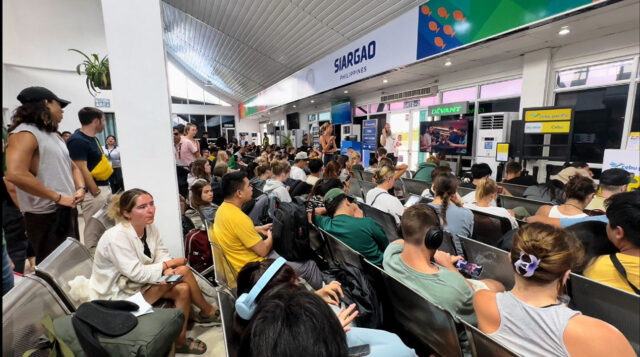
THE Department of Transportation (DoTr) said it ordered the expansion of the Siargao’s Sayak Airport terminal to 700 seats from 200 in the face of growing passenger demand.

“We are going to monitor this expansion and upgrade to increase the seating capacity of this passenger terminal building,” Transportation Secretary Vivencio B. Dizon said in a statement on Thursday.

Mr. Dizon said the DoTr will pursue a “modular” expansion of the terminal and expects the upgrades to be completed within six months.

The expansion will involve the removal of redundant x-ray machines to create space for the extra capacity.

The DoTr also said it ordered the Civil Aviation Authority of the Philippines to remove the VIP lounge at the passenger terminal to accommodate the growing number of passengers.

In 2024, the DoTr said it is looking to develop six greenfield airports destinations such as Zamboanga, Dumaguete, and Siargao.

Talks are ongoing with local government units regarding the new airport in Siargao, it said. — Ashley Erika O. Jose

China told not to meddle in PHL-US ties

A Chinese Coast Guard vessel fires its water cannon at Unaizah Mae 4 during a Philippine resupply mission for Filipino troops stationed on BRP Sierra Madre in Second Thomas Shoal on March 5, 2024. — ARMED FORCES OF THE PHILIPPINES

By John Victor D. Ordoñez, Reporter

THE PHILIPPINE presidential palace on Thursday urged China to respect Manila’s freedom to boost military ties with Washington and stop meddling in its foreign affairs to keep regional peace.

“Whatever actions we take or projects we pursue regarding our military operations, these are entirely our decisions, and no one has the right to interfere,” Presidential Communications Office Undersecretary Clarissa A. Castro told a news briefing. “We are independent, and no one should meddle in the decisions of our government.”

The Chinese Embassy in Manila did not immediately reply to a Viber message seeking comment.

The Chinese Foreign Ministry on Tuesday urged the Philippines to stop “serving as other countries’ mouthpiece and more stunts for personal political agenda” ahead of US Defense Secretary Peter Hegseth’s visit to Manila on Friday.

“Any defense or security cooperation between the Philippines and other countries should not target any third party or harm their interest, still less threaten regional peace or escalate tensions in the region,” Chinese Foreign Ministry spokesman Guo Jiakun told a news briefing in Beijing on Wednesday.

“Our message to some in the Philippines: Stop serving as other countries’ mouthpiece and no more stunts for personal political agenda.”

The US Defense chief will visit the Philippines on March 28 to 29 for a meeting with Philippine President Ferdinand R. Marcos, Jr. and Defense Secretary Gilberto C. Teodoro, Jr., with talks expected to center on advancing Manila and Washington’s defense ties, the US Embassy in Manila said in a statement last week.

“The Philippines is no one’s chess piece; we are an independent country,” Ms. Castro said.

China’s ineffective strategic communication on interference in our military’s internal affairs brings further rift between Beijing and Manila, Chester B. Cabalza, founding president at Manila-based think tank International Development and Security Cooperation, said in a Facebook Messenger chat.

“The Philippines has every right to manage its own alliance,” he said. “What China wants to see is for the Philippines to fail and mismanage our security alliance with the US.”

“It is China that is undermining our independence and sovereignty. If that’s how the Chinese politburo sees us with our relationship with the US, then China does not fathom alliance management at all,” he added.

The Armed Forces of the Philippines on Tuesday said Mr. Hegseth’s visit reaffirms the US’ “ironclad” commitment to its oldest treaty ally in Asia.

The US Defense chief’s trip to the Philippines comes on the heels of his tour to Hawaii and Guam, where he would meet military leaders overseeing the Pacific region. He will also visit Japan, another Asian ally of the US that has been at odds with China over Senkaku Islands.

China claims more than 80% of the South China Sea based on a 1940s map, which a United Nations-backed arbitration court in The Hague voided in 2016 for being illegal.

Philippine and US army soldiers on Monday started three weeks of joint military exercises that focus on territorial defense and commanding large-scale deployment of forces.

About 5,000 soldiers from the Philippine Army and US Army Pacific will take part in warfighting and exchange of expertise in the first phase of this year’s Exercise Salaknib. A second phase is scheduled for later this year.

Manila has been at the forefront of efforts to contest Beijing’s expansive sea claim, deepening security ties with western countries and regional allies like Japan and Australia.

The war games between Manila and Washington’s forces have focused on enhancing the Southeast Asian nation’s ability to defend its territory from external threats, conducting past drills near potential flashpoints of the South China Sea and self-governed Taiwan, which Beijing considers a renegade state.

The People’s Daily, the newspaper of the governing Communist Party, has urged the Philippines to give up the Typhon missile system, which was deployed by US forces to the Philippines in April last year as part of joint military exercises to keep the peace in the region.

The Philippine President earlier said he was willing to pull out the US Typhon missile system once China stops its aggression in the South China Sea.

The US is the Philippines’ major security partner, with a 1951 Mutual Defense Treaty compelling both nations to defend each other in case of an armed attack.

Washington’s military has moved its Typhon launchers, which can fire multipurpose missiles up to thousands of kilometers, from Laoag airfield to another location on the island of Luzon, Reuters earlier reported.

The Philippines secured an exemption from the 90-day funding freeze that US President Donald J. Trump ordered in January so it could receive $336 million for the modernization of its security forces.

‘REAL WAR’
“If China truly believes in and is concerned about peace and stability in the region, it should abide by international law and respect the sovereignty of each country,” Ms. Castro said.

“If both parties continue to engage in word war, only time will tell when the real war will occur between the two countries,” Rommel C. Banlaoi, president of the Philippine Society for International Security Studies, said in a Viber message. “But we can avoid war and prevent armed conflicts through amity and cooperation within the principles of peaceful coexistence, mutual respect and due regard.”

Meanwhile, the Philippine Defense department said it seeks to strengthen security ties with Cambodia after a recent courtesy call by Lieutenant General Rath Dararoth, Cambodian secretary of state for the Ministry of National Defense on Mr. Teodoro on March 25.

“Secretary (Teodoro) expressed optimism about strengthening defense ties between the Philippines and Cambodia,” the agency said in a statement on Thursday. Mr. Dararoth agreed to deepen bilateral cooperation between the two Southeast Asian nations, it added.

“He extended his appreciation for the Philippines’ continued support, particularly in education and training programs,” it added.

Earlier, President Ferdinand R. Marcos, Jr. said the Philippines should hold more frequent military training exercises with Cambodia to coordinate efforts in addressing the security challenges in the South China Sea and Indo-Pacific Region.

The South China Sea is a vital waterway for more than $3 trillion worth of annual ship-borne commerce. China, the Philippines, Brunei, Indonesia, Malaysia and Vietnam have competing sea claims.

Mr. Teodoro said the Philippines would continue to engage with its regional peers to strengthen defense ties.

During the meeting, Mr. Teodoro cited the need for regional cooperation in tackling security issues and promoting mutual growth.

On Tuesday, the Philippines and Cambodia held their fourth joint defense cooperation committee meeting in Manila, where they tackled national defense plans and cybersecurity.

The Cambodian envoy said these dialogues are key to bolstering defense partnerships and regional stability. — with Adrian H. Halili


Philippines urged to shun EU-like media regulation

STOCK PHOTO | Image by memyselfaneye from Pixabay

By Beatriz Marie D. Cruz, Reporter

A PHILIPPINE government proposal to regulate harmful information online through international standards could stifle free speech, according to political analysts.

“We don’t want laws to be weaponized,” Danilo A. Arao, an associate journalist professor from the University of the Philippines, said by telephone. “Such media regulations would be tantamount to censorship even without using the word censorship; it’s de facto censorship.”

The House of Representatives has been investigating the spread of malicious and fake content online, citing its threat to democracy, national security and public trust.

Presidential Communications Office (PCO) Chief Jaybee C. Ruiz last week urged congressmen to pass a European Union (EU)-like Digital Services Act, which would outlaw the publication of harmful information online.

“I respectfully encourage our lawmakers to consider the framework of the Digital Services Act, a recently adopted EU regulation which prevents illegal and harmful activities and disinformation online, while still ensuring that the freedom of expression is upheld,” he told a House hearing.

However, many anti-fake news laws around the world have been heavily criticized for preventing freedom of expression, Mr. Arao said, citing Germany’s Network Enforcement Act, which mandates online platforms to remove illegal content or face fines of up to €50 million for systemic failures.

“What’s happening in Europe is not necessarily the context here in the Philippines, where we’ve had the history of censorship, and we’ve been under tyrannical rule,” Mr. Arao said.

The EU’s Digital Services Act itself has been deemed “incompatible” with America’s free speech tradition, US Federal Communications Commission (FCC) Chairman Brendan Carr said, citing tech firms’ commitment to diversity and inclusion, Reuters reported.

“It’s incumbent upon the PCO, especially given that the likes of [PCO Undersecretary Claire A.] Castro and Ruiz have a background in journalism, to review their knowledge of censorship on the one hand and responsible gatekeeping on the other,” Mr. Arao said.

“Because we cannot afford to have media regulation under the regime of the son of the dictator, and we recall that from 1972 to 1986, there was widespread censorship then,” he pointed out.

The late dictator Ferdinand E. Marcos, Sr. — the father of the Philippine President now — declared martial law in September 1972, which led to the heavy regulation and censorship of news.

Mr. Marcos ordered the shutdown of 292 radio stations, 66 community newspapers, 11 English weekly magazines, seven major English dailies, seven television stations, four Chinese dailies, three Filipino dailies, one Spanish daily and one English-Filipino daily, data from the state-run Official Gazette showed.

‘LAZIEST APPROACH’
Michael Henry Ll. Yusingco, a lawyer and senior research fellow at the Ateneo Policy Center, said copying laws from other jurisdictions is the “laziest approach to lawmaking.”

“For now, civil society needs to help netizens be less vulnerable to disinformation,” he said in a Facebook Messenger chat.

Mr. Arao cited the need to “go back to the basics,” including stronger media literacy and education, as well as self-regulation of the press.

Jonathan de Santos, chairman of the National Union of Journalists of the Philippines, said the government should focus on seeking accountability from networks and agencies focused on spreading misleading information.

“I think one way is going after the influence networks and public relations or social agencies that are creating and spreading misleading content,” he said in a Viber message. “We haven’t really done that as we have focused on individuals.”

Lawyer Antonio Gabriel M. La Viña, convenor of Movement Against Disinformation, said media platforms should be held liable for allowing the proliferation of wrong information on their platforms.

“[Between] posting the truth versus posting an ‘untruth,’ more users will look at an ‘untruth’ because it’s controversial,” he told News and Views on One News on Wednesday.

“Media platforms benefit from hate and disinformation, so we have to punish them and even close them down if they don’t comply,” he said in mixed English and Filipino.

“Perhaps a doable intervention, whether from government or from civil society organizations, would be to call out social media platform owners and demand that they undertake third-party fact-checking and other aspects of responsible gatekeeping,” Mr. Arao said.

Representatives from social media platforms should be made to explain before the House what they are doing about responsible gatekeeping, he said, citing Meta’s removal of its third-party fact-checking feature.

The next House hearing is scheduled for April 8. Social media personalities absent at the last hearing would be cited in contempt if they fail to attend.

“Such hearings should not be within the framework of what kind of regulation you need — that’s the wrong question,” Mr. Arao said.

“The right question would be: How do we fight disinformation? Or what can government do to strengthen self-regulation in media? Or how do we find ways to strengthen media literacy and education?” he added.

Palace: Duterte-Marcos rift not a factor in his arrest

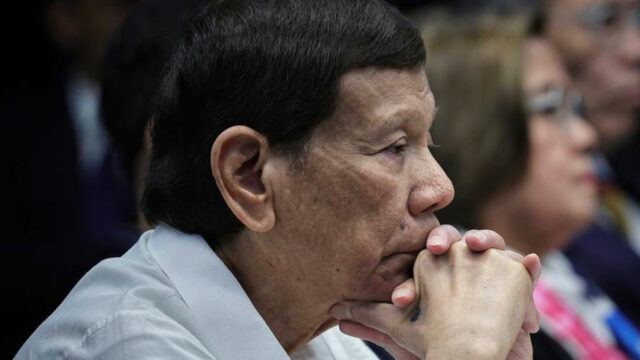
FORMER PRESIDENT Rodrigo R. Duterte — OFFICIAL FACEBOOK ACCOUNT OF THE SENATE OF THE PHILIPPINES

THE PRESIDENTIAL palace on Thursday rejected Senator and presidential sister Maria Imelda “Imee” R. Marcos’ claim that soured ties between the Marcos and Duterte clans had led to the government’s willingness to carry out the International Criminal Court’s (ICC) arrest order against former President Rodrigo R. Duterte.

“The administration’s actions were solely based on the law and its obligations to the International Criminal Police Organization (Interpol),” Presidential Communications Office Undersecretary Clarissa A. Castro told a news briefing. “If Senator Marcos has a different perspective, that is her personal opinion.”

Mr. Duterte, who sat as president from 2016 to 2022, was arrested on March 11 in Manila, marking the biggest step yet in the ICC’s probe of his alleged crimes against humanity in connection with his anti-illegal drug crackdown that killed thousands and drew condemnation around the world.

The Hague-based tribunal has been investigating the firebrand leader for crimes he allegedly committed when he was Davao City mayor and during the first three years of his government, when the Philippines was still a party to the international tribunal.

Ms. Marcos, who remains a close friend of the Dutertes, on Wednesday withdrew from her brother’s senatorial slate, citing a deliberate effort to “obscure the truth” about the ex-President’s arrest.

Suspicions that she had been dropped from the slate arose after the President left her name out in his speech, only accounting for 11 senators in the administration’s senatorial ticket.

The senator earlier told a Senate hearing looking into the arrest high-ranking government officials and witnesses were deliberately hiding facts about the arrest by repeatedly invoking executive privilege.

At the same Senate hearing, Justice Secretary Jesus Crispin C. Remulla said the government did not plan Mr. Duterte’s arrest and surrender to The Hague-based tribunal.

Ms. Marcos said the Philippines had no obligation to arrest and surrender Mr. Duterte to the ICC.  “There were glaring violations of the rights of the former President,” she told a news briefing.

Ms. Marcos added that the government had not only helped the ICC in the arrest had already planned his arrest before a warrant was issued.

The war on drugs was Mr. Duterte’s signature campaign platform that swept the mercurial, crime-busting former prosecutor to power in 2016, and he soon delivered on promises made during vitriolic speeches to kill thousands of drug dealers and users.

“Executive privilege is a constitutional doctrine that allows the president and high-ranking executive officials to withhold sensitive information, especially if it risks encroachment by one branch of government over another,” Ms. Castro said.

“This is not about hiding anything; it’s about ensuring that sensitive matters are handled appropriately.”

Mr. Marcos earlier said his government was just doing its job in carrying out the ICC arrest warrant and cooperating with Interpol, adding that it was nothing personal.

During Mr. Duterte’s six years in office, 6,200 suspects were killed during anti-drug operations, by the police’s count. Human rights groups say the deaths could be as many as 30,000.

“If she is investigating this matter, we hope she remains impartial and also considers the view of those who support the administration’s decision to surrender former President Duterte to the ICC,” Ms. Castro said.

“We are simply following what the law states and what our obligations and commitments to Interpol are. That is all we are doing — nothing personal,” she added. — John Victor D. Ordoñez

Probe of ‘irregularities’ in DepEd’s voucher program for low-income students sought

PHILSTAR FILE PHOTO

A CONGRESSMAN on Thursday called for a probe of the Department of Education’s (DepEd) financial assistance for low-income students amid reported irregularities involving ghost students among other schemes.

“There is still a need to look into these allegations of irregularities to ensure that public funds are used properly, and that deserving students receive the assistance due them,” Cagayan de Oro Rep. Rufus B. Rodriguez said in a statement.

Under House Resolution No. 2252, dated March 17, Mr. Rodriguez asked the House Committee on Basic Education and Culture to investigate the government’s Education Service Contracting (ESC) school voucher program funds, which provides financial assistance to students from low-income families to enroll in private schools.

Under the ESC, students are given P18,000 to P22,500 to cover a portion of their tuition and other costs such as books and other school fees.

Only high school graduates of government schools and private schools participating in the Education Service Contracting program are automatically qualified for DepEd’s Senior High School voucher assistance.

DepEd had earlier withheld P200 million worth of school vouchers “due to questionable and unverifiable student claims.”

Education Secretary Juan Edgardo M. Angara had raised concerns about the prevalence of “ghost students” after his agency halted the release of almost P52 million worth of subsidies to at least 12 schools nationwide for the school year 2023-2024.

Mr. Rodriguez alleged that some private schools manipulated their enrollment record by logging non-existing students.

“Certain private schools manipulated their enrollment date by registering non-existence students to secure voucher funding from the government, resulting in the misuse of public funds that re intended for legitimate education beneficiaries,” he added.

The lawmaker also said that “fly-by-night” schools were also participating in the government voucher program. 

“This not only result in the loss of public funds but also deprive deserving students of the financial assistance intended to support their education, undermining the integrity and effectiveness of the government’s education assistance program,” Mr. Rodriguez added.

He added that there is a need to enforce policies and guidelines for the voucher program, this includes the implementation of stricter verification, monitoring and accountability mechanisms “to prevent similar incidents in the future.” — Adrian H. Halili

DoTr won’t close EDSA bus lane

PHILIPPINE STAR/EDD GUMBAN

THE EDSA Carousel bus lane will remain operational despite the upcoming rehabilitation of the Epifanio de los Santos Avenue (EDSA), which is set to begin in April, the Department of Transportation (DoTr) said on Thursday.

“The consensus is that we will keep the dedicated bus carousel as it is. We will explain how it will be managed next week,” Transport chief Vivencio B. Dizon said in a briefing with the Metro Manila Council, the Metropolitan Manila Development Authority (MMDA), and the Department of Public Works and Highways.

Mr. Dizon admitted that the upcoming facelift of Metro Manila’s main highway is expected to significantly impact traffic.

The project could take up to a year and a half to complete, Mr. Dizon said, noting that while they aim to begin the rehabilitation next month, they are amenable to delaying it further to avoid compromising motorists.

He assured the public that all relevant agencies and local government units are working to minimize disruptions and safeguard the welfare of both motorists and commuters.

“This project is no joke; it needs to be carefully planned, and we can’t proceed without finalizing everything first. It’s not just about the construction itself but also about all the other factors needed to ease the difficulties,” he said in Filipino.

MMDA Chairman Romando S. Artes said extensive meetings were conducted to prevent a “carmageddon.”

“Rehabilitating EDSA is extremely complex, and decisions cannot be rushed. There are many moving parts, and addressing one aspect affects others. Everything needs to be synchronized to avoid turning EDSA and the rest of Manila into a parking lot,” he said in Filipino.

The rehabilitation is to address structural deterioration and improve the overall condition of Metro Manila’s busiest thoroughfare.

Around 300,000 to 400,000 vehicles pass through EDSA daily, with an estimated 1.6 million commuters relying on various modes of transportation along the highway. — Chloe Mari A. Hufana

ICTSI, SMC warn against deepfakes 

THE COUNTRY’S biggest conglomerates have fallen victim to deepfakes with International Container Terminal Services, Inc. (ICTSI) and San Miguel Corp. (SMC) issuing warnings against scams.   

In a media release on Thursday, ICTSI cautioned the public over deepfake videos and audio recordings of ICTSI Chairman Enrique K. Razon, Jr. and other ICTSI executives trying to lure the public to pursue investment opportunities.

The company has denied the claims and reiterated that Mr. Razon and ICTSI have not endorsed such investments.

“The scam content is designed to appear convincing and may include offers that seem legitimate. ICTSI emphasizes that these are not authorized and are intended to mislead viewers,” ICTSI said.

With this, the listed port operator has also encouraged the public to be vigilant and verify content that references that company.  

Deepfakes are artificially generated images, videos, or audio meant to deceive consumers of media. Earlier this month, the Cybercrime Investigation and Coordinating Center (CICC) said it is drafting guidelines regulating deepfakes.

The Department of Information and Communications Technology (DICT), through CICC, has established a national deepfake task force to help develop industry standards for content creation, distribution, and labeling of manipulated media like deepfakes.

Separately, SMC has issued a warning against fake investment advertisements.   

The company urged the public to be cautious of the spread of fake videos and online advertisements falsely using its chairman and chief executive officer Ramon S. Ang.

“Many of these videos appear as paid ads on Facebook, Instagram, and other social media platforms. Some are made to look like real news reports… These scams use advanced technology like deep fakes to mislead people,” SMC said in a media release.

Meanwhile, SMC said it is collaborating with the authorities to trace down the people behind these scams and is looking to pursue legal actions against those responsible for these fake investments. — Ashley Erika O. Jose

BI uncovers fake identity scheme

PHILSTAR FILE PHOTO

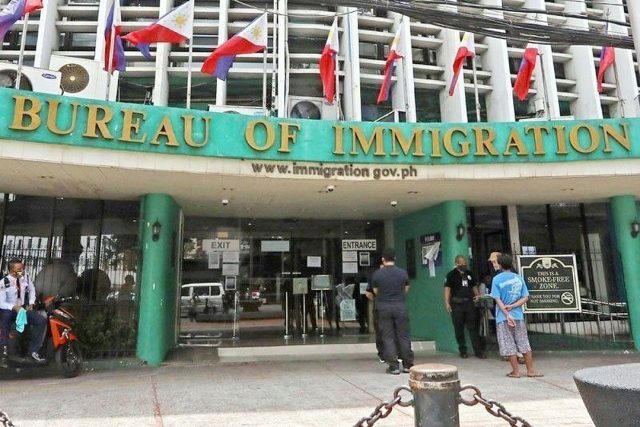
AUTHORITIES have uncovered a scheme that involves the use of fake Filipino identities to operate businesses employing illegal foreign workers in Mindanao, the Bureau of Immigration (BI) reported on Thursday.

The BI crackdown led to the arrest of a 50-year-old Chinese national on March 20 in Digos City.

She was managing a hardware store registered under a Filipino identity now under investigation.

Investigators found she held a work visa issued by a company in Pasig City but was engaged in unauthorized employment in Davao del Sur.

Filipino employees at the hardware store admitted that the registered owner was nonexistent, and the business permits were based on falsified documents.

In a related operation on March 24, BI operatives apprehended four other Chinese nationals working illegally at a chemical manufacturing plant in M’lang, North Cotabato.

Further investigation revealed that one of them had obtained Philippine birth certificates and other documents under a false identity.

Employees at the plant claimed that the registered Filipina owner had been absent since the business opened and that the real owner was a Chinese national based in Manila.

BI Commissioner Joel Anthony M. Viado expressed deep concern about the increasing trend of foreign nationals acquiring Philippine identities to set up businesses, warning that these fraudulent identities could be exploited for nefarious purposes.

“These documents and new identities may be used by foreigners with mal-intent and could be exploited by possible spies embedding themselves in society by pretending to be Filipinos,” he said in a statement.

He called for stricter regulations governing the issuance of Filipino documents and identification cards to prevent further abuse.

All five Chinese nationals now face deportation proceedings. The arrests were conducted in cooperation with intelligence agencies in Region 12, the National Bureau of Investigation, the Philippine Drug Enforcement Agency, and the Mlang Municipal Police Station. — Chloe Mari A. Hufana

Filipinos still struggling to attain basic human rights, group says

PHILIPPINE STAR/WALTER BOLLOZOS

A PHILIPPINE-BASED human rights organization on Thursday said Filipinos struggle to attain basic human rights due to low wages, inaccessible healthcare, lack of proper education, high housing prices, and rising utility costs in the country.

“Filipinos constantly need to leap over multiple obstacles stacked against each other just to survive. However, in the first place, we are already entitled to the rights we are struggling to attain,” Philippine Human Rights Information Center (PhilRights) Executive Director Nymia Pimentel-Simbulan said in a virtual briefing.

She added that most of the available jobs in the Philippines are in low-paying and insecure sectors such as domestic work or wholesale and retail trades.

“Informal workers have to endure long working hours to receive a small amount without any access to government-mandated benefits,” Ms. Pimentel-Simbulan said.

She added that neglecting health remains common among the urban poor due to high healthcare and hospital expenses.

“With limited means and a lack of accessible healthcare services, they prioritize other basic needs that will ensure their and their families’ daily survival,” she said.

Ms. Pimentel-Simbulan added that Filipinos continue to face the lack of proper education due to the neglect of adequate budget allocation for education.

“The belief that education is the only path out of poverty is deeply embedded in the minds of many people,” she said.

Housing prices remain a luxury rather than a right in the country, according to Ms. Pimentel-Simbulan.

She added that informal settlers continue to face constant threats of demolition without the government providing prior relocation or aid.

She said that rising utility costs also worsen living conditions for the urban poor.

“The price of electricity in the country remains one of the highest in Asia, mainly due to a highly privatized and deregulated energy production and distribution, as well as insufficient state subsidies and efforts to enhance energy sufficiency,” The PhilRights official added. — Adrian H. Halili