Home Blog Page 1252

APECO revives 10 infra projects worth P800M

NEW.APECO.GOV.PH

THE Aurora Pacific Economic Zone and Freeport Authority (APECO) said it revived 10 previously abandoned infrastructure projects valued at nearly P800 million.

In a statement on Wednesday, APECO said the projects include underground power distribution lines, water systems, sanitation facilities, and public buildings.

“(They) are now either completed, inaugurated, or under active construction under the leadership of APECO President and CEO Gil G. Taway IV,” APECO said, noting that the projects were inherited from the past administration.

Among the completed projects are the first phase of the P60-million Central Water Supply and Reservoir (CWSR), the first phase of the P28-million Sewage Treatment Plant (STP), and the P12-million APECO Fire Station.

APECO said that the first phase of the Underground Power Distribution Line (UPDL) is currently 98% complete. Combined with UPDL Phase 2, the project is 78% complete. They are worth P70 million overall.

Other ongoing projects are the second phase of the P30-million CWSR and the P15-million acquisition of fire trucks and ambulances. These are 87% and 50% complete, respectively.

One project in pre-construction is the P47-million STP Phase 2. — Justine Irish D. Tabile

Dante, Emong interaction may boost southwest monsoon, bring more rain

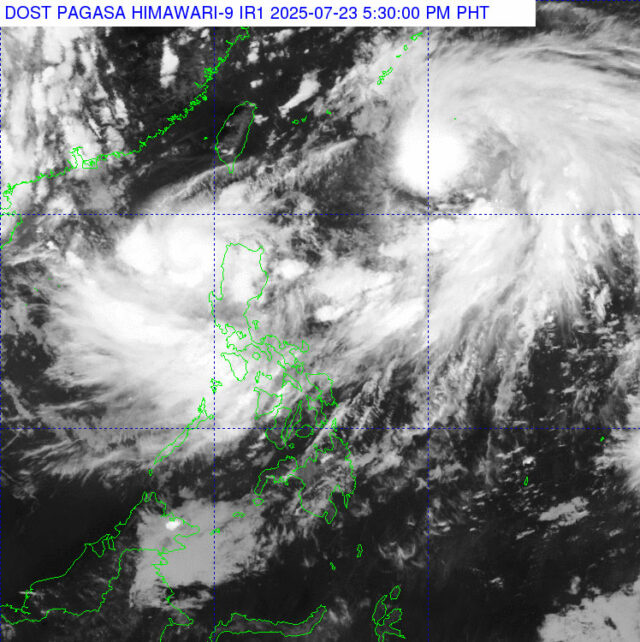
SATELLITE photo of Tropical Storms Dante and Emong. — PAGASA

By Kyle Aristophere T. Atienza, Reporter

TWO TROPICAL cyclones in the Philippines were beginning to interact as they drew closer to each other, a weather phenomenon that could enhance the southwest monsoon and bring heavier rains, according to the state weather bureau.

Emong, which had intensified into a tropical storm, was seen 120 kilometers (km) west of Laoag City in Ilocos Norte in northern Philippines as of 4 p.m. on Wednesday, the Philippine Atmospheric, Geophysical and Astronomical Services Administration (PAGASA) said in a 4 p.m. report.

It added that Dante, another tropical storm, was last spotted 845 km east-northeast of extreme northern Luzon.

Dante and Emong were close enough to trigger a binary interaction as they were only about 1,100 km apart, PAGASA said earlier in the day, calling the phenomenon the “Fujiwhara effect.” It said a binary interaction could happen if the distance between two storms is less than 1,500 km.

“Based on their tracks, we are seeing a possible interaction between the two,” the agency said in Filipino.

PAGASA said Dante, which was moving north toward Taiwan, might pull Emong along as the latter was initially looping on the western side of Ilocos Norte.  Dante could become the dominant system because it is stronger, it added.

“So, instead of Emong moving toward the West Philippine Sea, it will follow Dante’s path,” PAGASA said. The two storms would likely have the closest interaction near Taiwan as Dante leaves the Philippine area of responsibility.

“They will not necessarily combine into one, but this will be their closest interaction.”

The combined strength of the two cyclones could enhance the southwest monsoon, it said. It added that parts of northern Luzon might experience heavy rains due to the circular movement of Emong.

Dante and Emong both had maximum sustained winds of 65 kilometers per hour (kph) near the center and gustiness of up to 80 kph. Dante was moving north-northwestward at 25 kph, while Emong was moving southwestward at 20 kph, PAGASA said.

PAGASA said the southwest monsoon was affecting central and southern Luzon, the Visayas and Mindanao.

More than 3,000 villages across 15 provinces in Bicol, Cagayan Valley, Mimaropa and Western Visayas were “very highly susceptible” to rain-induced floods and landslides, the Department of Environment and Natural Resources-Mines and Geosciences Bureau (DENR-MGB) said in a separate statement, citing PAGASA’s rainfall forecast.

Almost 5,000 villages in 22 provinces including the Cordillera Administrative Region, Ilocos Region, Calabarzon and Central Luzon were “highly susceptible,” it added.

In the National Capital Region, 1,403 villages faced “high susceptibility risks,” that needed urgent precautionary measures.

DENR-MGB said its forecasts highlight Occidental Mindoro, Antique and Zambales as areas expected to experience the highest rainfall, with over 80% of villages there likely to be affected in the next three days.

“These conditions necessitate prompt action from local government units to mitigate risks to residents.”

The Philippines has been dealing with heavy flooding for days largely triggered by the southwest monsoon.

The disaster agency on Wednesday put the death toll at seven, up from six a day earlier, after recording a death in Metro Manila.

Two of the reported deaths have been confirmed, while five were still being verified, the National Disaster Risk Reduction and Management Council (NDRRMC) said in a morning report. 

The agency previously reported three deaths in Northern Mindanao and one each in the Davao Region, Caraga Region and Mimaropa. It said seven people had been injured and eight were still missing.

About 1.41 million people from more than 401,000 families have been affected. More than 141,000 people were staying at 537 evacuation sites.

In a separate statement, the Department of Public Works and Highways (DPWH) said damage to public infrastructure from the southwest monsoon and recent tropical cyclones had reached P3.75 billion.

The agency said the Bureau of Maintenance recorded the most significant losses in flood control structures at P3.24 billion. Damage to national roads was estimated at P483.68 million, and national bridges suffered P24.48 million in losses.

The agency said the estimates include infrastructure losses in Central Luzon, Ilocos Region, Mimaropa (Mindoro, Marinduque, Romblon and Palawan), Western Visayas and the Negros Island Region.

The damage was attributed to the southwest monsoon and the effects of tropical cyclones Crising, Dante and Emong, which brought widespread rains and flooding across several provinces.

As of July 23, the DPWH said 27 national roads remained partially passable due to flooding, precautionary closures, collapsed slope protections, road slips and washed-out detour roads.

These affected road sections were in the National Capital Region, Ilocos Region, Central Luzon, Calabarzon, Bicol Region and the Zamboanga Peninsula.

Despite the extensive impact, the agency said it had reopened 35 national road sections affected by the storms. However, five roads remained impassable including Kennon Road, the Urdaneta Junction–Dagupan–Lingayen Road via Tarlac, Urdaneta Junction–Dagupan–Lingayen Road via Zambales, Paniqui–Camiling–Wawa Road and Talisay–Laurel–Agoncillo Road.

The DPWH is proposing a P150-billion budget for its flood control projects next year, lower than this year’s budget, as the agency plans to carry out its own dredging activities, Public Works Secretary Manuel M. Bonoan told “Storycon” on One News.

The heavy flooding that severely hit parts of Metro Manila and nearby provinces in recent days happened just a few days before Philippine President Ferdinand R. Marcos, Jr. holds his fourth address before Congress.

Greenpeace Philippines urged the President to make climate injustice a major issue in his state of the nation address

He should “demonstrate real climate leadership in his upcoming SONA by making the biggest contributors to the climate crisis pay their fair share,” Virginia Benosa-Llorin, a senior campaigner at Greenpeace Philippines, said in a statement.  “We call on President Marcos to use his SONA platform to push for bold climate action.”

Greenpeace noted that communities pay the price for a crisis they didn’t cause “while huge corporate polluters — giant oil and gas companies — rake in trillions [of pesos].”

“The climate crisis is an unfair burden on communities and on taxpayers who are shouldering the costs and burden of the never-ending response and relief activities,” she added.

The statement was also made ahead of the International Court of Justice’s release of an advisory opinion on “the obligations of states in respect of climate change” on July 23. “It is expected to serve as a guide for governments to put people and the planet as top policy priorities,” Greenpeace said.

In its formal submission to the international court, the Marcos administration said the “Philippines is committed to shaping a global framework that ensures justice for those most affected by the climate crisis and secures a sustainable future for all.”

“We want more than speeches,” Ms. Benosa-Llorin said. “We want action. Support stronger climate policies, end support for fossil fuel expansion and fast-track the passage of the CLIMA bill.”

The bill seeks to hold corporations responsible for climate damage and secure justice for affected communities. “It will raise the bar for climate policy in the Philippines and around the world.” — with Ashley Erika O. Jose


‘No alliance discount’ on tariffs raises questions; PHL-US ties seen holding

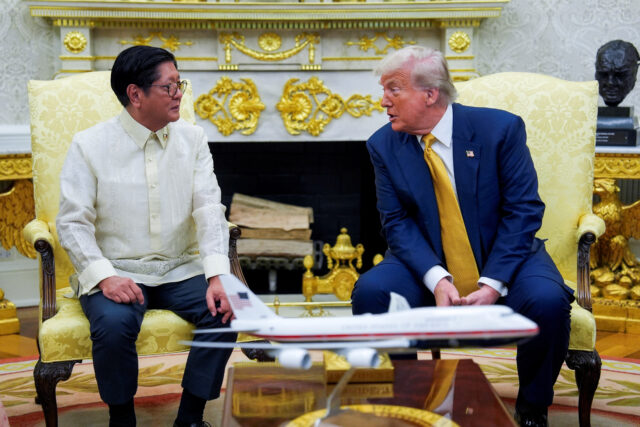
US PRESIDENT Donald J. Trump and Philippine President Ferdinand R. Marcos, Jr. met in the Oval Office at the White House in Washington, DC on July 22, 2025 — REUTERS/KENT NISHIMURA

By Kenneth Christiane L. Basilio, Reporter

US PRESIDENT Donald J. Trump might have placed little emphasis on Washington’s decades-old alliance with the Philippines when he modestly cut tariffs on Filipino goods, political analysts said on Wednesday, but ties between the two nations are unlikely to unravel over the trade deal.

Manila’s inability to secure a larger tariff cut from the US could raise concerns over Washington’s willingness to provide concessions and economically reward its allies, said Justin Keith A. Baquisal, a national security analyst at FACTS Asia.

As this developed, the US Embassy in Manila, citing the US State department, said the Philippines would get at least P3 billion ($53 million) worth of funding from the US to support its energy, maritime and economic growth programs.

Mr. Trump on Wednesday said the US had reached an agreement with the Philippines to set a 19% tariff on the country’s exports, a percentage point lower than the 20% that he dangled ahead of the Aug. 1 deadline. The Philippines was initially levied a 17% rate in April.

“Trump missed an opportunity to reward or put a premium on its most agreeable partner in ASEAN (Association of Southeast Asian Nations),” Mr. Baquisal said in a Viber message. “There seems to be no alliance discount.”

Manila and Washington are long-time allies, and their security ties are anchored on a 1950s Mutual Defense Treaty that obligates both nations to come to each other’s aid in case of an armed attack in the Pacific, including         the South China Sea.

President Ferdinand R. Marcos, Jr. last week left the Philippines for an official trip to the US, where he held investment talks, security discussions and trade negotiations on the tariff placed by Washington on the Southeast Asian nation.

Mr. Trump’s aggressive tariff policy is part of Washington’s toolkit to reinforce US global influence and curb the rise of rival economies like China, said Josue Raphael J. Cortez, who teaches diplomacy and governance at De La Salle-College of St. Benilde in Manila.

“With the imposition of new tariff schemes, Washington is clearly trying to ensure that it would still have the upper hand,” he said in a Facebook Messenger chat.

The Philippines, US and their allies have been boosting cooperation by holding joint naval drills and patrols in the South China Sea to counter Beijing’s increasing assertiveness in the waterway.

China claims nearly the entire South China Sea through its so-called nine-dash line, a sweeping assertion that overlaps with the exclusive economic zones of Southeast Asian nations such as the Philippines, Vietnam, Malaysia and Brunei.

In 2016, a United Nations-backed arbitral tribunal in The Hague voided China’s expansive claims, ruling in favor of the Philippines. China, however, has rejected the ruling.

‘ALLIANCE CARD’
The outcome of the tariff negotiation suggests that Manila’s strategic alliance with Washington carried little weight at the bargaining table, said Chester B. Cabalza, founding president of Manila-based think tank International Development and Security Cooperation.

“The alliance card did not work, but the Philippines must continuously cultivate its own economic security to maintain the momentum of its fast-growing economy,” he said via Messenger chat.

“Washington has its own economic prerogatives and policies to protect its own domestic market and international economic interests,” he added.

Despite the deal’s outcome, Philippine-US military relations are expected to remain ironclad, Victor Andres C. Manhit, president of think-tank Stratbase-ADR Institute, said in a Viber message.

Mr. Trump said in a Truth Social post that the two nations would work together militarily, as they are set to celebrate 80 years of diplomatic relations next year. Mr. Marcos said at the start of their meeting at the White House that the US is Manila’s “strongest, closest, most reliable ally.”

“He was affirming the commitment of the US to the region… as the Indo-Pacific is America’s priority theater,” Mr. Manhit said, noting that Mr. Trump’s statement could pave the way for greater deployment of US assets and increased investment in the country’s defense sector, alongside an expansion of joint exercises and maritime patrols in the region.

The US Embassy announcement came after the July 21 meeting between Mr. Marcos and US Secretary of State Marco Rubio in Washington, DC.

The US State department was also looking for congressional approval of about P825 million ($15 million) to bolster private sector development in the Luzon Economic Corridor, it said.

“If approved, this funding will support investments in the areas of transport, logistics, energy and semiconductors that will help create jobs and drive economic growth in the country,” it added.

The Luzon Economic Corridor is a trilateral agreement among the Philippines, US and Japan that seeks to boost the connectivity in key Luzon sites such as Metro Manila, Batangas, Subic and Clark.

It is also part of a broader collaboration supported by the G7 Partnership for Global Infrastructure and Investment.

The embassy added that the P3-billion allocation was the “first announcement of new foreign assistance for any country since the Trump administration began its review and realignment of foreign assistance in January.

Also on Wednesday, Philippine Defense Secretary Gilberto C. Teodoro, Jr. said the Philippines and US are looking at “nuancing” the annual Balikatan (shoulder-to-shoulder) war games to boost interoperability and make it better aligned with regional security threats.

“A major part of the takeaways from this trip [was] enhanced cooperation, including assurance of support for our continuing modernization of the military, our armed forces through the Philippine sectors,” he told a news briefing after the Philippine delegation’s meeting with Mr. Trump, based on a transcript from the Presidential Communications Office.

The Balikatan has in recent years grown in scale and increasingly featured advanced weaponry, as Manila and Washington seek to strengthen security cooperation and enhance force interoperability in response to China’s growing military presence in the region. — with Adrian H. Halili

More Filipinos using GenAI highlights need for cybersecurity guardrails

STOCK PHOTO | Image by Gerd Altmann from Pixabay

ORGANIZATIONS should adopt stronger guardrails while pushing for innovation to maintain consumer trust as more Filipinos adopt generative artificial intelligence (GenAI) tools, according to cybersecurity firm Palo Alto Networks.

In a report, Palo Alto noted an almost 10 times surge in GenAI traffic across the Asia-Pacific region and Japanese enterprises. Deepseek-related traffic alone surged 19 times within two months after the launch of the Chinese AI startup in January.

Filipinos’ top GenAI tools include Grammarly (46.21%), Microsoft PowerApps (33.32%) and Microsoft 365 Copilot (13.97%), according to the report.

“As GenAI tools become more embedded in enterprise operations in the Philippines, the risk of data exposure and threats grows significantly,” said Steven Scheurmann, regional vice president for ASEAN at Palo Alto Networks.

“It is imperative to create stronger guardrails, striking the right balance between AI-driven innovation and security,” he added.

Palo Alto cited the Department of Science and Technology’s plan to invest more than P2.6 billion in AI projects by 2028, with a focus on sectors such as healthcare, mobility, the environment, disaster risk reduction and other upcoming tech platforms.

The Philippine government is hard-pressed to US AI investments to strengthen the delivery of public services, improve disaster response and support the growing digital economy.

However, organizations in the region are managing 66 GenAI applications on average, Palo Alto said, with 10% classified as high-risk.

Likewise, GenAI-related data loss prevention incidents more than doubled, accounting for 14% of all data security incidents.

“Many high-risk AI models remain susceptible to jailbreak attacks that produce unsafe content, including offensive material and instructions for illegal activities,” it added.

To safely harness GenAI, organizations should enforce conditional access policies and manage permissions to gain oversight of GenAI app usage, deploy real-time content inspection and implement Zero Trust security architectures.

“As organizations adopt AI, we’re focused on helping them safeguard against potential cyber-risks associated with GenAI, empowering organizations to deploy AI bravely while protecting their entire AI ecosystems.”

Palo Alto analyzed GenAI traffic across 7,051 global customers through 2024 for its report. — Beatriz Marie D. Cruz

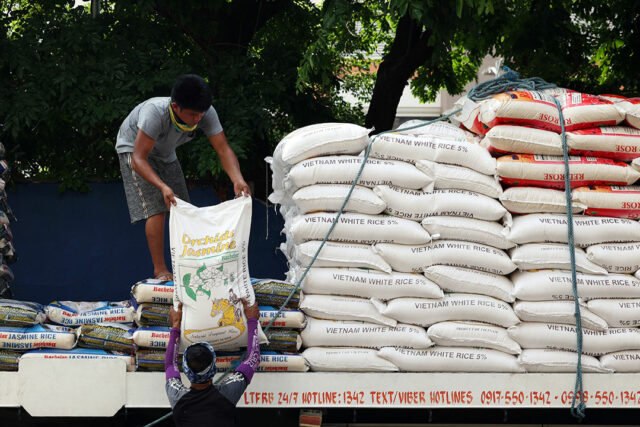
NFA releases rice stocks for disaster-stricken families

PHILIPPINE STAR/KRIZ JOHN ROSALES

THE NATIONAL Food Authority (NFA) has mobilized emergency rice stocks to support families hit by heavy rains brought by recent typhoons and monsoon rains in various parts of the country, the Palace said on Wednesday.

In coordination with the Department of Social Welfare and Development (DSWD), the NFA released 6,600 sacks of rice to Tarlac for immediate disaster relief distribution.

Additional allocations included 200 sacks for the Puerto Princesa City local government and 300 sacks for the provincial government of Palawan.

Palace Press Officer Clarissa A. Castro, during a virtual briefing, quoted the agency assuring that the rice stocks remain undamaged across NFA warehouses, particularly in Occidental Mindoro and Valenzuela City, where concerns about spoilage had been raised amid adverse weather conditions.

The NFA assured the public that the country has enough rice supplies to last at least 12 days.

Meanwhile, President Ferdinand R. Marcos, Jr., in a press briefing in Washington, DC, said that nearly Around 488,000 families have been affected by heavy rains nationwide, with over 49,600 people taking shelter in 500 evacuation centers. Another 2,790 families are staying outside evacuation sites and are being provided relief by the DSWD.

The extreme northern part of Luzon is being battered by Tropical Storm Dante, while Laoag City in Ilocos Norte is hit by Tropical Storm Emong, as of 3 p.m. on Wednesday, according to the 4 p.m. bulletin of the Philippine Atmospheric, Geophysical and Astronomical Services Administration on.

The bulletin, published on Facebook, noted that the central and southern parts of Luzon as well as Visayas and Mindanao are also affected by the southwest monsoon.

The new tropical storms came just days after Typhoon Wipha (Crising) hit the country, developing into a severe tropical storm before exiting the Philippine area of responsibility.

The typhoon and monsoon rains have caused widespread flooding in 1,875 areas spanning Metro Manila and regions including Ilocos, Cagayan Valley, Central Luzon, Cordillera Administrative Region, CALABARZON, MIMAROPA, Bicol, Western Visayas, Central Visayas, Zamboanga Peninsula, Northern Mindanao, Davao, Soccsksargen, Caraga, and BARMM.

Mr. Marcos reported six deaths, five injuries, and eight missing persons, with most casualties caused by fallen trees, drowning, and strong flood currents.

Damage to infrastructure is initially estimated at P4 billion, while agricultural losses stand at P134.7 million, including P113 million in MIMAROPA alone.

The President said government response teams have delivered relief goods and conducted evacuations as needed, though rains have yet to subside in many areas, including Metro Manila. Nine rain-induced landslides and incidents involving collapsed structures have been recorded so far. — Chloe Mari A. Hufana

Marcos: SONA speech 80% complete

PHILIPPINE STAR/KJ ROSALES

PHILIPPINE President Ferdinand R. Marcos, Jr., said his State of the Nation Address (SONA) is about 80% complete, with only final refinements needed before its delivery next week.

Speaking to reporters before concluding his trip to the US on July 22 (DC time), Mr. Marcos said his team has been working intensively on the speech despite his four-day official visit to meet with US President Donald J. Trump.

“When I knew that I was coming to the United States to meet with President Trump, I’ve cleared my schedule, and I said, we have to take — we’re going to lose four days,” he said, according to a transcript from his office. “So, I cleared my schedule. We’ve been working very hard on it. As soon as I get back, we’ll be working on it again.”

The annual address is held every fourth Monday of July where the President outlines his administration’s achievements, policy priorities, and legislative agenda for the coming year, shaping the direction of national governance and setting expectations for lawmakers, businesses, and millions of Filipinos.

Malacañang on Tuesday suspended all pre-SONA preparations as mass flooding hit some areas of the country, including the capital region.

The Palace said government agencies were ordered to focus on disaster response efforts and ensure the safety of affected residents, which Mr. Marcos “fully agrees” on, noting the actions were “highly inappropriate.”

“That is an unfortunate misjudgment on their part. But we’ve corrected it, and I trust it will not happen anymore.”

Mr. Marcos is expected to deliver his fourth SONA before a joint session of Congress on July 28. — Chloe Mari A. Hufana

BPO workers call for work suspension

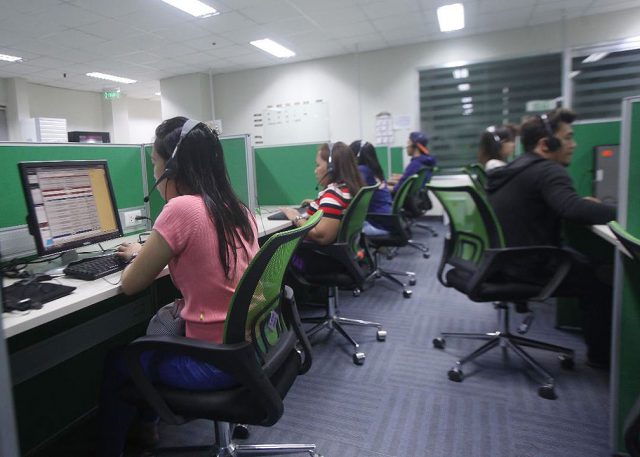
BW FILE PHOTO

A BUSINESS process outsourcing (BPO) workers group urged the Labor department to direct companies to suspend work amid “imminent danger” in workplaces affected by heavy rains and flooding.

“We cannot accept business-as-usual while our fellow workers are wading through floodwaters, risking their health and safety just to report to work,” BPO Industry Employees Network (BIEN) President Mylene Cabalona said in a statement on Wednesday.

The Southwest Monsoon and a tropical depression have brought heavy rainfall causing flooding throughout the Philippine capital.

“If the government and employers truly value workers’ lives, they must recognize that this is a clear and present danger — not just an inconvenience,” she added, noting that some BPO workers were still required to report on site.

Employers are required to suspend work if there is imminent danger to workers’ safety, under the Department of Labor and Employment’s (DoLE) Occupational Safety and Health Standards.

“We challenge DoLE to enforce its own mandate and direct BPO companies to prioritize worker safety over profit. It’s not enough to leave this to employer discretion,” she added.

BIEN also called on the companies to implement work options, flexible shifts, and no-fault attendance policies in all areas affected by flooding.

“Technology allows our industry to work remotely, so there is no excuse to endanger lives just to meet (Key Performance Indicators),” Ms. Cabalona said. — Adrian H. Halili

Meralco updates brownout situation

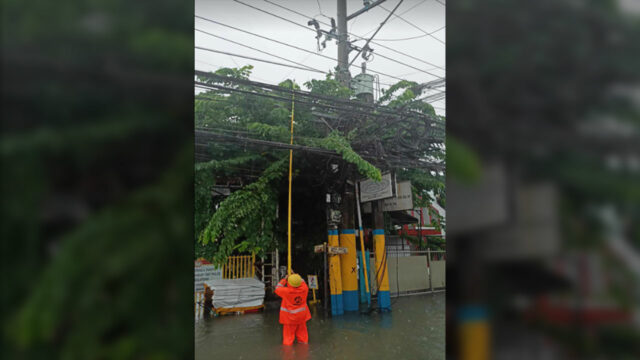
MERALCO personnel brave the floods and storms to restore electricity service in flood-stricken areas.

POWER DISTRIBUTOR Manila Electric Co. (Meralco) reported on Wednesday that the number of customers affected by service interruptions due to inclement weather has gone down to 2,790.

In a statement on Wednesday, Meralco said that 1% of its total customers who experienced power outages mostly reside in Cavite, Metro Manila, and Bulacan.

The power distributor said that it remains on heightened alert as Tropical Storm Dante and Tropical Storm Emong, combined with the enhanced southwest monsoon, are expected to bring rains across its franchise area.

“As we near completion of our restoration activities, we would like to thank our customers for their patience and understanding and assure them that we will continue to closely monitor the weather situation and respond to electricity-related incidents, while prioritizing safety,” Meralco Vice-President and Head of Corporate Communications Joe R. Zaldarriaga said.

“We also join the Department of Energy in relentlessly reminding the public to prioritize safety by strictly following electrical safety protocols, especially in communities impacted by floods,” he added.

Meralco said that it also deployed high-bed trucks and motorized fiberglass boats to support power restoration and rescue operations. — Sheldeen Joy Talavera

Use of EDCA sites for disaster response criticized

PILIPPINE STAR/MIGUEL DE GUZMAN

A CONGRESSMAN on Wednesday accused the Philippine military of using disaster response efforts as a pretext to expand the presence of US forces through joint bases in the country.

In a statement, Party-list Rep. Antonio L. Tinio said the military could possibly leverage the outfall of the torrential rains brought by Severe Tropical Storm Wipha (Crising) and southwest monsoon to justify expanding joint Philippine-US bases, warning the move could make the country a bigger strategic target amid rising tensions with China.

The Defense department and Armed Forces of the Philippines (AFP) did not immediately reply to separate Viber messages seeking comment.

“The AFP sees no shame in using a disaster to persuade the public to accept the continued presence of foreign military bases,” Mr. Tinio said in Filipino.

Defense Secretary Gilberto C. Teodoro, Jr. on Tuesday said the Philippine military activated the joint military sites to serve as relief hubs to support humanitarian operations amid heavy rains that battered the country earlier this week.

Manila hosts US troops at select military bases under the Enhanced Defense Cooperation Agreement (EDCA), a pact that permits Washington to rotate forces throughout the country.

President Ferdinand R. Marcos, Jr. in 2023 gave the US access to four more military bases under the EDCA, on top of the five sites that US troops already had access to since 2016. Most of the joint Philippine-US bases are in the northern Philippines.

“EDCA sites are not neutral evacuation centers; they are forward-operating bases,” said Mr. Tinio “Every relief airlift doubles as a live drill for rapid weapons deployment. The floods merely provide the perfect pretext.” — Kenneth Christiane L. Basilio

Subsidies for college students sought

PHILIPPINESTAR/ MIGUEL DE GUZMAN

THE GOVERNMENT should consider providing monthly stipends, transportation subsidies, and food allowances for college students to ease financial burdens and curb dropout rates, a congressman said on Wednesday.

Despite the implementation of the country’s free college education law, Leyte Rep. Ferdinand Martin G. Romualdez said that gaps in access and support continue to undermine the measure’s intent.

“Free tuition was a landmark achievement, but the work is far from over,” he said in a statement. “Nearly four out of 10 students in state universities and colleges are still dropping out. In some regions, the situation is even more alarming.”

About 39% of college students nationwide dropped out during 2023-2024, according to data from the Second Congressional Commission on Education.

“These are not just statistics,” said Mr. Romualdez. “They are shattered dreams and interrupted futures, often because students cannot afford transportation, food, rent, books or internet.”

“We need to protect and build on the gains of the free higher education law by ensuring students have the means to actually finish school,” he added. — Kenneth Christiane L. Basilio

ILO: BARMM finalizing labor code

WORKERS are seen at a manufacturing facility in Santa Rosa, Laguna. — PHILIPPINE STAR KRIZ JOHN ROSALES

THE Bangsamoro Autonomous Region in Muslim Mindanao (BARMM) is finalizing a labor code that seeks to promote better working conditions in the region, according to the International Labour Organization (ILO).

In a statement, the ILO said that the Bangsamoro Labor and Employment Code (BLEC) is expected to foster decent work, social justice, and inclusive development in the region.

It was also designated as a priority legislative measure by BARMM Interim Chief Minister Abdulraof Macacua. The region is set to hold its first parliamentary elections in October.

“Finalizing and enacting the labor code will demonstrate the region’s commitment to decent work, participatory governance, and lasting peace,” the ILO said.

Officials of the region are currently aligning the draft labor code with constitutional and international labor standards, resolving remaining technical issues, and building consensus among legislators, labor experts, employers, and civil society.

It added that the proposed legal framework is expected to institutionalize an inclusive, rights-based approach to labor governance across the region to support its peacebuilding efforts.

The labor code also includes the rights for self-organization, collective bargaining, negotiations, and the right to strike, aligning with the Constitution and the Labor Code of the Philippines.

“The BLEC stands as an important milestone for BARMM. It is more than a legal instrument. It is a statement of commitment to decent work, social justice, and inclusive growth for all workers and employers in the region,” ILO Country Director Khalid Hassan said.

“Without a local labor code, the region cannot attract investments, build institutions, or achieve industrialization to create jobs. And without jobs, lasting peace will remain out of reach,” he added.

The ILO said that it had offered technical guidance and convened partners and stakeholders through a series of dialogues and consultations. — Adrian H. Halili

Death and disability benefits for BARMM barangay officials mulled

COTABATO CITY — Members of the Bangsamoro parliament have assured support for a proposed regional law that will grant at least P500,000 death and disability benefits for barangay and Sangguniang Kabataan officials in the autonomous region.

The Barangay Officials Death and Disability Benefit Act of 2025, Bangsamoro Transition Authority (BTA) Bill 379, was filed at the 80-seat regional parliament in Cotabato City on Tuesday, member of parliament Naguib G. Sinarimbo

Ranking members of the public information team in the Bangsamoro parliament, among them Jamaleah L. Benito, told reporters on Wednesday that the BTA Bill 379 will soon be subjected to extensive procedural deliberation by regional lawmakers.

Mr. Sinarimbo had proposed in the draft regional law the grant of at least P500,000 to P1 million cash each for any barangay officials who dies, or gets physically incapacitated due to atrocities, or accidents in line of duty, or ailments while serving an elective term.

“We have colleagues in the parliament who assured us to help us work out the passage of this bill into law,” Mr. Sinarimbo said.

Mr. Sinarimbo was local government minister in the Bangsamoro Autonomous Region in Muslim Mindanao before he was appointed last March as member of the BARMM parliament by President Ferdinand R. Marcos, Jr.

“We have barangay and Sangguniang Kabataan officials who are active in maintaining law and order in some troubled areas. This measure is so important. We need to have this as regional law,” Mr. Sinarimbo said.

More than 20 out of 80 members of the BARMM parliament had separately told reporters on Wednesday morning that they will work together in ensuring the passage into law of BTA Bill 379.

The measure compels the BARMM government to allocate the funds for the death and disability packages, which two private entities, the Al-Amanah Islamic Bank and the insurance firm Pru Life UK will help manage as a regional humanitarian program.

Gov. Emmylou T. Mendoza of Cotabato province in Region XII, which has 63 barangays under the Bangsamoro regional government, said she is hoping for the enactment into regional law of the BTA Bill 379.

“That will be good for the barangay and Sangguniang Kabataan officials of the 63 barangays in my province that are under the Bangsamoro government, but are inside several towns under my administration,” Ms. Mendoza said.

The provincial government of Cotabato has not stopped its public service thrusts benefitting the residents of the 63 BARMM barangays, now grouped into eight towns created last year by the Bangsamoro parliament, despite being no longer under its jurisdiction. — John Felix M. Unson

ADVERTISEMENT
ADVERTISEMENT