Home Blog Page 1236

UnionBank books P3.25-B net profit

BW FILE PHOTO

UNION BANK of the Philippines, Inc. (UnionBank) booked a net income of P3.25 billion in the first half on the back of strong revenues, it said on Monday.

The bank’s revenues rose by 9.2% year on year to P39.7 billion in the period amid higher net interest income and an expanded fee income base, it said in a disclosure to the stock exchange

Its financial statement was unavailable as of press time.

UnionBank said its strong revenue performance as well as “one-time costs aimed at enhancing operational and financial resiliency” helped offset the earnings impact of higher credit costs, which came amid the increase in its new credit card customers.

“As we continue our efforts to grow our customer base, we are also ensuring we enhance operational resilience to be able to deliver our desired customer experience. These strategic moves come with upfront costs booked in 1H 2025. This positions us to better reflect the bank’s true performance moving forward,” UnionBank President and Chief Executive Officer Ana Maria Aboitiz-Delgado said.

“Our topline has consistently shown an encouraging trend, and with lower costs ahead, we anticipate improved net income in the coming months. These efforts position the bank for a more resilient, sustainable, and accelerated trajectory as we enter the next phase of our growth journey,” she added.

UnionBank’s net interest income stood at P31.311 billion in the first semester, with interest income at P41.765 billion and interest expense at P10.454 billion. Its net interest margin increased by 61 basis points to 6.4%.

“This was driven by continued growth in the bank’s high-yielding consumer portfolio — particularly in credit cards and personal loans — underpinned by continuous customer acquisition and cross-sell initiatives,” UnionBank said.

Its net loans and other receivables stood at P519.003 billion at end-June.

On the funding side, deposit liabilities were at P682.554 billion.

“Funding costs also improved amid a declining interest rate environment and an increase in the share of low-cost CASA (current account, savings account) deposits. The bank’s CASA ratio improved to 65.2%, underscoring the strength of its transaction banking franchise,” it said.

Meanwhile, other income was at P8.44 billion.

“UnionBank’s retail customer base reached 18 million as of the first half of 2025, contributing to higher transaction volumes and a 17.1% year-on-year increase in fee income,” it said.

“The bank’s fees-to-assets ratio stood at 1.3%, among the highest in the industry, reflecting its strong ability to generate fee-based revenues relative to its size.”

On the other hand, UnionBank’s operating expenses were at P23.37 billion in the first semester, with provisions for credit losses at P11.55 billion.

The bank’s assets stood at P1.14 trillion as of June, while total capital was at P195.97 billion.

UnionBank’s shares closed at P32 apiece on Monday, dropping by 30 centavos or 0.93%. — A.M.C. Sy

FAO: Philippines’ undernourishment prevalence in 2022-2024 hits record low

THE NUMBER of Filipinos experiencing moderate or severe food insecurity declined after the pandemic to 37.8 million during the 2022 to 2024 period, according to the Food and Agriculture Organization (FAO). Read the full story.

FAO: Philippines’ undernourishment prevalence in 2022-2024 hits record low

AGI says 12,000 room key target achievable by 2028

ALLIANCEGLOBALINC.COM

ALLIANCE GLOBAL Group, Inc. (AGI) is on track to reach 12,000 room keys across its key hospitality units by 2028, the company’s president said.

“Before 2028, we will definitely hit 12,000 room keys through our Megaworld Hotels & Resorts and through Travellers [International Hotel Group], which currently hosts Newport World Resorts,” AGI President, Chief Executive Officer, and Vice Chairman Kevin Andrew L. Tan said during Philippine Hotel Connect 2025, a forum hosted by the Philippine Hotel Owners Association, Inc., on Thursday last week.

This year alone, AGI expects to end 2025 with 10,000 room keys, he added.

Mr. Tan also cited plans to invest $2 billion (around P114 billion) to expand the company’s integrated resort developments, pointing to new projects in Boracay, Aklan and Lapu-Lapu City, Cebu.

The company earlier said it is investing P5 billion in Travellers International’s ongoing expansion, including the development of The Narra Palm Hotel and Villa within the Newport World Resorts complex.

“This hotel is comprised mostly of suites and villas. It’s very much a curated service… and it’s elevating the hospitality industry to new heights,” Mr. Tan said.

He also said there are plans to build Narra Palm Hotels in both Boracay and Cebu.

Megaworld is also adding around 3,600 room keys through new hotels in Metro Manila, Pampanga, Palawan, Bacolod, Iloilo, and Boracay.

AGI is likewise investing in the upskilling of Filipino talent in the hospitality industry.

“We’re investing a lot of our capital as well in building schools and institutions that will help train the next generation of tourism executives,” he told the forum.

AGI is also optimistic about the growth of the local tourism industry, citing the country’s ongoing infrastructure developments.

“We believe there’s nowhere else to go but up. So, our group’s committed to really expand aggressively,” Mr. Tan said. — Beatriz Marie D. Cruz

Cleo Laine, British jazz singer who performed with Ray Charles and Frank Sinatra, 97

AMAZON.COM

LONDON — British jazz singer Cleo Laine, who performed with musical greats including Frank Sinatra and starred as an actor in London’s West End and on Broadway, has died aged 97, the Guardian newspaper reported on Friday, citing a statement from her children Jacqui and Alec.

Born to an English mother and a Jamaican father in a suburb of London in 1927, she initially worked as a hairdresser, a hat-trimmer, and a librarian. She married in 1946 and had a son while still a teenager.

Driven on by her dream of becoming a singer, she divorced and got her big break in 1951, when she joined the band of English saxophonist and clarinetist John Dankworth at 24.

Mr. Dankworth’s band decided her name was too long — at the time she thought she had been born Clementine Campbell, though a passport application later revealed her mother had used her own surname Hitching on the birth certificate.

The men of the Dankworth Seven band thought her name was too cumbersome for a poster, and that her nickname Clem was too cowboy-like. They settled on a new stage persona for her by drawing “Cleo” and “Laine” from hats.

In 1958, she and Mr. Dankworth married. Their home became a magnet for London’s jazz set: friends included stars from across the Atlantic such as Oscar Peterson and Ella Fitzgerald, Lester Young and Dizzy Gillespie.

After acting as well as singing in Britain through the 1960s, Ms. Laine toured Australia in 1972 and performed at New York’s Lincoln Center. The recording of a further show, at Carnegie Hall, won her a Grammy.

Recordings included “Porgy and Bess” with Ray Charles. In 1992 she appeared with Frank Sinatra for a series of shows at the Royal Albert Hall in London, but she was best known for her work with Mr. Dankworth’s bands. He later became her musical director.

The couple built their own auditorium in the grounds of their home near London and were friends with the late Princess Margaret, the sister of the late Queen Elizabeth II. Their two children went on to become musicians.

Mr. Dankworth — who Ms. Laine described as being “joined at the hip” with her — died in 2010. Hours after his death, Ms. Laine performed a scheduled show in their auditorium, announcing the news about her husband only at the end of the concert. — Reuters

Power distributor Meralco sees P50-billion earnings this year

PHILSTAR FILE PHOTO

By Sheldeen Joy Talavera, Reporter

POWER DISTRIBUTOR Manila Electric Co. (Meralco) is on track to hit its target earnings of P50 billion for this year, driven by its power generation business, its chairman said.

At a press briefing on Monday, Meralco Chairman and Chief Executive Officer Manuel V. Pangilinan said the company is on track for “low double digits” over last year’s P45.1-billion earnings.

“The biggest growth will come from generation,” Mr. Pangilinan said.

Betty C. Siy-Yap, Meralco’s senior vice-president and chief finance officer, said Meralco saw its core net income increase by 9.5% to P14.4 billion from a year earlier, driven by solid contributions from its power distribution and generation businesses.

Revenues declined by 2% to P130.7 billion due to lower pass-through charges and the implementation of a refund.

For the six months ending in June, the power distributor reported a 10% increase in its core net income to P25.54 billion from P23.21 billion in the same period last year.

Of this total, the distribution business accounted for 54%, power generation contributed P13.7 billion or 37%, while retail electricity supply and non-electricity businesses accounted for 9%.

Gross revenues climbed by 3% to P245.22 billion from P237.48 billion, driven by higher pass-through charges, an increase in sales volume from the distribution utility and retail electricity supply, and higher revenues from power generation in the reserve market.

Residential sales volume rose by 0.7% to 9,778 gigawatt-hours (GWh), due to steady growth in newly energized accounts offsetting flat demand.

Commercial sales volume climbed by 0.3% to 10,103 GWh, supported by the ramp-up and expansion in retail and restaurant sectors, which countered the impact of office vacancies due to the exit of Philippine offshore gaming operators.

Industrial sales increased by 0.5% to 7,137 GWh, as growth in the semiconductor and cement sectors and a recovery in steel offset the decline from operational shifts in food and beverage and the termination of embedded generation accounts.

By the end of the first half, consolidated customer count had reached 8.1 million, marking a 3% increase from 7.9 million in the same period last year.

“As we move into the second half, we remain focused on achieving key milestones that will enable us to meet our full-year profit target and business goals,” Mr. Pangilinan said.

COAL POWER PROJECT
Emmanuel V. Rubio, president and chief executive officer of Meralco PowerGen Corp. (MGen), announced that the Department of Energy (DoE) had reissued the “committed capacity” status for its Atimonan Energy Power Plant project, reaffirming that the project is outside the coverage of the coal moratorium.

MGen is the power generation arm of Meralco.

Following the go-signal from the government, MGen, through its subsidiary Atimonan One Energy, Inc., is set to pursue the development of the 1,200-megawatt ultra-supercritical coal-fired power plant, beginning with the processing of the required additional permits through the Energy Virtual One-Stop Shop.

“As MGen plays a key role in ensuring the country’s energy security and leading the energy transition, our investment in Atimonan will help address today’s needs while preparing for tomorrow’s opportunities,” Mr. Rubio said.

In 2020, the DoE issued a moratorium on the development of new coal-fired power plants.

Meralco’s majority owner, Beacon Electric Asset Holdings, Inc., is partly owned by PLDT Inc.

Hastings Holdings, Inc., a unit of the PLDT Beneficial Trust Fund subsidiary MediaQuest Holdings, Inc., has an interest in BusinessWorld through the Philippine Star Group, which it controls.

What makes a person cool? Global study has some answers

STOCK PHOTO | Image by Val Vesa from Unsplash

From Lagos to Cape Town, Santiago to Seoul, people want to be cool. “Cool” is a word we hear everywhere — in music, in fashion, on social media. We use it to describe certain types of people.

But what exactly makes someone cool? Is it just about being popular or trendy? Or is there something deeper going on?

In a recent study I conducted with other marketing professors, we set out to answer a simple but surprisingly unexplored question. What are the personality traits and values that make someone seem cool — and do they differ across cultures?

We asked nearly 6,000 people from 12 countries to think of someone they personally knew who was “cool,” “not cool,” “good,” or “not good.” Then we asked them to describe that person’s traits and values using validated psychological measures. We used this data to examine how coolness differs from general likeability or morality.

The countries ranged from Australia to Turkey, the US to Germany, India to China, Nigeria to South Africa.

Our data showed that coolness is uniquely associated with the same six traits around the world: cool people tend to be extroverted, hedonistic, adventurous, open, powerful, and autonomous.

These findings help settle a long debate about what it means to be cool today.

A BRIEF HISTORY OF COOL
Early writing on coolness described it as emotional restraint: being calm, composed, and unbothered. This view, rooted in the metaphor of temperature and emotion, saw coolness as a sign of self-control and mastery.

Some of these scholars trace this form of cool to slavery and segregation, where emotional restraint was a survival strategy among enslaved Africans and their descendants, symbolizing autonomy and dignity in the face of oppression. Others propose “cool” restraint existed long before slavery.

Regardless, jazz musicians in the 1940s first helped popularize this cool persona — relaxed, emotionally contained, and stylish — an image later embraced by youth and various countercultures. Corporations like Nike, Apple, and MTV commercialized cool, turning a countercultural attitude into a more commercially friendly global aesthetic.

THIS IS WHAT MAKES SOMEONE COOL
Our findings suggest that the meaning of cool has changed. It’s a way to identify and label people with a specific psychological profile.

Cool people are outgoing and social (extroverted). They seek pleasure and enjoyment (hedonistic). They take risks and try new things (adventurous). They are curious and open to new experiences (open). They have influence or charisma (powerful). And perhaps most of all, they do things their own way (autonomous).

This finding held remarkably steady across countries. Whether you’re in the US, South Korea, Spain, or South Africa, people tend to think that cool individuals have this same “cool profile.”

We also found that even though coolness overlaps with being good or favorable, being cool and being good are not the same. Being kind, calm, traditional, secure, and conscientious were more associated with being good than cool. Some “cool” traits were not necessarily good at all, like extroversion and hedonism.

WHAT ABOUT SOUTH AFRICA AND NIGERIA?
One of the most fascinating aspects of our study was seeing how consistent the meaning of coolness was across cultures — even in countries with very different traditions and values.

In South Africa, participants viewed cool people as extroverted, hedonistic, powerful, adventurous, open and autonomous — just like participants from Europe to Asia. In South Africa, however, coolness is especially distinct from being good. South Africa is one of the countries in which being hedonistic, powerful, adventurous, and autonomous was much more cool than good.

Nigeria was the only country in which cool and uncool people were equally autonomous. So basically, individuality wasn’t seen as cool. That difference might reflect cultural values that place a greater emphasis on community, respect for elders, or collective identity. In places where tradition and hierarchy matter, doing your own thing might not be cool.

Social sciences, like all science, however, are not perfect. So, it’s reasonable to speculate that autonomy might still be cool in Nigeria, with the discrepancy resulting from methodological issues such as how the Nigerian participants interpreted and responded to the survey.

Nigeria was also unique because the distinction between cool and good wasn’t as notable as in other countries. So coolness was seen more as goodness than in the other countries.

WHY DOES THIS MATTER?
The fact that so many cultures agree on what makes someone cool suggests that “coolness” may serve a shared social function. The traits that make people cool may make them more likely to try new things, innovate new styles and fashions, and influence others. These individuals often push boundaries and introduce new ideas — in fashion, art, politics, or technology. They inspire others and help shape what’s seen as modern, desirable, or forward-thinking.

Coolness, in this sense, might function as a kind of cultural status marker — a reward for being bold, open-minded and innovative. It’s not just about surface style. It’s about signaling that you’re ahead of the curve, and that others should pay attention.

SO WHAT CAN WE LEARN FROM THIS?
For one, young people in South Africa, Nigeria, and around the world may have more in common than we often think. Despite vast cultural differences, they tend to admire the same traits. That opens up interesting possibilities for cross-cultural communication, collaboration, and influence.

Second, if we want to connect with or inspire others — whether through education, branding, or leadership — it helps to understand what people see as cool. Coolness may not be a universal virtue, but it is a universal currency.

And finally, there’s something reassuring in all this: coolness is not about being famous or rich. It’s about how you live. Are you curious? Courageous? True to yourself? If so, chances are someone out there thinks you’re cool — no matter where you’re from.

THE CONVERSATION VIA REUTERS CONNECT


Todd Pezzuti is an associate professor at the Business School, Universidad Adolfo Ibáñez, He has received funding from ANID Chile to conduct this research.

Peso down as markets eye Fed meet

PHILIPPINE STAR/WALTER BOLLOZOS

THE PESO weakened further against the dollar on Monday amid expectations that the US Federal Reserve will keep its target rate unchanged at its policy meeting this week.

The local unit closed at P57.20 per dollar, dropping by nine centavos from its P57.11 finish on Friday, Bankers Association of the Philippines data showed.

The peso opened Monday’s session slightly weaker at P57.13 against the dollar. Its intraday best was at P56.98, while its worst showing was at P57.21 against the greenback.

Dollars exchanged increased to $1.699 billion on Monday from $1.64 billion on Friday.

“The dollar-peso ended higher amid cautious trading ahead of the FOMC (Federal Open Market Committee) meeting later this week,” a trader said in a phone interview.

The dollar was generally stronger on Monday as the Fed is expected to keep borrowing costs unchanged, Rizal Commercial Banking Corp. Chief Economist Michael L. Ricafort said in a Viber message.

For Tuesday, the trader sees the peso moving between P56.90 and P57.30 per dollar, while Mr. Ricafort expects it to range from P57.10 to P57.35.

The dollar rose against major peers on Monday after the United States and the European Union (EU) struck a framework trade pact, the latest in a flurry of deals to avert a global trade war, with investors also looking to this week’s US and Japanese central bank meetings, Reuters reported.

Meeting in Scotland on Sunday, US President Donald J. Trump and European Commission President Ursula von der Leyen said the deal provided for an import tariff of 15% on EU goods, half the rate Mr. Trump had threatened from Aug. 1.

That follows last week’s US agreement with Japan, while top US and Chinese economic officials will resume talks in Stockholm on Monday aiming to extend a truce by three months and keep sharply higher tariffs at bay.

The euro was last at $1.1693, down 0.4% on the day, reversing an initial knee-jerk rise in Asia trade as investors’ focus shifted to what an easing in global trade tensions meant for the dollar overall.

The dollar was stronger elsewhere, up 0.15% on the yen at 147.83, while the pound was down 0.13% at $1.3428.

As concerns subside about the economic fallout from punishing tariffs, investor attention is shifting to corporate earnings and central bank meetings in the United States and Japan in the next few days.

Both the Fed and the Bank of Japan are expected to hold rates steady at policy meetings this week, but traders will watch subsequent comments to gauge the timing of the next moves.

Investors will also be watching to see Mr. Trump’s reaction to the Fed’s decision.

The US president has been putting the Fed under heavy pressure to make significant rate cuts, and Mr. Trump appeared close to trying to fire Fed Chair Jerome H. Powell last week, but backed off with a nod to the market disruption that would likely follow. — Aaron Michael C. Sy with Reuters

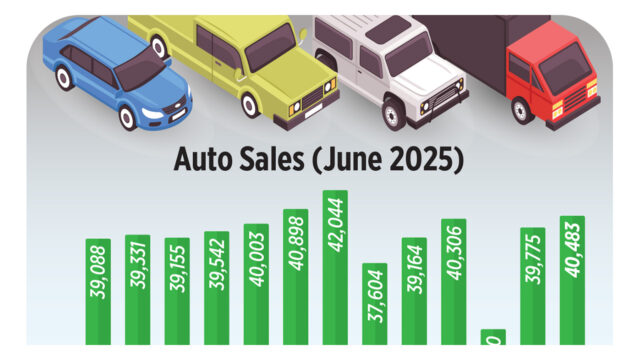
Auto Sales (June 2025)

NEW VEHICLE SALES inched up by an annual 3.6% in June as a double-digit surge in commercial vehicle sales helped offset a 35% decline in sales of passenger cars, an industry report showed. Read the full story.

Auto Sales (June 2025)

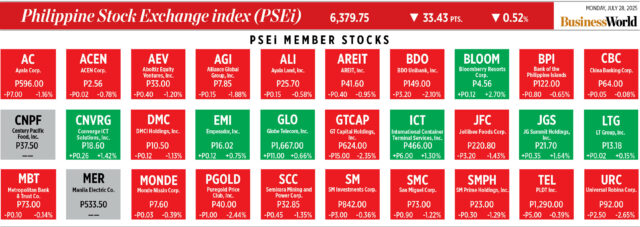
How PSEi member stocks performed — July 28, 2025

Here’s a quick glance at how PSEi stocks fared on Monday, July 28, 2025.


PHL stocks extend decline before Marcos’ SONA

BW FILE PHOTO

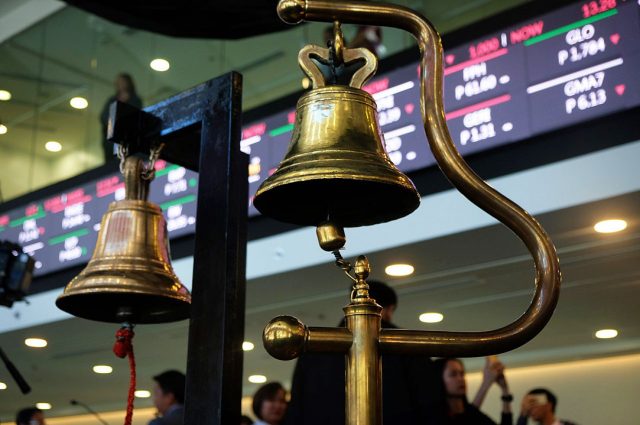
PHILIPPINE STOCKS ended lower for the third straight day on Monday before President Ferdinand R. Marcos, Jr. delivered his State of the Nation Address (SONA) after the market’s close.

The benchmark Philippine Stock Exchange index (PSEi) dropped by 0.52% or 33.43 points to close at 6,379.75, while the broader all shares index declined by 0.08% or 3.38 points to 3,793.49.

The PSEi opened the session higher at 6,411.26 and even hit a high of 6,417.43 before succumbing to weakness by the closing bell.

“The PSE started the week on a negative tone… The local market dropped as investors took a cautious stance while waiting for President Marcos’ SONA,” Philstocks Financial Inc. Research Manager Japhet Louis O. Tantiangco said in a Viber message.

“Investors are going to pay close attention to the SONA, particularly regarding which industries might receive more support from the government, face stricter regulation, and the overall direction of the local economy,” Regina Capital Development Corp. Head of Sales Luis A. Limlingan said in a Viber message.

Mr. Marcos delivered his fourth SONA at the Batasang Pambansa in Quezon City on Monday. Before the SONA, Senator Francis “Chiz” G. Escudero and Leyte Rep. Ferdinand Martin G. Romualdez were reelected as Senate President and House Speaker, respectively, for the 20th Congress.

“The peso’s pullback for the day also weighed on the local bourse,” Mr. Tantiangco said. The peso dropped by nine centavos to close at P57.20 per dollar on Monday, Bankers Association of the Philippines data showed.

“Moreover, investors are still waiting for the PSEi rebalancing that might also affect price reactions,” Mr. Limlingan added.

“While the trend remains upward, investors should remain mindful of potential near-term consolidation as market sentiment evolves.”

Almost all sectoral indices closed lower on Monday. Mining and oil went down by 1.68% or 158.7 points to 9,253.28; property sank by 0.8% or 19.14 points to 2,358.42; financials decreased by 0.66% or 14.97 points to 2,237.96; holding firms fell by 0.62% or 34.45 points to 5,441.83; and industrials retreated by 0.57% or 52.18 points to 9,097.76.

Meanwhile, services rose by 1.52% or 34.09 points to 2,270.16.

“Bloomberry Resorts Corp. was the day’s index leader, climbing 2.7% to P4.56. Universal Robina Corp. was the main index laggard, falling 2.65% to P92,” Mr. Tantiangco said.

Value turnover went down to P6.61 billion on Monday with 1.11 billion shares exchanged from the P6.95 billion with 1.69 billion shares traded on Friday.

Decliners bested advancers, 108 versus 90, while 48 names were unchanged.

Net foreign selling was at P155.996 million on Monday, a reversal of the P113.74 million in net buying recorded on Friday. — Revin Mikhael D. Ochave

Food insecurity recedes in PHL after pandemic — FAO

BW FILE PHOTO

By Kyle Aristophere T. Atienza, Reporter

THE NUMBER of Filipinos experiencing moderate or severe food insecurity declined after the pandemic to 37.8 million during the 2022 to 2024 period, according to the Food and Agriculture Organization (FAO).

This was equivalent to 32.9% of the population, the lowest share since the 44.7% during the pandemic years of 2020-2022, the FAO said in its State of Food Security and Nutrition in the World report.

FAO: Philippines’ undernourishment prevalence in 2022-2024 hits record lowThe Philippine hunger indicators were the third highest in Southeast Asia, where food insecurity averaged 14.4%.

The Philippine food insecurity rate was edged out by Cambodia with 40% and Laos with 35.6%. The equivalent numbers for the rest of the region were 32.7% for Myanmar, 16.7% for Malaysia, 10.7% for Vietnam, 9.5% for Singapore 5.4% for Thailand, and 4.5% for Indonesia.

The FAO said an estimated 8.2% or between 638 million and 720 million of the global population may have faced hunger in 2024, down from 8.5% in 2023 and 8.7% in 2022, amid “notable improvement” in Southeast Asia, Southern Asia and South America “in contrast to the continuing rise in hunger in most subregions of Africa and in Western Asia.”

The global number of undernourished is expected to decrease, but 512 million people are still projected to be facing hunger in 2030, of whom nearly 60% will be in Africa, it added.

Between 2022 and 2024, 3% or 3.4 million of the Philippine population was undernourished, the FAO said.

In Southeast Asia, the number of undernourished stood at 35.1 million during the 2022-2024 period.

The undernutrition rate in Southeast Asia averaged 5.1%.

Indonesia had the highest number of undernourished people with 17.7 million, or 6.3% of its population.

Leonardo A. Lanzona, who teaches economics at the Ateneo de Manila, said research indicates that many urban poor adolescents eat three times a day, with families from poor households often prioritizing the nutritional needs of their children, particularly those attending school. 

“This is part of their coping mechanisms that resulted in greater food security but at the expense of education,” he said in an e-mail. “In other words, much of the achievements in food security is due to the effort of households, not the government, and is paid at a very high cost.”

“This trade-off between food security and education results in a heavy burden for our present workforce who can survive daily but lack the skills to secure gainful jobs,” he added.

The FAO said 44% or 51 million of the Philippine population could not afford to eat healthy in 2024, against 45.4% or 52.2 million a year earlier.

It said the average cost of a healthy diet was $4.39 per person per day on a purchasing-power parity (PPP) basis in 2024, against $4.21 in 2023 and $3.73 in 2021.

It said the Philippines, Chile, India, and Mexico introduced subsidies for agricultural inputs starting in 2022 in the face of persistent inflationary pressures after the pandemic.

Many countries cut down on expenditures after the pandemic “but inflationary pressures led to continued support for key sectors, including agriculture.”

“The inflationary period after the pandemic made it difficult for countries to remove some support measures, as livelihoods were at risk due to food price increases,” it said.

“A flexible use of fiscal policy, considering well-targeted support for some segments of the population combined with fiscal restraints for other sectors, could reduce inflation while maintaining adequate levels of protection for the most vulnerable,” it added.

The report found that within Asia, Indonesia, the Philippines and Sri Lanka notably focused on food price interventions such as price controls.

“Effectiveness of price policies remains limited in the long term and can lead to an inequitable distribution of costs and benefits. Price caps at the retail level for some products resulted in the expected short-term effect of reducing prices and protecting consumers,” the FAO said.

The FAO noted that when subsidies are used to reduce consumer prices while maintaining high producer prices, they require substantial government spending, can be regressive particularly for non-targeted programs, and may also fuel inflation.

“The effectiveness of these policies depends on the sensitivity of supply and demand behavior to prices — that is, their level of elasticity — and the nature of the initial shocks,” it said.

“Elastic systems characterized by strong market mechanisms benefit from allowing prices to adjust; meanwhile, it is important to prioritize other instruments such as social protection programs.”

The FAO called for targeted fiscal interventions, including robust social protection systems, coordinated macroeconomic policy, structural and trade-related reforms, and strategic investments in data, infrastructure and innovation.

It said fiscal responses to high food prices must be time-bound and include well-defined exit strategies to prevent “the risk of permanent budgetary commitments that could constrain future fiscal space or bring public debt to unsustainable levels.”

It said tax reductions on essential goods, including food, can provide immediate relief to households facing rising living costs but such measures “must be weighed against the need for sustainable public revenue, particularly in countries with limited fiscal capacity.”

The FAO also said social protection systems — through cash or in-kind transfers — are indispensable for cushioning the effects of food price crises on low-income households.

“However, in high-inflation contexts, the value of these transfers can erode. Programs must therefore be calibrated to respond to inflationary pressures, with flexible mechanisms to adjust transfer values and avoid price increases,” it added.

It said instead of resorting to short-term price interventions, such as price controls or subsidies, which may provide temporary relief but often distort markets and are inefficient over time, governments should adopt a stable, coordinated and transparent strategy to manage long-term food price trends including strengthening food reserves, improving market transparency, and investing in trade-related infrastructure.

It said maintaining strategic food reserves can help cushion supply shocks and stabilize prices.

“Policymakers should balance food security and nutrition objectives against potential fiscal and market risks,” it said.

“Embedding food reserves within a broader risk-management framework enhances their effectiveness and reduces unintended consequences,” it added.

The FAO also urged governments to boost investment in research and development, storage, and transport infrastructure that could address food loss, improve supply chain functioning, and mitigate future food price shocks.


DBM backs raising health spending but cites fiscal hurdles

PHILIPPINE STAR/MIGUEL DE GUZMAN

THE Department of Budget and Management (DBM) said a bill that will set a floor to healthcare spending of 5% of gross domestic product (GDP) is likely to run into fiscal and constitutional hurdles.

Budget Secretary Amenah F. Pangandaman said the DBM supports the intent of House Bill No. 1973, which sets the spending minimum for healthcare, but added: “It is important to note that any increase in funding will depend on several key factors — including our country’s available fiscal space, the nature and readiness of proposed programs and projects, and the government’s overall expenditure priorities,” she told BusinessWorld via Viber.

Ms. Pangandaman said healthcare remains a top priority, and the DBM will continue collaborating with executive and legislative partners to obtain adequate resources for Filipinos.

Budget Undersecretary Goddes Hope O. Libiran added that the proposed allocation, estimated at over P1.3 trillion, could violate constitutional provisions requiring education to receive the largest share of the national budget.

“If that happens, healthcare spending would surpass the education sector, which is prohibited under our Constitution. Education must always be the top budget priority in the National Expenditure Program (NEP) and the General Appropriations Act (GAA),” she said via Viber.

In the 2025 spending plan, education was allocated P1.055 trillion, followed by public works (P1.007 trillion), defense (P315.1 billion), interior and local government (P279.1 billion), and health (P267.8 billion).

John Paolo R. Rivera, a senior research fellow at the Philippine Institute for Development Studies said funding healthcare with at least 5% of economic output is “necessary” to build a more resilient and inclusive health system.

“Many economies with stronger health outcomes spend at or above this threshold. However, feasibility will depend on fiscal space, political will, and how efficiently the funds are spent,” he said via Viber. 

Mr. Rivera added it should not be an either-or choice between education and healthcare. 

“The NG (National Government) can still boost health spending through targeted reforms, better efficiency, and increased absorptive capacity without breaching fiscal or legal thresholds,” he said.

Essential services should be progressively funded in a balanced and sustainable way, Mr. Rivera said.

The P6.326-trillion national budget for 2025 raised concerns about the zero subsidy for the Philippine Health Insurance Corp., casting into doubt the sustainability of universal healthcare programs.

In 2026, Finance Secretary Ralph G. Recto said the government health insurer will be allocated a P53.26-billion subsidy in the National Expenditure Plan, the document prepared by the executive branch that will serve as the basis for the budget bill.

Economic managers have proposed a P6.793-trillion national budget for 2026, up 7.4% from the actual P6.326-trillion budget in 2025. This is equivalent to 22% of GDP.

The DBM projected appropriations of P7.232 trillion in 2027 and P7.702 trillion in 2028. — Aubrey Rose A. Inosante

ADVERTISEMENT
ADVERTISEMENT