Home Blog Page 1233

Analysts’ Expectations on Policy Rates (April 2025)

THE BANGKO SENTRAL ng Pilipinas (BSP) is expected to cut rates this week as low inflation and the US’ tariff policy will give it more than enough room to resume its rate-cutting cycle, analysts said. Read the full story.

Analysts’ Expectations on Policy Rates (April 2025)

Splash! New London exhibition dives into a century of swimming

PAMELA ANDERSON’S iconic red swimsuit from the 1990s TV show Baywatch (R) is one of the items in the exhibit which looks into a century of swimwear. — DESIGNMUSEUM.ORG

LONDON — From an Olympic gold medal to Pamela Anderson’s Baywatch red bathing suit, a new exhibition dedicated to all things swimming has opened at London’s Design Museum.

Splash! A Century of Swimming and Style features more than 200 items that look at our love of water since the 1920s, be it at the lido, the pool, or in nature.

“The show explores the last century of swimming through the lens of design,” Amber Butchart, guest curator of the exhibition, told Reuters at a press preview last Wednesday.

“We begin in the pool, we move into lido, and then we end in nature and each of those sections allows us to explore different themes, whether it’s materials and making, whether it is the… evolution of swimwear as a fashion object, or whether it is swimming in outdoor spaces and the architecture that allows access for that.”

A variety of colorful swimwear from various decades takes center stage, including a 1950s bikini and a selection of 1980s Speedo briefs alongside an edition of the famed red suit Anderson wore to play lifeguard CJ Parker in Baywatch in the 1990s.

Items date from a 1920s example of rental swimwear to more contemporary and adaptive designs.

Also on show are various items belonging to Olympians — including the first Olympic solo swimming gold medal won by a British woman as well as diver Tom Daley’s Team GB trunks.

Splash! A Century of Swimming and Style runs until Aug. 17. — Reuters

Farm producers could target PHL after US tariffs

REUTERS

By Kyle Aristophere T. Atienza, Reporter

US FARM exporters locked out of markets by retaliatory tariffs could target the Philippines, crowding out domestic producers, industry officials said.

“If US producers face retaliatory tariffs, they might seek alternative markets, including smaller countries like the Philippines,” former Agriculture Secretary William D. Dar said via Viber.

“This could lead to an influx of cheap US agricultural products, undercutting domestic producers and harming local farmers’ livelihoods,” he added.

Former Agriculture Secretary Leonardo Q. Montemayor said the Philippines could also be targeted by producers that can no longer export to the US because the tariffs make their products less competitive, causing them to “dump” their excess produce here.

There is also a risk that US producers “will try to look for alternative markets and could end up selling their excess supply to us at very low prices,” he added.

“In the end, it might be our own farmers who will bear the brunt of the Trump tariffs.”

The US will charge Philippine exports a 17% tariff, which officials have noted will give the country an advantage over economies in the region that make similar products.

In Southeast Asia, Cambodia faces the steepest tariff at 49%, followed by Laos (48%), Vietnam (46%), Myanmar (45%), Thailand (37%), Indonesia (32%), Malaysia (24%) and Brunei (24%). Singapore, deemed by the US to be an open economy, is being charged a baseline tariff of 10%.

The Philippines had a trade surplus with the US of $4.9 billion in 2024.

Mr. Dar said focusing solely on tariff differentials is “insufficient,” as other countries are likely to double support for their agriculture industries to offset the tariff regime’s impacts and maintain their competitive advantage.

“The Philippines must consider broader competitive factors,” he said.

“If competing countries provide subsidies or other support to their exporters, they can offset the tariff impact, maintaining their price advantage,” he added.

“In our case, farmers and exporters are basically left to fend for themselves,” Mr. Montemayor said.

Mr. Dar noted that the level of agriculture resilience varies across Southeast Asian, with some having more diversified export markets and stronger agricultural infrastructure.

“Increasing the efficiency of the Philippines’ agricultural practices is essential in maintaining its market share in global trade,” he said.

“Any method that contributes to lowering the price of goods to consumers in foreign markets will be heavily favored in the consideration of being chosen for admission to US markets,” he added.

Mr. Montemayor said among those highly vulnerable to the tariff regime are the Philippines’ 3.4 million coconut farmers, who may see a downturn in copra prices if foreign demand slows down.

In 2023, the Philippines exported nearly P22 billion worth of coconut products to the US.

Processed fruits and seafood are also among the Philippine products affected by the new tariffs, Mr. Dar said.

Samahang Industriya ng Agrikultura (SINAG) spokesman Jayson H. Cainglet said the Philippine products that will be most affected by the new tariff rate are semi-processed goods like coconut oil, desiccated coconut, canned pineapple, and coconut water.

Philippine agricultural exports in January rose to $715.25 million from $538.68 million a year earlier, according to the Philippine Statistics Authority (PSA).

Agricultural exports accounted for only 29.4% of two-way agricultural trade, which was valued at $2.43 billion for the month. Exports of farm goods accounted for 11.2% of total exports.

The PSA said exports of animal, vegetable, or microbial fats and oils and their cleavage products, prepared edible fats, and animal or vegetable waxes accounted for 36.9% or $263.87 million of all agricultural exports.

In 2024, the Philippines imported about two and a half times more agricultural products than it exported both to the US and the world, according to the Federation of Free Farmers.

The US market accounted for around 17% of total Philippine agricultural trade.

Ateneo de Manila economics professor Leonardo A. Lanzona said the Philippines should see the tariff regime as an “opportunity to develop its manufacturing.”

“Whatever export earnings we have gotten from microchips are now going to diminish. So, if food prices rise globally, agriculture products are the best option we have in terms of replacing microchips as our top export,” he said in an e-mail.

Top Philippine exports to the US are integrated circuits, office machine parts, and semiconductors.

Retired agriculture professor Roy S. Kempis, who now heads a business center at the Angeles University Foundation, said in discussing trade differentials, the Philippines should also see how the new tariff rates will increase the prices of supplies and materials that go into the production and sale of exportable goods.

He said the Department of Trade and Industry and the Department of Science and Technology will play key roles in boosting the competitiveness of Philippine agriculture products.

He cited the need for improvements in the areas of phytosanitary compliance, vacuum-packing, and labeling.

Mr. Cainglet of SINAG said tariffs should not be used to kill competition but level the playing field, noting that a proposed agreement on agriculture at the World Trade Organization has been facing a 24-year-old impasse “because countries are choosing to protect local agriculture and domestic markets against the influx of heavily subsidized agriculture imports.”

“Tariffs protect local industries maintain market share and protect jobs in key sectors,” he said via Viber.

The Philippines has lowered tariffs for key Philippine imports including rice, the duty for which is set at 15% from 35% previously.

“In general, increasing tariffs mean additional subsidies for local agriculture and local industries, or to fund social programs,” Mr. Cainglet said.

“If we do not do our homework and the US eventually withdraws these tariff hikes, we will be back to zero and lose our position again to other countries,” Mr. Montemayor said.


Globe expects prepaid services to drive growth this year

BW FILE PHOTO

GLOBE TELECOM, Inc. expects prepaid services to be a major driver of revenue growth this year as the company launches its next-generation fifth-generation (5G) router.

“We have sufficient 5G coverage and are also redefining how we treat prepaid versus postpaid services. We are positioning this service to become a major revenue stream for us,” Globe Chief Commercial Officer Darius R. Delgado told reporters last week.

The Ayala-led telecommunications company recently launched its Globe At Home 5G WiFi, featuring limited-edition skins with works by national artists.

The company said it is rolling out its next-generation router in collaboration with global technology company Rainx, which provides a range of 5G routers and end-to-end technology to optimize the network experience for customers.

Mr. Delgado said the company is experiencing growth in prepaid users, attributed to the increasing adoption of digital services.

“We are also redefining the way we treat prepaid versus postpaid. Previously, they were separate segments and brands. Now, it’s a payment option available to any segment that wants it,” he said.

“Prepaid is no longer a chore, unlike before when you had to go out to top up. Now, it’s in your hands anywhere, as long as you have the required signal — you can load and top up.”

For 2024, Globe recorded a core net income of P21.5 billion, marking a 14% increase from the P18.92 billion in 2023, driven by higher revenues.

The company reported a combined revenue of P165.02 billion, up 2% from P162.33 billion in 2023, driven by a 4% increase in mobile revenues, which rose to P116.71 billion.

Last year, Globe said its mobile subscribers grew by 7% year-on-year to 60.9 million, while mobile data users increased by 3% to 37.4 million. — Ashley Erika O. Jose

BSP bills fetch mixed rates on lower demand for both tenors

YIELDS on the Bangko Sentral ng Pilipinas’ (BSP) short-term securities ended mixed on Friday as lower demand led to both tenors going undersubscribed.

The BSP bills fetched bids amounting to P155.76 billion on Friday, lower than the P190-billion offer and the P195.495 billion in tenders for the same volume auctioned off the week prior. The central bank awarded only P153.76 billion in securities.

Broken down, tenders for the 28-day BSP bills reached P59.534 billion, below the P70 billion placed on the auction block and the P81.659 billion in bids for the same volume offered in the previous week. The central bank awarded just P58.534 billion in one-month bills.

Accepted rates ranged from 5.78% to 5.86%, a tad wider than the 5.79% to 5.8575% band seen a week earlier. This caused the average rate of the one-month securities to inch down to 5.8221% from 5.8222% previously.

Meanwhile, bids for the 56-day bills amounted to P96.226 billion, also below the P120-billion offering and the P113.836 billion in tenders for the same volume offered by the central bank a week ago. The BSP made a partial P95.226-billion award of the two-month papers.

The BSP accepted bids with yields ranging from 5.773% to 5.86%, narrower than the 5.74% to 5.85% margin seen a week prior. With this, the average rate of the 56-day securities rose by 1.55 basis points to 5.8289% from 5.8134% logged in the previous auction.

The central bank’s total award of BSP bills (BSPB) on Friday dropped from the prior week as demand declined even as it maintained its offer volume, BSP Deputy Governor Francisco G. Dakila, Jr. said in a statement.

“Total tenders decreased to P155.76 billion from P195.495 billion in the previous week. The resulting bid-to-cover ratios were at 0.85 times for the 28-day BSPB and at 0.80 times for the 56-day BSPB.”

The central bank uses the BSP securities and its term deposit facility to mop up excess liquidity from the financial system and to better guide market rates.

The BSP bills were calibrated to not overlap with tenors of the Treasury bills and term deposits also being offered weekly.

Data from the central bank showed that around 50% of its market operations are done through the short-term BSP bills.

Short-term instruments offer more stability and predictability, the BSP has said. These are also considered high-quality liquid assets, giving banks more flexibility.

BSP securities can also be traded in the secondary market. — Luisa Maria Jacinta C. Jocson

Hope for 2025: Reform local, transform national

ERIC ASEO — FACEBOOK.COM-ENASEO

We say transformation in Philippine politics is not elusive, yet looking at the current lineup of senatorial candidates, it’s hard not to feel disheartened. Once again, familiar names dominate, and real hope for change feels distant. But maybe that’s the problem: we keep looking to national politics for solutions, when the real action — and the real potential for change — is at the local level.

Too often, we overlook local candidates, especially in small, rural towns where reforms are needed the most. The spotlight stays on big-city leaders like Mayor Vico Sotto, whose work in Pasig has shown what good governance can achieve. But if we want true national transformation, it can’t be just Vico. We need reformers winning everywhere — even in remote, rural towns far from the spotlight — where the need for change is just as (or perhaps more) urgent. Change doesn’t have to start from the top — it can grow from the ground up. And that means paying attention to leaders quietly working at the grassroots — those who aspire for public office not for recognition but to realize long-standing reforms. Time and again, they rally behind the call: win locally, transform nationally.

Eric Aseo is one of them. Eric, whom I worked with for a program on data-driven development, has spent around 30 years working with local government units (LGUs) across the country. His work with LGUs encompasses research, policy advocacy, procedural reform, and community development.

He has had a long experience in civil society. He has stepped into local politics after years of working behind the scenes as a reform advocate, a donor-partner representative, and an independent consultant to LGUs. Now, he has decided to throw his hat in the ring as a mayoralty candidate in San Julian, Eastern Samar, a fourth-class municipality. This is far from the spotlight. Just when we thought that he would end his colorful NGO career by doing farming and futures thinking, he surprised us with this decision to run for mayor.

A LIFETIME IN PUBLIC SERVICE
Local governance is not new to Eric. As a young research assistant, he supported work in monitoring decentralization efforts just after the Local Government Code of 1991 was enacted. What seemed like a short, trivial role at the time sparked a deep interest in local development — one that would shape the rest of his career.

His succeeding engagements spanned administrative and policy support work at the provincial government of Eastern Samar, followed by a role at the League of Cities of the Philippines, where he coordinated a USAID-supported procedural reforms project across 16 Mindanao cities. He then joined The Asia Foundation-Philippines, as a local governance officer for two cycles of the Transparent Accountable Governance (TAG) Project. His expertise and good track record at the Foundation eventually led him to the frontlines of conflict management in Zamboanga, Sulu, and Basilan.

Then came Typhoon Yolanda in November 2013 — a turning point in his career that brought him home to Eastern Visayas. He resolved to focus his efforts on his home region, where, as he puts it, there is still so much to be done.

A CHAMPION FOR LOCAL DEVELOPMENT
Post-Yolanda, Eric helped rebuild livelihoods for farmers and fisherfolk in southern Eastern Samar. He introduced alternative crops to coconut, like cacao, and championed inclusive market systems for small farmers. Afterward, he did freelance consulting with LGUs while serving on the Board of Regents of several universities in Eastern Visayas, representing the Senate Committee on Higher Education and TechVoc Education in institutions such as Southern Leyte State University, Eastern Visayas State University, Eastern Samar State University, Samar State University, Northwest Samar State University, and Visayas State University.

In 2021, Action for Economic Reforms brought him on board, and we became colleagues. Eric enjoyed the flexibility of freelance work, but he couldn’t resist the opportunity to work with LGUs, this time on something new: a data-driven development (3D) initiative. The program’s tripartite approach— a partnership of local government, the academe, and civil society — perfectly aligned with his advocacy: bridging the disconnect between academic research and the needs of LGUs and communities.

He was our policy lead in select local government units in Eastern Samar, Leyte, and the Sorsogon province. His proudest contribution is advancing 3D policymaking in LGUs by institutionalizing data-driven governance in agriculture, health, tourism, and disaster risk reduction and management.

Quite a lot for just two years, isn’t it? Imagine what he could do as mayor of San Julian.

ON THE CAMPAIGN TRAIL
Running as an independent but with the support of incumbent councilors, his team anchors the campaign on a simple and powerful message — Pagkaon. Tubig. Pakabuhi (Food, Water, Livelihood) — the core needs of San Juliananons. The message resonates deeply.

Now on the campaign trail, he relies heavily on social media, the poor candidate’s medium of choice, he said.

But make no mistake: he is an astute strategist and a seasoned organizer, well-connected in government and the private sector.

Support has started to pour in through San Juliananons here and abroad, who are rallying behind him. A nurse overseas has covered the costs of the sound systems for campaign events. Others have paid for campaign materials — T-shirts, mugs, tote bags, tarpaulins, and even seedlings for farmers. One supporter is footing the bill for fuel. Many offer their homes, vehicles, time, and other resources to help the campaign forward.

I asked him: Why enter politics now, after all these years?

“Well, I’m a husband and father first,” he said. “I had to make sure my family was ready. They would have less of me once I finally hold public office.”

His children are now grown. His eldest, a former NEDA (National Economic and Development Authority) employee, is now a World Bank scholar at the prestigious University of Tokyo. His second child is in her third year studying Economics at Ateneo de Manila University.

Could Eric be San Julian’s best choice?

Eric’s candidacy reminds us that meaningful change often begins in places where it is most unknown and difficult — and most needed. Small towns like San Julian face steeper challenges than their urban counterparts, grappling with limited resources, inadequate technical capacity, and limited access to support networks. Reform in these contexts requires not only vision but also grit, creativity, and deep local knowledge. Eric certainly brings knowledge, experience, and a vast network — resources he’s eager to use to spur and sustain San Julian’s development.

And oh! Masaya din siyang ka-kape (he is fun to share coffee with)!

But if you ask him about farming, be ready — he can talk about it endlessly. Then again, you’re in luck, because you’ll find yourself drawn into deep discussions about poverty, philosophy, and poetry. And he listens with intent, speaks with purpose, and always leaves you with something to reflect on. San Julian is fortunate to have his full attention now.

Allow him to give back before he takes to farming full-time.


Daffodil Santillan is a data and research consultant at Action for Economic Reforms. She was formerly AER’s Data Officer for its Coalescing Organizations Towards Locally Led Actions to Boost Development (COLLABDev) project.

Back on Patrol

PHOTO BY KAP MACEDA AGUILA

Nissan’s iconic SUV model is back

HAVING FIRST entered the market way back in 1951, the Patrol is truly a legacy model of Nissan — a storied nameplate already present when the sport utility vehicle segment was still on the rise. The Patrol has always been known for a heightened level of both class and ruggedness, so much so that it traditionally had been among the de facto choices of the discriminating and moneyed long before newer brands started to flood into the market to sate an ever-growing appetite for the format.

Were you among the people who wondered about and pined for the Patrol? Well, wait no more. It finally made its return to the Philippines via the latest generation — the seventh — which was first revealed to the world in 2024 in Abu Dhabi. “The Patrol is one of Nissan’s most iconic nameplates, having always carried a rich legacy of luxury, power, and reliability,” said Nissan Philippines President Yasuhisa Masuda. “We are excited that we have officially introduced this latest generation to the Philippine market.”

Versus the outgoing generation, the all-new Nissan Patrol dons a new outfit. The designers have seemingly let go of an evolutionary or incremental change in favor of a more radical one.

There’s a lot to take in when you gaze upon the front fascia. The vehicle gets two pairs of signature C-shaped headlamp DRLs which flank a large inverted isosceles trapezoidal grille — or simply, the newest iteration of the V-Motion grille. I think that the inserts on this grille are very elegant-looking, and the two chrome lines upon which the Nissan logo rests serve as a welcome breaker.

Speaking of the logo, a small camera is situated right underneath the typography — obviously one of the tools which help in realizing some of the many tech and safety features of the vehicle which we’ll get to later. Underneath are a pair LED foglamps above the lower lip of the considerable fascia. Overall, the front succeeds in conveying what Nissan obviously wants to: That the Patrol is an imposing, rugged yet elegant presence that will not be overlooked.

The side profile serves to project the same heft. The Patrol gets large 20-inch alloy wheels, and its flanks have but a simple character line plus a side vent on the edge of the front fender. A two-tone execution gives it a nice touch of added luxury, with the greenhouse, save for a bit of body color on the D-pillar, bathed in black. Its doors are huge with actual door handles — not the new-fangled deploying type found on some models.

In the rear, the Nissan Patrol receives a rear light bar — which runs the length of the vehicle, broken only by another Nissan logo in the middle. Underneath that are spaced-out letters of the model. The rear lighting reflects the double-C of the front headlamps. The rear diffusers underneath are also a highlight and attention grabber.

Powering this beautiful beast is Nissan’s V6TT-VR35 3.5-liter twin-turbo V6 that churns out 425hp and 700Nm of torque. We’re not sure if Nissan will offer the naturally aspirated V6, but this turbo variant is, to my mind, the better option because of the more generous output. This is mated with a nine-speed automatic transmission.

The true measure of luxury and tech are the most tactile expressions — the ones the owner can actually feel and touch. Aboard the Patrol, there are a lot of soft-touch surfaces, premium materials, exhibitions of craftmanship, and thoughtful executions to show all occupants that they’re in no ordinary point A-to-B vehicle. The Frameless Smart Rear View Mirror, whose feed comes from a camera mounted in the rear hatch, is clear and crisp — and Nissan says it will brighten automatically in low-light conditions. The well-bolstered Zero Gravity seats bear a “Japanese-inspired” design, and can give the driver and front passenger a massage on the go.

A single upright structure houses the instrument cluster and infotainment screens, which Nissan collectively calls the Monolith Display — measuring 28.6 inches. Two displays comprising the Monolith can together show a single stream, like when Invisible Hood View is engaged. This removes the guesswork about what’s ahead — showing the forward area of the vehicle, including what’s underneath. This is certainly useful in helping protect the vehicle from nasty incidents, dings, and scrapes. The feature is on top of the 3D Around View Monitor which does exactly as it’s called.

Your music or content can find expression through a 12-speaker Klipsch audio system — strategically placed through the cabin for what Nissan calls immersive sound and clarity. And did you know that the Nissan Patrol also has what Nissan calls a biometric cooling feature? This automatically scans and reads the passenger’s body temperature through a built-in infrared sensor and activates individual cooling zones where cooler airflow is needed.

Meanwhile, the SUV earns its stripes as a true off-roader with on-the-fly drive modes which allow the driver to choose from among the following terrains/settings as needed: Rock, Mud/Rut, Sand, Standard, Eco, and Sport. Fitted on the model for the first time is Nissan’s suite of advanced driver assistance goodies, ProPilot, which can take control of steering, braking and accelerating when needed. Then there’s also Predictive Forward Collision Warning, Lane Departure Prevention, Intelligent Cruise Control with Stop and Go, Intelligent Lane Keep Assist, and other safety measures. Also deployed in the Patrol are advanced chassis systems and electronic driver aids that allow it to respond and react to any road condition.

Second-row seating is generous, even for taller fellows. Two 12.8-inch rear-facing screens are here as well, allowing them to watch their desired content — which they can listen to on their own, or share with the group through the aforementioned 12-speaker system. They also have their own air-conditioning control and vents, and charge sockets. The Patrol’s panoramic sunroof is also best appreciated from the second row — adding to the sense of space.

I must admit I had my doubts when I ventured to sit in the third row (the Patrol is positioned as an eight-seater) but I was able to fit most nicely — particularly since, at the touch of a button, I can recline the seatback. There are a couple of cupholders here too, along with a charge point.

With a slew of tech features underpinning its good design, robust engine, and creature comforts, the Nissan Patrol roars back into the arms of a market eager for its cache of offerings and promises. We find the Patrol not only updated but ready for competitors that have also leveled up. It certainly ticks even more boxes, and designers and engineers have truly thought about things even the most discriminating of motorists haven’t.

The all-new Nissan Patrol is available at all Nissan dealerships nationwide with a suggested retail price of P5.385 million. It is available in four exterior color options: Granite Black, Everest White, Gun Metallic with Black Roof, and Everest White with Black Roof.

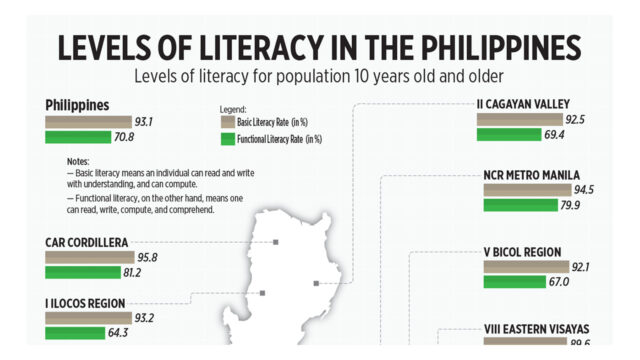
Levels of literacy in the Philippines

Levels of literacy in the Philippines

Max Mara educates this season

MAX MARA is clothing very chic women, and in the Philippines, it begins an initiative to educate them too.

At a fashion show in their Greenbelt store on March 26, Max Mara showed its Spring/Summer 2025 collection, inspired, fittingly, by a very educated woman. For this season, the collection is inspired by Hypatia: mathematician, philosopher, astronomer, and teacher. A daughter of a mathematician in the early days of the Eastern Roman Empire, much of her work was derived from Pythagoras, but she was also believed to have a hand in making early astronomical instruments.

At the fashion show, we saw camel-colored coats, sweater sets in nude colors, a white pantsuit, a white halter dress, a white wraparound shirtdress that clung to the body, and various sexy pieces in copper. The overall effect was dressing a sexy intellectual. In box-fresh cottons, they are stitched through externally, lending Max Mara’s tailoring and trench coats a trigonometric turn. Arranged into asymmetric origami-like clusters radiating from one shoulder or hip, they are a new take on the draped gowns of Hypatia’s time.

EDUCATION INITIATIVE
Aside from introducing the new collection, during the event it was announced that Max Mara in the Philippines will also help young women finish their schooling.

In time for Women’s Month this March, Max Mara in the Philippines partners with U-GO, an organization that helps fund higher education scholarships for talented young women enrolled in public universities in low-income countries. It does so by providing grants funded by individuals and corporations, according to the website of the Ayala Foundation, which is their implementing arm in the Philippines. Aside from the Philippines, U-GO also operates in Pakistan, India, Bangladesh, Cambodia, Vietnam, Indonesia, Nepal, and Tanzania, according to its website. It currently has 4,320 scholars enrolled around the world. The Max Mara promotion will run until April 30, with 10% of each sale going to U-GO.

“We’re helping young women here in Manila to go and finish school. Once they finish school, then they can be somebody (who) can help in society,” Alou Koa, Max Mara’s local partner in the Philippines, told BusinessWorld.

“Our customers, indirectly, they’re also doing charity,” she said.

The Max Mara boutique is in Greenbelt 3, Ayala Center, Makati. — JL Garcia

Agri dep’t pushes BSP for continued use of abaca fiber in PHL banknotes

BW FILE PHOTO

THE Department of Agriculture (DA) said on Sunday that it will seek to reverse a central bank decision halting the use of abaca fiber in Philippine banknotes.

“We will request that the Bangko Sentral ng Pilipinas (BSP) reconsider its decision to remove abaca fiber from Philippine banknotes, given the impact this decision has on the livelihoods of millions who rely on the abaca industry,” Secretary Francisco Tiu Laurel, Jr. said in a statement 

“We will also urge the Department of Foreign Affairs to incorporate abaca fiber into Philippine passports and ask other government agencies to consider its use in official documents,” he added.

The BSP in December said polymer banknotes help in “significantly reducing replacement costs.”

Polymer notes have a lifespan of 7.5 years compared with the 1.5 years for paper banknotes, it said.

Abaca, also known as Manila hemp, is indigenous to the Philippines, accounting for 86% of the global supply in 2023.

The abaca industry generated an average annual export revenue of $139.2 million between 2013 and 2024, with 18% derived from raw fiber and 82% from manufactured products, primarily pulp.

“Nearly all abaca pulp produced in the Philippines is exported,” the DA said.

Abaca production fell to about 40,000 metric tons (MT) in 2024, from 61,100 MT in 2023. In 2022, production fell by 5.7% year on year to 63,640 MT.

“As the world’s largest supplier of abaca, we have a responsibility to ensure that more of this valuable resource is available to support both the environment and local farmers,” Philippine Fiber Industry Development Authority Executive Director Arnold I. Atienza said.

He said the 120,145 farmers engaged in abaca cultivation are among the poorest in the country, earning an estimated annual gross income of less than P40,000. — Kyle Aristophere T. Atienza

Meralco activates Sta. Rosa substation

POWER distributor Manila Electric Co. (Meralco) said it activated a new substation in Sta. Rosa, Laguna, to meet the increasing power requirements of commercial, industrial, and residential hubs in the province.

Located in Hacienda Sta. Elena, the new Mesaland 115-kilovolt (kV)-34.5-kV substation aims to improve the power quality and system reliability in Sta. Rosa and Cabuyao in Laguna, as well as Silang and Tagaytay City in Cavite, Meralco said in a statement on Sunday.

The project involved the installation of a new 83-megavolt-ampere power transformer, capable of supporting four new 34.5-kV distribution feeders.

The substation has two 115-kV sub-transmission feeds through the cutting-in of the existing Sta. Rosa 2 – Light Industry and Science Park 115-kV line, providing N-1 contingency.

“The newly energized Mesaland Substation underscores Meralco’s unwavering commitment to quality and continuous service improvement, meeting the growing power demands of commercial, industrial, and residential customers in Sta. Rosa and nearby areas,” said Froilan J. Savet, first vice-president and head of networks at Meralco.

“As part of its dedication to supporting economic growth, Meralco will continue to invest in the expansion and enhancement of its distribution network, ensuring a reliable and efficient power supply for the communities it serves,” he added.

Meralco said that residential communities, as well as education and health institutions in the area, are expected to benefit from the new substation. These include Treveia, Adventist University of the Philippines, The Medical City South Luzon, Zadia Towers, Hacienda Sta. Elena, The Sonoma Residences, Abrio, Santierra, Lumira, and Venare.

The company added that it will also serve the power requirements of business and commercial establishments, including Landers Superstore, S&R, Ayala Malls Solenad, Robinsons Nuvali, The Landmark Supermarket, Seda Hotel, Concentrix, Asurion, AllHome Sta. Rosa, Vista Mall Sta. Rosa, Paseo de Sta. Rosa, and Promenade Sta. Rosa.

“The development of the Mesaland Substation is part of Meralco’s commitment to improving its distribution system to ensure the delivery of safe, stable, and reliable electricity service to its customers,” it said.

Last year, Meralco energized a P450-million substation in Batangas City and invested P48.43 million to upgrade a substation in Quezon City. 

Meralco’s controlling stakeholder, Beacon Electric Asset Holdings, Inc., is partly owned by PLDT Inc.

Hastings Holdings, Inc., a unit of PLDT Beneficial Trust Fund subsidiary MediaQuest Holdings, Inc., has an interest in BusinessWorld through the Philippine Star Group, which it controls. — Sheldeen Joy Talavera

Waller says stablecoins will bring benefits to US payments system

US FEDERAL RESERVE Governor Christopher Waller said on Friday that stablecoins are a good thing for the US payments system, but he doubts the financial system can support a large number of these assets.

“I’ll say I’m a personal, big advocate of stablecoins,” Mr. Waller said at a New York Fed event. “I have been saying this for over three-plus years now, about how this could bring competition, efficiency and speed into the payments system.”

“Do I think there’s going to be 100 stablecoins circulating after legislation happens? I don’t think so,” he added.

Mr. Waller is leading the work on payments system issues for the US central bank, a job he acknowledges would have at one point been grim but is now “fascinating” given the level of innovation happening in the sector. He noted “if you had told the (Fed) governor 25 years ago they had to oversee the payments committee, they’d put a gun in their mouth.”

Mr. Waller again noted that he sees no need for the Fed to adopt its own fully digital dollar and said that it’s best when the private sector leads payments system innovation.

“I prefer to let the private sector solve these problems,” Mr. Waller said. “It’s not my job as an unelected bureaucrat to tell everybody how they should do things,” he said, adding that the Fed’s role is to “convene the industry together to think about what the problems are” and how they can be solved.

Mr. Waller also reiterated that the challenge of speeding up the payments system is that everyone wants to get paid quickly but not everyone wants to send the cash as quickly. — Reuters