Home Blog Page 1203

Ayala Corp. recognized for governance at ASEAN CGCA 2025

(L-R) AYALA CORP. Compliance Manager Melody B. Trinidad; Ayala Corp. Chief Legal Officer, Chief Compliance Officer, Corporate Secretary and Corporate Governance Group Head Franchette M. Acosta; Securities and Exchange Commission Chairman Francis Edralin Lim; Ayala Corp. Assistant Corporate Secretary and Corporate Secretarial Services Head Carmela G. Austria; and Securities and Exchange Commission Commissioner McJill Bryant Fernandez at the 2025 ASEAN Corporate Governance Conference and Awards in Kuala Lumpur, Malaysia, July 24. — AYALA CORP.

LISTED conglomerate Ayala Corp. said it received recognition for its corporate governance at the 2025 ASEAN Corporate Governance Conference and Awards (ASEAN CGCA 2025).

In a statement on Monday, Ayala Corp. said the ASEAN CGCA 2025 recognized it as one of the top 50 publicly listed companies in the region and among the top five in the Philippines for excellence in corporate governance during the July 24 event held in Kuala Lumpur, Malaysia.

The awards recognized top publicly listed companies from the Philippines, Indonesia, Malaysia, Singapore, Thailand, and Vietnam. This followed an assessment of their corporate governance practices based on publicly available disclosures, the company said.

“At Ayala, we believe that excellence in corporate governance enables decision-making processes and actions that are purposeful and consistent with our objective to build businesses that enable people to thrive,” Ayala Corp. Chief Legal Officer, Compliance Officer, Corporate Secretary, and Corporate Governance Group Head Franchette M. Acosta said.

“At the same time, a strong governance ethic is key to maintaining investor interest and confidence,” she added.

Ayala-led Globe Telecom, Inc. was also included among the top 50 ASEAN companies and the top five in the Philippines.

Five other Ayala companies were also included in the list of ASEAN Asset Class companies, namely ACEN Corp., AREIT, Inc., Ayala Land, Inc., AyalaLand Logistics Holdings Corp., and Bank of the Philippine Islands.

ASEAN Asset Class companies are those that reached the cutoff score of 97.5 points, or at least 75% of the maximum score of 130 under the ASEAN Corporate Governance Scorecard. A total of 35 Philippine companies met the score this year.

The latest assessment reflected sustained improvements in corporate governance practices across Southeast Asia, particularly in board accountability, shareholder rights, disclosure practices, and sustainability integration, ASEAN CGCA said.

Ayala Corp. shares rose by 1.02% or P6 to P596 apiece on Monday. — Revin Mikhael D. Ochave

DBP on track to hit P5-B profit goal

THE DEVELOPMENT Bank of the Philippines (DBP) is on track to hit its P5-billion income target this year, its top official said.

The state-run bank also plans to restructure its loans to government contractors amid repayment issues to improve its financial position.

“We’re targeting about P5 billion this year, approximately. So, we’re on target. Right now, we’re about half of that,” DBP President and Chief Executive Officer Michael O. de Jesus told reporters on Thursday.

He said this was driven by loans for infrastructure projects.

DBP’s net income stood at P2.53 billion as of end-June, its latest financial statement posted on its website showed.

Mr. De Jesus said the bank will extend the payment terms of their “legacy loans” to help their contractor clients repay their debt and fix past dues that weigh on the DBP’s asset quality.

The bank’s nonperforming loan (NPL) ratio was at about 7% as of end-June, which the official noted is higher than industry average.

“We’re very selective also in our lending. We noticed a few contractors that have problems with collections and all that. Although we’re active in lending to them, we also have to be very careful because we’re monitoring our past dues. And I think there were some contractors that were having some problems with collections. Government contracts. So, they basically were having problems paying their loans, too,” he said.

“We do loans that maybe other banks would not do. But we do it because there’s a developmental aspect. But our priority is to fix those nonperforming loans, to restructure them… We extend the payments. We work with our borrowers to restructure… Sometimes, one or two accounts could increase the past due. Many of them are government contractors. They’re having a hard time collecting now from the government,” Mr. De Jesus added.

He said that while the bank’s current NPL ratio is still “manageable,” they want to eventually bring this down to 5%.

Meanwhile, Mr. De Jesus said the DBP could resume its lending for the jeepney modernization program if the loans could have more equity support as the loan program was suspended earlier this year as the repayment levels of the sector went to as high as 40%.

“We had a very poor experience with the jeepney modernization. Our past due in that field went up to as high as 40%. So, it wasn’t good for us. If we do come back, we have to look at other things. Maybe increasing the equity and all that. But it was not successful for the past two years,” he said.

“We want to help the industry, but there are a lot of issues. Sometimes you’re lending to cooperatives. The drivers, for example, their routes are changed. They have a profitable route, [but] a mayor can change the route to a less profitable route. That affects the payment capability. There are a lot of things going on… We have to change things. There should be more equity support.” — Aaron Michael C. Sy

Loni Anderson, who played smart against stereotype on WKRP in Cincinnati, 79

LONI ANDERSON (center) and the rest of the cast of the TV series WKRP in Cincinnati.

LOS ANGELES — Actress Loni Anderson, who won acclaim for her US television sitcom role as the brainy, glamorous radio station receptionist defying workplace sexual stereotypes on WKRP in Cincinnati, died on Sunday at age 79, according to her publicist.

Ms. Anderson, also remembered for her much-publicized storybook marriage to actor Burt Reynolds in 1988 and their tabloid-fixated divorce six years later, died at a Los Angeles hospital “following an acute prolonged illness,” her family said.

“We are heartbroken to announce the passing of our dear wife, mother, and grandmother,” the family said in a statement, adding that she was surrounded by loved ones.

Ms. Anderson, a native of St. Paul, Minnesota, and natural brunette who competed in local beauty pageants and got her showbiz start in community theater, dyed her hair platinum blonde after moving to Los Angeles in the mid-1970s.

A flurry of television work followed, with appearances on such prime-time series as The Bob Newhart Show, Police Story, The Incredible Hulk, The Love Boat, and Three’s Company.

She had auditioned for the role of one of the two female lead characters, Chrissie, on Three’s Company, but the part ultimately went to Suzanne Somers.

Ms. Anderson’s big break came soon after when she landed the co-starring role of Jennifer Marlowe on WKRP in Cincinnati, persuading the show’s producers to let her play the part against the stereotype of a bubble-headed blonde.

Instead, her character was written as the deceptively shrewd receptionist who refused to take dictation or fetch coffee but turns out to be the smartest person in the room, keeping the fictional Ohio radio station afloat despite the shortcomings of male bosses.

The show ran four seasons, 1978-1982, on the CBS network, and earned Ms. Anderson two prime-time Emmy nominations.

She also played two real-life, ill-fated sex sirens of earlier Hollywood eras in a pair of made-for-TV-movies — The Jayne Mansfield Story, co-starring Arnold Schwarzenegger as her bodybuilder husband during the 1950s, and The Mysterious Murder of Thelma Todd, set in the 1930s.

In all, Ms. Anderson starred in six television series, seven feature films, 19 television movies, and two mini-series during a four-decade career she chronicled in her best-selling autobiography, My Life in High Heels.

She and Mr. Reynolds first met in 1981 as guests on a television talk show, began dating a year later and co-starred in the 1983 race car-themed romantic comedy film Stroker Ace. They wed in 1988, she for the third time, he for the second.

Ms. Anderson is survived by her adopted son, Quinton Anderson Reynolds, and her fourth husband, Bob Flick, a member of the 1950s-’60s folk-singing group the Brothers Four. — Reuters

Our romance with ‘small is beautiful’ and how large businesses provide needed remedies

MVP Group Chairman Manny V. Pangilinan, Israel Ambassador Ilan Fluss, and Metro Pacific Agro Ventures CEO Jovy Hernandez led the ceremonial first harvest in Metro Pacific Fresh Farm located in San Rafael, Bulacan. — FACEBOOK.COM/NEWS5EVERYWHERE

(Part 2)

THE MAIN PROBLEM with large commercial establishments is the “too-big-to-fail” feature: when a commercial and industrial enterprise has become so large and encompassing, they achieve quasi-immunity from regulatory intervention by virtue of size and systemic reach. They cannot be brought down without courting the collapse of the whole economic system. They become, as it were, exempted from the Schumpeterian “creative destruction” rule which is the anchor of capitalist dynamism. The 2008 Financial Crisis with the Lehmann Brothers collapse shows this clearly even under so-called cutting edge regulation.

But even more dangerous in environments with weak public ordering is the problem of “too-big-to-behave.” Being too big, they change their color and become political actors on top of being economic actors. They train their political clout not to enable, but to prey on weaker rivals – to suppress any form of competitive challenge. Large conglomerates may succumb to the temptation of employing political leverage for rent-seeking after the capture of political centers of power.

Many large business groups may indeed develop and maintain clandestine but mutually beneficial relations with political actors. This murky matrix of relationships and connected dealings became the favorite whipping boy of sanctimonious Western observers in the wake of the Asian Financial Crisis of 1998 which, for many, signaled the end of the proverbial East Asian Model (“In Praise of Rules,” The Economist, April 7, 2001).

This danger re-emerged in the 21st century case of massive self-dealing of the Saigon Commercial Bank in Vietnam, and in the collapse of the state-supported “Evergrand” in the People’s Republic of China where some rules of law on self- and connected dealings were rendered inapplicable by political interference. We still do not know how much damage will be wrought upon these economies. And we do have problems of our own with too-big-to-behave entities in our midst. They are largely associated with political power blocks.

For all the dangers of large corporations, this is just the echo of the classic risk-return conundrum of state-formation. It endows the state with a monopoly on the use of violence on a hope and a prayer; that the powers bestowed will be used for our boon rather than its opposite. On the whole, the historical gamble has been successful, although we need a judiciary that understands its role as a firewall against abuse to make it work.

We do not underestimate this risk. Our view is that rather than condemn size at the outset, we consider firm size as necessary investments in efficiency and sustainability. Where such investment is prudent and kept in place by the guardrails of rule-of-law, even if only by a lapse-prone judiciary, the returns on investment is substantial.

When all is said, the economics profession should have known better. It was its duty to know better than their tutors in the West.

A different question is the following: had they known better, would we have stood up against the tide? There is a place for smallness in the economy but like the season, its place is not everywhere and not every time. We are a small economy but our vision should encompass the whole world. If tiny Denmark can host a global giant container shipping company, Maersk, which employs many Filipinos, so can Filipino companies become leaders and pioneers in global businesses, if only our regulators look more benignly at big business.

THE BOON OF LARGE CAPITAL
The Philippines started out on the wrong foot in its farm and land policies with its Comprehensive Agrarian Reform Program (CARP). It chased big private capital away from the farm sector.

Some 20 years ago, Metro Pacific President Manny V. Pangilinan (often referred to as MVP) called the UP School of Economics Group at Diliman to ask for the whereabouts of the government’s 100,000 hectares of land for lease, as announced by then Secretary of Agriculture Arthur Yap of the Arroyo administration. MVP said he was interested in large-scale farming and was ready to pour in billions of pesos if a suitable location was found. He said he was anticipating that China would become a food importer and we may as well be ready to answer the demand. After a few phone enquiries later, we discovered that the 100,000 hectares was the aggregate of five hectares in Tawi-Tawi, three hectares in Sorsogon, four hectares in Batanes, etc. This killed the enthusiasm of MVP who said his expertise was organizing and managing production, not in consolidating many disparate pieces of farm lands quickly. He said he was not interested in owning land, but would like to sign a contract of lease with a consolidator (government or otherwise) for 25 years for 10,000 hectares and to pour in considerable sums in the venture. Bottom line, he would not sign 1,000 lease contracts with 1,000 farmers for 1,000 pieces of farmland. That seemed the end of the story. But having large capital and enthusiasm will travel. As the saying in a western movie goes, “Have gun will travel.” MVP had other ideas.

In 2019, Metro-Pacific Agri-ventures entered into a joint venture agreement with the LR group of Israel to establish a high-tech vegetable outfit in the Philippines. LR Israel is a world leader in drip irrigation greenhouse farming and precision agriculture in Fort Magsaysay, Nueva Ecija. The project was a 50-hectare industrial scale farm which was to produce high value crops (bell peppers, tomatoes, and lettuce) in climate-controlled greenhouses. Their sales destination were the supermarkets in Manila and elsewhere so as to reduce the imports of these from other countries. Every greenhouse was air-conditioned and climate controlled for the optimal growth of each vegetables type. The farm is now producing batches of vegetables for shipment to Metro Manila.

The vision is to expand the area to a thousand hectares in the vicinity, but also in other areas where suitable land could be leased. That is not easy because of restrictions on land ownership in the country. The trick is state-of-the art industrial greenhouse farms. This would be the first of its kind in the Philippines! This shows that having large capital can afford the importation of new technologies and modalities to overcome the rigidities posed by CARP. At the moment, the firm is privileging worker-leaseholders and their children for employment among its workforce.

Metro Pacific Dairy Farms, Inc., a P2-billion state of the art dairy processing plant in Bay, Laguna, produces up to 2 million liters of local fresh milk. It started out with the acquisition in 2019 of majority ownership of Carmen’s Best from the Razon Group, which retained a significant minority ownership and continuous in the management. The goal was to establish the largest and most technologically endowed local dairy processing facility. Local dairy farmers will have a stable fair priced market for their milk. It will clearly reduce imports of fresh milk.

LARGE CAPITAL REDUX AND BRINGING REMEDIES
All these mark a new beginning in our farming sectors, viz., the return of big capital to our farm sector which, in the past, due to land reform property rights chaos, it had been fleeing. Since these are all about traded goods production, it augurs well also for our Manufacturing sector besides our food sectors.

Would that these ventures make as much money as they would in the non-traded goods sector. Would that other deep pockets find the farm sector and the traded goods sectors — for so long condemned to what Nick Joaquin called our “timorous clinging to smallness” — congenial for investment.

(Read Part 1 here: https://tinyurl.com/2xv75o4x )


Raul V. Fabella is a retired professor of the UP School of Economics, a member of the National Academy of Science and Technology, and an honorary professor of the Asian Institute of Management. He gets his dopamine fix from tending flowers with wife Teena, bicycling, and assiduously, if with little success, courting the guitar.

Alternergy’s 64-MW Alabat wind farm cleared for grid integration

STOCK PHOTO | Image by ZHANG FENGSHENG from Unsplash

ALABAT Wind Power Corp. (AWPC), a unit of Alternergy Holdings Corp., has secured the green light from the Energy Regulatory Commission (ERC) to inject electricity from its 64-megawatt (MW) Alabat wind project into the Luzon grid via a transmission facility.

In a media release on Monday, Alternergy said the ERC approved AWPC’s application to develop and own a dedicated point-to-point transmission facility to connect the wind farm to the grid.

The P1.8-billion facility involves the installation of a substation at the wind farm site and a 37-kilometer transmission system from Brgy. Villa Norte in Alabat to Brgy. Hondagua in Lopez, Quezon.

This will then link to the existing 69-kilovolt Gumaca-Tagkawayan-Lopez transmission line of the National Grid Corp. of the Philippines in Lopez, Quezon, via a switching station.

“With this approval, AWPC reaffirms our goal of promoting environmental stewardship through the development of renewable energy resources and supporting our host communities while ensuring a reliable and efficient energy supply to the grid,” said AWPC President Gerry P. Magbanua.

Straddling the municipalities of Alabat and Quezon, the P7-billion wind farm is targeted for completion by the end of the year.

In April, Alternergy took delivery of the first two 8-MW wind turbines built by Envision Energy, part of the eight turbines to be delivered for the wind project.

The company has secured P5.3 billion in financing from Rizal Commercial Banking Corp. to partially fund the project’s construction.

The Alabat wind farm is one of five renewable energy projects under construction by Alternergy as part of its goal to reach a 500-MW capacity target by 2026.

On Monday, shares in the company fell by 1.98%, closing at P0.99 apiece. — Sheldeen Joy Talavera

BSP launches open finance pilot for PERA

BW FILE PHOTO

THE BANGKO SENTRAL ng Pilipinas (BSP) has launched a pilot program that will use open finance to boost access to the Personal Equity and Retirement Account (PERA) and encourage more Filipinos to save.

The central bank on July 29 launched the Open Finance for PERA Pilot, which leverages the regulator’s Open Finance framework that allows for secure sharing of customers’ financial data across institutions.

“By making PERA the starting point for open finance, we make it part of a seamless digital ecosystem, making saving and investment simpler for everyone,” BSP Governor Eli M. Remolona, Jr. said “At the same time, we give open finance a jumpstart from concept to practice. This is more than innovation; this is financial health.”

Through the initiative, Filipinos can open PERA accounts by logging into their selected provider’s platform and consenting to bank or e-wallet know your customer data sharing, which the BSP said eliminates the need for manual forms or ID verification.

“The BSP sees open finance as a means to expand financial choice and convenience… The pilot will soon allow users to open accounts directly via participating apps, making PERA more accessible and user-friendly,” the central bank added.

The launch was attended by BSP officials, Monetary Board members, as well as representatives from participating financial institutions and PERA Administrators. The participating institutions will enable their customers to open PERA accounts, while the PERA Administrators will manage the investments.

The participating financial institutions are Land Bank of the Philippines; Maya Philippines, Inc.; Metropolitan Bank & Trust Corp.; Philippine National Bank; Rizal Commercial Banking Corp.; Union Bank of the Philippines, Inc.; and G-Xchange, Inc.

Meanwhile, the PERA Administrators are ATRAM Trust Corp.; BDO Unibank, Inc.; and BPI Wealth – A Trust Corp.

Launched in 2016, PERA is a voluntary fund scheme meant to supplement retirement benefits from the Government Service Insurance System or the Social Security System, as well as private employers.

Contributors aged 18 and above who have a tax identification number are allowed to open a PERA account. Self-employed and locally employed contributors can make an annual contribution of P200,000, while overseas Filipino workers can invest up to P400,000.

The PERA Law also offers various incentives to contributors, such as tax exemptions on earnings from PERA investments, a 5% income tax credit on contributions that can be used for paying income tax liabilities, and a tax-free distribution on qualified withdrawal of PERA investments.

Accumulated PERA contributions climbed by 24% year on year to P491.4 million at end-2024 from P396.3 million in 2023, data from the BSP showed.

The total number of PERA contributors likewise rose by 6.4% to 5,912 at 2024’s close from 5,555 a year prior. — Katherine K. Chan

Metro Manila condo vacancy may drop in 2026

METRO MANILA’S residential market continues to experience dampened take-up for mid-income condominium projects (priced from P3.2 million to P12 million per unit). This has prompted major property developers to aggressively offer attractive and innovative ready-for-occupancy (RFO) promos to encourage more buyers to acquire units in the capital.

Hefty discounts on spot cash payments, extended payment terms, free appliances, and other concessions are indeed enticing more investors to purchase vertical units. These promotions appear to be effective, with Colliers recording improved take-up across nearly all condominium price segments in Metro Manila.

We are now seeing a more pronounced influx of luxury developments — high-end projects dominating both supply, through new launches, and demand, as evidenced by positive net take-up for luxury to ultra-luxury units priced at P100 million and above.

Developers have become more prudent with their launches within and outside Metro Manila, capitalizing on a consumer base flush with cash and actively seeking capital value appreciation opportunities even beyond the capital.

DEMAND AND RENTS REMAIN SOFT
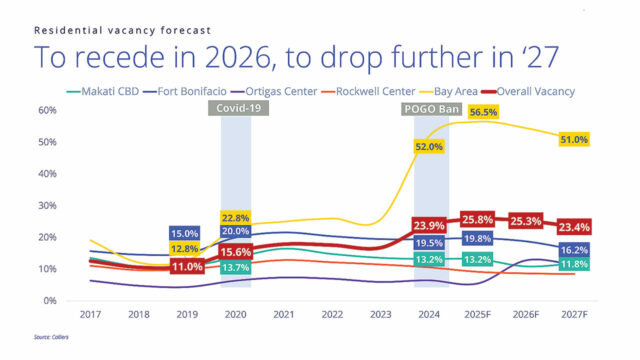
Weak demand for units for rent and for sale has resulted in elevated vacancy levels across Metro Manila, particularly in the Bay Area, which continues to suffer from the effects of the Philippine offshore gaming operator (POGO) exodus. More established central business districts (CBDs) continue to outperform their peripheral counterparts.

We forecast a marginal rental correction of 1.5% in 2025, followed by a recovery in 2026 as vacancy begins to ease. We also expect sustained demand, particularly from expatriates seeking larger units and more open spaces.

VACANCY TO EASE IN 2026 AND 2027
Colliers expects vacancy levels to begin declining in 2026 as condominium completions slow and demand picks up, especially in key CBDs. This trend will likely continue through 2027, driven in part by fewer unit turnovers and stabilizing take-up in major business districts.

We project a more stable vacancy rate in Metro Manila over the next 24 to 26 months, as the worst impact of the POGO exodus on the condominium market has likely passed.

CUT-THROAT RFO BATTLE TO CONTINUE
As of the second quarter (Q2), the remaining condominium inventory in Metro Manila stands at 81,000 units, 30,600 of which are RFO. Colliers recommends that developers with significant RFO inventory offer more attractive and curated promos. We have seen select developers offer up to 40% discounts on total contract prices (TCPs) for spot cash payments, early move-in packages, rent-to-own options, and even gift certificates of up to P150,000 ($2,700).

Meanwhile, tenants and buyers should watch for areas offering larger discounts on lease rates and prices. In our view, RFO units in the Bay Area and other fringe locations are likely to be offered at steeper discounts due to slower demand and elevated vacancies caused by the POGO exit.

DEVELOPERS CORNER LUXURY DEMAND
The substantial volume of unsold inventory in the mid-income segment (P3.6 million to P12 million) is prompting developers to pivot toward high-end developments. In 2024, Colliers recorded that the upscale to ultra-luxury segments (P12 million and above) accounted for 41% of total condominium launches in Metro Manila. Several developers have recently launched new luxury projects both within and beyond the capital. These include Ayala Land Premier’s Laurean Residences in Makati, Cebu Landmasters’ The Wave in Cebu, and SM Prime’s Signature series, which will be located across several provinces.

Colliers expects demand for luxury projects to remain strong, with take-up driven primarily by expatriates, international visitors, and sustained interest from affluent buyers. Developers should emphasize upscale amenities, premium concierge services, and strong capital appreciation potential — key considerations for discerning investors and end-users.


Joey Roi Bondoc is the director and head of Research of Colliers Philippines.

joey.bondoc@colliers.com

Too many em dashes? Weird words like ‘delves’? Spotting text written by ChatGPT is still more art than science

PEOPLE ARE NOW routinely using chatbots to write computer code, summarize articles and books, or solicit advice. But these chatbots are also employed to quickly generate text from scratch, with some users passing off the words as their own.

This has, not surprisingly, created headaches for teachers tasked with evaluating their students’ written work. It’s also created issues for people seeking advice on forums like Reddit, or consulting product reviews before making a purchase.

Over the past few years, researchers have been exploring whether it’s even possible to distinguish human writing from artificial intelligence (AI)-generated text. But the best strategies to distinguish between the two may come from the chatbots themselves.

TOO GOOD TO BE HUMAN?
Several recent studies have highlighted just how difficult it is to determine whether text was generated by a human or a chatbot.

Research participants recruited for a 2021 online study, for example, were unable to distinguish between human- and ChatGPT-generated stories, news articles, and recipes.

Language experts fare no better. In a 2023 study, editorial board members for top linguistics journals were unable to determine which article abstracts had been written by humans and which were generated by ChatGPT. And a 2024 study found that 94% of undergraduate exams written by ChatGPT went undetected by graders at a British university.

Clearly, humans aren’t very good at this.

A commonly held belief is that rare or unusual words can serve as “tells” regarding authorship, just as a poker player might somehow give away that they hold a winning hand.

Researchers have, in fact, documented a dramatic increase in relatively uncommon words, such as “delves” or “crucial,” in articles published in scientific journals over the past couple of years. This suggests that unusual terms could serve as tells that generative AI has been used. It also implies that some researchers are actively using bots to write or edit parts of their submissions to academic journals. Whether this practice reflects wrongdoing is up for debate.

In another study, researchers asked people about characteristics they associate with chatbot-generated text. Many participants pointed to the excessive use of em dashes — an elongated dash used to set off text or serve as a break in thought — as one marker of computer-generated output. But even in this study, the participants’ rate of AI detection was only marginally better than chance.

Given such poor performance, why do so many people believe that em dashes are a clear tell for chatbots? Perhaps it’s because this form of punctuation is primarily employed by experienced writers. In other words, people may believe that writing that is “too good” must be artificially generated.

But if people can’t intuitively tell the difference, perhaps there are other methods for determining human versus artificial authorship.

STYLOMETRY TO THE RESCUE?
Some answers may be found in the field of stylometry, in which researchers employ statistical methods to detect variations in the writing styles of authors.

I’m a cognitive scientist who authored a book on the history of stylometric techniques. In it, I document how researchers developed methods to establish authorship in contested cases, or to determine who may have written anonymous texts.

One tool for determining authorship was proposed by the Australian scholar John Burrows. He developed Burrows’ Delta, a computerized technique that examines the relative frequency of common words, as opposed to rare ones, that appear in different texts.

It may seem counterintuitive to think that someone’s use of words like “the,” “and,” or “to” can determine authorship, but the technique has been impressively effective.

Burrows’ Delta, for example, was used to establish that Ruth Plumly Thompson, L. Frank Baum’s successor, was the author of a disputed book in the Wizard of Oz series. It was also used to determine that love letters attributed to Confederate Gen. George Pickett were actually the inventions of his widow, LaSalle Corbell Pickett.

A major drawback of Burrows’ Delta and similar techniques is that they require a fairly large amount of text to reliably distinguish between authors. A 2016 study found that at least 1,000 words from each author may be required. A relatively short student essay, therefore, wouldn’t provide enough input for a statistical technique to work its attribution magic.

More recent work has made use of what are known as BERT language models, which are trained on large amounts of human- and chatbot-generated text. The models learn the patterns that are common in each type of writing, and they can be much more discriminating than people: The best ones are between 80% and 98% accurate.

However, these machine-learning models are “black boxes” — that is, we don’t really know which features of texts are responsible for their impressive abilities. Researchers are actively trying to find ways to make sense of them, but for now, it isn’t clear whether the models are detecting specific, reliable signals that humans can look for on their own.

A MOVING TARGET
Another challenge for identifying bot-generated text is that the models themselves are constantly changing — sometimes in major ways.

Early in 2025, for example, users began to express concerns that ChatGPT had become overly obsequious, with mundane queries deemed “amazing” or “fantastic.” OpenAI addressed the issue by rolling back some changes it had made.

Of course, the writing style of a human author may change over time as well, but it typically does so more gradually.

At some point, I wondered what the bots had to say for themselves. I asked ChatGPT-4o: “How can I tell if some prose was generated by ChatGPT? Does it have any ‘tells,’ such as characteristic word choice or punctuation?”

The bot admitted that distinguishing human from nonhuman prose “can be tricky.” Nevertheless, it did provide me with a 10-item list, replete with examples.

These included the use of hedges — words like “often” and “generally” — as well as redundancy, an overreliance on lists, and a “polished, neutral tone.” It did mention “predictable vocabulary,” which included certain adjectives such as “significant” and “notable,” along with academic terms like “implication” and “complexity.” However, though it noted that these features of chatbot-generated text are common, it concluded that “none are definitive on their own.”

Chatbots are known to hallucinate, or make factual errors.

But when it comes to talking about themselves, they appear to be surprisingly perceptive.


Roger J. Kreuz is an associate dean and professor of psychology at the University of Memphis.

The heroic role of gas plants in cheaper electricity

A number of non-truthful statements against gas plants especially liquefied natural gas (LNG) came out recently. These include that: a.) gas plants are responsible for recent higher Meralco electricity prices; and, b.) gas plant costs are driving up electricity prices globally and cause more hardship to households.

I said “non-truthful” because there are numbers and facts that disprove the above narratives. I compared the electricity rates from July 2022 — the start of President Ferdinand R. Marcos, Jr.’s administration — to July 2025, the last billing period. Here we go.

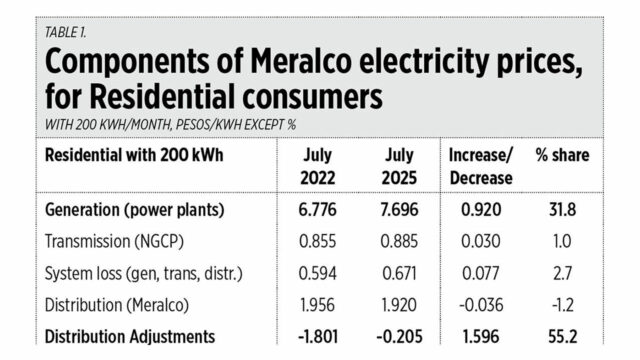
Meralco’s total electricity rates collected increased from P9.75 per kilowatt-hour (kWh) in July 2022 to P12.64/kWh. This increase was due mainly to: a.) a lower distribution refund rate, and, b.) a higher generation charge from pass-through of higher Malampaya prices and the Energy Regulatory Commission (ERC) denial or inaction on requests to adjust charges due to Change in Circumstance (CIC) claims.

The LNG plants in Batangas — jointly owned by Aboitiz Power (AP), Meralco Power Gen (MGEN) and San Miguel Global Power (SMGP), the Excellent Energy Resources, Inc. (EERI) and South Premier Power Corp. (SPPC or the Ilijan plant) — have nothing to do with the higher prices this year. And there was even a decline in the Meralco distribution charge from 2022 to 2025 by nearly 4 centavos/ kWh (see Table 1).

Here are the numbers for the two reasons for the increase that I mentioned.

On (a.): in July 2022, Meralco residential customers got a refund of P1.80/kWh in the distribution charge due to distribution rate true-up. The total refund of P48.2 billion was completed in May 2023. In July 2025, the distribution refund rate covering the latest true-up was lowered by the ERC to P0.205/kWh. So there was an “increase” of P1.596/kWh in distribution adjustments which constitutes 55% of the P2.89/kWh increase over three years.

On (b): the generation costs of First Gas Sta. Rita and First Gas San Lorenzo, both owned by FirstGen (not affiliated with Meralco), increased by P1.988/kWh and P2.806/kWh, respectively, over the same period. Both power plants account for about 30% of the generation supply.

The ERC denial of, or inaction on, requests for price adjustment based on CIC claims forced the power suppliers — SPPC, Sual Power Inc. (SPI), and ACEN — to terminate their fixed price Power Supply Agreements (PSAs) with a total contracted capacity of 1,310 megawatts. Meralco was then forced to enter into emergency PSAs, which were more expensive by about P1.32/kWh than the PSAs that were terminated.

I asked Meralco for more data on the PSA between it and EERI. They replied that the generation cost of the EERI gas plant under the PSA with Meralco would have been lower if the ERC had acted on Meralco’s PSA applications filed in 2021. After conducting a competitive selection process (CSP) in 2021, Meralco and its counterparty suppliers (EERI and Masinloc Power) asked for ERC approval of the two resulting PSAs totaling 1,800 MW — but the ERC did not act for two years. So the power suppliers terminated the two PSAs in March 2023 after the lapse of the long-stop date. Meralco then conducted another CSP in 2024, a period of higher inflation (the Philippine inflation rate was 6% in 2023 and 3.2% in 2024). The offered prices of the 2024 winning power suppliers were P2+ per kWh higher than the winners of the 2021 CSP.

So the PSAs of the Meralco “sister companies” — EERI and SPPC/Ilijan — with a combined capacity of 2,400 MW, are not the main drivers of the increase in the total rate. Rather, these PSAs helped augment the supply in the grid to avert power supply shortages and bring down the cost of electricity.

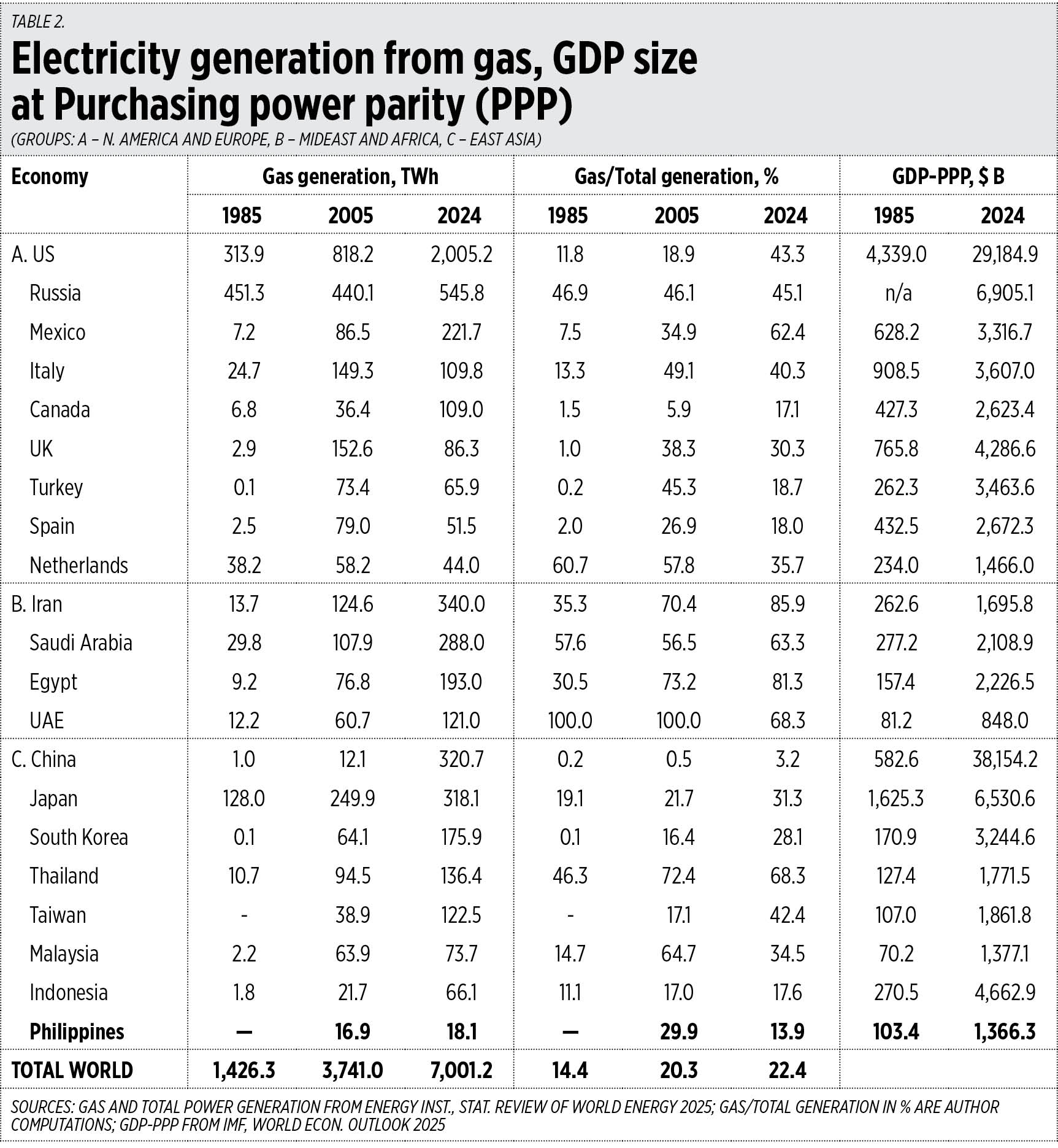
Blaming gas plants for driving up electricity prices globally and causing more hardship to households is an idea that I find far out. Many countries, both industrialized and industrializing, are using more gas power. From 1985 to 2024, the expansion in gas power generation in terawatt-hours (TWh) among selected countries was as follows: the USA, from 314 TWh to 2,005 TWh; Mexico from 7 TWh to 222 TWh; Canada from 7 TWh to 109 TWh; Iran from 14 TWh to 340 TWh; Egypt from 9 TWh to 193 TWh. In East Asia the increase was as follows: China from 1 TWh to 321 TWh; South Korea from 0.1 TWh (or 100,000 MWh) to 176 TWh; and, Malaysia from 2 TWh to 74 TWh. Globally it increased from 1,426 TWh to 7,001 TWh.

The share of gas to total power generation for many countries has been rising. Looking at the numbers from 1985 to 2024, the USA’s gas share rose from 12% to 43%, Mexico’s from 7.5% to 62%, the UK’s from 1% to 30%, South Korea’s from 0.1% to 28%, and Taiwan’s from zero to 42%. There has been  a significant expansion in GDP size of many countries as they used more hydrocarbons like gas to produce electricity over the past four decades (see Table 2).

The Philippines’ gas generation of only 18 TWh in 2024 was equivalent to only seven weeks of gas generation in Thailand, five weeks in South Korea, three weeks in Japan and China, and only three days in the US. It is so small and yet some climate-obsessed activists want to discontinue the expansion of our gas power capacity.

The Philippines should have expanded its gas power generation by four times (4X) to be at the level of Malaysia, or 7.6 times to be at the level of Thailand in 2024. The climate activists should turn their anti-gas noise and drama on the USA, Russia, Iran, Saudi Arabia, China, Japan, and Korea. It is very likely that these countries will laugh at these activists.

I hope that AP, MGEN, and SMGP will continue their LNG partnership and further expand the Philippines’ gas capacity. More power from stable, dependable sources means there is less threat of blackouts and lower prices of electricity.


Bienvenido S. Oplas, Jr. is the president of Bienvenido S. Oplas, Jr. Research Consultancy Services, and Minimal Government Thinkers. He is an international fellow of the Tholos Foundation.

minimalgovernment@gmail.com

SMPC Q2 earnings down 33% as coal, power prices ease

SEMIRARAMINING.COM

SEMIRARA MINING and Power Corp. (SMPC) saw its second-quarter (Q2) attributable net income decline by 33% to P4.1 billion as coal and electricity prices continued to normalize.

For the three months ended June, SMPC’s revenues dipped by 18.4% to P18.17 billion due to lower selling prices in the coal segment and weaker spot market prices in the power segment, according to its financial statement released on Monday.

Broken down, coal and power revenues decreased by 20% to P10.27 billion and 6% to P6.47 billion, respectively.

The average selling price for Semirara coal went down by 20% to P2,223 per metric ton (MT) due to “the combined effect of stabilizing global market indices and a higher proportion of lower-quality and non-commercial grade coal shipments.”

During the period, the average Newcastle Index fell by 26% to $100.50, while the Indonesian Coal Index 4 went down by 16% to $46.40.

SMPC’s coal production increased by 8% to 5.6 million MT, driven by improved access to coal seams at the Narra mine.

The company, however, reported flattish shipments at 4.6 million MT, as increased own-plant sales offset lower foreign shipments.

In the power segment, average spot electricity prices on the Luzon-Visayas grid declined by 42% to P4.04 per kilowatt-hour due to large supply margins brought about by additional power capacity, fewer outages, and a modest increase in demand.

The company reported a 17% increase in power sales to 1,435 gigawatt-hours, fueled by stronger plant availability and higher average capacity.

Of the total energy sold, 56% was sold to the spot market, while the remaining 44% was covered by bilateral contracts.

As of end-June, the company had committed 38% of its 840-megawatt (MW) total dependable capacity. After accounting for internal power usage, about 435.6 MW was left that could be sold to the spot market.

“While energy prices eased, we ramped up coal production and boosted power generation. By keeping our costs under control and operating more efficiently, we were able to cushion the impact of weaker prices,” SMPC President, Chief Operating Officer and Chief Sustainability Officer Maria Cristina C. Gotianun said in a media release.

For the first six months ended June, SMPC’s earnings decreased by 33.1% to P8.42 billion due to the continued stabilization of coal and spot electricity prices, and the recognition of an equity net loss from its cement associate.

Revenues sank by 14.4% to P31.33 billion, driven by softer coal index benchmarks and weaker electricity spot prices, cushioned by improved power segment generation.

“Looking ahead, we expect prices to remain relatively stable. Our focus is on ramping up coal production toward our 18 million metric ton target and optimizing our generation mix to maximize contracted capacity,” Ms. Gotianun said.

SMPC is the only vertically integrated power generator in the country that runs on its own fuel. The company supplies fuel to power plants, cement factories, and other industrial facilities across the Philippines. It also exports coal to China, South Korea, Brunei, and other nearby markets.

At the local bourse on Monday, shares in the company declined by 1.52% to close at P32.45 apiece. — Sheldeen Joy Talavera

Peso surges to P57 level on renewed Fed cut hopes

BW FILE PHOTO

THE PESO rebounded sharply against the dollar on Monday to return to the P57 level after weaker-than-expected US jobs data revived hopes of a September rate cut by the US Federal Reserve.

The local unit closed at P57.29 per dollar, surging by 85.5 centavos from its P58.145 finish on Friday, Bankers Association of the Philippines data showed.

The peso opened Monday’s session stronger at P57.75 against the dollar, which was already its worst showing. Its intraday best was its closing level of P57.29 against the greenback.

Dollars traded fell to $1.69 billion on Monday from $2.54 billion on Friday.

“The dollar-peso closed lower on back of a weak dollar following low nonfarm payrolls data last Friday, strengthening bets of Fed cuts,” a trader said in a phone interview.

Data on Friday showed US employment growth undershot expectations in July while the nonfarm payrolls count for the prior two months was revised down by a massive 258,000 jobs, suggesting a sharp deterioration in labor market conditions, Reuters reported.

Markets are now pricing an almost 90% chance the Fed will ease rates next month owing to the weaker-than-expected jobs data, with just under 60 basis points worth of cuts expected by December, implying two quarter-point cuts and a 40% chance of a third.

The peso gained ground on expectations that Philippine headline inflation eased in July, Rizal Commercial Banking Corp. Chief Economist Michael L. Ricafort said in a Viber message.

The Philippine Statistics Authority is scheduled to release July inflation data on Tuesday (Aug. 5). A BusinessWorld poll of 17 analysts yielded a median estimate of 1.2% for the July consumer price index (CPI), within the central bank’s 0.5%-to-1.3% projection.

If met, the July CPI print would be slower than the 1.4% in June and the 4.4% clip in the same month a year ago.

This would also be the slowest in nearly six years or since the 0.6% print posted in October 2019.

For Tuesday, the first trader sees the peso moving between P57 and P57.50 per dollar, while Mr. Ricafort expects it to range from P57.10 to P57.40. — Aaron Michael C. Sy with Reuters

Retail group says tech shift won’t end Filipinos’ love for malls

PHILIPPINE STAR/KJ ROSALES

THE PHILIPPINE Retailers Association (PRA) said the rise of artificial intelligence (AI) in retail will not lead to the decline of brick-and-mortar stores, countering fears that smarter online shopping could drive Filipinos away from malls.

“They say that people won’t come to malls anymore [because of AI], but Filipinos as a whole are still very social creatures. We’re all social citizens, and we go to malls to truly interact with one another,” PRA President Alice T. Liu told reporters on the sidelines of an event on Thursday last week.

“Although some purchases may shift online, we believe malls will continue to be places where people will still congregate.”

PRA Chairman Roberto S. Claudio noted that AI will only drive growth in the country’s retail sector.

“Over the last five years, retail has been growing by 10% to 15%, and that’s without the use of AI,” Mr. Claudio said. “So next year, as [retailers] adopt AI, I think growth will be even greater — higher than 10% to 15% — depending on how well they use AI.”

Ms. Liu noted AI’s potential to create new positions and roles in the industry, citing the need for upskilling and investment in data management.

“There will be jobs that will be replaced by AI, but there will also be new roles and positions created that will give others opportunities to grow in this field,” she said.

“We are hoping that companies will invest in cleaning up their data, getting their data architecture ready for AI implementation, and at the same time, building a workforce that is more comfortable with using AI,” Ms. Liu added.

The Metro Manila retail sector is expected to deliver about 300,000 square meters of new retail space between this year and 2030, according to real estate consultancy firm JLL Philippines. — Beatriz Marie D. Cruz

ADVERTISEMENT
ADVERTISEMENT