Home Blog Page 1171

Metrobank to boost consumer lending to support profitability

METROBANK.COM.PH

METROPOLITAN Bank Trust & Co. (Metrobank) is looking to further expand its lending to the consumer segment to help boost its profits as easing interest rates affect margins.

“Actually, we see that when you compare commercial loans versus consumer loans, you see bigger margins for consumer loans unlike for commercial loans. Unlike for commercial loans, you talk about billions or big amounts, but the spreads are really very thin. So, for every peso that you lend out, you get more in return when it’s consumer loans. And we have realized that there’s really a big opportunity in that space. And then of course, it’s supporting also the thrust of financial inclusion,” Metrobank Senior Vice-President and Consumer Lending Group Head Anna Therese Rita “Peaches” D. Cuenco told reporters on the sidelines of an event Friday.

As of end-June, consumer loans made up 22% of Metrobank’s total loan book, she said. The bank’s consumer loans grew by 15.3% year on year in the first half, with auto and home loans climbing by 17.8% and 8%, respectively.

“As of the first half, our consumer loan books have shown steady year-on-year growth. This is expected to continue for the rest of the year, as we launch offers like the Happy Holideals promo and as more Filipinos look into making major life purchases ahead of the holidays,” she said. “Our consumer business remains to be a top growth priority of the bank and car and home loans play a critical role. That is why part of our plans is to provide our clients with offers that will help them achieve goals in their financial journey.”

Ms. Cuenco said the Metrobank Group, including its thrift bank subsidiary Philippine Savings Bank (PSBank), has the largest share of car loans in the industry. Metrobank is also among the top five lenders in terms of housing loan market share.

The official said they do not expect a material deterioration in Metrobank’s asset quality even as increased consumer lending could lead to a slight increase in its nonperforming loans (NPLs).

“We have the best NPLs in the market because we have been very prudent in terms of lending. We constantly review it. Of course, we know that expansion can actually go into riskier segments, so we’re very careful in going into those segments. It will be very guided, very deliberate. But of course, we’re not simply going to blow out our risk indicators just to get volume. It has to be balanced. It’s very sustainable,” Ms. Cuenco said.

“For car and home, we’re only at around… 1-1.2% NPL. That’s how low we are. For some other banks, it reaches as high as 6%. So, I can confidently say we’re really at the best position when it comes to that.”

Ms. Cuenco added the bank will not be increasing its provisioning for credit losses even as it continues expanding into riskier markets.

As part of its efforts to tap the consumer market, Metrobank on Friday launched its 2025 Happy Holideals promo, which runs from Aug. 1 to Oct. 15. Borrowers who get loans approved by Oct. 31 can take advantage of competitive rates and waived fees of up to P100,000. 

For car loans, the bank is offering interest rates of 8.7% per annum for a 36-month term, 8.89% for a 48-month term, and 9.11% for a 60-month term, with a one-month advance payment setup.

Waived fees include the security interest or chattel mortgage registration fee, documentary stamp tax, and notarial fee. The loan also comes with a free first-year car insurance package from AXA Philippines.

For home loans, interest rates are at 6.5% per annum for a three-year fixed term, 6.75% for a five-year fixed term, and 7% for a seven-year fixed term.

Fees that can be waived include mortgage registration, documentary stamp tax, and notarial fees.

Metrobank’s attributable net income rose by 8.44% year on year to P12.59 billion in the second quarter.

This brought its first-semester net earnings to P24.85 billion, climbing by 5.25% year on year from P23.61 billion.

Metrobank shares went down by 50 centavos or 0.7% to close at P71 each on Friday. — Aaron Michael C. Sy


AI doesn’t just lie — It can make you believe it

STOCK PHOTO | Image from Freepik

By F.D. Flam

ONE of the more subtle and insidious threats posed by artificial intelligence (AI) and related technology is its ability to tamper with memories.

Psychologist Elizabeth Loftus has spent the last 50 years demonstrating how easily humans can be manipulated into remembering things that never happened — especially in the hands of prosecutors and police questioning witnesses.

Now Loftus, a professor at the University of California, Irvine, has teamed up with researchers at the Massachusetts Institute of Technology to explore how AI can manipulate what we think we remember. This manipulation occurs even when subjects know they’re looking at AI-generated text and images. The findings suggest that artificial intelligence could amplify humans’ ability to implant false memories.

In a famous series of experiments starting in the 1970s, Loftus showed that with the right suggestions, psychologists could implant memories that people had been lost in a shopping center as children, or that they’d been sickened by eggs or strawberry ice cream at a picnic. The latter actually turned people off from wanting those foods. Despite the evidence, we still can’t shake the idea that memory is like a tape recording of events — and that misperception of our own minds makes us vulnerable.

“People who adhere to this tape recorder model of memory don’t seem to appreciate that memory is a constructive process,” Loftus said, explaining that our brains build memories from bits and pieces acquired at different times. We intuitively understand forgetting as losing or fading memories, but not the addition of false details.

Loftus also has been studying the mind-scrambling potential of “push polls,” where pollsters embed misinformation in a question, such as, “What would you think of Joe Biden if you knew he’d been convicted of tax evasion?” She said it’s chilling to consider how effectively AI might conduct this kind of deception at scale.

Memory manipulation, notes Pat Pataranutaporn, a researcher with the MIT Media Lab, is a very different process from fooling people with deep-fakes. You don’t need to create an elaborate fake of, say, the New York Times website — you just have to convince people they read something there in the past. “People don’t usually question their own memory,” he said.

Pataranutaporn was the lead author of three memory experiments, the first of which showed how chatbot interrogators can alter witness testimony simply by embedding suggestions into their questions — an AI extension of Loftus’ earlier work on human interrogations.

In that study, participants watched video footage of an armed robbery. Some were then asked misleading questions, such as: “Was there a security camera near the place the robbers parked the car?” About a third of those participants later recalled seeing the robbers arrive by car. There was no car. The false memory persisted even a week later.

Subjects were divided into three groups: one received no misleading questions, another received them in written form, and the third received them from an AI chatbot. The chatbot group went on to form 1.7 times as many false memories as those who received misleading information in writing.

Another study demonstrated that dishonest AI summaries or chatbots can easily insert false memories into a story people read. What’s even more concerning, Pataranutaporn said, was that participants who received misleading AI summaries or chats also retained less of the real information from their reading — and reported less confidence in the true information they recalled.

The third study demonstrated how AI can implant false memories using images and video. Researchers divided 200 volunteers into four groups. Participants in each group looked at a set of 24 images — some were typical images found on news websites, while others were personal, such as wedding photos someone might post on social media.

During a second viewing, a few minutes later, each group was shown a different version of the images. One group saw the same (unaltered) images. A second group saw AI-altered versions. A third group saw AI-modified images converted into short AI-generated videos. The final group viewed entirely AI-generated images that had been transformed into AI-generated videos.

Even the group that saw the original images retained a few false memories — not surprising, given how difficult it is to recall 24 distinct pictures. But participants exposed to any level of AI manipulation reported significantly more false memories. The group with the highest rate of memory distortion was the one that viewed AI-generated videos based on AI-generated images.

Younger people were somewhat more likely to incorporate false memories than older people. And education levels didn’t seem to affect susceptibility. Notably, the false memories didn’t rely on fooling participants into thinking the AI-generated content was real — they were told at the outset they’d be seeing AI-created content.

In the image experiment, some of the alterations entailed changes in the background — adding a military presence to a public gathering or changing the weather. The images retained most of the features of the original. As I’ve learned from experts, to have a real impact, disinformation must incorporate a story that’s at least 60% true.

This latest research should spur more discussion of the effects of technology on our grasp of reality, which can go beyond merely spreading misinformation. Social media algorithms also encourage people to embrace fringe ideas and conspiracy theories by creating the false impression of popularity and influence.

AI chatbots will have even more subtle and unexpected effects on us. We should all be open to having our minds changed by new facts and a strong argument — and wary of attempts to change our minds by distorting what we see, feel or remember.

BLOOMBERG OPINION

Pest diagnostics startup hoping to expand beyond mango farms

PHILSTAR FILE PHOTO

AN AGRICULTURE startup helping diagnose pest problems in mango farms said it is hoping to help farmers of other high-value crops.

Founded in 2022, AGRI-Tips, Inc. provides mango farmers personalized scientific-backed farm input recommendations based on the farm’s pests, growing stage, weather, and previous farming practices.

It does so via a mobile app generating personalized options to manage insecticide resistance.

Founder Karl Medina said agri-technology startups like AGRI-TIPS play a role in modernizing every part of the value chain — from propagation, crop management, pest management, to post harvest and processing. 

“Multiply that by the type of crop that they would like to focus on. Add the globalization factor, the opportunities are limitless,” he said in an e-mail.

The mango industry employs about 2.5 million farmers, according to the Department of Trade and Industry.

It’s the third most important fruit crop based on export volume, after banana and pineapple, according to the Philippine Council for Agriculture, Aquatic and Natural Resources Research and Development.

It said pests and diseases and low rates of adoption of improved technologies are among the major challenges preventing the mango industry from maximizing its potential.

The main challenge for startups like AGRI-Tips is reaching out to as many farmers as possible, Mr. Medina said, citing the need to sustain farmer training and adoption.

The startup addresses the problem by partnering with industry partners including local agriculturist offices and farmer cooperatives.

“Agribusiness players can maximize available resources by partnering with academia and research and training institutions,” Mr. Medina said.

“This can help in updating the knowledge of agribusiness players into new methods and technology that can be beneficial to their farms,” he added.

“Since Agri-TIPS started with a specific crop, Mango, the prospects would be expanding to other high value crops with the goal of making all farmers an expert in decision making in farming,” Mr. Medina said. — Kyle Aristophere T. Atienza

Inundation nation

PHOTO BY JESSE BUSTOS/THE PHILIPPINE STAR

Yes, we really have to talk about floods

IT WAS ONE absolutely wet and windy stretch. Two weeks or so ago, we were assaulted with about five consecutive typhoons in and around the Philippine area of responsibility, a deluge of monsoon rains, and almost 10 days of gray storm clouds — all adding up to an exceptional drenching for the Luzon and Metro Manila areas.

Of course, with the non-stop rains came the inevitable floods. And, as President Ferdinand R. Marcos, Jr. pointedly called out in his third State of the Nation Address (SONA) recently, “Mahiya naman kayo (Have some shame),” referring to possible lapses and irregularities in the government’s flood control projects. He rued the lack of maintenance leading to collapsed, ill-designed infrastructure, and sub-standard work and materials (“palpak” or badly done) as evidence of incompetence and dubious or ghost (“guni-guni”) contracts. Truly, the recurring — even worsening — state of flooding in the country is lamentable and worrisome. It is a clear case of throwing good money after bad, year after year after year — not to mention the adverse impact to economic activity and the daily life of innumerable Filipinos.

According to a study published by Global Climate Risks in February 2025, the Philippines suffers an annual economic loss of US$500 million to US$625 million from flooding — cited as the second-most frequently occurring hazard after storms. This is despite the stupefying increases in the flood mitigation budget of the Department of Public Works and Highways (DPWH). In 2015, the budget was P42.2 billion; in 2024 this rose to P244.5 billion. This year, the DPWH allocated P254.29 billion for its flood management program. Some estimates place spending on flood control projects at P1.2 trillion from 2009 to 2024. That comes to around P80 billion a year over the past 15 years or about P220 million a day. And yet the rise in flood waters continue unimpeded whenever the rains come.

While these might all sound very alarming at the macro level, I can only imagine that the reality on the ground in flood-prone areas must be simply and utterly devastating. To live in constant fear of waters rising — at times up to rooftops — or to be constantly ready to evacuate at a moment’s notice or to lose property and lives is not something that anyone should have to endure. It is truly a tragedy when Filipinos simply must resign themselves to living with this sorry state of public service.

With the pronouncements of President Marcos, Jr. in his SONA, hope of improvements — if not a serious attempt at the eradication of floods — rise on the horizon. It is probably too much to expect a “one-time-big-time” win in the battle against flooding. Streamlining and intense scrutiny of projects will be key. However, equally as important will be for the people to do their part.

We have to take waste disposal seriously. Blockage of sewage and drainage canals by garbage (including so much plastic) — is as much a culprit of flooding as the lack of infrastructure. We need to be more responsible in managing and, as importantly, creating waste. Local government units (LGUs) can spearhead educational programs and a more systematic approach to waste management. Nothing short of a nationwide effort is needed to succeed in this battle.

As rising waters circled the metropolis, nearby cities, and rained-out areas, social media were also flooded with reports of motoring incidents. Photos and updates of street flooding were rampant. The inevitable videos of cars powering through flooded thoroughfares filled the cyber-highways. The usual reels of the tough guys — pickups and SUVs — were totally compelling. But amazing videos of even smaller vehicles of the subcompact kind filled SocMed channels as well. It came to the point, though, that some of the playbacks caused a suspension of disbelief. True or fake? With the enhanced capabilities of mobile apps, online software and artificial intelligence, the lines between reality and sheer imagination have become completely blurred.

In my mind, posting these “brave” crossings across flooded roads are as dangerous as they are informative; fake ones are just outright irresponsible. These videos could give drivers-at-large a false sense of security when faced by floodwaters. They can fall prey to the “anything they can do, I can do better,” syndrome.

First of all, driving through floods must be avoided as much as possible, especially in waters that rise halfway above the wheels or above the floorboard. Cars were designed to run on land, not in water. With all the on-board circuitry that modern vehicles carry, the possibility of stalling is that much higher than in mechanical technologies of earlier generations. Internal combustion engines (ICE) stall when water enters the engine’s air intake, interfering with the combustion process. In newer technologies, there is the added and higher risk of short circuits in electrical systems due to water damage. And it pays to remember that electrical repairs or parts replacement — like, for example, the electronic control unit (ECU) — can make a big dent on your pocket.

Navigating through high waters requires skill and an elevated level of mastery of the vehicle. Safety to yourself and others on the road — pedestrians and vehicles alike — trumps everything else. If you find yourself in a flooded area, it might be best to find a safe place to park and wait for the waters to recede. If you are caught in traffic and the waters keep rising, better to get out of the car before the inundation traps you inside. There is no shame in being cautious and keeping your wits about you. Of course, having an emergency pack on board — with the likes of bottled water, light snacks, first aid items, an umbrella or raincoat — is always advisable.

The advent of electrified vehicles (xEVs) leads to even more escalated cautionary action. To be sure, anxiety about batteries getting immersed in water is not uncommon. Of course, xEVs were designed with the prospect of having to traverse floods in mind. But, like their ICE-powered cousins, they are aimed at covering only short distances and specific water levels — particularly in exceptional or emergency situations only. The same conventional wisdom of avoiding driving through high waters should prevail.

At the end of the day, it is better to be safe than sorry. When in doubt, err on the side of caution. Safe motoring, everyone.

Globe Telecom upbeat on second-half prospects

GLOBE.COM.PH

GLOBE TELECOM, Inc. said it expects better performance in the second half of the year as gross service revenue returns to growth, signaling a more stable footing for the company.

“If one takes a look from a quarter-on-quarter perspective, gross service revenue is now back in the growth area,” Globe President and Chief Executive Officer Carl Raymund R. Cruz said at a briefing last week.

“This turnaround really indicates stability and solid footing for the company, with which we can build upon for better growth in the second half of the year,” he added.

For the second quarter, Globe’s attributable net income fell by 29.46% to P5.46 billion as weaker revenues and higher expenses weighed on earnings.

Its combined revenues for the second quarter declined by 1.92% to P43.47 billion from P44.32 billion in the second quarter of 2024, while gross expenses rose by 0.72% to P39.21 billion from P38.93 billion in the same period last year.

Quarter-on-quarter, the company’s mobile service revenues improved by 2% to P28.78 billion from P28.29 billion in the first quarter of this year.

The Ayala-led telecommunications company said it expects operational efficiency and capital optimization to drive growth in the second half.

“We’re ensuring that we have the right amount of capital for all our initiatives. This is part of our broader effort to diversify funding sources and optimize our capital structure, so we can manage the cost of funding while supporting strategic programs,” Globe Chief Finance Officer, Treasurer and Chief Risk Officer Juan Carlo C. Puno said.

For the first half, the company’s attributable net income dropped 14.5% to P12.44 billion from P14.55 billion in the same period last year, following lower revenue for the six months ending in June.

Globe’s gross revenue for the January-to-June period declined by 2.68% to P87.23 billion from P89.63 billion a year earlier.

Additionally, ST Telemedia Global Data Centres (STT GDC) Philippines said it is on track to increase its capacity to over 30 megawatts (MW) by yearend through ongoing construction. 

“This expansion aligns with our strategic growth initiatives and addresses increasing market demand,” Globe said.

STT GDC Philippines, a joint venture among Globe Telecom, Ayala Corp., and ST Telemedia Global Data Centres, operates seven data centers in the country with a combined IT load of 150 MW.

The company expects to complete two new data centers — the 124-MW STT Fairview and 6-MW STT Cavite 2 — this year, with a combined investment of up to $1.56 billion.

Shares in Globe Telecom were last traded at P1,720 each, down 1.15% or P20. — Ashley Erika O. Jose

Mexico wants Adidas to pay up after Mexican-American designer launches Indigenous-inspired shoe

MEXICAN PRESIDENT Claudia Sheinbaum Pardo addresses the case of plagiarism of the traditional Mexican huarache by the Adidas Oaxaca Slip-On, the Adidas tennis brand, and Willy Chavarria at a press conference at the National Palace, Aug. 8, 2025. — LUIS BARRON/ALTO PRESS/REUTERS

MEXICO CITY — Mexico is looking for footwear giant Adidas to pony up after a Mexican-American designer, Willy Chavarria, working with the firm launched a shoe inspired by a traditional Indigenous sandal, authorities said on Friday.

Mr. Chavarria, who has been hailed in the United States for his work bringing Latino issues to light — including his controversial collection touching on the alleged gang members locked up at El Salvador’s notorious CECOT prison — recently dropped the “Oaxaca Slip-On” shoe, a sneaker sole topped with the weave of Mexico’s huarache sandals.

Critics in Mexico argued that the shoe uses the name of the southern Mexican state, a major manufacturer of the traditional leather sandals, while Mr. Chavarria’s design is manufactured in China and Indigenous artisans received no credit or benefit from the multinational firm.

“Big companies often take products, ideas and designs from Indigenous communities,” Mexican President Claudia Sheinbaum Pardo said in her morning press conference. “We are looking at the legal part to be able to support them.”

Deputy Culture Minister Marina Nunez confirmed that Adidas had contacted Oaxacan officials to discuss “restitution to the people who were plagiarized.”

The dispute is the latest by Mexico to protect its traditional designs from global fashion firms, having previously lodged complaints against Zara-owner Inditex and Louis Vuitton.

Mr. Chavarria said in a statement on Saturday that he was “deeply sorry that the shoe was appropriated in this design and not developed in direct and meaningful partnership with the Oaxacan community.”

His approach fell short of the respect the community deserved, he said, stating that his intention had always been to “honor the powerful cultural and artistic spirit of Oaxaca and its creative communities,” the statement added.

Adidas did not respond to a request for comment.

Mr. Chavarria, born in the United States to an Irish-American mother and a Mexican-American father, had told Sneaker News in a prior interview that he had intended to celebrate his cultural heritage through his work with Adidas. — Reuters

Beyond 100% tariffs: From risk to resilient trade

STOCK PHOTO | Image from Freepik

The Executive Order issued on July 31 further modified the US reciprocal tariffs and imposed a more uniform tariff at 19% to 20% for six of the 10 ASEAN countries: the Philippines, Indonesia, Malaysia, Thailand, Vietnam, and Cambodia. Laos and Myanmar have been slapped with the highest tariffs at 40%, while Brunei’s is 25%. In contrast, the April “Liberation Day” tariffs were more widely dispersed, ranging from 17% to 49%, with the Philippines having one of the lowest US tariffs following Singapore at 10%.

In terms of export performance of the five ASEAN countries, the Philippines had the smallest exports, valued at $73 billion in 2024. Vietnam was the largest with total exports amounting to $406 billion, followed by Malaysia ($330 billion) and Thailand ($301 billion).

In assessing trade risks arising from the reciprocal tariffs, one factor to consider is the country’s level of dependence on the US market — the higher the dependence, the more vulnerable the country is. Among the five countries, Vietnam is the largest exporter to the US, valued at $143 billion. Vietnam’s exports to the US accounted for 35% of its global exports, led by electronics (data processing machines, communication apparatus), furniture, and footwear.

A far second is Thailand, with US exports amounting to $66 billion representing 22% of its global trade. Its export mix is dominated by automotive parts, electronics, and transmission equipment.

For the Philippines, the US is the destination of 20% of its exports. Though small in terms of absolute value ($14 billion), these are largely concentrated in electronics such as semiconductor media, storage devices, and ICT (information and communications technology) parts alongside coconut oil and printing machines.

Next is Malaysia with US exports amounting to $54 billion and contributing 16% to its total global exports. Its shipments are heavily concentrated in high-value electronic components, particularly integrated circuits, semiconductor media, and ICT accessories. Indonesia’s exports to the US reached around $30 billion and represent only about 11% of its total exports which are heavily oriented toward primary and agro-based goods like palm oil, rubber, frozen seafood, and footwear.

The reciprocal tariffs are applied to all goods imported by the US except for an initial list of 1,039 product lines that are exempted due to US economic and national security interests. These include organic chemicals, wood, copper, electrical machinery and equipment, computers and semiconductor manufacturing equipment, telecommunications and networking devices, storage media and display panels, semiconductor devices and components, and integrated circuits.

Given these exemptions, another key factor to consider is a country’s export composition — the greater the share of exempted products, the lower the overall risk. These exempted products are more resilient and less vulnerable to immediate trade disruption. The Philippines, Vietnam, Malaysia, and Thailand share a common core of exempted electronics, ICT equipment, and machinery parts like electronics integrated circuits (ICs), especially processors and controllers; automatic data processing machines and their parts; and solid-state non-volatile storage devices and other semiconductor media. Indonesia’s exempted exports are heavily skewed towards primary products and low-tech goods. Indonesia has limited presence in electronics.

Malaysia benefits from the highest exemption coverage among the ASEAN-5 at 46%, particularly for high-tech components like integrated circuits and semiconductor manufacturing equipment. This high level of tariff shielding provides a strong buffer against the impact of the additional ad valorem tariffs. The Philippines also enjoys a relatively high exemption coverage of 33%, largely due to the structure of its exports. Electronics — including semiconductors — account for over 50% of the country’s total exports, and many of these products are included in the US exemption list. Thailand and Vietnam benefit from moderate exemption coverage (29% and 30% of US-bound exports, respectively) while Indonesia’s exemption coverage is limited at only 10%, exposing a large portion of its US-bound exports to tariff hikes.

The non-exempted products are the areas where countries face potential cost pressures, competitive disadvantage, or trade reallocation risks in the US market which include:

• The Philippines: electrical components, coconut oil, printing machines, rubber tires

• Vietnam: furniture, footwear, photovoltaic panels, consumer electronics

Thailand: solar panels, TV cameras, car/bus tires, rice, consumer electronics, automotive parts, agri-food exports, low-to-mid tier electronics

• Malaysia: solar panels, rubber gloves, printing equipment, miscellaneous medical devices, low-end electronics

• Indonesia: palm oil, rubber tires, footwear, crustaceans, apparel

These non-exempted goods comprise the base of the tariff burden, which is another critical factor in assessing trade exposure. This is measured by the share of tariff costs in the export basket. Even when nominal tariff rates are comparable, countries with higher concentration of dutiable goods will experience a disproportionately higher impact.

Due to its limited exemption coverage, Indonesia registers the highest tariff burden at 17%. Vietnam follows at 14%, Thailand and the Philippines at 13%, and Malaysia at 10%. In terms of the absolute tariff costs, Vietnam incurs the steepest hit at $20.3 billion, followed by Thailand ($8.8 billion), Malaysia ($5.5 billion), Indonesia ($5.1 billion), and the Philippines ($1.9 billion).

With tariff structures now more harmonized, the Philippines’ previous tariff advantage has narrowed. Trump’s recent announcement of 100% tariffs on semiconductors — if applied broadly, would heighten the risks for countries most dependent on semiconductor exports, particularly the Philippines and Malaysia. Preliminary analysis shows that for the Philippines, where electronics (mainly semiconductors) dominate US-bound shipments, the removal of semiconductor-related exemptions would reduce its effective tariff shield, reducing exemption coverage from 33% to 19% and leaving a much larger share exposed to severe tariff penalties.

Malaysia, which enjoyed the highest exemption coverage at 46% would also see this buffer reduced to 21%, though its more diversified electronics portfolio may cushion the impact. Vietnam’s exemption coverage would likewise experience a slight reduction from 29% to 27%. Thailand and Indonesia, given their limited semiconductor presence, would be less directly affected by the semiconductor tariff, though their exposure to other tariffed products remains high.

These developments underscore that tariffs alone cannot sustain competitiveness. What matters more is a country’s capacity to adapt its trade and production structures, confront risks, and seize opportunities through swift action in supply chain diversification and integration of trade and industrial policy to manage heightened exposure. As the global trading system recalibrates, closer regional cooperation — particularly in supply chain integration, technology sharing, and coordinated trade strategies — will also be crucial in facing the impact of Trump’s tariffs and strengthening collective bargaining power.

In this environment, enhancing competitiveness through innovation, value upgrading, and industrial transformation is essential to sustaining growth in an increasingly fragmented global trade landscape.


Rafaelita Mercado-Aldaba is the current Department of Education’s (DepEd) strategic advisor for the Education Center for AI Research. She is a former Department of Trade and Industry undersecretary, an emeritus research fellow of the Philippine Institute for Development Studies, and a senior fellow of Action for Economic Reforms.

Cattle, buffalo products from Italy, France banned

STOCK PHOTO | Image by Serge Le Strat from Unsplash

THE Department of Agriculture (DA) has issued a temporary ban on imports of live cattle and buffalo from France and Italy.

In Memorandum Order No. 43, the DA also banned byproducts like milk and milk products, embryos, skin, and semen from Italy.

The DA cited reports of an outbreak of lumpy skin disease (LSD) in Orani, Nuoro, Sardegna, Italy, on July 18, affecting domestic cattle.

“There is a need to prevent the entry of the LSD virus to protect the health of the local cattle and water buffalo population,” according to the memo.

In Memorandum Order No. 44, the DA also said it is banning imports of live cattle and buffalo and their byproducts originating from France.

An outbreak of LSD was recorded in Chambéry, France on June 23, which affected domestic cattle.

However, importations of skeletal muscle meat, casings, gelatine and collagen, tallow, hooves, and horns may continue subject to terms and conditions.

Milk and milk products and meal and flour from blood, meat other than skeletal muscle, or bones from bovines and water buffaloes are allowed provided that they have additional attestation.

Imports of bovine and water buffalo hides are also allowed provided that their international veterinary certificate attests that the products were derived from animals that had undergone ante- and post-mortem inspections, dry- or wet-salted for at least 14 days, treated in salt and sodium carbonate for at least seven days, and dried for at least 42 days.

Imports of other bovine and water buffalo products are also allowed, provided that their international veterinary certificates attest that they were processed to ensure the destruction of LSD and that necessary precautions were taken after processing to avoid contact with potential sources of the virus. — Justine Irish D. Tabile

A paws trophy

Mazda Philippines President Steven Tan poses aboard the Mazda BT-50 specially outfitted for the use of Pawssion Project, a nonprofit that rescues cats and dogs. With him is the organization’s founder, Malou Perez, with a rescued pooch named Garen. — PHOTO BY KAP MACEDA AGUILA

Mazda PHL gives rescued dogs and cats hope — and a set of wheels

IN A HORRIBLE hit-and-runincident, Garen, a pudgy aspin (or asong Pinoy), was run over by a vehicle — leaving, according to Malou Perez, the creature’s eyeballs “hanging out” of their sockets. The poor animal, who was someone’s pet, went about his way for a few days before someone mercifully reported the sorry animal to the Pawssion Project. “The owner couldn’t afford to bring him to the vet,” she narrated. By the time Garen was brought to a veterinarian, it was too late to save his eyeballs — and sight.

Still, Garen is one of the nicest dogs you’ll ever meet, said Malou. And, ironically, “He’s also probably opened the most number of eyes.” She’s referring to the pressing problem of stray cats and dogs — particularly the awful fate that usually awaits them.

Lolo Paul, meanwhile, is a rescue from the Old Balara pound. He settled on the floor and rested after feeling more comfortable in the unfamiliar environs of the showroom. “He was one of thousands of dogs in pounds waiting to die in vain. That’s basically why I started Pawssion Project — because of dogs and pounds,” added Malou. It was close to seven years ago when the animal advocate had an epiphany as she heard about 50 dogs waiting to be shot at a pound. Prior to that, she was unaware that it was legal to exterminate animals just like that.

At the Mazda Philippines showroom, Garen trundled — tentatively, at first — with Ms. Perez. The dog would bark occasionally, the sound filling the cavernous space. I wondered if this was a move to ascertain the unfamiliar surroundings he was in, or an expression of nervousness. Malou had told us that Garen’s smell and hearing are unusually heightened to make up for his sightlessness.

Garen is surely a fitting poster pooch (or, as they call him, an “ambassadog”) for the Pawssion Project — a nonprofit, nonstock organization devoted to the “rescue, rehabilitation, and rehoming of rescued animals.”

Mazda Philippines recently forged a partnership with the group to help raise funds for the upkeep and basic needs of some 400 rescued dogs and cats who call a leased property in San Jose Del Monte, Bulacan home. Malou oversees another shelter in Bacolod with around 300 rescues. The unwanted and abandoned find refuge and safety in both locations — not to mention food, water, and even medical attention. Malou said she cried when she saw how some of the dogs reacted to being given toys. They didn’t know what to make of them because they simply didn’t experience having toys.

“We have been so desensitized to the sight of stray dogs and cats in the city that we don’t realize what becomes of them or even how they manage to stay alive,” she rued.

On top of the “long-term loan” of a specially equipped and fitted Mazda BT-50 pickup truck that is designed to transport animals in safety, Mazda Philippines is donating P1,500 to the Pawssion Project every time a new Mazda BT-50 (regardless of variant) is sold from this month onward. The sum will sponsor a rescue on behalf of the buyer. Furthermore, BT-50 buyers “will also be given the opportunity to adopt, donate, or continue the sponsorship of a rescue through a certificate that comes with the purchase of each Mazda BT-50.”

Pawssion Project’s BT-50 is a 3.0L AT 4×2 variant, and features livery designed by local artist Jaykee Evangelista “to help raise awareness about Pawssion Project and its cause.” It is fitted with an “aluminum canopy that will protect cargo such as animal food, medicine, crates, and various donations and supplies from the elements, and keep them safe and secure,” reported Mazda Philippines. Additionally, a cargo bed sliding tray makes it easier to load and unload cargo without needing to board the cargo bed.

Mazda Philippines President Steven Tan shared that he loves dogs, growing up in a household with big dogs and cats. The opportunity to assist Pawssion Project is a perfect fit because, he averred, “We’re always looking for purpose every time.” This is certainly the case with the earlier partnership with the Katala Foundation, forged in 2020, seeking to protect the endangered endemic Philippine Pangolin.

“I don’t want to go on a journey or program that’s not sustainable,” Mr. Tan added.

Ms. Perez shared with “Velocity” that 90% of their rescues are comprised of “death row” dogs in pounds, with the rest being hit-and-run survivors, sick dogs on the verge of death, and even surrendered pets because either the owner can’t feed their dogs or a neighbor turns over a dog whose owner passed on.

There have been cases of kittens and puppies left in boxes, sacks, or even plastic bags outside the shelter. “Basically, most of them are unwanted,” she sadly noted.

There’s a lot of euthanasia going on in pounds, Malou continued. “In the Philippines, not a lot of people know the difference between a shelter and a pound. Almost all of the shelters in the Philippines are nonprofits that are privately owned, while pounds are being run by the government.

“The pounds exist because they have the mandate to catch strays, to protect the community from the rabies virus. The problem is, because not everyone is educated that rabies is not inborn, the fear in them is what compels them to call the pound to catch strays,” she lamented.

Of course, the biggest problem of pounds is the lack of financial resources. “While people think that dogs are kept there while they await adoption, and while they await adoption they are taken care of and fed, that is not the reality.” What happens is that many of the dogs die even before they’re euthanized because of hunger or disease.

What can we do? First, adopt, said Malou. Don’t buy dogs or cats. Next, choose compassion. Did you know that just by naming a stray you always see already impacts them positively? “They react differently if you call them by their names,” she stressed.

“Additionally, demand better programs from the government, as culling is never the solution for this problem that has existed for years. The only humane way to address the stray population is through spaying and neutering, through penalizing irresponsible pet owners. Many dogs in pounds have owners, but they’re irresponsible,” Ms. Perez lamented. “We need to build a kinder world for animals.”

To check out what you can do to adopt, sponsor, donate, volunteer, or advocate, visit www.pawssionproject.org.ph, and follow Pawssion Project on Facebook and (pawssionproject) on Instagram, X, YouTube, and TikTok.

Yields on government debt drop after data

By Lourdes O. Pilar, Researcher

YIELDS on government securities (GS) went down last week following the release of the latest Philippine inflation and gross domestic product (GDP) data and strong demand for the retail Treasury bond (RTB) offering.

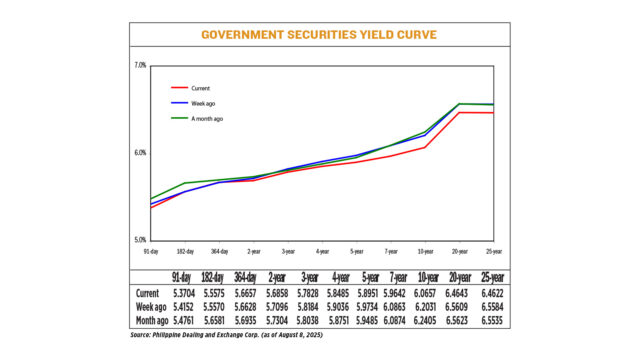
GS yields, which move opposite to prices, declined by an average of 6.24 basis points (bps) week on week at the secondary market, according to data from the PHP Bloomberg Valuation System Reference Rates as of Aug. 8 published on the Philippine Dealing System’s website.

At the short end, rates were mixed. The 91-day Treasury bills (T-bill) fell by 4.48 bps week on week to fetch 5.3704%. Meanwhile, yields on the 182- and 364-day T-bills inched up by 0.05 bp and 0.29 bp to 5.5575% and 5.6657%, respectively.

At the belly, rates of the two-, three-, four-, five- and seven-year Treasury bonds (T-bonds) declined by 2.38 bps (5.6858%), 3.56 bps (5.7828%), 5.51 bps (5.8485%), 7.83 bps (5.8951%), and 12.21 bps (5.9642%), respectively.

Rates at the long end likewise dropped across the board, with the 10-, 20-, and 25-year debt yielding 6.0657%, 6.4643%, and 6.4622%, down by 13.74 bp, 9.66 bps, and 9.62 bps week on week, respectively.

GS volume traded climbed to P90.84 billion on Friday from the P26.1 billion recorded the week prior.

“Local bonds saw a sharp rally and bull flattened [last] week, with yields gapping lower by over 20 bps as market liquidity was put into play. A bevy of bond-friendly news also added fuel to the bond rally [last] week, such as lower US rates as well as the softer-than-expected July inflation print for the Philippines at 0.9% versus 1.2% market expectations. The 10-year government bonds dipped below 6% trading as low as 5.97% for the first time since last year, while the 20-year broke the 6.5% resistance level,” Dino Angelo C. Aquino, vice-president and head of fixed income at Security Bank Corp., said in an e-mail on Friday.

“The market reacted positively to the CPI (consumer price index) surprise as it would give the Bangko Sentral ng Pilipinas (BSP) ample room to reduce policy rates this month. The gross domestic product print was slightly above expectations and market participants did not react much given that BSP Governor Eli M. Remolona, Jr. hinted at the figure a few weeks back,” Mr. Aquino said.

Philippine headline inflation eased to 0.9% in July from 1.4% in June and the 4.4% print in the same month a year ago, the government reported last week.

This was the lowest CPI in nearly six years or since the 0.6% posted in October 2019. It also marked the fifth straight month that inflation settled below the central bank’s 2-4% target range.

The July print was within the BSP’s 0.5%-1.3% forecast for the month, but below the 1.2% median estimate yielded in a BusinessWorld poll of 17 analysts.

Year to date, the CPI averaged 1.7%, slightly higher than the BSP’s 1.6% full-year forecast.

Meanwhile, Philippine GDP expanded by 5.5% in the April-to-June period, slightly faster than the 5.4% growth in the first quarter but slower than the 6.5% expansion in the second quarter last year.

This matched the 5.5% median forecast in a BusinessWorld poll of 17 economists and the lower end of the government’s 5.5%-6.5% growth target for this year.

For the first half, GDP growth averaged 5.4%, slightly below the government’s goal.

Following the release of the July inflation data, Mr. Remolona told Bloomberg on Tuesday that the latest CPI reading makes a rate cut “more likely” at the Monetary Board’s Aug. 28 meeting.

He added that this would likely be followed by another reduction in the fourth quarter.

After this month’s review, the Monetary Board’s remaining meetings for this year are scheduled for Oct. 9 and Dec. 11.

Mr. Remolona also said that the BSP has room to continue lowering benchmark borrowing costs until next year “as long as the numbers look good, inflation remains low and the economy can still afford” more easing, although he flagged lingering global uncertainties.

The Monetary Board has slashed benchmark borrowing costs by a total of 50 bps this year via two consecutive 25-bp cuts in April and June, with the policy rate now at 5.25%. This brought cumulative reductions since August 2024 to 125 bps.

Mr. Aquino added that GS market took its cue from the lower-than-expected nonfarm payroll data out of the United States, which dragged down US Treasuries.

US employment growth was weaker than expected in July while the nonfarm payrolls count for the prior two months was revised down by a massive 258,000 jobs, suggesting a sharp deterioration in labor market conditions that puts a September interest rate cut by the Federal Reserve back on the table, Reuters reported.

“US bond yields took a dive, with the US 10-year dropping 15 bps to 4.21% after the data print. Perhaps the more pressing concern was the revisions which saw a downward revision of 258,000 which roughly estimates that the US only added 30,000 plus jobs in the past three months which puts the US Federal Reserve in a bind as now it appears they are late in their easing cycle,” he said.

“Bond yields declined week on week, supported by a favorable move in US Treasuries, a well-received RTB auction, and a better-than-expected local CPI print,” a bond trader added in a Viber message.

The government raised an initial P210 billion from via its offer of five-year RTBs at the rate-setting auction held on Tuesday, with tenders reaching P354.175 billion.

The notes are priced at 6% per annum, payable quarterly.

The public offer period will run until Aug. 15, while settlement is on Aug. 20. On Friday, the government closed the bond exchange component of the RTB offering. It also began limiting the sale of new retail bonds to individual investors.

For this week, the bond trader said the market will likely focus on US data releases — particularly the July US CPI report due out on Aug. 12 (Tuesday) — amid the lack of domestic catalysts.

“For now, conditions appear supportive for a possible BSP rate cut on Aug. 28, while expectations for a US Fed rate cut in September are also gaining momentum. We expect local bond yields to drop further in anticipation of the said policy move,” the trader said.

“The market may see some consolidation at current levels as most players are now all eyes on the final amount of RTB31 that would be issued after the BTr closed the offering to institutions by Aug. 8. RTBs are still offered by the Treasury to individual investors,” Mr. Aquino said.

MPTC may further delay listing as debt, projects take priority

PHILIPPINE STAR/ MICHAEL VARCAS

METRO PACIFIC Tollways Corp. (MPTC) may further delay its plan to list on the stock exchange as the company focuses on debt reduction and completing ongoing road projects, according to its president.

“The need for an infusion of equity is still there but we have prioritized the debt servicing agreements for the maturities that are going to be expected in the next 12 months, we need to meet those requirements because this will greatly improve the prospects for the listing,” MPTC President and Chief Executive Officer Jose Ma. K. Lim told reporters last week.

In April, MPTC announced plans to go public as early as next year while concentrating on toll road expansion and debt reduction this year.

“MPTC is a promising IPO (initial public offering) candidate, but it has to rationalize its debt load to make the company more attractive to equity investors,” China Bank Capital Corp. Managing Director Juan Paolo E. Colet said in a Viber message.

MPTC is also working to complete the remaining sections of its road projects, particularly the Cavite-Laguna Expressway (Calax) and Cavitex-Calax Link Expressway Project (CCLink), before listing, Mr. Lim said.

“At the same time, we’re trying to complete the remaining sections of our roads in the south, especially Calax and CCLink, because those will greatly improve the prospects for the listing,” he added, noting that some right-of-way issues have delayed the projects’ completion.

For China Bank Capital’s Mr. Colet, an IPO deferral would give MPTC time to shed some assets to pay down debts as well as an opportunity to refinance loans as interest rates move lower due to expected policy rate cuts.

“The decision [to list] would be a function of market conditions. Selling at the highest possible price would be for the best interest of the issuer and the shareholders,” Rizal Commercial Banking Corp. Chief Economist Michael L. Ricafort said.

“It would be a function of other share sales that could compete with investible funds in the market,” Mr. Ricafort added.

MPTC has cited uncertainties surrounding its IPO due to the company’s planned merger with San Miguel Corp. (SMC).

Mr. Lim declined to comment on MPTC’s anticipated merger with SMC.

MPTC Chairman Manuel V. Pangilinan said earlier that the company deferred merger talks with San Miguel Corp. to focus on fundraising activities to reduce debt.

Metro Pacific Investments Corp. (MPIC), which owns 99.9% of MPTC, said MPTC accounted for most of its P64.99-billion short-term debt and the current portion of its long-term debt as of end-2024.

MPIC is one of three key Philippine units of Hong Kong-based First Pacific Co. Ltd., alongside Philex Mining Corp. and PLDT, Inc.

Hastings Holdings, Inc., a unit of PLDT Beneficial Trust Fund subsidiary MediaQuest Holdings, Inc., holds a majority stake in BusinessWorld through the Philippine Star Group, which it controls. — Ashley Erika O. Jose

A 240-year-old Swiss watchmaker’s race to beat Trump’s tariff deadline

DuBois et fils’ DBF008-07 watch which comes in a limited edition of 22.

LONDON/GENEVA As a US tariff deadline neared this week, Swiss watch manufacturer DuBois et fils rushed to ship five high-end watches worth thousands of dollars each to the United States. By Wednesday the firm had blocked orders on its US website. Now, Chief Executive Officer Thomas Steinemann is calculating the price hikes he’ll need to make.

The whipsaw week for the Swiss horologist, as US President Donald J. Trump slapped a surprise 39% trade tariff on imports from the European country, underscores how businesses big and small are being forced to adapt and rejig operations under pressure.

DuBois et fils, founded in 1785, accelerated shipments last Monday from its factory in Muttenz, near Basel, to get through customs before the US tariff on imports from Switzerland came into force.

The 39% rate — up from the baseline tariff rate of 10% since April — took effect at 0400 GMT on Thursday after the Swiss president came back from an emergency trip to Washington without a deal.

“For the watch industry it’s a huge disaster,” said Mr. Steinemann, who explained that he’d blocked US orders because prices would need to be recalculated to account for tariffs. The firm would not soak up the hit, he said.

“The US was a big driver in the last two years. Now this kills a lot of the business.”

His US prices were going to rise, he added. The DuBois DBF008 watch, for example, would likely go up to $14,500, from $10,800. The United States accounts for around 15% of the global sales of DuBois, which sells directly to US consumers.

The wider Swiss watch industry is feeling the pinch, planning price hikes, pausing US orders, and looking for alternative markets for its expensive, hand-made timepieces. The country is home to brands such as Rolex, Patek Philippe, LVMH-owned Tag Heuer, Swatch-owned Omega and IWC Schaffhausen, owned by Richemont.

The US accounted for 17% of Switzerland’s total 26 billion Swiss francs ($32 billion) of watch exports last year, according to the Federation of the Swiss Watch Industry. Exports to the US surged in April as watchmakers frontloaded shipments ahead of a first tariff deadline.

‘LOSS FOR THE UNITED STATES’
Combined with a weaker dollar against the Swiss franc, the tariff hike will make Swiss watches some 65% more expensive on average for US consumers, estimated Amarildo Pilo, owner of Pilo & Co watchmakers.

He said that many brands had already shipped some product to the US in advance, but warned this was not a long-term solution. The United States had been a market that everyone was focusing on recently and wanted to develop, he added.

“My personal opinion is that what’s going to happen is that Americans will no longer buy watches in the United States,” said Mr. Pilo, who is also founder of the Swiss Independent Watchmakers Pavilion, which represents 28 independent brands.

“But those who want them and who like watches will buy them elsewhere. So honestly, it’s a loss for the United States.”

The tariff hit is a wider broadside against Switzerland, even if talks are continuing with the hope of eventually striking a deal. Mr. Trump argues that tariffs are needed to undo trade distortions and bring manufacturing back to the United States.

“The impact could be very strong on the Swiss economy,” said John Plassard, partner and head of investment strategy at Cite Gestion Private Bank. Analysts estimate the tariffs could knock between 0.3% to 0.6% off Swiss gross domestic product growth over the next year.

“It will cut the potential growth in half, I would say. So the indirect impact could be more unemployment in the Swiss economy,” said Mr. Plassard.

‘GAME OVER NUMBER’
In Sacha Davidoff’s vintage watch boutique in Geneva, there was a sense of shock. Many in the country had expected a deal similar to or better than the 15% that will be levied on most imports from the European Union. Switzerland is outside the bloc.

“Right now we’re living the nightmare that we had hoped wouldn’t come to be. You kind of like wake up in the morning and you’re like, ‘no, that wasn’t real,’” Mr. Davidoff told Reuters, saying that 39% was a hammer blow for exports.

“(It) is kind of a ‘game over’ number for us. It basically cuts the US market as a possibility for export of vintage watches entirely.”

He hoped, however, that the situation would be resolved eventually.

“I think that this is just going to be a difficult period where we’re basically going to have to put the American market kind of on pause and focus on domestic sales,” he said. — Reuters

ADVERTISEMENT
ADVERTISEMENT