Home Blog Page 1158

A show of gratitude on a brand-new stage

“SERAPHIC FIRE” from ARDP’s Pasasalamat. — KURT COPON/ARDP

By Brontë H. Lacsamana, Reporter

Ballet Review
Pasasalamat
By Alice Reyes Dance Philippines

WITH a National Artist for Dance at its helm, Alice Reyes Dance Philippines (ARDP) mounted its latest performance to boast of a repertoire that is both expansive and varied, showcasing twists, turns, and utter mastery of the art.

The program on Aug. 1 was billed as Pasasalamat, indicating it was a show of thanksgiving. But the four choreographers involved presented works that prove something beyond that — a vow to continue offering more and more each time, be it new or classic.

The performance consisted of Erl Sorilla’s entertaining “Mga Kuwento ni Juan Tamad,” Augustus “Bam” Damian III’s electrifying update on “C’est La Cie,” Monica Gana’s romantic piece “Para Kay Gabriela,” and Norman Walker’s anguished “Songs of a Wayfarer” and the world premiere of his luminous master work “Seraphic Fire.”

HUMOR AND ENERGY
Having a Philippine folk tale as the first dance in the program was a good way to get the audience going. It had some interactive elements, with Ricmar Bayoneta as Juan Tamad and Dan Dayo as his monkey sidekick Matsing going offstage and engaging the audience with their infectious humor and spirited movements. As a whole, Mr. Sorilla choreographed a lovely dance-theater piece that enriches the original narrative.

For Mr. Damian’s abstract ballet “C’est La Cie” to come after that was a shock of energy that stayed in one’s mind well after the night ended. It could even be described as the scene stealer of the evening. Propelled forward by galvanizing rhythms, the complex and physically demanding choreography utilized ARDP’s dancers with striking ease. Their bodies gave in to sharp, sometimes even jagged, tension, spiraling from one solo to another until group sequences had them moving in sweeping arcs around each other with precision.

The choreographic debut of Ms. Gana followed, her piece, “Para Kay Gabriela,” the shortest in the program — but also the sweetest. It depicts a romantic dance between revolutionary heroes Gabriela and Diego Silang, backed by tender guitar music and a soft chemistry between its dancers, Krislynne Buri and Renzen Arboleda. The folk dance elements mixed with ballet make for simple yet meaningful choreography.

Finally, Norman Walker’s two works allowed the ARDP dancers to highlight their ability to be graceful and also evoke drama. “Songs of a Wayfarer,” set to music about unrequited love by Gustav Mahler, was as fluid as it was operatic. The spacious stage allowed for the love triangle of dancers at its center — Ejay Arisola as the heartbroken lead, Erl Sorilla as the reliable groom, and Monica Gana as the lustrous bride — to play out the story with openness and classic emotion.

It was Mr. Walker’s world premiere of “Seraphic Fire” that showcased the natural ebb and flow of his meditative choreography. Truthfully, its length could be felt at parts, the energy of the choreography not sustained from one section to the next. But divided into four sections, the company’s dancers got to flex their skills in shifting atmosphere using movement, from dignified strides and contemplative sweeps to dynamic duets and, finally, the triumphant conclusion.

The night’s performance was by invitation only, but hopefully its contents will be shown in future ARDP programs, each with their own wellspring of creativity in dance worth sharing with more people.

WOBBLY START FOR MAKATI’S NEWEST THEATER
For the newly opened Proscenium Theater in Rockwell, Makati, this was the chance to show the world that it is a venue fit for the best live performances. In attendance were members of the arts community, groups of lucky students, and five National Artists: Virgilio Almario, Benedicto “Bencab” Cabrera, Ramon Santos, Ryan Cayabyab, and Alice Reyes herself.

Pasasalamat was honestly a demanding program for a theater still on its pre-opening test run, and it showed.

The ushers were not yet quick to manage crowds in the lobby or answer questions about the show. The lighting was also unreliable at parts, with spotlights too slow to follow certain characters in “Juan Tamad” and nocturnal moments in Mr. Walker’s choreography momentarily receiving bursts of bright light — but these are things that can be fixed.

The venue itself, with a capacity of 780, may be spacious and grand, but it feels almost intimate. The main downside is that the uneven stairs, are a pain to navigate in the dark due to inadequate step lighting. The main upside is that wherever you sit in the theater gives you a clear view of the stage and the performers, thanks to the raked elevation of seats.

Overall, the Proscenium Theater is a promising venue that the Filipino performing arts scene can use well moving forward — once it smoothens out all the kinks. ARDP’s Pasasalamat was proof of that.

The theater’s first commercial show will be The Bodyguard The Musical, opening on Sept. 26. Tickets, priced from P4,120 to P6,965, are now available via TicketWorld.


First Gen Q2 income rises 5.2% on lower costs

FIRSTGEN.COM.PH

LOPEZ-LED First Gen Corp. reported a 5.2% increase in its attributable net income for the second quarter to $79.21 million amid lower costs of sale of electricity and expenses.

Revenues from energy sales declined by 7.6% to $629.98 million, while the costs of sale of electricity decreased by 8.5% to $440.89 million, based on the company’s financial report released on Tuesday.

General and administrative expenses went down by 1.2% to $69.3 million.

For the six months ended June, First Gen saw its attributable net income climb by 4.8% to $161.5 million as higher contributions from some hydro assets cushioned the decline in the natural gas and geothermal platforms.

Revenues declined by 5.1% year on year to $1.21 billion, due to lower volumes of electricity sold in the natural gas platform.

The natural gas platform posted a 6.6% decline in its topline, due to lower revenues from the San Gabriel plant following the expiration of its supply contract with Manila Electric Co. in February 2024, coupled with its lower spot market sales.

This was partially offset by higher revenues from Santa Rita and San Lorenzo due to both plants’ higher fuel revenues resulting from higher liquefied natural gas prices and consumption.

The geothermal, solar, and wind (GSW) portfolio registered a decline of 6.1% to $23.6 million, weighed down by lower average selling prices.

Revenues in the hydro business increased by 69.6% to $50.1 million, as higher starting water elevation and higher irrigation diversion requirements resulted in higher electricity sold to the spot market.

The natural gas portfolio accounted for the bulk of revenues at 66%, followed by GSW at 30%, and hydropower at 4%.

“First Gen’s steady performance in the first half of 2025 was an achievement as the industry was affected by a softer increase in power demand, as well as lower electricity prices,” First Gen President and Chief Operating Officer Francis Giles B. Puno said.

“We, however, continue to see challenging market conditions with the local economy not performing as strongly as expected in 2025,” he added.

At present, First Gen has a total of 3,675 megawatts of combined capacity from its portfolio of plants running on geothermal, wind, hydropower, solar energy, and natural gas. — Sheldeen Joy Talavera

China forces Thai art show to remove, change works

Claims exhibit distorts Chinese policies on Tibet, Xinjiang, HK

BEIJING — China on Monday accused organizers of an exhibition in Thailand of distorting Chinese policies on Tibet, Xinjiang, and Hong Kong (HK) after the show’s co-curator said artworks were removed or altered at Beijing’s request.

The exhibition, which opened on July 24, “promoted the fallacies of so-called ‘Tibetan independence,’ ‘the East Turkestan Islamic Movement,’ and ‘Hong Kong independence,’” distorted China’s policies and “undermined China’s core interests and political dignity,” the foreign ministry said in its replies to Reuters questions about the show.

The Bangkok Arts and Cultural Centre, one of Thailand’s top galleries, removed or altered artworks on Hong Kong as well as the Chinese government’s treatment of ethnic minorities in Tibet and Xinjiang at the request of the Chinese embassy.

The foreign ministry neither confirmed nor denied that the Chinese embassy was behind the removal and alteration.

When Reuters visited the exhibit on Thursday last week, some works previously advertised and photographed had been removed, including a multimedia installation by a Tibetan artist, while other pieces had been altered, with the words “Hong Kong,” “Tibet,” and “Uyghur” redacted, along with the names of the artists.

Three days after the show opened on July 24, Chinese embassy staff, accompanied by Bangkok city officials, “entered the exhibition and demanded its shut down,” said the exhibit’s co-curator, Sai, a Myanmar artist who goes by one name.

In a July 30 e-mail seen by Reuters, the gallery said: “Due to pressure from the Chinese Embassy — transmitted through the Ministry of Foreign Affairs and particularly the Bangkok Metropolitan Administration, our main supporter — we have been warned that the exhibition may risk creating diplomatic tensions between Thailand and China.”

The e-mail said the gallery had “no choice but to make certain adjustments,” including obscuring the names of the Hong Kong, Tibetan and Uyghur artists.

Several days later, Sai told Reuters, the embassy demanded further removals.

China has been building its influence in Southeast Asia, where governments tread cautiously as they balance cooperation with the regional economic giant against concerns over political sovereignty.

Beijing recently sought unsuccessfully to block screenings in New Zealand of a Philippine documentary on that country’s struggles in contested parts of the South China Sea amid alleged harassment from the Chinese Coast Guard and maritime militia, local media reported. It was pulled from a film festival in the Philippines in March due to “external factors,” the filmmakers said.

The Bangkok show, Constellation of Complicity: Visualising the Global Machinery of Authoritarian Solidarity, had a theme of authoritarian governments and featured multiple works by artists in exile.

The co-curator, the gallery, and Thailand’s foreign ministry did not immediately respond to requests for comment.

The Bangkok Metropolitan Administration referred Reuters to the gallery, which did not respond to an e-mail seeking comment. A gallery representative at the exhibit said the team had agreed not to comment on the issue.

“The fact that the relevant country took timely measures precisely shows that the promotion of the fallacies of ‘Tibetan independence,’ ‘East Turkestan Islamic Movement,’ and ‘Hong Kong independence’ has no market internationally and is unpopular,” the ministry said.

China is against anyone “using the guise of cultural and artistic exchange to engage in political manipulation and interfere in China’s internal affairs,” it added.

‘AUTHORITARIAN PRESSURE’
Rights groups say China carries out a sophisticated campaign of harassment against critics overseas that has often extended into the art world, allegations Beijing has denied.

Sai, co-founder of Myanmar Peace Museum, the organization that put together the exhibition, said the removed pieces included Tibetan and Uyghur flags and postcards featuring Chinese President Xi Jinping, as well as a postcard depicting links between China and Israel.

“It is tragically ironic that an exhibition on authoritarian cooperation has been censored under authoritarian pressure,” he said. “Thailand has long been a refuge for dissidents. This is a chilling signal to all exiled artists and activists in the region.”

Sai said he was speaking from overseas, where he had fled after Thai police sought to find him. The superintendent of Pathumwan Police Station, who oversees the gallery’s Bangkok neighborhood, told Reuters he had received no reports of such an incident.

Thailand this year returned to China 40 Uyghurs, members of a mainly Muslim ethnic minority numbering about 10 million in China’s far western region of Xinjiang, in a secretive deportation. UN experts had warned they would be at risk of torture, ill-treatment and “irreparable harm.” China denies abusing Uyghurs.

The Bangkok exhibition also features works by artists in exile from Xinjiang as well as Russia, Iran, and Syria. — Reuters

RCBC eyes to grow credit card base to 1.5 million

RCBCCREDIT.COM

RIZAL Commercial Banking Corp. (RCBC) is targeting to bring its credit card base to about 1.5 million by yearend, and is counting on its latest co-branded card to help it reach this goal.

RCBC and AirAsia rewards, the loyalty and rewards program of AirAsia’s parent company Capital A, on Tuesday launched a co-branded credit card that offers travel perks. The new AirAsia Platinum Credit Card allows customers to earn AirAsia rewards points and also offers a low foreign exchange (FX) conversion fee of just 1.85% for in-store and online international purchases.

“We made it very easy for them to earn points. It’s very cheap. For as low as P22, they get one AirAsia point, and then it’s now automatically credited to their AirAsia app,” RCBC Credit Cards President and Chief Executive Officer Arniel Vincent B. Ong said during the launch event.

“This is the first RCBC credit card product where we have brought down the foreign exchange (FX) fee,” Mr. Ong added.

He said the new AirAsia Platinum Credit Card is targeted towards premium and affluent customers.

“We’re trying to get the entire RCBC credit card base to about 1.5 million total for RCBC by the end of the year, and this product will contribute to that,” Mr. Ong said.

Cardholders earn one AirAsia point for every P28 spent on domestic transactions and one point for every P22 spent overseas. Every P25 spend on AirAsia or via the AirAsia MOVE app earns two points.

New customers will also get a welcome bonus of 15,000 AirAsia points upon card activation, with additional rewards for frequent card usage.

AirAsia Platinum Credit cardholders will get automatic AirAsia Platinum membership status for the first year after the card is issued, which entitles them to benefits such as priority check-in, boarding, and Xpress baggage when flying with AirAsia.

Other perks are complimentary lounge access for principal cardholders, travel insurance coverage, and access to Visa concierge.

“This partnership not only provides our customers with a credit card, but also opens the door to a rewarding, accessible, and globally connected lifestyle,” Diyao Leong, Head of Rewards Regional Partnerships at AirAsia rewards, said.

The AirAsia Credit Card was first introduced in 2018 with a Classic variant. Following the launch of the Platinum variant, the Classic card’s benefits have been enhanced, including the introduction of a lower FX conversion fee of 2.50% and a monthly bonus of 300 AirAsia points based on the program’s mechanics.

Mr. Ong said RCBC is boosting its partnership with AirAsia as it a strong brand in terms of domestic and foreign travel, especially for those who are seeking more value.

“They’re a reliable partner and we’ve grown the base together as our partners,” he added.

RCBC’s attributable net income rose by 10.26% year on year to P2.43 billion in the first quarter.

Its shares dropped by 45 centavos or 1.74% to close at P25.35 each on Tuesday. — A.R.A. Inosante

The Philippines: A global power in seafaring

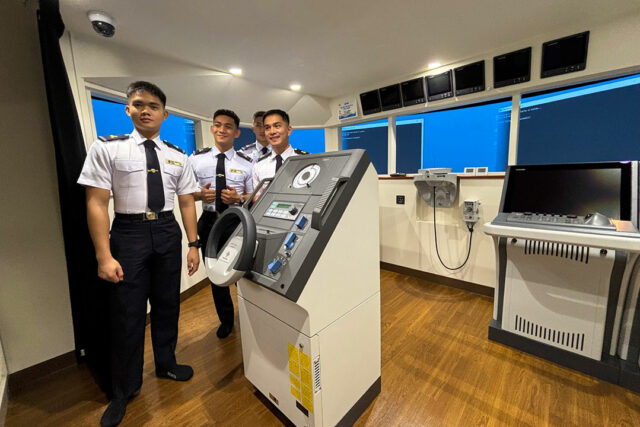
NTMA cadets participated in the Yusen Mirai Program, a short-term student exchange program in Japan organized by NYK Line last October 2024. — NYK-TDG MARITIME ACADEMYFACEBOOK PAGE

(Part 1)

At a recent graduation ceremony of the NYK-TDG Maritime Academy (NTMA), located at the Carmelray Industrial Zone in Canlubang, I felt very proud of Filipino manpower, despite recent breast-beating about the poor state of Philippine education.

NTMA is a maritime academy founded through a partnership between Nippon Yusen Kaisha (NYK) — one of the world’s largest shipping companies based in Japan which was established in 1885 — and the Transnational Diversified Group, a Filipino-owned business conglomerate established in 1976. It is a boarding “officer school” offering maritime education (e.g., BSMT, BSMarE), with guaranteed employment aboard NYK vessels after graduation.

What impressed me was to see the parents of the graduating officers. They were clearly from very low-income households coming from some remote regions of the Philippines, especially the Cordillera region or Mountain Province. Listening to some of the speeches delivered by some of the graduating officers and the very polished manner with which all the graduates conducted themselves, both during the commencement exercises and the reception that followed after, I am convinced of the great potential of our human resources, despite all the challenges that our educational system is currently facing.

As long as we continue mobilizing the resources and energy of the private sector, we can still address the limitations of our public education system and not give up on our existing labor force, no matter how poor the quality of education they might have received in our public schools. Given remedial measures by private enterprises like NTMA, the handicap suffered by products of our less-than-ideal public educational system can be overcome because of innate talent, especially of our people coming from the lower income groups. I saw that very clearly among those who graduated in that officers training program in Canlubang. The Valedictorian who spoke can hold a candle to any graduate of UP, Ateneo, or La Salle.

In fact, Filipino seafarers in general (not only officers) make up the largest percentage of maritime labor in the world today. As of recent reports, 400,000 Filipinos are deployed annually, accounting for about 25% of the world’s 1.6 million seafarers. Around 90% of world trade is carried by sea. Filipino seafarers crew tankers, bulk carriers, container ships, cruise ships, and more — ensuring supply chains operate smoothly. Filipino seafarers send home billions of dollars in remittances annually.

Filipino seafarers serve in both officer and ratings positions. A good number of them, especially in ships owned by Japanese companies, have become deck officers (navigation, safety, and cargo handling) as well as engine officers (machinery operation and maintenance). I know of graduates of NTMA who have risen to the ranks of Captain (Master) or Chief Engineer, managing entire ships and multinational crews. Given the serious depopulation and ageing problem of Japan (and some seafaring countries in Europe) more Filipinos can aspire to rise to these high positions in international shipping.

Of course, the vast majority of Filipino seafarers are in support roles like able seamen, oilers, cooks, stewards, and hospitality workers in cruise ships (e.g., musicians and other entertainers). Filipinos are in big demand in the global seafaring industry because they can be fluent in English, the global language of shipping; they are well-trained in such schools as NTMA and the Philippine Merchant Marine Academy (PMMA), and others; they are culturally adaptable and hard working, oftentimes praised for discipline, professionalism, and cheerfulness. The International Maritime Organization (IMO) and global shipping companies recognize Filipino seafarers as essential maritime workers, especially highlighted during the COVID-19 pandemic when crew changes became difficult.

Naturally, not everything is a bed or roses for Filipino seafarers. Their job security is often short-term. Long periods away from home, isolation on long trips especially in oil tankers, and stress from work can take a toll on both physical and mental health. They also face the risks of maritime incidents and piracy, depending on routes and ship types. These risks have become more pronounced in recent times because of the Russian-Ukraine War and the conflicts in the Middle East. There is also the need for constant upskilling and reskilling because of automation and digitalization.

With the help of ChatGPT, I was glad to find out that there are other top maritime academies in the Philippine like NTMA. There is the government-run PMMA, located in San Narciso, Zambales, which offers a BS in Marine Transportation and Marine Engineering. Their cadets are considered midshipmen of the Armed Forces of the Philippines. I can identify with them because during my college days at De La Salle University, our military training was with the Naval ROTC and we had to spend one whole summer on a patrol craft (from the Second World War) guarding the seas around Polillo Island and Bicol against smugglers.

Then there is the Maritime Academy of Asia and the Pacific (MAAP), a private institution founded by the Associated Marine Officers’ and Seamen’s Union of the Philippines (AMOSUP), that offers BS degrees in Marine Transportation and Marine Engineering, among other maritime related programs. It is located in Mariveles, Bataan, and has highly modern training facilities that are up to international standards. It is worth noting that Bataan will become even a more important naval, transport, and logistics hub once the bridge connecting Cavite to Bataan through Corregidor is completed. This game-changing infrastructure project received special mention from President Ferdinand Marcos, Jr. in his fourth State of the Nation Address on July 28.

Then there is the John B. Lacson Foundation Maritime University (JBLFMU) located in Iloilo City, the logistics hub of the Visayas. It offers Marine Engineering, Marine Transportation, Customs Administration, etc. Yearly, it enrolls some 11,000 students and has campuses in other cities and Visayas towns like Bacolod, Molo, and Arevalo. It is a private institution and is one of the largest maritime schools in the entire country. The City of Iloilo in the province of Panay is well known for having produced the largest number of seafarers from the Philippines. There is a long-standing tradition among Ilonggo families to produce seafarers among the males in their families.

Others are the Asian Institute of Maritime Studies in Pasay City, also private, offering BS Maritime Transportation, Maritime Engineering, and BS Naval Architecture. As regards the last-mentioned degree, it is worth noting that there have been talks recently about countries from the Scandinavian region, Japan, and South Korea on establishing ship-building facilities in the Philippines to take advantage of our still young and growing population.

There are also other private universities and technical institutes that offer courses in marine engineering and marine transport. These are the Technological Institute of the Philippines in Manila and Quezon City; the University of Cebu – Maritime Education and Training Center; DMMA College of Southern Philippines in Davao City; Northern Philippine College for Maritime, Science and Technology; and the PMI Colleges (formerly the Philippine Maritime Institute), one of the oldest maritime schools in the Philippines, that has campuses in Manila, Quezon City, and Tagbilaran City. Enrolment in these maritime academies can range from 5,000 to 11,000.

Considering the irreversible ageing of all the maritime powers of the world today, it would be wise for private for-profit schools to follow the lead of these existing maritime academies and add to their curricular offerings courses in maritime studies. I am referring to very successful for-profit private universities like the PHINMA Education schools, the National University, and the Far Eastern University, among others. We still will enjoy another 20 to 30 years during which we will have a young and growing population, despite the less than replacement birth rate of 1.9 that we have already reached.

(To be continued.)


Bernardo M. Villegas has a Ph.D. in Economics from Harvard, is professor emeritus at the University of Asia and the Pacific, and a visiting professor at the IESE Business School in Barcelona, Spain. He was a member of the 1986 Constitutional Commission.

bernardo.villegas@uap.asia

PHL brands told to counter AI-fueled misinformation

PHILIPPINE STAR/KJ ROSALES

By Beatriz Marie D. Cruz, Reporter

PHILIPPINE COMPANIES must strengthen efforts to combat online misinformation and disinformation, as the rise of artificial intelligence (AI) makes it easier to spread false narratives that could damage brand reputation, erode public trust, and hinder business growth, according to consumer intelligence firm Meltwater.

“The scale of media consumption in a country like the Philippines is much higher, so the spread of misinformation and disinformation is also at multiple levels of scale,” Ramnath Bojeesh, senior regional director for enterprise sales (SAPAC) at Meltwater, said in a virtual interview with BusinessWorld.

The rise of AI and large language models has made it easier to spread false narratives about a company, he said, noting their risks to brand reputation and public awareness.

“[If misinformation and disinformation are not addressed,] online users will naturally be split between whether the content they’re consuming is right or wrong,” Mr. Bojeesh said.

“This causes chaos, and would probably hamper the growth of a brand, a company, or the country as a whole.”

Even the country’s tycoons have been victims of AI-generated disinformation.

Earlier this year, San Miguel Corp. Chairman and Chief Executive Officer Ramon S. Ang and International Container Terminal Services, Inc. Chairman and President Enrique K. Razon, Jr. warned about fake advertisements that used their names and images to promote fraudulent investment schemes.

As a “mobile-first” nation, Filipinos spend about eight hours and 52 minutes on the internet daily, higher than the global average of six hours and 38 minutes, according to a report by Meltwater and media company We Are Social.

The country’s excessive online media consumption, along with the rise of AI, has raised concerns about how misinformation and disinformation are shaping Filipinos’ ability to distinguish facts from lies.

According to the 2025 Reuters Institute Digital News Report, 67% of Filipinos are concerned about misinformation and disinformation, well above the global average of 58%.

Older generations, typically active on social media platforms like Facebook, are mainly targeted through impersonated websites or domains, Mr. Bojeesh said.

Younger generations are also victimized by misinformation and disinformation in the form of memes or slang posts on short-form content platforms like TikTok.

Across all media platforms, bots and trolls propagate false content through clickbait posts, rage baiting, memes, and similar tactics.

To combat this, companies and public sector organizations must actively monitor online platforms used to spread false narratives about them, while verifying information circulating online about them, Mr. Bojeesh said.

Likewise, brands must ensure that the right technologies and frameworks are in place to combat the spread of false content, he added.

“To understand audience perception, brands need to be present in these [online] channels, be aware of the forms of content users are consuming, and educate them on false information about them with evidence,” he said.

Social media platforms also have the responsibility to label or take down posts that mislead the public, Mr. Bojeesh said.

“It is also in the earnest interest of brands or public sector organizations to work very closely with social media platforms and their security or compliance teams to proactively track fake campaigns being coordinated against them,” he said.

According to Mr. Bojeesh, creating a trust-based economy starts with actively dismantling misinformation and disinformation about brands online.

MREIT board approves capital stock hike to P8 billion

MEGAWORLD

MREIT, Inc., the real estate investment trust (REIT) of property developer Megaworld Corp., plans to raise its authorized capital stock to P8 billion from P5 billion to prepare for a possible asset infusion from its sponsor.

MREIT’s board approved the capital increase as well as the issuance and listing of up to 1.36 billion primary common shares in exchange for cash and/or properties, it said in a regulatory filing on Tuesday. These will be up for approval during the annual stockholders’ meeting on Sept. 29.

“Once approved, these measures are expected to pave the way for a significant infusion of prime, income-generating assets, further enhancing portfolio scale and earnings capacity,” MREIT said.

MREIT said the capital increase and share issuance will help reach its target of 1 million square meters (sq.m.) of gross leasable area (GLA) by 2027, three years ahead of schedule.

“When we envisioned MREIT, our goal was to build a REIT that would grow faster and deliver more value than the market expected. Accelerating our 1-million sq.m. GLA target to 2027 aligns with that vision, especially amid a more accommodative global rate environment,” MREIT Chairman Kevin L. Tan said.

“Soon, Megaworld will have close to 1.7 million sq.m. of office GLA and close to 700,000 sq.m. of mall GLA, giving MREIT unparalleled access to a deep pipeline of prime assets,” he added.

Megaworld also aims to grow its office GLA to 2 million sq.m. and its retail GLA to 1 million sq.m. by 2030, bringing the company’s total leasing portfolio GLA to 3 million sq.m.

“The planned infusion of additional assets, subject to stockholder approval, is expected to significantly boost MREIT’s earnings base, dividend-paying capacity, and market presence in the coming years, while cementing its position as one of the largest office REITs in the country,” MREIT said.

The moves came as MREIT reported a 25% increase in second-quarter distributable income to P932 million as revenues rose by 32% to P1.36 billion.

For the first half, MREIT said distributable income rose 26% to P1.86 billion, led by a 28% increase in revenue to P2.7 billion.

The growth was driven by contributions from six newly acquired office properties in 2024, sustained rental escalations, and resilient occupancy levels across the portfolio.

“Our portfolio’s quality, scale, and income resilience give us the confidence to accelerate our plans. We are well-positioned to capitalize on the robust demand for Grade A office spaces and further diversify into complementary asset classes,” MREIT President and Chief Executive Officer Jose Arnulfo C. Batac said.

To date, MREIT’s portfolio comprises 24 prime office properties strategically located in five Megaworld premier townships: Eastwood City, McKinley Hill, McKinley West, Iloilo Business Park, and Davao Park District.

MREIT shares rose by 0.98%, or 14 centavos, to close at P14.48 apiece on Tuesday. — Revin Mikhael D. Ochave

Digital lending boom drives growth in PHL credit data

STOCK PHOTO | Image by Katemangostar from Freepik

CREDIT INFORMATION Corp.’s (CIC) database now has 66 million borrowers and 413 million tradelines at end-July, driven by the growth in loans, especially those offered via financial technology (fintech) platforms such as buy now, pay later (BNPL) products.

This is up from the 62 million unique individuals and 298 million tradelines recorded at end-2024. Tradelines refer to accounts included in credit reports, which include credit cards and installment and non-installment loans.

“BNPL has outpaced all of the other products that we normally would gravitate towards, but now this has grown faster than the rest of them. Really, this growth has been driven mostly by our fintech partners,” CIBI Information, Inc. Chief Analytics Officer John Harley Chan said at an event on Tuesday.

State-run CIC manages the public credit registry that acts as the central repository of credit information, receiving and collating data from entities like banks, quasi-banks, investment houses, cooperatives, micro-financing organizations, credit card companies, insurance firms, and government lending institutions.

Authorized financial institutions can also access borrowers’ credit reports via accredited credit bureaus. CIBI is one of three credit bureaus accredited by the CIC.

Short-term borrowings of below P100,000 had a market share 15% in 2024, CIC data showed.

Meanwhile, loans with tenors below six months, which Mr. Chan said is where most BNPL loans fall under, had a 28% market share last year from 14% in 2021.

“These numbers underscore the reality that the cost-consumer behavior has really shifted towards high-frequency small ticket loans,” he said.

CIC data also showed that personal loan and BNPL bookings rose by 16% year on year to P853 billion in 2024. Mortgage bookings and auto loan bookings also went up by 2.3% and 10% to P183 billion and P247 billion, respectively.

Meanwhile, new credit card bookings declined by 6.6% to P519 billion last year.

However, CIBI noted high delinquency rates among online lending platforms, which provide quick cash releases via cash loans.

“Effectively, our fintech partners have digitized what we used to fondly call as 5-6. So of course, I know that for our banking partners, this particular segment has always been viewed as high risk. To some, they would completely avoid it. To others, they would test it from time to time. And we’re not ignoring that reality,” Mr. Chan said.

“The delinquency rates that we see in this segment are really high. It’s double-digit across the board.”

CIC data showed that the delinquency rate of borrowers who’ve never availed of these cash loan products in the last 12 months is at 12%.

However, this would double to at least 30% once they avail of cash loans.

Delinquency rates also increase depending on the size and term of the loans taken out, CIBI said. — AMCS

US as a steadfast ally among a growing list of friends

PRESIDENTIAL COMMUNICATIONS OFFICE

“Multilateral” is a good word to describe the Philippines’ foreign relations policy. It reflects our country’s consistent efforts to build partnerships and alliances with numerous countries who share our values and our commitment to international law. It is embodied in the pronouncement of President Ferdinand Marcos, Jr. that we are “a friend to all and an enemy to none.”

Our dealings with the outside world are determined solely by our national interest and by the increasingly crucial role we play in maintaining peace in the Indo-Pacific region and in the world.

President Marcos Jr. recently concluded a trip to India this month, during which he secured new defense agreements, expanded coast guard cooperation, and expressed interest in acquiring additional missile systems. In April this year, we signed a Visiting Forces Agreements with New Zealand, and there are now ongoing negotiations with France and Canada to establish similar defense arrangements.

Last month, the President went to the United States and met with top officials led by US President Donald Trump. The meetings that transpired during that trip are a validation of the continuing strong alliance between the two countries.

The Philippines and the US have maintained a security alliance since the 1951 Mutual Defense Treaty, further reaffirmed and guided by the 2023 Bilateral Defense Guidelines that highlights their long-standing commitment to regional security. In recent years, the relationship has been reinvigorated due to the increasing threats posed by China, particularly its disregard for international law and its coercive actions against the Philippines.

A significant aspect of this cooperation involves US military equipment and financing aimed at bolstering the Philippines’ defense capabilities. As part of the fiscal year 2024 Indo-Pacific Security Supplemental Appropriations Act, the US supplied the Philippines with $500 million in Foreign Military Financing.

The US is encouraged to explore flexible financing options for the sale of F-16 fighter jets to the Philippines, potentially integrating these into a military aid deal, and to establish rotational basing of US Air Force F-16 squadrons in the Philippines for joint training.

Joint military exercises and strategic deployments form another critical component of the alliance. Cooperation currently includes purchases of military equipment from the US, joint naval and amphibious exercises, and the deployment of US Army intermediate-range missile forces.

The Enhanced Defense Cooperation Agreement (EDCA), which grants the US military access to 10 Philippine military bases to build and operate facilities and rotate troops, is foundational to these efforts. The effectiveness and interoperability of forces at these sites were notably tested during the 2024 Balikatan exercise, where US and Philippine militaries deployed troops from these bases.

And then, American forces operating in the Philippines are increasing rotational capabilities of integrated air and missile defense systems, including Terminal High-Altitude Area Defense (THAAD) systems and Short-Range Air Defenses (SHORAD).

Beyond military support for the defense sector, PHL-US cooperation extends to strategic alignment and infrastructure development. The US aims to work with the Philippines to build infrastructure at bases that host US rotational forces and maintain the deployment of key assets to the Philippines.

Such investment in Philippine infrastructure is expected to have positive economic effects, stimulating growth and job creation. It is also seen to improve the US military’s ability to deliver humanitarian aid during natural disasters.

In light of these developments, the Stratbase Institute, in partnership with The Heritage Foundation, hosted a roundtable event yesterday, Aug. 12, entitled “Prospects for the Philippines-United States Alliance in a Complex Geopolitical Landscape.” Two of the foundation’s senior experts — Wilson Beaver, Senior Policy Advisor for Defense Budgeting and NATO Policy, and Robert Peters, Senior Research Fellow for Strategic Deterrence — discussed their latest research, “Strengthening the US-Philippines Alliance.”

The paper falls under the Foundation’s Project 2025, a comprehensive policy agenda outlining strategic priorities for US governance, defense posture, and national security readiness.

Mssrs. Beaver and Peters’ paper underscored that the Philippines is a US ally that occupies a position of strategic importance in the Western Pacific, both for the United States and its neighbors. The initial steps that the Philippines is taking to defend itself from Chinese aggression will be the same capabilities that would deter broader regional action from China. Thus, the US commits to working with the Philippines to ensure that the latter can be an important and valuable member of a coalition of like-minded states that oppose China’s hegemonic ambitions.

Government officials and members of the security sector and of the academe were present during the forum to exchange ideas about the developments in and pathways for an enhanced Philippines-US cooperation amid these challenging times.

A recent Pulse Asia survey commissioned by the Stratbase Institute shows that 73% of Filipinos view the US as the top country the Philippines should partner with in asserting its rights in the West Philippine Sea. Indeed, as both nations invest in each other, their partnership grows stronger, more agile, and more meaningful. Together, the Philippines and the US are laying the foundations for lasting peace.

We hope to replicate this kind of steadfast friendship with many other countries that share our values and our regard for the rule of law. Amid these perilous times, such friendships are a gem — and an indispensable way to achieve an open, more secure Indo-Pacific region.


Victor Andres “Dindo” C. Manhit is the president of the Stratbase ADR Institute.

Portrait of an accidental art collector

A room of their own. — HOWARD CHUA-EOAN/BLOOMBERG

By Howard Chua-Eoan

I ONCE ENTERED the Manhattan apartment of a cantankerous, retired investment banker and almost walked into his Willem de Kooning. That would have been extremely unfortunate. I don’t know what he paid for that human-height painting, but one piece by the Dutch-American artist (who died in 1997) was purchased for a reported $300 million* in 2015, a couple of years after my near run-in. The ex-financier showcased his lavish art collection — including, if memory serves, another De Kooning — in a sprawling apartment, which was oddly dim because of sallow lighting. All that hoard did not glitter.

I don’t aspire to the life of an art collector — and certainly not one dealing with altitudinous sums of money. I like art, but I’m just a dabbler popping in and out of museums and galleries to admire and attempt to keep current. I wish I could be artsy for art’s sake, but the whirl — and lingo — can be bewildering. I’ve only just become aware that a huge and expensive mania for a generation of younger artists has come and gone. That speculative period is now called “zombie formalism” because the paintings evoked the style of deceased modern masters without incremental inspiration. I’m fascinated but afraid to bring up the zombie apocalypse. It’s so last decade.

Recently, there’s been a patter on the sidelines of my news feed about galleries closing. Being the uncle of a couple of art school grads, I figured that isn’t a good thing. How would they get their works into the world if the gallery system collapsed? Who’d introduce them to appreciative buyers and help them navigate the treacherous business? How would the world know they’d “arrived” if there weren’t prestigious showrooms to bestow that glory?

Still, it didn’t strike me as particularly surprising that the industry was in a bad way. The market has crashed a number of times this century; most recently, after the financial meltdown and during the pandemic. According to the latest Art Basel & UBS Art Market Report, sales plummeted by 12% last year to $57.5 billion. The high end — involving objects at seven figures and up — was particularly badly hit. Are discounted De Koonings now a thing?

All that said, I’ve wandered back into the art world. In my perpetual pursuit of good food, I was at René Redzepi’s Noma in Copenhagen in May and I was captivated by the lively paintings at the restaurant entrance. The same style was echoed in ceramic pieces within. As it turned out, I’d met the artist, Jenny Sharaf, at the wedding of mutual friends in Mexico City, but I’d never seen her work before. Sharaf was born in Los Angeles and lives in San Francisco, but — like me — she loves the Danish capital and was there for an extended stint, long enough to paint several panels. I loved them for the color and energy and how kaleidoscopic they could be — the image shifting with the angle at which you approached it. And, better yet, I could afford them.

However, more numbers were involved and they threw me. Calculating the costs of shipping the one I liked most to London plus insurance and the confusion over post-Brexit tariffs put me off sealing the deal. With US tariffs (and potential counter-tariffs) in the air, I didn’t want to consider the alternative: sending any of her paintings over from America. It’s a problem for the arts and antiques establishment as well: The arithmetic is antithetical to sales strategies and bottom lines. Who knows what those big beautiful duties might do?

As the UBS report notes: “Economic nationalism chips away at the foundations of economic growth. Tariffs worsen inflation and can threaten job security. Restrictions on capital flows can limit investment and may hit higher-income groups, which are more global in their behavior, disproportionately.”

So I suggested to the artist, if you get a chance to come to London, why don’t you create a painting for me using my apartment as a studio? In late July she did just that. It dovetailed, she said, with the way she was approaching her career, dealing directly with customers. “Artists shouldn’t hold back from forming relationships with collaborators and collectors.” She has several patrons, but she’d never painted for them in their own homes before.

For me, the process has been exhilarating. We discussed the artists influencing her direction on the project. As a hopeless dilettante, I appreciate being able to point to my art and name-drop Cy Twombly, Joan Mitchell, Lee Ufan, Hans Hoffman, Philip Guston, Ad Reinhardt, and Gunter Forg. After helping shop for supplies, I set her up in my flat so she could create directly in the space where the art would reside. We figured out which wall in my apartment would potentially be the best for display. As she progressed, she gauged my reaction to what was on the canvas. “I like the drippy bits,” I said. And, lo, more drippy bits appeared.

I won’t quite say I was Pope Julius and Sharaf was Michelangelo — she didn’t paint my ceiling — but I love what she produced after three sessions. In fact, I now have two Sharafs because her inspiration overflowed into a smaller piece.

My London flat now has metaphysical super-dimensions — intimations of Denmark and California with a resident-patron’s smiling presence in the beautiful blobs of paint. It’s art for my sake. And it’s fun. As the UBS report says: “The trend in consumer spending has recently skewed away from goods toward having fun.” Maybe fun is just what an art world in the doldrums needs.

And if you visit, you don’t have to worry about barging into them. They’re safely away from the front door.

*De Kooning originally sold the painting for $4,000 in 1955. It may sound like a steal but, after 70 years of inflation, that’s more than $47,000 today. — Bloomberg Opinion

Asialink, Kredit Hero team up to boost MSME financing

PHILIPPINE INFORMATION AGENCY

ASIALINK FINANCE Corp. has partnered with artificial intelligence (AI) lending marketplace Kredit Hero to increase access to financing for micro, small, and medium enterprises (MSMEs), particularly those in areas outside urban centers.

“This partnership is a pivotal step in our digital transformation journey because we believe MSMEs deserve the same seamless and efficient experience as large-scale borrowers,” Asialink President and Chief Executive Officer (CEO) Samuel Z. Cariño said in a statement on Monday.

“With Kredit Hero’s AI platform, we can break down long-standing barriers in the lending process, making financing faster, smarter, and more accessible,” he added.

Under the partnership, Asialink will gain access to Kredit Hero’s pre-screened loan applicants on the platform.

“A dedicated dashboard enables the company to efficiently manage and prioritize leads based on borrower profiles and financial needs,” the company said.

Meanwhile, Kredit Hero users will be able to explore and apply for Asialink’s loan products.

“Kredit Hero is built to remove friction in the lending process. By using AI to match quality leads with lenders like Asialink Finance Corp., we’re making it easier for SMEs with hard assets to get the financing they need, quickly and at scale,” Kredit Hero Founder and CEO Scott Moore said.

The partnership is part of Asialink’s push to expand its reach to underserved sectors through diversified product offerings.

In April, the company also partnered with Cebu-based digital vehicle marketplace AutoHousePH to boost access to auto financing.

Mr. Cariño previously said Asialink aims to disburse P24 billion in loans this year, while net income is projected to reach P2 billion from P1.1 billion in 2024.

Asialink hopes to conduct an initial public offering by 2028.

The company secured a P4-billion strategic investment from Malaysian equity firm Creador in February last year. — Aaron Michael C. Sy

Century Pacific expands plant-based portfolio with Loma Linda deal

CENTURYPACIFIC.COM.PH

CENTURY PACIFIC Food, Inc. (CNPF), a Filipino food and beverage company, said its US subsidiary Century Pacific North America, Inc. (CPNA), a plant-based food producer, has expanded its portfolio by acquiring the Loma Linda brand and related assets from Atlantic Natural Foods, Inc., a health food manufacturer, for under $10 million.

The acquisition covers other brands such as Tuno, neat, and Kaffree Roma, as well as formulations, select manufacturing assets, licenses, and remaining inventory, CNPF said in a regulatory filing on Tuesday.

CNPF Chief Operating Officer Gregory Francis H. Banzon said the transaction, valued at less than $10 million, is expected to be immediately accretive to the business.

“This is a strategic and synergistic move for CPNA. We are bringing together a trusted heritage brand and a disruptor brand under one roof — leveraging decades of consumer trust with bold innovation. This allows us to serve both loyal customers and new generations seeking accessible, nutritious, and sustainable food choices,” Mr. Banzon said.

Loma Linda is a 135-year-old brand that has catered to the dietary requirements of health-conscious consumers, especially among the Seventh-day Adventist community. It has product creations dating back 1890 by John Harvey Kellogg, from the family behind today’s Kellogg Co.

After ANF acquired Loma Linda in 2016, the brand emerged as a major name in health foods, offering products such as BIG FRANKS vegan hotdogs, SKALLOPS — the first plant-based seafood alternative — and TUNO, its flagship plant-based tuna, which are now available throughout North America and in more than 30 countries globally.

CNPF said that CNPA’s research and development capabilities and manufacturing attracted ANF as a supply partner, which eventually led to the acquisition.

“The acquisition reflects CPNA’s measured and profitable growth strategy: tapping into established markets while accelerating momentum for plant-based food adoption across diverse geographies. Ultimately, it reinforces the group’s broader mission of building a healthier, more sustainable portfolio that provides affordable nutrition to the consumers we serve,” Mr. Banzon said.

CPNA is known for plant-based products under the unMeat brand, which is available across major US retailers and over 13,000 stores globally.

CNPF shares dropped by 1.13% or 40 centavos to P35 apiece on Tuesday. — Revin Mikhael D. Ochave

ADVERTISEMENT
ADVERTISEMENT