Home Blog Page 1153

China accuses Philippines of ‘playing with fire’ on Taiwan

BW FILE PHOTO

BEIJING – China accused the Philippines on Friday of “playing with fire” after President Ferdinand Marcos Jr said the Southeast Asian nation would be drawn into any conflict between China and the United States over Taiwan.

It was responding to remarks by Marcos during a state visit to India that the Philippines’ closeness to Taiwan and the large Filipino community there would make involvement necessary in such a conflict.

“‘Geographical proximity’ and ‘large overseas populations’ are not excuses for a country to interfere in the internal affairs of others,” China’s foreign ministry said in a statement.

“We urge the Philippines to earnestly adhere to the one-China principle … and refrain from playing with fire on issues concerning China’s core interests.”

Mr. Marcos’ remarks came amid heightened tension between Beijing and Manila over territorial disputes in the busy waterway of the South China Sea.

Both countries have traded accusations of aggressive maneuvers and sovereignty violations there, prompting the United States to reaffirm its commitment to defend the Philippines.

Beijing views democratically-governed Taiwan as its territory, a claim Taipei rejects.

The Philippine embassy in Beijing did not immediately respond to a request for comment.

On Wednesday, Mr. Marcos told Indian media outlet Firstpost, “If there is an all-out war, then we will be drawn into it.”

He added, “There are many, many Filipino nationals in Taiwan and that would be immediately a humanitarian problem.

“We will have to go in there, find a way to go in there, and find a way to bring our people home.”

China said such arguments “not only violate international law and the ASEAN charter, but also undermine regional peace and stability and the fundamental interests of (the Philippines’) own people.” — Reuters

SNAP wins NordCham Community Impact Award for empowering its host communities

L-R: Centre Medicale Internationale President Gary de Ocampo, SNAP President and CEO Joseph Yu, SNAP Corporate Social Responsibility and Sustainability Sr. Manager Enrico Laluan, SNAP Head of Sales and Marketing Shan Benjamin Buyco, and Nordic Chamber of Commerce (NordCham) Executive Director Axel Fries during the 2025 NordCham Business Awards held on Aug. 6 at the BDO Tower in Makati

Renewable energy solutions provider SN Aboitiz Power Group (SNAP) won the Community Impact Award at the 2025 Nordic Chamber of Commerce (NordCham) Business Awards, held on Aug. 6 at the BDO Tower Valero in Makati.

The award is one of the categories of the annual 2025 NordCham Awards. It recognizes organizations that contribute to inclusive development through social impact, community engagement, social innovation, and the integration of sustainability into its core operations. SNAP stood out among this year’s nominees in the category for its dedication to volunteerism, sustainable development, and uplifting its host communities.

SNAP believes that business success is deeply intertwined with the well-being of the communities we serve,” said Joseph Yu, SNAP President and Chief Executive Officer. “Throughout our 18 years of operations, our focus on community development has defined the way we do business. Tonight’s award affirms the impact of the time, effort, and investment we have dedicated to building value with our host communities. We are deeply grateful to everyone who has been part of this mission.”

For nearly two decades, SNAP has been a trusted partner of local government units, host communities, and Indigenous Cultural Communities/Indigenous Peoples. Guided by the principles of transparency, collaboration, and shared growth, the company has built strong relationships with stakeholders across its areas of operation in the provinces of Benguet, Ifugao, Isabela, and Nueva Vizcaya.

Through its business units, SNAP-Benguet and SNAP-Magat, the company has financed 1,196 host community-driven projects under the company’s Community Investment and Development Program (CIDP). As of 2024, SNAP has voluntarily invested over P590.4 million through CIDP, supporting initiatives that drive community development across key areas such as health, education, livelihood, infrastructure, governance, environment, and support for Indigenous Peoples.

SNAP’s win this year not only celebrates its impact but also reinforces its mission of energizing a more sustainable future. The company was previously recognized at the NordCham Awards, earning runner-up honors for both CSR Business Partner of the Year and Sustainability Business Partner of the Year in 2023, and was also a finalist for Sustainability Business Partner of the Year in 2022.

The NordCham Sustainability Awards are part of the annual Nordic Business Awards organized by the Nordic Chamber of Commerce, which honor companies in the Philippines and across Southeast Asia for excellence in sustainability, corporate responsibility, and ethical business practices.


Spotlight is BusinessWorld’s sponsored section that allows advertisers to amplify their brand and connect with BusinessWorld’s audience by publishing their stories on the BusinessWorld Web site. For more information, send an email to online@bworldonline.com.

Join us on Viber at https://bit.ly/3hv6bLA to get more updates and subscribe to BusinessWorld’s titles and get exclusive content through www.bworld-x.com.

Trump’s higher tariffs hit major US trading partners, sparking defiance and concern

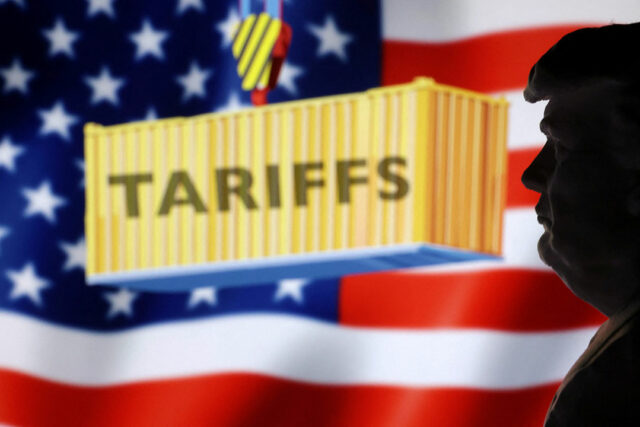
US President Donald J. Trump announced he will impose a 10% baseline tariff on all imports to the United States. — REUTERS

US President Donald Trump’s higher tariffs on imports from dozens of countries kicked in on Thursday, raising the average US import duty to its highest in a century and leaving major trade partners such as Switzerland, Brazil and India hurriedly searching for a better deal.

The US Customs and BorUSder Protection agency began collecting the higher tariffs of 10% to 50% at 12:01 a.m. EDT (0401 GMT) after weeks of suspense over Trump’s final tariff rates and frantic negotiations with countries seeking to lower them.

The leaders of Brazil and India vowed not to be cowed by Trump’s hardline bargaining position, even while their negotiators sought a reprieve from the highest tariff levels.

The new rates will test Trump’s strategy for shrinking US trade deficits without causing massive disruptions to global supply chains or provoking higher inflation and stiff retaliation from trading partners.

‘BILLIONS’ IN TARIFF REVENUE
After unveiling his “Liberation Day” tariffs in April, Trump has frequently modified his plans, slapping much higher rates on imports from some countries, including 50% for goods from Brazil, 39% from Switzerland, 35% from Canada and 25% from India. He announced on Wednesday a further 25% tariff on Indian goods, to be implemented in 21 days over India’s purchases of Russian oil, on top of the 25% already imposed.

“BILLIONS OF DOLLARS, LARGELY FROM COUNTRIES THAT HAVE TAKEN ADVANTAGE OF THE UNITED STATES FOR MANY YEARS, LAUGHING ALL THE WAY, WILL START FLOWING INTO THE USA,” Trump said on Truth Social just ahead of the tariff deadline.

Tariffs are ultimately paid by companies importing the goods, and passed on in full or in part to consumers of end products.

Trump’s top trade negotiator, Jamieson Greer, said the US was working to reverse decades of policies that had weakened US manufacturing capacity and workforce, and that many other countries shared concerns about macroeconomic imbalances.

“The rules of international trade cannot be a suicide pact,” he wrote in a column published by the New York Times.

“By imposing tariffs to rebalance the trade deficit and negotiating significant reforms that form the basis of a new international system, the United States has shown bold leadership,” Greer said.

Eight major trading partners accounting for about 40% of US trade flows have reached framework deals for trade and investment concessions to Trump, including the European Union, Japan and South Korea, reducing their base tariff rates to 15%.

Britain won a 10% rate, while Vietnam, Indonesia, Pakistan and the Philippines secured rate reductions to 19% or 20%.

“There’ll be some supply chain rearrangement. There’ll be a new equilibrium. Prices here will go up, but it’ll take a while for that to show up in a major way,” said William Reinsch, a senior fellow and trade expert at the Center for Strategic and International Studies in Washington.

Countries with punishingly high duties, such as India and Canada, “will continue to scramble around trying to fix this,” he added.

Switzerland’s President Karin Keller-Sutter said on Thursday that talks with the US would continue after she returned home empty-handed from an 11th-hour trip to Washington aimed at averting the crippling US import tariff on Swiss goods.

A last-minute attempt by South Africa to improve its offer in exchange for a lower tariff rate also failed. The two countries’ trade negotiating teams would have more talks, South African President Cyril Ramaphosa’s office said.

Vietnam said on Thursday it would continue talks with the US as it seeks to lower tariffs further still, after negotiating a reduction to 20% from the 46% duty Trump slapped on imports from the Southeast Asian country in April.

Meanwhile, Brazil’s President Luiz Inacio Lula da Silva told Reuters on Wednesday he would not humiliate himself by seeking a phone call with Trump even as he said his government would continue cabinet-level talks to lower a 50% tariff rate.

Indian Prime Minister Narendra Modi was similarly defiant, saying he would not compromise the interests of the country’s farmers. The pressure has also strengthened India’s commitment to a “strategic partnership” with Russia, with Russian President Vladimir Putin set to visit by the end of the year.

Some countries were also rallying together to confront Trump, with Brazil’s Lula saying he would call the leaders of India and China to discuss a joint BRICS response to tariffs. Trump has repeatedly railed against BRICS members and recently threatened to subject their imports to an additional 10% tariff.

India said on Wednesday that Modi would visit China for the first time in seven years.

REVENUES, PRICE HIKES
US import taxes are one part of a multilayered tariff strategy that includes national security-based sectoral tariffs on semiconductors, pharmaceuticals, autos, steel, aluminum, copper, lumber and other goods. Trump said on Wednesday the microchip duties could reach 100%.

China is on a separate tariff track and will face a potential tariff increase on August 12 unless Trump approves an extension of a prior truce. He has said he may impose additional tariffs over China’s purchases of Russian oil as he seeks to pressure Moscow into ending its war in Ukraine.

Trump has touted a vast increase in federal revenues from his import tax collections, with US Commerce Secretary Howard Lutnick saying on Fox Business Network on Thursday that he expected revenue from tariffs to reach $50 billion a month, with more increases expected from separate duties on semiconductors and pharmaceuticals that should be announced soon.

The increase in duties will drive average US tariff rates to around 20%, the highest in a century and up from 2.5% when Trump took office in January, the Atlantic Council estimates.

Commerce Department data released last week included more evidence that tariffs were driving up US prices, including for recreational goods and motor vehicles, while costs are mounting for companies, including bellwethers Caterpillar, Marriott, Molson Coors and Yum Brands.

Toyota on Thursday said it expected a hit of nearly $10 billion from tariffs on cars imported into the US as it cut its full-year profit forecast by 16%.

But other Japanese companies such as Sony and Honda said they now expected a smaller impact on profits after Japan agreed a bilateral deal with Washington to lower tariffs. — Reuters

PHL economy expands 5.5% in Q2

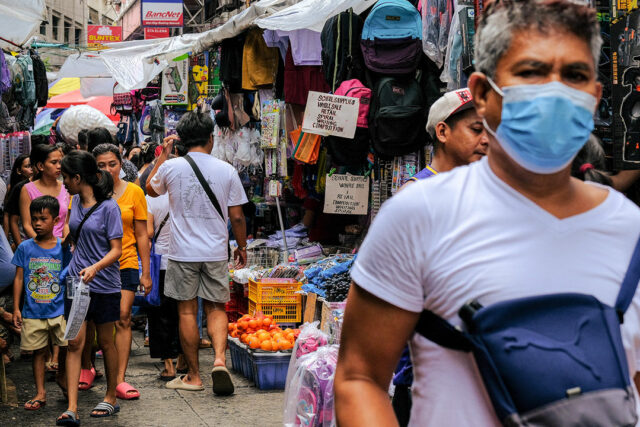
Shoppers are seen buying school supplies in Divisoria, Manila. — PHILIPPINE STAR/RYAN BALDEMOR

By Aubrey Rose A. Inosante, Reporter

THE PHILIPPINE ECONOMY expanded at a slightly faster pace in the second quarter, driven by strong agriculture production and an uptick in consumption, the statistics agency said on Thursday.

Preliminary data released by the Philippine Statistics Authority (PSA) showed Philippine gross domestic product (GDP) grew by an annual 5.5% in the April-to-June period, up from the 5.4% in the first quarter.

It also matched the 5.5% median forecast in a BusinessWorld poll, and the lower end of the government’s 5.5% to 6.5% growth target this year.

Philippines’ Quarterly Gross Domestic Product PerformanceHowever, this was slower than the 6.5% growth in the second quarter of 2024.

On a seasonally adjusted quarter-on-quarter basis, the country’s GDP expanded by 1.5%, improving from 1.3% a year ago.

“The Philippine economy continues to show resilience and stability, even as global challenges persist and fuel uncertainty across many fronts,” Department of Economy, Planning, and Development (DEPDev) Secretary Arsenio M. Balisacan said at a briefing on Thursday.

“With this performance, we maintain our place among the fastest-growing economies in emerging Asia,” he said, adding the Philippines was only behind Vietnam (8%) and ahead of China (5.2%) and Indonesia (5.1%).

While the Philippines may fall behind India’s projected 6.5% growth, Mr. Balisacan said it is still likely to outpace Malaysia’s projected 4.3% GDP growth and Thailand’s 2.4%.

For the first half, GDP growth averaged 5.4%, slower than the 6.2% a year ago.

Mr. Balisacan said GDP must grow by 5.6% for the rest of the year to achieve the low end of the full-year target.

“I think we can do better in the second half. (I am) confident that inflation has gone down substantially and the past reduction in the policy rates is now beginning to be felt,” he said.

Inflation slowed to a near six-year low in July at 0.9% as utilities and food costs continued to ease. For the first seven months of the year, inflation averaged 1.7%, a tad higher than the central bank’s 1.6% forecast for 2025.

The Bangko Sentral ng Pilipinas (BSP) has lowered benchmark interest rates by a cumulative 125 basis points since it started its easing cycle in August last year.

To reach the upper end of the target, the DEPDev chief said the economy must grow by 7.5% in the July-to-December period.

“Of course, 7.5% is high, but it’s not impossible. I think that if we see continuing improvement in the confidence of our consumers and our domestic investors, (we can see) higher growth in consumption and investment and services,” he said.

PSA data showed household final consumption, which accounts for over 70% of the economy, jumped by 5.5% in the April-to-June period. This was faster than the 4.8% in the second quarter of 2024 but slower than 5.3% in the first quarter. It was the fastest since the 8.1% growth in the first quarter of 2023.

“Our strategic, sustained, and coordinated efforts to manage inflation and safeguard purchasing power are making an impact. Notably, rice prices, a major concern for households, have been declining steadily in recent months,” Mr. Balisacan said.

The election-related ban on public works dampened government final consumption expenditure, which grew by 8.7% in the second quarter from 18.7% in the first quarter and 11.9% a year ago.

National Statistician Claire Dennis S. Mapa attributed this slowdown to public construction, which contracted by 8% in the second quarter.

The 45-day election ban on public works started on March 28 and ended with the May 12 elections.

“We expect to maintain that momentum in the spending side. The second half of the year, you should see improvements in the construction, public construction spending because it’s there where we had a bit of a slowdown, but that was expected because of the election ban,” Mr. Balisacan said.

TARIFF UNCERTAINTY
Uncertainty over the US tariffs has started to weigh on the Philippine economy, as growth in exports, industry and investment slowed in the second quarter.

Total exports growth grew by 4.4% in the April-to-June period, picking up from 3.9% a year ago but slowing from the 7.1% growth in the first quarter.

Merchandise exports also rose by 13.6% in the second quarter, driven by semiconductors, as US firms began front-loading before the higher tariffs took effect.

The US set a 19% tariff on Philippine goods, which took effect on Aug. 7.

“I expect the local economy to stabilize a bit with all this tariffs uncertainty, although they’re still there, but I think that supposedly this is the end of that series of announcements. We hope that there will be no further destabilization in the expectations about trade uncertainty,” Mr. Balisacan said.

Meanwhile, exports of services contracted by 4.2% in the second quarter, a reversal of the 6.3% growth in the previous quarter and 7.6% a year ago.

“It’s possibly following the overall state of the global economy. In recent months, we saw deceleration and uncertainty in the trade sector, including trade and services,” Mr. Balisacan said.

On the other hand, imports of goods and services slowed to 2.9% in the second quarter, slower than the 5.3% in the same period last year and 10.3% in the first quarter.

Gross capital formation, the investment component of the economy, grew by 0.6% in the second quarter, slower than the 11.5% growth a year ago and the 4.8% growth in the first quarter.

“I think we will see a rebound of investment in the second quarter. The election ban is over so we should continue and that should be a positive factor. The domestic investment climate is improving as seen in the continuing decline in interest rates,” Mr. Balisacan said.

AGRICULTURE
On the supply side, agriculture output grew by 7% in the second quarter, the fastest in nearly 14 years or since 8.3% recorded in the second quarter of 2011.

Mr. Balisacan attributed the strong rebound in farm output to palay and corn, which grew by 14.2% and 29.8% respectively.

The services sector, which made the biggest contribution among major industries, expanded by 6.92% in the second quarter, faster than 6.87% a year ago.

The industry sector grew by 2.1% in the second quarter, slowing from 7.9% a year ago and 4.6% in the first quarter.

“Industry growth slowed to 2.1%, affected by declines in output for coke and refined petroleum products (-12.2%), chemical products (-6.6%), and computer and electronics (-2.5%),” Mr. Balisacan said.

Food manufacturing grew by 9.3%, slightly below the 10.8% in the previous quarter.

The PSA said among the main contributors to the second-quarter growth were wholesale and retail trade, repair of motor vehicles and motorcycles (5.8%), compulsory social security (12.8%) and financial and insurance activities (5.6%).

Gross national income posted an annual 8.2% growth in the second quarter, slightly lower than the 8.1% expansion a year ago.

Net primary income went up by 38.8% in the second quarter, higher than the 25.8% in the same period in 2024.

GROWTH OUTLOOK
Capital Economics Senior Asia Economist Gareth Leather said in a commentary that they expect “steady” growth for the rest of the year as domestic consumption will be supported by easing inflation and lower interest rates. They see Philippine GDP growth averaging 5.5% for the full year, meeting the low end of the government’s goal.

However, the “fragile” external environment poses risks to the outlook, Mr. Leather said.

“Trump tariffs and weaker global demand mean export growth is likely to slow further over the coming months.”

ANZ Research added that external headwinds would also affect private investment.

“Private investment remains constrained by low productivity growth and slowing global growth… Given the subdued outlook for external demand, private investment is unlikely to rebound in the near-term. However, the strong rise in capital goods imports in June indicates an increase in government capital expenditure, which can help partly offset the weakness in private gross fixed capital formation,” it said in a report.

While inflation has eased, private consumption will continue to be weighed down by low wages, ANZ Research added. “Overall, we forecast growth to ease to 5.1% in 2025.”

“We believe private investment spending will be more subdued, as businesses turn more cautious owing to surging global trade policy uncertainty and an increasingly challenging operating environment. In the same vein, we expect goods export growth to slow due to the impact of US tariffs, but acknowledge rising downside risks particularly from sectoral tariffs on semiconductors in the coming quarters,” Nomura Global Markets Research said in a separate note.

It expects the economy to grow by 5.3% for the full year. “Our forecast pencils in GDP growth slowing to 5.2% year on year in the second half from 5.4% in the first half, even as we expect a rebound in public investment spending.”

Jonathan L. Ravelas, senior adviser at Reyes Tacandong & Co., said that global trade uncertainty and supply chain risks are a “red flag” for long-term growth.

“We’re on track, but not cruising,” Mr. Ravelas said. “Stakeholders should double down on consumer confidence, unlock private investments, and leverage [the agriculture sector’s] momentum.”

“The second half is crucial — it’s time to push, not pause.”

Wealth of top 50 tycoons in Philippines reaches $86B

THE PHILIPPINES’ 50 richest tycoons increased their combined wealth by 6% to over $86 billion (around P4.92 trillion) this year, with nearly half of those on the list now wealthier than a year ago, according to Forbes Asia.

“Buoyed by domestic demand and an uptick in infrastructure investments, the Philippine economy expanded by 5.4% in the first quarter of 2025, but US tariffs proved to be a spoiler. The country’s benchmark stock market index dipped 7% since fortunes were last measured, though that was partially offset by a firmer peso,” Forbes Asia said in a statement.

The Sy siblings once again topped the Forbes list of the Philippines’ 50 Richest for 2025, despite a $1.2-billion drop in their net worth.

The six Sy siblings, namely, Teresita, Elizabeth, Henry Jr., Hans, Herbert, and Harley, posted a combined net worth $11.8 billion. They are the heirs to the SM Group built by the late Henry Sy, Sr., who was the richest man in the Philippines until his death in January 2019.

Ports and casino tycoon Enrique K. Razon, Jr. landed on the second spot for the second straight year. The chairman of International Container Terminal Services, Inc. and Bloomberry Resorts Corp. had a net worth of $11.5 billion, up from last year’s $11.1 billion.

Property tycoon and former politician Manuel B. Villar, Jr. remained in third place with a fortune of $11 billion, slightly higher than his net worth of $10.9 billion last year. This comes as he turned his mass-housing and memorial park developer Golden MV Holdings into Villar Land Holdings.

San Miguel Corp. Chairman and Chief Executive Officer Ramon S. Ang ranked fourth with a net worth of $3.75 billion, slightly lower than the $3.8-billion net worth last year.

In fifth spot was DMCI Holdings, Inc. Chairman Isidro A. Consunji and his siblings with a net worth of $3.7 billion.

The Que Azcona family debuted at No. 6 with $3.6 billion net worth. The family entered the richest list after the Mercury Drug Corp. President Vivian Q. Azcona passed away in April. Her son Steven Azcona took over the drugstore chain.

Jaime Zobel de Ayala and his family inched up a spot to 7th place with a net worth of $3.4 billion, higher than the $2.6 billion a year ago.

Taipan Lucio C. Tan, chairman of LT Group, Inc., slipped a spot to 8th place with a net worth of $3.2 billion.

Puregold Price Club, Inc. founders Lucio and Susan Co came in on ninth place with a net worth of $3 billion, while Jollibee Foods Corp. Chairman Tony Tan Caktiong rounded out the top 10 with $2.9 billion.

The Ty siblings, Arthur, Alfred, Alesandra and Anjanette, are 11th richest in the country with a net worth of $2.8 billion. They are the children of late banking tycoon George Ty, who was the founder of Metropolitan Bank & Trust Co.

The Aboitiz family, who owns Cebu-based conglomerate Aboitiz Equity Ventures, Inc., are in 12th spot with a net worth of $2.2 billion.

The Po family, who controls Century Pacific Food, ranked 13th with a net worth of $1.9 billion.

Lance Y. Gokongwei and his siblings, whose companies include JG Summit Holdings, Cebu Pacific and Robinsons Land, are in 14th spot with a net worth of $1.8 billion.

Andrew L. Tan, who owns Alliance Global Group, Inc., landed in 15th place with a net worth of $1.65 billion.

Dennis Anthony H. Uy and Maria Grace Y. Uy, co-founders of broadband services provider Converge ICT Solutions, Inc., were in 16th place as their combined net worth surged 74% to $1.6 billion.

In 17th spot was Soledad Oppen-Cojuangco and family with a net worth of $1.15 billion, followed by online gaming, education, and logistics tycoon Eusebio H. Tanco in 18th spot with a wealth of $1.1 billion.

In 19th place were the Campos siblings, Jocelyn, Joselito and Jeffrey, with $910 million. Their father Jose Campos founded Unilab with business partner Mariano Tan.

Indonesian-born Hartono Kweefanus, chairman emeritus of Monde Nissin, and his family landed in 20th spot with a net worth of $840 million. He is the brother-in-law of Monde Nissin president Betty Ang, who ranked 23rd on the list with $615 million.

A minimum net worth of $185 million was needed to make this year’s list, up from $170 million in 2024.

Forbes said the net worth of top Philippine tycoons were based on the closing stock prices and exchange rates as of close on July 18, 2025. The list used shareholding and financial information from families and individuals, stock exchanges, analysts, and other sources. It also includes family fortunes, including those shared among extended families.

The list may also include foreign citizens or citizens who don’t reside in the Philippines but who have significant business or ties to the country. — with Arjay L. Balinbin and Revin Mikhael D. Ochave

Gross international reserves slip to $105.7B in July

PHILSTAR FILE PHOTO

THE PHILIPPINES’ gross international reserves (GIR) slipped in July amid lower gold prices and as the government paid back more of its foreign debt, preliminary data from the central bank showed.

The Bangko Sentral ng Pilipinas (BSP) on Thursday reported that dollar reserves dipped by 0.3% to $105.7 billion as of end-July from $106 billion as of end-June.

Year on year, the GIR inched down by 1% from $106.74 billion.

The central bank said the decline was mainly due to “lower global gold prices and the National Government’s drawdowns on its foreign currency deposits with the BSP to service external debt obligations.”

Ample foreign exchange buffers protect the country from market volatility and ensure that it is capable of paying its debts in the event of an economic downturn.

The central bank said the latest GIR provides “a robust external liquidity buffer.”

The level of dollar reserves as of end-July is enough to cover about 3.4 times the country’s short-term external debt based on residual maturity.

It is also equivalent to 7.2 months’ worth of imports of goods and payments of services and primary income.

“By convention, GIR is viewed to be adequate if it can finance at least three months’ worth of the country’s imports of goods and payments of services and primary income,” the BSP said.

“The latest GIR level ensures availability of foreign exchange to meet balance of payments financing needs, such as for payment of imports and debt service, in extreme conditions when there are no export earnings or foreign loans.”

International reserves are foreign assets of the BSP held mostly as investments in foreign-issued securities, monetary gold, and foreign exchange.

These are supplemented by claims to the International Monetary Fund (IMF) in the form of reserve position in the fund and special drawing rights (SDRs).

The BSP’s foreign exchange holdings plunged by 34.3% to $826.3 million as of July from $1.26 billion as of end-June. Year on year, it rose by 2.1% from $809 million.

The value of the central bank’s gold holdings edged lower by 0.1% to $13.78 billion from $13.8 billion as of June. On the other hand, it jumped by 33.7% from $10.31 billion a year earlier.

At end-July, spot gold was down 1.5% at $3,275.92 per ounce. US gold futures settled 0.8% lower at $3,352.8, Reuters reported.

Gold tends to perform well during economic uncertainty and a low-interest-rate environment further supports the non-yielding asset.

BSP data showed foreign investments increased by 0.2% to $86.42 billion as of July from $86.26 billion a month ago. However, it dropped by 5.1% to $91.1 billion from the same period in 2024.

The country’s reserve position in the IMF slipped by 0.5% to $729 million from $732.4 million in the previous month. Year on year, it went up by 1.3% from $719.9 million.

SDRs — or the amount which the Philippines can tap from the IMF’s reserve currency basket — was unchanged month on month at $3.94 billion.

Meanwhile, net international reserves decreased by 0.3% to $105.7 billion as of end-July from $106 billion as of end-June.

Net international reserves refer to the difference between the GIR and reserve liabilities, including short-term foreign debt, and credit and loans from the IMF.

“The decline in GIR may be caused by larger debt repayments to address maturing securities and other obligations,” Reinielle Matt M. Erece, an economist at Oikonomia Advisory and Research, Inc., said.

Rizal Commercial Banking Corp. Chief Economist Michael L. Ricafort said the drop in GIR was also amid the continued “Trump risk factor that led to some market volatility worldwide.”

Markets have been in a wait-and-see mode amid the US’ flip-flopping tariff policies.

In an executive order signed on July 31, US President Donald J. Trump imposed a 19% duty on many goods from five members of the Association of Southeast Asian Nations — the Philippines, Cambodia, Malaysia, Thailand and Indonesia. This was expected to take effect on Thursday (Aug. 7).

Meanwhile, Bank of the Philippine Islands Lead Economist Emilio S. Neri, Jr. said that the dollar reserves could trend lower in the coming months if the BSP intervenes to support the peso.

“If the BSP intervenes to keep the US dollar from breaching P59 and P60, we should see further depletion of our GIR,” he said in a Viber message.

BSP Governor Eli M. Remolona, Jr. told Bloomberg on Tuesday that the central bank is intervening more forcefully during periods of extended peso weakness as part of a new strategy, gradually moving away from day-to-day intervention.

He said the central bank adopted a new formula that determines the magnitude of peso losses that require stronger intervention to curb price pressures, Bloomberg reported.

“They aren’t worried about breaches of these levels though since inflation is pretty low,” Mr. Neri added.

Inflation sharply eased to a near six-year low of 0.9% in July from 1.4% in June and 4.4% a year ago, marking the fifth straight month that it settled below the central bank’s 2-4% target.

For the first seven months of the year, inflation averaged 1.7%, a tad higher than the BSP’s 1.6% forecast for 2025. — Luisa Maria Jacinta C. Jocson

Megaworld bets on tourism with 7 new hotels by 2030

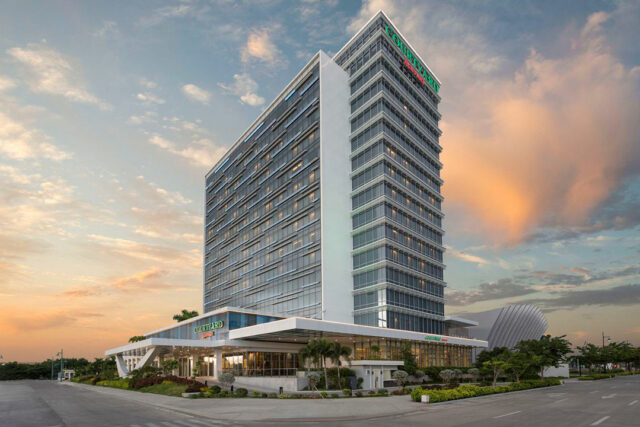
The 326-room Courtyard by Marriott in Iloilo will be consolidated under Megaworld Hotels & Resorts portfolio this year. — MEGAWORLD CORP

LISTED property developer Megaworld Corp., through its hospitality arm Megaworld Hotels & Resorts, is planning to open seven new hotels by 2030 as part of its goal to expand its portfolio to 9,000 rooms.

The hotels targeted for opening include the 554-room Chancellor Hotel in Boracay Newcoast; the 404-room Belmont Hotel Iloilo in Iloilo Business Park; and the 300-room The Kingsford in The Upper East Bacolod, Megaworld said in a regulatory filing on Thursday.

Also slated for launch are the 304-room Savoy Hotel Palawan and the 313-room Paragua Sands in Paragua Coastown, San Vicente, Palawan; the 373-room Savoy Capital Town in Capital Town, San Fernando, Pampanga; and the 339-room ArcoVia Hotel in ArcoVia City, Pasig City.

“It is Alliance Global Group, Inc.’s (AGI) thrust to strengthen and streamline our hospitality portfolio as we look to attract and welcome more tourists, more conventions, and more events to our hotel developments,” said Kevin L. Tan, president and chief executive officer (CEO) of AGI, the parent company of Megaworld.

Megaworld Hotels & Resorts currently operates 13 hotel properties with around 6,000 rooms.

These include properties under the Richmonde Hotel brand (Richmonde Hotel Ortigas, Eastwood Richmonde Hotel, and Richmonde Hotel Iloilo); Belmont Hotel brand (Belmont Manila, Belmont Boracay, Belmont Mactan); Savoy Hotel brand (Savoy Manila, Savoy Mactan, Savoy Boracay); Hotel Lucky Chinatown; Twin Lakes Hotel; Kingsford Hotel Manila; and Grand Westside Hotel.

The company is also set to add 326 room keys to its hotel portfolio this year through the consolidation of the 15-story Courtyard by Marriott in Iloilo Business Park.

Within the year, Belmont Hotel Mactan in Cebu will transition into an Accor-branded international hotel, the Mercure Mactan Cebu.

Over the next five years, at least five more existing homegrown properties of Megaworld Hotels & Resorts will be rebranded under Accor, allowing the company to operate both homegrown and international hotel brands.

Earlier this year, Megaworld Hotels & Resorts tapped hotel chain Accor to elevate its domestic hotel portfolio.

“The inclusion of international hotels in our portfolio will further cement our position as the largest hotel operator in the country for both local and international hotels. Through this expansion program, we aim to continue to further grow and strengthen our contribution to the Philippine tourism industry,” Megaworld President and CEO Lourdes T. Gutierrez-Alfonso said.

Megaworld shares rose 2.45% or five centavos to P2.09 apiece on Thursday. — Revin Mikhael D. Ochave

Hann Holdings says P13-B IPO on track, no pushback expected

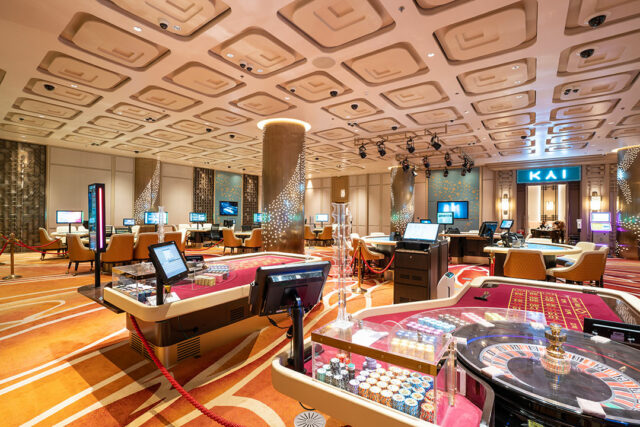
HANN CASINO — HANN HOLDINGS INC.

HANN HOLDINGS, Inc., the operator of the Hann Casino Resort in Clark, said it does not expect any delays to its planned P13-billion initial public offering (IPO).

“We don’t see any risk that is going to push back (the IPO),” Hann Group Founder, Chairman, President, and Chief Executive Officer Dae Sik Han told reporters on Thursday.

Hann Group consists of Hann Holdings, Hann Philippines, Inc., Hann Properties Corp., Hann Property Development, Inc., Hann Foundation, Inc., and Widus International Leisure, Inc.

Hann Holdings plans to conduct a P13-billion IPO, which consists of a primary offer of up to 500 million common shares and an overallotment option of up to 50 million secondary common shares priced at up to P23.60 apiece.

The overallotment option will be offered by Hann Group Holdings W.L.L., the parent company of Hann Holdings.

Based on its latest prospectus dated July 31, the IPO offer period will run from Sept. 9 to 15, with listing on Sept. 23.

“This IPO will open another window for us to expand. IPO for fundraising is one thing, but the other one is credibility as well,” Mr. Han said.

“It’s going to be very difficult for me to somehow dream that someday I may branch out in different areas in the Philippines or even different countries. That kind of opportunity brought by the IPO, that makes me excited,” he added.

Hann Holdings expects to generate P11.43 billion in net proceeds, which will be used to fund the development and expansion plans and general corporate purposes of Hann Philippines.

Asked about the possibility of establishing new locations, Mr. Han hinted that he is open to “any opportunity” but reiterated that his current focus is on scaling up operations in Clark.

“Any business opportunity to increase the value of the company, yes, I will do it,” he said.

Hann Holdings tapped CLSA Ltd. as the sole global coordinator for the IPO. It will also serve as joint bookrunner, together with domestic underwriters Asia United Bank Corp., BDO Capital & Investment Corp., China Bank Capital Corp., and PNB Capital and Investment Corp.

It is set to become the second IPO this year, following Cebu-based fuel retailer Top Line Business Development Corp. — Revin Mikhael D. Ochave

CREC taps P4.4-B Security Bank loan for 125-MW solar farm

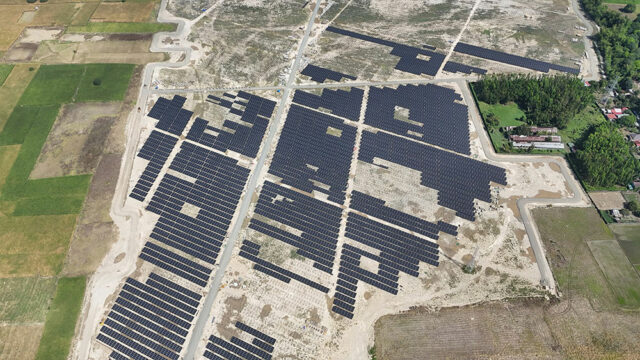
CREC.COM.PH

LISTED renewable energy company Citicore Renewable Energy Corp. (CREC) has secured a P4.4-billion term loan facility from Security Bank Corp. to finance its 125-megawatt (MW) solar power project in Pangasinan.

“Project finance is key to realizing the renewable energy transition, with projects like Citicore Solar (CS) Pangasinan able to move faster and mitigate risks with the support of partners like Security Bank, which understand that sustainability requires cooperation between industries,” CREC President and Chief Executive Officer (CEO) Oliver Y. Tan said in a statement on Thursday.

Situated in the municipality of Sta. Barbara in Pangasinan, the CS Pangasinan Solar project is one of CREC’s priority projects in its “five gigawatts (GW) in five years” goal.

The Department of Energy has certified the solar farm as an energy project of national significance, expediting the permitting and development processes to ensure its completion by yearend.

“By supporting Citicore’s Sta. Barbara solar power project, we acknowledge that achieving long-term energy security requires proactive investment and development today,” said Security Bank Capital President and CEO Virgilio O. Chua.

“We see this financing not only as a catalyst for clean energy development but also as a means to create meaningful socioeconomic benefits, including local job creation and land use optimization,” he added.

For 2025, CREC has earmarked a capital expenditure budget of more than $1 billion, with the majority of the funds allocated to its first GW of solar power projects.

CREC, directly and through its subsidiaries and joint ventures, manages a diversified portfolio of renewable energy generation projects, power project development operations, and retail electricity supply services.

At present, the company has a combined gross installed capacity of 287 megawatts from its solar facilities in the Philippines. — Sheldeen Joy Talavera

LG drops latest AI-powered xboom lineup, in collaboration with will.i.am

THE Black Eyed Peas front man will.i.am with the LG xboom Stage 301

SOUTH KOREAN tech brand LG has officially launched its latest audio lineup, xboom, which features artificial intelligence (AI) smart sound, with nine-time Grammy winner will.i.am steering its creative direction.

Xboom officially dropped its first beat on Tuesday. In the lineup are the LG xboom Stage 301, LG xboom Bounce, LG xboom Grab, and LG xboom Buds.

“The lineup is meticulously tuned by will.i.am, the experiential architect of LGX booth AI, to deliver richer, warmer, and an unparalleled immersive listening experience,” Mildred Bugay, LG Philippines product manager, said during the launch.

“This is a kiss of a deep blend of cutting-edge technology and vibrant pop culture, elevating the entire audio experience,” she added.

The speakers feature AI Sound, which allows them to adjust their settings based on the song’s genre and the environment where it is played.

Similarly, its AI Lighting feature can also detect the mood of the song and match it with lighting effects.

The biggest of the speakers is the LG xboom Stage 301, which features a 6.5-inch woofer and 2.5-inch midranges. The speaker is expected to deliver immersive sound, filling the room with deep bass and wide stereo clarity.

LG said it has a battery life of 12 hours of playtime, and it also has an IPX4 rating for water resistance and a dedicated LG ThinQ app for sound controls.

For a more portable design, the LG xboom Bounce offers deep bass and dynamic sound, boosted by dual passive radiators and twin dome tweeters.

Uninterrupted playtime is also expected from the speaker, with its 30-hour battery life — the longest among the bunch. It is also equipped with a military-grade IP67 rating for water and dust protection, according to LG.

For handheld speaker enthusiasts, the LG xboom Grab could be a choice. The speaker is distinct for its crisp, dynamic sound, delivered through its small yet high-performing 16mm dome tweeter. It is also protected by the military-grade IP67 rating for water and dust resistance and offers up to 20 hours of playtime.

For the true wireless earphones, the lineup has the LG xboom Buds, which are expected to deliver rich and crisp sound powered by the brand’s latest technology. Much like its big brothers, the buds are also powered by AI and feature advanced noise cancellation, even for their microphones.

The latest xboom lineup is now available on LG Philippines’ official website. — Edg Adrian A. Eva

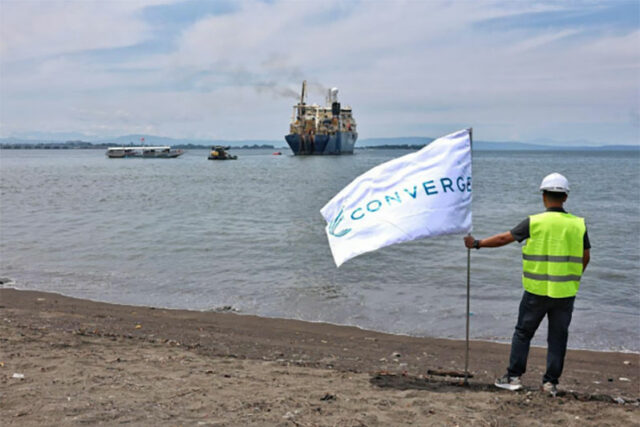
20,000-km Bifrost Cable lands in Davao — Converge ICT

The Bifrost Cable System is the first trans-pacific system in over two decades that traverses a new route between the United States (California and Oregon), Guam and Southeast Asia via Indonesia, Singapore, and the Philippines — enabling ultra-low latency and high-capacity bandwidth essential for today’s digital economy. — CONVERGE ICT SOLUTIONS, INC.

CONVERGE ICT SOLUTIONS, Inc. said the Bifrost Cable System has reached the Philippines following its landing in Davao.

“Since we’ve announced this project, we’ve seen overwhelming demand from carriers and internet service providers (ISPs) seeking to purchase capacity,” Converge Chief Executive Officer Dennis Anthony H. Uy said in a media release on Thursday.

The Bifrost Cable System is a trans-Pacific cable system that connects Singapore, Indonesia, the Philippines, and the United States.

The system also enables ultra-low latency and high-capacity bandwidth amid the growing digital economy, it said.

This development is expected to advance the country’s digital transformation and global connectivity, Converge said, noting that the company will now provide direct access to one of the most advanced international subsea cable systems.

“This milestone is more than a technological achievement — it’s a national enabler. With this critical infrastructure in place, we are not only enabling digital transformation but also creating new trade pathways and opportunities for the Philippines,” Mr. Uy said.

The expected commercial operations of the Bifrost Cable System are also seen to attract hyperscalers, data centers, and enterprise clients, and to provide secure and scalable international gateway access to North America and other regional hubs.

“This upgrade will empower businesses, financial institutions, tech companies, and the public sector to tap into a world-class infrastructure backbone that meets the demands of next-generation applications and global e-commerce,” Converge said.

Once the 20,000-kilometer (km) Bifrost Cable System is fully operational, Converge will be the exclusive Philippine partner operating the international cable landing station in Davao and will help position the country as a digital hub in Asia, Mr. Uy said.

Converge operates about 862,000 kilometers of fiber optic assets nationwide. The company also serves as a partner in international subsea cable systems such as the Bifrost and SEA-H2X, which aim to boost trans-Pacific and intra-Asia connectivity.

At the stock exchange on Thursday, shares in the company fell by 24 centavos, or 1.32%, to close at P17.96 apiece. — Ashley Erika O. Jose

Filipino talent shines in Freakier Friday

MANNY JACINTO

Manny Jacinto attends PHL movie premiere

TWENTY-TWO years after the 2003 Disney Movie classic Freaky Friday comes an unexpected yet delightful surprise for adults who are still teens-at-heart — the sequel, titled Freakier Friday.

There’s another draw to the film for Filipinos. One of its stars is the heartthrob Filipino-Canadian actor Manny Jacinto.

Freakier Friday continues the story of a dysfunctional mother-daughter relationship that was introduced by Jamie Lee Curtis and Lindsay Lohan in the 2003 movie. That comedy film (itself a remake of the 1976 film starring a very young Jodie Foster) became a cult classic for millennials, embedded in popular culture. Twenty-two years after Tess (Ms. Curtis) and her daughter Anna Coleman (Ms. Lohan), had their bodies swapped, Anna now has a daughter (Julia Butters) and, after striking up a romance with fellow single parent Eric Reyes (played by Mr. Jacinto), a British soon-to-be stepdaughter (Sophia Hammons). While navigating a new blended family, Tess and Anna experience an even bigger body swap spell that threatens to tear the future of the family apart.

Mr. Jacinto flew to Manila to attend the premiere of the film. He met with fans, signed their merchandise, and spoke to the press on Aug. 5 at SM Mall of Asia.

“It feels like a dream,” he said. “I was born here, so a local boy that gets to act opposite Lindsay Lohan and Jamie Lee Curtis is wild to me. I never would have thought. But here we are.”

The 37-year-old actor was born in Manila and moved to Canada when he was three years old when his family emigrated.

During his visit, he was excited to be able to “practice Tagalog.”

Sana panoorin niyo ang Freakier Friday. Maraming maraming salamat po (I hope you all watch Freakier Friday. Thank you very very much),” he said. “It’s a dream to be here right now.”

For Mr. Jacinto, the role is special because it is his first time to play a father. His Hollywood career includes many acclaimed roles: he played Jason Mendoza in the NBC comedy The Good Place, the villain Qimir in Disney’s Star Wars series The Acolyte, the wellness guru Yao in Nine Perfect Strangers, and small roles in films like Top Gun: Maverick and Bad Times at the El Royale.

He said that he “drew upon the experiences and memories of his parents” for this first role as a parent.

“They’re [my] biggest fans. They’re super supportive,” he explained. On getting the news that he would be in the film, he added, “It was unbelievable. I was going to play a father for the first time. I would have an anak, a little kid of my own for the first time.”

Freakier Friday, the sequel to the beloved Disney classic, is now showing in Philippine cinemas nationwide. Directed by Nisha Ganatra, it features elements similar to the first film: a body swap among women in the family who must learn from each other, and hijinks that ensue as a result.

Aside from the four female leads, Mr. Jacinto’s other co-stars are Chad Michael Murray, Mark Harmon, and Rosalind Chao who are reprising their roles from the first movie, Maitreyi Ramakrishnan, and Vanessa Bayer.

Mr. Jacinto hopes that he will make Filipinos proud with his performance as Filipino-British chef Eric Reyes.

“It’s nerve-wracking. I can’t wait. I hope I made you guys proud,” he said. — Brontë H. Lacsamana, with a report from Reuters