Home Blog Page 115

Charlie brings his Chocolate Factory to Manila

COHEN TOUKATLY (right) and Daniel Plimpton give a preview of their characters Charlie Bucket and Willy Wonka. — BRONTË H. LACSAMANA

WHO DOESN’T KNOW Roald Dahl’s iconic children’s novel Charlie and the Chocolate Factory?

The wonderful, trippy visuals of the iconic 1971 film with Gene Wilder are ingrained in a generation’s brains. The Tim Burton-helmed wackiness of the 2005 film with Johnny Depp has become a fond memory for those approaching middle age. Even kids these days may know Willy Wonka through Timothée Chalamet’s take in the 2023 prequel.

While one can always go back to their film version of choice to revisit dancing Oompa-Loompas and rivers of chocolate, Manila audiences are now being offered the golden ticket to accompany Charlie Bucket on his adventure into a haven of sweets onstage. This July, GMG will bring the Broadway production of Charlie and the Chocolate Factory to the Philippines for the first time.

Filipino theater fans have seen their fair share of musical spectacles which have stopped over in Manila while on global tours — Cats, Wicked, Phantom of the Opera, Les Misérables, The Sound of Music are just a few examples — which has motivated the folks behind this stage musical to step it up.

“The Filipino audiences are very familiar with spectacle and big technical elements, and I think our production picks up the antics just one notch higher,” said director Drew Cipillone at a Jan. 8 press conference.

“What live theater brings to the experience and the overall story is a lot more imagination. It is very, very innovative, with new technology,” he added.

To set the touring version apart from its original Broadway production, the team has modified the pacing and utilized magic and illusion to better tell the story, according to Mr. Cipillone.

Of course, it will still have the movies’ beloved songs, like “Pure Imagination,” “The Candy Man,” and “I’ve Got a Golden Ticket.”

Aside from using LED screens, projection mapping, and immersive technology, the creative team also incorporated magic taught by illusion designer Tim Clothier and his Las Vegas-based company, the Illusions Project.

“What we’ve actually accomplished in this brand-new production is the immersive feel, so you actually feel like you’re part of it,” Mr. Cipillone said.

THE STARS
The role of Charlie Bucket — the boy from an impoverished family whose dream comes true when he gets a golden ticket to Willy Wonka’s Chocolate Factory — falls to Cohen Toukatly. For the young actor, landing the lead role in this musical is like “his very own golden ticket.”

“Being able to bring this character to life, to show people what being kind can get you, is awesome,” he told the press.

Meanwhile, Daniel Plimpton, who plays Willy Wonka, acknowledged that he has big shoes to fill following the iconic actors who have played the eccentric chocolatier in years past — so he will be bringing his unique talents to the role.

“I come into this with a strong tap dance background, so we got to throw a little bit of that into the show, which has never been in the show before,” he explained.

There will be bits of hip-hop and even Bavarian slap dancing alongside classic Broadway-style numbers, incorporated smoothly into the choreography thanks to choreographer Joshua Bergasse.

Mr. Plimpton added that Charlie and the Chocolate Factory cuts across generations, making it a great show for the whole family. “Kids will love seeing themselves in Charlie. Adults will see aspects of themselves in Willy Wonka. It really gives you a chance to reflect on your own childhood dreams and what you want the world to be,” he said.

He explained that there’s a deeper message beneath the vibrant spectacle of the chocolate factory, that “while things can be very shiny, we need to maintain our groundedness and our hope for humanity.”

The actors also teased a special moment that they adjust for each country they stop on the tour. At some point, Willy Wonka suddenly bursts into song in a different language, so Manila audiences can expect him to sing in Filipino.

Charlie and the Chocolate Factory features original music by Grammy and Tony Award winners Marc Shaiman and Scott Wittman, with a book by David Greig based on the novel by Roald Dahl.

The musical will run from July 8 to 26 at The Theatre at Solaire, Solaire Resort & Casino, 1 Aseana Ave., Entertainment City, Parañaque City. Early ticket access is available through UnionBank until Jan. 15, via ticketworld.com.ph. Tickets go on sale to the general public through TicketWorld on Jan. 17. — Brontë H. Lacsamana

Anti-corruption sentiment must translate into results

PEOPLE raise their placards during the 2nd Trillion Peso March at the People Power Monument in Quezon City on Nov. 23, 2025. — PHILIPPINE STAR/MIGUEL DE GUZMAN

The holiday noise has died down, and Filipinos have gone back to their usual routines. With all the difficulties and challenges presented by 2025, many are wondering what this new year holds for the people.

A Stratbase commissioned survey, conducted Dec. 12-15, 2025 by Pulse Asia, revealed that economic issues remained to be top-of-mind of most Filipinos. Some 59% of respondents cited the rising prices of basic goods such as food, and the lack of job opportunities, as a pressing concern at the community level.

This goes to show that many things can be happening in the political sphere, but ultimately the people are concerned about whether they can afford the prices of basic necessities, put food on the table, and find and keep a job that would ensure their income.

A separate, earlier survey, conducted by the Social Weather Stations between Nov. 24 and 30 last year, showed that 51% of Filipino families think of themselves as poor. The majority figure translates to an estimated 14.3 million families across the country.

These survey numbers do not lie. They reflect the worsening pressure being experienced by Filipinos on how they could respond to their basic needs amid the economic hardships and the lack of economic opportunities.

CORRUPTION
But it would be wrong to portray this concern for day-to-day survival as remote and separate from the problem of corruption.

To be sure, the problem of corruption has always been on the minds of Filipinos. Another Pulse Asia survey revealed that 94% of Filipinos believe that corruption is prevalent in the Philippines. Filipinos are split on whether corruption is a normal part of politics in this country. Some 41% agree with this statement, while 43% disagreed.

Thus, while just 31% of respondents identified corruption as a top concern, it remains a significant issue far beyond being a moral or political issue. Filipinos do want an honest government and are angry and frustrated at those in power who abuse their positions for their selfish gain. They wish they could trust their institutions again.

Unfortunately, corruption has farther-reaching consequences. How a government conducts its affairs, proposes a budget, and actually spends people’s money directly affects the perception of investors. These are the people who bring capital to the country and fuel our industries, creating jobs and providing opportunities for sustainable incomes.

Indeed, corruption — an act of misallocating resources and abusing fiscal power for personal gain — has profound economic effects on the life of a nation.

This administration is, at the very least, aware of the intimate link between governance and economics. Despite the challenges now being faced by the various bodies investigating high-profile and high-stakes corruption, it is trying to introduce changes to the way the national budget is drafted.

We saw for the first time how the deliberations at the bicameral conference committee were livestreamed. While the system was not perfect, the public was generally aware of what was going on and which issues were deemed contentious, even how lawmakers were conducting themselves. The public wanted to make sure there were no opportunities for insertions or any similar maneuvers.

The 2026 national budget reflects an attempt to respond to these concerns. Signed into law on Jan. 5 by President Ferdinand “Bongbong” Marcos, Jr., Republic Act No. 12314 or the 2026 General Appropriations Act (GAA) allocates P6.793 trillion — 7.4% higher than in 2025 and equivalent to 22% of GDP. This signals an expansive fiscal response.

In this budget, social services and economic foundations are prioritized. Education has the largest share at P1.345 trillion to fund classrooms, feeding programs, and tertiary education support; infrastructure follows with P530.9 billion to improve connectivity; health gets P448.125 billion to strengthen Universal Health Care, rural health staffing, and PhilHealth benefits.

President Marcos also vetoed seven of 10 unprogrammed items in the budget, amounting to P92.5 billion out of the total P234.4 billion. He said the allowed funds represented the absolute bare minimum.

Then again, deliberating the line items and passing the budget are one thing. Actually implementing the budget as planned is another. Further, ascertaining whether the goods and services are delivered to the public is a sensitive issue altogether. Filipinos have seen and experienced too many inadequate or nonexistent projects, even though the paperwork says otherwise.

In sum, what awaits us in 2026 and onward is what we will want it to be. Do our leaders sincerely want to introduce reforms that would purge the system of corruption? How much do the people want a clean and honest government and are they willing to participate in ensuring this will be realized? Rising prices, weak job opportunities, and corruption-driven inefficiencies are shaping today’s political landscape, and while the 2026 national budget is large and people-centered on paper, its real impact will depend on the implementation that hopefully, directly addresses everyday economic concerns of the Filipino people.


Victor Andres “Dindo” C. Manhit is the president of the Stratbase ADR Institute.

Del Monte completes 1.45% Sundrop stake sale

DELMONTEPACIFIC.COM

DEL MONTE PACIFIC LTD. (DMPL) said it has completed the sale of a 1.45% equity stake in India’s Sundrop Brands Ltd., covering 547.95 million ordinary shares priced at 715 Indian rupees each, to an independent third-party buyer.

In a disclosure on Tuesday, the company said the share purchase agreement closed on Jan. 9, after meeting required conditions.

The deal follows DMPL India Holdco, its indirect subsidiary, completing the first tranche of the Sundrop disposal through a share purchase agreement with CAG-Tech (Mauritius) Ltd., selling 1.88 million ordinary shares or a 4.99% stake for about $15 million.

“Sundrop Brands, a leading player in India’s food and edible oils industry, owns popular brands like ACT II popcorn and Sundrop edible oil,” DMPL said.

The company said the transactions are part of its restructuring efforts to streamline its businesses.

Funds raised from the Sundrop sales will support its main operating subsidiary, Del Monte Philippines, Inc. (DMPI), which handles the Group’s core businesses.

The transactions aim to unlock value from non-core investments, strengthen DMPI’s balance sheet to fund working capital and debt, and refocus management and capital on DMPL’s core strategic businesses.

Del Monte shares remained unchanged at P4.55 apiece on Tuesday. — Alexandria Grace C. Magno

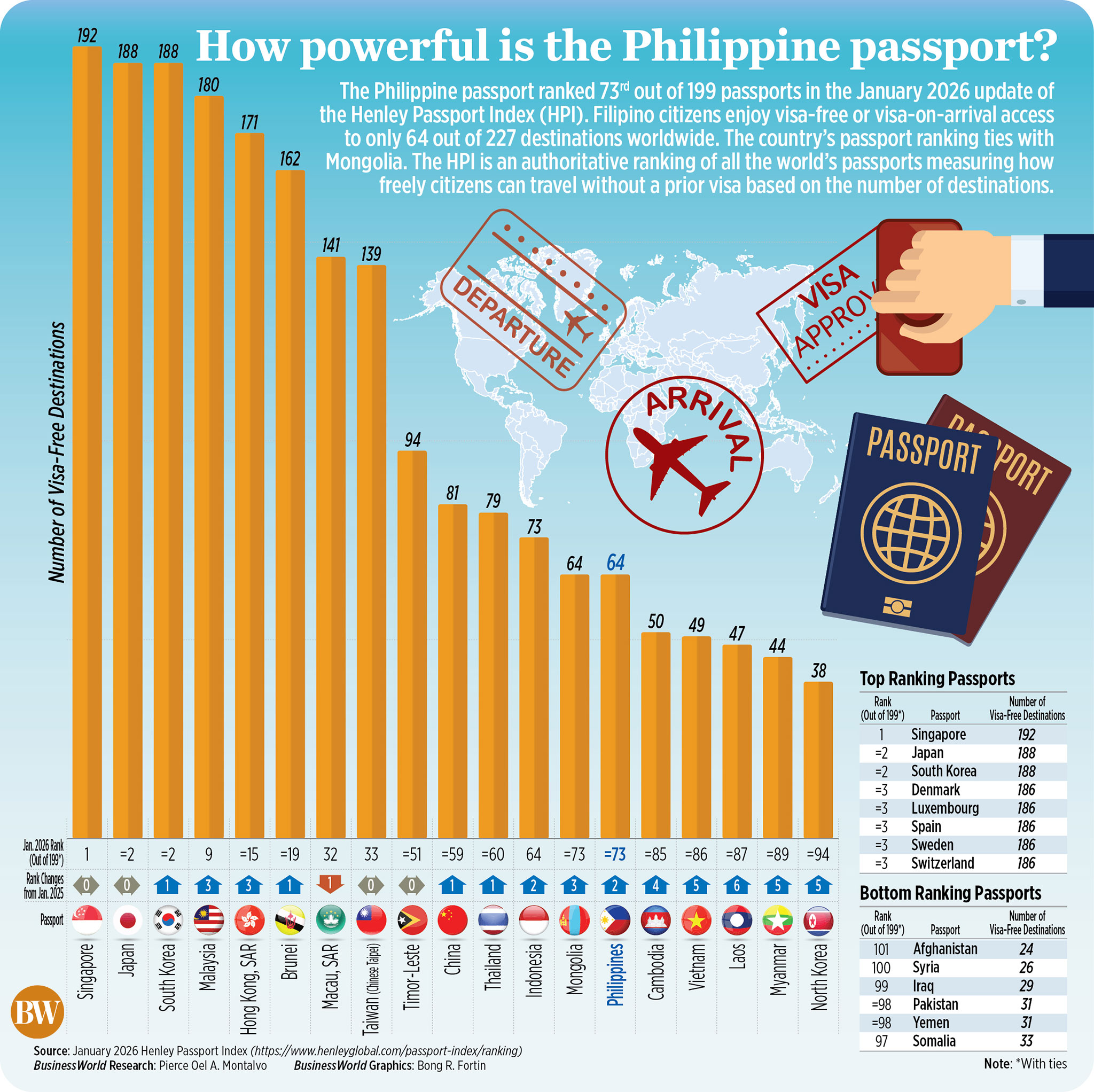
How powerful is the Philippine passport?

The Philippine passport ranked 73rd globally, two ranks higher than a year earlier, in terms of visa-free privileges in global destinations, according to the London-based Henley Passport Index (HPI) on Tuesday. Read the full story.

Atome secures $345-M debt facility

DIGITAL FINANCE platform Atome has closed the renewal of an upsized $345-million debt facility that will help fund its continued expansion in Southeast Asia, including the Philippines.

Atome said in a statement on Tuesday that it has finalized the syndicated facility that was up from the $200 million it secured in 2024 following the entry of new participating banks.

“The expanded facility will accelerate the expansion of Atome Financial’s profitable regional portfolio and products such as buy now, pay later (BNPL), lending and the Atome (PayLater Anywhere) Card across key Southeast Asian markets Singapore, Malaysia and the Philippines,” it said.

“This facility has grown significantly within a year. We’re now even better positioned to support a rapidly growing, healthy and profitable loan book, while scaling transparent and flexible credit solutions to serve both merchants and consumers,” said Andy Tan, Atome chief commercial officer.

HSBC reprised its roles as structuring bank and mandated lead arranger and bookrunner, while DBS also joined as mandated lead arranger and bookrunner.

Returning lenders include Sumitomo Mitsui Banking Corp.’s Singapore branch, Brunei’s Baiduri Bank, and Cathay United Bank. Fubon Bank and Shanghai Pudong Development Bank joined as new participants.

“At HSBC, we support businesses by leveraging our global network, deep sector expertise, and capital strength. Our long-standing partnership with Atome reflects this commitment. We appreciate their continued trust and the opportunity to support them on this milestone transaction. We look forward to more shared successes in the years to come,” HSBC Singapore Head of Banking, Corporate and Institutional Banking Gilbert Ng said.

“DBS is pleased to support Atome as mandated lead arranger and bookrunner, reaffirming our commitment to catalyzing innovative and responsible growth in the digital economy. Atome continues to successfully leverage technology to scale accessible, transparent, and flexible credit solutions for underserved consumers in Southeast Asia within a robust risk framework — supporting DBS’ commitment to creating meaningful impact across the region,” DBS Head of Digital Economy Group Chua Shih Guan added.

Atome is part of Singapore-headquartered Advance Intelligence Group’s wallet platform Atome Financial, which is backed by investors including SoftBank Vision Fund 2 and Warburg Pincus. It is active in the Philippines as a BNPL firm and also offers insurance, savings, cards and lending services across Southeast Asian markets.

In 2025, Atome Financial’s annualized net revenue breached $500 million, supported by annualized gross merchandise value (GMV) of $6 billion. It posted its strongest monthly GMV on record last month, reflecting a 70% annual increase, it added.

In the Philippines, Atome has disbursed over 2 million PayLater Anywhere Cards, with up to 80% of these being to first-time cardholders. — A.M.C. Sy

Bamboo enterprise empowers residents with market access

EDG ADRIAN A. EVA

By Edg Adrian A. Eva, Reporter

ALIMODIAN, Iloilo — A community-based bamboo enterprise in this western Philippine town is helping almost 300 residents earn more from their craft by organizing production, securing buyers and linking small producers to wider markets.

The Alimodian Bamboo Producers Association (ABPA), founded in 2022, brings together farmers, weavers and traders who depend on bamboo for their livelihoods. The group was established by the municipal government’s Local Economic Development and Investment Promotion Office (LEDIPO) to organize a fast-growing but fragmented local industry.

“Eighteen percent of the total land area of our town is bamboo plantations, and on average, 10,000 bamboo poles are sold every month based on the data,” LEDIPO officer Mark Dave A. Botol said in an interview.

ABPA has 278 members from 11 of Alimodian’s 51 villages. Many of them had long worked independently, selling bamboo poles or handcrafted products to middlemen at uneven prices.

“Before, the weavers were scattered and not organized,” Mr. Botol said in Filipino. “They were not intact as a group.”

The association was formed after the local government identified two major gaps: limited access to markets and weak links to government support programs.

By organizing producers under a single entity, ABPA has been able to consolidate supply, standardize products and negotiate better terms for its members.

Through the association, bamboo products from Alimodian have been featured in major trade fairs in Iloilo and Metro Manila. Items made by local weavers are also sold at a well-known mall in Iloilo City and at the town’s One Town, One Product center.

ABPA’s offerings range from practical items such as bamboo baskets used by farmers to transport produce, to decorative home furnishings, including lampshades etched with dried cacao leaves aimed at urban consumers.

Mr. Botol said members are earning more because ABPA buys their products directly and handles marketing and sales with the support of the local government. The enterprise sells about 5,000 items a month, providing producers with more predictable demand and income.

Beyond market access, the association has become a channel for training and assistance. Members have received support from local and national agencies, including the Department of Science and Technology’s Community Empowerment through Science and Technology program, which provided product development training as well as tools and equipment based on scientific standards.

“As we noticed, the farmers do not have a voice to request assistance from government agencies,” Mr. Botol said. “That is why the role of the local government is very important. We should know their needs so that we can act as their voice.”

The initiative also aligns with broader provincial goals. Iloilo aims to position itself as a bamboo hub in Southeast Asia by 2030, focusing on green exports, community enterprises and climate-smart industries.

Governor Arthur R. Defensor, Jr. has said the province is considering more than 9,000 hectares as potential bamboo plantation sites to support that plan.

Still, challenges remain. Poor road conditions in some remote villages have pushed up transport costs, cutting into earnings and forcing producers to raise prices.

The local government is seeking funding from national agencies to improve road access, particularly in areas such as the village of Bugang, Mr. Botol said. Better infrastructure would reduce costs for ABPA members and benefit other farmers as well.

Despite these hurdles, the association’s members remain hopeful. Participation in trade fairs has helped them build links with buyers in nearby towns and Metro Manila, opening doors to repeat orders.

“That’s what I tell them: little by little, they will also achieve what they have been aiming for,” Mr. Botol said.

For ABPA, the goal goes beyond sales figures. The association seeks to improve the long-term stability of its members by turning traditional skills into sustainable livelihoods.

“The dream is really to change lives,” Mr. Botol said, adding that through bamboo, members can work toward more secure incomes and better opportunities for their families.

Arts & Culture (01/14/26)


PPO opens the year with Preludi

THE Philippine Philharmonic Orchestra (PPO) is scheduled to present PPO Concert V: Preludi on Jan. 16, 7:30 p.m., at the Samsung Performing Arts Theater in Circuit, Makati. Under the baton of PPO music conductor and principal conductor Grzegorz Nowak, the program will feature soprano Andion Fernandez and pianist Szymon Nehring. Tickets are available via https://premier.ticketworld.com.ph/shows/show.aspx?sh=PPOCON526.


Talk on PHL clothing and craftsmanship

DR. STEPHANIE COO is set to discuss how clothing becomes a tool of power and resistance in colonial Philippines in the talk “Threads of Empire: Fashion, Power, and Resistance in Colonial Philippines.” The event is open to all curious and interested in Philippine material culture, craftsmanship, and the living histories embedded in art and clothing design. It will take place on Jan. 21, 2 p.m., at the National Museum of Fine Arts’ auditorium. Pre-registration is required through https://forms.gle/QBXQaYwWB1waXoFu9.


MSO holds benefit concert at Proscenium Theater

THE Manila Symphony Orchestra (MSO) is having a special benefit concert titled Legacy, featuring two pianists — Carmen Sipin-Aspiras and Inna Montesclaros — under the baton of Darrel Ang. It is slated for Jan. 25, 7:30 p.m., at the Proscenium Theater, Rockwell, Makati. The special evening will feature works of Johannes Brahms and Frederick Chopin. It is for the benefit of the MSO Foundation’s Basilio Manalo Scholarship Program, supporting the next generation of young Filipino musicians. Tickets are available via TicketWorld.


Poklong Anading showcases artist-run initiatives

FILIPINO contemporary artist Poklong Anading is presenting a collection of unrealized and abandoned ideas in #AVoidWork. The project showcases his interviews with key individuals in artist-run initiatives and self-organized models, namely Surrounded by Water, Big Sky Mind, Green Papaya, Junk Shop, Future Prospects, Lost Frames, Spare Bedroom, Art School Now Salon, Golden Cargo Gallery, Bastards of Misrepresentation, and the Museum of Mental Objects. #AVoidWork will be on view from Jan. 28 to Jan. 30, 12 p.m., at the Ideation Room at The Atrium @ Benilde of MCAD, 1040 Arellano Ave. corner Ayala St., Malate, Manila. Interested participants may e-mail mcad@benilde.edu.ph.


Bagets The Musical opening week cast schedule revealed

NEWPORT WORLD RESORTS has released the cast performance schedule for shows from Jan. 23 to Feb. 1, giving audiences a heads up on who they will be seeing on stage. Andres Muhlach as Adie, Ethan David as Arnel, Milo Cruz as Tonton, Jeff Moses as Topee, and Tomas Rodriguez as Gilbert are performing on Jan. 23 at 8 p.m., Jan. 25 at 3 p.m., and Jan. 31 at 3 and 8 p.m. Mico Chua takes on the role of Adie alongside KD Estrada as Arnel, Migo Valid as Tonton, Sam Shoaf as Topee, and Noel Comia, Jr. as Gilbert in performances set for Jan. 24 at 3 and 8 p.m., Jan. 30 at 8 p.m., and Feb. 1 at 3 p.m.. The production’s gala night performance on Jan. 29 at 8 p.m. features Mr. Muhlach, Mr. Estrada, Mr. Cruz, Mr. Moses, and Mr. Rodriguez.


Imelda Cajipe Endaya exhibit opens at Silverlens

THIS MONTH, Imelda Cajipe Endaya has an exhibition at Silverlens. Titled Kahapon Muli Bukas, the show situates her work Filipina DH alongside more recent mixed media works, which tackle issues ranging from the struggle against religious oppression to the catastrophic effects of climate change in the Philippines. The pieces on display center on women across the country’s history. It is ongoing until Feb. 14 at Silverlens, 2263 Chino Roces Ave., Makati.


Jessica Zafra brings book club back

THE Jessica Zafra Book Club, a literary club moderated by Palanca-winning author and columnist Jessica Zafra, has returned. The annual project is back thanks to a partnership with bookstore Fully Booked. It is set to take place once every other month from February to December, from 4 to 6 p.m. at Fully Booked BGC’s U-View. The reading schedule is as follows: Wuthering Heights by Emily Brontë on Feb. 7, El Filibusterismo by Jose Rizal on April 4, The Odyssey by Homer on June 6, Short Stories by Ted Chiang (Stories of Your Life and Others, and Exhalation) on Aug. 1, and Our Share of Night by Mariana Enriquez on Oct. 3. The book for December has yet to be revealed. Registration is required online.


ALT Collective goes to SMX MOA

ALT ART is set to mount its biggest edition yet with expanded exhibitions at a new venue, the SMX Convention Center, Mall of Asia (MOA) Complex in Pasay. It will open to the public on Feb. 13 to 15, 11 a.m. to 7 p.m., and feature nine of the country’s top galleries: Artinformal, Blanc, The Drawing Room, Galleria Duemila, Finale Art File, MO_Space, Underground, Vinyl on Vinyl, and West Gallery. The fourth edition of the fair will have twice the floor area of its 2024 iteration and have sections like “Special Projects” and “Discoveries” dedicated to artists pushing conceptual possibilities and offering fresh perspectives in art. Tickets, available onsite, will be priced at P500 for the general public and P250 for students.


Manila Metropolitan Theater offers free guided tours

THE Manila Metropolitan Theater now offers free guided tours of its facilities. Taking place every third Sunday of the month, a guide from the National Commission on Culture and the Arts will take guests through the theater’s indoor and outdoor facilities. Social media posts from the Metropolitan Theater page will have a link for tour registration, with slots available on a first-come, first-served basis. Only 100 participants are allowed per batch. The January tours are fully booked, so stay tuned for next month’s batch.

10 reasons for removing VAT on electricity

STOCK PHOTO | Image by Macrovector_official from Freepik

Halfway into his term, President Ferdinand Marcos, Jr. faces the weakest political position of his presidency. Approval ratings are at historic lows. Trust has collapsed. Disapproval now outweighs support in every major survey.

Filipinos are angry — and rightly so. Massive corruption scandals, the rising cost of living, especially food, the spate of disasters, excessive politicking, broken promises of reform. Filipinos wonder why should they continue to pay tax when corruption is so brazen and massive?

In short, in today’s Philippines, trust in government is the scarcest public good of all.

One way to recover that trust is to do one thing that people can see and feel immediately — by removing the 12% VAT on electricity. Marcos’ technocrats will push back — loss of tax revenue, it is regressive, broad-based VAT is more efficient, it undermines credit rating, targeting is better, and many more explanations. But they miss the real point. When your house is on fire, aanhin pa ang damo kung patay na ang kabayo*? We studied this issue and below are 10 reasons why Congress should remove VAT on electricity now.

1. The focus on headline revenue loss misses the real economic picture. Technocrats will likely argue that VAT removal will lead to a significant revenue loss for the government: the gross VAT revenue foregone — around P110 billion a year. That number is real — but it is not the whole story.

Removing VAT on electricity transfers that P110 billion back to households and firms as purchasing power. Much of that money will be spent, reinvested, and circulated through the economy by factor of about 1.3 times. Some returns will come through higher consumption, higher output, more competitive industries, and downstream tax collection.

The policy may not fully pay for itself — but it meaningfully reduces its own net cost. Treating VAT removal as money simply “lost” ignores these dynamics and leads to distorted fiscal judgments. It is good political optics for sure, but it is also good economics.

2. Concerns about regressivity are solvable through design. Technocrats will argue that VAT removal is regressive because higher-income households consume more electricity in absolute terms. But electricity is embedded in the price of everything, so lower power costs benefit poorer households indirectly as well.

Congress can make the policy explicitly progressive by exempting only a basic “lifeline” block of consumption from VAT. Poor design is not an argument against action — it is an argument for better legislation.

3. Broad based VAT is efficient. Economists will argue that a broad-based VAT is more efficient. That argument is weak when the taxed good is an inelastic necessity — like electricity — that underpins the entire economy. Households cannot meaningfully reduce consumption without sacrificing their welfare. Small businesses cannot substitute away from power without cutting output or jobs. A 12% VAT on electricity functions less like a neutral consumption tax and more like a penalty on living and working.

4. Philippine electricity is already expensive — VAT compounds an existing disadvantage. Filipino households and firms pay power prices comparable to Singapore and significantly higher than many Southeast Asian neighbors whose electricity is subsidized by their governments. In that context, VAT is not neutral. It compounds an existing competitiveness problem. It raises costs for manufacturers, service firms, and exporters before they even begin competing.

Power prices reflect many structural constraints — but VAT is not one of them. It is a policy choice, and one Congress can reverse immediately.

5. Better than ayuda** — no intermediaries, no discretion, no delay. Unlike cash transfers or subsidies that must be identified, approved, and distributed, VAT removal is automatic. Every household and every business sees it directly on their bill. In a moment when trust is badly damaged, that matters. This is precisely why it works politically and administratively: VAT removal cannot be captured, politicized, or quietly delayed. Moreover, ayuda is only for poor households. Struggling lower middle income households need as much relief as lower income households.

6. VAT removal lowers inflation where it hurts. Electricity enters inflation directly through household bills and indirectly through transport, food storage, retail, and services. Lower power costs reduce cost-push pressure across supply chains.

Even when headline inflation moderates, households still feel squeezed if bills remain high. People experience inflation through electricity statements, not through statistical averages.

7. Fiscal discipline and VAT removal are not mutually exclusive. This is not a binary choice between keeping VAT forever and blowing a permanent hole in the budget. Congress can design VAT removal responsibly: time-bound, with automatic reinstatement triggers tied to inflation or electricity prices, and with lifeline thresholds that protect basic household consumption while retaining VAT on higher usage. The Department of Finance will argue that VAT removal can undermine the country’s creditworthiness. This may be partly true but creditworthiness depends on credibility and design, not on rigid adherence to technocratic orthodoxy. A temporary, targeted, well-signaled reform does not threaten fiscal stability.

8. Universal relief restores tax morale better than selective subsidies. When citizens see corruption scandals and wasteful spending while necessities remain heavily taxed, compliance erodes. Filipinos rightfully ask why should they pay taxes that goes to the corrupt?

Removing VAT on electricity sends a powerful signal: the state will not balance its books on a basic need while citizens suffer from massive corruption. Over time, that perception of fairness strengthens voluntary compliance — the most valuable foundation of any tax system.

9. It shows the government understands the cost-of-living crisis. When trust in government is at rock bottom and citizens feel the government is manhid (numb), removing VAT shows empathy to their daily struggles. Any reduction in the cost of electricity is felt immediately and repeatedly. Few policies touch daily life as directly or as predictably. VAT removal is one of the few levers that can be pulled now, while longer-term fixes work through the system.

10. Aanhin pa ang damo kung patay na ang kabayo? Economists have an argument when they say that removing VAT leads to a loss of P110 billion in government revenues; it is regressive and there are better alternatives; it could lead to a credit downgrade, broad-based VAT is more efficient, etc. Well taken but none of these arguments matter when your house is on fire. Ask the Batangueño: “aanhin pa ang damo kung patay na ang kabayo?”

*A traditional Filipino saying — Why harvest hay when the horse is dead?

** Ayuda — assistance — referring to money or help doled out by the government or politicians.


Eduardo Araral, PhD is an associate professor at the Lee Kuan Yew School of Public Policy, National University of Singapore (NUS). This op-ed is written in his personal capacity. Dianne Araral was a teaching assistant at NUS and independent researcher and fellow at Terra.do.

MPower to supply power for Makati office tower under CREM

In photo are (L-R) Meralco Vice-President and MPower Retail Sales Head Eddie John V. Adug, Meralco Senior Vice-President and MPower Head Redel M. Domingo, Burgundy Corporate Tower Building Engineer Jorfel Lozano, and Burgundy Corporate Tower Property Manager Bernardo Ortiz-Luis.

MPOWER, the retail electricity supplier of Manila Electric Co. (Meralco), is set to provide the power supply requirements of a 38-storey office condominium in Makati City.

In a statement on Tuesday, MPower said it has signed power supply agreements with Burgundy Realty Corp. and Burgundy Corporate Towers Office Owners Association, Inc. to energize the property.

With the agreements, the building becomes the first customer to join the competitive retail electricity market (CREM) following the lowering of the eligibility threshold in June.

Last year, the Energy Regulatory Commission (ERC) approved lowering the minimum threshold for the retail market to 100 kilowatts (kW) from 500 kW.

“By joining CREM, we can explore cost saving options without requiring additional funding. Participating in this program and partnering with MPower will deliver meaningful cost savings for the building, making it a strategic and beneficial decision,” Burgundy Corporate Tower Property Manager Bernard T. Ortiz-Luis said.

With the planned transition, MPower said the establishment paves the way for other developments exploring smarter and more strategic energy solutions under the ERC’s new threshold.

“The lowering of the contestability threshold is a major step in expanding access to CREM, giving businesses greater flexibility and control over their strategies,” Meralco Senior Vice-President and Head of MPower Redel M. Domingo said.

“I’m thrilled that Burgundy Corporate Tower is leading the way as a pioneer, setting a strong example of forward-looking energy management while fully leveraging the benefits of increased market competition,” he added.

MPower serves contestable customers, including large corporations within Meralco’s franchise area, and currently holds more than a 25% share of the CREM within Meralco’s coverage.

Meralco’s controlling stakeholder, Beacon Electric Asset Holdings, Inc., is partly owned by PLDT Inc.

Hastings Holdings, Inc., a unit of PLDT Beneficial Trust Fund subsidiary MediaQuest Holdings, Inc., has an interest in BusinessWorld through the Philippine Star Group, which it controls. — Sheldeen Joy Talavera

Peso weakens further on geopolitical risks

BW FILE PHOTO

THE PESO weakened further on Tuesday to end near its record low following fresh tariff threats from US President Donald J. Trump and rising political risk in Japan.

The local unit closed at P59.341 versus the greenback, declining by 8.1 centavos from its P59.26 finish on Monday, data from the Bankers Association of the Philippines data showed.

This was its worst showing in nearly a week or since its all-time low close of P59.355 per dollar recorded on Jan. 7.

The peso opened Tuesday’s trading session slightly weaker at P59.28 versus the dollar. Its intraday best was at P59.26, while it dropped to as low as P59.36 against the greenback.

Dollars traded increased to $999.22 million from $887.3 million on Monday.

“The dollar-peso closed higher mainly due to geopolitical concerns after Trump said that any country that does business with Iran will get a 25% tariff,” a trader said in a phone interview.

The peso was also dragged by a weaker yen after signals from the camp of Japanese Prime Minister Sanae Takaichi on a possible snap election next month, Rizal Commercial Banking Corp. Chief Economist Michael L. Ricafort said in a Viber message.

For Wednesday, the trader said the peso could weaken further and even test the P59.50 level as heightening geopolitical tensions may lead to safe-haven demand for the greenback.

For Wednesday, the trader expects the peso to move between P59.10 and P59.50 per dollar, while Mr. Ricafort sees it ranging from P59.20 to P59.40. — Aaron Michael C. Sy

HitPay, Primer partner to expand cross-border payments for MSMEs

STOCK PHOTO | Image by David Dvořáček from Unsplash

HITPAY, a Singapore-based payment platform, has partnered with payment infrastructure firm Primer to help Filipino micro, small and medium enterprises (MSME) tap overseas markets by making cross-border transactions easier to manage.

Under the partnership, HitPay merchants can accept payments from customers in major markets such as the US and Europe using Primer’s global infrastructure. HitPay will continue to manage payment processing, compliance and settlement for merchants operating in the Philippines, Singapore, Vietnam and Malaysia.

HitPay is regulated by multiple authorities including the Bangko Sentral ng Pilipinas, Monetary Authority of Singapore, Bank Negara Malaysia, Australian Transaction Reports and Analysis Centre and the US Financial Crimes Enforcement Network, giving merchants regulatory coverage across key markets.

MSMEs account for about 99% of businesses in the Philippines, but payment complexity has long limited their ability to sell abroad. HitPay said local firms have often treated overseas expansion as a lower priority due to fragmented payment systems and compliance hurdles.

“The Philippines is at a tipping point,” HitPay said in a statement, adding that simplifying access to international payments could help smaller businesses compete beyond the domestic market.

Across Southeast Asia, MSMEs represent about 97% of all businesses. The region’s cross-border e-commerce market is projected to exceed $76 billion (P4.5 trillion) by 2030 as merchants seek customers outside their home countries.

HitPay said the partnership lets merchants accept multiple currencies beyond Southeast Asia, while keeping payment performance aligned with local market conditions.

For sellers, this reduces the need to manage multiple payment service providers and navigate complex licensing requirements, which often slow expansion.

“Pairing HitPay’s regional depth with Primer’s global infrastructure creates a two-way expansion model,” Primer co-founder and Chief Executive Officer Gabriel Le Roux said. “It connects Southeast Asian merchants to the world, and global merchants to Southeast Asia.”

The deal also brings HitPay into the Primer for Partners Program, launched in December 2025. The program allows payment providers to build and manage their own integrations on Primer’s platform, making their services available to Primer’s merchant network while tracking performance across markets.

Primer said the partnership gives its merchants access to Southeast Asia’s fragmented payment landscape without the need for additional integrations. — B.M.D. Cruz

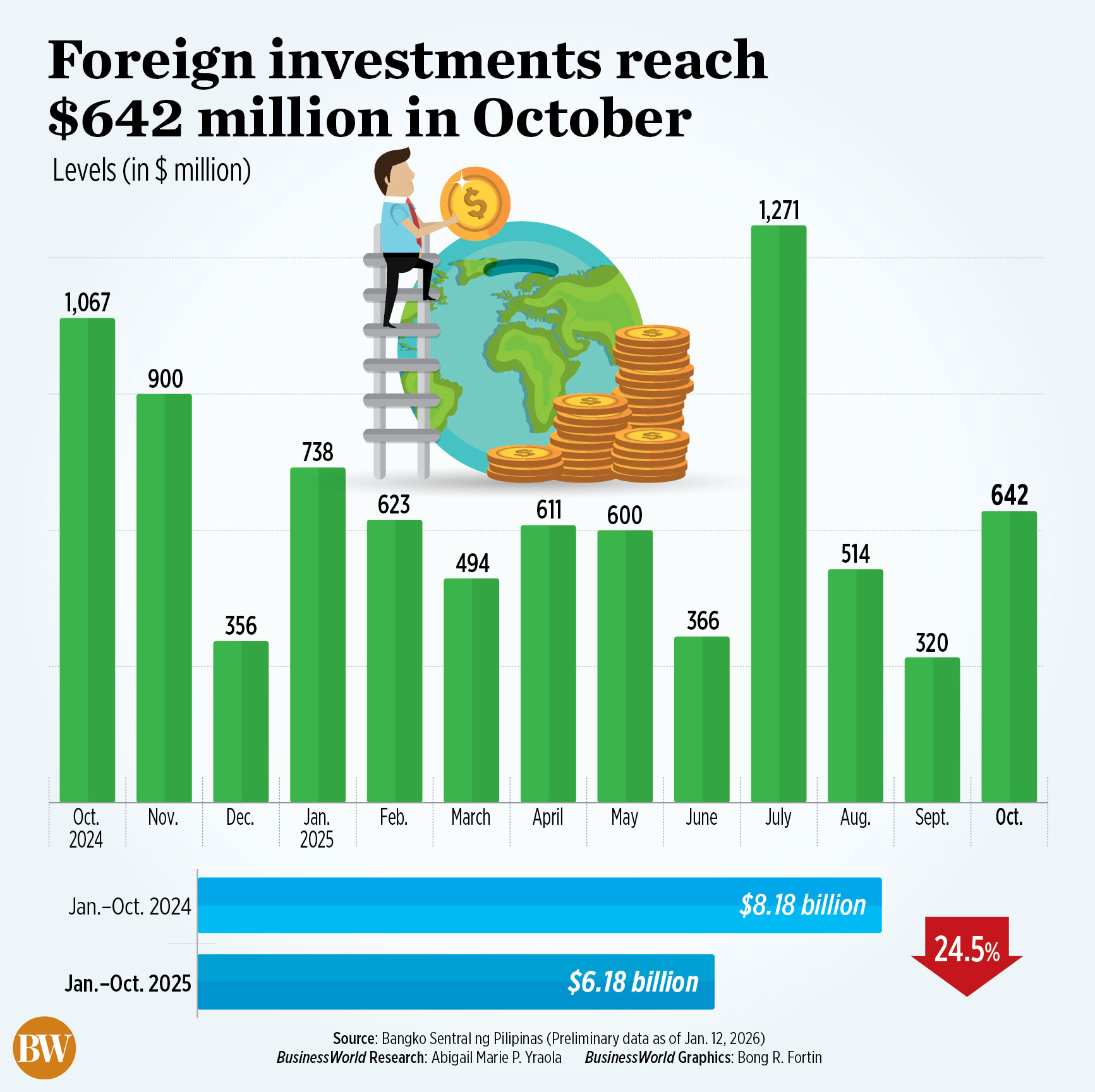
Foreign investments reach $642 million in October

NET INFLOWS of foreign direct investments (FDI) into the Philippines plunged nearly 40% year on year in October, as foreigners’ net investments in debt instruments slumped. Read the full story.