Home Blog Page 1130

PhilSME eyes franchising expo in November

THE PHILIPPINE SME Business Network (PhilSME) plans to hold another exposition on franchising in November after attracting 12,000 visitors to its 16th Philippine SME Business Expo and Conference this month, according to its top official.

“This is more about business solutions with the major component of franchising opportunities and solutions,” Trixie E. Abrenilla, chief executive officer and managing director at the PhilSME, told BusinessWorld.

The 16th Philippine SME Business Expo and Conference brought fresh elements with a lineup of powerhouse speakers and the introduction of the Malaysian Pavilion, she told a news briefing on May 9.

“The conference lineup, especially for day one, these are the top businesspeople in their industries,” she said. She added that more than 10 Malaysian firms joined this year’s expo.

“They came here to collaborate with Filipino companies and offer their own SMEs (small, medium enterprises) so they can also grow,” she said.

The two-day expo on May 9-10 featured well-known business figures like Chinkee Tan, Cristalle Belo-Pitt and RJ Ledesma, who shared tips on how SMEs could grow.

More than 120 exhibitors, mostly SMEs, had the opportunity to network with other businesses and potential partners.

The initiative supports MSMEs, which account for more than 99% of businesses in the country and contribute 40% of economic output, PhilSME said in a separate statement.

“We created PhilSME to guide SMEs toward practical, real-world business solutions, and this year, we witnessed powerful exchanges and partnerships take shape right on our expo floor,” Ms. Abrenilla said.

She said the event attracted about 12,000 visitors, surpassing their 10,000 target. — Edg Adrian A. Eva

Dollar set for more weakness as ‘Brand USA’ falls further out of favor

REUTERS

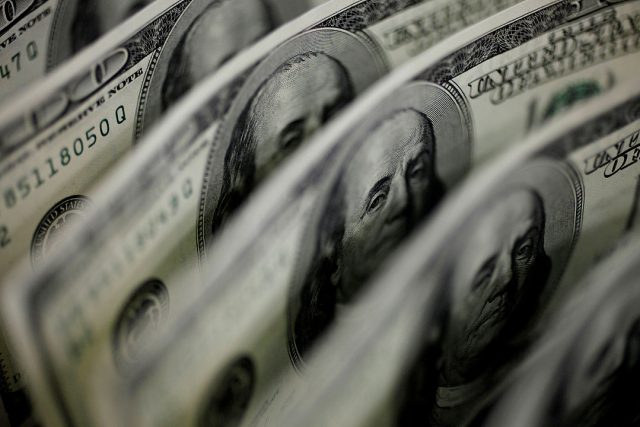
NEW YORK — Trade-related uncertainties, ballooning fiscal debt and weakened confidence about enduring US exceptionalism have weighed on US assets, with the dollar one casualty. Investors see the currency losing more of its luster as the greenback comes back to earth from lofty valuations.

The Trump administration’s tariffs salvo this year prompted investors to cut exposure to US assets after a long period of overperformance. While the US currency steadied somewhat in recent sessions as investors took heart from a truce in the ongoing US-China trade war, it came under renewed selling pressure after ratings agency Moody’s cut the United States’ pristine sovereign credit rating by one notch.

“There’s plenty of room for further depreciation, purely from a valuation perspective,” said George Vessey, lead FX and macro strategist at payments firm Convera. The “sell America” trade was back in focus after Moody’s US credit downgrade, he said.

The US dollar index has tumbled as much as 10.6% from its January highs, one of the sharpest retreats for a three-month period, leaving speculators net short the dollar to the tune of $17.32 billion, close to the most bearish position on the buck since July 2023, according to CFTC data.

Part of the bearishness around the dollar has been due to the currency trading at a relatively rich valuation — in January trading as high as 22% above its 20-year average of 90.1 on the dollar index. Currently, the index is hovering about 10% above its 20-year average level.

There is room for it to weaken significantly further, for example another 10% slide would take it to the lows touched during President Donald J. Trump’s first term.

LONG-TERM CONCERNS
Investors and strategists have viewed the dollar as overvalued for years but betting against the currency has proved painful time and again, as the US economy powered on. That could be about to change.

Steve Englander, head of global G10 FX Research at Standard Chartered in New York, said that while recent trade arrangements might calm markets somehow, they do not address long-term confidence issues facing the US.

“The dollar weakness story is not over,” said Mr. Englander.

Investors are also concerned about the long-term fiscal picture for the United States. Analysts say Mr. Trump’s sweeping tax-cut bill would add $3 trillion to $5 trillion to the nation’s $36.2 trillion in debt over the next decade.

“The combination of diminished appetite to buy US assets and the rigidity of a US fiscal process that locks in very high deficits is what is making the market very nervous,” George Saravelos, global head of FX research at Deutsche Bank, said in a note.

The Trump administration has said it backs a strong-dollar policy.

“President Trump has been unequivocally clear about maintaining the strength and power of the US dollar as the world’s reserve currency,” White House spokesperson Kush Desai said.

FOREIGN HOLDINGS
Despite recent foreign selling, years of US asset appreciation mean the world still holds trillions in US equities and Treasuries.

Such selling pressure could come from various corners of the globe as more people zero in on the dollar’s recent failure to act as a haven, investors said.

“That’s really what gave people a jolt… and say ‘Well, if the dollar is no longer acting as a safe-haven currency, if it’s not diversifying us any longer, should we really be holding this much of it?’” said Peter Vassallo, FX portfolio manager at BNP Paribas Asset Management.

Colin Graham, head of multi-asset strategies at Robeco in London, however, said that while there had been a rebalancing of portfolios where people wanted to cut risk, “it hasn’t turned into people selling dollars, assets or equities or Treasuries to repatriate yet.” That could still follow, he said.

UNHEDGED RISK
The dollar’s strength over the last decade had let market participants hold US assets without worrying too much about currency risk.

With foreign holdings of US assets in trillions of dollars, per estimates from banks, including Deutsche Bank, even a modest rise in hedge ratios — the portion of foreign currency exposure that is protected — could spell significant selling.

Increased hedging by investors means less direct demand for the dollar and more dollar selling pressure in the forward markets.

Asian economies including China, South Korea, Singapore and Taiwan have accumulated massive USD exposure as a result of a decades-long trend of investing big trade surpluses in US assets.

An unprecedented two-day surge in Taiwan’s currency in early May showed investors how a scramble out of the US dollar could roil markets.

Eurizon SLJ Capital’s Stephen Jen and Joana Freire said in a note in early May that USD hoardings of about $2.5 trillion by Asian exporters and institutional investors “pose sharp downside risks to the dollar vis-à-vis these Asian currencies.”

One counterargument to the bearish dollar story, however, is the resilience of the US economy.

Should economic growth surprise on the upside, it could keep the US Federal Reserve on hold for longer and support the buck.

Jack McIntyre, portfolio manager at Brandywine Global, noted that US consumers have remained resilient so far in the face of bets on weakness. Still, he and others were more inclined to sell rallies in the dollar than bet on a rebound.

“The story is more kind of looking for opportunities to sell dollars on strength right now,” Mr. McIntyre said. — Reuters


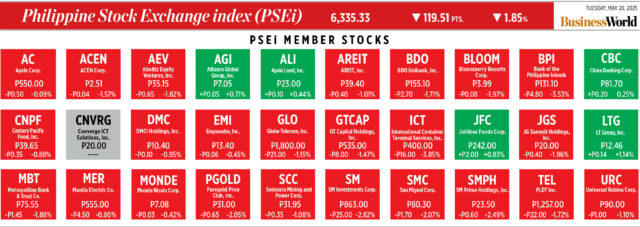
How PSEi member stocks performed — May 20, 2025

Here’s a quick glance at how PSEi stocks fared on Tuesday, May 20, 2025.


Philippines continues to fall in Global Startup Ecosystem Index

THE PHILIPPINES dropped four spots in the 2025 Global Startup Ecosystem Index amid persistent gaps in infrastructure and regulations, according to global research firm StartupBlink. Read the full story.

Philippines continues to fall in Global Startup Ecosystem Index

Peso rebounds as markets await US tax bill vote

PHILIPPINE STAR/ MIGUEL DE GUZMAN

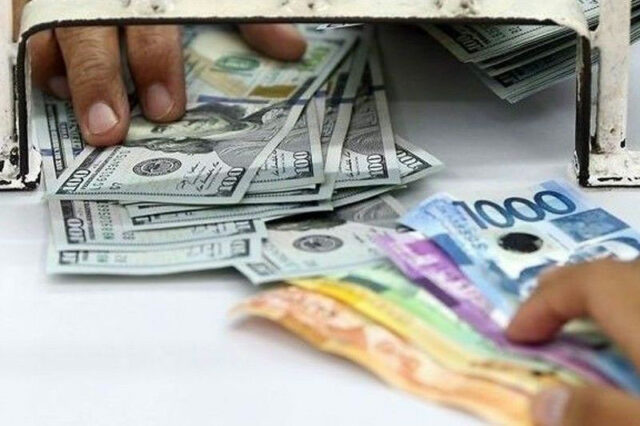
THE PESO rebounded slightly on Tuesday as the dollar remained under pressure following the downgrade of the US’ credit rating.

The local unit closed at P55.63 per dollar, strengthening by four centavos from its P55.67 finish on Monday, Bankers Association of the Philippines data showed.

The peso opened Tuesday’s session weaker at P55.73 against the dollar, which was also its worst showing. Its intraday best was at P55.57 versus the greenback.

Dollars exchanged rose to $1.999 billion on Tuesday from $1.41 billion on Monday.

The peso rose “on mounting concerns over the US economy, still following Moody’s credit rating downgrade,” a trader said in a phone interview.

The downgrade caused the dollar to weaken against most currencies, which also supported the local unit’s recovery, Rizal Commercial Banking Corp. Chief Economist Michael L. Ricafort said in a Viber message.

For Wednesday, the trader expects the peso to move between P55.50 and P55.80 per dollar on Tuesday, while Mr. Ricafort said it could range from P55.55 to P55.75.

The dollar traded sideways on Tuesday after declining for a week, hemmed in by the US Federal Reserve’s caution over the economy and as US lawmakers came closer to passing a bill expected to widen the nation’s fiscal deficit, Reuters reported.

The greenback sold off broadly on Monday following last week’s downgrade of the US sovereign rating by Moody’s on deficit concerns. Now attention turns to a critical vote in Washington over US President Donald J. Trump’s sweeping tax cuts.

Mr. Trump was expected to join the congressional debate over his tax bill on Tuesday. The vote comes after Moody’s stripped the US government of its top-tier credit rating, citing concerns over the nation’s growing $36.2-trillion debt pile.

Mr. Trump’s bill would add $3 trillion to $5 trillion to the debt, according to nonpartisan analysts. Ballooning fiscal debt, trade frictions, and weakened confidence about enduring US exceptionalism have weighed on US assets. The US dollar index has tumbled as much as 10.6% from its January highs, one of the sharpest retreats for a three-month period.

The dollar got a breather after Mr. Trump paused many of the largest tariffs he announced last month. But comments from Japan’s top trade envoy on Tuesday that Tokyo was firm in its anti-tariff stance pointed to no easy off-ramp in the negotiations in the weeks and months ahead.

And in the wake of Mr Trump’s tariff turmoil, Britain on Monday agreed to the most significant reset of defense and trade ties with the European Union since Brexit.

The greenback was little changed at 144.75 yen after touching 144.66 on Monday that was the weakest since May 8. The dollar index slid 0.1% after losing 0.6% in the previous session. — A.M.C. Sy with Reuters

PSEi falls to 6,300 level as BoP deficit widens

REUTERS

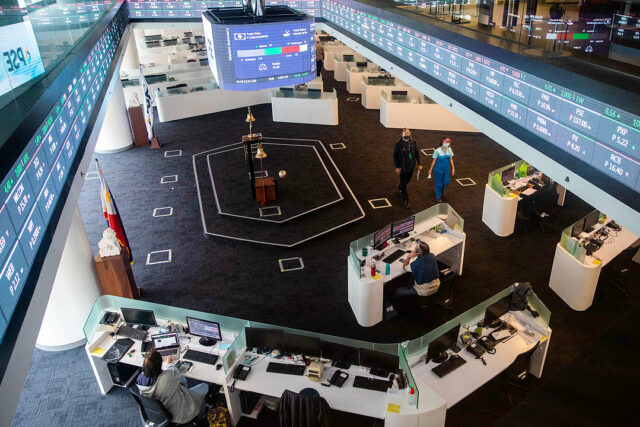
PHILIPPINE STOCKS slid further on Tuesday, with the main index falling to the 6,300 level, following weak data on the country’s external position and amid heightened cautiousness after Moody’s cut the United States’ credit rating.

The bellwether Philippine Stock Exchange index (PSEi) fell by 1.85% or 119.51 points to close at 6,335.33, while the broader all shares index dropped by 1.19% or 45.09 points to 3,720.57.

This was the PSEi’s lowest close in three weeks or since its 6,252.19 finish on April 29. The index has now ended in the red for five consecutive sessions.

“The local market plunged as investors dealt with the further widening of the Philippines’ balance of payments (BoP) deficit last April, which hit $5.52 billion,” Philstocks Financial, Inc. Senior Research Analyst Japhet Louis O. Tantiangco said in a Viber message. “Investors also digested the 10% drop in new vehicle sales in the Philippines, taking it as a sign of challenged consumption in the country.”

The Bangko Sentral ng Pilipinas said on Monday that the country’s BoP deficit widened to $2.56 billion in April from the $639-million gap in the same period last year and the $1.97-billion shortfall in March as the government paid back its external debt.

For the first four months, the country’s external position was at a $5.52-billion deficit, wider than the $401-million gap last year.

“Philippine shares extended their decline as investors grew more wary, opting to scale back their holdings after initial optimism waned following Moody’s US downgrade,” Regina Capital Development Corp. Head of Sales Luis A. Limlingan said in a Viber message.

On Friday, Moody’s lowered the US sovereign credit rating to “Aa1” from “Aaa” amid concerns over the country’s growing $36-trillion outstanding debt.

Asian stocks rose on Tuesday as investors took stock of the debt load of the world’s biggest economy and awaited trade deals, Reuters reported. MSCI’s broadest index of Asia-Pacific shares outside Japan was 0.33% higher, hovering near the seven-month high touched last week.

All sectoral indices closed lower on Tuesday. Services sank by 2.2% or 47.54 points to 2,107.80; financials went down by 1.98% or 47.66 points to 2,350.33; holding firms declined by 1.83% or 100.21 points to 5,375.35; mining and oil shed 1.64% or 151.05 points to end at 9,033.68; property retreated by 0.98% or 22.41 points to 2,249.85; and industrials decreased by 0.47% or 43.54 points to 9,037.10.

“LT Group, Inc. was the day’s index leader, climbing 1.14% to P12.46. International Container Terminal Services, Inc. was the day’s worst index performer, dropping 3.85% to P400,” Mr. Tantiangco said.

Value turnover went up to P7.32 billion on Tuesday with 1.35 billion shares traded from the P6.19 billion with 755.08 million issues exchanged on Monday.

Decliners overwhelmed advancers, 126 versus 62, while 55 names closed unchanged.

Net foreign selling grew to P886.21 million on Tuesday from P223.77 million on Monday. — Revin Mikhael D. Ochave

Floor price under study for buying palay from farmers 

A farmer threshes newly harvested palay grains at a ricefield in Mogpog, Marinduque in central Philippines, March 22, 2016. — REUTERS

THE Department of Agriculture (DA) said it is considering setting floor prices for traders buying palay (unmilled rice) from farmers.

The scheme, modeled after practices in Indonesia and Thailand, will encourage farmers to plant rice in the next cropping season, Agriculture Assistant Secretary Arnel V. de Mesa told reporters.

“If our farmers are assured that their harvests will be sold profitably, they will be encouraged to plant more in the next cropping season,” he said.

The DA is currently tracking areas where  farmgate prices are unusually low, with traders enjoying leverage over farmers because they control milling, storage, and transport. Competition from cheaper imported rice is also forcing them to hedge against being stuck with expensive inventories of domestic rice.

Mr. De Mesa said the DA is studying the Price Act, the Anti-Agricultural Economic Sabotage Act, and other laws that could serve as the legal basis for imposing such a floor price.

The department said earlier this week that it was looking into reports that traders are paying farmers as little as P13 per kilo for their palay in Luzon.

The buying price set by the National Food Authority is between P18 and P24 per kilo for clean and dry palay.

The government projects a 24.4 million metric-ton (MMT) palay harvest this year due to favorable weather.

The volume of palay production rose to 4.7 MMT in the three months to March, from 4.69 MMT a year earlier.

The government is currently selling subsidized rice at P20 per kilo to vulnerable segments of society like the poor and persons with disabilities. Mr. De Mesa said the program will be expanded to lower middle-income families, with the government planning to observe its impact on farmgate and retail prices. — Kyle Aristophere T. Atienza

PSA says illiteracy figures for high school grads misreported

A boy picks out a book at Hernando Guanlao's communal library in Makati, Metro Manila, Philippines, Feb. 7, 2024. -- REUTERS

THE Philippine Statistics Authority (PSA) said recent reports on illiteracy levels of high school graduates are inaccurate, and clarified that the correct number is 5.58 million 2024 graduates that are “basically literate but not functionally literate.”

It was responding to reports that 19 million graduates are “functionally illiterate,” saying that it reported no such statistic.

“The PSA has no report, in any form, stating that the estimated number of functionally illiterate high school graduates and junior high school completers is 19 million,” it said, citing the results of its 2024 Functional Literacy, Education, and Mass Media Survey. 

The PSA said the “not functionally literate” category, which had been misreported as “functionally illiterate,” covers graduates who can read, write, and compute only.

It said the 19 million figure reported referred to “basically literate but not functionally literate” individuals ages 10 to 64 years old regardless of highest grade completed — not high school and junior high school graduates only.

The estimated number of “not functionally literate” high school graduates, including junior high school completers aged 10 to 64 years is 6.45 million in 2024, it said. 

Meanwhile, the “not functionally literate” population between 10 and 64 years old, regardless of highest grade completed, is estimated at 24.83 million.

In the report, the PSA said among persons for ages five years old and over, 6.9% cannot read and write and can be classified as illiterate. — Aubrey Rose A. Inosante

Midterm election result reflects ‘dissatisfaction’ with economy

The Commission on Elections (COMELEC) officially proclaimed the 12 winning senators of the 2025 Philippine midterm elections at the Manila Hotel Tent City in Manila.

THE outcome of the midterm elections reflects general dissatisfaction with President Ferdinand R. Marcos, Jr.’s handling of the economy, GlobalSource said.

Voters took issue mainly with high food prices and swelling debt, according to a report by GlobalSource Country Analysts Diwa C. Guinigundo and Wilhelmina C. Mañalac.

“What is also significant in the outcome of this midterm election is that the electorate seems to be showing its general dissatisfaction, especially with the economic management of the Marcos administration,” they said.

“While inflation continues its downtrend, prices remain elevated, especially for food products.”

They added that the downtrend may not be sustainable as it was achieved “by extending a food subsidy, which will only be in effect for a few months, and by reducing tariff duties on rice imports, obviously for political reasons.”

Headline inflation slowed to 1.4% in April from 1.8% in March and 3.8% a year earlier. This brought average inflation in the first four months to 2%.

In June, Executive Order 62 slashed rice import tariffs to 15% from 35% until 2028.

Mr. Guinigundo and Ms. Mañalac also noted the debt situation, which stood at P16.68 trillion at the end of March. 

Philippine debt as a share of gross domestic product rose to 62% at the end of the first quarter, the highest in 20 years.

“President BBM will have to outdo himself and focus more on building a legacy of good economic, political and social governance by pursuing strategic policy and structural reforms in order to invest the Philippine economy with greater potential and resiliency,” they said. — Aubrey Rose A. Inosante

PHL-EU trade up 3.8% in 2024

REUTERS

TRADE between the European Union (EU) and the Philippines grew 3.8% in 2024 to 16.8 billion euros, the EU Delegation to the Philippines said.

Philipp Dupuis, minister counselor and head of the economic and trade section of the EU Delegation, said: “EU imports from the Philippines grew 3.1% to 9.1 billion euros. EU exports to the Philippines increased 4.7% to 7.7 billion euros,” he said in an e-mail.

“Electronic products remain the main export of the Philippines to the EU in terms of value at 6.3 billion euros in 2024. The majority of these products enjoy a most favored nation (MFN) rate of 0%,” he added.

Philippine exports to the EU include 2.8 billion euros worth of goods admitted under the EU Generalized Scheme of Preferences Plus (GSP+) scheme.

“This brings the Philippines’ GSP+ utilization rate to a record high of 80% in 2024,” he added.

He said that the Philippine exports that benefited from GSP+ accounted for 25% of the country’s total exports to the bloc.

“The main beneficiaries are the agri-food, chemicals, and footwear sectors,” he added.

The Philippines participates in the GSP+ scheme, a special incentive arrangement for low and lower middle-income countries, under which over 6,000 Philippine products are admitted duty-free.

The Philippines will lose its EU GSP+ eligibility once it reaches upper middle-income status and maintains it for three consecutive years. The government is hoping to achieve upper middle-income status next year.

The Philippines and the EU are negotiating a free trade agreement (FTA), which is set to improve on the market access provided under GSP+.

The parties are set to hold a third round of negotiations for the FTA next month. — Justine Irish D. Tabile

Common station contract could be offered as PPP

DEPARTMENT OF TRANSPORTATION

THE Department of Transportation (DoTr) will once more bid out the contract to build the common station for Metro Manila’s commuter railways, with a public-private partnership (PPP) under consideration.

“We are looking for other modes of procurement. We can do this through bidding, but we can also do this via PPP. We are now assessing how we can do this,” Transportation Secretary Vivencio B. Dizon told reporters on Tuesday.

Last week, the DoTr issued a notice of termination to the contractors of the Unified Grand Central Station at North Avenue-EDSA, Quezon City, also known as the common station for the Metro Rail Transit (MRT) and Light Rail Transit (LRT) lines and the Metro Manila Subway.

The contractors — BF Corp. and Foresight Development and Surveying Co. (BFC-FDSC) were terminated due to excessive delays, the DoTr said.

“For now, we are looking at PPP because it would be the fastest,” Mr. Dizon said.

The BFC-FDSC consortium signed a P2.8-billion agreement with the government in 2019 for the construction of Area A of the Unified Grand Central Station project.

The project aims to link Metro Manila’s main commuter rail lines, including LRT-1, MRT-3, MRT-7, and eventually the Metro Manila Subway.

The project was initially targeted for completion in the first quarter of 2021. It was designed to have three sections, each built separately: Area A by BFC-FDSC, Area B by Ayala Corp., and Area C by San Miguel Corp., the concessionaire for the MRT-7 project.

Mr. Dizon said the DoTr is now hoping to complete the common station project by early 2027, in line with the target completion of MRT-7 which is projected to start full operations by 2026.

Foresight Development and Surveying Co. was formerly registered with the Securities and Exchange Commission on March 25, 1997, as Foresight Surveying Co., with a primary focus on surveying and related geodetic engineering services.

Meanwhile, BF Corp., founded by former Metropolitan Manila Development Authority Chairman Bayani F. Fernando, is primarily engaged in general construction and engineering.

The DoTr is also studying the possibility of imposing penalties against the joint-venture company over the delays, Mr. Dizon said, adding that the department is not yet studying the possibility of filing charges against the contractor.

“What we are discussing right now are the financial obligations,” Mr. Dizon said.

Asked to comment, the BF-FSDC consortium said it had complied with its contractual obligations and delivered all the engineering work for the project, but experienced payment delays.

“The undue and habitual delays in payment of quality work forced BF-FSDC consortium to stop work, since 2024; otherwise, its financial standing and quality reputation would be severely impaired… The work stoppage was solely due to DoTr’s prolonged non-payment of completed work,” it said. — Ashley Erika O. Jose

Manila Water targets completion of upgrades at Cardona plant by Sept.

MANILAWATER/SCOTT WOODWARD

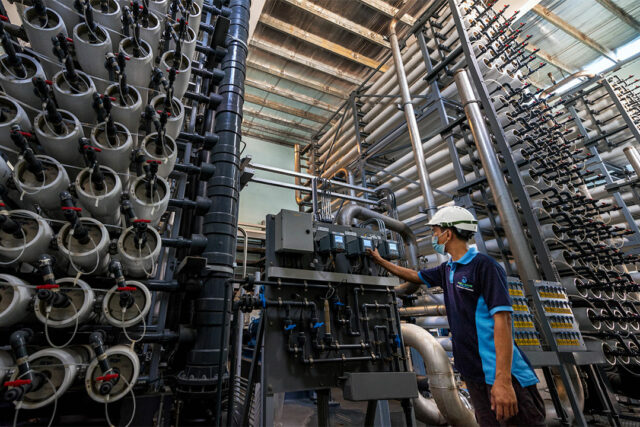
EAST ZONE concessionaire Manila Water Co., Inc. said it is hoping to complete a wastewater recovery project at its Cardona treatment plant in Rizal by September.

“The wastewater recovery project at the Cardona Treatment Plant does not only enhance our efficiency and reduces costs but also plays a crucial role in minimizing environmental impact,” Manila Water Communications Affairs Group Director Jeric T. Sevilla said in a statement on Tuesday.

The P13-million improvement involves the installation of a 200-millimeter diameter high-density polyethylene (HDPE) pipeline with concrete encasement, as well as a 110-millimeter diameter HDPE pipeline.

A key component of the project is the supply and installation of four 7.5-kilowatt submersible pumps with a capacity of 1.5 million liters per day (MLD), new wastewater recovery pumps, valves, and other equipment.

Manila Water said these elements are “crucial for the efficient handling and transportation of brine wastewater during treatment.”

Upon completion of the project, the improved facility will treat and reuse over 6 MLD of brine wastewater.

The company said advanced automation systems will streamline operations, reduce costs, improve treatment performance, and mitigate environmental impact.

The Cardona water treatment plant currently yields 100 MLD of potable treated water drawn from Laguna de Bay. It distributes potable water to a service area with a population of about 800,000.

Manila Water provides water supply, wastewater, and sanitation services to over 7.3 million customers in 23 cities and municipalities in the east zone of Metro Manila, as well as Rizal province.

Outside the east zone, Manila Water operates in Laguna, Clark, and Boracay. — Sheldeen Joy Talavera