Home Blog Page 111

Long-term solutions needed to reduce dependence on fossil fuels in PHL – Oxfam

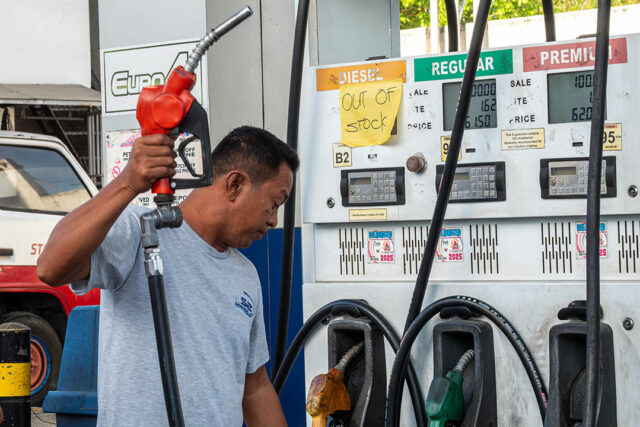
MOTORISTS queue at a gasoline station along Norzagaray Road in San Jose del Monte on March 8, 2026. — PHILIPPINE STAR/RYAN BALDEMOR

The Philippine government must pursue long-term solutions to reduce the country’s dependence on fossil fuels, as global oil price surges continue to weigh on Filipino consumers, according to Oxfam Pilipinas on Friday.
The call comes after Philippine President Ferdinand R. Marcos Jr. declared a state of national energy emergency last Tuesday in response to rising oil prices linked to escalating tensions in the Middle East.

“Oxfam Pilipinas believes that while the executive order provides a mandate to respond to disruptions in the global energy supply and its impacts on the domestic economy, the government must think of long-term solutions to transition away from fossil fuel dependence and accelerate the renewable energy (RE) transition,” Maria Rosario “Lot” Felizco, executive director of Oxfam Pilipinas said in a statment.

The group also urged the government to address the country’s reliance on imported, privately owned oil, warning that consumers continue to bear the brunt of price volatility.

It also highlighted the need to maximize indigenous RE sources and modernize the power grid as part of a long-term strategy.

“We are facing a polycrisis of increased inequality, climate impacts, and an energy crisis. The national energy emergency must ensure energy solutions are 1.5°C-aligned and provide safeguards for Filipinos now and in the future,” Ms. Felizco said.

Oxfam Pilipinas also called for an immediate end to the ongoing Middle East conflict, citing its catastrophic impact on civilians, including Palestinians in Gaza.

Meanwhile, the Department of Energy (DoE) said another round of price adjustments will take effect for the week of March 24 to 30, with gasoline products (RON 97, 95, and 91) increasing by P8.00 to P12.00 per liter, diesel and diesel plus by P15.00 to P18.00 per liter, and kerosene by P12.00 to P22.00 per liter.

Following these adjustments, the estimated pump price range for Metro Manila and other highly urbanized areas will be: P87.69 to P112.40 per liter for RON 97, P83.10 to P109.78 for RON 95, P82.60 to P102.50 for RON 91, P107.00 to P134.30 for diesel, P114.99 to P144.20 for diesel plus, and P111.99 to P165.79 for kerosene. — Edg Adrian A. Eva

EU agrees to fine online platforms importing unsafe products

STOCK PHOTO | Image by andrespradagarcia from Pixabay

BRUSSELS — The European Union agreed on Thursday to an overhaul of its customs system, including a crackdown on mainly Chinese e-commerce platforms that face potential fines if they sell illegal or unsafe products into the bloc.

The 27-nation bloc is seeking to coordinate collection of duties and safety checks as it struggles to manage the high volume of low-value e-commerce parcels entering the bloc, with the total reaching 5.8 billion in 2025.

Representatives of the European Parliament and EU governments struck a provisional deal late after negotiations running into Thursday evening to clarify final details.

Under the new system, online platforms that sell into the bloc will be treated as importers and responsible for payment of duties and product safety. Companies repeatedly flouting EU rules could face fines of between 1 and 6% of their total sales into the EU over the previous 12 months.

The EU does not apply customs duty on parcels valued at less than 150 euros ($173.85), which has fueled rapid growth of online shopping platforms such as Shein, Temu, and AliExpress that send consumers packages direct from China.

The bloc aims to scrap the duty exemption and plans to impose a 3 euro fee from July as a interim measure. The European Commission will also now determine an additional handling fee to be imposed from November 1.

On Wednesday, French city Lille was selected as the location of the future EU Customs Authority (EUCA), whose 250 staff will oversee a new EU data hub that will provide a more centralized and digital view of incoming goods.

The data hub is slated to open for e-commerce consignments in 2028 and cover all imported goods by March 1, 2034.

EU LAWMAKERS TO VISIT CHINA
Next week, the EU will send a nine-member delegation to Beijing and Shanghai to address challenges in the digital and e-commerce sector as well as foster fair competition between China and the bloc, a statement from the EU Delegation to China on Thursday showed.

Over three days, the European lawmakers will meet with Chinese legislators and market regulators as well as Shein, Alibaba, and Temu.

The bloc’s concerns over product safety were highlighted by a study published by the European Commission this month. It found that 60% to 65% of imported cosmetics, including make-up, food supplements and personal protective equipment, such as bicycle helmets, did not comply with EU safety rules.

“A top concern … are the systemic breaches of EU laws and the high volume of non-compliant small parcels coming from non-EU online platforms, including from China,” the EU statement said.

In what would be the first EU parliamentary visit in eight years, the engagements are expected to focus on digital regulation, consumer protection, and compliance with product safety rules. — Reuters

India cuts excise duties on gasoline, diesel as global oil prices surge

PHILSTAR FILE PHOTO

NEW DELHI — India has slashed excise duties on gasoline and diesel to protect consumers and rein in a potential spike in inflation, while imposing windfall taxes on aviation fuel and diesel exports, amid volatile global oil markets as a result of the Iran war.

Economists said the tax cuts will hit government finances.

Global oil prices have surged past $100 per barrel after the near closure of the Strait of Hormuz, which ​serves as a conduit for 40% of India’s crude oil imports, since the US and Israel first struck Iran on February 28.

In a government order released late on Thursday, India’s finance ministry reduced the special excise duty on gasoline to 3 rupees ($0.0318) per liter from 13 rupees earlier. It also cut the duty on diesel to zero from 10 rupees per liter.

The government did not say how much the duty cuts would cost. The move comes ahead of elections next month in four Indian states and one federal territory with Indian voters known to be extremely sensitive to higher prices.

“Government has taken a huge hit on its taxation revenues to ensure very high losses of oil companies, approximately 24 rupees a liter for gasoline and 30 rupees a liter for diesel, at this time of sky high international prices, are reduced,” Oil Minister Hardeep Singh Puri said in a post on X.

Madhavi Arora, an economist at Emkay Global, estimated the annualized fiscal hit to be nearly 1.55 trillion rupees. The duty cuts would absorb about 30% to 40% of annual losses of oil marketing companies on auto fuel at current prices, she added.

The yield on 10-year government bonds rose 7 basis points to 6.95%, its highest level in 20 months.

Shares of oil marketing companies like Bharat Petroleum Corp and HPCL rose more than 4% at the open, but later pared gains.

While fuel prices in India are technically deregulated, oil companies do not always raise prices when crude oil costs increase.

WINDFALL TAX ON EXPORTS
The diesel export tax was set at 21.5 rupees a liter as well as a 29.5 rupees a liter tax on the export of aviation fuel, the order said.

Between April 2025 and January 2026, India exported 14 million metric tons of gasoline and 23.6 million tons of gasoil. Most Indian state-run refiners have largely stopped exporting fuels, and Reliance Industries is the country’s biggest fuel exporter.

The tax would ensure adequate availability of these products for domestic consumption, Finance Minister Nirmala Sitharaman said in a post on X.

India is the world’s third-biggest oil importer and consumer and imports most of its fuel.

The South Asian country consumed 33.15 million metric tons of cooking gas last year, with imports accounting for about 60% of demand. About 90% of those imports came from the Middle East.

Prime Minister Narendra Modi and his government have stressed adequate arrangements are in place, including for the supply of fertilizers for the summer sowing season and coal to meet the rising demand for electricity. ($1 = 94.1980 Indian rupees) — Reuters

South Korea’s Lee to pursue wartime command, selective conscription

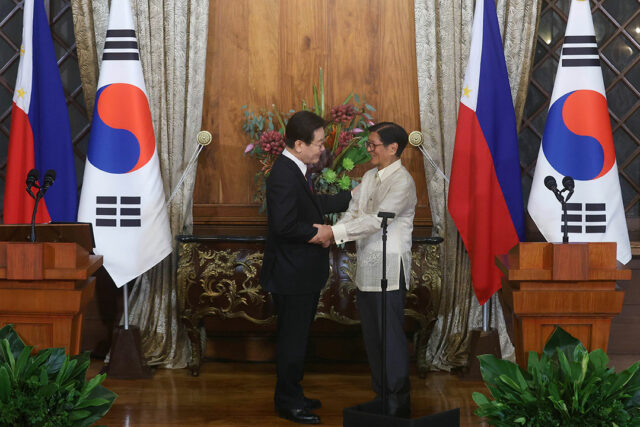
PRESIDENT Ferdinand R. Marcos, Jr. (R) and President Lee Jae Myung of the Republic of Korea witness the exchange and presentation of signed agreements at the President’s Hall in Malacañan Palace on March 3, 2026. — PPA POOL/MARIANNE BERMUDEZ

SEOUL — South Korean President Lee Jae Myung on Friday said the country would seek to reclaim wartime operational control from the US at an early date, underscoring the need for greater military self-reliance.

In a meeting with military leaders at the defense ministry, Lee also said the government would pursue military reform such as implementing selective conscription to better reflect demographic and security realities.

Mr. Lee cited wars in Ukraine and the Middle East, as well as tension on the Korean Peninsula, saying the armed forces’ foremost responsibility was to maintain readiness to respond to provocation by North Korea.

“The ironclad South Korea-US alliance is an essential pillar of peace and stability on the peninsula but excessive dependence is not desirable,” Mr. Lee said.

“The transfer of wartime operational control will be pursued swiftly.”

Currently, the US would command allied troops in the event of war on the Korean peninsula, but successive South Korean governments have sought to regain wartime operation control.

Mr. Lee’s administration has signaled it aims to finalize the process during his term, which runs through 2030, once South Korea meets a set of military capability conditions agreed with the US.

Mr. Lee said South Korea’s military must be prepared to take a leading role in defending the peninsula, calling for a shift toward a “smarter, stronger military” equipped to deal with future battlefields shaped by advanced technology.

The armed forces are largely made up of conscripts, with most men required to serve for around 18 months, reflecting the country’s status as still at war with North Korea in the absence of a peace treaty following a 1953 armistice.

Selective conscription was a theme in Mr. Lee’s presidential campaigns, during which he pledged to retain mandatory service but allow eligible recruits to choose volunteer or alternative pathways and adjust service terms to address South Korea’s shrinking military manpower brought about by demographic change. — Reuters

Trade gap widens to $3.68B in February

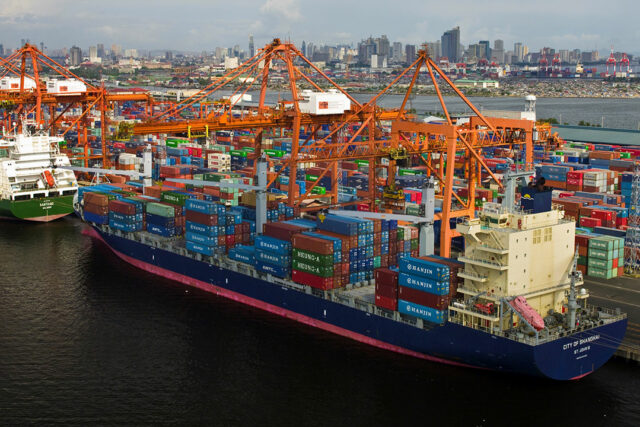
A view of the Manila International Container Terminal. — COURTESY OF ICTSI

THE Philippines’ trade-in-goods deficit widened year on year in February as imports rose by double-digits while exports eased, the Philippine Statistics Authority (PSA) reported on Friday.

Analysts said that February trade data suggests that recovery remains intact but vulnerable to external shocks due to the rising energy prices from the Middle East conflict.

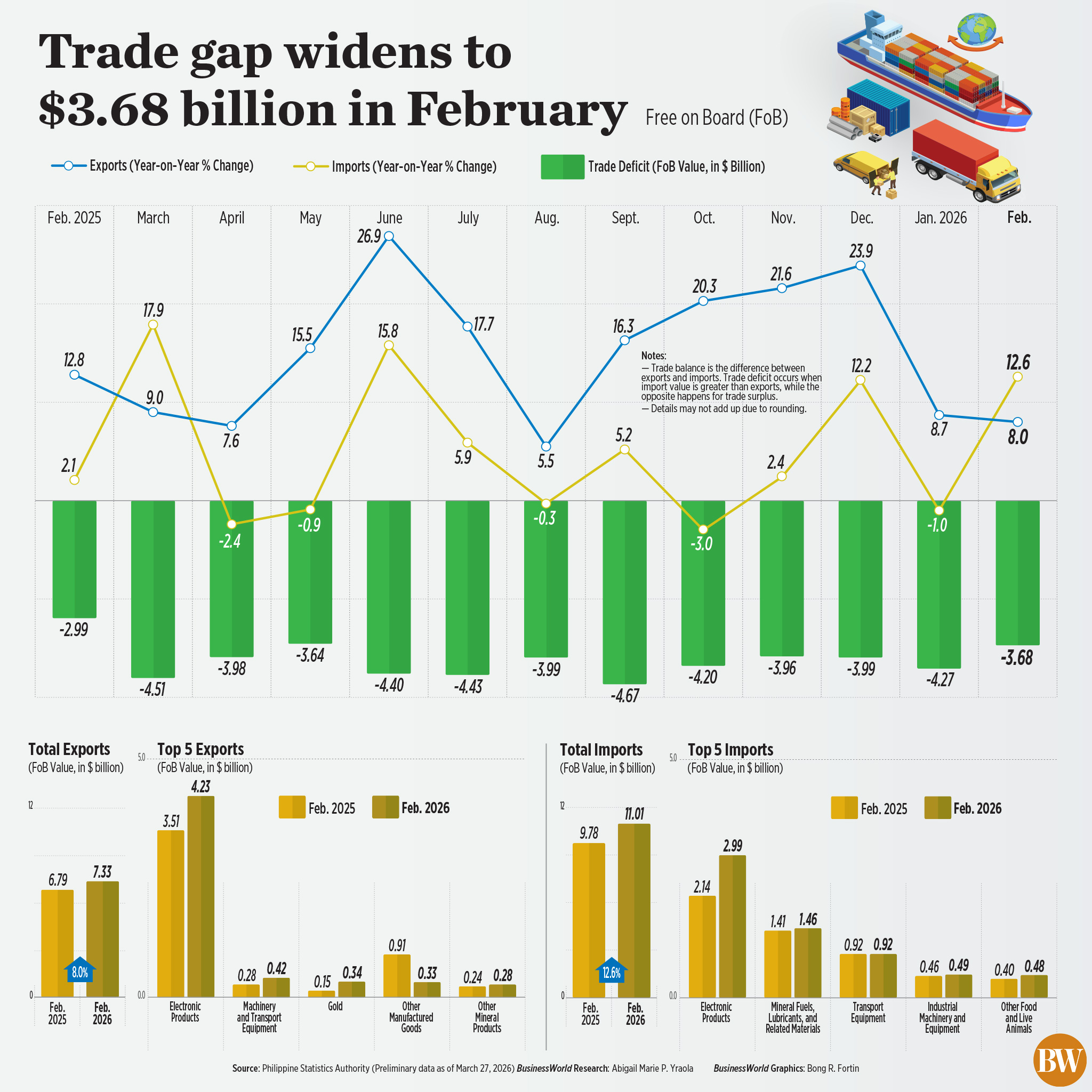
Preliminary data from the PSA showed that the country’s trade balance — the difference between exports and imports — reached a $3.68-billion deficit in February, 23.1% wider than the $2.99-billion gap posted a year earlier.
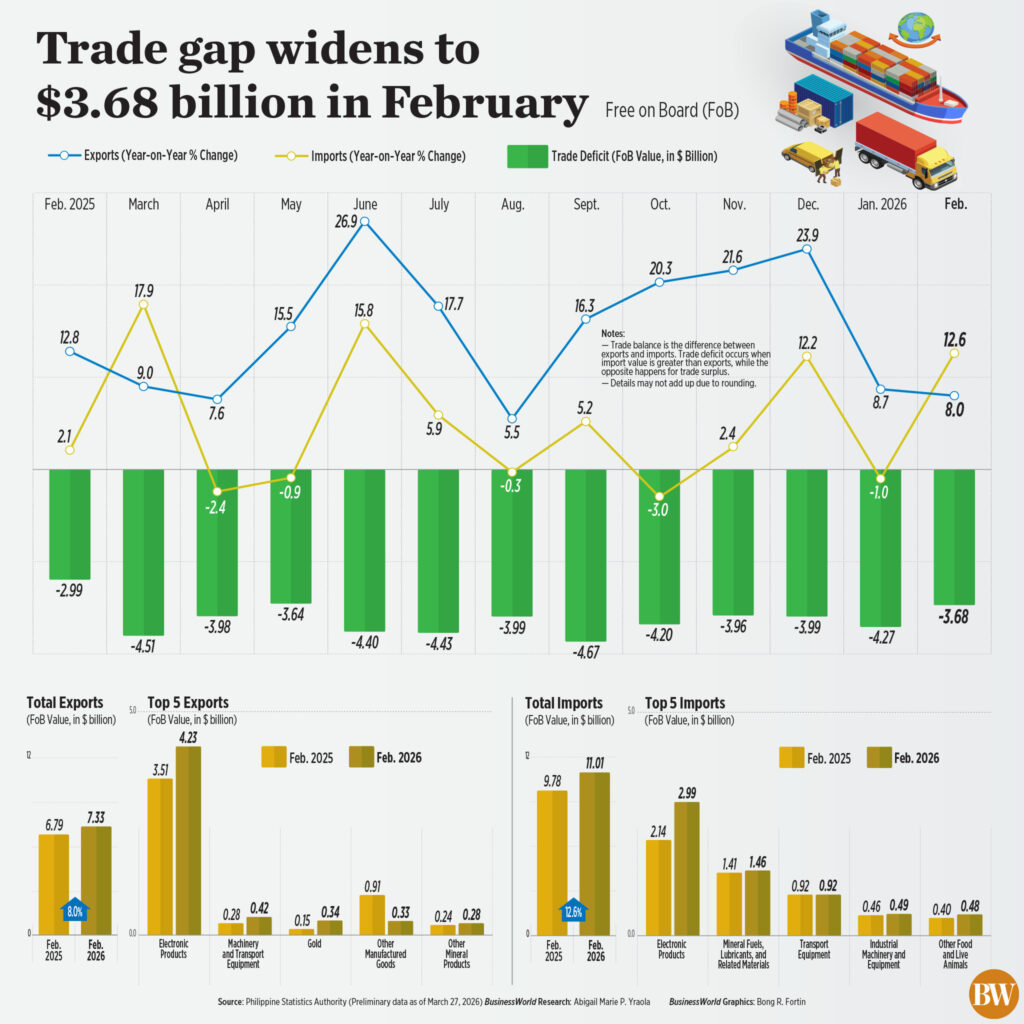
Month on month, the trade gap narrowed from the revised $4.27 billion posted in January.

February saw the smallest trade balance in nine months or since the $3.64 billion recorded in May 2025.

Merchandise imports climbed by 12.6% year on year in February 2026. It was faster than the 2.1% expansion a year ago but a turnaround from the 1% drop in January.

The import bill for that month reached $11.01 billion, bigger than the $9.78 billion in February 2025.

On the other hand, total outbound sales of Philippine-made goods went up by 8% year on year in February to $7.33 billion, slower than the 12.8% expansion in February 2025 and 8.7% gain a month earlier.

It was the slowest pace for exports in six months or since the 5.5% growth in August 2025.

For the first two months of the year, the trade-in-goods deficit widened to $7.96 billion, 0.1% higher than the $7.95 billion-gap in the January-February period last year.

Outbound sale of goods expanded by 8.3% to $14.47 billion in the first two months of 2026, while imports rose by 5.3% to $22.43 billion.

The Development Budget Coordination Committee (DBCC) projects 6% and 5% growth in exports and imports, respectively, this year.

IMPORTS REBOUND
Chinabank Research said in a research note that imports rebounded through near-term growth will largely be driven by oil price effects as the demand for capital goods surged even before the Middle East conflict escalated.

It added that surging oil prices will likely push up total imports and widen the trade deficit in the near term.

“However, softer demand due to supply shortages will correct this price-driven import growth by the second half of the year,” it said.

Ruben Carlo O. Asuncion, chief economist at Union Bank of the Philippines said that the trade deficit widening is due to the double-digit growth in imports, driven by higher purchases of electronic products, capital goods, fuel, and intermediate inputs.

He added that the imbalance mechanically widened the trade gap even as export earnings improved.

“The faster expansion reflects a combination of firm domestic demand, ongoing capital spending, and higher global prices, particularly for energy and industrial inputs,” he said in an e-mail.

Imports of raw materials and intermediate goods in February fell by 13.7% to $3.22 billion. These accounted for 29.3% of the total February import bill.

In February, imports of capital goods grew by 55.5% to $4.15 billion, while the imports of consumer goods also jumped by 10.4% to $2.14 billion.

Imports of mineral fuels, lubricants and related materials increased by 3.8% year on year to $1.46 billion.

China was the top source of imports, accounting for 28.4% of the total or $3.12 billion of the total import bill in February. It was followed by South Korea with an 12.5% share or $1.37 billion and Japan with 8.5% or $933.36 million.

EXPORT GROWTH EASE
“On the export side, growth continued to be supported by the electronics sector, which remains the country’s largest export contributor, alongside gains in machinery and gold,” Mr. Asuncion said.

He added that the modest growth on exports is due to base effects “as February 2025 already posted double‑digit expansion, and lingering softness in global demand in selected non‑electronics products.”

For Chinabank Research, even with the 8% decent growth, the conflict in the Middle East could disrupt supply chains.

“Exports face headwinds from supply chain disruptions and a potential slowdown in global economic activity. This could temper earlier gains from lower-than-expected US tariffs,” it said.
Electronic products, which made up almost three-fourths of manufactured goods and more than half of total exports in February, grew by 20.5% to $4.23 billion.

With 43.7% share from semiconductors of the total exports, it jumped by 26.9% to $3.20 billion.

Exports of mineral products also expanded by 52.7% to $615.26 million in February, while petroleum products declined by 34.5% to $16.54 million.

The United States was the main destination of Philippine-made goods in February, accounting for 19.3% or $1.41 billion in export sales. Other top export destinations were Hong Kong, which accounted for 16% or $1.17 billion and Japan, which accounted for 13.5% or $986.44 million.

Chinabank Research added that exports to the US—the country’s largest export market—surged by 42.9%. The 10% global US tariff currently in place, lower than the reciprocal tariffs that were struck down by the US Supreme Court, could help improve US demand.

“Still, market diversification was evident as US trade policy remains highly uncertain. Shipments to East Asia rose by 14.2% and the EU by 9.5%,” it said.

MIDDLE EAST CONFLICT
Chinabank also said that the conflict in the Middle East poses a significant risk to the country’s trade performance this year.

For Mr. Asuncion, if these geopolitical tensions in the Middle East persists, the most immediate transmission channel would be through higher global oil prices, which could raise the peso value of fuel and transport‑related imports.

“This may again put upward pressure on import values and the trade deficit in the near term. Higher fuel costs could also push up production and logistics expenses, with possible spillovers to export costs and margins.”

He added that the March trade performance will depend not only on oil prices but also on global electronics demand, exchange rate movements, supply chain conditions, and seasonal trade patterns.

Additionally, any easing in shipping disruptions or currency support from remittance and portfolio inflows could partly cushion the impact on external trade.

“In the coming months we could see imports rise further for mineral fuels with crude oil prices surging. Other energy costs will also likely increase. We could also see imports of capital goods and raw materials take a back seat as investor sentiment takes a hit,” Nicholas Antonio T. Mapa, chief economist and markets strategist at Metropolitan Bank & Trust Co., said in an e-mail.

He added that one development that is being monitored is the import of materials used in electronics exports.

“It is now negative which suggests that companies are no longer importing factors of production for our mainstay electronics. Thus, we could eventually see exports face challenges in the coming months.”

GOVERNMENT EFFORTS
Even if geopolitical risks remain elevated, the country can still work toward the DBCC’s export and import growth targets through a mix of policy support and structural measures, said Mr. Asuncion.

“On the export side, improving trade facilitation, easing logistics bottlenecks, and accelerating investments in manufacturing, electronics, and high‑value agro‑exports will be crucial. On the import side, continued emphasis on productive imports, particularly capital goods that expand supply capacity, will help support sustainable growth rather than widen vulnerabilities,” Mr. Asuncion added.

“From a policy perspective, government efforts that would help ease the impact of prolonged external shocks include energy diversification, targeted fuel support during price spikes, strengthening local supply chains, and maintaining macroeconomic stability,” he said.

Mr. Asuncion also said that Monetary and fiscal coordination will also be important to keep inflation expectations anchored while supporting growth and external competitiveness. — Lourdes O. Pilar


RRHI board OKs voluntary delisting plan

PHILSTAR.COM

Robinsons Retail Holdings, Inc. (RRHI) on Friday said its board approved the voluntary delisting of its shares from the Philippine Stock Exchange (PSE), following a notice of intent from controlling shareholder JE Holdings, Inc. to conduct a tender offer.

In a disclosure, the Gokongwei-led retailer said JE Holdings plans to launch a tender offer for all issued and outstanding shares not beneficially owned by the group and other delisting proponents, as part of the process to take the company private.

The proposed transaction is subject to compliance with regulatory requirements, including approvals from the Securities and Exchange Commission, the PSE, and the Philippine Competition Commission.

“The proposed tender offer and voluntary delisting provide RRHI shareholders with a meaningful exit opportunity,” RRHI President and Chief Executive Officer Stanley C. Co said, citing a gap between the company’s market price and its intrinsic value amid prevailing market conditions.

Chairman Robina Gokongwei-Pe said the move reflects the company’s commitment to shareholders while preparing for its next phase.

JE Holdings set the tender offer price at P48.30 per share, representing a 32.23% premium over RRHI’s one-year volume-weighted average price (VWAP) of P36.5285 as of March 26, supported by an independent valuation and fairness opinion.

RRHI said shareholders will vote on the proposed delisting at its annual stockholders’ meeting on May 12, in line with regulatory requirements.

Under existing rules, voluntary delisting requires a tender offer to public shareholders at a fair price and approval by at least two-thirds of outstanding capital stock, including a majority of minority shareholders.

RRHI earlier said it will close 11 No Brand standalone stores nationwide by end-June, noting the move is not expected to have a material impact on its financial performance as the segment accounts for about 0.2% of annual net sales.

The company has earmarked P5 billion to P7 billion in capital expenditures for 2026, mainly for store expansion and renovations. — ALB

ASEAN summit to go ahead in May, but shortened to ‘bare bones’ program due to Middle East conflict

The ASEAN Philippines 2026 logo is seen in this file photo. — PPA POOL/NOEL B. PABALATE

MANILA — Philippine President Ferdinand R. Marcos Jr. said on Friday that the ASEAN Leaders’ summit will go ahead in May, but will be shortened to a “bare-bones” program that focuses on addressing issues like fuel supplies, food prices, and migrant workers.

Mr. Marcos said he has consulted with his counterparts in the regional bloc and asked them whether they preferred to postpone the ASEAN summit due to the conflict in the Middle East.

“The consensus that we came to is that it is precisely now that we must coordinate our efforts,” Mr. Marcos told reporters. — Reuters

PHL Malls cut operation hours amid energy emergency

BW FILE PHOTO

Philippine malls on Thursday announced shortened operating hours, effective March 30, following the country’s declaration of a state of national energy emergency.

SM Supermalls, the mall operations unit of Sy-led SM Prime Holdings Inc. (SMPH) with 90 branches nationwide, said the adjustment aims to support nationwide energy conservation by significantly reducing demand on the national grid.

“SM is proactively adapting to the current situation by adjusting our operating hours,” said Steven Tan, president of SM Supermalls.

“We remain committed to delivering elevated retail experiences for all Filipinos, supported by our increased use of renewable energy to power our malls,” he added.

The new mall hours for SM run from 11:00 am to 9:00 pm during weekdays and 10:00 am to 9:00 pm on weekends.

Robinsons Malls, with 53 branches operated by Gokongwei-led Robinsons Land Corporation (RLC), also announced its nationwide adjustment as a means to contribute to “responsible management of power consumption” across the country.

“By optimizing daily mall operations, Robinsons Malls aims to help ease demand on the national grid while continuing to provide a safe, comfortable, and elevated retail environment for its shoppers,” it said in a statement.

Robinsons Malls would open its doors from 11:00 am to 9:00 pm on weekdays, and 10:00 am to 10:00 pm on weekends.

Mallgoers are still advised to check the operating hours of their preferred locations through the official website and social media channels of Robinsons Malls.

Opus Mall, the RLC’s luxury mall in Bridgetowne Destination Estate in Quezon City, will operate from 11:00 am to 10:00 pm on weekdays and 10:00 am to 10:00 pm on weekends.

The 30 mall branches of Ayala Malls, owned by Ayala Land, Inc. (ALI), a subsidiary of the Ayala Corporation, also trimmed down its hours on weekdays from 11:00 am to 9:00 pm, while weekdays remain from 10:00 am to 10:00 pm.

For the 18 branches of Andrew Tan-led Megaworld Lifestyle Malls, operational hours vary at each mall.

Cinema hours have also been adjusted from 1:00 pm to 9:00 pm every Monday and Tuesday, while 11:00 am to 10:00 pm on Wednesdays to Sunday. However, the mall said schedules may differ at each branch and advised goers to check the official website.

Villar-led Vista Malls, with over 30 locations nationwide, likewise, reduced its hours from 11:00 am to 9:00 pm on weekdays, and 10:00 am to 9:00 pm on weekends.

The nine branches of Starmalls, under Vistamalls Inc., have adjusted their hours as well. The mall chain will open from 11:00 am to 9:00 pm on weekdays and 10:00 am to 9:00 pm on weekends.

President Ferdinand R. Marcos Jr. declared a state of national emergency on Tuesday due to the Middle East war, which is disrupting the country’s fuel and energy supply.

Under Executive Order (EO) 110, the Department of Energy (DoE) is expected to provide energy supply management measures, including fuel optimization plans, load adjustments, and stricter enforcement of conservation efforts. — Almira Louise S. Martinez

Messaging is strategic for business, a driver for revenue in PHL – study

Majority of Philippine businesses, or 80%, expect messaging-based commerce to be “strategic or transformational for revenue” in the next two years, yet “fragmented” messaging remains a barrier that stifles customer engagement and growth, according to a study commissioned by Rakuten Viber.

The study, released Thursday, surveyed 271 decision-makers from Germany, Greece, Bulgaria, and the Philippines, and was conducted by analysts at Omdia, a technology research group.

The research covers sectors such as retail, banking, and logistics, aiming to identify key business messaging trends to guide brands on how to stay competitive over the next three years.

The optimistic 80% outlook is driven by messaging now being a critical business capability in the local market.

More than two-thirds of local organizations, or 68%, already use messaging for transactional notifications, while 67% utilize it for promotional campaigns and 36% for customer service and feedback, the study said.

However, this growth is being hampered by a “fragmentation tax,” as businesses struggle to operate seamlessly across Short Message Service (SMS), Over-the-Top (OTT) apps, and email.

The study found that 38% of Philippine respondents identify fragmented communication as a major roadblock for engagement, while 42% report difficulty reaching customers on their preferred channels.

This fragmentation leads to missed conversion opportunities, with 41% of respondents citing low engagement and open rates as a primary challenge and 28% reporting difficulty in converting campaigns into sales.

“The data is clear: the businesses that win in the next three years won’t necessarily be the ones with the most channels, but the ones that remove the most friction,” Cristina Constandache, chief revenue officer at Rakuten Viber, said in a statement.

“By treating messaging as a part of business operations, brands in the Philippines can turn fragmented conversations into consistent growth,” she added.

In response, Philippine organizations are prioritizing platforms that offer seamless integration with Customer Relationship Management (CRM) and core business systems, a feature 46% of organizations deem essential for driving engagement.

To increase the value of their messaging efforts, 49% of businesses are looking toward Artificial Intelligence (AI)-driven personalization.

Security has also become a top priority, with 65% of local businesses citing strong data protection as a primary driver when choosing a messaging platform.

The research suggests that the future points toward a “super app” approach to business messaging that connects workflows, delivers intelligence, and builds trusted, continuous experiences.

This shift is supported by the 43% of surveyed business leaders in the Philippines who believe that consolidating communication channels into a single platform will help meet business goals over the next two years.

“The next phase of messaging growth will belong to brands that simplify and coordinate – not those that simply add channels,” Adam Holtby, principal analyst at Omdia, said in a statement. — Edg Adrian A. Eva

DITO bags back-to-back awards as PH’s top rated, fastest network

DITO Telecommunity Corp. was recognized as the country’s back-to-back top-rated and fastest mobile network by two renowned global internet analytics companies.

During the 2026 Mobile World Congress held early this month, the company was hailed as the #1 Rated Mobile Network in the Philippines by Ookla, and also received the Fastest Mobile Network award from Opensignal.

The third telco player said the back-to-back recognition reflects its continued improvements in network quality, noting that these are driven by investments in 5G standalone technology and its nationwide rollout.

“These recognitions aren’t just about awards — they reflect the role DITO plays in shaping a more connected Philippines,” Eric R. Alberto, chief executive officer (CEO) of DITO Telecommunity Corp., said in a statement.

“Every day, our network helps bridge communities, enable opportunities, and empower Filipinos to participate fully in the digital future,” he added.

For a player that only started in 2021, DITO said the recognition indicates its growing presence and competitiveness in the country’s telco space, traditionally dominated by long-established operators. — Edg Adrian A. Eva

Malampaya operator aims to deliver gas by fourth quarter

A drillship testing the Camago-3 well in offshore Palawan.—PRIME ENERGY

Razon-led Prime Energy Resources Development B.V., the operator of the Malampaya deep water gas-to-power project, said it is on track to start producing gas by the fourth quarter this year following the completed drilling of one of the wells.

In a statement late Thursday, Prime Energy said it had a successful drilling, completion, and flow test of the Camago-3 well in offshore Palawan.

According to the company, the Camago-3 well produced gas at rates reaching up to 60 million standard cubic feet of gas per day, adding to the Malampaya’s remaining reserves.

The drilling of the well is part of the $893-million Malampaya Phase 4 development campaign.

Prime Energy said that the discovery in the Camago-3 is estimated to be approximately 2.5 times greater than the discovery at the Malampaya East-1 announced earlier this year.

“The single well alone effectively doubles the volume of gas that can be produced from Malampaya’s remaining reserves,” the company said.

Both wells are intended to extend the operating life of the Malampaya gas field by approximately six years, helping ensure the continued supply of indigenous natural gas to the Luzon power grid.

The Malampaya consortium, led by Prime Energy in collaboration with joint venture partners UC38 LLC, Prime Oil & Gas, Inc., and PNOC Exploration Corporation, continues to advance activities under the project on schedule.

After the completion of the two wells, the consortium is gearing up for the drilling of the Bagong Pag-asa exploration well, situated about 30 kilometers north of Malampaya.

If gas is confirmed, the well will undergo drill-stem testing to assess its production potential, Prime Energy said.

“The results at Camago-3 further strengthen our confidence in Malampaya’s remaining resource potential,” the company said. “Together with the Malampaya East-1 gas discovery, this will deliver continued value of indigenous natural gas in ensuring a stable and reliable power supply for Filipino consumers.”

Malampaya Phase 4 has been certified as a project of national significance by the government. Since inception, the Malampaya project has generated more than $14 billion in revenues for the Philippine government, while significantly reducing dependence on imported fuels. — Sheldeen Joy Talavera

Philippines, France sign military pact amid South China Sea tensions

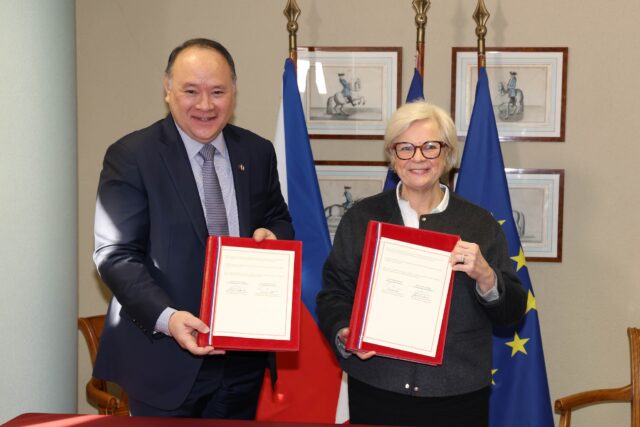
Defense Secretary Gilbert C. Teodoro with French Minister for the Armed Forces and Veterans Catherine Vautrin during the singing of the visiting forces agreement in Paris, France, Mar. 26, 2026.— DEPARTMENT OF NATIONAL DEFENSE FB PAGE

MANILA — The Philippines and France have signed a visiting forces agreement that would allow them to conduct joint military training in each other’s territory, as Manila expands defense ties amid rising tensions with Beijing in the South China Sea.

Philippine Defense Secretary Gilberto Teodoro and French Minister for the Armed Forces and Veterans Catherine Vautrin signed the agreement on March 26 during a meeting in Paris, where they discussed regional security challenges and reaffirmed support for rules-based international order.

The two also called for “the peaceful resolution of disputes” and the need to strengthen supply chain resilience in times of crisis.

“The agreement will greatly bolster bilateral cooperation and offer an adequate level of legal protection to the joint activities between the Armed Forces of the Philippines and the French Armed Forces,” the Philippine defense department said in a statement.

Aside from France, the Philippines also has the visiting forces agreements with the US, Australia, Japan, and New Zealand.

The Philippines’ signing of the landmark military deal with France came a day after the Philippine military said a Chinese missile frigate “executed an unsafe and unprofessional maneuver” against a Philippine Navy vessel conducting maritime operation near Thitu Island, one of the Philippines’ key outposts in the disputed sea.

Beijing claims almost the entire South China Sea, a strategic waterway where more than $3 trillion of trade passes annually.

The Asian economic and military giant has repeatedly refused to recognize a 2016 landmark ruling that invalidated its claim in the entire waterway. — Reuters

ADVERTISEMENT
ADVERTISEMENT