Home Blog Page 1082

Peso strengthens vs dollar on BSP rate cut, dovish Fed bets

BW FILE PHOTO

THE PESO rose slightly against the dollar on Thursday after the Bangko Sentral ng Pilipinas (BSP) delivered a widely-expected rate cut and amid dovish expectations for the US central bank’s easing cycle.

The local unit closed at P57.12 per dollar, strengthening by four centavos from its P57.16 finish on Wednesday, Bankers Association of the Philippines data showed.

The peso opened the session sharply higher at P57.05 against the dollar. Its intraday best was at P56.93, while its worst showing was at P57.17 versus the greenback.

Dollars exchanged went down to $1.86 billion on Thursday from $1.9 billion on Wednesday.

“The dollar-peso closed a tad lower because the BSP delivered a rate cut. But profit taking ensued because the market is awaiting US PCE (personal consumption expenditures) data,” a trader said in a phone interview.

The BSP on Thursday cut its target reverse repurchase rate by 25 basis points (bps) to 5%, as expected by all 20 economists in a BusinessWorld poll conducted last week. Rates on the overnight deposit and lending facilities were likewise lowered by 25 bps to 4.5% and 5.5%, respectively.

This marked the third straight 25-bp reduction since April. Since starting its easing cycle in August 2024, the BSP has now slashed borrowing costs by a cumulative 150 bps.

The dollar was also generally weaker on Thursday amid dovish signals from US Federal Reserve officials, Rizal Commercial Banking Corp. Chief Economist Michael L. Ricafort said in a Viber message.

For Friday, the trader sees the peso moving between P56.90 and P57.30 per dollar, while Mr. Ricafort expects it to range from P57 to P57.2.

The dollar was little changed on Thursday as traders added to bets for a Federal Reserve interest rate reduction next month after New York Fed chief John Williams signalled a cut was possible, Reuters reported.

The US currency has been under renewed pressure from President Donald J. Trump’s ramped-up campaign to exert more influence over monetary policy decisions, as he attempts to fire Fed Governor Lisa Cook and replace her with a loyalist.

The dollar flattened against the euro even after France’s prime minister on Monday unexpectedly called a confidence vote for next month, which is likely to result in the fall of his minority government.

The Fed’s Mr. Williams said in an interview with CNBC on Wednesday that it is likely interest rates can fall at some point, but policymakers will need to see what upcoming data indicate about the economy to decide if it’s appro-priate to make a cut at the Sept. 16-17 meeting.

Key among data releases before that meeting are the PCE price index on Friday — the Fed’s preferred inflation measure — and the monthly payrolls report a week later.

Traders currently lay around 89% odds of a quarter-point rate cut next month, and have priced in a cumulative 55 bps of easing by yearend, according to LSEG data.

That helped send two-year Treasury yields, which are sensitive to policy expectations, sliding to the lowest level since May 1, adding to pressure on the dollar.

Mr. Trump’s push to place hand-picked, dovish-leaning candidates into the central bank’s decision-making committee also pulled short-term yields lower, even though his attack on Ms. Cook could spark a protracted legal battle after she sued to keep her job.

“Short-dated US yields remain near their recent lows, and most would conclude that this week’s (attempt to remove) Fed’s Lisa Cook by President Trump is dollar-negative,” said Chris Turner, global head of markets at ING.

The dollar index, which gauges the currency against six major peers, edged 0.1% higher at 98.225, following two days of declines.

The euro was little changed, down 0.07% at $1.1630.

Against the yen, the dollar slipped 0.03% to 147.34 yen.

Japan’s chief trade negotiator Ryosei Akazawa canceled a trip to Washington at the last minute on Thursday, delaying an announcement of the details of Japan’s $550-billion investment pledge in the United States as part of a tariff deal.

A government spokesperson said the decision was taken after talks with the US side revealed some points that need further discussion “at the administrative level.”

The dollar slipped to its lowest level against China’s offshore yuan since November, last down 0.2% to 7.1360 yuan in offshore trading. — A.M.C. Sy with Reuter

Debate over 14th month pay called a ‘distraction’

PHILIPPINE STAR/NOEL B. PABALATE

By Kenneth Christiane L. Basilio, Reporter

THE LABOR movement continues to prioritize the campaign for a P200 daily minimum wage and warned that calls for 14th month pay could serve as a “distraction” from this effort.

Federation of Free Workers President Jose Sonny G. Matula said via Viber: “Our foremost priority is the P200 nationwide legislative wage hike… We hope the 14th month pay will not become a distraction or a substitute for a genuine wage hike.”

Senate Minority Leader Vicente C. Sotto III filed in July a bill seeking to require employers to grant workers 14th month pay to help them deal with the cost of living.

Senate Bill No. 193 also proposed that the 13th month pay be released no later than June 14, with 14th month pay disbursed no later than Dec. 24 of every year.

Presidential Decree No. 851 of 1976 requires employers to pay workers 13th month pay, equivalent to one-twelfth of an employee’s total basic salary earned within a calendar year.

Mr. Sotto’s bill “recognizes the indispensable value of labor to the growth of capital,” National President of Bukluran ng Manggagawang Pilipino Renecio S. Espiritu said via Viber.

Benjamin B. Velasco, an assistant professor at the University of the Philippines Diliman School of Labor and Industrial Relations, said: “A 14th month pay is one way to address and attend to retention issues of firms,” he said via chat. “Happy workers are hard workers.”

But the productivity boost will likely be short-lived if monthly wages still lag the rising cost of goods, Josua T. Mata, Sentro ng mga Nagkakaisa at Progresibong Manggagawa secretary-general, said.

“Bonuses can indeed incentivize employees. However, this effect is short-lived if underlying pay remains inadequate,” he said via Viber.

Mr. Sotto’s proposal represents two pump-priming events each year, boosting domestic demand and providing support to local businesses, Mr. Velasco said.

“The 14th month will hit firms’ profits as it means bigger labor costs. But this can be offset by higher productivity and bigger demand,” he said.

Stuff to Do (08/29/25)


See Ice Seguerra perform in the mall

SINGER-SONGWRITER Ice Seguerra will be making a rare appearance in a mall — in a busking act. On Aug. 29, 5 p.m., Mr. Seguerra will be at the Activity Area of Gateway Mall 1, in Cubal, Quezon City, as part of the promotion of his new album titled Being Ice. The busking act will include some of his greatest hits plus songs from his new album.


Catch Kim Myung Soo at the Korea Travel Fiesta

KOREAN star Kim Myung Soo is flying back to the Philippines for the Korea Travel Fiesta 2025. It takes place on Aug. 30 and 31 at the SM Mall of Asia Music Hall in Pasay City. The event is meant for Filipinos to discover the beauty of Korea’s winter. Kim Myung Soo, also known as L from the K-pop group Infinite, will serenade local fans at the event and will be joined by other entertainers: Se7en, Kim Dong-jun from ZE:A, Sunye from Wonder Girls, Lim Se-jun from Victon, musical actor Kim Da-hyun from Dream High: The Musical, dance crew ARTix from the South Korean dance survival show Street Dance Girls Fighter, world-renowned Taekwondo performance team K-TIGERS, and the Korean Cultural Center in the Philippines’ Everyone’s KPOP winners. The Korea Travel Fiesta is hosted by the Korea Tourism Organization Manila Office.


Bring your kids to the Nips park in Market! Market!

CHOCOLATE BRAND Jack ‘n Jill Nips has mounted the Nips Pour Pop & Play Park event. Happening on Aug. 30 at the Ground Floor of Market! Market!, Taguig, this interactive playground is designed to give kids and their parents an avenue for play and creativity. It has three activity zones: Pour Zone, which offers Nips chocolates; Pop Zone, where visitors can participate in a dance challenge to win Nips products and merchandise; and Play Zone, a ball pit for kids to play in.


Spread faith at Jescom Fair 2025

THE Jescom Fair 2025, with the theme “Engage: Stories of Hope,” will take place on Aug. 30 at the Quantum Skyview of Gateway Mall 2, Cubao, Quezon City. This year, it gathers storytellers, dreamers, and digital missionaries who want to spread hope through faith and media. The event encompasses talks, creative booths, live performances, and encounters with others who want to spread Catholicism.


Watch horror movie The Conjuring: Last Rites

FROM New Line Cinema comes the ninth entry in the Conjuring film universe, The Conjuring: Last Rites, directed by franchise veteran Michael Chaves and produced by franchise architects James Wan and Peter Safran. The latest film delivers another chapter based on real events, with Vera Farmiga and Patrick Wilson reuniting for one last case as renowned, real-life paranormal investigators Ed and Lorraine Warren. The Conjuring: Last Rites will be shown in Philippine cinemas starting Sept. 3.

Closet clerk: A manager with zero authority

I work for a medium-sized organization. I feel bad for our department manager who has no authority to approve even small purchases like staplers. He told us that all disbursements, regardless of amount, must be approved by the chief executive officer (CEO). The trouble is that our manager appears unbothered by the situation. What can we do? — White Lotus.

In most organizations, the word manager implies decision-making authority and autonomy — qualities essential to leadership. Yet, in some companies, managers become mere coordinators, or as I call them, closet clerks or “glorified messengers.”

When they lack even basic approval power, it’s not just inconvenient — it’s a fundamental breakdown of real management responsibility.

When that happens, the manager title starts to feel like a cruel joke. Dig deeper and you’ll find a quiet, corrosive force at play — one that undermines productivity, damages morale, and erodes credibility, like what you’re feeling now.

A policy meant to save pennies can, in fact, undermine an organization’s effectiveness. Lost time, wasted energy, and damaged manager credibility often cost much more than any savings on office supplies. Over-controlling spending at this level signals a much larger issue: systemic distrust and inefficiency.

Organizations often centralize disbursements in the name of control. When taken to extremes, the policy flips into dysfunction. If a manager needs permission to buy pens, the system has crossed from prudent governance into bureaucratic farce.

It signals a deeper cultural message: people don’t trust their managers.

When the workers see their boss powerless to authorize buying a box of paper clips, the unspoken question arises: if he’s not authorized to make small decisions, how can I trust him with big ones?

This credibility gap isn’t the manager’s fault — it’s structural. Yet he’s the one who absorbs the pity, the jokes, and the loss of respect. They’re only tasked with relaying requests after nominal vetting instead of making inde-pendent decisions. If this happens all the time, credibility erodes, followed by disengagement in the workforce.

DEATH BY DELAY

That’s not all. There’s also the issue of efficiency and productivity. Imagine a frontline team that runs out of printer ink on a Tuesday. Instead of replacing it immediately, the manager submits a request to the head office. It travels through approvals, lands on someone’s desk, and — if you’re lucky — the ink replacement arrives a week later.

Multiply that scenario across dozens of small needs and you get a steady drip of lost time, slowed projects, and frustrated employees. This is the organizational equivalent of paying $100 to save $10.

DECENTRALIZATION

The solution is a functional decentralization. Many successful organizations implement petty cash or small discretionary budgets for department heads. A monthly allowance of even $100–$200 is enough to cover incidentals while maintaining financial oversight.

Handled correctly, small allowances eliminate frustration and free the CEO to focus on strategy, not minutiae. More importantly, restoring this authority to managers strengthens their leadership role, improves team morale, and removes the inefficiencies caused by centralized control.

For managers caught in this trap, the challenge is how to address it without sounding like they’re complaining about pens and staplers. The key is to frame the conversation in terms of business impact. However, this can only be done by the department manager.

Depending on your relationship with your boss, you may want to discuss the following major points:

One, productivity loss. Document delays caused by approval bottlenecks for small purchases. Time wasted is measurable, and executives respond to numbers.

Two, comparative cost. Show how the labor hours spent on approval often exceed the item’s value. Processing a $10 request might cost $50 in administrative effort.

Three, employee engagement. Point out how credibility suffers when managers can’t act autonomously, creating hidden, unimaginable cultural costs.

Four, best practices. Highlight industry peers who empower managers with small budgets and their efficiency gains.

By shifting the discussion from “I need staplers” to “Here’s how we can save money and time,” the manager elevates the issue from trivial to strategic. Of course, that’s assuming that he has the courage to discuss the issue with the CEO.

This scenario illustrates a broader truth about authority matching responsibility. If managers are held accountable for results but denied even minor decision-making power, the structure is flawed. It’s like asking a pilot to fly a plane on the condition that the head office has to approve every time he adjusts altitude.

Many managers recognize that empowerment is not an act of generosity minutiae it’s a performance strategy. Trusting managers with small expenditures is not about generosity; it’s about enabling them to deliver results with-out being tripped up by bureaucracy.

The fix is both obviously simple and powerful. Grant managers modest discretionary authority. The upside is faster decisions, higher morale, and restored faith in leadership. In the end, autonomy is not a perk. It’s the fuel that keeps managers credible, teams productive, and organizations competitive.


Ask questions and receive Rey Elbo’s insights for free. E-mail elbonomics@gmail.com or DM him on Facebook, LinkedIn, X or via https://reyelbo.com. Anonymity is guaranteed.

Ovialand says Laguna, Bulacan sales lift first-half profit

https://ovialand.com/savana/

REAL ESTATE developer Ovialand, Inc. saw a 37% increase in its first-half consolidated net profit to P420 million, driven by surging demand for premium-affordable homes.

Revenue from January to June rose by 20% to P1.1 billion amid strong sales and continued demand for the company’s premium-affordable homes in Laguna and Bulacan, Ovialand said in an e-mailed statement on Thurs-day.

Homes turned over increased by 19% on the back of rising annual production capacity.

Total assets went up by 12% to P2.9 billion, with real estate inventories and land acquisition options accounting for 48% of the growth.

“Ovialand is on track to hit its target growth for 2025 and is continuously watching out for opportunities in the market to be able to expand its reach to more homebuyers in other areas in Luzon,” Ovialand Chief Executive Officer Pammy Olivares-Vital said.

Ovialand recently broke ground in Baliwag, Bulacan, marking its second project in Central Luzon as the company expands its presence north of Metro Manila.

“We are very happy to serve and bring our promise of premier family living to more locations as we add new properties and expand our current projects,” Ms. Olivares-Vital said.

Ovialand is a real estate developer engaged in the premium-affordable housing market. It has projects in Laguna, Quezon, Batangas, and Bulacan. — Revin Mikhael D. Ochave

Climate change and consumer behavior

Climate change has significantly intensified over the years, impacting lives around the world. In a recent Deloitte study, more than half of respondents said they have experienced at least one extreme weather event, pushing majority of them to agree that climate change is an emergency. Organizations are also feeling increasing pressure to integrate sustainability in their business agenda, with consumers demanding the same from producers of goods and services.

Globally, almost 60% of respondents said they make deliberate changes to their personal activities and purchasing habits to help mitigate environmental damage. Thirty-three percent also said that sustainability con-siderations are impacting where they bank and invest their money, and nearly 40% are paying more for sustainable product alternatives.

Beyond their personal steps toward sustainable consumption, people’s heightened environmental awareness extends to their workplace expectations. Among those surveyed by Deloitte, there has been a decline in the number of people who believe their employer is doing enough to address climate change and sustainability.

Moreover, almost 25% globally said they have considered switching jobs to work for a more sustainable company, and the same number of people say that they will consider a potential employer’s position on sustainabil-ity before accepting a job. This just proves that sustainability is slowly becoming less of just a consideration, and more of a key criterion in choosing where to work.

THE YOUNGER GENERATIONS’ EMOTIONAL INVESTMENT AND INITIATIVES
While concern for the environment spans across all generations, Gen Zs and millennials have expressed greater emotional engagement and more curiosity about the impact of climate change.

In the Philippines, climate change as a cause of anxiety is especially apparent. Over 90% of the country’s college-educated, working Gen Z and millennials have expressed worry about their environmental impact, and most of them intend to make better climate choices. Eighty percent are willing to pay more to purchase environmentally sustainable products or services, 95% primarily use recyclable or recycled plastics/paper to reduce environmental impact, and 90% improve their home to make it more sustainable.

These personal commitments signal a clear expectation: businesses must respond by offering more sustainable choices. As the younger generations increasingly align their actions and behaviors with environmental values, they look to companies to complement these efforts with sustainable products, services, and practices.

Furthermore, their appeal for businesses to prioritize environmental responsibility also bleeds into their employer choices, with 95% of them considering companies’ environmental credentials or policies when choosing a poten-tial employer, and 30% of them changing jobs and/or industries due to concerns about the organization’s sustainability impact, higher compared globally.

Along with their expectations from businesses, Gen Zs and millennials are also calling for increased involvement from the government in mitigating climate change impacts. They urge policymakers to take climate action, foster-ing a sustainable future through policies and public-private partnerships.

Clearly, from choosing recycled packaging to calling for the government and businesses to prioritize sustainable practices, these generations are driving the shift in consumer behavior and employer expectations.

CLIMATE ACTION IS NO LONGER OPTIONAL BUT IMPERATIVE
The incorporation of sustainability-related actions to both personal and professional domains is already an existing principle for most, especially younger generations. As sustainability becomes embedded in people’s every-day lives and decision-making, businesses must evolve in response.

Organizations that fail to integrate it into their culture and operations risk losing climate-conscious customers and top talent. In this age of accountability, being sustainable shouldn’t just be a differentiator — it should be the baseline.

The views expressed herein are the author’s own and do not necessarily reflect the opinion of his office as well as FINEX.


Jesus Ma. Lava III is a FINEX member and the Sustainability and Emerging Assurance Leader at Deloitte Philippines, a member firm of the Deloitte network. For comments or questions, e-mail phcm@deloitte.com.

Staying the course, steering the future

STOCK PHOTO | Image by Jcomp from Freepik

(This is a speech given by Mr. Bernardo before the Bankers Institute of the Philippines, Inc. or BAIPHIL, on Aug. 19 at the Dusit Thani Hotel, Makati City. The theme of the event was “Continuing Partnership to R.I.S.E. in Banking — Resilience. Inclusivity. Sustainability. Engagement.” It has been edited for length and clarity.)

Let me ask: What does it mean to rise when the ground beneath us keeps shifting?

Let me highlight a few key developments that are shaping our path ahead.

• First, inflation is easing. Over the past five months, inflation has come down to less than 2%, thanks to moderating rice and energy prices and actions by the Bangko Sentral ng Pilipinas (BSP).1 We expect the full-year average this year to settle near the lower end of our target range. But what matters even more is how people see inflation one year from now. Based on our surveys, expectations remain anchored — people believe inflation will stay low over the next year. 2

• Second, our economy is growing steadily. GDP expanded by 5.5% in the second quarter, placing the Philippines as the second fastest-growing economy in the region.3 This momentum is supported by a healthy banking sector. Lending continues to grow, and digital financial channels are helping households and firms to continue to invest and spend.

• Third, our banking system remains strong and resilient. We continue to exceed international standards in capital buffers, liquidity coverage, and asset quality. Our non-performing loan ratio is steady at 3.4%, and capital adequacy stands at 16.5%. Key regulatory reforms — such as the new Capital Markets Efficiency Promotion Act — are expected to deepen our domestic financial markets, facilitating more efficient funding for infrastructure, innovation, and national priorities.

• Of course, we face headwinds. Global trade tensions and lingering geopolitical risks have introduced uncertainty, affecting both emerging and advanced economies. For small, open economies like ours, remaining insulated is difficult — especially with rising US protectionism expected to impact not only trade in goods but also services and remittances. In addition to imposing higher tariffs on its trade partners, the US has introduced a tax on remittances and is now considering measures to curb offshoring. So far, the overall impact on our external balance has been limited, supported by steady remittance inflows — which have reached nearly $14 billion as of May this year. Service exports from our IT-BPM industry remain robust and are expected to overtake remittance receipts for the first time this year.

• Finally, we have solid buffers despite these external shocks. Our gross international reserves (or GIR) stand at $105.7 billion, enough to cover 7.2 months of imports4 and 3.4 times the country’s short-term external debt.

These aren’t just good numbers — they show we’re learning to navigate the storms. Let us now break down what R.I.S.E. means in practice.

‘R’ FOR ‘RESILIENCE’
Resilience today goes beyond capital buffers and spreadsheets. In a digital world, it means standing firm against cyberattacks, fraud, outages, and even economic sabotage. Operational disruptions in the financial system are escalating.

The BSP’s cybersurveillance activities show a continued trend in cybercrime-related losses for the first half of 2025. Prevalent threats target the human element, which includes phishing, card-not-present fraud, and unauthorized access. This indicates attempts by threat actors to continually exploit vulnerabilities of digital financial consumers. Nonetheless, net losses declined notably, driven by improved loss-recovery mechanisms and cooperation among financial institutions.

That is why the BSP has taken decisive actions:

1. We rolled out the 2024-2029 Financial Services Cyber Resilience Plan (or FSCRP) on Aug. 6, 2024. The plan is a sector-wide roadmap and strategic framework to strengthen the cyber resilience and maturity of the financial services sector.5
2. We created the Financial Cyber Resilience Governance Council on Feb. 11 to oversee the FSCRP and facilitate coordination, collective decision-making, and guiding efforts toward a unified and proactive cybersecurity posture.
3. We updated IT and risk management rules6 to help banks respond faster.
4. We issued guidelines on operational resilience to ensure the continual delivery of critical operations to customers through disruptions. Operational resilience is a critical defense of BSP-supervised financial institutions against cyber threats and climate-related shocks.
5. We strengthened KYC and AML standards, including electronic due diligence.7,8,9
6. We issued enhanced rules for e-money and digital banks.10,11
7. We introduced a regulatory sandbox for testing innovations under the BSP’s oversight.12
8. We rolled out guidelines for the Anti-Financial Account Scamming Act, or AFASA, in May to crack down on mule accounts and phishing scams.13
9. And we conducted cyber education and awareness initiatives to build the capacity of small- and medium-sized financial institutions.

We are not plugging leaks — we’re reinforcing the entire system for greater resilience.

‘I’ FOR ‘INCLUSIVITY’
One of the most inspiring stories in Philippine banking is our progress in financial inclusion.
People who once dealt only in cash — vendors, tricycle drivers, sari-sari store owners — are now part of the digital economy. Thanks to Paleng-QR Ph Plus, now active in 180 LGUs.14 Even MRT-3 commuters can now tap or scan their way through turnstiles.15
In 2019, only 29% of Filipinos had bank accounts. By 2021, that jumped to 56%.16
But opening an account is just the beginning. MSMEs make up 99% of businesses,17 yet receive less than 3.9% of total bank loans.18 Why? No credit score. No formal income. No paperwork. So, the BSP responded:
• We promoted the Basic Deposit Account to bring more people into the formal financial system.19
• We launched the Credit Surety Fund and Credit Risk Database to help banks lend with confidence.20
• We supported Supply Chain Finance to reach underserved markets.21
• And we introduced the Standard Business Loan Application Form to cut red tape for MSMEs.22
Having worked in government, in multilateral institutions, and on private boards, I have seen that the best lending decisions aren’t always the obvious ones.
Inclusion isn’t charity. It’s smart, long-term banking.

‘S’ FOR ‘SUSTAINABILITY’
We can’t talk about resilience without addressing climate and environmental risks.
Floods, typhoons, and droughts don’t just damage property — they disrupt business models, strain credit quality, and challenge long-term economic growth.

Here is what the BSP is doing:

• Since 2020, we have issued a series of regulations to equip banks to effectively manage climate, environmental, and social risks. We have shifted our focus from reducing the Philippines’ already negligible carbon footprint (just 0.3% of the global total) to adapting to climate change-driven disasters, such as typhoons and flooding, to which our country is among the most vulnerable. Banks should integrate these risk factors into their corporate and risk governance.

• We also released Circular No. 118523 to incentivize sustainable financing. For instance: a 15% increase in the single borrower’s limit for sustainable projects; and a zero-reserve requirement for sustainable bonds. These incentives will run for two years until January 2026 — and we’ve already surveyed banks to gather feedback supporting the policy review.

• We introduced the Philippine Sustainable Finance Taxonomy Guidelines,24aligned with national climate goals, emphasizing adaptation as the priority action, and ASEAN Taxonomy, to give banks and investors a common language. Following this, a series of supplementary guidance is being issued to ensure consistent interpretation and implementation of the local taxonomy.25

• We are developing an Adaptation and Resilience Catalogue to guide banks in identifying and classifying adaptation-aligned projects. Through stakeholder input, pilot projects, and innovative financing, we aim to show their viability and build confidence in adaptation investments.

So, the question isn’t just, “Are you compliant?” It’s “Is your balance sheet future-ready?” Sustainability is not just a reporting line. It is a survival strategy and a leadership opportunity.

FINALLY, ‘E’ FOR ‘ENGAGEMENT’
Good regulation is not one-way. The BSP does not regulate from a tower. We engage, listen, and adapt.

We issue exposure drafts, hold policy dialogues, monitor feedback, and co-develop with the industry. We are active on major social media platforms to stay connected with the public. We even have a chatbot to assist financial consumers 24/7 and a mobile app for the most convenient access to BSP resources.

BAIPHIL has long played a role in this. My challenge to you: play an even bigger one. Don’t just learn the rules. Help shape them. To the new Board: you step into leadership at a defining moment. My wish for you is simple: rise not just to meet the future, but to shape it.

1 Inflation eased to 0.9% in July, with a year-to-date average of 1.7%, below the government’s target range. https://www.bsp.gov.ph/SitePages/MediaAndResearch/MediaDisp.aspx?ItemId=7614&MType=MediaReleases
2 “Households” mean 12-months-ahead inflation point forecasts eased to 3.7% in Q2 2025, from 3.8% in Q1. Likewise, “firms” mean forecasts decreased to 3%, from 3.4% in the previous quarter. Source: Consumer Expectations Survey (CES), Business Expectations Survey (BES).
3 The Philippines’ Q2 2025 real GDP growth is next only to Vietnam (8%); and higher than China (5.2%); Indonesia (5.1%), Malaysia (4.4%) and Singapore (4.3%).
4 Country’s foreign reserves settle at $105.7 billion in July 2025 Bangko Sentral ng Pilipinas Media and Research Press Releases.
5 BSP Launches the 2024 – 2029 Financial Services Cyber Resilience Plan https://www.bsp.gov.ph/SitePages/MediaAndResearch/MediaDisp.aspx?ItemId=7199
6 Circular No. 808 on IT Risk Management Framework, Circular No. 982 on Information Security Risk Management Framework, Circular No. 1137 on Outsourcing Framework, and Circular No. 1140 on Fraud Management System
7 Circular No. 1170 dated March 30, 2023
https://www.bsp.gov.ph/Regulations/Published%20Issuances/Images/Circular_1170.pdf
8 Circular No. 1182 dated Nov. 10, 2023 https://www.bsp.gov.ph/Regulations/Issuances/2023/1182.pdf
9 Circular No. 1193 dated April 29, 2024 https://www.bsp.gov.ph/Regulations/Issuances/2024/1193.pdf
10Circular No. 1105 dated Dec. 2, 2020, as amended by Circular Nos. 1154 and 1205 dated Sept. 14, 2022 and Dec. 26, 2024, respectively. https://www.bsp.gov.ph/Regulations/Issuances/2020/c1105.pdf
11 Circular No. 1166 dated Feb. 7, 2023 https://www.bsp.gov.ph/Regulations/Issuances/2023/1166.pdf
12Circular No. 1153 dated Sept. 5, 2022. https://www.bsp.gov.ph/Regulations/Issuances/2022/1153.pdf
13https://www.bsp.gov.ph/Regulations/Banking%20Laws/AFASA-Booklet-with-IRRs.pdf
14https://www.bsp.gov.ph/Pages/InclusiveFinance/PalengQR/PalengQRProgram.aspx
15BSP: Tap-to-pay & scan-to-pay in MRT-3 to drive digitalization transformation https://www.bsp.gov.ph/SitePages/MediaAndResearch/MediaDisp.aspx?ItemId=7598&MType=MediaRelease
16https://financialinclusion.gov.ph/wp-content/uploads/2025/07/2024-NSFI-Annual-Report.pdf
17https://www.dti.gov.ph/resources/msme-statistics/
18https://financialinclusion.gov.ph/-dashboard/
19Introduced by the BSP in 2018, the BDA aims to meet the needs of the unbanked and low-income sector for affordable and easy-to-open bank accounts. It has a low opening deposit requirement of P100 or less, simple identification requirements, no maintaining balance requirement, and no dormancy charges.
20https://www.bsp.gov.ph/Inclusive%20Finance/Financial_Inclusion-Advocacies/CSF_Primer.pdf
21Input from FSS
22Circular No. 1156 dated Sept. 30, 2022 https://www.bsp.gov.ph/Regulations/Issuances/2022/1156.pdf
23https://www.bsp.gov.ph/Regulations/Issuances/2023/1185.pdf
24Circular No. 1187 dated Feb. 21, 2024. https://www.bsp.gov.ph/Regulations/Issuances/2024/1187.pdf
25https://www.bsp.gov.ph/Regulations/Issuances/2025/M-2025-025.pdf; https://www.bsp.gov.ph/Regulations/Issuances/2024/M-2024-028.pdf; https://www.bsp.gov.ph/Regulations/Issuances/2024/M-2024-035.pdf

Romeo L. Bernardo is a member of the Philippine central bank’s Monetary Board.

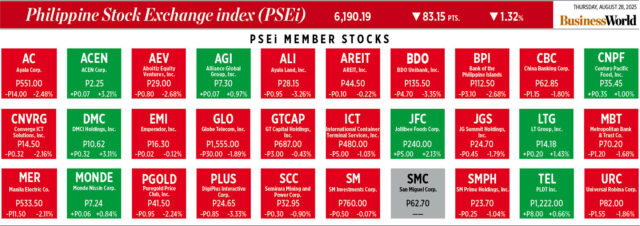
How PSEi member stocks performed — August 28, 2025

Here’s a quick glance at how PSEi stocks fared on Thursday, August 28, 2025.


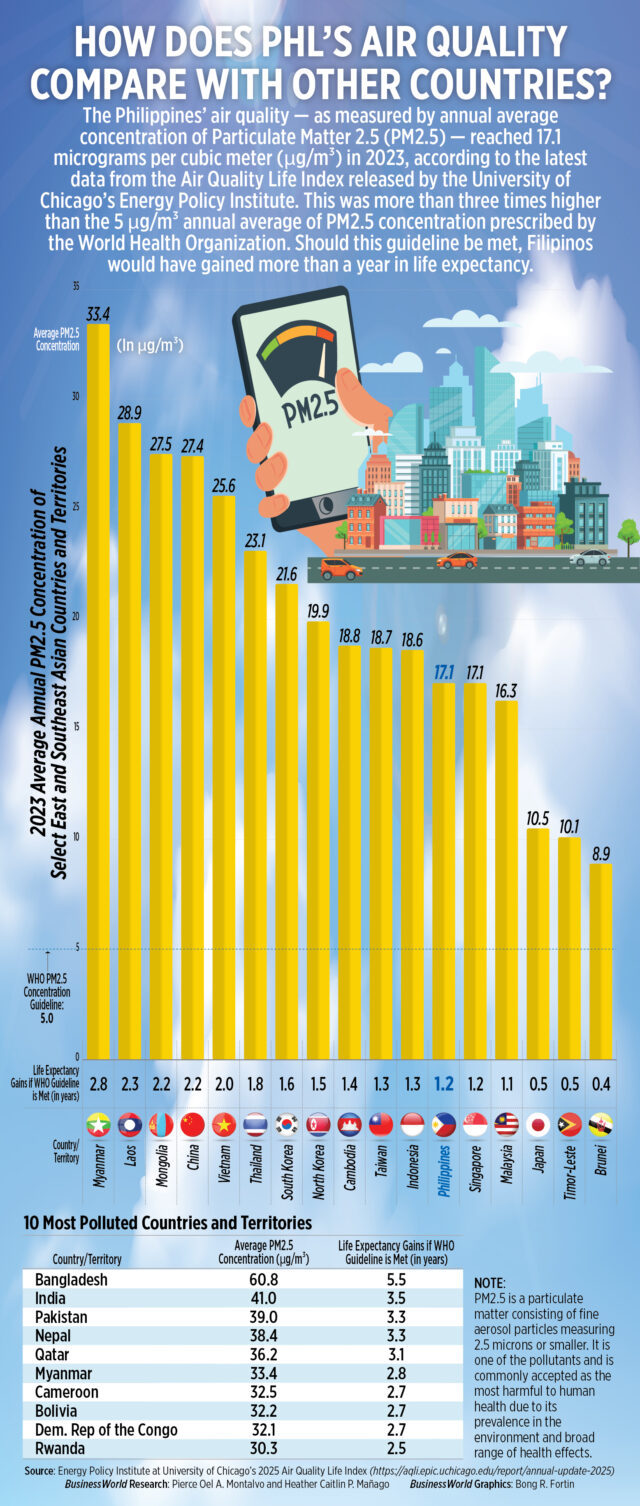
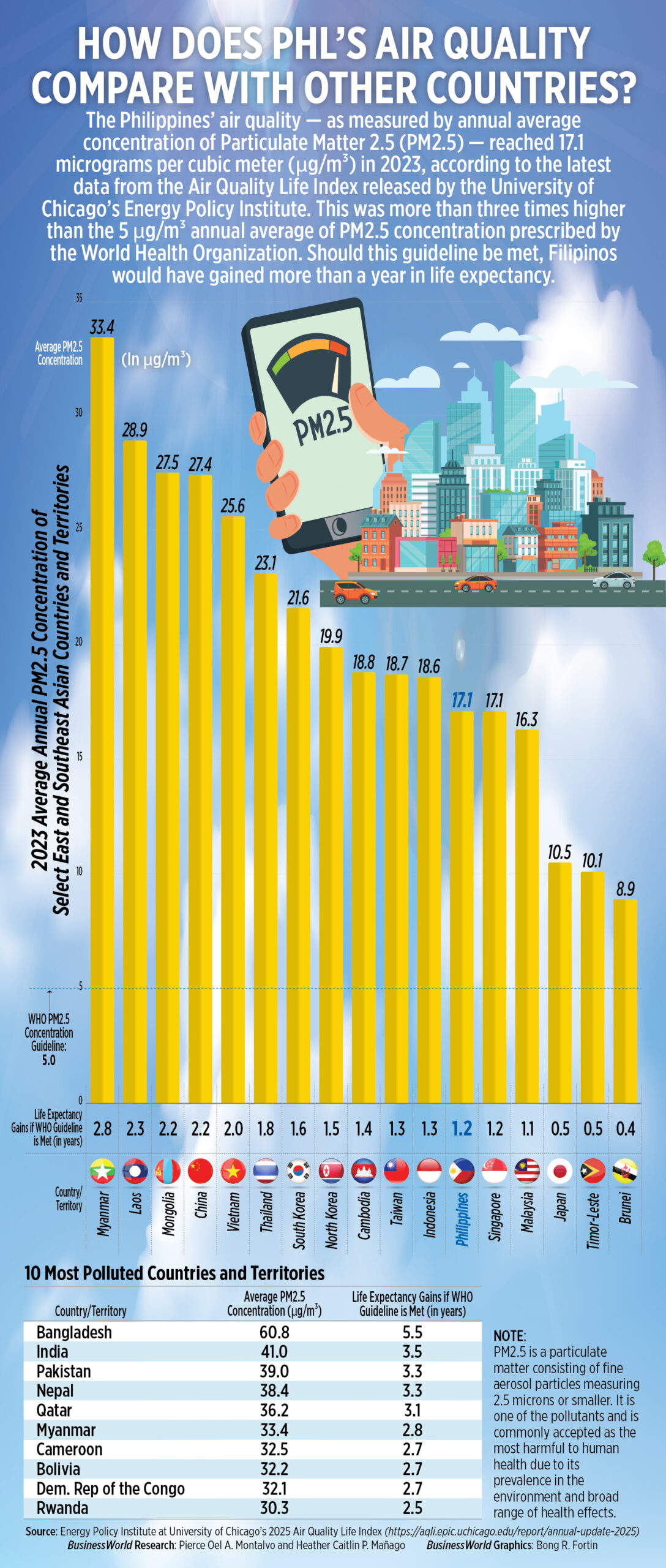
How does PHL’s air quality compare with other countries?

PEZA says ‘robust’ pipeline keeps it on pace to hit target

THE Philippine Economic Zone Authority (PEZA) said its project pipeline remains “healthy and robust,” keeping it on track to achieve its target this year after having approved 29 projects in August valued at P14.872 billion.

“What we’re seeing now is still a healthy, robust pipeline of projects — and with our expanded regional engagements, we expect strong growth momentum in the months ahead,” PEZA Director General Tereso O. Panga said in a statement on Thursday.

“With the volume of interest we are receiving and the quality of projects in our pipeline, we are confident that the coming months will not just achieve our target for the year but also bring even greater gains for our economy and our people,” he added.

Investment approvals declined 8% year on year in August due to strong year-earlier activity after the PEZA Board met twice in August 2024, it said.

“This occurrence is common, especially as PEZA is mandated to convene as necessary to ensure that projects move forward without delay,” it added.

The new projects approved in August are expected to create 4,764 jobs and generate $1.374 billion in exports.

Of the 29 projects approved this month, 16 involve manufacturing, five information technology and business process management, four domestic market-oriented activities, and three economic zone development ven-tures. One approval concerns facilities.

A majority of the applicants are expected to locate in Region IV-A, with the others setting up shop in the National Capital Region and in Regions III, VII, XI, and XII.

The latest approvals brought PEZA’s total approvals this year to P105.834 billion, up 71.54% year on year.

These consist of 179 projects, which are expected to generate 40,638 jobs and $3.377 billion in exports.

“Year to date, investors from the Cayman Islands lead the investments by nationality, followed by South Korean, Chinese, American, and Dutch investors,” PEZA said.

Investors incorporated in the Cayman Islands provided P13.143 billion, while South Korean and Chinese investments totaled P10.765 billion and P6.152 billion, respectively.

The eight-month approvals total represents 42.3% of PEZA’s P250-billion target for the year. — Justine Irish D. Tabile

Auction for offshore wind delayed to fourth quarter

BUHAWIND.COM.PH

THE Department of Energy (DoE) said the auction round for offshore wind projects has been delayed to the fourth quarter from the original third-quarter target.

Consultations are now ongoing regarding the terms of the fifth round of the green energy auction (GEA-5) program, Energy Undersecretary Mylene C. Capongcol added on the sidelines of the European Chamber of Commerce of the Philippines Energy Smart forum on Thursday.

GEA-5 will include fixed-bottom offshore wind technology, with an installation target of 3.3 gigawatts and a delivery period of between 2028 and 2030.

“For GEA-5, the target is within the year. The auction will be later this year. Once we issue the notice of auction, this will also include the Green Energy Auction Reserve (GEAR) price,” Ms. Capongcol said.

GEA-5 is expected to facilitate market access for offshore wind developers, ensuring long-term demand for their generation capacities.

She added that the power system will move towards decentralization, which an analyst said is better suited to the needs of an archipelagic country.

“We will support the energy decentralization and promote it. The department is working to improve the regulatory framework and encourage the growth of renewable energy,” she said.

Pedro H. Maniego, Jr., senior policy advisor of Institute for Climate and Sustainable Cities said decentralizing power generation and distribution are crucial for energy security due to the Philippines’ archipelagic nature.

Decentralization refers to a shift towards diverse energy sources and smaller-scale technologies that are more evenly distributed, as against large energy projects in limited locations.

The DoE reported a power generation mix of 63% coal-fired and 22% RE in 2023. The Philippines is aiming for a 35% RE share in the power mix by 2030, and 50% by 2040.

The DoE has called offshore wind vital to increasing the share of RE in the energy mix.

Ms. Capongcol expressed optimism about hydrogen exploration, with foreign companies signifying interest.

The DoE considers hydrogen a clean alternative fuel that can be used as an energy carrier to store, move, and deliver energy from other sources.

“Our study is ongoing for this. There are international companies interested,” she said.

In July, the DoE identified Zambales and Pangasinan as designated sites for possible hydrogen exploration. — Ashley Erika O. Jose

DBM backs bigger LGU role in infra projects

PHOTO CREDIT | Philstar

THE Department of Budget and Management (DBM) said it will support a provision in the proposed 2026 General Appropriations Act (GAA) that gives local government units (LGUs) an expanded role in shaping infrastructure pro-jects.

Budget Secretary Amenah F. Pangandaman said she plans to propose this provision to the 20th Congress after LGUs claimed they were not consulted on a number of faulty or “ghost” projects within their jurisdic-tions.

“Maybe I’ll write to the Senate and the House about closer coordination with local government units for the projects,” Ms. Pangandaman told reporters on the sidelines of a DBM event on Wednesday. “Maybe I can propose a general provision in the GAA.”

Legislators are currently investigating alleged corruption in flood control and other infrastructure projects.

Last week, President Ferdinand R. Marcos, Jr. ordered a freeze on P60 billion to P80 billion worth of infrastructure funds in the 2025 national budget after he personally inspected a river wall in Baliwag City, Bulacan which was falsely reported as completed but turned out to be non-existent.

Party-list Rep. Terry L. Ridon said the 220-meter-long reinforced concrete river wall in Bulacan was funded in the 2025 National Expenditure Program, which served as the basis for the legislated budget.

Ms. Pangandaman said such ghost projects are “regrettable” considering the government’s limited fiscal space.

“We don’t have enough fiscal space, right, and then there are projects that actually are not being done,” Ms. Pangandaman said. “It’s really regrettable… Let’s hold (those responsible) accountable.”

The Department of Public Works and Highways is working with the Department of Economy, Planning and Development in auditing government infrastructure projects following a Presidential directive.

The Commission on Audit has also submitted its report, according to Ms. Pangandaman.

In separate remarks on Thursday, Ms. Pangandaman said her department is working on a provision in the GAA that would more tightly control infrastructure budget releases.

She added that her staff is preparing letters to be sent to the Senate President, the chairman of the Senate Committee on Finance, the Speaker and the chairman of the House Committee on Appropriations.

“It should be done next week,” Ms. Pangandaman said.

She said legislators will be approached to sponsor such a provision. — Katherine K. Chan

ADVERTISEMENT
ADVERTISEMENT