Home Blog Page 1050

Poll: Inflation picked up in August

A woman looks at items for sale at a stall inside Commonwealth Market in Quezon City. — PHILIPPINE STAR/MIGUEL DE GUZMAN

By Katherine K. Chan

HEADLINE INFLATION may have slightly picked up in August as rising food and electricity costs were tempered by low rice prices, analysts said.

A BusinessWorld poll of 16 analysts yielded a median estimate of 1.3% for the August consumer price index (CPI), picking up from 0.9% in July but slower than the 3.3% clip in August 2024.

If realized, August would mark the sixth month in a row that inflation was below the Bangko Sentral ng Pilipinas’ (BSP) 2-4% target range.

Analysts’ August inflation rate estimates

The Philippine Statistics Authority is scheduled to release the August inflation data on Friday, Sept. 5.

The BSP projects inflation to have settled within the 1% to 1.8% range in August.

“Upward price pressures for the month are likely to arise from higher costs of fruits, vegetables, and fish due to unfavorable weather conditions,” the BSP said in a statement late on Friday. “Higher electricity rates, elevated domestic fuel costs, and the depreciation of the peso likewise contribute to upside price pressures.”

However, these could be partially offset by the low prices of rice and meat, the BSP said.

Metropolitan Bank & Trust Co. (Metrobank) said inflation likely picked up to 1.3% in August from the near six-year low in July because of “accelerating food prices due to disruptive weather and higher energy costs.”

It noted that fish and vegetable prices rose as supply was disrupted after typhoons in late July and early August. However, the price of meat and fruits went up year on year, but at a slower pace.

Tropical storms Crising, Dante and Emong, and the southwest monsoon brought heavy rains and flooding in late July until early August, left P4.86 billion worth of agricultural damage, according to the Department of Agriculture.

ENERGY COSTS
Price pressures also emanated from higher power rates and pump prices in August.

“Among the factors for upward inflation pressures include higher price inflation for fish, fruits, and vegetables due to inclement weather, electricity rate hike, and higher petroleum prices,” Angelo B. Taningco, research head and chief economist at Security Bank, said.

Metrobank noted that the three major electricity players in the country — Manila Electric Co. (Meralco), Visayan Electric Co., and Davao Light and Power Co. — raised their rates in August due to higher power supply costs and transmission fees.

Meralco hiked rates by P0.6268 per kilowatt-hour (kWh) in August, bringing the overall rate for a typical household to P13.2703 per kWh. This translates to an additional P125 in the total electricity bill of residential customers consuming 200 kWh.

Chinabank Research noted upward adjustments in domestic pump prices in August.

“However, these were likely tempered by the month-on-month decline in the prices of rice, meat, and LPG (liquefied petroleum gas),” Chinabank said.

As of Aug. 26, pump price adjustments stood at a net increase of P0.70 per liter for gasoline, P0.50 a liter for kerosene, and P0.30 for diesel.

However, Jonathan L. Ravelas, a senior adviser at Reyes Tacandong & Co., said the August print is still “soft” as rice prices remained low and consumer demand has not picked up much.

RICE PRICES
Rizal Commercial Banking Corp. Chief Economist Michael L. Ricafort said low prices of rice could help inflation stay below the BSP’s target.

“Inflation could remain relatively benign and still below the BSP’s inflation target of 2%-4% (near the lower end of the said range), largely due to lower rice prices, which account for 9% of the CPI basket due to lower tariff on imported rice since early July 2024,” he said.

However, Union Bank of the Philippines Chief Economist Ruben Carlo O. Asuncion said upside risks to inflation include a rise in palay prices in some regions ahead of the government’s 60-day ban on rice imports and potential supply disruptions.

“On the downside, base effects from last year’s La Niña and sustained rice deflation may temper inflation,” he said.

Rice inflation has been decelerating in the last few months on the back of the government’s measures to curb rising prices of the staple grain, including lowering the tariffs on rice.

The 60-day suspension of rice imports starts today (Sept. 1) and will end on Oct. 30. It covers imports of regular milled and well-milled rice but excludes varieties that are not commonly produced locally.

Maybank Economist Azril Rosli said the impact of Mr. Marcos’ rice import ban will likely be felt starting in the fourth quarter.

“We anticipate that immediate pass-through effects to consumer prices will remain limited during the late third quarter to early fourth quarter 2025 period,” he said.

“We expect the more pronounced impact of this supply-side intervention to materialize in subsequent months, particularly from late fourth quarter 2025 through early first quarter 2026, as the policy implementation fully takes effect and market adjustments occur.”

Arindam Chakraborty, an economist at ANZ Research, said lower international rice prices may have helped sustain food price deflation in August.

“Going forward, the potential reversal of rice import tariff reductions could introduce upward pressure on food prices,” Mr. Chakraborty said. “Even so, given moderate demand conditions, we expect inflation to remain below BSP’s official target range in 2025.

Meanwhile, Mr. Asuncion said recent wage hikes and the weak peso as among the drivers of August inflation.

“The slight uptick from July’s 0.9% is driven by emerging pass-through effects from higher energy prices, wage adjustments, and imported goods — especially amid a weaker peso,” he said.

The local unit closed at P57.13 per dollar on Friday, stronger by P1.19 from its P58.32 finish a month ago, Bankers Association of the Philippines data showed.

Euben Paracuelles, a research analyst at Nomura Global Markets Research, noted that August core inflation is likely to remain unchanged. Core inflation slightly picked up to 2.3% in July from 2.2% in June.

“Core inflation, however, likely remained unchanged from the previous month, consistent with stable demand conditions and the still-negative output gap,” he said.

RATE CUT IMPACT
Analysts expect the impact of the Monetary Board’s latest policy rate cut on inflation in the coming months to be “muted.”

“The immediate effect of this rate cut on actual inflation is expected to be muted,” Mr. Asuncion said. “With demand-side pressures still soft and supply-side factors — such as rice deflation and China’s producer price weakness — continuing to dominate, the cut is unlikely to trigger a sharp rebound in prices in the near term.”

At its Aug. 28 meeting, the central bank delivered a third straight 25-basis-point (bp) cut, bringing its policy rate to 5%. BSP Governor Eli M. Remolona, Jr. also signaled they could deliver one more 25-bp cut this year, depending on data.

Mr. Rosli said the 25-bp cut “will likely generate modest inflationary pressures.”

“Lower borrowing costs should stimulate consumer credit demand, particularly for durable goods and housing-related expenditures, creating upward pressure on inflation,” he said. “However, given the subdued economic momentum, this demand-side stimulus is expected to be measured rather than pronounced.”

Mr. Ravelas said the rate cut is a “calculated push” that could support the country’s growth without stoking inflation.

“If demand starts to recover, we might see inflation edge up, but for now, it’s a calculated push to keep the economy moving,” he added.

Reinielle Matt M. Erece, an economist at Oikonomia Advisory & Research, Inc., said rate cuts may drive up inflation as consumer demand increases.

“Rate cuts, along with the onset of the holiday season, may spark higher demand for goods and services,” Mr. Erece said. “This may cause an uptick in inflation as spending on goods may drive prices higher.”

The central bank said it will keep monitoring factors that could influence its inflation and growth outlook, following its data-driven approach to monetary policy decision making.

The BSP’s next policy-setting meetings are in October and December.

Bonoan resigns; Dizon named as DPWH chief

Philippine President Ferdinand R. Marcos, Jr. named Transportation Secretary Vivencio B. Dizon to take over the Department of Public Works and Highways (DPWH), replacing Manuel M. Bonoan. — PHILIPPINE STAR/MIGUEL DE GUZMAN

PHILIPPINE President Ferdinand R. Marcos, Jr. has accepted the resignation of Public Works Secretary Manuel M. Bonoan as the agency comes under investigation over alleged irregularities in multibillion-peso flood control projects.

Malacañang on Sunday confirmed that Mr. Bonoan tendered his resignation, which the President accepted effective immediately.

The President appointed Transportation Secretary Vivencio “Vince” B. Dizon as his replacement, tasking him to lead a sweeping anti-corruption campaign within the agency.

“Secretary Dizon has been tasked to conduct a full organizational sweep of the department and ensure that public funds are used solely for infrastructure that truly protects and benefits the Filipino people,” the Palace said in a statement.

In his resignation letter, the outgoing secretary expressed support for the President’s call for accountability, transparency and reform within the Department of Public Works and Highways (DPWH), it added.

Mr. Bonoan, who was appointed in June 2022, leaves less than halfway through the administration’s term. His exit comes as government auditors and anti-graft agencies examine reports of anomalies in the planning and implementation of flood control projects in several regions, including Metro Manila and Central Luzon.

The probes are looking into alleged overpricing, substandard construction and possible collusion between contractors and government officials in awarding contracts. Billions of pesos have been allocated annually to flood mitigation programs, considered a top priority under the Marcos administration in light of worsening typhoons and climate change.

In recent weeks, lawmakers and watchdogs raised questions about the ballooning cost of certain projects and the pattern of contract awards. Some reports also flagged unfinished or nonfunctional facilities despite the full release of funds.

The presidential palace did not disclose whether Mr. Bonoan was asked to step down, but his resignation is widely seen as part of accountability measures as the administration faces pressure to demonstrate transparency in infrastructure spending.

During his tenure, Mr. Bonoan oversaw the continuation of flagship road, bridge and flood control projects inherited from the previous administration, while also expanding the “Build Better More” infrastructure program. His departure, however, is expected to cast uncertainty on timelines for several major initiatives, particularly those linked to flood management.

To guarantee uninterrupted service delivery at the Department of Transportation (DoTr), the President appointed Giovanni Z. Lopez as acting secretary. He was sworn in as DoTr undersecretary for administration, finance and procurement in February.

He served as chief of staff in the Office of the Secretary from 2020 to 2022 and held senior positions overseeing critical railway, aviation and maritime infrastructure projects, the palace said.

As Acting Secretary, Mr. Lopez will ensure continuity and build upon the gains initiated under Mr. Dizon’s leadership, particularly in advancing transport modernization and supporting initiatives that prioritize commuter safety, efficiency and seamless project delivery.

INDEPENDENT COMMISSION
Mr. Marcos also set up an independent commission to investigate flood control anomalies to further reinforce accountability, Malacañang said. “This body will conduct a comprehensive review of projects, identify irregularities and recommend accountability measures to ensure public trust in infrastructure spending.”

“These decisions reflect the administration’s firm resolve to clean up corruption, strengthen institutions, and deliver honest and effective public service under Bagong Pilipinas,” it added.

Hansley A. Juliano, who teaches political science at the Ateneo de Manila University, questioned why Mr. Dizon was transferred to the DPWH instead of naming an interim secretary from within. He said the decision might signal distrust in the agency’s leadership amid corruption concerns.

He said the move could be “more about optics and narrative — building on [Mr. Dizon’s] positive press — rather than genuine systemic reform, which one official alone cannot achieve.”

He also cited the abrupt turnaround of Mr. Bonoan, who had signaled on Saturday that he intended to stay but stepped down the following day, possibly under pressure after the flooding chaos that hit parts of the country.

The DPWH is one of the biggest recipients of the national budget, with an allocation of more than P900 billion this year. Much of the allocation is earmarked for flood control projects across the country.

The Commission on Audit earlier issued notices questioning cost discrepancies and project delays, while citizens’ groups have called for an independent probe into what they describe as “systemic issues” in flood control spending. The Office of the Ombudsman has also been asked to look into possible violations of procurement laws.

Mr. Bonoan’s resignation marks the first Cabinet-level exit linked to corruption allegations under the Marcos administration. Observers say the appointment of a new secretary will be critical not only for the credibility of the DPWH but also for the overall delivery of infrastructure programs central to the government’s economic agenda.

In recent weeks, Mr. Marcos has been inspecting areas including a “ghost” project worth P55 million in Baliwag, Bulacan, where it was marked completed but not even a wall was erected on site.

In his fourth State of the Nation Address on July 28, Mr. Marcos ordered a wide-ranging probe into questionable flood control projects amid heavy rains and widespread flooding. He ordered the DPWH to submit a full list of projects from the past three years, warning that those tainted with irregularities must undergo a thorough investigation. — Chloe Mari A. Hufana and Norman P. Aquino

PHL economy on track to grow by 5.7% — Moody’s

Individuals walk along España Boulevard in Manila. — PHILIPPINE STAR/RYAN BALDEMOR

THE PHILIPPINE ECONOMY is on track to grow by 5.7% this year on the back of strong household spending, steady remittances and sustained public investments, Moody’s Ratings said.

“We expect the Philippines to maintain strong economic growth relative to regional and rating peers,” Moody’s said after the completion of a periodic review of Philippines’ credit rating.

“Growth will be supported by resilient household consumption, stable remittance inflows from overseas workers, and public investment spending, and ongoing structural reforms,” it said in a report.

Moody’s forecast is within the government’s revised 5.5-6.5% gross domestic product (GDP) growth target for this year.

In the second quarter, GDP expanded by an annual 5.5%, up from 5.4% in the first quarter but slower than the 6.5% in the same period last year.

For the first half, GDP growth averaged 5.4%, slower than the 6.2% a year ago.

Moody’s flagged downside risks to the outlook arising from the US tariff policies.

“Although the Philippines’ exposure to trade and global value chains is relatively low, uncertainty around US trade policy and tariffs presents some downside risks to domestic consumption and investment,” it said.

Since Aug. 7, the United States has been imposing a 19% tariff on Philippine goods entering the US. The US is one of the top destinations for Philippine-made goods.

Growth will also be supported by its fiscal consolidation efforts, but Moody’s flagged the government’s high debt stock and interest burden.

“Fiscal consolidation efforts are on track to meet the government’s revised Medium-Term Fiscal Framework of reducing the deficit to 4.3% of GDP by 2028, supported by the implementation of reform measures at enhancing revenue collection and spending efficiency,” Moody’s said.

While this will help temper Philippines’ debt burden, Moody’s said debt will remain “above pre-pandemic levels.”

As of June, the Philippines’ sovereign debt hit a fresh high of P17.27 trillion, up 11.5% from P15.48 trillion in the same month in 2024.

This brought the debt-to-GDP ratio to 63.1% at the end of June, the highest ratio since 2005. This is above the 60% debt-to-GDP threshold considered by multilateral lenders to be manageable for developing economies.

“Debt affordability, measured by the ratio of interest payments to revenue, is expected to weaken over the next two years, before gradually normalizing as global refinancing rates decline and economic growth returns to its long-term trend,” the debt watcher said.

“Despite rate cuts by the central bank since the second half of 2024, elevated government funding costs and a lag in the monetary policy transmission will keep interest burden higher,” it added.

The central bank has so far lowered borrowing costs by a total of 150 bps since it began its easing cycle in August last year.

Moody’s said the Philippines’ “strong access” to domestic and international funding sources and ample foreign-currency reserves can help it manage volatility in global capital flows.

Moody’s periodic review came after it affirmed the Philippines’ “Baa2” rating and “stable” outlook in August 2024.

It said that its outlook mirrors a balance of risks at the “Baa2” rating level.

“Structural reforms implemented over the past several years, along with a pipeline of public and private sector investment projects raise the prospect that growth accelerates more than we currently project, improving fiscal performance,” Moody’s said.

“This is balanced against downside risks to the sovereign’s economic and fiscal strength stemming from slower-than-anticipated fiscal consolidation that could lead to fiscal slippages, regional geopolitical tensions, and climate-related shocks,” it added.

Moody’s also assigned the Philippines an “a3” rating for its economic strength. It said this reflects a balance between the economy’s strong growth potential and its low GDP per capita compared to other investment-grade countries, as well as its vulnerability to climate-related risks.

Meanwhile, the “baa1” rating for the Philippines’ institutions and governance shows a balance between existing governance challenges and the efficiency of its macroeconomic and fiscal policy.

On the other hand, its “ba1” fiscal strength rating indicates a moderately high government debt level, rising debt costs, and a relatively large amount of foreign currency-denominated debt.

The debt watcher said sustained strong economic growth, signaling recovery from pandemic shocks, could improve the country’s credit rating.

“Upward pressure on the rating would likely be driven by a more rapid improvement in fiscal and government debt metrics than we currently expect, indicating sustained trend recovery from the deterioration caused by the pandemic shock,” Moody’s said.

In a separate statement, the central bank welcomed Moody’s “favorable assessment.”

“The Philippines has built ample reserves and policy space to absorb external shocks, allowing us to maintain stability even in times of global uncertainty,” BSP Governor Eli M. Remolona, Jr. said. — Katherine K. Chan

Australia’s energy grid strategy holds key lessons for Philippines

SHELDEEN JOY TALAVERA

By Sheldeen Joy Talavera, Reporter

SYDNEY, Australia — As the Philippines anticipates the entry of new capacity to meet growing electricity demand, the country should learn from Australia’s coordination between transmission and generation.

“One area where Australia might allow us to learn from and apply to the Philippines is the planning and enabling of the transmission and energy storage system needed now and into the future,” ACEN Australia Executive Chairman Jose Maria Zabaleta told visiting reporters here.

“There can be no successful energy transition and self-sufficiency without new transmission and energy storage capacity.”

While coal dominates the power generation mix of Australia and the Philippines, both countries have set ambitious targets to increase the share of renewable energy.

Among the evident energy players in both these countries is ACEN Corp., the listed energy platform of conglomerate Ayala Corp.

The company’s portfolio has around 7 gigawatts (GW) of attributable renewable capacity in operation, under construction, and in committed projects. Aside from the Philippines and Australia, ACEN also operates in Vietnam, India, Indonesia, Laos, and the United States.

ACEN Australia is the subsidiary of ACEN that manages its renewable energy assets in the country. The company is currently gearing up for a 2-GW pipeline of projects over the next three years.

Mr. Zabaleta said that the company works with all the different stakeholders in each location “to enable the optimal outcome of each project.”

“The Philippines is one market under the purview of one government. Australia is a large country comprised of several different markets, and regulations differ across project locations,” Mr. Zabaleta said. “There are federal regulations, but each state also has its own.”

In New South Wales (NSW), ACEN Australia Head of Development Killian Wentrup said that the state is coordinating transmission investments while private companies are developing generation projects.

“We’ve been working together for three or four years now and the generators have been awarded what we call access rights to the new network so that we have the confidence that when we build our projects, we will have those rights to connect to the new transmission and we have the access to a new transmission to the exclusion of other parties,” he said.

As a result of one coordinated development, the state is expected to deliver 7.1 GW of power supply.

“What we figured out, think in Australia quite well, is to enable the next phase of the energy transition, you need to do it in a much bigger, more coordinated way,” Mr. Wentrup said.

With the ongoing project development, Mr. Wentrup said that ACEN is on track to become a significant player in Australia’s energy market.

“By 2030, with projects like Valley of the Winds, Birriwa solar and battery hybrid and our Phoenix pumped hydro development, we will have built several gigawatts of solar, wind, and firming capacity,” he said.

“This positions us to deliver fully green, fully firmed electricity to any customer in the NSW market, supporting Australia’s ambitious goal of reaching 82% renewables by 2035,” he added.

WIND FARM INVESTMENT
To further position itself as a major power generation player in Australia, among the company’s recent breakthroughs in the renewable energy space is the 900-MW Robbins Island wind farm, which is expected to generate enough power for up to 500,000 homes.

ACEN Australia obtained approval from the federal government to pursue the $3-billion wind power project in the north-west Tasmania after more than eight years of review.

“The decision shows that large, complex projects can be delivered responsibly, balancing overall impacts and conserving biodiversity, with the need for clean energy to address climate change,” ACEN Australia Managing Director David Pollington said.

“It comes at a time when Australia faces a stalling energy transition and looming power shortages as coal exits the system.”

According to the company, the Robbins Island wind farm is one of the largest private investments in Tasmania’s history.

ACEN Australia said that the project will help the state and federal governments achieve legislated emissions commitments, including Tasmania’s goal to double clean energy production by 2040, half by 2030.

After securing approval, the company will work through the detailed approval conditions to understand their implications for project design and ongoing environmental monitoring. It is continuing preparations for its transmission proposal, slated for assessment in 2026.

NG gross borrowings fall to P166 billion in July

BW FILE PHOTO

By Aubrey Rose A. Inosante, Reporter

THE NATIONAL GOVERNMENT’S (NG) gross borrowings slipped by 12% in July as the decline in domestic issuances were partly offset by a sharp rise in foreign borrowings, the Bureau of the Treasury (BTr) reported.

Data from the BTr showed that total gross borrowings fell by 11.96% to P166.11 billion in July from P188.67 billion in the same month a year ago.

Month on month, gross borrowings declined by 37.08% from P263.99 billion in June.

Gross domestic borrowings went down by 15.54% to P152.54 billion in July from P180.6 billion in the same month last year. This accounted for 91.83% of the total gross borrowings in July.

Broken down, domestic borrowings included P125 billion in fixed-rate Treasury bonds and P27.54 billion in Treasury bills.

On the other hand, gross external borrowings surged by 68.26% to P13.57 billion in July from P8.06 billion in the previous year. This consisted of project loans.

Rizal Commercial Banking Corp. Chief Economist Michael L. Ricafort said the total gross borrowings in July was due to a narrowing budget deficit, which reduced the need for additional borrowings.

Data from the BTr showed that the budget gap shrank by 34.42% to P18.9 billion in July. For the seven-month period, the budget deficit widened to P784.4 billion.

“(This) may reflect a combination of frontloaded issuances in earlier months, the election-related spending pause, and a deliberate pacing to manage debt servicing costs amid high interest rates,” John Paolo R. Rivera, a senior research fellow at the Philippine Institute for Development Studies, said in a Viber message.

END-JULY BORROWING
Meanwhile, NG’s gross borrowings dipped by 0.09% to P1.758 trillion in the January-to-July period from P1.759 trillion a year ago.

Domestic debt accounted for the bulk or 76.34% of total gross borrowings in the first seven months.

Gross domestic debt slid by 9.57% to P1.34 trillion as of end-July from P1.48 trillion in the same period last year.

This was composed of P881.84 billion in fixed-rate Treasury bonds, P300 billion in fixed-rate Treasury notes and P159.85 billion in Treasury bills.

As of end-July, gross external debt stood at P415.92 billion, up 50.98% from P275.48 billion a year ago.

These consisted of P191.97 billion in global bonds, P171.31 billion in program loans and P52.65 billion in project loans.

Analysts expect higher government borrowings in the second half amid ramped up spending and maturing government securities.

“We can still expect higher borrowings in the latter part of the year, especially as NG ramps up spending to hit growth targets and if revenue collections fall short,” Mr. Rivera said.

In the following months, Mr. Ricafort said the NG borrowings would likely increase to reflect the retail Treasury Bond (RTB) issuance in August.

The BTr earlier announced that the government sold P507.16 billion worth RTBs, exceeding the P30-billion target. The public offer period ran from Aug. 5 to 15, while settlement is on Aug. 20.

Mr. Ricafort said the government is also scheduled to settle the P288.66-billion Treasury maturity on Sept. 9.

This year’s financing program is set at P2.6 trillion, of which P2.11 trillion will be from local lenders and P488.17 billion from foreign sources.

Twin stars

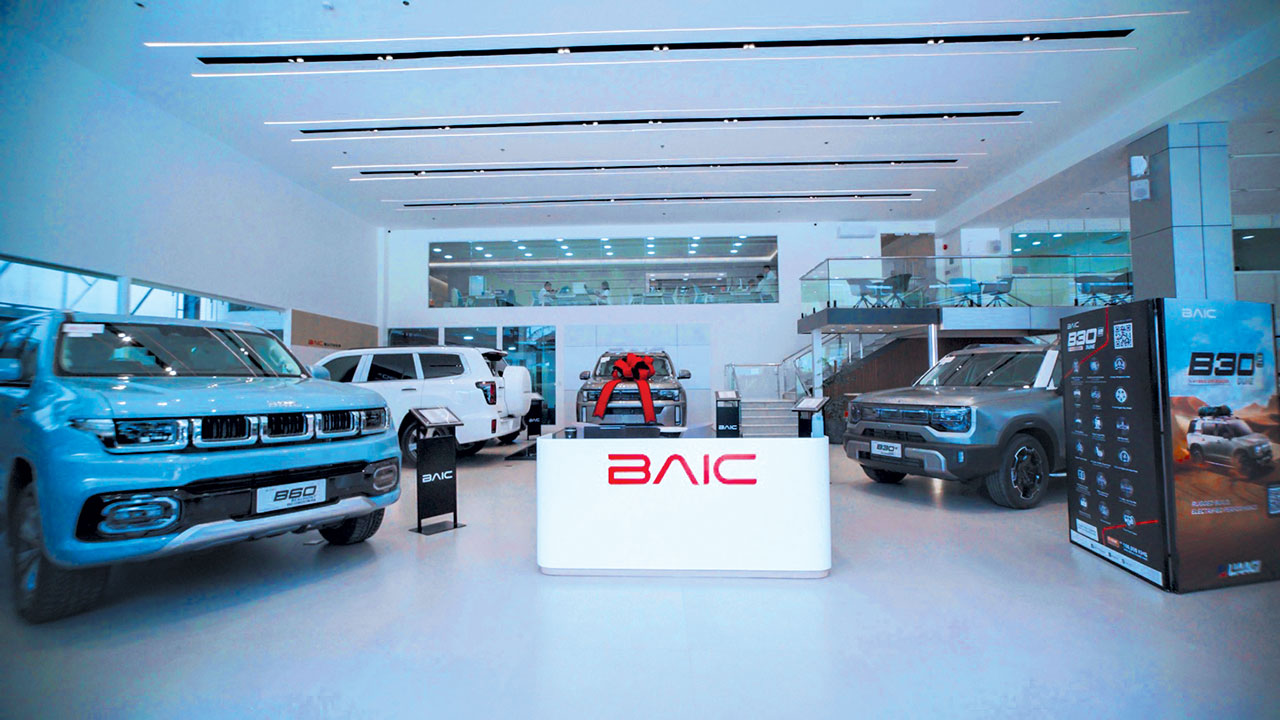
BAIC North EDSA is the fifth dealership for the brand to officially open this year, bringing the total number to 13. — PHOTO FROM UNITED ASIA AUTOMOTIVE GROUP, INC.

UAAGI inaugurates flagship showrooms for BAIC and Lynk & Co

MULTI-BRAND AUTO DISTRIBUTOR United Asia Automotive Group, Inc. (UAAGI) recently inaugurated its new flagship dealerships for its two upscale brands, BAIC and Lynk & Co. Owned and operated by Beatitude Auto Group, the state-of-the-art showrooms and service centers are located at 931 to 933 EDSA southbound, Brgy. Philam, right across TriNoma in Quezon City.

Present at the inauguration ceremony were local government officials led by Quezon City Mayor Joy Belmonte, UAAGI Chairman Rommel Sytin, UAAGI Vice-Chairman Kenneth Sytin, dealer principal Vincent Licup, UAAGI Director for Sales and Marketing Timothy Sytin, and Lynk & Co Philippines Managing Director Franz Decloedt.

Premium SUV, crossover, and 4×4 enthusiasts, as well as hybrid, plug-in hybrid, and EV buyers may now visit the expansive twin six-car showrooms, which are open Mondays to Saturdays from 8:30 a.m. to 5:30 p.m., and Sundays and holidays from 10 a.m. to 5 p.m. — for both sales and after-sales services.

Both North EDSA dealerships are designed as “one-stop shops” for BAIC and Lynk & Co owners and future customers, where sales, after-sales, and fully equipped service centers with highly trained specialists (separate for each brand) are all under one roof.

The spacious facilities are built to global showroom standards and feature a coffee bar where customers can relax in comfortable lounges, and a merchandise display where visitors can browse and shop a wide range of lifestyle products. The showrooms offer a premium atmosphere that allows visitors to experience both brand’s range of vehicles while enjoying a pleasant and relaxing customer experience.

Test drives for select BAIC and Lynk & Co models are available, giving customers the opportunity to experience the upmarket brands’ performance and comfort firsthand. Complementing the world-class lineup are the brands’ confidence-inspiring after-sales programs, which offer a 150,000-km or five-year warranty and 200,000-km or eight-year warranty (whichever comes first) for hybrids and EVs.

During the launch event, guests were treated to the exclusive premiere of BAIC’s latest brand campaign featuring BAIC’s brand ambassador Ian Veneracion, promoting its latest and most exciting vehicle lineup.

Lynk & Co also had its brand-specific program, which saw the unveiling of the new 08 EM-P plug-in hybrid premium SUV. Members of Lynk & Co’s global team including East Asia Regional Director Jeff Cao, Country Manager Victor Shu, Marketing Manager Lyn Ruan, and Assistant Manager Luca Shi were present at the inauguration as well.

“The opening of Lynk & Co North EDSA is more than a milestone — it’s a bold step toward redefining mobility in the Philippines,” said Mr. Cao. “The Lynk & Co 08 EM-P reflects our vision for the next generation, blending power, refinement, and advanced electrification for an unparalleled driving experience. In partnership with UAAGI, we’ve created a destination where innovation meets aspiration, and where every journey moves us toward a future without boundaries,” he added.

Timothy Sytin emphasized the significance of the launch, saying, “Today marks a significant milestone as we open the doors to our flagship dealership in North EDSA. Lynk & Co is a global premium brand that has been making waves internationally for its sophisticated design, advanced technology, and attainable prices. And now, we’re bringing that same standard to the Philippines. The unveiling of the Lynk & Co 08 EM-P represents a new benchmark for premium hybrid mobility in the country, offering up to 1,400 kilometers of range and exceptional efficiency without compromising on comfort, quality, or style.”

Meanwhile, BAIC North EDSA is the fifth dealership for the brand to officially open this year, bringing the total number to 13.

From rugged, true 4×4 SUVs built for real off-road adventures to stylish and versatile crossovers designed for the urban jungle, BAIC offers models that appeal to executives, entrepreneurs, and next-generation explorers alike. The impressive range includes the B80 Wagon, B60 Beaumont, B40 Ragnar, B30e Dune and X55 Verve Sport, along with newly launched additions such as the B40 Pro TrailMaster and B60e Beaumont rEV, all reflecting the brand’s dedication to cutting-edge technology, robust capability, and sustainability.

With bold design, spacious comfort, and powerful yet efficient petrol, diesel, hybrid, and electrified performance, BAIC continues to redefine the SUV experience in the Philippines.

Lynk & Co North EDSA, meanwhile, brings the number of Lynk & Co dealerships to six nationwide. Beatitude Auto Group is a multi-brand car dealership and service center that carries a variety of auto brands. With flagship showrooms for BAIC and Lynk & Co. in North EDSA, the group currently operates 11 dealerships across Metro Manila and Northern Luzon — with plans to expand to 20 by 2027 as part of its growth strategy.

All-new Mini JCW family now available

Mini’s more potent John Cooper Works versions have arrived in five models of the brand. — PHOTO FROM MINI

MINI ASIA and British United Automobiles recently announced the availability of the all-new Mini John Cooper Works (JCW) family comprised of five models epitomizing “pure driving fun in its most powerful form and a unique driving experience.”

Significantly, the first-ever Mini John Cooper Works Electric and first-ever Mini John Cooper Works Aceman — two fully electric John Cooper Works models — join the product portfolio. “The powerful electric drives open a new chapter in the brand’s long history and demonstrate its ongoing commitment to performance and innovation,” said Mini in a release. Meanwhile, the all-new Mini John Cooper Works and all-new Mini John Cooper Works Convertible “provide driving fun with a powerful TwinPower Turbo engine.” Finally, the all-new Mini John Cooper Works Countryman All4 presents enthusiasts with off-road capability thanks to all-wheel drive.

“Mini John Cooper Works boasts a cult following around the world that few others can match,” said Mini Asia Head Daren Ching. “Steeped in heritage and oozing pure racing DNA, these striking machines are a sight to behold on the road. Now with the addition of two fully electric models to the lineup, a new dimension of the iconic Mini go-kart feeling is born.”

The first-ever Mini John Cooper Works Electric and first-ever Mini John Cooper Works Aceman boast up to 190kW/258hp and 350Nm. Both models provide an additional 20kW of motor power via an electric boost function, allowing for dynamic acceleration. The JCW-specific suspension tuning maximizes the typical Mini go-kart feeling while guaranteeing agile handling. High-performance tires are said to be part of the standard equipment of both models.

Exclusive equipment details include the red-white-black John Cooper Works logo in the style of a checkered flag from motorsports, as well as a JCW-specific red roof. Black side skirts, model-specific aero-blades at the C-pillar, and the accentuated rear spoiler optimize the aerodynamics for increased range. The three-door Mini John Cooper Works Electric achieves 371km, while the five-door Mini John Cooper Works Aceman can drive up to 355km on a single battery charge.

On the other hand, the all-new Mini John Cooper Works and all-new Mini John Cooper Works Convertible get a four-cylinder 2.0-liter TwinPower Turbo serving up 231hp and 380Nm. A sportily tuned dual-clutch automatic transmission translates the engine power into “particularly dynamic gear changes.” The standstill-to-100kph time for the Mini John Cooper Works is 6.1 seconds (onto a top speed of 250kph), while the all-new Mini John Cooper Works Convertible takes 6.4 seconds (with a maximum rate of 245kph). The soft top of the Convertible can be fully retracted in just 18 seconds at speeds of up to 30kph.

The large octagonal high-gloss black front grille with wide air vents for efficient engine cooling and the modern JCW logo mark the front fascia of both models. Red-colored inserts in the side air inlets on the front apron underscore the motorsport-oriented design for maximum performance.

As the largest model, the all-new Mini John Cooper Works Countryman with All4 all-wheel drive allows enthusiasts to drive off-road. It offers “a unique combination of style, power, and adventurous spirit.” A top speed of 250kph is made possible by a mill that delivers 300hp and 400Nm.

Aerodynamic elements with red reflectors emphasize a wide stance, while at the rear of the vehicle, vertical taillights with the John Cooper Works Signature Mode frame the upright body. Advanced assistance systems support the driver through progressive technologies.

The clear design ethos of the interior in the all-new Mini John Cooper Works models is characterized by JCW-specific equipment details in red and black. The black JCW sports steering wheel with red decorative stitching and a six o’clock spoke made of black and red fabric provides “excellent grip.”

Additionally, JCW sports seats offer secure support during dynamic driving. The combination of black leatherette with multi-colored knitted material in the shoulder area and red accent stitching picks up the color pattern of the knitted surface of the dashboard. All Mini John Cooper Works models are given an exclusive Harman Kardon sound system.

The all-new Mini John Cooper Works family will officially debut at the Autohub Trackday on Sept. 7 at the Clark International Speedway in Pampanga.

SEC says GOCC listing push in initial phase

FRANCISCO ED. LIM — THE SECURITIES AND EXCHANGE COMMISSION/BW FILE PHOTO

By Ashley Erika O. Jose, Reporter

THE Securities and Exchange Commission (SEC) has started work on a plan to bring government-owned and -controlled corporations (GOCCs) to the stock market after securing approval from the Department of Finance, with the goal of deepening investor participation and boosting the capital market, its chairman said.

“We are still in the initial stages. Of course, we have to do the rounds of inventory of GOCCs. We already (secured) the go signal from Secretary of Finance [Ralph G.] Recto to look at the GOCCs that are listable,” SEC Chairman Francisco Ed. Lim told BusinessWorld on the sidelines of the Philippine Investment Conference 2025 last week.

For China Bank Capital Corp. Managing Director Juan Paolo E. Colet, the absence of GOCCs in the Philippine Stock Exchange (PSE) is why the stock market capitalization-to-gross domestic product (GDP) ratio remains low compared with most of the country’s Southeast Asian peers.

“Listing our country’s most eligible GOCCs can definitely beef up our stock market. Among key Southeast Asian economies, the Philippines is the only one without a publicly listed GOCC,” Mr. Colet said in a Viber message.

Mr. Colet said bringing GOCCs to the equity market is a good way for the government to raise funds as well as make these companies more efficient and competitive.

“The goal should not be to do an IPO (initial public offering) just for the sake of it, but to get a valuation that makes sense for both the state and investors,” he said.

Unicapital Securities Equity Research Analyst Peter Louise D.C. Garnace said the public listing of GOCCs will be a significant catalyst for the development of the local bourse.

“It would increase market depth and liquidity, widen the country’s investor base, and prove that the equity market is a viable source of financing,” Mr. Garnace said.

Although GOCCs are often deemed less efficient and profitable given weaker incentives for better performance and limited accountability for results, listing GOCCs can help mitigate these challenges by subjecting them to greater market discipline and stricter disclosure requirements, Mr. Garnace said.

“From a fiscal standpoint, IPOs of GOCCs can generate revenues for the government that can be used for critical public investments such as education, health, and infrastructure. If we take a look at other countries, the listing of GOCCs has driven the growth of investments in their capital markets,” he said.

In June, the SEC said it hoped to encourage GOCCs to list on the stock exchange to spur investor activity, citing similar initiatives in neighboring countries like Vietnam.

In its Capital Market Review of the Philippines last year, the Organisation for Economic Co-operation and Development (OECD) said many Philippine state-owned enterprises (SOEs) are candidates for public listing, such as Land Bank of the Philippines and Development Bank of the Philippines.

The OECD also said the Philippines could grow its capital markets by listing minority stakes in financially significant SOEs.

SOEs occupy a significant share of market capitalization in other ASEAN countries such as Singapore, Indonesia, Malaysia, and Vietnam.

“SEC is working to future-proof the Philippine capital market. We are also working on listing for grantees of legislative franchises and exploring the listing of commercially viable state-owned enterprises, which will bring new scale and diversity into our market,” Mr. Lim said.

Further, stock market analysts said the success of GOCC listings will require a broad investor base and adequate market infrastructure, while also depending on timing and business fundamentals.

“The key challenges are readiness and timing. The focus should be on GOCCs with strong business fundamentals and prospects. Apart from the usual listing requirements, a GOCC should be considered IPO-ready if it has high-quality corporate governance structures, independent private auditors, a commitment to delivering shareholder value, and robust protections for minority investors,” Mr. Colet said, noting that if all these elements fell into place and market conditions are conducive, GOCC IPOs could be doable as soon as next year.

“We note, however, that successful GOCC listings require a broad investor base, solid market infrastructure, and a stable macroeconomic backdrop,” Mr. Garnace said.

Treasury bill, bond rates may drop after BSP cut

BW FILE PHOTO

RATES of the Treasury bills (T-bills) and Treasury bonds (T-bonds) to be auctioned off this week could decline further after the Bangko Sentral ng Pilipinas (BSP) cut borrowing costs and signaled that they are nearing the end of their current easing cycle.

The Bureau of the Treasury (BTr) will auction off P25 billion in T-bills on Monday, or P8.5 billion each in 91-day and 182-day securities, and P8 billion in 364-day papers.

On Tuesday, the government will offer P30 billion in reissued 10-year T-bonds with a remaining life of seven years and 13 days.

T-bill and T-bond auction yields could go down in line with the broad week-on-week drop in secondary market rates after BSP Governor Eli M. Remolona, Jr. said they could opt to keep benchmark borrowing costs steady after their latest cut, Rizal Commercial Banking Corp. Chief Economist Michael L. Ricafort said in a Viber message.

“BSP Governor Remolona gave less dovish signals on a possible one 25-basis-point (bp) rate cut for the rest of 2025 if economic data remained weak, or even no more rate cut for the rest of 2025 if the economic data remained the same,” he said.

Mr. Ricafort added that the market will monitor the August inflation data to be released on Friday as this could justify further reductions from the BSP.

A trader said in an e-mail that the reissued 10-year bond could fetch rates ranging from 5.875% to 5.925%.

At the secondary market on Friday, the 91-, 182-, and 364- day T-bills went down by 2.57 bps, 9.09 bps, and 6.28 bps week on week to end at 5.2321%, 5.3921%, and 5.5357%, respectively, based on PHP Bloomberg Valuation Service Reference Rates data as of Aug. 29 published on the Philippine Dealing System’s website.

For its part, the 10-year bond rose by 1.6 bps week on week to yield 6.016%, while the seven-year tenor, the closest to the remaining life of the reissued papers on offer this week, went down by 2.1 bps to close at 5.9011%.

The BSP on Thursday lowered benchmark interest rates by 25 bps for the third consecutive meeting to bring the policy rate to 5%, as expected by all 20 analysts in a BusinessWorld poll.

It has now slashed borrowing costs by a cumulative 150 bps since it began its rate-cut cycle in August 2024.

Mr. Remolona said the key rate is now at the “sweet spot” in terms of inflation and output, but he left the door open for one more cut this year, which would likely mark the end of the central bank’s current easing cycle.

The Monetary Board’s last two meetings this year are scheduled for Oct. 9 and Dec. 11.

Last week, the government raised P25 billion as planned from the T-bills it auctioned off as the offer was more than four times oversubscribed, with total bids reaching P113.02 billion.

Broken down, the Treasury borrowed P8 billion as planned via the 91-day T-bills as total tenders for the tenor reached P31.89 billion. The three-month paper was quoted at an average rate of 5.195%, down by 3.9 bps from the previous auction. Accepted yields ranged from 5.188% to 5.2%.

The government likewise raised the programmed P8 billion from the 182-day securities as tenders amounted to P39.27 billion. The average rate of the six-month T-bill was at 5.398%, dropping by 3.7 bps, with accepted rates ranging from 5.388% to 5.413%.

Lastly, the Treasury sold the planned P9 billion in 364-day debt as demand for the tenor totaled P41.86 billion. The average rate of the one-year T-bill went down by 4.2 bps to 5.522%. Tenders accepted carried yields of 5.518% to 5.53%.

Meanwhile, the reissued 10-year T-bonds to be offered on Tuesday were last auctioned off on July 8, where the government raised P30 billion as planned at an average rate of 6.128%, below the 6.75% coupon rate.

The Treasury is looking to raise P220 billion from the domestic market this month, or P100 billion via T-bills and P120 billion through T-bonds.

The government borrows from local and foreign sources to help fund its budget deficit, which is capped at P1.56 trillion or 5.5% of gross domestic product this year. — Aaron Michael C. Sy

Ayala Land shares rise on MSCI rebalancing, foreign inflows

Nuvali in Laguna is Ayala Land’s largest eco-city development in the country unlocking the potential for future eco-communities in Southern Luzon.

AYALA LAND, INC.’S (ALI) share price rose last week after the Morgan Stanley Capital International (MSCI) rebalancing, a huge volume of net foreign inflows, and anticipation of interest rate cuts.

The property developer was the third most actively traded issue last week, with a total of 96.98 million shares worth P2.76 billion changing hands from Aug. 26 to 29, data from the Philippine Stock Exchange (PSE) showed.

At the end of the trading week, Ayala Land closed at P28 per share, up 3.3% from the previous Friday’s close of P27.10. The uptick was a reversal compared with the property sector, which slipped by 0.04%, and the benchmark PSE index (PSEi), which contracted by 2% week on week.

Year to date, the stock rose by 6.9%, reflecting the property sector’s 2.8% growth but contrasting with the PSEi’s 5.7% decline.

“The strong move on Ayala Land’s stock price this week was primarily driven by the anticipation of Bangko Sentral ng Pilipinas’ interest rate cuts, which could boost the property sector. Also, the recent MSCI rebalancing supported the strong price action on Ayala Land as it has a huge volume of net foreign inflows,” said Jash Matthew M. Baylon, an equity analyst at The First Resources Management and Securities Corp., in a Viber message.

Ayala Land was among those included in the top ten constituents in the MSCI rebalancing. As of Aug. 31, the company had an index weight of 7.27%, with a market capitalization of P409.53 billion.

The index is designed to measure the performance of the large- and mid-cap segments of the Philippine market. Some fund managers track the MSCI index composition to realign their portfolios.

Ayala Land saw net foreign buying in three out of four trading sessions last week, with inflows amounting to P797.94 million from Aug. 26 to 29, according to PSE market data.

Trading days were cut to four due to the National Heroes Day holiday on Aug. 25.

Mr. Baylon also said that Ayala Land’s acquisition agreement for ABS-CBN’s property in Quezon City affected Ayala Land’s stock, as the formalization of the deal was seen as positive sentiment for the market.

“The move was also considered to be a strategic acquisition, as the firm could use it for future developments,” said Mr. Baylon.

Last week, ABS-CBN Corp. said it signed the deeds of absolute sale covering part of its Quezon City property with Ayala Land, formalizing a P6.24-billion deal. The sale covers up to 30,000 square meters, or 68.14% of ABS-CBN’s 44,027.30-square-meter property.

Meanwhile, the Monetary Board reduced the target reverse repurchase rate by 25 basis points (bps) to 5% from 5.25%, as expected by 20 analysts in a BusinessWorld poll last week. This was also the lowest level in nearly three years, or since November 2022.

Latest audited financial statements showed ALI’s consolidated attributable net income reached P14.17 billion in the first half of 2025, 7.9% higher than the P13.13 billion recorded in the same period last year, driven by the company’s diversified portfolio. Meanwhile, consolidated revenue fell by 1.4% to P83.07 billion from P84.27 billion.

“We forecast ALI’s net income to grow to P31.43 billion for the full year 2025 mainly driven by its robust mall segments and improved leasing revenues,” Mr. Baylon said.

For this week, Mr. Baylon placed Ayala Land’s support levels at P28 per share, while its resistance levels are at P30 per share. — Lourdes O. Pilar

Good coffee, vinyl, and a Lexus

PHOTO FROM LEXUS PHILIPPINES

UNTIL Sept. 23, Lexus Philippines blends “good coffee and good records” at Flat Six Café in Quezon City. Located at 131 Katipunan Avenue, Barangay St. Ignatius, the “cozy café” will host the Lexus LBX for an up-close-and-personal experience. During their stay at the coffee shop, Lexus owners will also get a special treat. Guests only need to show their Lexus car key to get an exclusive complimentary drink.

The Lexus LBX is a premium compact crossover powered by a 1.5-liter, three-cylinder hybrid engine, and is said to deliver responsive performance with outstanding fuel efficiency. Its lightweight build and finely tuned suspension ensure dynamic handling. The cabin features a seven-inch digital instrument cluster, ambient lighting, and meticulous omotenashi (the Japanese concept of deep, wholehearted hospitality, rooted in selfless service without expectation of reward) details that “create a luxurious, driver-centric experience.”

Central bank sets indefinite moratorium on grant of new licenses to virtual asset service providers

Representations of cryptocurrency Bitcoin are seen in this illustration picture taken in Paris, France, March 9, 2024. — REUTERS/BENOIT TESSIER/ILLUSTRATION/FILE PHOTO

THE BANGKO SENTRAL ng Pilipinas (BSP) has extended indefinitely its moratorium on the grant of new virtual asset service provider (VASP) licenses as it noted “heightened risks” in the sector.

“The extension of the moratorium considers the heightened risks associated with virtual assets (VAs) and underscores the BSP’s commitment to protect consumers and uphold the stability and integrity of the financial system,” the central bank said in a statement on Friday.

“The BSP will periodically review the moratorium on VASP licensing in line with industry developments, as it strengthens its monitoring, surveillance, and enforcement capabilities. This approach ensures that the BSP can effectively address emerging risks and respond to evolving trends in the domestic and global VA landscape.”

The central bank added that enhanced monitoring of VASPs is also part of its efforts to strengthen its anti-money laundering, counter-terrorism financing (AML/CFT), and counter-proliferation financing of weapons of mass destruction framework following the Philippines’ removal from the Financial Action Task Force’s (FATF) “gray list” of jurisdictions under increased monitoring in February this year.

This close monitoring is meant to ensure that these entities operate “in full compliance with regulations and international standards, and implement secure, transparent, and accountable practices.”

The Anti-Money Laundering Council (AMLC) earlier said it is pushing amendments to the Anti-Money Laundering Act that could include the authority to temporarily suspend transactions and the designation of VASP as covered persons under the revised international standards and FATF recommendations.

The FATF has said that countries must ensure VASPs are regulated for AML/CFT as “virtual assets also risk becoming a safe haven for the financial transactions of criminals and terrorists.” These providers must also be licensed or registered, and subject to effective systems for monitoring.

The BSP initially imposed a three-year moratorium on new VASP licenses in September 2022.

Virtual assets refer to any digital representation of value that can be traded online, transferred, or used for payment, including cryptocurrencies.

VASPs offer services or engage in activities that provide facilities for the safekeeping, administration, transfer or exchange of virtual assets, such as cryptocurrency exchanges. The products and services of VASPs include cryptocurrencies and electronic wallets for holding and storing these virtual assets.

BSP data showed that 13 entities held VASP licenses as of May 15, with three of them being inactive or nonoperational.

In an advisory also issued on Friday, the central bank warned the public against dealing with unlicensed or unauthorized VASPs, adding that the official list of registered VASPs is available on its website.

It also encouraged the reporting of any illegal or suspicious activities related to VAs or VASPs to the BSP. — K.K. Chan