Home Blog Page 10062

Peso seen weakening this year

AFTER REBOUNDING against the greenback in 2019, the peso might weaken this year on the back of a possibly wider trade deficit and as investors wait on the sidelines for the clarity of some business-related rules in the country.

Such pressures could drag the peso back to the P52-per-dollar level, according to an economist.

The peso ended at P50.635 per dollar on Dec. 27 — the last trading day of 2019 — stronger by P1.945 year on year from its close of P52.58 on Dec. 28, 2018.

In a note to reporters on Dec. 12, ING Bank NV-Manila Senior Economist Nicholas Antonio T. Mapa said the recent pause in monetary easing by the central bank could be the key to the appreciation of the local unit, aside from the seasonal flows of remittances from Filipino migrants.

“However, given the projected acceleration of the government’s infrastructure program, we expect the peso to face renewed depreciation pressure in the coming months as the trade balance is forecast to widen further into deficit,” Mr. Mapa said.

The Bangko Sentral ng Pilipinas (BSP) last year slashed key policy rates by a total of 75 basis points (bps) as prices of commodities cooled down, resulting in a benign inflation environment after price spikes in 2018 that triggered the BSP rate hikes.

Meanwhile, latest data from the Philippine Statistics Authority (PSA) showed the country’s balance of trade in goods as of October was at a trade deficit of $3.25 billion, slipping 26.4% from the $4.42 trade deficit seen in the same period in 2018.

UnionBank of the Philippines, Inc. Chief Economist Ruben Carlo O. Asuncion also sees that trade recovery would be “critical” for peso trading, specifically the country’s import performance.

He added that perception of the investment climate in the country will also be a key factor for the peso.

“Markets and investors need to see and feel the clarity of the rules and the insurance of proper execution on the side of the government,” Mr. Asuncion said in a text message on Dec. 27.

The Corporate Income Tax and Incentives Rationalization Act (CITIRA) has been approved in the House of Representatives. However, it is still awaiting its verdict in the Senate.

Among the propositions of the bill is the reduction of corporate income tax to 20% from 30% over 10 years to make the country have better competitive advantage in the region where average income tax rate is at 22.4%, according to data from the Philippine Exporters Confederation, Inc.

Meanwhile, the peso may be supported by improved risk appetite in 2020 due to recent positive developments in the trade negotiations between the world’s two biggest economies.

“For 2020, the peso exchange rate could continue to be relatively stable…after the phase one US-China trade deal which could be a step in the right direction to support…sentiment in emerging market economies and financial markets such as the Philippines,” Rizal Commercial Banking Corp. (RCBC) Chief Economist Michael L. Ricafort said in a text message last Friday.

Aside from this, Mr. Ricafort is bullish that the country’s dollar reserves will help prop up the local currency against the dollar.

“The peso exchange rate could also be supported by new record highs in the country’s GIR (gross international reserves) and relatively better BoP (balance of payments) data…as well as continued growth in OFW (overseas Filipino workers) remittances, BPO (business process outsourcing) revenues, foreign tourism receipts, and some pick in foreign investment inflows,” he added.

Central bank data showed the country’s dollar reserves as of end-November stood at $86.23 billion, which is enough to cover 7.5 months’ worth of imports of goods and payments of services and primary income.

Meanwhile, the country’s BoP position was at a surplus of $778 million as of the third quarter, a reversal of the $1.9-billion deficit logged in the same period a year ago. This was on the back of increased net inflows in the financial account paired with a lower deficit in its current account.

For this week, Mr. Ricafort thinks a vital catalyst for peso movement would be US data on employment and new cues “for the direction of the US-China trade talks.” He sees that the peso trading at a range of P50.40-50.80 from Thursday to Friday.

Reuters reported that White House trade adviser Peter Navarro said in a Dec. 30 interview with Fox that the much awaited phase one deal between Washington and Beijing would likely be signed by next week, although he said that the confirmation will come from US President Donald J. Trump or the US Trade Representative.

Mr. Navarro also cited a South China Morning Post report which said that Chinese Vice Premier Liu He would visit the US next week to sign the deal, although Mr. Navarro did not confirm it.

For his part, UnionBank’s Mr. Asuncion expects the local unit to move within the P50.50-50.80 band this week as he expects “the strength to continue until we see imports recovering by at most Q1 2020.”

For the entire year, RCBC’s Mr. Ricafort sees the peso moving around P50-51 versus the dollar. Meanwhile, UnionBank’s Mr. Asuncion believes the local unit will trade from the P51-52.50 against the dollar, with the peso seen to end the year at P52.19. — L.W.T. Noble with Reuters

Shares to climb on budget’s signing, trade deal

LOCAL SHARES are seen to move upwards on the first trading day and week of 2020 as investors expect the signing of the national budget for this year and positive developments in the US-China trade war.

The bellwether Philippine Stock Exchange index (PSEi) closed the previous year on a negative note, losing 0.34% or 27.02 points to 7,815.26. The market was up by 4.7% from its finish of 7,466.02 in 2018.

“We have an upward bias for the first trading day and week of 2020. The national budget is also expected to be signed on time this 2020. Coupled with the low interest rates, we have accommodative policies that could boost the market [this] year,” Japhet Louis O. Tantiangco, senior research analyst at Philstocks Financial Inc. said in a text message.

The proposed P4.1-trillion national budget for 2020 secured approval from the Bicameral Conference Committee on Dec. 12. It was also ratified by both the House of Representatives and the Senate on the same day. What is left is the signature of President Rodrigo R. Duterte for its enactment.

This is seen to prevent the delay that happened with the P3.757-trillion budget for 2019 which was signed April 15, where about P95.3 billion was vetoed. This, coupled with the ban on new public works ahead of the May 13 midterm elections, slowed economic growth to 5.8% in the first three quarters of 2019 from 6.2% year-on-year and versus the 6-7% target of the government for 2019.

Mr. Tantiangco also expects some bargain-hunting as many shares remain at attractive levels and amid favorable developments in the negotiations between US and China.

US President Donald Trump announced that he will be signing the phase one deal of the two economic giants’ trade agreement on Jan. 15, which will be signed in Washington. This is expected to reduce tensions between the two.

Negotiations for phase two of the deal will then be done in Beijing.

“These could induce investors to take up positions by the start of 2020. Support is at 7,800 while resistance is at 8,000,” Mr. Tantiangco noted.

“With the early approval of the 2020 budget plus the continued approval of the spending of the 2019 budget coupled with the positive developments in the US-China trade negotiations, this will provide better growth prospects for the incoming year,” Diversified Securities, Inc. Equity Trader Aniceto K. Pangan said in a separate text message, and placed the PSEi’s support and resistance levels at 7,772 and 7,900, respectively, this week.

On the other hand, PNB Securities, Inc. President Manuel Antonio G. Lisbona is projecting slow trading given the shortened week and with many investors still on holiday.

“Movers will be the water concessionaire related names (AC [Ayala Corp.], DMC [DMCI Holdings, Inc.], MPI [Metro Pacific Investments Corp.], and MWC [Manila Water Co., Inc.]). Trading range will be 7,700 to 8,000,” he noted. — Vincent Mariel P. Galang

Critical thinking for business leadership

Business leaders need to exercise more critical thinking to avoid and solve the problems businesses have caused in the last two decades. While business has created massive economic growth all over the world and lifted billions out of poverty, chronic management malpractices have also harmed consumers and worsened income inequality, environmental damage, and psychological and health issues for so many workers.

Business managers do not intentionally set out to harm others when they fall into malpractice. They have good intentions, but unfortunately, they pursue these based on unsound beliefs and dangerous half-truths that are basically myths. To paraphrase a well-known Josh Billings quote: “It’s not what we don’t know that gets us in trouble; it’s what we know that ain’t so.” Business leaders have their share of beliefs that just ain’t so. But because these myths are so durable and widely believed, they have caused so much trouble for people and societies.

Myth #1: Numbers reflect business reality and should be the main basis for decisions.

This myth comes from the absurd claim that “accounting is the language of business.” In recent decades, the numbers mania has been pushed by the mindless use of “metrics,” “key performance indicators,” and “analytics.”

Numbers can never fully capture business reality because they do not reflect context, and quite a lot of subjective judgment goes into producing such numbers. Whether the numbers come from accounting, operational, or technological processes, numbers merely show the tips of icebergs, so to speak. They give a hint of what may be happening in the business. Fuller knowledge requires finding out the stories behind the numbers. Some of the worst scandals in the last 20 years, including Enron, the US-mortgage crisis, Volkswagen’s emissions cheating, and the BW Resources stock manipulation scam, all happened because people put too much blind faith in numbers — leading to short-term thinking, the manipulation of numbers, and poor judgment.

Good managers try to know as much about business reality by observing and talking to people on the ground and understanding the stories behind the numbers. They combine this information with the numbers and make sounder decisions accordingly.

Myth #2: Markets are fair and should be trusted above all else.

University of Chicago economist Milton Friedman made this ideology famous, but repeated market-based debacles since the turn of the century and culminating in the Global Financial Crisis have completely discredited it. Unfortunately, I still hear thought leaders in business argue that we should “let the market decide.” They assume that forces of demand and supply will provide the optimal outcomes that ultimately benefit everyone.

To be sure, markets play an essential role in business and economic success. But markets are fair only if: 1.) information on market options and activities is transparently available to all participants; 2.) buyers and sellers are free to move in and out; 3.) all stakeholders have the resources to participate in the market; and 4.) all benefits and costs to all stakeholders are included in the pricing. In reality, these conditions are violated most of the time. Important information is not disclosed, or is available only to insiders. Dominant players make it difficult for other participants to move in or out. Affected members of the public do not have the voice or the resources to counter negative impacts on them. And finally, the poor do not have the resources to participate.

Environmental damage, the sale of harmful products, and community harm are the results of unfair markets. Government regulation is necessary to ensure that: 1.) sellers disclose accurate product and service information; 2.) sellers avoid harm to others or include the cost of preventing such harm as part of their prices; and 3.) those with fewer resources can also participate in the market.

Myth #3: Workers are expensive resources.

Economics refers to labor as factor, input, or resource for production, similar to capital or technology. Accounting practice considers workers only as expenses. The half-truth that people are expensive resources has led to much business malpractice because resources more properly refer to inanimate things meant to be used or exploited for one’s own benefit.

In reality, a worker is not a thing, but an animate person with dignity, a set of capabilities, decision-making power, and feelings. Business managers who do not empathize with workers and who overwork or otherwise exploit them are causing serious psychological harm. The World Health Organization has sounded the alarm that burnout is a result of “chronic workplace stress that has not been successfully managed.” It results in: 1.) feelings of energy depletion or exhaustion; 2.) increased mental distance from one’s job, or feelings of negativism or cynicism related to one’s job; and 3.) reduced professional efficacy.

Workers are best viewed as capable partners in production and value creation. They deserve respect, support, and fair compensation. Moreover, they have the right to participate in decisions that affect their welfare and achieve the goals of the business. Business leaders who can harness the creativity, judgment, and passion of workers can create a healthier workplace and thereby achieve sustainable competitiveness.


Dr. Benito L. Teehankee is the Jose E. Cuisia Professor of Business Ethics and Head of the Business for Human Development Network at De La Salle University.

benito.teehankee@dlsu.edu.ph

What we learned from 2019’s worst PR disasters

By Kara Alaimo

AS A PUBLIC relations professor, I know a few of my fellow professionals can be counted on to do things that keep my students’ jaws dropping in class each week — and, like 2018, this year was no exception. Here are the five decisions that beat out stiff competition to rank as the worst corporate PR moves of 2019:

1. Dennis Muilenburg’s week of silence after the crash of Ethiopian Airlines Flight 302 in March. As crisis guru Helio Fred Garcia once wrote, “incremental delays in showing that an organization cares can lead to greater-than-incremental harm.” Even if Muilenburg, Boeing Co.’s now-former chief executive officer, didn’t initially have all the answers about his company’s role in the disaster, he should have immediately expressed sympathy for the victims and their loved ones, then pledged to provide the public with more information as soon as possible. Every PR executive worth their paycheck knows that, during a crisis, it’s critical to say something during what Garcia calls the “golden hour.” Just as a patient having a heart attack is much more likely to survive if they are brought to the hospital in the first hour, an organization is more likely to survive a crisis with its reputation intact if it immediately speaks for itself rather than allowing others to speculate about its motives and behavior.

2. The Peloton ad depicting a svelte woman making a video to thank her male partner for buying her an exercise bike for Christmas. The ad was widely interpreted as disturbing because the woman appeared to many to be frightened. Some pointed out that the woman was already trim and hardly needed to lose weight; others said the ad reinforced stereotypes of women needing to stay in shape in order to keep their affluent significant others (the bike costs over $2,000, before monthly subscription fees). These reactions were of course eminently predictable. The key lesson for brands? Test audiences’ reaction before going public with new campaigns. The ad could have been an easy win just by, say, showing a woman giving the gift to a man instead.

Peloton Interactive Inc. loses more points for crafting a response as tone-deaf as the ad itself. “We’re disappointed in how some have misinterpreted this commercial,” the company said. An insincere non-apology is the only thing worse than not apologizing at all.

3. Richard Branson’s launching his Center for Entrepreneurship in South Africa with a picture of all white people. The need to ensure diversity when doing anything public shouldn’t require further explanation in 2019.

4. Sallie Mae’s decision to fly more than 100 staffers to Hawaii to celebrate a record number of student loans. The (totally foreseeable) NBC News report on this one pretty much summed it up: “As one in five American adults wonder how to pay off their combined $1.6 trillion in student debt, Sallie Mae executives and sales team members wrestled with a different question: Between meetings, how should they spend their time on their five-day paid trip to the luxury Fairmont resort on Wailea beach in Maui?”

Seriously? In the era of social media outrage, organizations need to work a little harder to make sure their executives don’t appear so deeply out of touch with the publics they serve.

5. Hallmark’s decision to pull — and then reinstate — an ad showing lesbian brides. The only thing less savvy than alienating important audiences is offending everyone. Companies have to decide what they stand for before they’re put on the spot. Another news flash: As we approach the year 2020, homophobia is not a winning strategy.

Dishonorable mentions also go to Facebook Inc. (another organization that should be doing some hard thinking about its values and has managed to offend absolutely everyone) for not vetting for truth in political advertising on its platform and to Australian Kmart for selling child bride costumes. Their executives apparently missed the class on the need to consider the deeper messages their products send.


BLOOMBERG OPINION

Parliamentarism in BARMM: Important considerations

Article IV, Section 3 of Republic Act No. 11054 — otherwise known as the Organic Law for the Bangsamoro Autonomous Region in Muslim Mindanao (BARMM) — states that “the Bangsamoro Autonomous Region shall have a parliamentary form of government.” This is repeated in Article VIII, Section 1 on the Wali: “Consistent with a parliamentary form of government, there shall be a Wali who shall serve as the ceremonial head of the Bangsamoro Government.”

Parliamentarism in BARMM beginning in July 2022 is unprecedented. The original 1973 Constitution, framed by the 1971 Constitutional Convention, created a parliamentary system but subsequent amendments, especially in 1976 and 1981, altered the form of government. The pure parliamentarism adopted by the framers never materialized. From January 1973 to April 1978, only the Transitory Provisions were in operation. From June 1978 to June 1981, following the 1976 Amendments, President Ferdinand Marcos was both prime minister and president. From June 1981 to February 1986, semi-presidentialism was in place, following the 1981 Amendments, modeled after the French Fifth Republic.

To prepare for parliamentarism in BARMM, there is a need to highlight some important considerations on the actual workings of parliamentarism.

PARLIAMENTARISM: VARIANTS AND ELECTORAL SYSTEMS
Alfred Stepan and Cindy Skach defines “a pure parliamentary regime in a democracy” as a “system of mutual dependence” with two fundamental characteristics*:

1.) The chief executive power must be supported by a majority in the legislature and can fall if it receives a vote of no confidence; and,

2.) The chief executive power has the capacity to dissolve the legislature and call for elections.

“Majority in the legislature” mentioned in the first characteristic can result in variants in parliamentarism. The majority in the legislature can be either a single political party or a multi-party coalition. Parliamentarism with a single party legislative majority is also called majoritarian or “Westminster” parliamentarism with the British parliamentary system as the oldest working model. Parliamentarism with a multi-party coalition as a legislative majority is usually called coalitional or consociational parliamentarism and is more commonly found in Continental Western European democracies.

Whether the legislative majority is a single political party or a multi-party coalition is, to a large extent, shaped by the electoral system used to select the members of parliament (MPs). A single-member plurality (SMP) or “first-past-the-post” (FPTP) electoral system generally results in a legislative majority of one party while a party-list proportional representation (PR) system produces a coalitional majority. SMP/FPTP is commonly identified with a two-party system and “exaggerates” the electoral plurality of the largest political party by allowing it to win a parliamentary majority. In UK elections, a party’s 40% electoral plurality can translate to a 60% parliamentary majority.** Party-list PR, contrariwise, opens up the party system by allowing small political parties to win parliamentary seats and the opportunity to be part of the ruling coalition.

PARLIAMENTARISM: CONSEQUENCES
The first characteristic states that “the chief executive power must be supported by a majority in the legislature.” In parliamentarism, the government is always supported by a legislative majority. When it loses majority support, the government becomes vulnerable to a vote of “no confidence” and is replaced by a new government with legislative majority support.

When government is supported by a legislative majority, three consequences follow. First, the cabinet headed by the prime minister (PM) dominates the legislative process. Second, the PM assumes multiple related but distinct roles. Third, the opposition minority cannot trigger a vote of “no confidence.”

Enjoying legislative majority support, the PM comes to dominate law-making. Cabinet bills or bills introduced by members of the Cabinet take priority. Government, led by the PM and Cabinet, effectively sets and controls the legislative agenda. The PM becomes extremely powerful with BOTH executive and legislative functions.

With a legislative majority, the PM comes to have three roles. As chief executive and head of government, he has executive functions and implements laws. He is also a member of parliament (MP) with legislative roles like the introduction of bills, participation in floor debates, and voting. In addition, his legislative majority makes him responsible for setting and realizing the legislative agenda. Finally, as leader of the majority party or coalition, he is responsible for keeping this majority cohesively behind him.

The third role as partisan leader is quite important as PMs have resigned, not through an opposition-triggered vote of “no confidence,” but because his co-partisans decided to elect a new leader. In June 2019, UK Prime Minister Theresa May ostensibly resigned as PM. Actually, she resigned as Conservative Party leader, the majority party in the House of Commons. May’s own co-partisans decided to replace her, thereby forcing her to likewise step down as chief executive and head of government. PMs should therefore appreciate and value the importance of co-partisan “back-benchers” as their continued support effectively inoculates him from an opposition minority-triggered vote of “no confidence.”

With a legislative majority, the only real way the opposition minority can check the government is through the “Question Hour.” Part of the regular business of parliament, it is held every so often in a week and provides the opposition the opportunity to fiscalize and scrutinize the PM and the Cabinet.

* Alfred Stepan and Cindy Skach, “Constitutional Frameworks and Democratic Consolidation: Parliamentarism and Presidentialism,” World Politics 46, No. 1 (October 1993), 3.

** David M. Farrell, Electoral Systems: A Comparative Introduction (London, Red Globe Press, 2001), 21.


Millard O. Lim is a lecturer at the Department of Political Science, Ateneo de Manila University.

Education as the premise of progress

The Philippine Constitution clearly states that “the State shall protect and promote the right of all citizens to quality education at all levels of education and shall take appropriate steps to make such education accessible to all.”

To further emphasize this basic policy, other sections of the Constitution enunciate the “duty of the State to establish, maintain and support a complete, adequate and integrated system of education relevant to the needs of the people and society.”

That education is given one entire article — Article 14 — in the basic law of the land is a reflection of how our constitutional framers clearly recognize the ardent desire of parents to have their children finish school, face the world and grab economic opportunities, improve themselves and elevate the standard of living of their families. Education is the ultimate enabler for any individual, regardless of location, race, sex, or creed. Oftentimes, it is a vehicle for upward mobility that would allow anyone to transcend the limit’s of one’s birth.

So when the results of the OECD-administered Program for International Student Assessment (PISA) in 2018 were recently released, the reaction was utmost dismay, frustration and embarrassment. The results showed that Filipino students garnered a mean of 340 points in reading comprehension, which is starkly below the established average of 487 points. And we all know that reading skills are a cornerstone of a human being’s ability to understand, comprehend, decide and take action in response to day-to-day human and societal events. Such skills are crucial to any professional undertaking.

In the areas of mathematics and science, competencies which are core to the nation’s vision of being globally competitive in technology, industry and innovation, our students got a mean of 353 in Math, and 357 in Science, against a 489 OECD average for both categories. Interestingly enough, China beat the pack by garnering scores higher than the aforementioned OECD averages.

NATIONAL RESPONSE
The reaction of the country, at first, was defensive disbelief and eventually, a humbling acceptance. After an honest recognition of the gaps and weaknesses of our educational system, its infrastructure, and issues around teacher-pupil ratio, and classroom shortages, teacher education development program, conditional school feeding and other initiatives are now being revived.

These results are also frustrating and embarrassing to the international community which has depended for many decades on millions of our workers and professionals who enjoyed the reputation of being well educated with good speaking skills and relationship management. If the scores are this low, how can we still be competitive or even respected within and outside of the Philippines?

Particularly encouraging, on hindsight, is the fact that our Department of Education (DepEd) made a conscious and brave decision to participate in PISA for the first time in 2018. Education Secretary Leonor Briones exercised political will by going through the process, accepting the results, and paving the way for understanding the deficiencies of our educational system and providing solutions that are not only relevant for students today but also those belonging to the next generation. And coping with the future risks and opportunities is very important because our youth are exposed to learning and communicating through the use of advanced information technology, artificial intelligence, and robotics. Secretary Briones is fully aware that the tools for future education shall be radically different from what we use today and in the next few years.

NECESSARY SOLUTION
Thus, participation in the PISA, no matter how painful the results were, was a journey worth taking. It was the proverbial bitter pill urgently needed to cure the ailing educational infrastructure. In fact, the DepEd launched Sulong Edukalidad which seeks to institute reforms in four key areas of K to 12 review and updating, improvement of learning facilities, teachers and school heads’ up-skilling and re-skilling through a transformed professional development program, and engagement of all stakeholders for support and collaboration.

Sulong Edukalidad has a great potential of being an effective platform which shall hopefully improve our scores in the PISA and make education a true vehicle for the ordinary student’s liberation from illiteracy, ignorance, and despondency. The overall agenda to ensure that our educational system shall be at par with the more advanced societies of the world is truly a paramount obligation of the state to its citizens.


Ariel F. Nepomuceno is a management consultant on strategy and investment.

Top 10 economic news stories of 2019

Here is my modest list of the major economic events this year, from international, to regional, to national news.

1. Global investments expand. After the global economic and trade slowdown in 2015-2017, foreign direct investments (FDIs) resumed expansion in 2018. The US remains the No. 1 most attractive investment area for many multinationals and individuals from around the world, followed by Hong Kong, China, and Singapore. The Philippines remains a laggard here.

2. Merchandise exports also recovered. Before the creation of the World Trade Organization (WTO) in 1995, export levels of many countries were low in 1994. After 23 years — from 1995 to 2018 — Vietnam and China were the biggest benefactors, China now the world’s largest exporter followed by the US and Germany. And the Philippines continues to be a laggard (see Table 1).

3. US-China trade deal phase one. The US will cut its 15% tariff to 7.5% on $120 billion of China exports, and suspend indefinitely planned tariff hikes on other goods. China made no tariff cut commitment but will increase its US imports by at least $200 billion in 2020-2021. China will also stop its old practice of forcing or pressuring foreign companies to transfer technology to Chinese companies as condition for obtaining market access and government business approvals.

4. Brexit victory. After its victory in the June 2016 referendum, years passed and it was not implemented. New UK PM Boris Johnson (“Bojo”) is determined to push it — his Conservative Party won big time in recent elections and Brexit will happen by end-January 2020. The UK will have freedom to have free trade agreements (FTA) with many countries outside the EU. A US-UK FTA, a Trump-Bojo partnership, will be very exciting starting 2020.

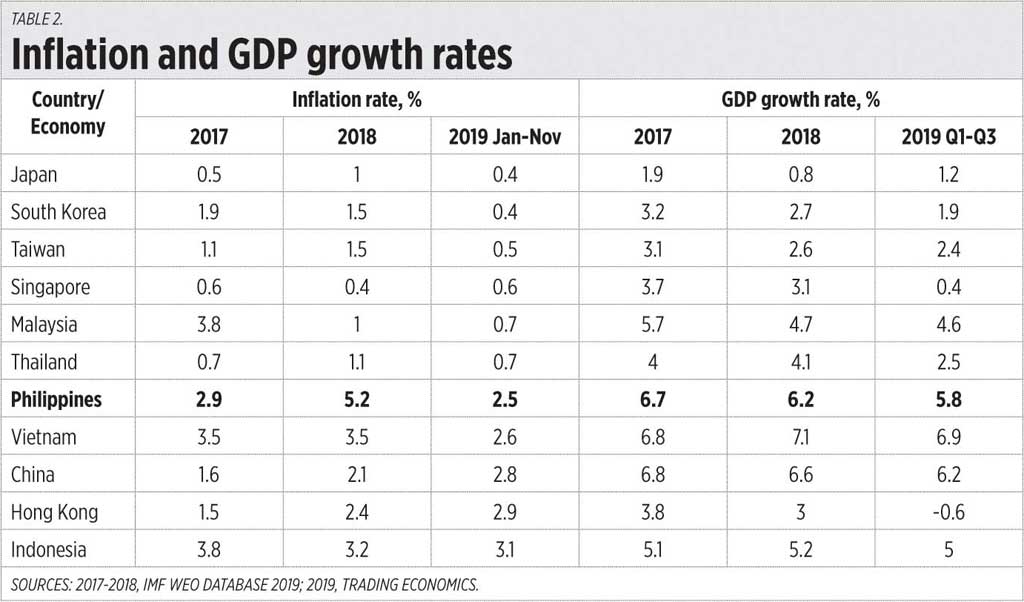
5. Stable regional inflation. Good news here — of the 11 major East Asian economies, six experienced inflation rates of below 1%. The Philippines also graduated from being the “inflation valedictorian” in 2018 at 5.9% and significantly brought it down to 2.5% year to date (ytd).

6. GDP growth deceleration. Of the 11 East Asian economies, seven including the Philippines have had declining trends from 2017 to 2019 ytd. Vietnam retains its fast 7% growth — in the region it is the main beneficiary of the US-China trade and investment conflict (see Table 2).

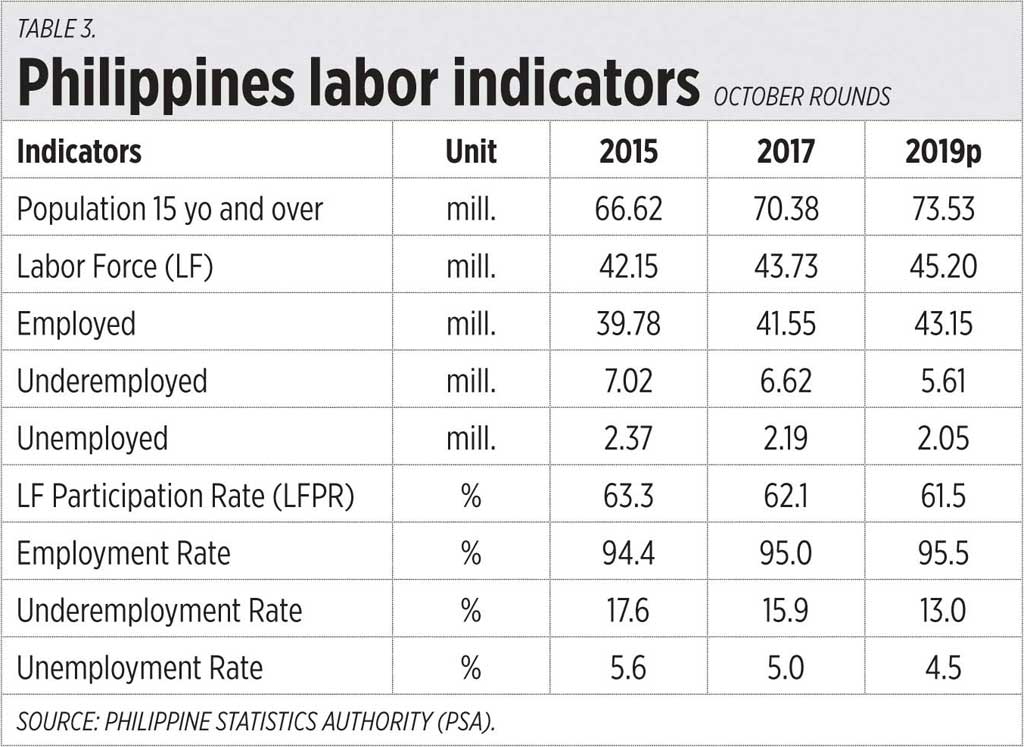
7. The Philippines’ unemployment rate continued to decline. It has gone down from 6% in October 2014 to only 4.5% in October 2019 — but the labor force participation rate (LFPR) is also declining, from 64.3% to 61.5% same period. A declining LFPR means people are less confident that they will be hired so they postpone seeking jobs and pursue more studies and training (see Table 3).

8. The Philippines’ rising debt ratio. The country experienced a sustained reduction in its public debt/GDP ratio from 52% in 2010 to only 42% in 2016. The Duterte administration’s borrow-borrow-borrow policy has stopped the decline — while still 42% in 2017-2018 it went up to 45% in 2019.

9. Price control in many sectors. Among many examples, there are: a.) the Land Transportation Franchising and Regulatory Board and Philippine Competition Commission imposing fare surge control and high penalties on Transportation Network Vehicle Services (TNVS); b.) the Energy Regulatory Commission proposed a lower electricity price cap in Wholesale Electricity Spot Market (WESM); c.) the Department of Health has proposed drug price controls; and, d.) expanded mandatory fare discounts for students all year round.

10. Water politics. The cancellation of the extensions to 2037 of the Maynilad and Manila Water concessions, the non-payment of penalties of nearly P11 billion on government for its water price control policy from 2013.

The Duterte administration’s many populist policies like many freebies and subsidies and disrespect of contracts, will have negative fiscal and investment impacts on the economy.


Bienvenido S. Oplas, Jr. is the president of Minimal Government Thinkers.

minimalgovernment@gmail.com

A decade of climate science confirmed what we already knew

By Faye Flam

OVER THE LAST DECADE, scientists learned a great deal about the climate, much of it concerning the connection between global warming and extreme events — heat waves, hurricanes, floods, droughts, and wildfires.

There has been, for many years, an understanding that a warmer world would be a more temperamental one, and measurements upon measurements show the average temperature is rising in step with those predictions. But until recently it was hard to prove that our changed atmosphere was having an influence on extreme events, which, after all, have been drowning and parching and starving people long before anyone started burning fossil fuels.

Asking whether climate change caused a particular wildfire or hurricane is the wrong question, said Benjamin Cook, a climate researcher with the Lamont-Doherty Earth Observatory. But in the last decade, the ability to model the climate has advanced so much, he said, that people can determine whether human-generated global warming made a storm wetter or a drought longer than it otherwise would have been. Such attribution, he said, is the biggest advance of the 2010s.

“This is important because extreme events are really where the impacts of climate change are being felt,” he said. It’s not necessarily alarming to hear that global temperatures will creep up another couple of degrees, but it’s another thing to realize that human activity contributed to a string of deadly heat waves in Europe — with temperatures climbing well above 108°F (42.2°C) in Paris — as well as the apocalyptic fires that destroyed what had been some of the most beautiful parts of California. “There’s a clear climate change signal,” he said.

If there’s any controversy now among scientists, it’s over whether they were too reluctant to sound the alarm about extreme events in the past. There was a reluctance to make recommendations based on probabilities and reasonable assumptions. Now there’s evidence to back them.

Over the last decade, climate researchers have been filling in gaps in their data on past temperatures, and improved models that are calibrated against the past to predict the future. That’s led to better predictions for weather as well, thanks to more complete data, better science, and more computer power.

There’s more data on cloud formation, on precipitation, on ground water and on what’s happening underneath ice shelves, said Gavin Schmidt, director of NASA-Goddard, Institute for Space Sciences. All that basic knowledge has come about from an exceptionally productive 10 years of remote sensing.

The Arctic is warming faster than lower latitudes, and this is affecting the wind patterns — especially the jet stream. Researchers say that a weakening of those winds is part of the reason storms such as Hurricane Harvey stall, and dry air lingers in other places for weeks.

Kevin Trenberth, a climate scientist at the National Center for Atmospheric Research in Boulder, Colorado, now on sabbatical in New Zealand, said that he’s been arguing since 2010 that extreme events are now happening in a different environment.

Because we’ve increased the earth’s atmospheric carbon by more than 40%, the oceans are warmer, and the air above the ocean is warmer and wetter, and the sea level is already a little higher. That contributes to making storms more intense, with heavier, prolonged rainfall, as people witnessed with Harvey in Houston and Florence in the Carolinas. The planet’s dry climates are getting drier, and the wet, wetter.

Global warming is also heating the world’s oceans, and this, too, is not uniform. Trenberth said and they can now track marine heat waves, which are killing coral and sea life from the Gulf of Maine to the Great Barrier Reef. A decade ago they could measure the ocean’s temperature down to 700 meters, he said; now they can track it to 2,000 meters. “We can actually see that heat penetrating down into the oceans.” The oceans have absorbed most of the energy that’s been trapped on Earth by added greenhouse gases. Some are worried they’re losing their capacity to buffer global warming.

A decade ago, there was already more than enough evidence to justify an effort to cut emissions. Scientists had reached a consensus that it was time to act. But a disinformation campaign was creating a different picture to the general public, with hackers stealing scientists’ personal e-mails, and various bloggers and media outlets launching personal attacks against them.

Adding fuel to the situation was a loss of trust in all of science following the so-called replication crisis, in which social science was exposed as contaminated with flimsy and erroneous results. Much of established nutrition research was overturned, and many medical findings were deemed impossible to reproduce. But this had nothing to do with basic, well-established physics and Earth science. The periodic table didn’t get torn up, electricity still works as predicted, and Einstein’s pedestal has only been elevated.

It was way back in the 1800s that French mathematician Joseph Fourier realized that our planet should be frozen down to the equator, considering it orbits at a distance of 93 million miles from the sun. It didn’t take long to realize that the small fraction of our atmosphere made up of carbon dioxide was keeping our planet warm, and that adding substantially to that will make it a lot warmer.

“What’s notable is what hasn’t changed” over the last 10 years, said Penn State climate scientist Richard Alley. “Carbon dioxide goes up the temperature goes up, ice melts, and there’s a migration of plants and animals.”

Thus the climate forecast for the 2020s is warmer and more eventful.


BLOOMBERG OPINION

Gov’t watching reported abduction of Filipino seafarers in Cameroon

THE Philippines is monitoring the reported kidnapping of eight mariners of an oil tanker from a port in Cameroon, two of which were Filipinos, the Foreign Affairs department said in a statement on Wednesday.

The Philippine Embassy in Abuja was “coordinating with relevant authorities to ensure the safety and security of the Filipino seafarers,” the agency said. It did not identify the Filipinos.

Eight people were abducted and one person was injured during an armed raid overnight on the Greek-registered tanker anchored off Cameroon, Greek authorities said on Tuesday.

The two Filipinos were among the eight seafarers kidnapped on Dec. 31, along with five Greek nationals and a Ukranian.

Greece’s shipping ministry said the Happy Lady tanker was two nautical miles off the port of Limboh in Cameroon when it was stormed by armed men.

Five Greeks, two people from the Philippines and a Ukrainian were kidnapped and a Greek national injured, the ministry said in a statement.

The tanker has a crew of 28.

In November, pirates abducted two Filipino seamen along with two other crew members aboard another Greek-flagged oil tanker off the coast of Togo.

Before that, pirates also kidnapped nine Filipino crewmen in a Norwegian vessel in the West African nation of Benin.

Also yesterday, the Foreign Affairs department, through the Philippine Embassy in Libya, called on Filipino migrants near conflict-stricken Tripoli to relocate or be ready to evacuate in case of clashes.

This advisory was issued after armed men took over a residential building that forced 17 Filipinos, including five minors, to flee their homes.

The Department reported in a Dec. 30 statement that the government has so far repatriated 149 Filipinos since the conflict started in April last year. — Charmaine A. Tadalan

NBI probing terror links in bombings

GOVERNMENT agents are looking at a possible terrorist link in the bombings in two Mindanao provinces on Dec. 22, Justice Secretary Menardo I. Guevarra said on Wednesday.

The National Bureau of Investigation (NBI) submitted a preliminary report on the Cotabato and Maguindanao bombings to the Justice department last week, “but the initial findings were still inconclusive,” he said in a Viber group message.

“They are presently conducting further investigation to determine if the perpetrators had any link with known terrorist groups operating in Mindanao,” Mr. Guevarra said. A progress report was expected this month.

“The NBI complied with my directive to submit a report before the year-end. Unfortunately, they have not identified the perpetrators as yet,” he said.

The Justice chief said government agents have another month to complete their probe and submit a final report.

Law enforcers earlier beefed up security in parts of the Mindanao region after blasts injured at least 21 people in Cotabato province on the eve of President Rodrigo R. Duterte’s planned visit on Dec. 23.

The initial explosions took place in Tantawan and Quezon Avenue in Cotabato City — the seat of the new Bangsamoro Autonomous Region in Muslim Mindanao — before 6 p.m. on Dec. 22. Two more followed in Libungan town in Cotabato province, and another in North Upi, Maguindanao province.

Authorities found another improvised bomb and detonated it on Monday morning, according to he Philippine Army.

The military said seven of those hurt were part of a military group that was helping to secure the area for a land distribution ceremony that Mr. Duterte was supposed to attend. Cotabato City is the seat of the new Bangsamoro Autonomous Region in Muslim Mindanao.

Seven other civilians were also reported hurt.

In Libungan, the first explosion took place near the town hall and the other at a store selling liquefied petroleum gas.

A 60mm mortar was used in the first and second blasts in Libungan, according to a bomb team. — Vann Marlo M. Villegas

New Year’s day clean-up

Waste management personnel in the cities of Valenzuela and Manila get to work early on Jan. 1 to clean up streets and other public spaces after the New Year revelry. Valenzuela Mayor Rexlon T. Gatchalian, in a Twitter post, commended the workers for their diligence and sacrifice on a holiday, saying: “… alam ko may mga pamilya kayo pero pinili niyo pa rin linisin ang ating city. Salamat po (I know you all have family, but you still chose to clean our city. Thank you).” In Manila, the Public information Office (PIO) also posted several photos of Department of Public Services members sweeping as well as areas free from garbage. At the Luneta Park, where a New Year’s eve event was held, Police Station 5 commander Lt. Col. Ariel Caramoan said they strictly implemented the anti-littering law and apprehended 11 violators.

Eventful 2019 for Philippine football

By Michael Angelo S. Murillo
Senior Reporter

THE YEAR 2019 saw Philippine football churn out a mixed bag of results across various levels but nonetheless had it eventful and left much to take cue from moving forward. Thus, said one local observer of the sport.

From the “botched” new local pro league, to the a breakthrough campaign of the men’s national squad, to the drama-filled election for the top football position in the land, to the spirited run of the women’s squad in the Southeast Asian Games, Philippine football had it all and more in the year that just passed.

“It’s a mixed bag. The season started on the edge when it comes to the professional league. Good thing was, through the sheer will of some of the stakeholders, things went towards a much better course, eventually preserving the league and football fans seeing the league champions, Ceres-Negros, crowned in spectacular fashion as ‘Invincibles,’ not to mention the domestic cup,” said Earl Averilla, author of the football site 5th Minute of Added Time in an interview.

He was referring to the Philippine Premier League (PPL) under which local club football competition was supposedly to be played under beginning in 2019, taking over from the Philippines Football League (PFL).

But the PPL did not pan out as expected across the board, prompting the Philippine Football Federation (PFF) to pull out of its agreement with the PPL operators and revert to the PFL.

The PPL only had one match date played on April 27.

Mr. Averilla said that what happened to the PPL was lamentable as the league showed a lot of promise in its buildup but thankful that parties concerned pulled together by way of the PFL to keep the league and the competition alive for a third season.

“The Philippine Premier League showed immense promise in the early stages of its buildup. However, challenges arose as the lead-up to the opening kickoff came nearer leading to its eventual demise. Several factors could be considered that might have contributed to the fiasco, but from Philippine football fans, all they really were hoping was for it to succeed. It’s just sad that it didn’t,” said Mr. Averilla, whose football site discusses everything of interest to the local fans of the sport.

“Philippines Football League really was tested big time after taking what’s left in the aftermath of the previous league organizers’ shortcomings to let the season fly. With the resources that they have they soldiered on to let the season stay afloat. In the end, it’s a relief that they pulled it off despite the challenges,” he added.

For a third straight year, Ceres was crowned PFL champion and went undefeated at that. The “Busmen” also claimed the Copa Paulino Alcantara title, dethroning erstwhile champion Kaya FC-Iloilo.

PROGRESS FOR THE AZKALS
Mr. Averilla said 2019 also showed how the Philippine Azkals have progressed, adding another feather in their cap with a first-ever appearance in the Asian Cup in January.

They failed to progress beyond group play but had their moments of brilliance, which he said should not be overlooked.

“As for the Azkals’ Asian Cup debut, it’s bittersweet, as despite their valiant efforts against continental powerhouse South Korea in their opener the Filipinos were not able to get a point resulting to an early exit in the tournament. It might have been expected, given the FIFA rankings, that the Philippines was in for a tough campaign but the fact that the Philippines was able to qualify and participate in the continental stage says a lot when it comes to the level of progress that the national football team has achieved and things could just get better, hopefully, in the following years,” Mr. Averilla said.

The 5th Minute of Added Time author also said local collegiate leagues delivered from their end as San Beda University and Ateneo de Manila University won the National Collegiate Athletic Association and University Athletic Association of the Philippines championships, respectively, in convincing fashion.

The Red Booters beat Arellano University in the final to reclaim the NCAA seniors crown while Ateneo dug deep to win over rival De La Salle University in the championship match in UAAP Season 81.

The election for the presidency of the PFF had a lot of color and drama as incumbent Mariano Araneta and Negros Occidental Football Association president Ricky Yanson pushed for their respective bids.

Both camps presented solid claims for the presidency, some of their points coming at the expense of the other.

In the end though, Mr. Araneta earned a third term, winning, 23-12, over Mr. Yanson in elections held on Nov. 29.

Mr. Averilla said the U-22 and women’s teams made a good run in the 30th SEA Games which the country hosted last month but still showed that work still needs to be done to take things to another level.

“The Azkals U-22 bannered by Stephan Schrock and Amani Aguinaldo bowed out of the group stage by the slimmest of margins despite what could arguably be the best-ever showing (technically speaking) by the national team in the tournament’s history,” he said.

Adding, “Meanwhile, although the Philippine Women’s National Football Team may have achieved a massive milestone by reaching the SEAG bronze medal match purely by merit for the first time, it was vanquished once again by perennial nemesis Myanmar denying a first medal for our ladies since 1985.”

MASSIVE NEXT YEAR
With the way things unfolded for Philippine football in 2019, Mr. Averilla said there is every reason to believe that 2020 could be “massive” for the sport.

“2020 is definitely going to be massive for Philippine football. The women’s team is going to suit up for the 2020 AFF Women’s Championship which will be hosted here in the Philippines. The Azkals continue their 2022 FIFA World Cup qualifiers campaign as early as March. The PFL, with the boost provided by Qatar Airways’ sponsorship, is set to begin as 2019’s ‘Invincibles’ Ceres-Negros commence their title defense,” he said.

“Of course, 2020 will also be the year for another edition of the AFF Suzuki Cup which will take place later in the year as the Azkals hope to break the semifinals curse and set foot in the final for the first time in history and, hopefully, bring the trophy to Philippine shores. Surely, 2020 is an exciting year for Philippine football,” Mr. Averilla added.

ADVERTISEMENT
ADVERTISEMENT