Home Blog Page 10037

Kinetic sculptor Gabriel Barredo, 62

SCULPTOR Gabriel “Gabby” Barredo, also known as the pioneer of kinetic art in the Philippines, passed away on Jan. 6. He was 62. Mr. Barredo was known for using found objects in his sculptures and mixed media installations which found fame both here and abroad and even inspired artists in other fields.

Silverlens Galleries, which represented the artist, made the announcement on its Facebook page. “It is with great sadness that we share with you that our dear friend, Gabriel Barredo, artist, has passed away. He leaves behind his daughter, and a lifetime of art making. Gabriel Barredo’s incomparable work has paved the way for kinetic art. His thoughtful approach to his practice took months of building, bricolage, sketching, and painting. Barredo created immersive spaces that encouraged viewers to rethink form, structure, and experience. A brilliant artist. We will miss him.”

At the first Art Fair Philippines in 2013, Mr. Barredo mounted a 30-foot-long installation of sculpture elements and kinetic objects. The English and Catholic culture-themed Asphalt — which featured an assortment of objects such as sharp metal bits, toys, and lights — was acquired by Louis Vuitton Moët Hennessy and displayed at the LVMH museum in Berlin, Germany.

One of his most recent solo exhibitions was Opera (2015), an installation of corpse-like mannequins and sculptures presented in Silverlens Galleries, was adapted into a dance performed by Ballet Philippines (BP) at the Cultural Center of the Philippines in 2016.

Born in 1957, Mr. Barredo studied sculpture at the University of Santo Tomas (UST). Among the accolades he received in his life were gold medals from the Art Association of the Philippines Annual Competition for Painting (1981), and Art Association of the Philippines Annual Competition for Sculpture (1982); and the 1998 Araw ng Maynila Award.

Family and friends posted tributes to him on social media.

Theater actress and singer Cara Barredo wrote on Facebook: “Our dearest Tito Gabby (Gabriel Barredo) passed away this morning leaving his house exploding with his beautiful art — finished and unfinished. Beautiful. Crazy. Very much like him. He was the silent type and mostly kept to himself. Never even bragged about his art or being an artist. But he was brilliant. Absolutely brilliant. We would like to ask for your prayers for the peace of his soul and for strength for the family.”

“I’ll always remember him as handsome and funny. Creating treasure out of trash. Bustiers, purses, paintings, sculptures. Pieces I couldn’t always define, but could definitely feel,” Mr. Barredo’s cousin, award-winning theater actress and singer Lea Salonga, wrote on Facebook.

“What a cousin to be proud of always. His passing is not just a loss to our country, but a loss for our family,” she added.

Art Fair Philippines: “Our thoughts are with Gabriel Barredo’s family, including his devoted team of workers whom he considered his family, on his untimely passing.

“Gabby was a steadfast supporter of Art Fair Philippines. We remember, with gratitude, his dedication to delivering the best of himself through his landmark piece, Asphalt, for the first edition of the fair, in 2013.”

Journalist Emmie Velarde posted a note she wrote for his very first exhibit: “Gabriel Barredo takes us on a journey inside, the most forbidding of all, there to meet creatures and things, thoughts and emotions at once dreaded and desired, forgotten and anticipated.

“It is the world in his mind, where imagination is memory and detail is essence. Headless faces float in a lake of dreams, or weep for liberation from the clutches of a clock’s hands… Gabriel invites us into his extraordinary mind. Fasten your brain waves: The sights are maddening.”

On a more personal musing she wrote: “Invariably, while the others then busied themselves ogling the latest pieces (they were always changing!) inside his cathedral-like home and also in his studio across the street, the two of us sat in a corner catching up on… our children. He was very shy that way; I never asked why.

“And I am not asking now why you left as suddenly, as inobtrusively, as you did yesterday.”

Details of his wake are yet to be announced.

UBS overhauls European wealth management business

UBS GROUP is reorganizing its wealth management business in Europe. — REUTERS

ZURICH — UBS Group is reorganizing its flagship wealth management business in the Europe, Middle East and Africa region and streamlining management, according to a staff memo seen by Reuters and confirmed by the Swiss bank.

Christl Novakovic will continue to lead its European business. Caroline Kuhnert was appointed head of Central and Eastern Europe and Ali Janoudi head of the Middle East and Africa, the memo said.

It marks the first big change since former Credit Suisse executive Iqbal Khan joined UBS as co-head of wealth management last year. UBS is with world’s biggest wealth manager with $2.5 trillion in invested assets.

It did not specify the extent of job cuts to accompany the revamp.

UBS said it was expanding its global family office group, aligning coverage of ultra high net worth clients to regional business units and enhancing its high net worth offering, adding that it was expanding partnerships within the investment bank and asset management arms.

“The new approach will provide (wealth management) clients with an enhanced offering, more competitive conditions, and faster execution thanks to regionally aligned structuring and origination. This will allow us to more easily satisfy client demand and meet our 2018 investor update ambition of $20-30 billion in net new loans per year,” the memo said. — Reuters

Top semiconductor manufacturers

Art & Culture (01/08/20)

Two exhibits at MO_Space

THE GALLERY will open two exhibits on Jan. 11 (they will run until Feb. 4) — Kristoffer Ardeña’s Geopoemas: Bacolod at the Main Gallery, and Czar Kristoff’s A Series of Suspended Readings No. 2 at Gallery 2. In his exhibit, Ardeña presents the painting entitled Ghost Painting/Cracked Category: Bacolod where the artist tackles the tradition of the landscape genre. The artist cut up a tarpaulin printed with Google street maps of Bacolod in Negros, where the artist is currently based, into almost 200 pieces. These were painted and hung from the ceiling of the gallery space using deconstructed basahan retaso rugs. This immersive and performative painting invites the public to then crack and reveal texts, images, iconography, and names of streets. Meanwhile, at Gallery 2, Kristoff, in his 5th solo exhibit, revisits his publications from 2015–2019 to both seal and reveal a chapter of inquiry on refuge and violence. The gallery, located at MOs Design on Bonifacio High Street, Bonifacio Global City, Taguig, is open daily, from 11 a.m. to 8 p.m.

Silverlens hosts symposium

IN CONJUNCTION with its exhibitions Equation of State and ZIGAZIG ah!, Silverlens is hosting a symposium — “Local Matters: Martha Atienza and Yee I-Lann on Communities, the Environment, and Art” — where Dutch-Filipino artist Martha Atienza and Sabahan artist Yee I-Lann will discuss their art within a broader context. Joining them are community organizer Haley Atienza, artist Roberth Fuentes, compressor diver Mario Forrosuelo, weaver Kak Roziah, and community organizer Omarjan Ibrahim Jahuran. It will be held on Jan. 11, 1-4 p.m., at Silverlens, 2263 Don Chino Roces Avenue Extension, Makati City. Admission is free. Atienza learned more about ecosystems and gained a richer understanding of the sea from her conversations with members of Bantayan Island’s community. Through different collaborations using island technology, Atienza produced installations and videos that present and question matters around the environment and socio-economic development. Similarly, Yee I-Lann teamed up with weavers from Keningau in the Borneo interior and Pulau Omadal, Semporna, in the Sulu Sea to create woven mats for ZIGAZIG ah!. Yee and the communities she worked with explore traditional crafts and aesthetics to tease out contemporary readings that also raise issues regarding community, empowerment, and alternative sustainable livelihoods. Given their inclusive approaches, the artists and their collaborators encourage audiences to consider the role of art and culture in socio-economic development and the power of artistic collaborations. Limited slots are available. RSVP at localmatters.rsvpify.com to secure a seat.

Ballet Manila returns with Sleeping Beauty

IT HAS been more than two months since the Aliw Theater and Star Theater — Ballet Manila’s home base — burned down in the fire that also destroyed Star City at the Cultural Center of the Philippines complex, and the dance company is rising from the ashes like the proverbial phoenix, all set to captivate its audience with the world premiere of Sleeping Beauty. The third show in its 24th performance season “On Pointe,” Sleeping Beauty is Artistic Director Lisa Macuja Elizalde’s homage to this ballet classic and fairy tale. Against the background of the music of Pyotr Ilyich Tchaikovsky, Macuja Elizalde adapted bits and pieces from the original staging by Marius Petipa and Konstantin Sergeyev while creating new portions. It will be staged on Jan. 18, 6 p.m., and Jan. 19, 3 p.m., at the Newport Performing Arts Theater, Resorts World Manila, Pasay City. The show’s cast is led by principal dancer Jasmine Pia Dames who will take on the role of Aurora, while her fellow principal dancer Romeo Peralta will be her love interest, Prince Phillip. Also in the cast are Mark Sumaylo, Rissa May Camaclang, Joan Sia, Gerardo Francisco, Rafael Perez, Alvin Dictado, Shaira Comeros, and Emma Harris. Tickets to Sleeping Beauty are available at Ticketworld (8891-9999, www.ticketworld.com.ph).

Art and antiques at Leòn Gallery online auction

THE LEÒN EXCHANGE Online Auction Edition XIV auction under the Leonexchange platform will be held on Jan. 18 and 19 starting at 11 a.m. All bidding will be purely online at www.leonexchange.com. The highlight of the auction is Hernando R. Ocampo’s Skyward boceto (1953), a dynamic study of the lush and alien terrain found its final version — a major work in oil on canvas in 1959 as an official entry to the 12th exhibition of the Art Association of the Philippines. Sharing center stage is a Mauro “Malang” Santos’ Still Life, which is unique as it deviates from his usual stained-glass window bouquet of sharply geometrical forms and genre scenes. There are also a pair of Onib Olmedo’s depictions of the denizens of the underbelly of Filipino culture. Also on auction is Prudencio Lamarroza’s Takipsilim, a fairytale landscape of a Philippine eucalyptus tree, with a sea of spotted Easter eggs. There are also “functional sculptures” by Benji Reyes; and, Under the Viridian Sky by Alfredo and Isabel Aquilizan. Also up for sale are crystal and silverware, chinoiserie, Filipino period furniture, fine bone China, coffee table books, and rare photographs. The items will be on view to the public starting Jan. 13, 10 a.m. to 6 p.m., with preview cocktails on Jan. 15, 4 p.m., at Leòn Gallery in Warehouse 14 La Fuerza Plaza, 2241 Chino Roces Ave., Makati. To participate in the auction, visit www.leonexchange.com and registering as a buyer.

Gelvezon-Tequi retrospective at the CCP

A MAJOR retrospective exhibition by Ofelia Gelvezon-Tequi entitled Allegories and Realities, Ofelia Gelvezon-Tequi: In Retrospect will open on Feb. 22, 4 p.m., at the Bulwagang Juan Luna (Main Gallery) of the Cultural Center of the Philippines (CCP). The exhibition, which runs until May 24, is presented as part of the CCP’s ongoing 50th-anniversary program. Gelvezon-Tequi earned two degrees in Fine Arts and English from the University of the Philippines-Diliman. Influenced by literature, art history and visual arts, her works emanate her deep understanding of these disciplines. Her series of prints from the 1980s are juxtapositions of sacred images vis-à-vis the mundane. Her works are also grounded on the real and personal — family life and losses, greed and corruption, the turbulent political climate, or simply a row of trees, a lush garden or a still life. She has been highly acclaimed for her use of allegory to express her take on social issues. This retrospective show is composed of prints and paintings made by Gelvezon-Tequi from the 1970s to the present. It explores the thematic contexts as well as modes of art practice Gelvezon-Tequi has pursued for more than five decades. Aside from the artist’s collection, other featured artworks will be borrowed from private and institutional collections.

How PSEi member stocks performed — January 7, 2020

Here’s a quick glance at how PSEi stocks fared on Tuesday, January 7, 2020.


Barangay Ginebra takes Game One, seizes early series lead

By Michael Angelo S. Murillo
Senior Reporter

THE Barangay Ginebra San Miguel Kings got the early lead in their best-of-seven Philippine Basketball Association Governors’ Cup finals series after taking Game One over the Meralco Bolts, 91-87, on Tuesday at the Smart Araneta Coliseum.

Banking on their collective depth, the Kings bucked early struggles in the contest and went on a strong finish to draw first blood against the Bolts in the championship joust for the season-ending PBA conference where they are meeting for the third time in the last four years.

Import Justin Brownlee led Barangay Ginebra with 38 points and 16 rebounds, with Japeth Aguilar adding 16 points and six rebounds in the win.

It was tightly fought in the opening quarter and a half until the Bolts made a late run in the closing half of the second frame to take a 41-37 advantage by the halftime break.

Mr. Brownlee got the Kings to a strong start in the third canto, with the team outscoring the Bolts, 10-4, in the first four minutes to take the lead, 47-45.

But Raymond Almazan and Allen Durham led a 13-3 response by Meralco in the next two minutes to go on top, 58-50.

Barangay Ginebra tried to rally back but it remained trailing, 71-68, heading into the final quarter.

The Kings opened the fourth quarter with an 8-2 run to seize the lead anew, 76-73, with 9:20 left in the game.

They continued to hold sway, 80-75, at the midway point of the payoff quarter.

The teams went back-and-forth after with Meralco eventually reclaiming the upper hand, 85-84, with 2:38 remaining.

LA Tenorio gave back the lead to the Kings, 86-85, with 1:40 to go on the clock.

Mr. Durham then countered with a deuce from the charity stripe with 1:20 left to hand back the lead to the Bolts, 87-86..

Meralco had a chance to add on to its lead with less than a minute to play but they turned the ball over.

Mr. Brownlee made them pay with two free throws made with 33 ticks left to push Barangay Ginebra ahead, 88-87.

Meralco sued for time to set up a play.

Off the timeout, the ball swung to rookie Bong Quinto whose three-point attempt missed the mark.

Mr. Quinto then was forced to foul Stanley Pringle off the rebound.

But Mr. Pringle split his free throws to still open the door for the Bolts, 89-87, with 18 seconds left.

Meralco once again called timeout.

The Bolts went to Mr. Durham, who drove to the basket hard only to be blocked by Mr. Aguilar.

Mr. Brownlee got the ball and was immediately fouled with 11 seconds left.

The Kings import drained his free throws to put the game away.

Mr. Tenorio finished with 14 points while Mr. Pringle had 10 for the Kings.

For Meralco it was Mr. Durham who paced with a triple-double of 25 points, 18 rebounds and 10 assists.

Mr. Newsome added 24 points while Mr. Almazan had 20.

Game Two of the finals is on Jan. 10.

DoF rejects claim of ‘onerous’ Kaliwa Dam loan

THE Department of Finance (DoF) said that the government maintains “strict standards” when dealing with foreign lenders, rejecting claims by a legislator that the loan agreements for the Kaliwa Dam and Chico River Pump Irrigation Projects have “onerous” provisions.

In a statement Tuesday, Finance Undersecretary Mark Dennis Y.C. Joven said the structure of water concession agreements, which are public-private partnership (PPP) contracts, “is very different” from that of official development assistance (ODA) financing agreements which the government enters to with other countries and multilateral lenders and are governed by international laws.

Deputy Minority Leader and Bayan Muna Representative Carlos Isagani T. Zarate has claimed that the loan agreement for the China-funded Kaliwa Dam and Chico River Pump Irrigation Projects contain “onerous provisions,” and should be reviewed by Malacañang. He objected to the waiver of sovereign immunity, the interpretation of the terms under Chinese law, and provisions outlining the procedure for arbitration in the event of disputes.

Mr. Joven said such provisions are standard on all loan agreements entered into by the Philippines with other countries and that the choice of governing law in interpreting the agreement “is often the law of the lender, as seen in our loan agreements with China, Japan, Korea and France, even during past administrations.”

“There is nothing unusual with this provision, as it is found in loan agreements with several countries,” he said, adding that “these choice of law provisions are essential to international agreements with a commercial nature because of the presence of a foreign element. On the other hand, this is not necessary in the case of a water concession contract, which is governed by domestic law.”

He also said the choice of arbitration venue, which in this case is Hong Kong, are determined on a per-loan agreement basis as a precaution against default by the borrower.

“Regardless of the venue of arbitration, the usual international arbitration rules apply, such as the nomination of three impartial arbitrators from among hundreds of arbitrators from Europe, US, Latin America, and other countries like Singapore and the Philippines,” he said.

He said the government is responsibly managing its debts both from local and foreign sources by maintaining a healthy ratio of debt to the size of the economy, currently at 37.6% as of first half of 2019.

“The country borrows from other countries to take advantage of concessional, or cheaper, financing… The interest rates offered by foreign countries are way lower than anything the private sector can offer. Borrowing at lower interest rates means having to pay less for the loans and thereby freeing up more government resources for other productive investments,” Mr. Joven said.

He said added that all loan agreements signed for projects under the “Build, Build, Build” program are published online in the interest of transparency.

“Although we will find that the loan agreements for the Kaliwa Dam and Chico River Pump Irrigation Projects do contain confidentiality clauses, they are accompanied by specific provisions stating that the agreements may be released ‘in accordance with any Philippine law.’ The Philippine Constitution mandates disclosure of information relating to foreign loans,” he added.

In a statement Monday, the Metropolitan Waterworks and Sewerage System (MWSS) said the construction of Kaliwa Dam will prevent another water crisis for Metro Manila.

Citing an analysis, it said the capacity of Angat Dam, a major source of Metro Manila’s water, will no longer be enough “to satisfy the water demand of Metro Manila between 2020 and 2025.”

“Taking into account a supply buffer of 15%, the Angat supply capacity will be insufficient before 2020. These numbers illustrate the need for a large water supply source. The events since March 2019 have only confirmed said projections,” it said.

Meanwhile, MWSS said that the social and environmental impacts of the Kaliwa Dam project will be minimal compared to the earlier plan of an integrated Kaliwa and Laiban Dam System in 2013.

It said its consultations with the indigenous people in Quezon and Rizal provinces “reached a positive outcome” in December after they adopted a resolution of consent to the project. — Beatrice M. Laforga

Diokno rejects ‘alarmist’ Mideast fears; cites $90 oil as red line

THE central bank governor remains bullish about the economy in 2020, noting that inflation remains “subdued,” and that growth assumptions will not be significantly dented until oil prices hit $90 per barrel.

Bangko Sentral ng Pilipinas (BSP) Governor Benjamin E. Diokno also downplayed risks to the economy coming from the looming Iran crisis and called on the public not to take on “alarmist” sentiments.

“Let’s not be alarmists here… For oil prices to make a difference in our forecast, it has to be $90 per barrel. And as you know what is relevant to us is the Dubai oil price… So let’s not panic,” he told reporters at the first meeting of the Tuesday Club in Pasig City.

The US carried out a drone strike in Baghdad last week which killed a senior Iranian general.

President Donald J. Trump said the US is prepared to strike Iran should it retaliate.

Inflation in December rose to 2.5% on seasonal demand for holida goods as well as weather-related disruptions to the supply chain, according to the Philippine Statistics Authority.

This is the second successive month of higher inflation after the indicator came in at 1.3% in November.

Average inflation in 2019 was 2.5%, down from 5.2% in 2018.

The BSP’s forecast range for inflation is 2-4% for 2020.

At the height of oil fears in September due to the attack on a Saudi Aramco facility, Mr. Diokno said that the inflation target will only be reconsidered when oil prices exceed $85 per barrel.

He also assured that there should be no worries on the remittance front as the Middle Easter work force is based mostly in “Saudi Arabia more than Iraq and Iran.”

According to the BSP, cash remittances in October rose 8% year-on-year to $2.671 billion.

The growth rate was the highest since the 8.7% logged in October 2018.

Top Middle Eastern sources of remittances in October were Saudi Arabia, the United Arab Emirates, and Kuwait. These three along with Singapore, Japan, the UK, Canada, Germany and Hong Kong make up 78.4% of cash remittances from overseas workers.

“I am confident that the quality of life of Filipinos will further improve this year. Economic growth will be faster. Inflation will continue to be subdued and on target,” Mr. Diokno said.

Gross domestic product (GDP) growth was 6.1% in the third quarter bringing the nine-month average to 5.8%, still below the government’s 6% target.

In 2020, the government targets 6.5-7.5% economic growth. — Luz Wendy T. Noble

BSP looking at rate cut to discourage hot money

THE central bank will consider another rate cut in the first quarter of 2020 in order to discourage hot money, according to Bangko Sentral ng Pilipinas Governor Benjamin E. Diokno.

“I promised first quarter of this year maybe 25 basis points (bps) and we’ll continue to look at other numbers,” he told reporters at the first meeting of the Tuesday Club held in Pasig City.

Kasi ayaw naman natin na ang real interest rates ay higher compared to the rest of the world. Papasok diyan ’yung tinatawag nating hot money (Because we would not want our real interest rates to be higher compared to the rest of the world. Hot money will enter in that case). We don’t like hot money,” he said.

In the first quarter, the Monetary Board is due to meet on Feb. 6 and March 19.

In 2018, the central bank reduced key policy rates by a total of 75 bps, partially dialling back the 175 bps worth of rate hikes in 2018 amid a multi-year highs in inflation. He declared his intention to work on reducing the remaining 100 bps.

The overnight reverse repurchase rate is at 4% while overnight lending deposits and lending are at 3.5% and 4.5%, respectively.

Inflation in December rose to 2.5% on seasonal demand from holiday goods and adverse weather, according to the Philippine Statistics Authority. Average inflation for the year was at 2.5%. — Luz Wendy T. Noble

GIR hits record levels at end-2019 as trade deficit narrows

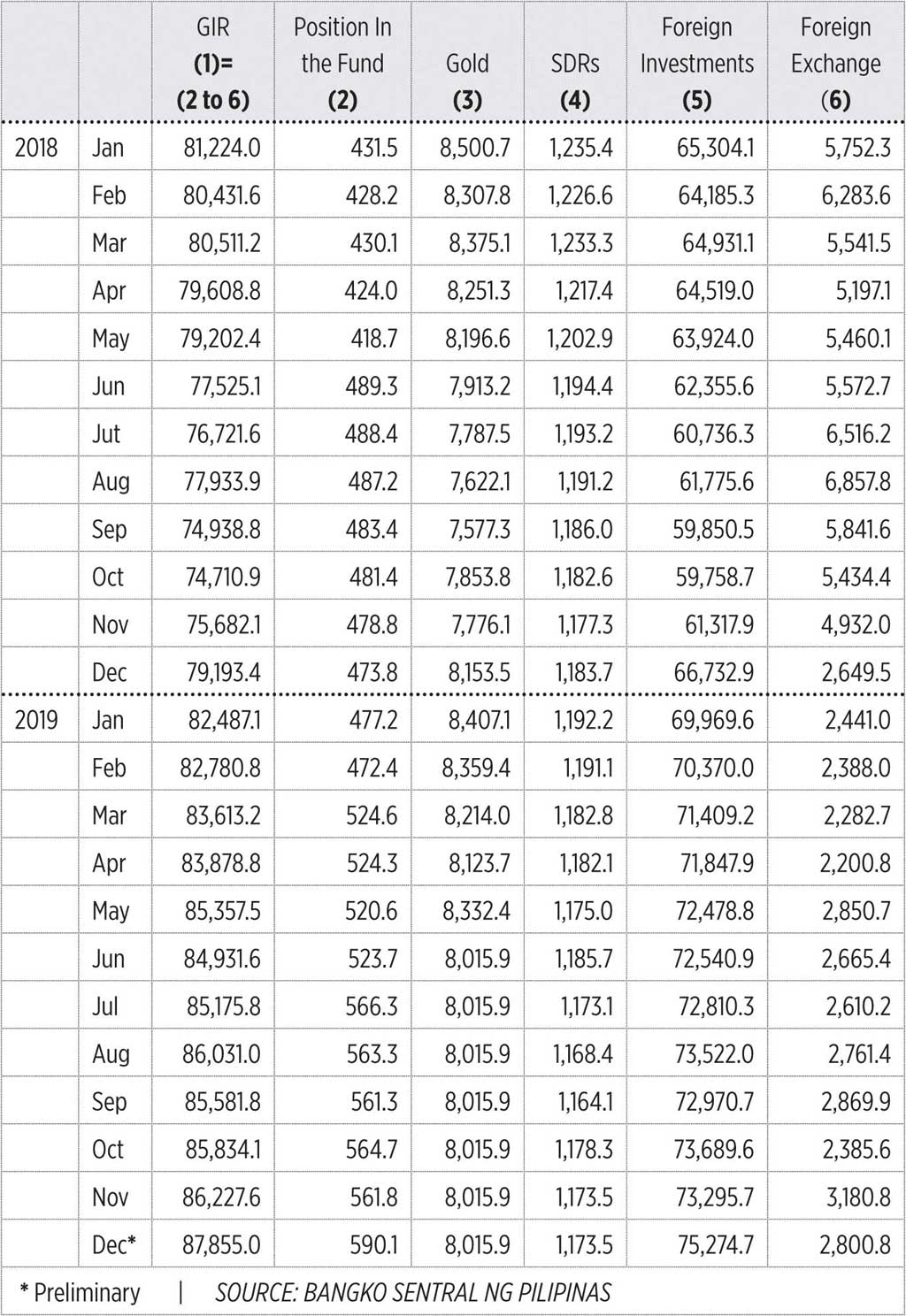
GROSS international reserves (GIR) hit record levels at the end of 2019, the Bangko Sentral ng Pilipinas (BSP) said, with analysts citing risk-on sentiment that drew foreign money out of safe havens, amid a narrower trade deficit.

On Friday, preliminary data showed GIR at $87.855 billion at the end of December, up 1.89% on the end-November level and up 10.94% from a year earlier.

December was the fourth consecutive month of higher GIR levels.

BSP said GIR’s month-on-month pickup was due to inflows from BSP’s foreign exchange operations and income from its investments abroad, and the national government’s net foreign currency deposits.

“The end-December 2019 level of the GIR provides an ample external liquidity buffer that is equivalent to 7.7 months’ worth of imports of goods and services and payments of primary income,” the BSP said in a statement.

The reserves are also equivalent to 5.5 times the country’s short-term external debt based on original maturities and 4.3 times based on residual maturity, the central bank added.

Rizal Commercial Banking Corp. Chief Economist Michael L. Ricafort attributed the record GIR performance to risk-on sentiment as balance of payments (BoP) improved.

“The latest increase in GIR may be attributed to the increase in foreign investment largely due to improved global risk appetite as of December 2019 after the phase one US-China trade deal that led to some gains in financial markets in the US and other countries,” he said in an e-mail.

“Higher GIR may be consistent with the improved balance of payments (BoP) data recently amid narrower trade deficits (net imports), continued growth in structural inflows such as OFW remittances, BPO revenue, foreign tourism revenue, POGO revenue, and continued inflows of foreign investment,” he added.

BoP in the third quarter was in surplus by $778 million, reversing a $1.9 billion deficit a year earlier.

The current account reversed to a surplus of $654 million in the third quarter from the $2.081 billion deficit a year earlier, backed by the lower deficit in the trade in goods account.

ING Bank-NV Manila Senior Economist Nicholas Antonio T. Mapa noted that foreign reserves at the end of the year are “up substantially” from the $82.49 billion at the start of 2019.

“Months of balance of payments surpluses, generated largely by financial account inflows that outpaced the current account deficit, allowed the BSP to rebuild its store of foreign currency,” he said in an e-mail.

The BSP also said gold reserves, which form part of the country’s foreign exchange buffer, were at $8.015 billion at the end of 2019, unchanged from June and down 1.69% from a year earlier.

Meanwhile, gains from the central bank’s investments overseas grew to $75.274 billion, up from the end-November and end-December 2018 levels of $73.295 billion and $66.732 billion, respectively.

Foreign-currency deposits dipped to $2.8 billion at the end of December from $3.18 billion a month earlier. It was higher compared to the $2.649 billion from a year earlier.

The central bank’s reserve position with the International Monetary Fund (IMF) rose to $590.1 billion at the end of the year from $561.8 billion at the end of November. A year earlier, IMF reserves were at $473.8 billion.

Meanwhile, special drawing rights (SDRs) were maintained at $1.173 billion for the second consecutive month. They were down from a year earlier, when SDR amounted to $1.183 billion.

Net international reserves (NIR) — or the difference between the central bank’s GIR and total short-term liabilities — rose to $87.83 billion from the month-earlier $86.21 billion.

Union Bank of the Philippines, Inc. Chief Economist Ruben Carlo O. Asuncion said record GIR levels are positive but noted some downward pressure on dollar reserves.

“A building up of GIR levels is certainly an advantage for a small, open economy like the Philippines that is very vulnerable to global economic shocks such as oil price shocks,” Mr. Asuncion said.

“However, the continuation of the government’s spending through the recently signed 2020 national budget and the approved validity extension of the 2019 extension may have a downward pressure on GIR levels. The growth of imports through more government expenditures on infrastructure (makes the) central bank… more likely to defend the peso in much of 2020, and GIR may end flat or slightly lower come end-2020.”

Mr. Mapa also said the current account deficit could widen in 2020.

“Despite a projected drawdown in GIR for this year, the Philippines will continue to enjoy ample reserves on top of enjoying the security of steady OF (overseas Filipino) remittances coupled with BPO (business process outsourcing) call center receipts to help replenish GIR from time to time,” he said.

Security Bank Corp. Chief Economist Robert Dan J. Roces said that the high level of dollar reserves provide a sufficient buffer for “any possible fallout against the peso, in the event that geopolitical issues worsen.” — Luz Wendy T. Noble

Kuwait ban on new-hire domestics enforced

THE Bureau of Immigration (BI) started implementing the ban on deployment of newly-hired domestic workers to Kuwait, it said in a statement.

The ban was authorized by a resolution from the governing board of the Philippine Overseas Employment Administration (POEA) on Jan. 3.

The resolution banned the deployment of new-hire domestic workers to Kuwait following the death of domestic worker Jeanelyn Padernal Villavende.

However, overseas employment certificates for Kuwait issued on or before 5 p.m. of Jan. 3 are still valid for deployment.

BI acting port operations division chief Grifton SP. Medina said all immigration officers in various ports have been instructed to impose the ban.

“Our system is integrated with POEA’s [system] hence with a click of a finger, we would be able to verify an OFW’s records immediately,” he said.

Commissioner Jaime H. Morente said the immigration bureau will also await word from the Department of Foreign Affairs and the Department of Labor and Employment should bans be imposed on deployment to Iraq, Iran, and Libya.

The US staged an air strike in Iraq which killed Iranian general Qassem Soleimani and Iraqi militia commander Abu Mahdi al-Muhandis, raising the prospect of further violence in the region.

The Pentagon said US President Donald Trump ordered the air strike following an attack by a pro-Iran mob on the US embassy in Baghdad.

The Philippine Embassy in Iraq also instructed OFWs there to go on leave after the strike.

“The government’s primary concern is the welfare of our kababayan (countrymen), hence the BI is ready to implement any directive regarding our foreign policy or OFW deployment should the concerned agencies sees a need to implement any change,” Mr. Morente said. — Vann Marlo M. Villegas

JICA, DoH launch relapse-prevention program for drug users

THE Japan International Cooperation Agency (JICA) and the Department of Health (DoH) have launched a project to train health professionals in preventing relapses among sufferers of drug dependence to help strengthen treatment and rehabilitation practices.

“JICA will continue to contribute to a drug-free Philippines through this cooperation with DoH. We believe that inclusive development also means enabling vulnerable people like persons who use drugs to integrate themselves back to society,” said JICA Philippines Senior Representative Ayumi Ohshima.

The training for health professionals is part of IntERlaPP (Introducing Evidence-Based Relapse Prevention Program), an ongoing JICA-DoH technical cooperation project that seeks to improve treatment methods in DoH-owned treatment and rehabilitation centers (TRCs).

Addiction specialists, psychologists, social workers and medical doctors are among the participants in the project’s pilot TRCs in Bicutan, Tagaytay, and Dagupan.

The training also includes a new treatment program called Intensive Treatment and Rehabilitation Program for Residential TRCs or INTREPRET which features cognitive behavioral therapy, social support, psycho-education, and self-help as adapted from the Matrix Institute of Addiction in the United States.

Aside from the treatment program, JICA also provided a 1.85 billion yen grant for the construction of a treatment and rehabilitation center.

According to the Dangerous Drug Board (DDB), 50.06% of drug dependents are unemployed.

Meanwhile, the 2018 preliminary study of JICA and DoH on illicit drug use indicates that out of 3,000 recovering drug dependents in TRCs, 33% have zero or negligible income. — Genshen L. Espedido

ADVERTISEMENT
ADVERTISEMENT