A PARAÑAQUE City court has acquitted Bureau of Corrections (BuCor) Director General Gerald Q. Bantag and two other jail officers of homicide charges over the 2016 explosion at the city jail, where 10 inmates were killed. In the 16-page decision penned by Acting Presiding Judge Betlee-Ian J. Barraquias of Regional Trial Court Branch 274, Mr. Bantag, along with SJO2 Ricardo S. Zulueta and JO2 Victor Erick L. Pascua, were cleared of 10 counts of homicide charges. The court said the prosecution was not able to prove all the elements that constitute homicide. “The prosecution failed to establish that the deaths of the victims were brought about by a common design by all the accused acting in unison or they mutually aided one another to cause the demise of the victims,” the judge said. The ruling also cited that the prosecution failed to present evidence of conspiracy among the accused. “No evidence was adduced that all the accused had the common objective to kill the victims. It is fundamental principle in Criminal Law that conspiracy must also be proven beyond reasonable doubt. The explosion occurred on Aug. 11, 2016, as inmates were to meet with Mr. Bantag to discuss matters on the transfer of cells. Mr. Bantag was appointed to head the BuCor by President Rodrigo R. Duterte in Sept. 2019, replacing Nicanor E. Faeldon who stepped down following the controversy on premature release of inmates. — Vann Marlo M. Villegas
THE ILOILO City Business Permit and Licensing Office (BPLO) sees the need to come up with local regulation for online businesses and food trucks as the number of such enterprises is on the rise. “With these kinds of businesses, we also need an ordinance to regulate them. If the ambulant vendors in the city have been regulated, these food trucks should also be regulated as well,” BPLO head Norman F. Tabud said in an interview. For online businesses, Mr. Tabud said these should be registered and pay appropriate taxes and fees to the government. “Based on my observation, most of the online businesses that apply for business permits are those that are required to issue (official) receipts,” he said.
“We are also strategizing on how we can encourage them to apply and secure business permits.” Meanwhile, the BPLO is expecting to issue 2,000 new business permits this year. In 2019, a total of 16,391 businesses were issued permits. The BPLO is operating on extended office hours from Jan. 2–20 for the processing of permit renewals.
INSPECTION
Mayor Jerry P. Treñas has also ordered the inspections of all business establishments to ensure compliance to permits and licenses. In Memorandum Order No. 19-223, Mr. Treñas directed the BPLO, Bureau of Fire and Protection, City Tourism and Development Office, and the City Treasurer’s Office to conduct the joint inspections starting Jan 21. Recently, the city government discovered that the Malabanan Siphoning Service, with head office in Manila, has been conducting business in the city without the necessary permits. “When I called their attention, it was only then that I found out that they have no permit. (They are) all over the city. I don’t want such things to happen because if you are a business operating in the city you have to secure a permit,” the mayor said. — Emme Rose S. Santiagudo
HOTDOG and sausage products containing pork, which were shipped in from Luzon, were burned on Wednesday by Cagayan de Oro City’s Anti-African Swine Fever (ASF) Task Force in collaboration with the National Veterinary Quarantine Services’ (NVQS) Misamis Oriental office. In a statement, the city government said at least 52 boxes containing the pork products were confiscated last January 3 at a depot located in Barangay Agusan. The task force also seized another 92 boxes of processed meat products that lacked documents such as certificate product registration, and a list of ingredients, among others. The goods were burned in a vacant lot of the city’s impounding facility.
THE DAVAO City Overland Transport Terminal (DCOTT) management is pushing for the immediate construction of two new bus terminals, one each in the northern and southern areas, as the existing lone facility could no longer handle the increasing number of provincial buses. “The property is not enough to cater additional bus units. Kino-control na namin ang mga bus na pumapasok sa DCOTT,” DCOTT Manager Aisa Usop said in a media forum earlier this week. She said the city council has already approved the proposal, and implementation is now in the hands of the City Planning and Development Office. The planned sites are Toril in the south and Buhangin in the north. Ms. Usop also noted that traffic congestion around the DCOTT, located in a 1.7-hectare property in the Ecoland area, is worsening, especially during peak hours. Ms. Usop also reported that DCOTT surpassed its P50-million income target in 2019 with P64 million already collected as of November. “There is no total yet, but I am expecting more or less P70 million income… for 2019,” she said. DCOTT’s revenues come from fees for buses and vans, stall rentals, and porter fee, among others. — Maya M. Padillo
Exchange of tirades continue over VP’s drug war report
OVP PHOTO
VICE PRESIDENT Maria Leonor G. Robredo defended her report tagging the Duterte administration’s drug war as a “massive failure,” citing that her office was “very careful” in its preparation and that all data were taken from government agencies. “We were very, very careful sa pag-finalize ng (in finalizing the) report. Hindi kami gagamit ng datos na hindi nanggaling sa mga ahensya (We would not use data that did not come from the agencies),” she said during Wednesday’s Kapihan sa Manila Bay forum that was streamed on Facebook. Philippine Drug Enforcement Agency (PDEA) Chief Aaron N. Aquino earlier said the report were based on “wild assumptions.” The opposition Liberal Party (LP), where Ms. Robredo is chair, also slammed PDEA over its criticism on the report. “Why are they criticizing the data mentioned by Vice President Leni in her report when they were the ones who submitted these numbers during her short stint as co-chair of the Inter-Agency Committee on Anti-Illegal Drugs (ICAD),” LP Vice President for External Affairs Lorenzo R. Tañada III said in a statement on Wednesday. Ms. Robredo on Monday presented her findings over her 18-day stint as co-chair of the ICAD, during which she was in constant consultation with Mr. Aquino. She also showed her recommendations to improve the government’s approach in its anti-illegal drug campaign. She described the campaign as a “failure” as the administration managed to seize only 1% of the total drug supply in the country, since its launch in 2016. She had recommended that the government shift in the supply side of the illegal drug trade as well as in its prevention, rehabilitation and reintegration.
COMPLEX
Senate President Vicente C. Sotto III, a former chair of the Dangerous Drugs Board, likewise criticized Ms. Robredo. “I’ve been in this war for 31 years and I know how complex the problem is,” Mr. Sotto told reporters over phone message on Wednesday. “The drug problem is not explained by numbers alone. It is deeper than mere arithmetic.” Mr. Sotto further argued that Ms. Robredo’s assessment is not reflected in the popularity of President Rodrigo R. Duterte. “The President’s high approval ratings after three years, is incompatible with a grand failure accusation. People deterred from illegal drugs do not raise their arms to be surveyed,” he said, claiming that more families feel safer now. Meanwhile, House Speaker Alan Peter S. Cayetano said the report is “unfair” and that the facts she presented do not support her conclusion. “I think very unfair ‘yung assessment kasi ‘yung (because the) facts nandun pero ‘yung conclusion niya (are there but the conclusion) does not support the facts,” said Mr. Cayetano, who previously served as Mr. Duterte’s foreign affairs chief. He added that the House of Representatives is ready to hold a hearing anytime to discuss the drug war with officials from PDEA, ICAD, the police, and Ms. Robredo. — Genshen L. EspedidoandCharmaine A. Tadalan
“A good name is better than fine perfume, and the day of death better than the day of birth.”
— Ecclesiastes 7:1
In the recent article in the Harvard Business Review, “Building an Ethical Career,” Maryam Kouchaki and Isaac Smith assert that good intentions are insufficient, and people must be vigilant lest they violate their own moral values and create post hoc justification for their behavior.
Planning to be good requires understanding your personal strengths and weaknesses. The authors cite David Brooks, who distinguishes between resume virtues and eulogy virtues. Resume virtues represent the skills, abilities, and accomplishments that you can put in your resume, such as achieving sales and ROI targets. In contrast, eulogy values pertain to things people praise you for after you’ve died, such as being a loyal friend, a kind person, and a hard worker. Resume virtues reflect what you’ve done for yourself while eulogy virtues define your character and include what you’ve done for others. At some point, these two categories may overlap.
At the onset of your career, framing your professional life as a quest for contribution rather than achievement will make a big difference in building your career. Although people bring their moral ethics into the workplace, they tend to be influenced by their peers or pressured by their bosses into deviating from what they strongly believe in. Many people focus too much on traditional metrics such as compensation and promotion opportunities in their job search. But how many look at the importance of right moral fit?
Even after you have carefully constructed your job goals, things can still go awry. Personal safeguards such as habits and tendencies such as quality sleep, personal prayer, and mindfulness can help people manage and strengthen their self-control as well as resist temptation at work.
If you are committed to living an ethical life, then you should not be shy about letting people know it. Do this by openly discussing potential moral challenges and how you would want to do the right things. Some include a quotation in their e-mail signature line (e.g., “Integrity is my commitment”). Others are even brave enough to include this in their discussion during their job interviews. A word of caution though: do so tactfully, and clearly state your expectations.
Our environment shapes us more than we realize. Employees who feel that their values fit well with their organization tend to be more motivated than their misaligned peers. In their study, Kouchaki and Smith showed that ethical stress strongly predicts employee fatigue, decreased job satisfaction, lower motivation, and increased turnover.
If you’re facing an ethical dilemma, how can you prevent self-deceptive rationalizations? The authors suggest three tests: 1.) The publicity test: Would you be comfortable having this choice — and your reasoning behind it — published on the front page of a local newspaper? 2.) The generalizability test: Would you be comfortable having your decision serve as a precedent for all people facing a similar situation?, and, 3.) The mirror test: Would you like the person you see in the mirror after making this decision? Is he or she the person you truly want to be? If you replied “no” to any of these questions, think carefully before proceeding.
Studies have shown that people are more prone to committing unethical mistakes when rushed, so take time to contemplate and put things into perspective before deciding. Be wary of doing something just because everyone else is doing it, or because your boss told you to do it. Take ownership of your actions. Learn from experience. A lot of growth happens after decisions have been made and actions have been taken. Ethical people aren’t perfect. When you make a mistake, review and reflect on it to ensure better decisions in the future.
Your parents have always told you: “Just do the right thing.” However, remaining morally chaste is difficult when the environment is not enabling. Yet always remember that you are in control of your ethics. Take charge, and live up to your values and aspirations.
After four decades as a civil servant mostly in the GOCC/GFI arena, I am ready to bid goodbye to my professional career. It has been both fulfilling and challenging, and I am grateful to my present and past superiors, my peers, my staff, and most importantly, the constituencies I have had the privilege of serving. Only time can tell if I have done enough to ensure that my eulogy virtues match or surpass my resume virtues. I’d like to be able to quote Robert Frost: “Two roads diverged in a wood, and I — I took the one less traveled by. And that has made all the difference.”
Benel D. Lagua is Executive Vice-President at the Development Bank of the Philippines. With an AIM-MBM and a Harvard-MPA, he is a part-time faculty of the Ramon V. Del Rosario College of Business of De La Salle University.
If some of our people have little regard for their own safety, can we still expect them to have any regard for the safety of the rest of us? Self-preservation is a natural instinct. And yet, with the way some of us conduct ourselves, this does not seem evident. And with this being the case, then maybe little to nothing can be expected from us with respect to the preservation of others.
At the corner of Dela Rosa and Salcedo streets in Legaspi Village in Makati City, a portion of the sidewalk is currently closed. Large signs clearly state that pedestrians are to use alternatives like the elevated walkway, for safety reasons. And yet, some of us choose to disregard the signs — and the alternatives — and instead walk on the road. By doing so, we risk not only our safety but the safety of others like passing motorists.
It is beyond me why we choose to do precisely what is discouraged primarily for our protection. Laziness seems too trivial a reason. And, it costs us only a bit of time and effort to take a roundabout route. But why is it that we are just too busy to be bothered to take precautions for our own safety and the safety of others? What does this say about us?
Have we become this callous and uncaring in this day and age that we can no longer tell right from wrong, proper from improper, safe from unsafe, considerate from inconsiderate, important from trivial? Why do we readily trade safety for comfort and convenience? Are we being practical by doing so? But, to what end? Does it profit us, in any way? But, at what cost?
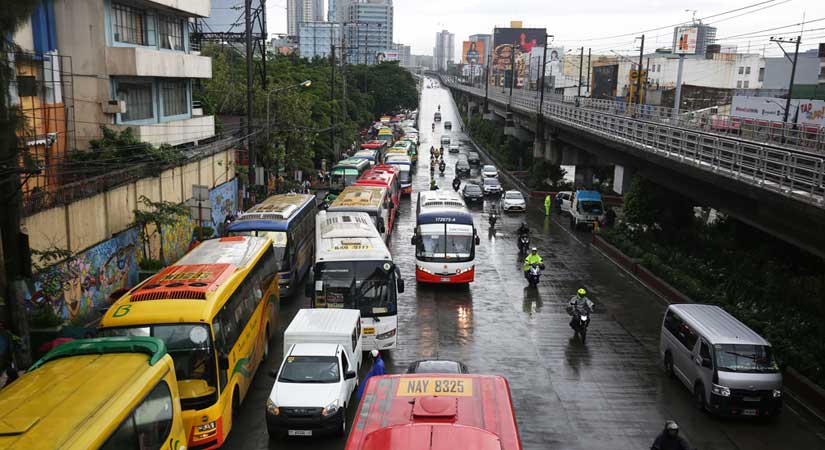
A newspaper photograph from 1975 was circulated in social media recently. It showed three buses coming from Liwasang Bonifacio, all going up what appeared to be MacArthur Bridge. The buses, three astride, didn’t want to give way to each other. Thus, they ended up hitting each other on their sides. As a consequence of this, they blocked the bridge and traffic.
This was in 1975, when the country was still under military rule. Obviously, even martial law was no match against the lack of discipline on our roads. But, even under better political conditions, lack of discipline — or lack of courtesy — remained an issue. It is as if we — as a people and as motorists — have not moved forward even after four decades.
In 2015, a similar incident again happened among buses refusing to give way to each other. On EDSA-Kamuning, three buses ended up blocking traffic after they sideswiped each other. And then, just late last year, a similar accident happened yet again. Three buses hit each other, and blocked traffic, inconveniencing hundreds of road travelers.
PHILIPPINE STAR/MICHAEL VARCAS
As I write this in the New Year, I come to the realization that nothing has changed in the last 45 years, as far as driving and pedestrian habits are concerned. They have only gotten worse, not better. Courtesy is now practiced more in breach, and not just in driving but everywhere else. The Filipino of today, it seems, has less regard for his fellow than the Filipino of yesteryears.
Gone is the post-war Filipino who used to be known for his values, and his strong sense of others as evidenced by his readiness to be part of any bayanihan (the spirit of communal unity, work and cooperation) to help his fellow man. In our cities in particular, people now look out more for themselves than each there. And with the spirit of bayanihan obviously dead, I can only wonder if bayan (country) itself will soon follow to the grave.
Just look at how we litter our streets, and you cannot help but think that the Filipino of old, the one who was friendly and helpful and considerate and mindful of others, is now GAGo or Good As Gone. Are we deliberately refusing to move up and forward as a people? Why have we chosen to abuse the political freedom regained in 1986 to bring out the worst in us?
Recently, I was at a shopping mall’s food court for lunch. On the tables were stickers encouraging diners to ClayGo or Clean As You Go. Diners are being reminded to clean up after themselves — to bring used plates and utensils to tray stations after dining. Same thing for water goblets or tumblers. The drinking station has crates for clean and used tumblers.
But despite the clear signs and markings for what I believe to be a reasonable request, most diners still leave their used plates, tumblers, and utensils on tables. Worse, they actually leave a mess after eating. Very few people bother to clean up and stow away. And with only a few hired cleaners doing the rounds, it takes them a long time to bus tables and wipe them clean.
I have raised this topic in my column time and time again primarily because I believe this to be a strong indicator of who and what we are as a people. This “problem” has less to do with the assumption that labor is relatively cheaper here, and more to do with how we regard each other. In Japan, for instance, it is practically second nature to them to clean up after dining.
The Filipino of old, the one with traditional values and who understood the spirit of bayanihan, is Good As Gone. And he is unlikely to come back. His ilk evolved, for sure, but not necessarily for the better. The personality traits of his descendants seem to have been shaped less by heredity and more by environment. And given how things are now, perhaps their disastrous end is inevitable.
Marvin Tort is a former managing editor of BusinessWorld, and a former chairman of the Philippines Press Council.
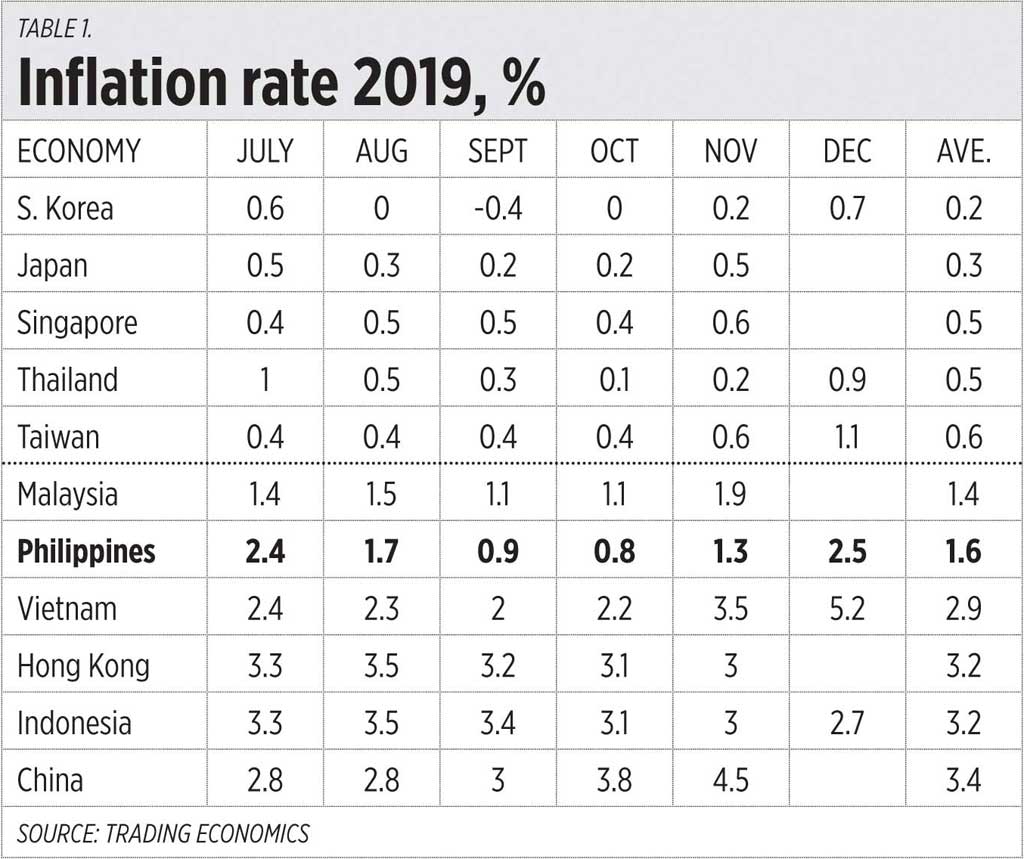
Regional and global inflation has been generally rising over the last two months of 2019. The Philippines reached its lowest inflation since around 2016 of only 0.8% last October, then a quick uptick to 2.5% by December (see Table 1).
The Philippines’ full year 2019 inflation was 2.5% and the “inflation valedictorian” position claimed by the Philippines with 5.2% in 2018 has been snatched by Indonesia with 3% in 2019.
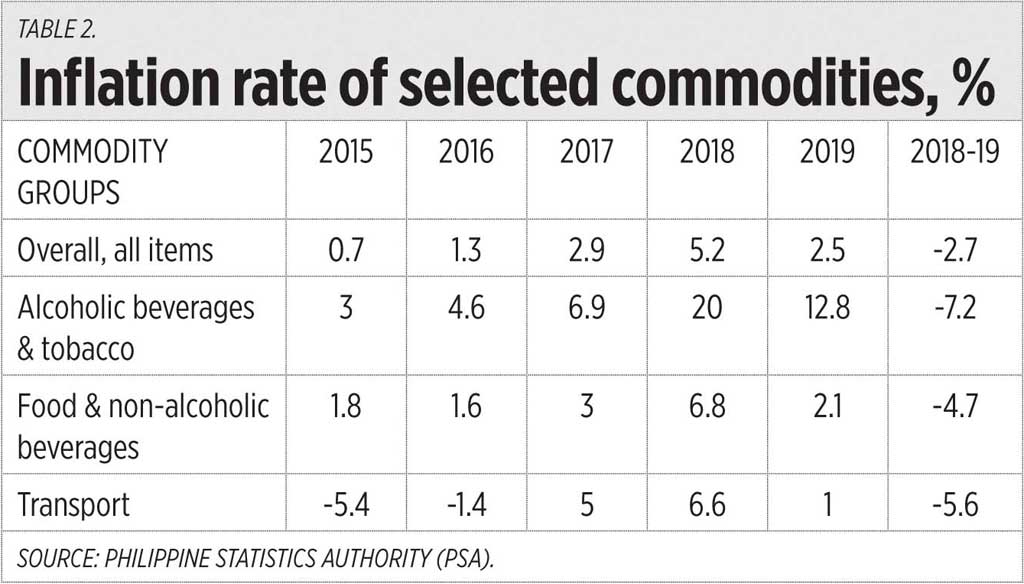
I checked the commodities inflation of the country, and saw that three groups have experienced significant declines in 2019 vs. 2018 levels: alcohol and tobacco, food, and transport. All other commodity groups have been generally flat or saw mild declines in prices. While this affirms the statement that the rice tariffcation law (RTL) has contributed to a significant price decline in rice and other food items, this contradicts the claim by some government agencies like the Land Transportation Franchising and Regulatory Board and Philippine Competition Commission (PCC) that fares by less-regulated transportation like transport network vehicle service (TNVS) are rising too fast (see Table 2).
If the PCC in particular thinks that there is “abuse of market power” by the dominant TNVS despite the presence of multiple choices for the passengers, then the PCC should also investigate coffee shops to see why brewed coffee is only P20 a cup in convenience stores like 7-Eleven but P100 to P120 in Starbucks. Or investigate the two dominant local airlines to see why their fares from, say, Manila to Cebu are at least P1,000 more expensive than the smaller regional airline.
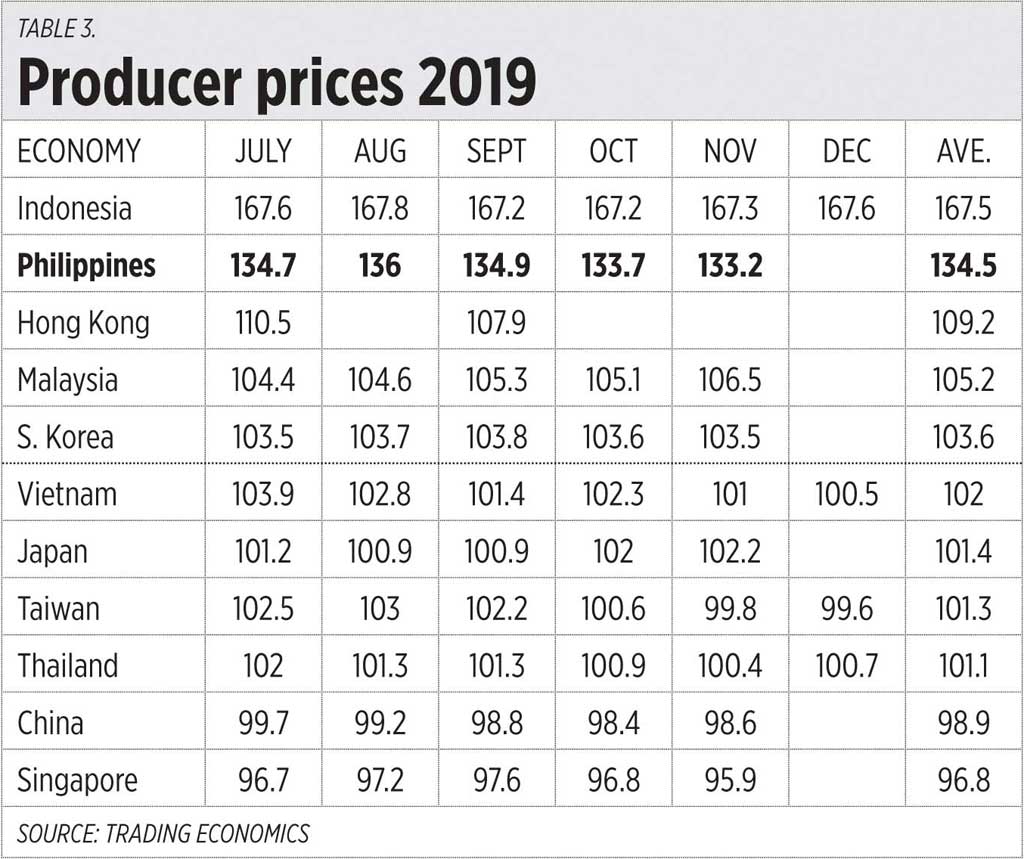
Related to inflation or price changes from the perspective of consumers is the producer price index which measures selling price changes from the perspective of domestic producers. Indonesia and the Philippines are the outliers among their neighbors which have price indices of only 97 to 109 (see Table 3).
Two headwinds face the Philippines in fighting high inflation in 2020. One is internal: the third part of the implementation of the “expensive energy is beautiful” policy via higher oil-coal taxes under the TRAIn (Tax Reform for Acceleration and Inclusion) law. The other is external: renewed political and military conflict in the Middle East with an immediate impact on world oil prices and the deployment of OFWs (Overseas Filipino Workers) to the region.
So two important lessons here: One, more government taxation of very useful commodities like oil and coal is anti-consumer and anti-producer; and, two, more government fines and restrictions on certain sectors like land transportation are often based on wrong premises and assumptions, and work to limit the supply of services, and are inimical to passengers’ welfare.
More tax hikes, fees, and new fines are being prepared this year by the administration to finance more spending and more borrowings. Not good. They should do the reverse. Step back and allow the people and private enterprises to keep more of their earnings to finance more household spending and enterprise investments.
Bienvenido S. Oplas, Jr. is the president of Minimal Government Thinkers.
THE INTERNET was built on open standards and interoperability, but networks tend to balkanize.
If you’ve ever tried to receive an e-mail from me through Gmail, it probably went to spam. My company runs its own e-mail server, and Google feels that our mail authentication is inadequate. And remember those Flash-based websites from the aughts? They’re no longer supported by major browsers, and entirely blocked from Apple’s mobile devices.
Every now and then, we see attempts to re-open the internet. Last month, for example, Twitter announced Bluesky, a project to create an open protocol for social media. If adopted, Bluesky would allow anyone to spin up a Twitter clone and host a social network. Content could be shared across platforms — for example, a Twitter user could retweet a post from a Bluesky version of Facebook, allowing her followers to interact with the post without switching accounts.
There are plenty of other examples. One of the older ones is XMPP, an open protocol developed for social networking and chatting. The project began in 1999, and was adopted and later abandoned by AOL Instant Messenger, Facebook Chat, and Google Talk. (Once a platform gains significant market share, there are competitive advantages to using a proprietary protocol.) A more recent introduction comes from Mastodon, a decentralized social network as well as a software, in the form of ActivityPub.
You know where I’d really like to see open protocols? On the entire rest of the internet. Take Wikipedia, regarded as a definitive source of truth by fact-checkers on Facebook and YouTube. After criticizing Wikipedia’s oligarchic editing process, a former co-founder created the Knowledge Standards Foundation to promote an open protocol where anyone can host wiki-type encyclopedia pages. Custom reading interfaces can then fetch pages from sources preferred by the individual user.
Then there’s Google Search. Google’s prowess doesn’t come from hundreds of petabytes stored on index servers, although that does create a massive barrier to entry for competitors. The company’s dominance comes from its proprietary ranking algorithm, designed to deliver the worthiest links to the top of a user’s search results.
Google has been accused of de-ranking certain sites, promoting political biases, or even spreading disinformation. An open protocol for Google Search could allow anyone to set up a web server to receive queries and forward them to the index servers, then rank results using competing algorithms. The approach could be extended to any content platform.
The challenge, of course, is making a profit. It’s hard for platforms to monetize an open protocol — it’s like trying to make money off of e-mail. Jack Dorsey explains how an open protocol might be good for Twitter: “It will allow us to access and contribute to a much larger corpus of public conversation, focus our efforts on building open recommendation algorithms which promote healthy conversation, and will force us to be far more innovative than in the past.” No company truly wants to be forced to innovate — Jack was just going for a tricolon — but the first two points are valid. As a non-dominant social network, Twitter could benefit from accessing external content, just like Google gains access to new data each time a Gmail user corresponds with an external e-mail address.
Distributed platforms also give companies a way to avoid the messy problem of content moderation. Google contracts with over 10,000 search quality raters who spend their days evaluating controversial search results, while Facebook has hired 15,000 moderators to manage problematic content. With a federated internet, these companies would not have to employ so many moderators, or worry about creating a catch-all policy that attempts to please everybody — anyone who didn’t like one server’s content policies could simply start their own social network. No one complains to Mastodon about unsatisfactory moderation rules, because the host of a Mastodon server can implement whatever filters or amplification algorithms they want without losing access to external content.
This doesn’t necessarily mean that nasty content will take over the internet. When a controversial social network called Gab created a Mastodon instance, many other servers simply preemptively blocked it.
Rather than adhering to content rules imposed in a top-down manner, individual communities make their own rules and create an actual marketplace of ideas.
Requiring open protocols could even be part of an antitrust approach to increasing competition among big tech companies. Back in March, Facebook CEO Mark Zuckerberg suggested that regulators should guarantee the principle of data portability between services. If regulators go a step further and promote interoperability as well, it could be the modern-day equivalent of forcing Bell Labs to liberate their patents. Compulsory sharing of technology may not have been advantageous to the Bell System, but it certainly increased US innovation in the long run.
MY MAIN PREDICTION for 2020, if it can be called a prediction, is trend exhaustion: For the first time in a long while, several important trends have come to an end.
What do I mean by that? Trends ebb and flow, of course, but at any given moment many of them embody one of two distinct states: momentum, or reversion to the mean. The first is a continuation of past progress, either upward or downward. The second is a movement back toward “normal,” however that may be defined.
Now, in an especially wide variety of areas, neither of these conditions is prevalent. Start with the US job market. Since the end of the recession, employment has been improving quite steadily. That has been great for the country, but with unemployment now at 3.5%, does that trend have much further to run? I am not pessimistic about the US economy, but I would say that the direction of the next jobs report is now harder to predict than it used to be.
How about relations with China? For the last few years, it has been fairly easy to predict that US-China relations will continue to get worse. But with a new US-China trade deal due to be signed later this month, this is no longer such a sure bet. I tend to think the deal will not stick, and perhaps could create new terms for intensified conflict, but there is a decent chance the negative momentum has been reversed. Whatever your view, recent trends are not necessarily helpful in making predictions.
Chinese economic growth is yet another major issue where past trends seem to have been drained of their informative value. For a long time, a good and indeed continually verified prediction was this: “The Chinese economy will continue to grow at a rapid clip.” After that, “Chinese economic growth will slow down” did well for a number of years.
Today there are mixed signals. On one hand, corporate debt problems seem to be getting worse. On the other, there are signs the Chinese economy may be stabilizing. You could argue this one either way, but looking at recent trends isn’t going to settle it.
Or you might have thought that India was the obvious new candidate for economy on the rise. And maybe it still is. But it turns out a lot of Indian economic data was falsified or exaggerated, and the true Indian growth rate may be closer to 4% than 6% or 8%. Once again, the (ostensible) past trend turns out not to be so informative.
Similarly, the potential trend of Africa as the “next big thing” has not (yet?) been crystallized into a consistent series of economic growth numbers. The economies of Ghana and Ethiopia are doing quite well, but elsewhere on the continent growth rates have disappointed; the largest African economy, Nigeria, grew at only about 2% last year.
Another big trend has been the rise of right-wing populist parties in many countries. That has been a pretty solid prediction for a few years, but now there is evidence that those parties are no longer growing more popular. Will they retreat as mainstream parties adopt their agendas, or is this just a slight pause? Again, I would say the previous trend has been exhausted and this is a new and hard-to-predict moment.
Another recent trend, the proliferation of new #MeToo cases and an accompanying rise in publicity, may also be losing momentum. Figures such as Jeffrey Epstein and Harvey Weinstein have receded from the news. Could this issue come back with another major celebrity-linked scandal? Absolutely — but it also might have cooled off for a while. The prediction that there will be more #MeToo cases is no longer so easy.
Are there examples of contrary cases, where an important preexisting trend still seems very much in force? Well, carbon emissions will almost certainly get worse before they get better. When it comes to temperatures, however, the global data have exhibited periodic flat periods or even declines before renewed rises. So at least in the short run, predictability there is not so great either.
One implication is that the coming year may hold an especially large number of surprises. Alternatively, rational people (and readers of Philip Tetlock, who has studied the difficulty of forecasting the future) might discard their hubris and not be very surprised at all.
In any case, it is a scary moment. Past performance is not indicative of future results, as they say on Wall Street, and that may be even more true in 2020. Don’t throw out your history books, but you may want to open your mind about what happens next.
OUTLASTED in Game One of their best-of-seven Philippine Basketball Association Governors’ Cup final series on Tuesday, the Meralco Bolts look to bounce back against the Barangay Ginebra San Miguel Kings in Game Two, hopefully with help from their bench.
Thus, said, Meralco coach Norman Black after his team dropped the series-opener of the finals, 91-87, in a game that they had control of for the most part only for them to falter in the end.
The multi-titled PBA coach said bench play left much to be desired in Game One and that it something they have to address come the next game.
“We need to get more production from the bench. I haven’t studied the statistics yet but we really have to get production from our bench. That is something we have to fix in Game Two,” said Mr. Black in the postgame press conference on Tuesday at the Smart Araneta Coliseum.
“I still have to get my starters out to rest and when we do that we want to maintain whatever advantage that we have or even build on it if possible. So our bench really have to play better in Game Two,” he added.
In Game One, Mr. Black tapped five players off the bench but only two managed to score — Anjo Caram (4) and Allein Maliksi (2).
The Meralco bench only had four rebounds, two steals, an assist and a block.
The Bolts’ starters, led by do-it-all import Allen Durham, tried their best to tow their team but the Kings just had more extra to give down the stretch to fend off the former to book the win and the early series lead.
Mr. Durham had a triple-double of 25 points, 18 rebounds and 10 assists to go along with four blocks in a losing cause.
Chris Newsome had 24 points and eight rebounds while Raymond Almazan added 20 points and 13 boards for Meralco.
For Barangay Ginebra, it was import Justin Brownlee who showed the way with 38 points and 16 rebounds, followed by Japeth Aguilar with 16 points, six rebounds and three blocks, the last off Mr. Durham in the dying seconds of the game that helped put the game away.
LA Tenorio and Stanley Pringle had 14 and 10 points, respectively, while Greg Slaughter led the Kings’ bench with eight points, eight rebounds and four blocks.
Game Two of the series goes on the road to Lucena on Jan. 10, and it is a game that Mr. Black considers as “must win” for them even as he said that Barangay Ginebra would have the crowd support advantage anew.
“That is really an advantage for Ginebra (crowd support). Wherever they go in the country they have the support of the fans. So we will see. Anyways, we have to win the game. It’s a must-win situation for us and it doesn’t matter where we play,” the Meralco coach said.