Notice: Function _load_textdomain_just_in_time was called incorrectly. Translation loading for the Newsmag domain was triggered too early. This is usually an indicator for some code in the plugin or theme running too early. Translations should be loaded at the init action or later. Please see Debugging in WordPress for more information. (This message was added in version 6.7.0.) in /data/bwonline/walaakomaisip/wp-includes/functions.php on line 6131
BusinessWorld Online | BusinessWorld: The leading and most trusted source of business news and analysis in the Philippines | Page 10014                                   
Home Blog Page 10014

Taal expected to add more ‘urgency’ to legislation creating disaster resiliency dep’t

LEGISLATORS described as “urgent” the bill creating the Department of Disaster Resilience, citing the ongoing activity at Taal Volcano.

“The occurrence of these unpredictable natural disasters make it more urgent for Congress to pass the measure creating the Department of Disaster Resilience which will be in charge of providing emergency response to natural disasters such (as) earthquakes, typhoons, floods and volcanic eruptions” Speaker Alan Peter S. Cayetano said in a press statement last Sunday.

Deputy Speaker Michael L. Romero called for a special session to tackle the disaster resilience bills and authorize additional funding for disaster response measures.

According to Mr. Romero, the National Disaster Risk Reduction and Management Fund currently has P16 billion, adding that local government units have their own funds for disaster resilience.

“This Taal Volcano eruption is just the first of many disasters this year. P16 billion may not be enough until December. Many of the people affected in the Mindanao earthquakes and by the typhoons that struck Bicol, Eastern Visayas, Mindoro and Western Visayas have yet to rebuild their homes” Mr. Romero said.

The House Committees on Government Reorganization and Disaster Management approved on Nov. 20 the still-unnumbered substitute bill consolidating all measures establishing the Department of Disaster Resilience.

Majority Leader and Leyte Rep. Martin Romualdez also called on the Philippine Institute of Volcanology and Seismology (Phivolcs) to expedite the use of its P221-million budget this year for capital spending on detection and early-warning equipment.

“We do not fault Phivolcs for the lack of adequate warnings on the impact of the phreatic explosion. We are aware that it is really difficult to predict the occurrence of volcanic eruptions and related disasters. But this is precisely the reason why Congress included more than P221.48-million capital outlays in the P588.12-million total budget of Phivolcs for 2020. We need to upgrade the country’s monitoring and warning program for volcanic eruption, earthquake and tsunami” Mr. Romualdez said.

Representatives Alfredo A. Garbin, Jr. of AKO Bicol Party List and Lawrence H. Fortun of Agusan Del Norte said that there should be no-build zones in the permanent danger zones around active volcanoes.

“Permanent and absolute no-build zones must be established fast as adaptation to climate and disaster hazards, as well as to protect ancestral lands, farms, and nature preserves and habitats on land and out at sea,” Mr. Fortun said.

Phivolcs raised Alert Level 4 over Taal Volcano late Sunday, the second-highest alert level on a scale of 0 to 5, signifying activity that can “progress into a highly hazardous eruption.”

Phivolcs recommended the total evacuation of Taal Volcano Island and the surrounding area up to a 14-kilometer radius from the main crater.

Mr. Fortun said the Taal alert is “a stark reminder of the urgent need for a national land and water use law with strong provisions on permanent and absolute no-build zones.”

He such a law, as well as a sustainable forest management law, will allow coastal towns and cities to adapt to higher sea levels that threaten to submerge their land.

“A sustainable forest management law is the natural tandem of a national land and water use law. Both of these our country still does not have despite the fact that the 1987 Constitution foresaw this need. After over 30 years, Congress has failed to approve such laws” Mr. Fortun said.

A national land use act has been pending in Congress for two decades, even after former President Benigno Simeon C. Aquino III certified the bill as urgent in 2013.

President Rodrigo R. Duterte also asked Congress to pass a national land use law during his 2019 State of the Nation Address (SONA). — Genshen L. Espedido

China says Kaliwa Dam deal conforms to international practice

THE CHINESE EMBASSY in Manila said Monday that the Kaliwa Dam project loan agreement is consistent with international practice and Philippine law, contrary to claims that it includes terms that are onerous for the Philippines.

“The loan agreement was reached by both sides through consultation on equal and voluntary basis,” the Embassy said in a statement.

“The terms and conditions of the agreement are general and standardized requirements in accordance with both international practice and Philippine laws,” it added, noting it had the approval of the Department of Finance (DoF) and the Department of Justice, among other government agencies.

The Kaliwa Dam project, which is expected to supply 600 million liters of water per day, is funded through a $211-million loan agreement between the Metropolitan Waterworks and Sewerage System and the Export-Import Bank of China. The loan deal was signed on Nov. 20, 2018.

“Once completed, the Kaliwa Dam project will fundamentally alleviate the severe challenge of the water shortage in Metro Manila,” the Embassy added.

“China will continue to work with the Philippines to ensure early implementation of the Kaliwa Dam Project for the benefit of the local people,” the Embassy added.

Deputy Minority Leader and Bayan Muna Rep. Carlos Isagani T. Zarate had earlier pointed out “onerous” provisions contained in the agreement, citing, among others, the waiver of sovereign immunity.

The agreement also had dispute-resolution terms such as the interpretation of the contract according to Chinese law and the designation of the Hong Kong International Arbitration Centre as the venue for hearing disputes.

The DoF later clarified these are standard provisions on loan agreements entered into by the Philippines. The Department noted that similar terms are contained in loan deals with Japan, South Korea, and France.

Malacañang has said that President Rodrigo R. Duterte is willing to review the agreement if onerous provisions are found. — Charmaine A. Tadalan

Valenzuela extends period for availing of tax relief

VALENZUELA CITY Mayor Rexlon T. Gatchalian has approved an ordinance extending the tax relief period on real property taxes by three months to the end of the first quarter.

Ordinance No. 641 amended Ordinance No. 586, S. 2019 by extending the grant of tax relief to March 31. The grant of tax relief under the previous ordinance expired on Dec. 31.

“There is a need to extend the Real Property Tax Relief to encourage bringing citizens into compliance with law rather than further burdening them with interest on their tax due,” according to the ordinance.

The ordinance was passed by the Sangguniang Panlungsod on Dec. 16 last year and takes effect immediately upon signing.

The Commission of Audit-Valenzuela City Field Office had recommended the extension as well as the payment of real property taxes for delinquency of five years and current tax due to encourage payment.

The ordinance deems tax relief eligibility to have been waived upon failure to settle delinquencies by March 31.

“They shall be deemed to have waived their rights under this Ordinance,” it stated. “And the total amount due including its interest from the time of their delinquencies before the amnesty shall become automatically due.”

Meanwhile, the computation of market value for undeclared properties that will be declared for the first time will be based on the existing ordinance at the time of the approval of Ordinance No. 586, S. 2019.

The Valenzuela City government first issued Ordinance No. 586, allowing delinquent taxpayers to settle property taxes including interest from 2014 up to the date of application. — Charmaine A. Tadalan

Water firms’ input on new contracts to be considered — DoJ

METRO MANILA’s water distributors will have the opportunity to comment on amendments to their concession contracts, Justice Secretary Menardo I. Guevarra said.

“These proposed new contracts intend to remove all illegal provisions and foster greater transparency and equitability in rate-setting, and should therefore provide a more stable and comfortable environment for investors,” Mr. Guevarra told reporters in a mobile-phone message.

“These proposed new contracts will not be absolutely imposed upon the water concessionaires, as they will be given a reasonable opportunity to comment on the proposed amendments in an open and public discussion of the issues,” he added.

Senator Francis N. Pangilinan has said that President Rodrigo R. Duterte’s threat to prosecute officials of Maynilad Water Services, Inc. and Manila Water Co., Inc. officers and investors if they refuse to accept the government contract was illegal.

Mr. Guevarra also said that government officials and water concessionaires who entered into the contract “and implemented these highly disadvantageous contracts” were those threatened by the President with possible criminal charges, and not the investors.

He also said that any takeover of water distribution, which is authorized by the Constitution, “is the government’s last option.”

Mr. Duterte said last week that the government will offer new contracts to the water concessionaires, adding that a government takeover of water services and criminal prosecution were on the table should the contracts be rejected.

Mr. Guevarra said last year that government lawyers found onerous provisions in the water contracts, including a provision that obliges the government not to interfere in rate-setting.

They also found irregular the extension of their 1997 contracts until 2037, which was undertaken 12 to 13 years before the expiration of the original deals in 2022.

Mr. Duterte has claimed that the water concessionaires committed economic sabotage following Manila Water’s disclosure last year that an arbitration court ruled that the company is entitled to a P7.39-billion indemnity from the government for the losses it suffered.

A Singapore arbitral body in October also upheld a P3.4 billion award to Maynilad.

The water companies said during hearings at the House of Representatives that they will no longer pursue collection on the award. — Vann Marlo M. Villegas

Trade deals ease health worker mobility — WTO

PHILIPPINE trade deals that grant access to health workers in partner countries represent a “substantive commitment” to allow a measure of worker mobility in the health care sector, the World Trade Organization (WTO) said in a working paper.

“Trade in services could help address the concerns of the health sector by ensuring that health worker mobility can respond to worldwide demand,” according to the International Health Worker Mobility and Trade in Services report.

The paper is a joint research project by staff of the World Health Organization (WHO) and the WTO.

A regional trade agreement between Japan and the Philippines is considered a “substantive commitment on health worker mobility,” as it gives Filipino nurses special working permits, with costs of recruitment covered by their Japanese employers.

The study said that international mobility of health workers has been accelerating over the last decade, with migrant doctors and nurses working in Organisation for Economic Cooperation and Development (OECD) countries increasing by 60% over the period.

WTO members have used the General Agreement on Trade in Services (GATS), a treaty that extends the countries’ multilateral agreements to the service sector, to attract health workers which their countries require.

The agreement allows for temporary cross-border movement for service providers, not permanent migrants.

Global, regional, and bilateral services trade agreements have facilitated health worker mobility, and “demonstrated the ability to bring together a range of national interests” such as education, foreign affairs, health, labor, migration, and trade.

Agreements with Japan would for example include inter-agency educational programs to improve nursing competency through in-service training.

“As an illustration, the negotiation of IJEPA (Indonesia-Japan Economic Partnership Agreement) was led by the Ministry of Trade and included participation from the Ministry of Manpower and Transmigration, the National Agency for the Protection and Placement for International Migrants, the Ministry of Health, the Ministry of Foreign Affairs, and the Ministry of Education,” the paper said.

A structured analysis of the health labor market, the paper said, can provide can address the needs of the economy of destination as well as the “brain drain” concerns of the country of origin.

“Health labor market analysis uses harmonized approaches to assess labor market trends in the health sector, including attention to production, employment and migration,” the paper said.

“It analyses the key factors influencing the domestic supply of and demand for health workers, and strengthens the ability to forecast and plan for current and future health workforce needs.”

WHO, the paper said, has introduced the health labor market analysis process in the design of a new generation of bilateral cooperation to understand the labor market and health needs of partner countries. — Jenina P. Ibañez

Are you a top withholding agent?

On Sunday afternoon, I was surprised to read news of Taal Volcano erupting, spewing ash and causing the shutdown of our international airport. I was caught unaware. A search of my newsfeed showed no prior articles about Taal Volcano, so I was surprised to see graphic images from friends and family of the volcanic eruption suddenly flooding my social media. Perhaps I was more focused on the Iran-US situation or the Duke and Duchess of Sussex’s announcement that they are stepping back from their royal roles to have missed updates on Taal, if there were any.

I hope that residents near the volcano had more prior warning than I did. Receiving the proper information is indeed important if we are to be prepared for contingencies and emergencies. The same is true if we are expected to comply with various rules and regulations applicable to our businesses. Hence, issuances from the Bureau of Internal Revenue (BIR) clarifying rules and requirements are always welcome developments.

Such was the case when the BIR issued Revenue Memorandum Circular (RMC) No. 143-2019 in December. RMC No. 143-2019 clarified the rules on being in the top withholding agent (TWA) list.

Prior to RMC No. 143-2019, some taxpayers complained of being on the list despite their businesses being small. I assume that the BIR is now cleaning up the TWA list. Last week, a friend happily announced that she had finally been delisted as a TWA. She should not have been on the list in the first place, considering her small trading business. Unlike in school, where students aim to be on the list of top students, being on the list of top withholding agents is not something most entrepreneurs aspire to.

TWAs have the additional task of withholding 1% on suppliers of goods and 2% on suppliers of services. The general rate of 1 and 2% creditable withholding tax (CWT) applies to regular local or resident suppliers, unless the withholding tax regulations specifically identify the payment as subject to a higher rate of withholding tax.

Under Revenue Regulations (RR) No. 7-2019, TWAs are taxpayers with gross sales/receipts or gross purchases or claimed deductible itemized expenses, as the case may be, of P12 million during the preceding taxable year.

Prior to 2018, newly identified TWAs received a letter from the BIR, informing them that they have been identified as TWAs and of their additional responsibility of withholding on all their regular purchases of goods and services. In early 2018, the BIR did away with sending notification letters to taxpayers identified as TWAs. The list is instead published in a newspaper of general circulation or posted on the BIR website. Hence, taxpayers are advised to regularly check the BIR website to ensure whether they are on the list.

Once published or posted, the TWA is obligated to withhold beginning the first day of the month following the month of publication. Taxpayers classified as TWAs under prior regulations remain as such, unless delisted from the existing TWA list.

Probably as a response to the confusion on why some taxpayers with relatively small incomes are included in the TWA list, RMC No. 143-2019 was issued to clarify the rules on TWAs. It emphasized that the TWA’s obligation to withhold is mandated only for businesses with significant levels of revenue, as identified in RR No 7-2019. It also reiterated the rules in Operations Memorandum Order No. 20-2019, which excluded the following taxpayers from the TWA list:

(a) National government agencies, government-owned or -controlled corporations, state universities and colleges, and local government units;

(b) Taxpayers who were included because of one-time transactions (i.e., estate and donor’s tax);

(c) Individual taxpayers deriving income on commission basis such as, but not limited to, insurance agents and real estate brokers if the P12-million income criteria was satisfied only in one taxable quarter (subject to verification);

(d) Taxpayers who are tax exempt from payment of income taxes with no proprietary activities (i.e., foundations, non-stock non-profit and tax exempt educational, religious and charitable institutions, etc.).

RMC No. 143-2019 emphasized that, even if taxpayers were included in the list or not removed from the existing list, they cannot be compelled to withhold the 1 and 2% CWT if they do not satisfy the P12-million threshold or they are excluded by Operations Memorandum Order No. 20-2019.

The clarification is a welcome break for small businesses on the list. The obligation of withholding the CWT is burdensome and even confusing for some businesses. In some cases, the obligation is even impossible to comply with, particularly if the expense is advanced by employees who are not well-informed on withholding tax rules. In such situations, some taxpayers just suffer the risk of paying deficiency taxes for failure to withhold the correct CWT.

However, even with the clarification under RMC No. 143-2019, it is indeed laudable that the BIR is continually cleaning up the list of TWAs. Taxpayers should not be left to fend for themselves and argue that they should no longer be on the list when audited by the BIR. Small businesses should be supported by the government by making compliance requirements easy to follow and understand. After all, the small businesses of today can become large taxpayers and important partners in inclusive growth, especially if given the proper support and guidance by the government.

I hope that residents affected by the Taal Volcano eruption are safe and receiving proper assistance from the government and NGOs. News reports have the shown the rapid escalation of Taal’s activity.

Many say prayers move mountains. In this case, I hope our prayers can calm a volcano.

Let’s Talk Tax is a weekly newspaper column of P&A Grant Thornton that aims to keep the public informed of various developments in taxation. This article is not intended to be a substitute for competent professional advice.


Eleanor Lucas Roque is the Head of Tax Advisory & Compliance division and one of the partner of P&A Grant Thornton, the Philippine member firm of Grant Thornton International Ltd.

pagrantthornton@ph.gt.com.

Me Too: It can happen to anyone

MeToo is a movement against sexual violence — it calls out perpetrators of violence and places them in an arena of shame. Unfortunately, in most cases, those who come out and share their MeToo narrative are met with doubt, blame, and are shamed themselves; in other instances, they are lauded by some for their courage amidst tragedy but they turn a blind eye to perpetrators whom they know.

Nonetheless, MeToo is also a moment when a victim realises that she has the power to overcome her frailty and self-assigned guilt and transforms herself into a discourse of justice.

OF EXPERIENCES AND REACTIONS
Sexual violence — advances, harassment, assault, rape — are mostly done by people we know, a mentor we look up to, a friend we trust, a colleague we work with. It knows no age, it cares not for boundaries, it does not matter how we look, and there is no such thing as respect.

My students know these too well and yet they still fall victims to sexual violence. It can happen to anyone… even to me.

Yes, I am a feminist, a staunch advocate of women’s human rights, a fierce no-nonsense woman and yet, I myself have not been immune.

Sexual advances by those known to us is a betrayal of personal trust, is a traitor to a meaningful advocacy, shows utmost disregard for a respectful working relationship. Touching the back while seated together in a vehicle, a slap on the butt after a joke, holding your hand as you fall asleep from anti-anxiety meds while on a flight, having an annoyingly repetitious script of casually telling others about wanting someone specific to be a “second” wife, etc. etc. Sexual predation displayed with normalcy! Sexual predators all assume the same thing of the non-reaction of their prey — the illusion of silence as consent, an amulet for impunity.

But silence is NOT CONSENT. Victims fall silent because of shock, disbelief, paralysis, trauma — there is an inability to comprehend how a person you trust can be so monstrous towards you. One just wishes the surreal unfolding situation stops — but it never does. Perpetrators are obsessed with their prey — they want to subdue them, control them, leave them to shame themselves to the point of self-flagellation. They have their own reality. “Peminista ka pa naman — bakit di mo sinapak, sinigawan o hiniya man lang?” (You are a feminist — why didn’t you slap me, shout, or shame me at least?)

Easier said than done. At worst, it puts the burden on victims who were not able to physically or verbally react at the time when the sexual advances were made. Believing or saying so is simply victim-blaming.

MAKING SENSE OF WHAT HAPPENED
We victims would wish never to see our predators again. But sexual predators are all over the place — not just in industries that deal with the most vulnerable, but also in places where even the most empowered women are victimized. They really are everywhere!

Seeing predators and perpetrators of sexual advances in a “collegial” environment again leads victims to put up their guard, set boundaries, move away whenever they move in close. Or ask genuine friends to act as “buffers,” to sit or stand in between us and predators when the latter insist on being near us. Yes, genuine friends must know. Victims must tell their stories to others. Anyone can be a victim and thus, sexual predators should be named and shamed.

As for institutions or organizations that the victims belong to, they should know about episodes of sexual predation. They should demand action from the perpetrators — tell them it can’t be “business as usual” with victim and perpetrator in the same space. Something must be done. Silence is not an acceptable response. Regardless of any strategic partnership or powerful connection with the perpetrators, sexual violence must never be condoned. It must never be rewarded with complacency from the organization. Don’t leave it to the victim to take matters in her own hands. For in the end, “aba, ang biktima pa ang masama at pagbibintangan na nag-maneobra na maalis ang may mga sala?!” (what, the victim has to be the villain and be blamed for having maneuvered to get rid of the culprit?) Jeez!!!

MY METOO, OUR METOO
The embeddedness of the patriarchy leads us to align with predators themselves. Woke groups, progressive organizations, reflexive institutions that have not responded accordingly and appropriately are nothing more than accomplices, are no better than the macho-centric institutions that laud male supremacy over women.

MeToo is about resisting, about fighting back when the victim/survivor has mustered the courage to speak out. Despite the general public’s victim doubting/blaming/shaming, it is reclaiming one’s own power to finally stand up and defend oneself. It’s a fiery beacon announcing to sexual predators — be they bosses, colleagues, peers, friends, etc. — that they will never get away with their advances again.

MeToo is about having a victim-centric orientation when it comes to empathy, support, and meaningful responses. MeToo points to perpertators of violence who should have no other opportunity to freely move around their victims, the same spaces that gave them the opportunity to victimize.

At the very least, we should support the MeToo movement and replace the culture of impunity with that of accountability.


Ma. Lourdes Veneracion-Rallonza, Ph.D. is an Associate Professor at the Department of Political Science, Ateneo de Manila University. She is also Program Director of Gender and Atrocity Prevention at the Asia Pacific Center for the Responsibility to Protect, University of Queensland.

mrallonza@ateneo.edu.

Offsetting measures, upsetting measures

The tax reform is well underway, but just as it had in 2018, it hit a snag yet again. In fact, it hit the same snag it had back then.

While the lowering of the corporate income tax (CIT) is generally accepted, business organizations are criticizing the other part of the Corporate Income Tax and Incentives Rationalization Act (CITIRA) bill — which is the incentives reform.

Unfortunately, the longer the debate goes, the more businesses continue to suffer. And, at its core, this delay is brought by the government’s line of thinking that for them to lower taxes, they must increase collections from somewhere else.

This “offsetting measure” thinking should not be how we plan to go into the tax reform.

NOT FAST ENOUGH
But, first, we need to address an underlying issue with the lowering of the CIT. With all eyes focused on the intricacies of the incentives reform, very few are questioning whether the lowering will be fast enough.

The lowering of the CIT will be implemented over a period of 10 years — a one percent deduction each year. That means, to match the second-highest tax rates in the ASEAN region (25% in Indonesia and Myanmar), we will need five years.

Assuming, of course, that they don’t lower their tax rates as well.

Even with that, there are plenty of other ASEAN countries which have lower tax rates than the Philippines. In fact, we will remain above the ASEAN average until nine years into the passage of the CITIRA.

This presents a problem for foreign investments since tax rates are one of the considerations, but, more importantly, it presents a problem for local corporate taxpayers.

What we should do instead is lower the CIT from 30% to 20% within this current administration. This would mean lowering the tax rate immediately to 25% by 2020, then gradually lowering it 2.5% every succeeding year.

For the longest time, corporations have shouldered a majority of the income tax collections. At first thought, that might seem obvious. After all, the first image that pops into our minds when we think of corporations are the larger conglomerates.

But that simply isn’t true.

Corporations are simply another way a business is organized, and even smaller businesses can be corporations. These smaller businesses bear the burden of the high CIT — and their burden is why the tax reform is urgent.

SEPARATING THE INCENTIVES ISSUE
That brings us full circle to the cause of the delay — the incentives rationalization.

In theory, yes, incentives rationalization is good — one of the goals of the tax reform is to create a fair system — and this is fair. But this rationalization will have far-reaching implications in employment, foreign investment, and possibly other aspects of the economy.

If this is rushed, then it could present unforeseen problems like with inflation and TRAIN Law. Remember, the government claimed that it would have very minimal inflationary impact. Then, a few months later, the Philippines’ inflation hit a nine-year high.

Was the TRAIN Law to blame? Not entirely. The inflation was largely brought by rising oil prices. Could it have been timed better? Possibly, if the increase in taxes had been studied more.

The government is singing the same tune now when they claim that there will be minimal job losses under CITIRA.

The takeaway here is not that the government is untrustworthy, but that they need to be certain.

They need to study the rationalization very carefully. What they don’t need to do is tie up the rationalization with the lowering of tax.

In fact, the rationalization itself needs to be a separate law, governed by the Department of Trade and Industry (DTI) — not the Department of Finance (DoF). Incentives are an investments issue, which is the job of the DTI.

Unlike the lowering of CIT, the government can take its time here. The timeline for the rationalization should be, at least, 10 years to allow all foreign investors adjust and adopt to the new status quo.

SOURCES OF REVENUE COLLECTIONS
It should be noted that the third and final round of excise tax hikes under the Tax Reform for Acceleration and Inclusion (Train) Law started to take effect on Jan. 1. Diesel is expected to increase by P1.50 per liter while gasoline, kerosene, and liquefied petroleum gas by P1 per liter.

Other reforms that are expected to earn additional revenues for the government are Package 1C: Motor Vehicle Users Charge, Package 2+: Sin and Mining Taxes, Package 3: Real Property Valuation, and Package 4: Passive Income and Financial Taxes.

Although these adjustments will ultimately help fund the National Development Program, many consumers have expressed to have carried the burden brought about by the price increases in basic goods since the TRAIN Law was implemented on Jan. 1, 2018.

“But our economy will worsen if we don’t implement offsetting measures!”

Yes. But “offsetting measures” should not mean shifting the tax burden from one shoulder to another. Instead of increasing tax rates, we need to address the inefficiencies and leakages in our tax system.

Have we taken steps to address corruption in the Bureau of Internal Revenue (BIR)? While corrupt examiners are enjoying their vacations abroad, businesses in the Philippines continue to be squeezed and harassed for bribes.

What about tax evaders? The tax amnesty was supposed to address this by encouraging them to start fresh. But will the amnesty really do so if bank secrecy is not lifted?

And, of course, the most important source of revenue collections — broadening the taxpayer base.

Lowering CIT can encourage more taxpayers to register. According to the BIR’s latest annual report, corporations shoulder 57.17% of the total income tax collection despite numbering only 1,047,818 (of which 794,203 are taxable).

If we lower the CIT, the government can encourage more taxpayers to establish their own businesses. Especially now that the Corporate Code has been amended to allow One-Person Corporations, it might encourage sole proprietors to register their businesses as corporations.

There is little point to tax reform if the tax system remains inefficient.

We need to continue the improvements that this current tax administration has started. Already, they have achieved the highest tax effort ratio, compared to previous tax administrations.

They have launched their own digital transformation initiatives, such as the Hack-A-Tax project — a hackathon that challenges software developers to conceptualize ways to make tax-related transactions easier.

These applications or programs could help automate BIR processes and, since there will be less contact between the tax collector and the taxpayer, hopefully remove corruption as well.

The Asian Consulting Group (ACG) is one of the partners of the BIR in promoting a more efficient tax administration through digitalization. In fact, ACG recently launched the TaxWhizPH Mobile App and YouTube Channel, both accessible to the taxpaying public free of charge.

This article reflects the personal opinion of the author and does not reflect the official stand of the Management Association of the Philippines or the MAP.


Raymond A. Abrea is a member of the MAP Tax Committee and was one of the 2017 Outstanding Young Persons of the World, a Move Awards 2016 Digital Mover, one of the 2015 The Outstanding Young Men of the Philippines (TOYM), an Asia CEO Young Leader of the Year, and Founding President of the Asian Consulting Group (ACG) and the Center for Strategic Reforms of the Philippines (CSR Philippines).

consult@acg.ph.

map@map.org.ph

http://map.org.ph

Taal, Cadiz City and Tapaz, Capiz

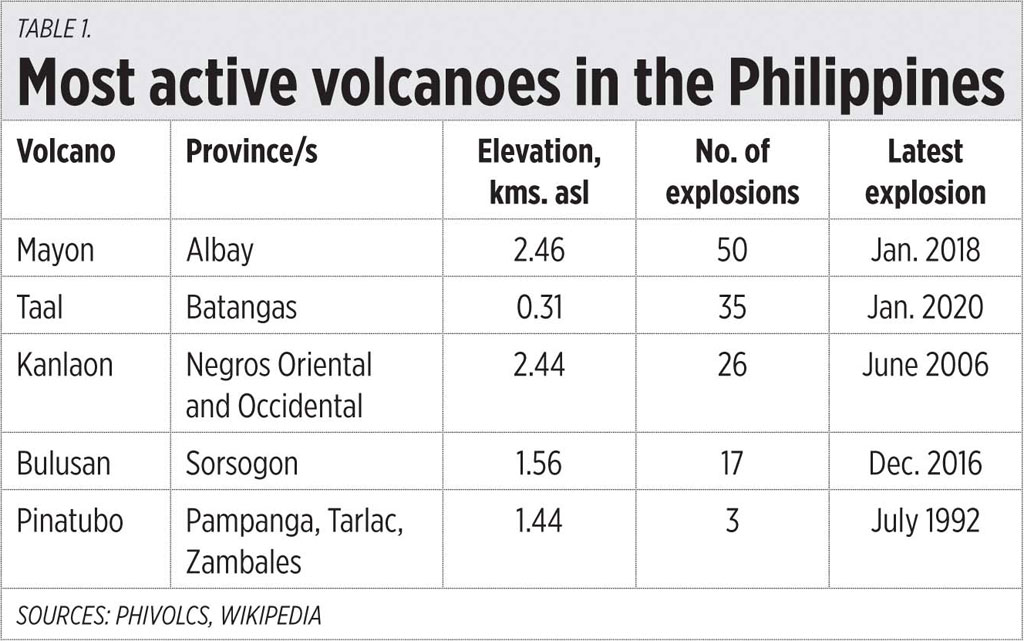
Volcanic areas are among the most beautiful places to see in the country — Mayon, Pinatubo lake, Bulusan lake, Taal lake, etc. They are beautiful when the volcanoes are at rest, but when they rumble and erupt, they are among the worst places in the planet to be due to the many dangers they pose. Among the most active, most violent volcanoes in the Philippines and their explosions since 1600 are listed in Table 1.

Residents and business locators around Taal volcano and lake in Batangas, Cavite, Laguna, and Quezon are suffering from the heavy ashfall. This is a big setback to business and tourism, but it is Nature taking its regular geological cycle of volcanic calm and eruption over decades or centuries.

Negros island has a huge, tall, active volcano — Kanlaon — that inspires plenty of tourism-related businesses around it. There are many waterfalls, big rivers, hot springs, then hills and flatlands below it.

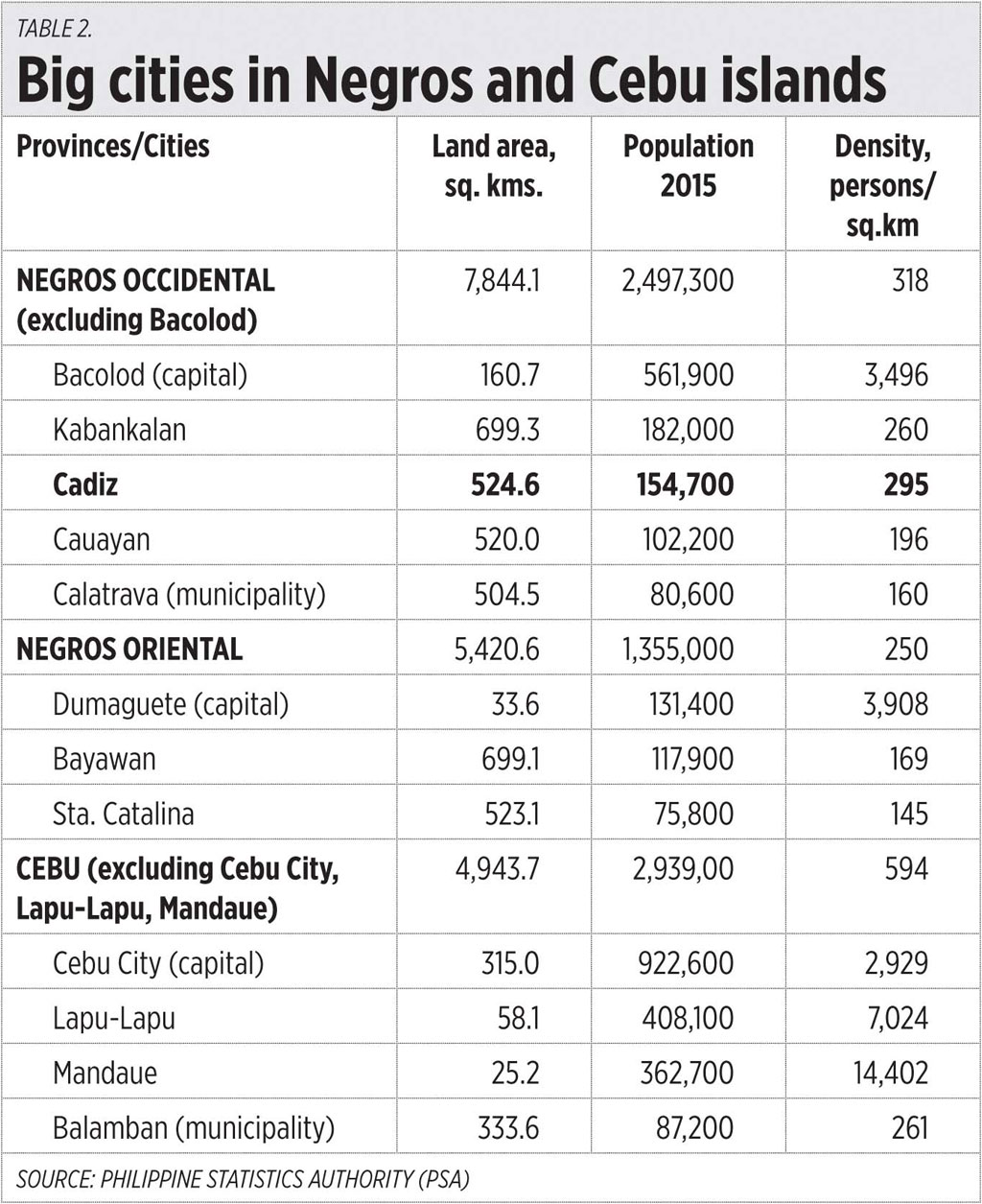
I am from Cadiz City, Negros Occidental. We are at the northern tip of Negros island and somewhat far from Kanlaon. It has the third biggest land area in Negros island, which is composed of two provinces. In terms of population though, cities in Cebu island are the biggest (see Table 2).

Last December, I spoke with Cadiz City Mayor Salvador Escalante, Jr. in the new City Hall building about the economic environment in the city. He was joined by City Engineer Jose Lauro Napud and City Investment Officer Lyn Regodos. I was surprised to hear of the many private investments, existing and planned, for the city. For instance, the malls that are already there are Citimall, Puregold, and SM Hypermart. Coming soon is Gaisano, and Robinsons has expressed an interest to come in. Some manufacturing and processing plants are being planned because of Cadiz’ huge land area, long coast, and access to the island’s nearly 5 million people and consumers.

Cadiz’ main tourism attraction is Lakawon island resort, with its modern facilities and its white sand beach which is considered the “little Boracay” of Negros.

Water should not be a problem because the city has many rivers. The problem though would be power as Negros island relies heavily on old and ageing geothermal power plants. There are many solar farms but solar is intermittent, unreliable, and non-dispatchable on demand. Negros does not have a single coal plant and is becoming more dependent on power “imports” from Iloilo and Cebu coal plants. I wish that my province mates will soon realize that the real “dirty energy” are candles and gensets running on diesel when there are frequent blackouts — not coal.

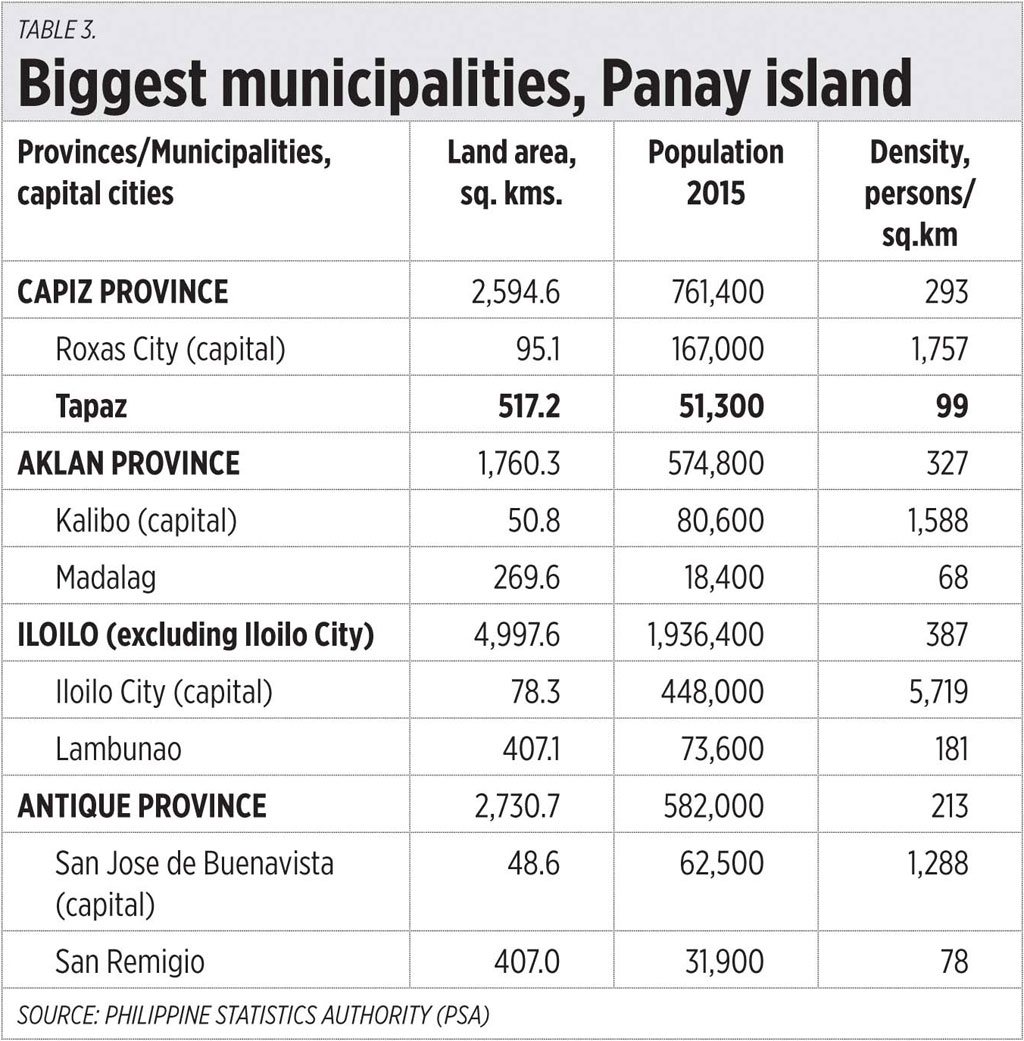
I also visited Tapaz, Capiz last December, and spoke with Mayor Roberto Palomar. I was introduced to him by my fellow Cadiznon Niel Defensor who works as a consultant to Mayor Palomar. I was surprised to know that Tapaz has the biggest land area in Panay island (composed of four provinces), and its population density is among the lowest in the island (see Table 3).

The municipality of Tapaz hosts the beautiful and very peaceful Marugo lake. My daughters and I enjoyed the swimming pool overlooking the lake. Then in the barrios there are four small waterfalls.

Mayor Palomar proudly enumerated the new structures that have been built there in the last three years — a new public market, a bus terminal, a new four-storey municipal hall to be finished this year, and many new cemented roads going to far away barrios. Coming soon is a municipal hospital.

The single biggest project in the municipality will be the construction of the management office of the Panay River Basin Integrated Development Project (PRBIDP), a P26-billion multi-year project that includes the construction of several dams for hydro power, bulk water, and irrigation along the huge and wide Panay River. The 18-MW hydro power plant will help address the problem of frequent blackouts in the province.

Panay island is lucky to have no active volcano and still have many big mountains, many big rivers and waterfalls.

Economic development should start from local businesses and local governments that optimize whatever resources they have, and not be too dependent on the Office of the President and the various national agencies.

Meanwhile, volcanoes and earthquakes, strong or mild, are 100% part of Philippines’ “geological DNA.” No earthquakes and volcanoes, no Philippines. Our archipelago came from under the sea.


Bienvenido S. Oplas, Jr. is the president of Minimal Government Thinkers.

minimalgovernment@gmail.com

Starting the year on the wrong foot

At the start of 2020, I was asked what the year would be like. I replied, “50-50.” I was just being facetious. It could very well turn out to be worse.

Over a period of two weeks, the world was rocked by rapidly escalating events in the Middle East triggered by a US decapitation strike on Jan. 2 that killed Iranian General Qasem Soleimani. He headed the Quds Force, built Iran’s terror networks in the region, and was high on Iran’s power ladder. His arc of influence stretched out to Lebanon, Syria, Iraq, and Yemen. He blazed a trail of death and destruction for decades with well-funded proxies — Hezbollah, Islamic Jihad, Hamas, Houthi rebels, Shiite militia groups, and terrorist groups outside the Middle East.

Claiming that a strike was “imminent” after its embassy in Baghdad was besieged in the last days of December, an event that brought back bitter memories of Benghazi, the US decided to take out Soleimani on Jan. 3 in an attack that also killed ranking members of Hezbollah and his team. On Jan. 4, two Iranian hit the Balad air base. A barrage of Iranian missiles struck two large military bases on Jan. 8. Hours later, a Ukranian commercial airliner was accidentally brought down by an Iranian missile minutes after it took off from Tehran. On Jan. 9, rockets hit the Green Zone. No Americans were killed or injured.

After its retaliatory strikes, Foreign Minister Javad Zarif tweeted: “Iran took & concluded proportionate measures in self-defense… we do not seek escalation or war, but will defend ourselves against any aggression.” President Donald Trump’s response hinted of deescalation: “All is well! So far, so good!” His statement the following morning ended on this note: “We want you to have a future and a great future — one that you deserve, one of prosperity at home, and harmony with the nations of the world. The United States is ready to embrace peace with all who seek it.” But he drew the red line — no nuclear Iran.

Eventually they deescalated after a harrowing year-starter I call Hell Week. Many thought the world was on the brink of World War III. Meanwhile, the court of public opinion believes the USA isn’t in the Middle East for altruistic reasons but for control of national resources. Its overextended presence in the region since 9/11, from Iraq (oil) to Afghanistan (opium poppy) is the alleged proof. For example, after the USA got out of the way of Turkey’s incursion into Syria in an anti-Kurd operation, President Trump said that the US will remain in Syria to “protect” its oil and prevent it from falling into the hands of ISIS, after proclaiming last year that the Caliphate was defeated.

Ironically, Soleimani’s proxy forces were also battling ISIS, whose fighters in the region remain in the thousands. After Soleimani’s death, the Iraqi parliament, now predominantly Shia and friendly to Iran (unlike in Saddam Hussein’s time), voted to end America’s military presence in Iraq. However, the US military leadership rejected it despite deep-seated resentment that it hasn’t done much to help the Iraqis rebuild their shattered country. It only deepens impressions about its real intent — endless war for selfish national interests, contrary to Trump’s Oct. 17, 2019 tweet: “…it is time for us to get out of these ridiculous Endless Wars, many of them tribal, and bring our soldiers home. WE WILL FIGHT WHERE IT IS TO OUR BENEFIT, AND ONLY FIGHT TO WIN.”

The hostilities placed our OFWs in Iran and Iraq (approx. 7,600 documented) in harm’s way, prompting President Rodrigo Duterte to order their immediate repatriation. However, the deescalation could place his order on hold. Even so, they must remain alert because as we’ve seen how modern conflicts can rapidly ramp up. Our actions must flow from intelligence with 20-20 vision, not 50-50. That means asking the right questions before anything else.

• How many will want to be redeployed? OFWs may want that instead of repatriation to avoid dislocation and more hardships for them and their families.

• How many want to be repatriated immediately?

• How long will it take to reach the OFWs?

• Where should they be assembled? Speed and accuracy are of the essence. My choice would be Basra in Iraq which hosts international seaports and an airport.

The total budget and the mix of human assets to be mobilized must be reckoned with the number and real needs of the evacuees. Fortunately, PAL and Cebu Pacific stepped up and offered to bring back whoever wants to be repatriated for free. That would be the quickest, cheapest, and most efficient way to get our OFWs out of harm’s way than our AFP assets. The distance from Manila to Basra by plane is 7,596 kilometers. It will take 14.5 hours of air travel. Ships will take 25 days. Iran is eight hours away by land from there.

We’re not out of the woods yet because all warfare is based on deception. The situation is still volatile and the protagonists remain on war footing. What should we expect in the near future? According to John Raine, Senior Adviser for Geopolitical Due Diligence of the International Institute for Strategic Studies: “Regardless of who drew the knife first, the nature of the fight has now changed. The US will likely continue to use non-military means but with a clear readiness to use lethal force.” Iran will be fighting asymmetrically while the US needs to find the elusive combination of techniques, capabilities, and diplomacy to counter it.

The global community though can’t be passive and allow these two countries to determine humanity’s fate, distracted from the real existential problem the world faces — climate change.

The UN’s Security Council better get moving because everyone loses in war. In our case, we must stay focused on possible rescue, and help vigorously in peacemaking and conflict resolution. Because if the world fails to get the US, Iran, and their allies to cool it, they’re bound to get us all killed.


Rafael M. Alunan III is a former Secretary of Interior and Local Government and chairs the Philippine Council for Foreign Relations.

rmalunan@gmail.com

map@map.org.ph

http://map.org.ph

The City wants to have its Brexit cake and eat it too

By Lionel Laurent

THE Bank of England’s outgoing boss, Mark Carney, has long come under fire from pro-Brexit politicians for his grim predictions for the British economy outside the European Union, including the possibility of a recession. It got to the point that it looked like one of the biggest tasks for his successor, Andrew Bailey, would be to un-ruffle feathers.

Yet Carney seems to be taking a more optimistic note of late, at least on the City of London’s ability to navigate Brexit and retain its role as a preeminent financial center. As the EU lays down the gauntlet on the trade rules and regulations it expects the UK to follow in return for access to the 27-member bloc’s lucrative single market, Carney seems unimpressed with the idea that the City should follow its lead. “It is not desirable at all to align our approaches, to tie our hands and to outsource regulation and effectively supervision of the world’s leading complex financial system to another jurisdiction,” he told the Financial Times last week.

This is a view shared by Boris Johnson — the UK Prime Minister recently rejected the idea of “regulatory alignment” as a basis for a post-Brexit partnership — and one that financial-industry executives have eagerly lined up to back. Legal & General Group Plc’s Nigel Wilson told the Telegraph the UK should “move as far away as we can” from EU rules. Paul Feeney, chief executive officer of wealth-manager Quilter Plc, went further to say future rules should be designed to strengthen Britain’s position as “a competitive and leading global investment center.” This sounds like the City wanting to have its cake and eat it too: Access to EU markets without the cost of having to play by EU rules.

It’s worth taking this chest-beating with a pinch of salt. Brexit is not a win for the City, and was never designed as such. The fact that the UK is leaving the single market and customs union, and that financial services aren’t part of the Brexit settlement, shows how little the interests of the financial sector have weighed in the debate since the 2016 referendum. London owes much of its growth in recent decades from the free movement of capital and labor that comes with EU membership. It exports about £60 billion ($78 billion) annually in financial and legal services to the bloc every year, and is still the world’s No. 1 center for trading euro derivatives. Barriers to trade won’t help any of this.

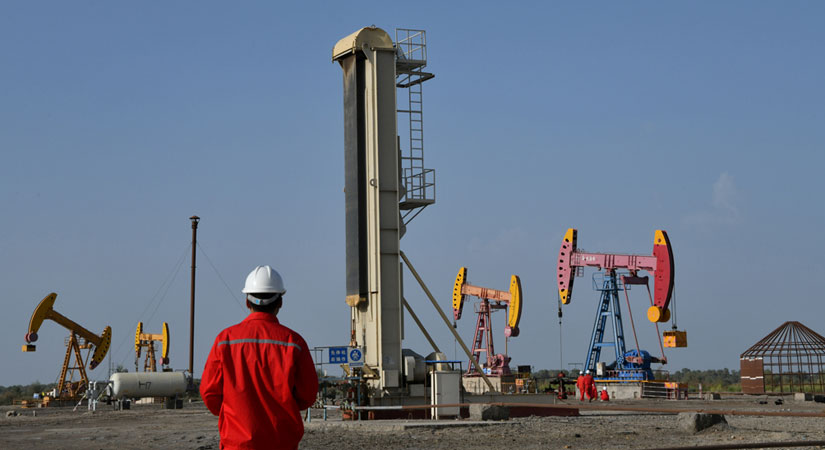
Workers are seen near pumpjacks at a China National Petroleum Corp. (CNPC) oil field in Bayingol, Xinjiang Uighur Autonomous Region, China on Aug. 7, 2019. — REUTERS

What the confident rhetoric is really about is trying to extract preferential treatment within the EU’s rules, rather than pretending that City firms could afford to do away with them altogether. This hinges around the technical details of so-called “equivalence” — a badge of approval granted to countries the EU deems close enough to its rules to be given market access to areas like investing or insurance. What the likes of Carney and Wilson are saying is the City is too important to be forced into a one-way street on regulation — simply adopting the EU’s rules — and should be given wiggle room within equivalence. This might mean tweaks to capital requirements under Solvency II, or to equity trading curbs under MiFID II, or even to banker-unfriendly rules like caps on bonuses. The terms of equivalence aren’t set in stone, and are a negotiation in themselves.

In an ideal world, a compromise deal on financial services would be straightforward. The EU knows that it can’t replace the City overnight either: London is currently its biggest capital market, and it would take years if not decades to properly integrate the continent’s disparate hubs. It seems eminently sensible that equivalence with the UK should be a two-way street: The City should recognize that it’s the best way to guarantee EU market access right now, while Brussels should understand that in the long run a bit of “rule-taking” from London might actually help its own ambitions to build a continent-wide financial system to replace Britain’s.

But that requires trust and goodwill on both sides. And to EU ears, the City’s current stance will sound too much like it wants to secure market access while also setting the rules. One of Brexit supporters’ favorite threats has been that deregulation would insulate the UK from any serious economic hit from leaving the EU. So Brussels is acutely sensitive to any sign that the country is more interested in competing with the EU (via regulatory arbitrage) than partnering with it. Talks over trade, while technically separate from financial services, will doubtless involve the kind of horse-trading over fish or agriculture that could sour the mood on both sides. And the EU is also keen to keep up the pressure on UK-based firms to relocate more activities to the continent, as reiterated by European Central Bank Vice-President Luis de Guindos last week. Even Legal & General is among those expanding their presence in the euro region to keep business going.

Considering how easily the upcoming talks could deteriorate, it’s far too early for anyone to gloat — least of all the City.


BLOOMBERG OPINION

Adjustments for Bolts in face of Almazan loss

By Michael Angelo S. Murillo
Senior Reporter

FACING the possibility of playing the rest of the best-of-seven Philippine Basketball Association Governors’ Cup finals series sans big man Raymond Almazan, the Meralco Bolts are bracing for a rougher road ahead against the Barangay Ginebra San Miguel Kings, necessitating for them to make added adjustments.

Midway into the opening quarter of Game Three on Sunday, Mr. Almazan went down with an apparent knee injury after colliding with Barangay Ginebra guard LA Tenorio.

The Meralco center failed to return to the game after and was set to undergo an MRI later on Sunday. Results have yet to be revealed as of this writing.

For Bolts coach Norman Black, the loss of Mr. Almazan affected their thrust in Game Three as they went on to lose, 92-84, and fell behind in the series, 1-2.

Mr. Black said from his initial assessment, they might have lost the services of Mr. Almazan, who they acquired from the Rain or Shine Elasto Painters via trade, for the rest of the series.

“From my viewpoint, we came out of the locker room very flat. We found out at halftime that we would probably lose Raymond for the rest of the game, and possibly the rest of the series. I think the guys were a bit down. They lacked the energy and the intensity going into the third quarter. I don’t know how much they were affected by it but they seemingly were and Ginebra did a good job on jumping on us and taking advantage of that, taking control of the game,” Mr. Black said post-Game Three.

“I try to be positive as possible. But when I talked to him, he said he could not move his leg. And as a former player it’s never a good sign. I hope he’ll be okay but I know when you have a swollen knee in the middle of a finals series it’s something you don’t bounce back right away,” he added.

The match was tightly fought in the opening half, with the Kings up by only a point, 43-42, at the break.

In the third quarter, Barangay Ginebra started to blow the game open.

It open the frame with a 10-0 run as Stanley Pringle started to find his mark, helping his team to a 53-42 lead with 9:43 to go.

The Kings stretched their lead to 21 points, 76-55, with a minute left before settling for a 78-68 advantage heading into the fourth.

But Meralco would not go down without a fight.

Led by rookie Trevis Jackson and import Allen Durham, the Bolts tried to rally back, coming to within five points, 87-82, with 2:04 left in the game.

But they would not get any closer than that as Barangay Ginebra went for the closeout after.

Chris Newsome top-scored for Meralco in the loss with 24 points with Mr. Durham adding 23 points, 13 rebounds and seven assists.

Bryan Faundo came off the bench to fire off 10 points in place of Mr. Almazan, who had two points and two rebounds before leaving the game because of his injury.

For Barangay Ginebra, it was import Justin Brownlee who led with 24 points, nine rebounds and nine assists. Japeth Aguilar had 23 points and seven blocks to win player of the game honors.

Mr. Pringle finished with 21 points, 17 coming from their telling third-quarter run. Mr. Tenorio had 11 markers.

“Because of what happened we will try to adjust as much as we can just in case we play without him (Almazan) and be ready in the next game. Our biggest concern is that without Raymond, you saw what happened, Japeth ran wild. Raymond allows us to match up with the big men of other teams. Without him we have a hole,” Mr. Black said.

Meralco looks to bounce back in Game Four tomorrow at the Smart Araneta Coliseum.

ADVERTISEMENT
ADVERTISEMENT