DoH freezes prices of medical goods in Batangas calamity zone

THE Department of Health (DoH) has ordered a price freeze on 218 medicines as well as other medical goods in Batangas province, following widespread panic-buying of N95 masks, which are rated for filtering out volcanic dust.
Issued Tuesday, the order, DOH 20202-005 ordered prices to be frozen in the province. The DoH is authorized by law to regulate prices of medical products. Batangas province, where Taal Volcano is located, has been placed under a state of calamity, which also triggers more general price-control measures.
health Undersecretary Rolando Enrique D. Domingo said in a briefing Wednesday that the list contains “lahat ng essential medicines. So, pati iyong mga high-blood, pang-diabetes, pang-asthma, ito iyong mga essential na hindi puwedeng tumaas (The price controls cover essential medicines for hypertension, diabetes, and asthma). Mayroon siyang range and it includes some devices like iyong mask (There is a prescribed range. The list also includes devices like masks).”
Also in the list are respiratory tract medicines, antibiotics, and cardiovascular medicines.
The order covers N95 masks, which are capable of filtering out particulates like volcanic dust. It said the permitted N95 price range was P45 to P105 pesos, while the price range for disposable surgical masks was P1 to P8. According to reports, consumers have been hoarding N95 masks, with prices rising to as much as P500 each.
The Department of Trade and Industry (DTI) also warned against profiteering and counterfeit masks.
During its inspection of a district in Manila where dealers of medical supplies are clustered, Trade Undersecretary Ruth B. Catelo found 12 out of 17 stores selling fake N95 masks. The DTI will be filing administrative charges against these store owners.
“Under Article 52 of the Consumer Act (these activities fall under) unfair and unconscionable sales acts or practices. They are taking advantage of the situation, the difficulties being experienced by consumers,” she said at the same briefing on Wednesday.
The DTI has noted that N95 masks are not on the suggested retail price list and added that it has contacted foreign suppliers to send more inventory.
DTI said in a statement Wednesday that its monitoring teams in Cavite, Laguna, Batangas, Quezon, and Metro Manila are tracking the prices of masks and other goods.
The DTI’s own findings are that N95 masks are selling for P120 to P150 per piece — outside the DoH’s own prescribed range — while surgical masks that normally sell for P1 each have been selling at P4 after the Taal emitted heavy ash starting Sunday.
“While we recognize that the N95, surgical, and other similar masks as medical supplies are under the jurisdiction of the Department of Health (DoH), the DTI readily dispersed its teams to monitor the prices and supply of these masks to assist the DoH and the consumers,” Trade Secretary Ramon M. Lopez said.
“As the Health Department, we understand that its utmost priority is ensuring the lives and health and safety of those who are affected by the phreatic eruption. Market surveillance and monitoring is the best form of immediate assistance that the DTI can provide. As the President constantly underscores, A whole-of-government approach is highly necessary and called for especially during times of calamities and disasters.”
DTI said that drug and medical stores have committed not to raise prices.
“However, the Price Act (Republic Act 7581) provides that the National Price Coordinating Council (NPCC) which the DTI and DoH are part of, can recommend to the President the inclusion of these masks in the list of basic or prime goods. When approved, the NPCC through the recommendation of the DoH and consultation with relevant stakeholders, can set an SRP, if found necessary,” the DTI said in a statement.
Along with foreign supplies, DTI had also asked domestic suppliers and major drug store chains including Mercury Drug, Watsons, and Southstar Drug to immediately restock in areas affected by the calamity.
“At the interim, current inventory in their branches and warehouses in non-affected areas will be distributed to their stores in CALABARZON (the Cavite-Laguna-Batangas-Rizal and Quezon region) and Metro Manila while waiting for the arrival of new stocks,” DTI said.
The DTI said in an earlier advisory that stores found to have been profiteering will face administrative or criminal charges.
The department reiterated that the prices of manufactured basic and prime goods will continue to conform to the DTI Suggested Retail Price (SRP) Bulletin published on Sept. 30.
The Batangas government has issued its own price freeze on basic goods and commodities, which is authorized by the Price Act, which comes into force upon a calamity declaration.
Price-controlled goods must still be sold for the suggested retail price (SRP).
Meanwhile, the Department of Tourism (DoT) is advising tourist establishments to consider health risks to visitors and workers should the situation at Taal Volcano deteriorate.
It said in a statement Wednesday that it “advises all tourism enterprises operating in all affected areas of the Taal Volcano disaster to immediately cease operations in light of the Phivolcs Alert Level 4 warning. The continued health, safety and welfare of our workers and tourists remain a top priority at this time as authorities have not downgraded the advisory on an imminent eruption.”
The Department of Labor and Employment (DoLE) on Wednesday also announced it will provide initial emergency assistance of P72.3 million to workers in the area. Labor Undersecretary Renato L. Ebarle said in a statement: “The assistance will be in the form of emergency employment under the government internship program where beneficiaries will be mobilized by the LGUs in the rehabilitation of nine affected municipalities of Batangas.” — Gillian M. Cortez and Jenina P. Ibañez
POEA bans all Kuwait OFW deployments
THE labor department said the agency regulating overseas labor has agreed to ban worker deployments to Kuwait after a dispute between the two countries over the circumstances surrounding a domestic worker’s death.
The Department of Labor and Employment (DoLE) said Wednesday that the action was taken one day after the National Bureau of Investigation (NBI) issued its autopsy findings on Jeanelyn Villavende, which concluded she bore signs of sexual assault, apart from sustaining severe trauma.
Kuwait’s own postmortem examination did not contain any findings pertaining to sexual assault. The NBI conducted another postmortem examination on Jan. 10.
Labor Secretary Silvestre H. Bello III, who also chairs the board of the Philippine Overseas Employment Administration (POEA), said the POEA approved a resolution ordering a ban Wednesday. The resolution had yet to be made public at deadline time.
“On recommendation of Labor Secretary Silvestre Bello III, the POEA governing board has just approved a resolution imposing a total ban on the deployment of workers to Kuwait,” DoLE said.
Earlier this month, POEA issued a resolution calling for a Kuwait deployment ban covering only newly-hired domestic workers.
Mr. Bello has said he considers Kuwait’s autopsy report to be “dishonest” for leaving out key details.
The NBI said in its postmortem report that it can confirm the Kuwaiti finding of severe trauma, but added that Ms. Villavende’s genitalia and anus had lacerations, suggesting sexual assault.
Ms. Villavende’s employers are currently detained and charged with abuse leading to homicide.
The ban goes against diplomats’ recommendations that Kuwait be given time to make progress on its prosecution of the employers.
Foreign Affairs Secretary Teodoro L. Locsin, Jr. on Wednesday advised the POEA to hold off on a ban to give Kuwait a chance to advance its investigation.
“POEA proposes a total deployment ban to Kuwait after the President said ‘No’ to media because he is satisfied that Kuwaiti authorities acted swiftly arresting, detaining and arraigning the murderers,” Mr. Locsin said in a social media post Wednesday.
“Give Kuwait time. At first hint of stalling: total ban. Say two weeks.”
Mr. Locsin added that agreements ensuring the protection of OFWs (Overseas Filipino Worker) in Middle East do not guarantee their safety.
“POEA wants to use torture/murder of OFW Jeanelyn Villavende as leverage to get Kuwait to sign on to labor standards. Signing on doesn’t mean observing in Middle East,” he added.
In 2018 declared a deployment ban for Kuwait which lasted four months over the death of domestic helper Joanna Demafelis.
In May 2019 Malacañang sought to review the memorandum of understanding between the two countries after the emergence of a case of harassment.
“Once a total ban is declared, Kuwait will live with it and Jeanelyn will be unavenged and all we’ll have is a piece of paper that Filipino recruiters in connivance with Filipino officials will treaty exactly as that: a piece of paper. Sick of standards. I want blood,” Mr. Locsin said. — Gillian M. Cortez and Charmaine A. Tadalan
Bamboo industry targets 19,000 hectares for new plantations
THE Philippine Bamboo Industry Council (PBIC) plans to convert at least 19,000 hectares of land into bamboo plantations this year, including 13,000 hectares in the Western Visayas.
The government inter-agency group said in a statement Wednesday that the Department of Trade and Industry (DTI) will be providing shared service facilities for agri-businesses that venture into bamboo processing.
Trade Secretary Ramon M. Lopez, who chairs PBIC, said that bamboo plantations will be included in the department’s Roads Leveraging Linkages of Industry and Trade program, which aims to build plant-to-market roads to ease the delivery of products, especially from remote areas.
Agri-business ventures like bamboo production and processing are also entitled to tax incentives under DTI’s Strategic Investments Priorities Plan.
“Bamboo planting can provide a sustainable source of livelihood to people in the countryside. Since the plant grows quickly and is weather-resilient, it is an ideal business for farmers who are looking for alternative sources of income,” Mr. Lopez said.
PBIC Vice Chairman and Ilocos Sur Representative Deogracias Victor B. Savellano, a Deputy Speaker, volunteered his district for the pilot program.
He said the target areas for plantations will increase as various groups, including the Department of National Defense and some State Universities and Colleges, are interested in planting bamboo on their properties.
The Department of Environment and Natural Resources (DENR) also committed more than half of its national greening program to the propagation of more bamboo, according to Environment Secretary Roy A. Cimatu.
DENR will also provide training on bamboo production, and will offer loans with 2% annual interest for bamboo farmers through LANDBANK’s Agricultural Competitiveness Enhancement Fund (ACEF) Lending Program.
DTI said that the plant, which takes two to three years to grow compared to the decades-long growth of wood trees, can be used for construction, furniture, and paper-making.
In March, PBIC will launch its official campaign, known as “Kawayan, Kalikasan, Kabuhayan, Kaunlaran, Kinabukasan” promoting the bamboo industry. — Jenina P. Ibañez
Mindanao rail track configuration still contentious
DAVAO CITY — The start of construction for the Mindanao Railway Project, which has been pushed back more than once due to right-of-way (RoW) issues within Davao City, is facing another stumbling block amid questions over the single-track diesel-powered system approved by the national government.
Assistant Secretary Romeo M. Montenegro of the Mindanao Development Authority (MinDA), said the community, including local governments and business groups, wants clarity whether the phase 1 segment approved by the National Economic and Development Authority-Investment Coordination Committee (NEDA-ICC) has provisions for future expansion to a two-track system as originally planned.
“Once the viability is seen to be really doing well then puwede na siya (it can be made into) two-track,” Mr. Montenegro said during Wednesday’s Habi at Kape Forum.
The Davao Regional Development Council has sent a letter to the Department of Transportation (DoTr) appealing for a reversion to a two-track and electric configuration.
Singletrack means trains have to be directed into sidings to give way to a train coming from the opposite direction. Singletrack, however, is faster to build, a likely consideration for a government eager to claim at least partially-completed projects by the time it steps down in 2022.
Mr. Montenegro noted that starting the railway project — which will eventually encircle the southern island — with a smaller and less environment-friendly option will affect the design of the other segments.
The first phase is 102-kilometer Tagum-Davao-Digos line.
“Right now there’s no answer to that question (future segments) yet, but we can assume that its going to be difficult… because I mean the logic of it does not explain the ideal scenario of a one-track and the other phases (becoming two-track, electric),” he said.
Mr. Montenegro said Mindanao stakeholders are pursuing continued discussions and are hoping changes can still be made.
“We have yet to see if anything is forthcoming arising out of that, translating into a final design which is two-track,” he said.
Mr. Montenegro said stakeholders hope to see the project get off the ground soon, noting that even just the bidding process could take months. — Maya M. Padillo
San Juan approves separate rules regulating e-cigarettes
SAN JUAN CITY has approved an ordinance calling for the separate regulation of e-cigarettes, prescribing a different set of rules than those governing conventional tobacco products, with city officials claiming that e-cigarettes are “safer.”
City Ordinance No. 41, Series of 2019, signed by Mayor Francisco Javier M. Zamora prohibits the use of e-cigarettes in places of worship, hospitals, health centers, public conveyances, government offices, and educational or recreational facilities.
E-cigarette smoking is allowed in places not listed among the prohibited areas, provided that the owners of the places designate areas for vaping.
According to the text of the ordinance, “studies have consistently concluded that e-cigarettes are significantly safer than conventional tobacco smoking.”
“This is largely attributable to the fact that conventional cigarettes release much more carcinogens and toxins from the combustion process that burns tobacco, whereas e-cigarette products forego the combustion process completely.”
It cited a report by the Royal College of Physicians in the UK which classified e-cigarettes as a tool for helping smokers quit. It also noted that the Public Health England and British Lung Foundation have called for the separate regulation of cigarettes and e-cigarettes.
The ordinance permits advertising at the point-of-sale and on the Internet, with restrictions against targeting minors. Buyers are also required to indicate that they are at least 25 years old.
A task force led by the Mayor will be created to oversee the implementation of the ordinance.
A first-offense violation warrants a P2,000 fine and 12 hours of community service. A second offense will merit a P3,000 fine and 18 hours’ community service and a third offense P5,000 and 24 hours, respectively.
The ordinance allows those not willing to contest the charges to pay a minimum administrative fine of P1,000 and render six hours of community service within 24 hours.
The ordinance takes effect 15 days after publication in at least two newspapers.
President Rodrigo R. Duterte in November announced a ban on the use and importation of vaping products.
San Juan in 2016 passed an ordinance banning smoking in public places. — Vann Marlo M. Villegas
DPWH sees Taguig River slope protection works completed by midyear

THE Department of Public Works and Highways (DPWH) said its P279.3-million slope protection project along the Taguig River is expected to be completed within the first half of the year.
“Completed within six (6) months, the slope protection project with bank improvement was implemented into several phases and subprojects situated along Taguig Bridge, M.L. Quezon Bridge, and Taguig River East and West Bank,” the DPWH said in a statement Wednesday.
It said the P279.3-million slope protection project is being built to ensure the safety of residents in the area, which is prone to flooding from the river, especially during the rainy season.
The DPWH said the project was funded out of the 2018 and 2019 General Appropriations Acts (GAA).
“The project was reported to be a part of a proposed linear park and roadway, which will serve as an alternate route that will decongest traffic in Taguig,” it said.
According to Public Works Secretary Mark A. Villar, the new structure will help prevent flooding in both Taguig City and Pateros.
The DPWH considers some places in Taguig and Pateros to be very susceptible to flooding. With the speedy completion of this project, residents can be more relieved knowing that a structure now safeguards their lives and properties.
In 2015, the DPWH issued a department order covering the implementation of flood control and drainage/slope protection projects which are funded, or proposed for funding, by the national government under the DPWH infrastructure program. — Arjay L. Balinbin

Crunch time approaching to pass CITIRA — EIU
CORPORATE tax legislation, still pending at the Congress, needs to pass by the first half to keep the tax reform program on track, according to the Economist Intelligence Unit (EIU).
In a note Wednesday, EIU said the proposed Corporate Income Tax and Incentives Reform Act (CITIRA) continues to face delays as business groups lobby over the planned overhaul to fiscal incentives.
It said the measure, which was approved by the House of Representatives on Sept. 13 and remains pending at the Senate, should be passed in the first half if the Philippines is to remain “on track” to bring corporate income tax rates to 20% by 2030.
“The president, Rodrigo (R.) Duterte, is facing delays in reforming the Philippines’ outdated tax code,” the report noted.
On the measure imposing higher excise tax on electronic cigarettes, vapor products and alcoholic products, Finance Assistant Secretary Antonio Joselito G. Lambino II has said that the measure is “under final review (by) the Office of the President.”
The measure, which forms Package 2+ of the Comprehensive Tax Reform Program, was ratified by the 18th Congress on Dec. 18. It lapses into law on Jan. 24 if the President takes no action.
Congress resumes session on Jan. 20, after a one-month recess.
BusinessWorld sought comment from the office of Senator Pia S. Cayetano, who chairs the Senate Ways and Means committee, to ask for a timeline on the bill’s approval but it had not replied at deadline time.
EIU said the reforms are needed if the government is to hit its tax collection target for this year of over P3 trillion.
“The resolution of Mr. Duterte’s corporation tax reforms will play out this year. The president needs to increase tax revenue to fund his commitments to raise social spending and disbursements for infrastructure,” it said.
“While the government will find it hard to achieve its ambitious revenue target, the shortfall in actual tax collection will not be wide, considering that the pace of reduction in the corporate income tax rate is much slower than that at which incentives are supposed to be rolled back,” it added.
However, it said the impact of the lower tax rates, which could arrest the decline in foreign direct investment (FDI), will largely depend on the bicameral review by the two Chambers.
FDI net inflows rose 33.7% year-on-year to $672 million in October but year-to-date figure is still down by 32.8% at $5.79 billion, due to “subdued investor sentiment.”
EIU said the bicameral session to harmonize both chambers’ bills will “likely… center on fiscal incentives and the status of tax on gross income earned (GIE).”
Business groups, including foreign chambers of commerce have constantly warned of job losses if fiscal incentives currently enjoyed by companies operating in special economic zones are overhauled.
Finance Undersecretary Karl Kendrick T. Chua has asked for more evidence on the job loss claims.
The report said various foreign chambers of commerce have that estimated at least 15 out of the 250 regional operating headquarters in the Philippines have closed after their 15% preferential tax rate for employees was removed under the Tax Reform for Acceleration and Inclusion (TRAIN) Act.
On the transition period for companies adopting new incentives, EIU said “a compromise is likely to be reached in the bicameral stage.”
The Philippine Economic Zone Authority (PEZA) has said it wants a 15-year transition period while the Department of Trade and Industry (DTI) is seeking a 7-year transition period, as opposed to the two to five year period in the bill approved by the House.
The remaining priority measures that have yet to be passed by Congress are CITIRA, the mining tax bill, the real property tax bill and a measure that will simplify the tax structure for financial investments.
So far, the government has passed Republic Act (RA) No. 10963, which slashed personal income tax rates and increased or added levies on several goods and services and RA 11213 or the Tax Amnesty Act of 2019 which granted an estate tax amnesty and an amnesty on delinquent accounts that remain unpaid even after final assessment. — Beatrice M. Laforga
Can PAN be the new FAN?
There’s a certain feeling of trepidation that most taxpayers get during tax audits. After all, a tax audit is no laughing matter. It involves flipping back the books and records of prior years to respond to the Bureau of Internal Revenue (BIR), and often, making sense of past transactions for hours on end. But this is all par for the course, and what a complicated course it is.
As people handling tax audits are well aware, a tax investigation has several stages: it begins with the issuance of a Letter of Authority (LoA) by the BIR. If the BIR finds any deficiency taxes during the examination of the taxpayer’s records, a Notice for Informal Conference (NIC) shall be issued inviting the taxpayer for a conference within 30 days from the receipt of the NIC. The conference allows the taxpayer to present its side to the BIR.
If the taxpayer and the BIR fail to resolve the issues at the informal conference stage, a Preliminary Assessment Notice (PAN) shall be issued, to which the taxpayer may reply in writing within 15 days of receipt. Within another 15 days from the taxpayer’s reply to the PAN, the BIR shall issue a Final Assessment Notice and a Formal Letter of Demand (FAN/FLD). The taxpayer must file a protest letter within 30 days from its receipt in the form of either a request for reconsideration or reinvestigation. In case of a reinvestigation, additional supporting documents may be submitted within 60 days from the date of filing the protest.
The Supreme Court (SC) and Court of Tax Appeals (CTA) have held in numerous cases that the failure to observe the above procedural rules constitutes a violation of the taxpayers’ right to due process, which renders the assessment void. The CTA has nullified assessments specifically for the non-observance of the prescribed timeline for the issuance of the assessment notices. Last year, the CTA canceled assessments where the taxpayer received a FAN/FLD before the lapse of the 15-day period from the receipt of the PAN, or worse, where the FAN/FLD was received on the same day as the PAN.
In one of its resolutions earlier last year, the SC again held an assessment void for violating the due process requirement. In this resolution, however, the SC clarified that Section 228 of the Tax Code — the provision which sets out the procedures on tax assessments — gives the taxpayer 60 days from the date of filing its protest to the PAN to submit relevant supporting documents. The SC held that the 60-day period to protest refers to the one made against the PAN and not the FAN.
While this is interesting on several points, it threads through this core question: Can the PAN be the new FAN/FLD?
Section 228 of the Tax Code specifically requires the Commissioner of Internal Revenue (CIR) or an authorized representative to first notify the taxpayer in writing through a pre-assessment notice if the CIR finds that proper taxes should be assessed. Then, the taxpayer is required to respond to the notice within the period prescribed by the regulations. If no response is made, the CIR shall issue an assessment based on his findings. The assessment may be protested by filing a request for reconsideration or reinvestigation within 30 days. Within 60 days from the filing of the protest, all relevant supporting documents should have been submitted; otherwise, the assessment shall become final.
Previously, we’ve associated the PAN as the first notice mentioned in Section 228, and the FAN/FLD to be the assessment subject to the 30-day period to protest and 60-day submission of documents. But if the SC considers the 60 days to apply to the PAN instead of the FAN/FLD, this could imply many things. First, a taxpayer is allowed 30 days to reply to the PAN (instead of 15). Second, the BIR is precluded from issuing the FAN/FLD until the lapse of the 30-day period, or if the taxpayer files a request for reinvestigation, 90 days (i.e., 30 days to protest and 60 days to submit documents). Third, a taxpayer’s failure to reply to the PAN would render the assessment final and executory. By this analogy, the PAN essentially becomes the FAN.
But if the PAN is the assessment subject to protest under Section 228, what then should be considered as the notice prior to the PAN? Could it be the NIC?
From a procedural perspective, this may make sense. The NIC does serve as an initial notification of the BIR’s findings and gives the taxpayer an avenue to respond and come to an agreement with the BIR. Although the previous CIR revoked the requirement for a NIC, this was reinstated in 2018 through Revenue Regulations No. 7-2018. In the period that the NIC formed part of the tax audit rules, the SC repeatedly recognized the NIC as an indispensable part of a tax assessment and held that its non-issuance is a violation of due process.
If the NIC is the pre-assessment notice and the PAN is the new FAN, what does this make the FAN/FLD and Final Decision on Disputed Assessment (FDDA)?
While the above points are all worthy considerations to ponder, it should be noted that the SC resolution earlier this year is merely a minute resolution signed by a Division Clerk of Court. As such, it cannot be considered yet as a binding precedent. The SC has previously ruled that only decisions, which have been duly signed by the members of the Court and certified by the Chief Justice, constitute a binding precedent that forms part of the law.
Nonetheless, as this is still a resolution from our High Court, we cannot discount the possibility that this will be adopted in a decision in the future, or that the BIR would consider this under advisement in future tax audits. For now, though, taxpayers and tax practitioners alike can only take notes and keep this resolution in mind.
The views or opinions expressed in this article are solely those of the author and do not necessarily represent those of Isla Lipana & Co. The content is for general information purposes only, and should not be used as a substitute for specific advice.
Olivia Erika Susa is a senior associate at the Tax Services Department of Isla Lipana & Co., the Philippine member firm of the PwC network.
+63 (2) 8845-2728
Developing resilience in 2020

The year 2020 started with a bang. From the wildfires that have been ravaging Australia, to the floods in the Indonesia capital, and to the political strife between the United States of America and Iran, the world has been in a constant state of flux. Here at home, we were treated to a spectacular volcanic plume that is causing dread and despair in Batangas, Laguna, and Cavite. This eruption reminds us of how nature’s wrath and fury should teach us to become more resilient.
In her Harvard Business Review article on how resilience works, Diane Coutu states that “more than education, more than experience, more than training, a person’s lever of resilience will determine who succeeds and who fails. That’s true in the cancer ward, it’s true in the Olympics, and it’s true in the boardroom.” We need resilience in our volatile, uncertain, complex, and ambiguous world. According to Coutu, resilient people possess the following: “a staunch acceptance of reality; a deep belief, often buttressed by strongly held values, that life is meaningful; and an uncanny ability to improvise.” Thus, we must develop resilience so that we can face the challenges within and outside our offices and homes in this new decade.
How do we develop resilience? There have been numerous studies on the development of individual-level resilience and organizational resilience specifically in the field of positive psychology and organizational behavior. Shawn Anchor and Michelle Gielan, in their Harvard Business Review article entitled “Resilience Is about How You Recharge, Not How You Endure,” assert that a resilient person is well-rested. This means that a person who is overworked and exhausted will not be resilient. Rather, “The key to resilience is trying really hard, then stopping, recovering, and then trying again.” Thus, working on a task for a prolonged period can be beneficial only if high-endurance performance is coupled with recovery.
But what is recovery? Zijlstra, Cropley, and Rydstedt, in their article “From Recovery to Regulation: An Attempt to Reconceptualize Recovery from Work,” differentiate between internal and external recovery. Internal recovery refers to “shorter periods of relaxation that take place within the frames of the workday or the work setting in the form of short scheduled or unscheduled breaks, by shifting attention or changing to other work tasks when the mental or physical resources required for the initial task are temporarily depleted or exhausted.” External recovery pertains to “actions that take place outside of work-in the free time between the workdays, and during weekends, holidays or vacations.”
The importance of maintaining appropriate levels of energy has been theorized by Stevan Hobfall in his conservation of resources theory, which “describes the motivation that drives humans to both maintain their current resources and to pursue new resources.” To become more resilient, we must be aware of our energies and find ways to conserve, maintain, and build our resources.
Another way to become more resilient is by developing an entrepreneurial mindset. Such a mindset does not mean that people must start their own businesses. Rather, it means thinking like an entrepreneur and applying this mindset to one’s personal and professional lives.
I gave a talk last November on “Developing an Entrepreneurial Mindset for Climate and Disaster Resilience,” hosted by the Resilience Institute of the University of the Philippines. I focused on how individuals and organizations must have an entrepreneurial mindset similar to the growth mindset espoused by Carol Dweck in her groundbreaking bestseller entitled, Mindset: The New Psychology of Success, in order for people to become more resilient. To become more resilient, one must have the following tools for life advocated by the National Foundation for Teaching Entrepreneurship: “flexibility and adaptability; communication and collaboration; creativity and innovation; future orientation; opportunity recognition; and comfort with risk.” Entrepreneurs or not, we can apply all of these traits to become more resilient.
The year and decade have just begun, and we are already faced with external upheavals. Given these issues and concerns that we will continuously face, having a resilient mindset will make us future-ready.
Brian C. Gozun is professor of the Decision Sciences and Innovation Department of the Ramon V. Del Rosario College of Business, De La Salle University Manila. He is doing research on resilience both on individual and organizational levels.
Boom and bust, repeat
The Tagaytay City of today is not the same sleepy town I knew 25 years ago when my family started frequenting the place on weekends and holidays. Back then, there were still lots of open spaces, clearings, green grass, trees, and pineapple plants. And, one could easily view Taal Lake and the volcano from anywhere on the ridge, along the main highway to Nasugbu.
As of last Sunday, Tagaytay was a boomtown. Residential and commercial buildings were on the rise. Lots of construction and tourism development going on. Even on weekdays the city was bustling, unlike in the past when the place came to life only on weekends and holidays. And there are now more roads going to and from the city. Big shopping malls have likewise sprouted.
Tagaytay also has a growing community of residents, many of them retirees and balikbayans. A lot of migrants have been moving to the city in the last 25 years, primarily for the weather and the scenery. And while it has also become congested, Tagaytay was still a good option as it was not as densely populated as Metro Manila, or big towns like Imus and Dasmariñas. The weather was conducive for gardening, too.
But since Taal Volcano started erupting Sunday afternoon, the place has become a ghost town. What was green has become dusty if not muddy gray. People have evacuated, and many businesses have temporarily shut down. Many have left not by choice. Practically the whole of Tagaytay City is within the 14-kilometer danger or evacuation zone, as measured by its radius to the volcano’s crater.
Tagaytay first became a chartered city in 1938, about 27 years after the destructive eruption of Taal Volcano in 1911. At that point, it was unlikely that government planners considered the possibility of another destructive eruption within their lifetime. The last eruption from the main crater in 1911 was said to have obliterated the crater floor, creating the present lake.
Despite the volcano’s long history of activity and eruptions, Tagaytay had always adapted and overcome. In similar fashion, I believe that despite a possibly destructive eruption this year, I am certain Tagaytay will again adapt and overcome. It will survive. It must, for the sake of its people who cannot afford to be displaced.
There are roughly one million people living within the volcano’s 17-kilometer danger zone, of which about 460,000 are within the riskier 14-kilometer danger zone. Many of these people may have come from Metro Manila and nearby provinces, and had dispersed to Cavite’s cooler city over time. If displaced by a volcanic eruption, where can we expect them to go?
There is no way of telling how things will be. But if we go by our Pinatubo experience, then one can have some idea of the magnitude of the potential displacement, damage, and economic havoc that may be expected from a Taal eruption. The sad part is that people knew this could happen again, as it did in 1911 and before that. But the reward from developing Tagaytay appeared to have outweighed that risk. Only time can tell if the gamble was worth it.
Recall what the 1991 Mount Pinatubo eruption did to Central Luzon, and how it changed the landscape and the economy of the provinces of Pampanga, Tarlac, Zambales, and Bataan. That was 24 years ago, when the region was not as developed and progressive as it is now. This, in a way, helped limit the damage. Just imagine if Pinatubo were to erupt now. The devastation will be severe, with heavy casualties.
Pinatubo is over 200 kilometers away from Metro Manila. This helps protect the center from its havoc in case of a destructive eruption. But Taal Volcano is just about 60 kilometers away. A Taal eruption now of the magnitude of Pinatubo in 1991 can have dire consequences for the capital and its neighboring provinces. One can only imagine the terrible destruction that can hit the whole of the Southern Luzon region.
“The Southern and Central Luzon as well as National Capital Region (NCR) are some of the heftier pistons of our country’s economic engine, and we will do what is necessary to get areas affected by this natural disaster up and running as fast as possible,” Finance Secretary Carlos Dominguez was quoted as saying in a report in this paper.
He was also quoted as noting that NCR and the Calabarzon Region — made up of Cavite, Laguna, Batangas, Rizal, and Quezon provinces — contributed 53% of the country’s total gross domestic product (GDP) in 2018, at 36% and 17%, respectively. Central Luzon had a 9% share. He also noted the country loses 1-2% of its yearly GDP due to natural disasters, especially typhoons.
The economy could lose as much as P35 billion because of the Taal eruption, the same report quoted the chief economist of a universal bank. In comparison, damage from the eruption of Mt. Pinatubo in 1991 reached P25 billion, excluding the cost of caring for evacuees worth P6.7 billion, he added, citing a study by the National Economic and Development Authority.
It is precisely because of this issue with volcanic eruption that I have been questioning the government initiative to relocate the National Government and its agencies outside of Metro Manila to New Clark City in Tarlac by 2030. New Clark City is just about 25 kilometers from the crater of Pinatubo, the eruption of which in 1991 was deemed the second-largest terrestrial eruption of the 20th century.
Who is to say that Pinatubo will not erupt again 10, 20, or 30 years from now? Let’s assume the country’s government center, the seat of power, is moved to New Clark City. What will be the implication of a major Pinatubo eruption, then? Are we not putting too much at risk by knowingly moving our government center nearer (about 25 kilometers) — rather than away — from an active volcano known for violent and destructive eruptions? Do the rewards outweigh the risks of relocating there?
Taal’s last major eruption was in 1911, more than 100 years ago. At that time, the crater caved in and became the lake. At least four Batangas towns were lost and had to be relocated. The landscape changed significantly. Prior to this, in a major eruption in the 1700s, Taal Lake lost its access to Balayan Bay after the Pansipit River was covered with earth. What are we to expect now in 2020? Must Tagaytay and other towns brace for the possibility of having to start all over?
Marvin Tort is a former managing editor of BusinessWorld, and a former chairman of the Philippines Press Council.
Smoking, vaping and the nanny state
“To act on the belief that we possess the knowledge and the power which enable us to shape the processes of society entirely to our liking, knowledge which in fact we do not possess, is likely to make us do much harm.”
— Friedrich Hayek,
“The Pretence of Knowledge”
— Nobel Prize lecture
Dec. 11, 1974
Among the stories we hear and read in the debates on higher tobacco/alcohol tax, smoking/vaping ban, are that 1.) smoking prevalence remains high and rising, 2.) vaping is not a smoking-cessation tool but smoking-enhancement, and, 3.) more government taxation and prohibitions are good to protect public health.
These are all myths and not consistent with facts. Here are the numbers and reasons why.
On No. 1, in most countries, smoking prevalence is declining. There has been a big decline of 10-11 percentage points for South Korea, Japan, and the Philippines in a span of 16 years. And as of 2015, only 2% of Philippine adults and 4.5% of youths were users of smokeless tobacco or e-cigarettes, vaping products (see Table).
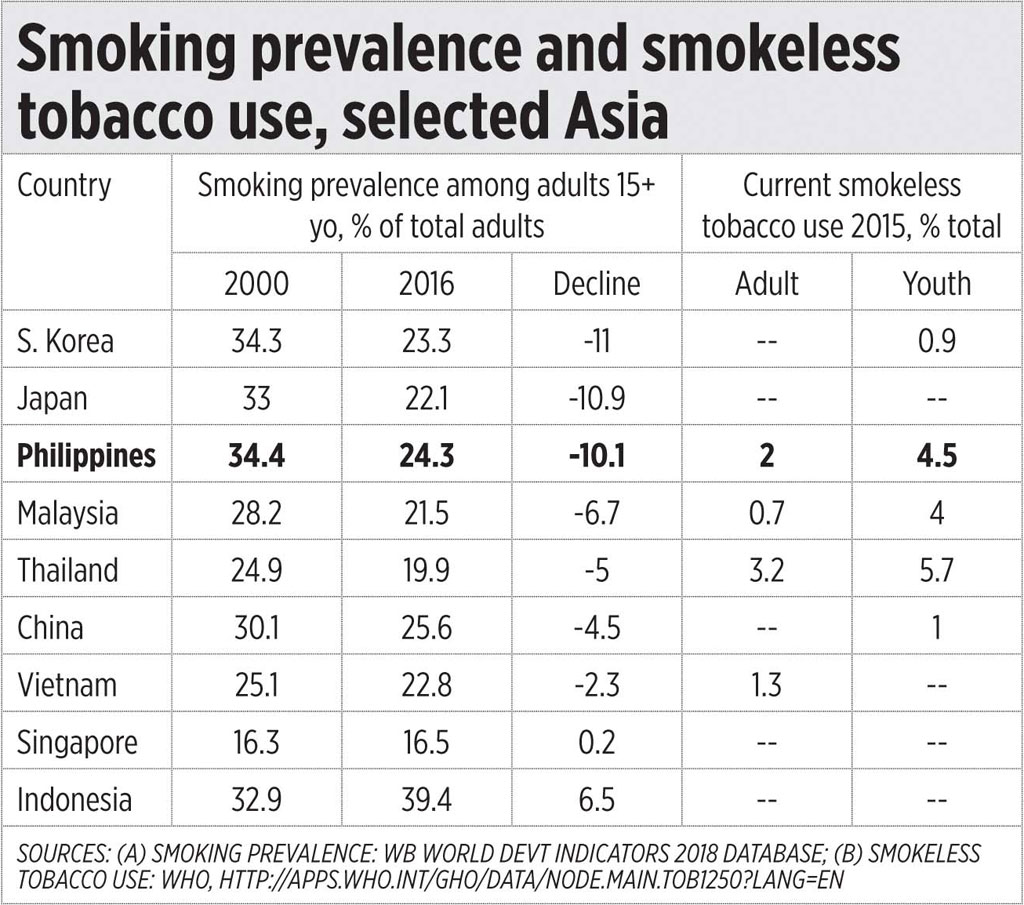
On No. 2, vaping products have actually become smoking substitutes or smoking-cessation tools, leading to a decline in smoking prevalence of five to 10 percentage points in the Philippines, Malaysia, and Thailand as a portion of their smokers shift to smokeless, non-burning nicotine substitutes.
A “gateway theory” that vaping leads to smoking in young people is just a disproven hypothesis. In early 2019, a UK anti-smoking charity, Action on Smoking and Health (ASH), released a report showing that vaping remains uncommon among young people and is almost exclusively confined to current or past smokers, and that most teen vaping is experimental and short-lived.
Recently, the President, supported by the Department of Health, ordered a ban on vaping in public places. Government over-regulation follows the famous Newton’s third law of motion: “for every action there is an equal and opposite reaction.” Restated it becomes “for every government intervention and taxation, there is an equal and opposite distortion.”
Seven examples and cases below show why No. 3 above is wrong:
One, more prohibition means more corruption. Prostitution, drugs, certain gambling, gun running, etc. are prohibited, not just restricted and taxed in the Philippines. And these prohibited activities and products are all around. That implies that the police and government officials themselves, local and national, allow their proliferation in exchange for big bribes, other financial and political favour.
Two, more smuggling. The National Committee on Intellectual Property Rights (NCIPR) reported that full year 2018 seizures of pirated and counterfeit goods jumped to P23.6 billion. Of this, fake or smuggled cigarettes were P20.3 billion or 86% of total. Higher tobacco taxes under the TRAIN law of 2017 resulted in many smokers buying cheaper, smuggled tobacco.
Three, recent cases of coconut wine or lambanog poisoning in the Philippines. At least 23 people died due to suspected methanol poisoning, with over 500 hospitalized. As branded alcohol becomes more expensive due to more taxes, more drinkers shift to cheaper, untaxed, unbranded alcohol like lambanog, where products can include chemicals and prohibited substances.
Four, the Singapore vape ban has been in place for two to three years now. But instead of killing vaping, it sent it underground. There were seizures of $30,000 worth of illegal e-cigarettes in September, another $66,000 worth in November 2019.
Five, with misregulations around e-cigarettes in the US, illicit pods containing tetrahydrocannabinol (THC) oil together with Vitamin E acetate as a thickening agent have become widely available. Around 55 people have died after using these black market products rather than standard vape juice.
Six, when I was in southern Sweden in 2003 for two months, I noticed and read that Swedes who wanted cheaper booze would travel to Denmark to buy lots of beer and alcohol because Sweden’s alcohol taxes are very high. The same in Scotland after “minimum unit pricing” on alcohol was introduced in 2018 — Scot drinkers would go to England across the border to get cheaper alcohol.
Seven, in the UK, smoking data released after the implementation of plain packaging for tobacco products shows that for the first time in seven years, the smoking rate has risen. Illicit and smuggled tobacco became much easier because of the ease of copying the packs and cheaper prices. The same thing happened in Australia after its plain packaging policy was instated in 2012 — illegal tobacco use came in higher starting 2013, shown in KPMG study.
Friedrich Hayek has reiterated that “all-knowing” pretense and central planning of a nanny state can backfire. Thus, the state should step back from over-regulations and prohibitions. People own their bodies, not the state or NGOs. More state prohibitions only send people to seek illicit, even dangerous products and activities.
Bienvenido S. Oplas, Jr. is the president of Minimal Government Thinkers.