
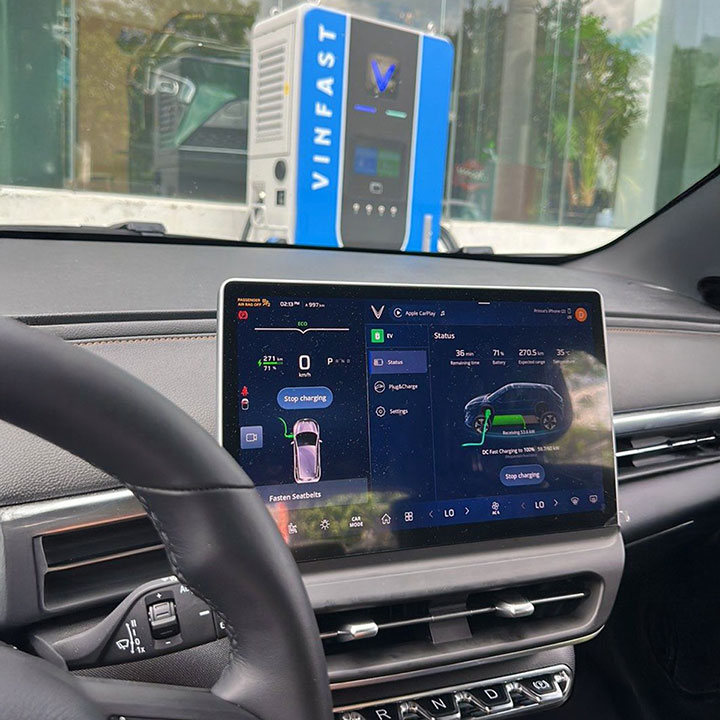
I went to the Legazpi CarPark in Makati recently and saw its electric vehicle charging bays. That morning, a couple of the slots were being used by EV taxis, which made me wonder if the chargers were installed in partnership with the EV cab company’s owner, or by the parking lot operator.
Sometime in 2025, VinFast and charging company V-Green made a public promise of up to 15,000 charging ports nationwide by the end of 2025, covering malls, expressways, commercial districts, and high-traffic zones. VinFast was selling cars. Cars need somewhere to charge. And the promise was part of the pitch.
But the target has not been met. VinFast Southeast Asia CEO Antonio Zara III has blamed the delay on inconsistent local government permit requirements, particularly how different local government units (LGUs) classify the installation of EV chargers in parking lots, with some treating it as a building renovation requiring a full permit.
I believe his regulatory complaint is legitimate. Permit inconsistency is a genuine problem in this country. But it is not a new one. And VinFast is not the first company to discover it the hard way. Rooftop solar installers have been fighting the same battle for years. The same goes for internet cable installers.
Without a nationwide policy on permit fee schedules, LGUs rely on their own resolutions to set prices, leading to confusion and delays. The fees vary, and so do timelines. In the case of charging stations, the classification of what counts as a simple electrical job versus a full building renovation varies.
In February, the Department of Energy (DoE) announced a whole-of-government push to speed up net-metering permits. Under the joint circular, LGUs must issue electrical permits for net-metering applications within three working days and Certificates of Final Electrical Inspection within seven working days.
If an LGU fails to act within those deadlines, the application is deemed approved.
But EV charging stations have no equivalent protection. Republic Act No. 11697, or the Electric Vehicle Industry Development Act, is the governing law. Department of Public Works and Highways (DPWH) Department Order No. 136 (2025) provides technical construction guidelines. But there is no national rule that tells an LGU it must process a charging station permit within a fixed number of days.
Thus, the standard permitting timeline for a charging station still varies per LGU. And there is no hard deadline with a consequence for missing it. This is the structural gap that produced VinFast’s shortfall. But it is also a gap that VinFast should have known about before promising thousands of chargers by end-2025.
To date, some solar rooftops within Meralco’s service territory are suspected to remain unpermitted, referred to locally as “guerrilla solar.” These installations exist because the formal permitting process can be slow, expensive, and inconsistent. Consumers chose immediate relief over regulatory compliance.
But the LGU permitting process is not arbitrary red tape. It is a system of protection for the property owner, for neighbors, and for the community. An unpermitted solar installation cannot legally participate in net metering. It is a liability that must be disclosed to any potential buyer. And in a typhoon, panels installed without a structural engineer’s sign-off can be torn from a roof and become projectiles. Electrical fire is another risk.
The same logic applies, but perhaps with greater force, to EV fast chargers. DC fast charging draws significant electrical load, generates heat, and introduces a different fire-risk profile. Lithium-ion battery thermal runaway can occur when a battery overheats in ways that conventional fire suppression cannot easily address.
EV charging is not a trivial electrical installation. You cannot think of it as simply plugging in an appliance. DPWH guidelines require an EV charging station site to have sufficient space, including a minimum dimension of 2.5 meters by five meters. They also require a reliable and stable power source capable of supporting the charger’s rated electrical demand. For DC fast charging, DPWH guidance also refers to a minimum bandwidth requirement of 10 Mbps per charging point, consistent with the connectivity needs of modern networked charging systems.
A parking building that gains a fast charger without proper electrical and fire-safety assessment is a building whose risk profile has changed in ways its original design did not anticipate. Thus, LGUs that treat EV charger installation as a serious building and electrical intervention are not necessarily being obstructionist.
The right response is not to bypass that judgment through emergency declarations. It is to standardize regulations nationally, the way the DoE did for solar installations in February, so that every LGU in the country applies the same rules on installing EV charging stations, on the same timeline, with the same consequences for delay.
That brings us to VinFast’s complaint. V-Green, the company building charging stations, is part of the same Vingroup ecosystem as VinFast. The free charging program VinFast offers runs until 2029, at V-Green-operated charging stations, and covers VinFast customers. It also applies to drivers using Green GSM transport services.
EV owners using other brands do not benefit from V-Green’s network the same way a VinFast owner does. The ports VinFast and V-Green announced are not a public good in the fullest sense. They are infrastructure that also serves a commercial strategy: support VinFast buyers, reduce their operating costs, and deepen loyalty to the brand.
I am not suggesting that this disqualifies the infrastructure. In a country with only 912 publicly accessible charging stations as of the end of March 2025, and a government target of around 7,300 public charging stations by 2028, every port counts.
But the moral weight of the argument shifts. A private company building brand-supporting infrastructure for its own customers is not the same as a public utility trying to serve the grid. The case for faster permitting is strong. The case for cutting safety corners is not.
Mr. Zara himself acknowledged that public safety is the LGU’s mandate and that VinFast does not want to compromise it. I take that at face value. But acknowledging safety while asking government to use emergency powers to accelerate a proprietary charging rollout does not sit well with me. Instead, the government should work out the rules for everybody’s benefit.
We are not just talking about one company’s missed target. We are talking about a pattern. The EV law was passed, and the DoE rollout targets were set shortly after. But the permitting framework was not built to match the ambition of the law. The same mismatch gave us guerrilla solar. It will give us guerrilla charging if we are not careful, with higher stakes because the fire-risk profile is more serious and the electrical load is heavier.
The answer is the same in both cases. Amend the building, electrical, and fire codes to classify EV charger installation by electrical load, fire risk, and structural impact, and not just by a building official’s discretion. If EV chargers are treated inconsistently by LGUs, then the answer is national clarification.
DPWH Department Order No. 136 (2025) already provides construction guidelines for EV charging stations. The next step should be to align those technical guidelines with building-code classification, electrical review, fire-safety requirements, and LGU permitting practice.
Clarify how the building, electrical, and fire codes, EVIDA (Electric Vehicle Industry Development Act), DPWH guidelines, DoE rules, and LGU permitting processes apply to EV charging installations. Publish uniform classification standards that every LGU can follow. Distinguish chargers according to actual electrical load, location, fire risk, and structural impact.
Talk of using an energy emergency to streamline permits should be handled carefully. That may sound practical. But in the Philippine context, emergency authority has a way of becoming a shortcut not only around delay, but also around discipline. Expediency should never compromise safety.
Marvin Tort is a former managing editor of BusinessWorld, and a former chairman of the Philippine Press Council.