
The sky is falling. This is what investors say during times of crisis, when market uncertainty makes it difficult to find a way forward. Today’s oil crisis is one of those times. What’s an entrepreneur to do?
My topic for today’s column — how to invest during a crisis if you’re an entrepreneur — is particularly useful for two reasons. The first is it will give investors a clearer idea of what to do in these tumultuous times. The second is that if you’re an entrepreneur, investment — whether by your company or from your personal finances — can be an important source of capital or a way to weather the storm if your business is negatively affected by the crisis. But ironically, many successful entrepreneurs who are great at business don’t know where to start when it comes to investing.
Enter Julian Tarrobago. He is an investment mentor and consultant who has managed funds worth billions for institutions like Union Bank, Atram, ING, and Sun Life. Today, he has a company called JT Train Consulting where he helps investors and entrepreneurs learn how to think, decide, and stay disciplined when everything becomes uncertain. In his own words, he teaches them everything from “knowing their investor profile to asset allocation, to doing the research, to doing risk management and portfolio management and using AI to turbocharge those frameworks.”
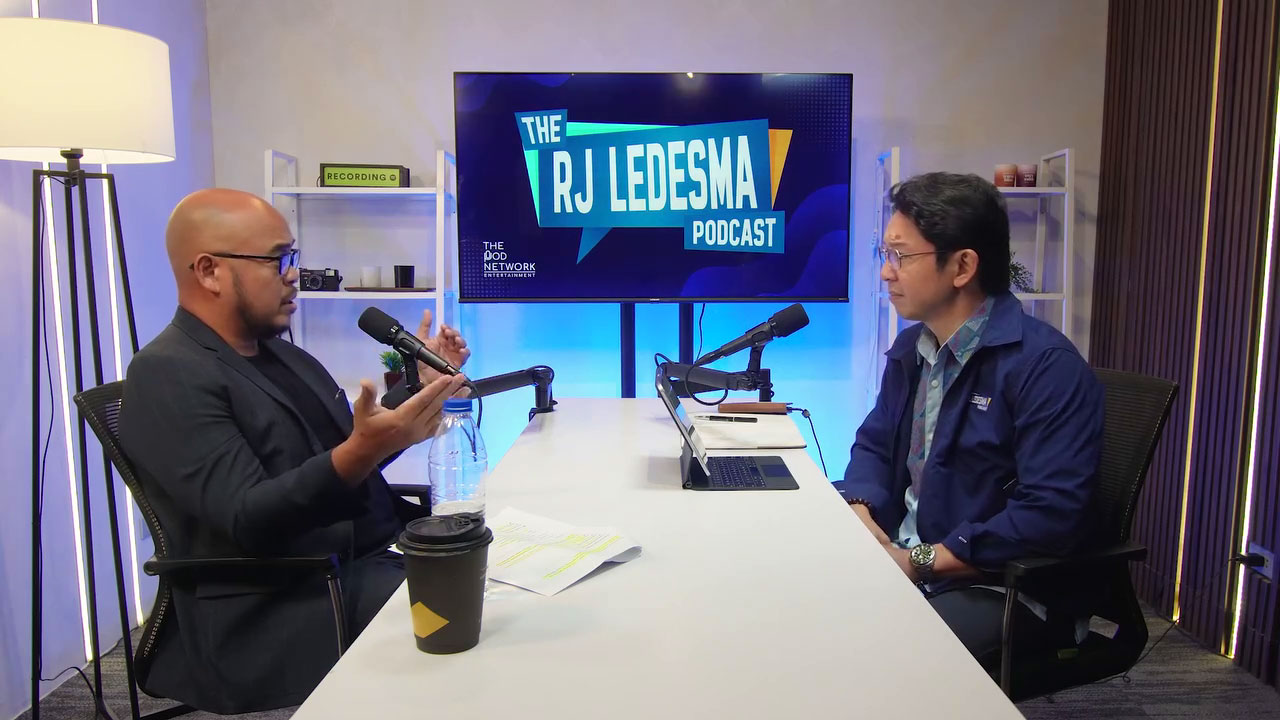
I was lucky enough to speak to Mr. Tarrobago in the RJ Ledesma Podcast where he imparted eye-opening information about what investors should do in times like these. Read on to learn some of the highlights of our conversation.
THE SKY IS FALLING. DON’T REACT.
When markets fall and the future is uncertain, many investors immediately choose to sell. Mr. Tarrobago warns against such panic-selling behavior. In fact, he cautions against any emotional response. Instead, he advises investors to rely on frameworks.
“When the sky is falling or when there is a major fundamental event or market crash, for example — like right now, there’s a lot of uncertainty out there — [fund managers] don’t get emotional, but they act using frameworks. The frameworks tell them exactly what to do when market conditions deteriorate, and they also see when market conditions — that’s market and macro conditions — are improving.
“Professional fund managers don’t try to predict what happens. They position and they prepare for different conditions.”
This systematic approach runs counter to many entrepreneurs’ quick, decisive, and aggressive business instincts, and we’ll discuss more about systems later…
FORGED IN FIRE: A HISTORY OF CRISES
Mr. Tarrobago is no stranger to financial crises. Inspired and informed by the movie Wall Street, he began his career as an equity analyst in 1995, and since then he has been through the Asian financial crisis in 1997, the subprime mortgage crisis in 2008, and the global pandemic in 2020.
Recalling the Asian financial crisis early in his career, he said, “I saw grown men and women, experts, grizzled veterans, really losing it, or [they] didn’t know what to do. Not because they didn’t understand what was happening, but they didn’t have systems to deal with the crisis.”
Things had changed by 2008, during the US subprime mortgage crisis. As the Philippines was not too adversely affected, Mr. Tarrobago called this a “mini crisis,” but more importantly, he had already begun to develop a system.
He said, “Over the years, there were some mini crises in between, but in 2008, I already had a semblance of a system with me, but I was still learning to trust that system.
“Fast forward to 2020 when the global crisis, the COVID lockdowns hit, I already had a system. So that allowed me to navigate the system. And that allowed my funds to outperform significantly and without the stress from the past crisis.”
Forged in fire, he now shares these lessons in his mentorship, providing priceless knowledge and practices from the last three major global financial crises.
A SYSTEMATIC APPROACH
To introduce his system — or the system he can help develop with you — he begins by talking about different assets. Each asset has a role to play in your portfolio, and he divides them between defensive assets (bonds and cash) and risk assets (equity and alternatives). For example, an aggressive investor who wants to earn big and is comfortable with risk may have 80% risk assets and 20% defensive assets in their portfolio while a balanced investor may have the assets split 50-50.
He tells investors to think of investment like a car where different parts have different roles to play. “During turbulent markets or financial conditions,” he says, “bonds are your portfolio’s shock absorber. Normally, the bonds do well in high uncertainty, very turbulent market conditions. Whereas equities or stocks are your portfolio’s growth engine over time. That’s where wealth is built.”
Keeping entrepreneurs — those businesspeople who always see opportunity in crisis — in mind, he added, “In particular, it’s a good market for risk assets.” Yet even for entrepreneurs like these, it can be difficult to overcome the tendency to react emotionally to falling markets. He reminded us, “All you want to do is protect yourself, driven by your prehistoric fight or flight responses. So, then you let that become your fund manager. It’s not usually the most rational decision, and oftentimes can be quite costly.” But for investors with risk appetite, undervalued stocks may prove to be golden opportunities in the future.
For those who are interested in Jun Tarrobago’s mentorship, you can check out his Substack or his LinkedIn where he talks about a wide range of investment topics. He also holds a mini workshop as well as a six-week program which starts with investment basics then goes deep into frameworks and ends with how to use framework accelerators like AI.
RJ Ledesma (www.rjledesma.com) is a Hall of Fame Awardee for Best Male Host at the Aliw Awards, a multi-awarded serial entrepreneur, motivational speaker, and business mentor, podcaster, an Honorary Consul, and editor-in-chief of The Business Manual. Mr. Ledesma can be found on LinkedIn, Facebook and Instagram. The RJ Ledesma Podcast is available on Facebook, Spotify, Google and Apple Podcasts. Are there entrepreneurs you want Mr. Ledesma to interview? Let him know at ledesma.rj@gmail.com.