DAVAO CITY’S water distributor has urged the city council to hasten the approval of the proposed P10-billion bulk water project as services worsen, particularly in the second district.
“This is an urgent request for approval of application for allowable use (for the bulk supply project source),” said Davao City Water District (DCWD) spokesman Bernardo D. Delima as he appeared before the council on Tuesday, where he was questioned by councilors over the longstanding water supply problem in the northeastern and central parts of the city.
The pending bulk water supply project — to be undertaken by Apo Agua Infrastructura, Inc (AAII), a partnership between Aboitiz Equity Ventures, Inc. (AEV) and J.V. Angeles Construction Corp. (JVACC) — is awaiting the city council’s approval after it was remanded to the committee level.
AAII has an exclusive contract with DCWD to supply 300 million liters of water per day for 30 years, beginning 2019.
AAII was aiming to start construction of the project, which will source water from the Tamugan River, by the fourth quarter this year.
“Apo Agua said it is still within the timetable. This means that once the permit is granted civil works will be fast-tracked,” Mr. Delima said.
AAII General Manager Cirilo Almario III, for his part, told the councilors that once they get the allowable use permit, they will immediately apply for a Certification for Eligibility to Convert from the Department of Agriculture and then to the Department of Agrarian Reform for land conversion.
Mr. Almario said with the delay in securing permits from government agencies, the project could start operations by the middle of 2020 instead of 2019.
In the meantime, DCWD General Manager Edwin V. Regalado said the district is carrying out works to address the supply problems.
“We will be able to provide 24-hour water supply to all areas in Cabantian in the second district once we complete all necessary interventions by December this year, “Mr. Regalado said.
DCWD serves 212,995 connections through 10 independent water supply systems using ground water sources.
Of the total service area, about 5% or 10,312 connections are under the Cabantian Water Supply System.
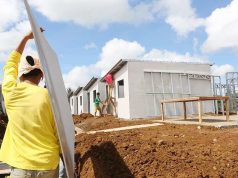
“Due to massive housing development in the area, the recharge zone has been significantly diminished resulting in the slower replenishment of the aquifer in the area, and aggravated by the El Niño phenomenon in 2015-2016 resulting in actual flow of only 5,930 cubic meters,” Cherry Mae Hidalgo of DCWD’s Engineering Department said. — Carmencita A. Carillo