

Gov’t plans P1.44-trillion Q1 outlay for spending catch-up
By Aubrey Rose A. Inosante, Reporter
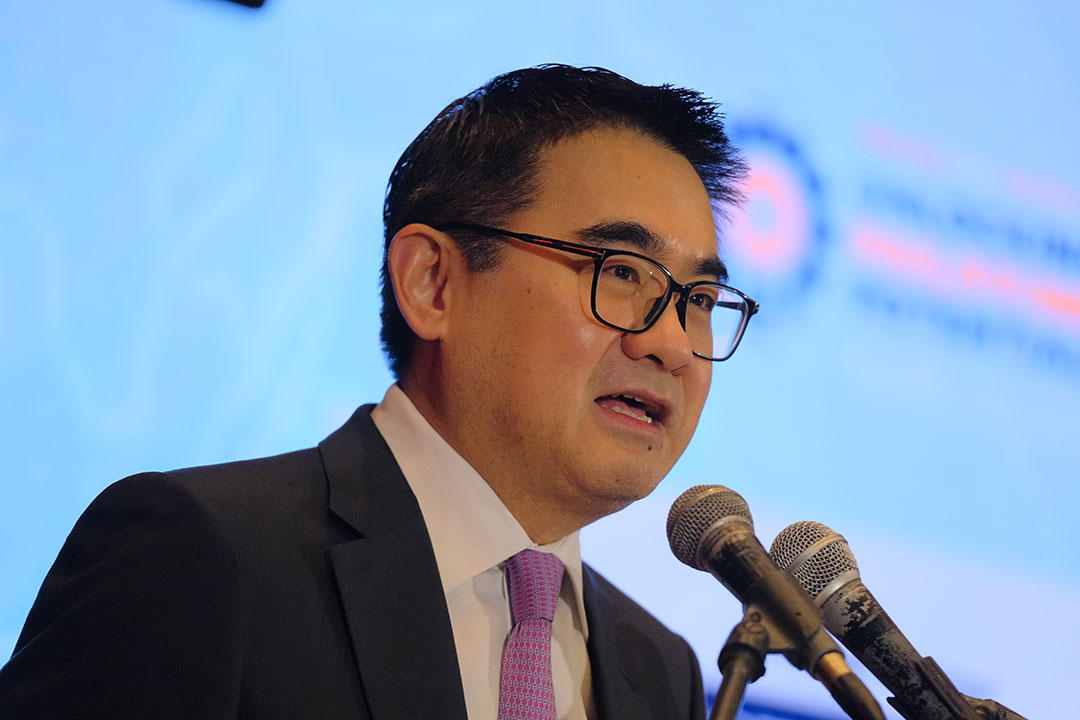
FINANCE SECRETARY Frederick D. Go said the government plans to spend P1.44 trillion this quarter as part of catch-up efforts to support the economy after last year’s growth slowdown.
The planned first-quarter outlay under the P6.793‑trillion national budget will help drive economic activity to meet the government’s gross domestic product (GDP) growth target, Mr. Go said at a Foreign Correspondents Association of the Philippines event on Monday.
“I expect that for 2026, we will bounce back, and we will definitely have a GDP of at least 5%,” he said.
The government is targeting 5%-6% GDP growth this year.
The Finance chief said he met with various government agencies, including the Department of Budget and Management, to clear the spending program.
Philippine GDP growth slowed to 4.4% in 2025 from 5.7% the prior year, missing the government’s 5.5%-6.5% target.
This was the weakest annual expansion since the 3.9% in 2011, counting out the 9.5% contraction in 2020 due to the pandemic.
Officials said tighter public spending and weak investor confidence due to a wide-ranging corruption scandal tied to state infrastructure projects continued to drag growth.
“All the other pillars of growth of our country remain solid and reliable,” Mr. Go said, adding that remittances and business process outsourcing receipts remain solid.
However, even as the government moves to speed up spending to pump-prime the economy, he reiterated that they remain committed to fiscal discipline.
“The most important part is not how much money you spend. It is how you spend that money.”
Mr. Go added that they want to focus on projects that have high multiplier effects.
He said governance reforms can help improve investor sentiment.
“I think the solution to that is simply prosecution, restitution, and genuine reform. The people want to see people punished and go to jail. That’s prosecution. People know that money has been taken. They want to see restitution. And number three, of course, we need to move on from this. We can’t keep talking about this. We need to move forward and the only way to move forward is through genuine reform,” he said.
“We continue to move the economy forward, create quality jobs, and grow, have financial inclusion for everyone.”
Several lawmakers, government officials, and contractors allegedly involved in anomalous flood control projects have already been charged, but observers have said that progress remains slow as other key figures named during the corruption probe continue to walk free.
Mr. Go added that the Public Works department, which is at the center of the graft scandal, has already moved to implement reforms to improve transparency.
NUCLEAR INDUSTRY
Meanwhile, the Finance chief said at the same event that the government is still pursuing bilateral agreements in the nuclear industry following the creation of the Philippine Atomic Energy Regulatory Authority (PhilATOM) via a law signed in September last year.
PhilATOM will serve as the country’s independent nuclear regulator, mandated to oversee the safe, secure, and peaceful use of nuclear energy and radiation sources.
“We continued to sign more bilateral agreements on technology sharing in the nuclear industry. We want to pursue that, as that will help deliver to us clean energy at lower prices,” Mr. Go said.
The Philippines’ power costs are among the highest in the region.
“I think that what everybody is talking about in the world today is what they call SMRs, or the small modular nuclear reactors, rather than these large-scale nuclear power plants,” he said.
The Department of Energy continues to pursue discussions on SMRs with various technology providers worldwide, he added.


