Senate summons VP Duterte as impeachment court convenes
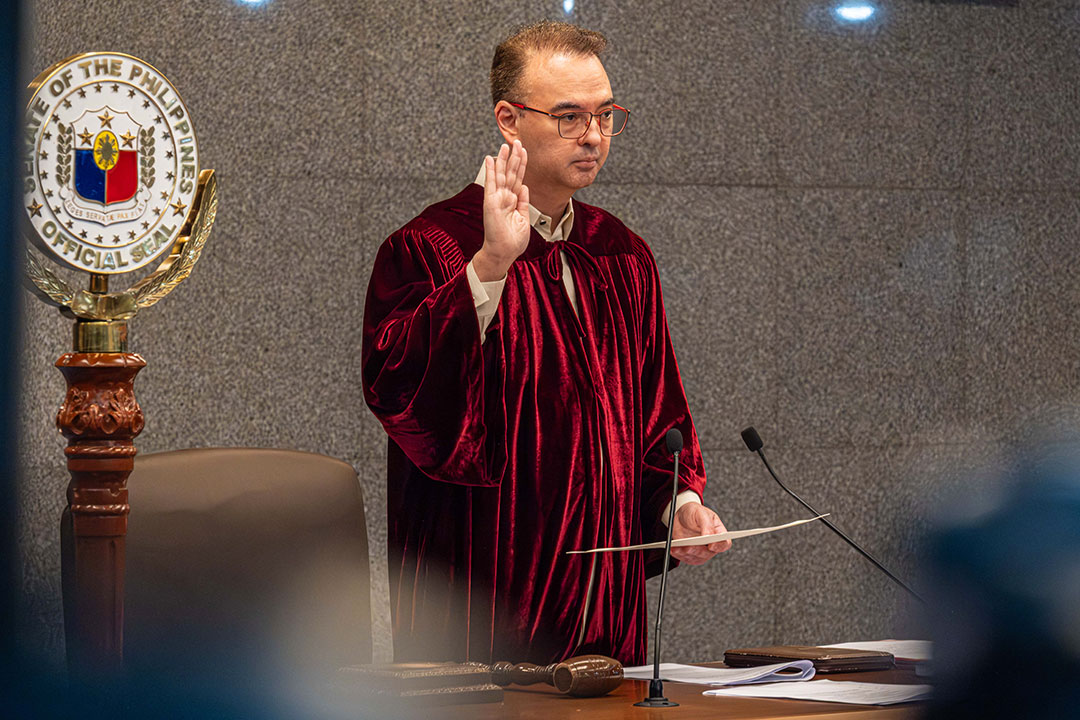
THE Senate on Monday convened as an impeachment court, summoning Vice-President (VP) Sara Duterte-Carpio, to face charges of corruption, misuse of public funds, betrayal of public trust, and alleged plot to assassinate President Ferdinand R. Marcos, Jr.
Senate President Alan Peter S. Cayetano, presiding over the impeachment court, ordered the issuance of summons for Ms. Duterte and granted her 10 calendar days to issue a response.
“Let a writ of summons be issued to Vice-President Sara Zimmerman Duterte, who is directed to file her answer within a non-extendable period of 10 days from receipt pursuant to Article VII of the Rules of impeachment,” Mr. Cayetano told the plenary.
The impeachment court convened amid reports of another Senate coup, with the Senate’s majority bloc holding 13 seats against the minority’s 11, after Senators Juan Miguel F. Zubiri and Joseph Victor G. Ejercito decided to join the latter on Monday.
The court also directed Ms. Duterte to appear before the chamber upon notice, while the prosecution has been given a non-extendable period of five days to file a reply from receipt of Ms. Duterte’s answer.
The defense team of Ms. Duterte said they would comply with the impeachment court’s order but refused to comment at this point.
“We will comply and file the appropriate response in accordance with the Constitution and applicable rules,” Ms. Duterte’s camp said in a statement.
“At this stage, and out of respect for the process, we find it prudent to refrain from further comment.”
The House of Representatives last week impeached Ms. Duterte for the second time with 257 affirmative votes, 25 negative, and nine abstentions.
The House first impeached the Vice-President in February 2025 with the endorsement of 200 congressmen that allowed the chamber to send the impeachment articles directly to the Senate without conducting any hearing. It, however, died in the Senate, which archived the articles after a Supreme Court ruling declaring the proceedings unconstitutional.
According to Mr. Cayetano, he has already approached the minority members of the Senate and will coordinate with the senator-judges for the establishment of the impeachment calendar.
He said they will factor in the schedule of the prosecution, defense, and the senators to avoid hampering their legislative work.
The prosecution will include House Justice Committee Chair and Batangas Rep. Gerville R. Luistro, Party-list Rep. James Mark Terry L. Ridon, Party-list Rep. Ramon Rodrigo L. Gutierrez, San Juan Rep. Ysabel Maria Zamora-Jornada, Iloilo Rep. Lorenz R. Defensor, Party-list Rep. Jose Manuel Tadeo I. Diokno, Party-list Rep. Leila Norma Eulalia M. de Lima, Dinagat Rep. Arlene “Kaka” J. Bag-ao, Bukidnon Rep. Jonathan Keith T. Flores, Cagayan de Oro Rep. Lordan G. Suan, and Manila Rep. Joel R. Chua.
Meanwhile, Malacañang urged senators to use the impeachment proceedings against Ms. Duterte to hold officials accused of corruption to account.
“What we should always remember is that not only the Senate, not only the Senate and senators but also we Filipinos — those who should be held accountable according to the President should be held accountable,” Palace Press Officer Clarissa A. Castro told a briefing in Filipino.
“Let no one be a way for those who should be held accountable to escape,” she added.
2028 PRESIDENTIAL BID
The Philippine Senate’s handling of Ms. Duterte’s impeachment case will likely influence the political landscape leading up to the 2028 presidential race, either boosting her profile or weakening her bid for Malacañang, GlobalSource Partners said.
In a commentary on Friday, GlobalSource Partners Philippine analyst and principal advisor Diwa C. Guinigundo said the upper chamber faces a “defining institutional choice” between allowing prompt and transparent impeachment proceedings or resorting to procedural delays to protect political allies.
“If the Vice-President successfully disproves the accusations, she could emerge politically stronger ahead of the May 2028 presidential elections,” Mr. Guinigundo said. “In Philippine politics, narratives of persecution often generate sympathy and political momentum. A public acquittal after nationally televised hearings could even strengthen her national standing.”
This came after Duterte-allied senators jolted the chamber, installing Mr. Cayetano as the new Senate president just as the House voted to remove Ms. Duterte from office.
According to Mr. Guinigundo, Ms. Duterte might lose her political momentum before the 2028 polls if evidence presented during the impeachment trial proves “credible and damaging.”
“If the evidence proves credible and damaging, the impeachment proceedings could weaken the Duterte political brand before 2028,” Mr. Guinigundo said. “Every hearing would place issues of accountability, misuse of public funds, and abuse of office under sustained public scrutiny.”
“Once the image of inevitability begins to crack, alliances shift, business interests recalculate, and political loyalties become fluid. That is why this impeachment battle could shape the political landscape leading to 2028,” he added.
Delaying the trial also risks undermining the Senate’s credibility and public trust, especially amid mounting public pressure, Mr. Guinigundo noted.
“It (Senate) can allow the impeachment trial to proceed openly and let evidence speak for itself. Or it can suffocate the process through delay and procedural escape routes,” he said.
“The first option may be politically uncomfortable, but it preserves institutional credibility and public trust. The second may appear safer in the short term, but it risks deepening public cynicism toward democracy itself. And that could prove decisive in 2028,” he added. — Kaela Patricia B. Gabriel, Katherine K. Chan, and Chloe Mari A. Hufana