Home Blog Page 9995

Peugeot to offer free inspection, car wash

WITH the recent volcanic activity of Taal Volcano resulting in extreme ashfall covering most of Metro Manila and the Southern Part of Luzon, Peugeot Philippines is offering free inspection and car wash to all their clients. The inspection will specifically cover the AC and engine systems together with some external vehicle operational functions, ie. wiper blades, tires, brakes, etc. And as an additional service to Peugeot owners, Peugeot Philippines will also provide free car wash after the inspection.

Protecting cars and upholding the stellar performance of Peugeot vehicles has always been a top priority for Peugeot. Volcanic ash has a high tendency to damage cars from the exterior appearance such as the paint and windshield and the mechanical overall health including but not limited to the engine and AC system as the main concerns. The inspection will also help lessen the chance of any road accidents by improving the quality of the tires, brakes as well as other external and internal issues.

Peugeot Philippines prioritizes its customers’ safety. This free inspection program is the company’s way of ensuring that the car and the driver are given the care and attention that they deserve. Motion and Emotion come hand in hand with the services of Peugeot Philippines. The free inspection and car wash will start on Monday, Jan. 20, 2020 and will be available at the Peugeot Pasig and Peugeot Alabang dealerships.

Shares to trade sideways ahead of Q4 GDP data

By Denise A. Valdez
Reporter

TRADING at the stock market is seen to stay quiet until the government’s scheduled release of its gross domestic product (GDP) report this week.

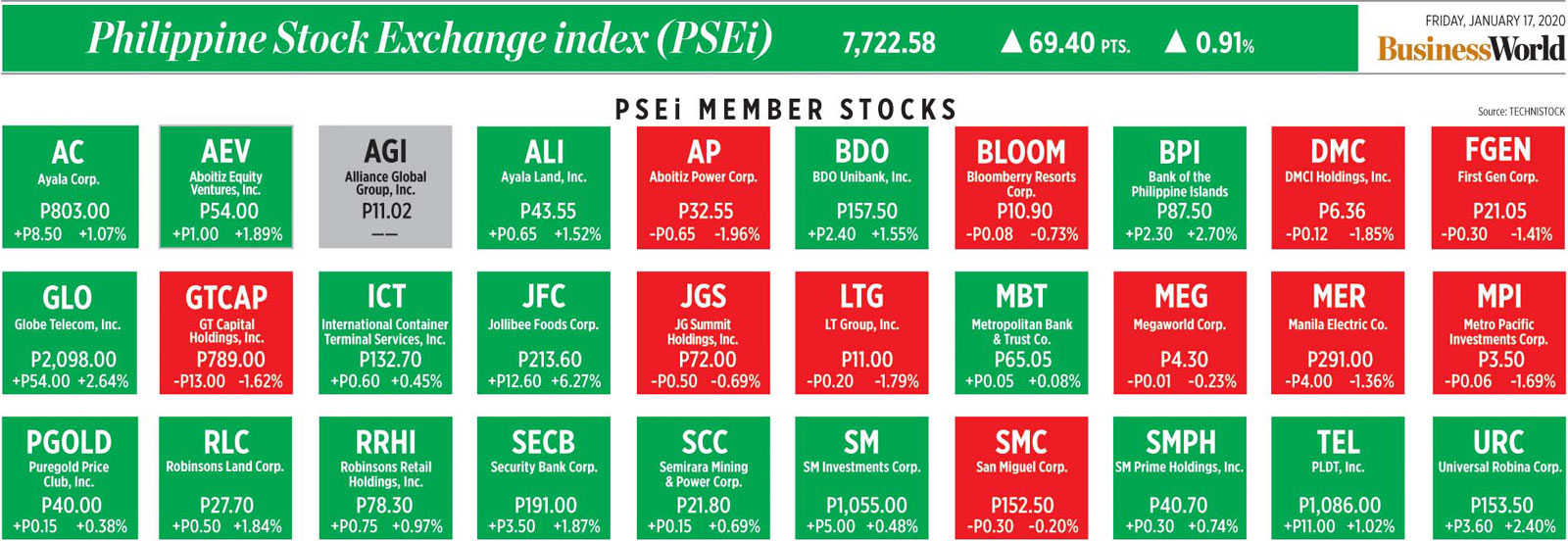
The benchmark Philippine Stock Exchange index (PSEi) climbed 69.40 points or 0.90% to close at 7,722.58 on Friday. However, the main index fell 54 points or 7% on a weekly basis due to the muted four-day trading.

“Taal Volcano’s unexpected eruption that spewed ashes as far as the metropolis kept investors on tentative note for most of the week, shrugging off the signing of phase one US-China trade accord,” online brokerage 2TradeAsia.com said in a market note.

While average value turnover last week improved 25% to P7 billion, net foreign selling also expanded to P1.4 billion from P1.2 billion in the week prior.

“[T]he main index could not seem to catch a break ending lower, marking its second consecutive week of losses. However, it was able to close the week above the 7,700 key support level after breaking below it several time throughout the week,” AAA Southeast Equities, Inc. Research Head Christopher John Mangun noted.

Heading into the new week, Mr. Mangun said investors are likely to stay silent amid the fading of their “new year’s optimism” and the continuous threat of a bigger natural calamity in Taal.

“The new year’s optimism that most investors had is slowly vanishing as the market continues to move sideways. Coupled with the threat of a major disaster, as the Taal volcano rumbles, investors have turned cautious again as no one wants to be holding the bag if things get worse,” he said.

But Mr. Mangun said investor interest may improve because of the release of the fourth-quarter GDP report by the Philippine Statistics Authority.

“This will prove if the government’s fiscal policy in the last twelve months has effectively spurred economic growth,” he said.

The Philippine Statistics Authority will report official fourth quarter and 2019 GDP data on Jan. 23.

AAA Southeast Equities is expecting GDP growth in the fourth quarter of 2019 to have come in at 6.5% at least.

For 2TradeAsia.com, this week’s trading will still largely take cues from the Taal volcano events. “In an extreme explosion scenario, it is…worth to note fiscal pump-priming follows next,” it said.

It also said the market may still enjoy some positive investor sentiment from the signing of the US-China phase one deal last week, which it noted should be seen as a “work-in-progress.”

“The list of attractive companies have already expanded, and it only takes a matter of time before these take notice. Position gradually on dips and hold. Immediate support is 7,600 resistance, 7,850-7,950,” 2TradeAsia.com said.

How PSEi member stocks performed — January 17, 2020

Here’s a quick glance at how PSEi stocks fared on Friday, January 17, 2020.


NEDA TWG studying road congestion pricing

THE government is evaluating at technical working group (TWG) level a proposal for a peak hours congestion pricing system in key parts of Metro Manila, a Transportation department official said.

The Department of Transportation (DoTr) said it submitted its proposal to impose congestion charges in Metro Manila’s business districts.

“It was submitted to NEDA (the National Economic Development Authority) for their initial evaluation, and it is with a NEDA technical working group. We are doing this in partnership with the Singapore government,” Transportation Undersecretary Mark Richmund M. de Leon told in BusinessWorld in an interview on Jan. 7.

He said the government of Singapore is providing both the concept and the technology to implement the congestion-pricing scheme.

Kung ma-approve na ’yun sa NEDA, tuloy-tuloy na ’yung proyekto (Once NEDA approves it, the project will go ahead),” he said, referring to the proposal which was submitted to the agency in “November or December.”

He said the proposal covers congestion charges in business districts during peak hours.

“The objective of the proposal is to remove the congestion in central business areas (CBAs), so you pay. If you want to use your car during peak hours, you pay a certain amount,” Mr. De leon said.

He noted that there is an oversupply of cars on Metro Manila’s roads. “Regardless of how good our bus system is, there’s terrible traffic along EDSA, vehicles are not moving, so what we need is to reduce cars,” he added.

According to the Chamber of Automotive Manufacturers of the Philippines, Inc. (CAMPI) and Truck Manufacturers Association (TMA), auto sales in 2019 totaled 369,941 vehicles, up 3.5%.

Current legislation aimed at discouraging the proliferation of automobiles include a proposed Proof of Parking Space Act, which would bar auto purchases if the buyer does not own a place to park. Car owners without parking sports or garages typically park on the street, hampering traffic flow.

A September study by the Asian Development Bank (ADB) found Metro Manila to be the “most congested” city in developing Asia.

The bank said rapid growth in car ownership and the demand for road capacity that it generates has given rise to congestion in many Philippine cities. — Arjay L. Balinbin

Taal Volcano agricultural damage exceeds P3 billion, led by fisheries

CROP DAMAGE due to Taal’s eruption was estimated at P3.17 billion a week after the volcano started emitting ash, with the fisheries sector accounting for more than half of the total, the Department of Agriculture (DA) said.

In a bulletin issued Saturday night, the DA noted that the ashfall damaged 43,772 metric tons (MT) of agricultural commodities, over 15,790 hectares of land in CALABARZON, which is composed of Cavite, Laguna, Batangas, Rizal, and Quezon.

It also “caused the death of 55,881 head of various farm animals. The large increase in animal deaths was due to the additional reports from validated areas in Batangas and Cavite.”

Fisheries accounted for 50.5% or P1.6 billion equivalent to 6,000 fish cages. Affected municipalities include Talisay, Laurel, Agoncillo, and San Nicolas, Batangas.

The pineapple industry accounted for 16.6% or P527.25 million. This covers 862 hectares and 21,079 MT of pineapple, mainly affecting General Trias, Amadeo, and Silang, Cavite.

Coffee damage was P360.5 million, or 11.4% of the total, over 4,309 hectares, equivalent to 8,240 MT of damaged production. Areas affected include Taal, Agoncillo, Lemery, San Nicolas, Laurel, Balete, and Talisay, all in Batangas; Calamba and Cabuyao in Laguna; and Amadeo and Silang in Cavite.

Damage to the coconut crop was P188 million or 5.9% of the total, affecting 8,700 hectares in Batangas.

Damage to the banana crop was P138.59 million, or 4.4% of the total, over 821 hectares with 7,338 MT of damaged production. Affected areas were San Nicolas, Batangas and Amadeo, General Trias, and Silang, Cavite.

Damage to the fruit and vegetable crop was P124.13 million, or 3.9% of the total, covering 197 hectares and 1,453 MT of production. Areas affected include Tanauan, San Nicolas, Balete, Cuenca, Alitagtag, Taal, Santa Teresita, Calaca, Agoncillo and Laurel in Batangas, and Silang, Amadeo, General Trias, and Magallanes in Cavite.

Corn damage was P88.9 million and livestock P20.1 million. — Vincent Mariel P. Galang

BIR sets goals for regional offices; Makati told to collect P129.5B

THE Bureau of Internal Revenue (BIR) has released the collection targets for its various regional offices, led by its Makati operation, which has been set a goal of P129.51 billion.

According to Revenue Memorandum Order No. 2-2020 dated Jan. 15 issued by Commissioner Caesar R. Dulay, the agency’s 19 implementing offices this year are tasked to collect a total of P821.935 billion, or about 31% of the BIR’s P2.576 trillion revenue goal for the year.

The next-largest target set for a regional office was P123.7 billion for its South NCR branch.

The Bureau’s overall full-year target includes a projected P90 billion in additional revenue generated by higher excise taxes imposed by the Tax Reform Acceleration and Inclusion (TRAIN) Act.

The overall target includes P1.673 trillion for the large taxpayers service, P453.58 billion from excise taxes, P66.528 billion from final withholding taxes on bank deposits, P7.57 billion from Malampaya and P10 billion from tax administration upgrades.

The non-BIR operations category is projected to raise P80.8 billion, including withholding taxes on deposits and documentary stamp taxes on government securities.

Other regional offices with top collection targets were Quezon City (P96.43 billion), East NCR (P90.15 billion), City of Manila (P57.24 billion) and the so-called Cabamiro office, covering Cavite, Batangas, Mindoro and Romblon (P47.46 billion).

Meanwhile, those with collection targets of P10 billion or less were Butuan City (P5.74 billion), Cordillera Administrative Region office (P6.98 billion), Zamboanga City (P7.26 billion), Eastern Visayas (P8.06 billion) and Koronadal City (P9.45 billion).

The Department of Finance (DoF) reported earlier that BIR, the country’s largest tax-collecting agency, missed its target by 6.8% last year, collecting P2.172 trillion against a P2.33 trillion goal.

The BIR’s 2019 performance beat the 2018 total by 10.67%.

BIR collections accounted for 77.57% of government revenue last year. — Beatrice M. Laforga

Fuel marking volumes top two billion liters

THE total volume of fuel marked as of Jan. 18 has topped two billion liters, Finance Secretary Carlos G. Dominguez III said, citing a report from the Bureau of Customs (BoC).

The total includes fuel marked by the Bureau of Internal Revenue (BIR) of around 600 million liters.

Fuel marking is an anti-smuggling measure. Fuel that has passed the various stages of tax compliance is marked by a special dye. The absence of a marker dye can be taken as prima facie evidence that no taxes were paid on the fuel.

The Department of Finance (DoF) reported that in 2019 the government marked a little over one billion liters.

Nine oil companies have participated in the program: Unioil Petroleum Philippines, Inc., Chevron Philippines, Inc., Phoenix Petroleum, Seaoil Philippines Inc., Pilipinas Shell Petroleum Corp., Insular Oil Corp., Filoil Energy Company, In., PTT Philippines Corp. and Petron Corp.

The volumes marked are well below initial estimates. In February 2019, authorities estimated that they can mark at least 15 billion liters of fuel products in 2019, with the BoC projecting around 6.8 billion liters of gasoline, diesel and kerosene imports while the BIR expected to mark around 8.4 billion liters processed by domestic refineries. — Beatrice M. Laforga

Nov. GOCC subsidies grow 46%

STATE SUBSIDIES to government-owned and -controlled corporations (GOCCs) grew 46.11% year-on-year to P11.815 billion in November, the Bureau of the Treasury (BTr) said.

According to the bureau’s cash operations report, the November total rose 63% from October.

In the 11 months to November, subsidies totaled P170.551 billion, against P187.1 billion budgeted for the year.

Philippine Health Insurance Corp. received the most budgetary support in November at P3.98 billion, up 44% year-on-year, followed by P2.758 billion for the National Irrigation Administration, up 62%, and P1.904 billion for the National Housing Authority.

Other top subsidy-receiving GOCCs were the Local Water Utilities Administration with P909 million, the Philippine Crop Insurance Corp. P772 billion, the Bases Conversion Development Authority P408 million, the Philippine Postal Corp. P271 million and the Philippine Heart Center P123 million.

Other state agencies that received more than P50 million worth of budgetary support in November were the Philippine National Railways with P81 million, the Philippine Children’s Medical Center P76 million, the Sugar Regulatory Administration P74 million, the National Kidney Transplant Institute P59 million, the Cultural Center of the Philippines P57 million and the Lung Center of the Philippines P51 million.

Those left unsubsidized were Land Bank of the Philippines, the National Electrification Administration, the National Food Authority, the National Power Corp., the Development Academy of the Philippines, the Small Business Corp. and the Social Housing Finance Corp. — Beatrice M. Laforga

Estate tax amnesty for non-resident Pinoys: Yay or nay?

Among all the internal revenue taxes imposed in the Philippines, estate tax is arguably one of the most neglected. It is not uncommon to see estate taxes remain unpaid for several years after the death of the decedent until the heirs see the need to transfer the inherited property. These properties then remain idle with their economic benefit unutilized.

Thus, the much-anticipated Estate Tax Amnesty program was welcomed when the President signed it on Feb. 14, 2019. This program provides a one-time opportunity to settle estate tax obligations at a reduced tax rate and with no penalties.

In a nutshell, the estate tax amnesty allows unpaid estate tax obligations to be settled at the rate of 6%, without any penalties imposed. This covers the estates of decedents who passed away on or before Dec. 31, 2017, with or without tax assessments issued by the Bureau of Internal Revenue (BIR) and that have remained unpaid as of the same date. The amnesty also covers “undeclared estates” or properties that were not included in a previously filed estate tax return and not subjected to estate tax.

The 6% amnesty tax rate is imposed on the net estate of the decedent at the time of death. This means that the estate can take advantage of the deductions that are available under the Tax Code as of the time of the decedent’s death.

AVAILING OF THE ESTATE TAX AMNESTY
The estate tax amnesty return (ETAR) shall be filed with the BIR Revenue District Office (RDO) that has jurisdiction over the place of residence of the decedent, who must be a resident of the Philippines, or of the executor/administrator in the Philippines if the decedent was a non-resident. If the estate has no executor or administrator in the Philippines, the ETAR will be filed with BIR RDO No. 39 in Quezon City. Following Revenue Memorandum Order No. 33-2019, the Certificate of Availment and the Electronic Certificate Authorizing Registration (eCAR), which authorizes the transfer of the estate properties to the heirs, shall be issued within 15 calendar days from the receipt of the validated Acceptance Payment Form and proof of payment of the Estate Amnesty Tax.

The estate tax amnesty is available for two years, starting June 15, 2019 and ending June 14, 2021. Any estate that fails to take advantage of the tax amnesty within the period given will be subject to the graduated estate tax rate that was in effect as of Dec. 31, 2017, with interests and penalties also due upon payment.

The law was good news to Filipinos in the Philippines as well as those residing overseas who are heirs to unsettled Philippine-based estates with unpaid taxes. Many Filipinos who have settled abroad with their families have expressed their preference to settle the estates and sell off Philippine-based properties.

CHALLENGES FOR NON-RESIDENT FILIPINOS
However, there are challenges for non-resident Filipinos who wish to take advantage of the tax amnesty.

One challenge is the availability of documents required by the ETAR. Under Revenue Regulations (RR) No. 6-2019, documents pertaining to the value of the properties within the estate must be attached to the ETAR to provide a basis for the tax base and the resulting estate amnesty tax payable.

If, for example, the decedent passed away decades ago, there is a good chance that the heirs no longer have documents that indicate the value of the properties as of the time of the decedent’s death. This can cause difficulty in proving the actual value of the properties, since it is certain that these properties were worth far less at the time when the decedent died than their current fair market value. Without the relevant documents, it will be difficult to determine the actual value of the decedent’s estate, and the resulting basis to compute the estate amnesty tax.

Another challenge for non-resident heirs is how to determine the actual properties that comprise their parents’ or grandparents’ estates. In some cases, the heirs had already migrated to other countries, leaving their parents behind in the Philippines. When the parents are gone, there is a chance that the survivors have no clear idea about the nature or number of properties that were left behind. As they have no resources in the Philippines to obtain information on their parents’ properties, the likely result is an ETAR that may not include all the properties that actually belonged to the decedent.

A third challenge for non-resident Filipinos is the actual filing of the ETAR and payment with the bank. Non-residents usually prefer to remit payments online or through wire transfer. However, the amnesty regulations require the physical filing of the ETAR and payment through BIR authorized-agent banks. To avail of the amnesty would require that the non-resident return to the Philippines or to authorize a representative for this purpose.

POTENTIAL COURSES OF ACTION
With the way that the regulations for estate tax amnesty are currently worded, non-resident Filipinos have the option to authorize representatives in the Philippines to file and process the applications on their behalf, without having to come to the Philippines themselves. Where a proper authorization is in order, these representatives can assist in determining the properties covered by the estate, preparing and submitting the ETAR to the BIR, making the actual payment, and claiming the eCAR to be issued to the estate.

In determining the properties that may be covered by the estate, the heirs or their representatives can try to confirm with the relevant government agencies any registered properties that the decedent may have. However, there may also be hurdles on this point as more and more government agencies begin to implement rules that limit information disclosure.

Given these challenges for non-resident Filipinos, there may be a need to first evaluate how the authorities can help them maximize the benefits of the amnesty. For example, it may be useful to determine whether it is feasible to authorize Philippine embassies or consulates to accept ETAR filings and amnesty tax payments. Another potential option would be to develop online platforms to enable these individuals to file the ETAR online and settle through bank-to-bank payments. These potential options will certainly help ease the compliance of non-resident Filipinos who may be keen on settling outstanding estate tax obligations.

The intent of the estate tax amnesty is certainly laudable as it seeks to increase the revenue of the government, while helping unlock idle properties and opening these up for transfers upon the payment of the estate tax obligation. These objectives can better be realized if additional measures can be developed to help Filipinos, wherever they may be in the world, conveniently and efficiently take part in the estate amnesty program within the given period of time.

This article is for general information only and is not a substitute for professional advice where the facts and circumstances warrant. The views and opinion expressed above are those of the author and do not necessarily represent the views of SGV & Co.


Betheena Dizon is a Tax Senior Manager of SGV & Co.

Congress to tackle priorities as sessions resume

THE Senate and House of Representatives will resume sessions on Monday after the holiday break, with both houses of Congress expected to prioritize the creation of several agencies including a Department of Disaster Resilience.

The House would also try to pass twin bills seeking to create a Department of Water Resources and Department of Filipinos Overseas, Leyte Rep. Ferdinand Martin G. Romualdez said in a statement on Sunday.

“The Speaker made a clear instruction to pass these bills,” said Mr. Romualdez, who is also the majority leader. “No less than President Rodrigo R. Duterte himself called on Congress to work on these measures during his fourth State of the Nation Address last July.”

The House has started debates on the proposed Department of Filipinos Overseas, and will start deliberating on the other two agencies when sessions resume this month.

The Senate, meanwhile, would prioritize the creation of the local disaster agency, as well as changes to the Anti-Terrorist Act, President Vicente C. Sotto III told reporters in a group message on Sunday.

The law only penalizes four acts of terrorism — the commission of the actual crime, conspiracy to commit terrorism, being an accomplice and an accessory.

The Senate bill seeks to expand this, including in its coverage any attacks that cause death or serious injury, extensive damage to property, as well as the manufacture, possession and supply of weapons.

Mr. Sotto also said the chamber would prioritize Senate Bill 1092 or the “Teaching Supplies Allowance Act,” which will allot P5,000 per teacher yearly for the purchase of chalks, erasers, forms and other classroom supplies.

Both bills have been endorsed by separate Senate committees and are awaiting approval on second reading.

Mr. Sotto also cited measures for a Local Government Unit Transportation Act, Comprehensive Values Education Act and a plan to increase spending by political parties during elections.

The first bill will expand local governments’ power over local public transportation, empowering them to develop their own mass transportation systems.

There’s also a proposal to increase spending by election candidates to P50 from P10 per voter, and expenses of political parties to P30 from P5 per voter. Another bill will integrate values education in the K to 12 curriculum.

Meanwhile, a congressman said the House would also prioritize changes to the Consumer Act and Price Act amid “unfair” price increases related to the eruption of Taal Volcano in Batangas province.

“Profiteers are illegally taking advantage of the environmental conditions in Batangas and the surrounding areas to make unfair price increases,” Valenzuela City Rep. Weslie T. Gatchalian said in a statement.

“We are appealing to manufacturers, distributors, and retailers to avoid profiteering. Let us not add to the already heavy burden of those affected by the Taal Volcano eruption” said the congressman, who also heads the trade and industry committee.

Mr. Gatchalian also said a law prohibiting donations of infant milk and similar goods should be seriously reconsidered.

About 21,000 children living within the 14-kilometer danger zone of Taal have been evacuated, Mr. Gatchalian said, noting that hundreds of infants in evacuation centers need milk and other substitute formulas. “We should be able to make use of them especially if there are those willing to donate.” — Charmaine A. Tadalan and Genshen L. Espedido

Duterte invited to US-Asean Summit

THE WHITE House has invited President Rodrigo R. Duterte to the upcoming United States-Southeast Asian Nations (Asean) Summit in March, the presidential palace said on Sunday.

“This will provide an excellent opportunity for us to broaden and deepen our cooperation on matters of great importance to the nearly one billion in the United States and ASEAN nations that we have the privilege to represent,” according to a copy of a letter signed by US President Donald Trump on Jan. 9.

Malacañang in December said it would ban several US lawmakers for seeking to bar Philippine officials behind the detention of Senator Leila M. de Lima, who is a staunch Duterte critic.

National Security Adviser Robert C. O’Brien will serve as Mr. Trump’s special envoy at the summit, which will be held in Las Vegas on March 14. — Gillian M. Cortez

33 Filipinos come home from Middle East

A TOTAL of 33 Filipino workers have been sent home from the Middle East, the Department of Foreign Affairs (DFA) said at the weekend, amid tensions between the US and Iran.

The Philippine Consulate General in Dubai was scheduled to send home 24 more distressed Filipino workers to the airport for their flight back home “and a much anticipated reunion with their families and loved ones,” DFA Undersecretary Brigido J. Dulay, Jr. said in a social media post on Saturday evening.

Nine other distressed Filipino migrants were sent back home from the Kingdom of Saudi Arabia, he said.

Meanwhile, the Philippine Embassy in Kuwait rescued distressed Filipina household worker Delia Solomon after she sought help on social media. The DFA is expected to repatriate Ms. Solomon this week.

“We are happy to report that she is now sheltered in our embassy and we’re working on reuniting her with her loved ones next week,” Mr. Dulay said in a separate post on Friday.

This comes as the Philippines imposed a total deployment ban on all Filipino workers to Kuwait, which will be in effect until the memorandum of agreement on labor standards between the two countries is fully implemented.

President Rodrigo R. Duterte approved the total deployment ban on Friday. The ban covers both skilled and domestic workers.

The ban was triggered by the National Bureau of Investigation’s findings that Jeanelyn Villavende, a Filipina housemaid working in Kuwait, had been physically and sexually abused.

But a labor group said the total ban would do more harm and could lead to more illegal recruitment cases.

“We are grieving over the death of Jeanelyn Villavende, another name to a very long list of OFWs maltreated and killed by their abusive employers, yet we may be issuing a sentence of slow death to the families of other OFWs who have no other way of feeding their families,” Josua Mata, secretary general of the Sentro ng mga Nagkakaisa at Progresibong Manggagawa, said in a statement.

The labor group said the ban could force Filipino workers to enter Kuwait illegally, while those already in Kuwait might stay illegally way beyond their contracts.

This would make it more difficult to track Filipino workers in Kuwait and could further endanger their lives, he said.

“Deployment bans had been issued time and again, but we all know that it is just a knee-jerk reaction whenever the harsh reality of not having enough employment in the country slaps the government in its face,” Mr. Mata said. — Charmaine A. Tadalan and Gillian M. Cortez

ADVERTISEMENT
ADVERTISEMENT