Home Blog Page 996

Floods, sachets, and intellectual property in the circular economy

STOCK PHOTO | Image by Fabrikasimf from Freepik

Metro Manila and other parts of the Philippines are increasingly vulnerable to flooding — a crisis exacerbated by the staggering volume of waste generated annually. Over 21 million metric tons of garbage, including plastic sachets and bottles, clog our rivers, canals, and drainage systems. The result: severe flooding during heavy rains, disrupting lives and livelihoods.

In response, Senate Bill No. 306, also known as the “Philippine Circular Economy Promotion Act” was recently filed by Senator Loren Legarda. The bill proposes a transformative shift from the traditional linear model of production and consumption to a circular economy — one that emphasizes sustainability through repair, reuse, and recycling.

In a linear economy, a gadget is bought, used, and discarded. In a circular economy, that same gadget is repaired, reused, or its parts recycled to create new products. The goal is simple: reduce waste and extend the life cycle of materials.

This theme was the centerpiece of my recent talk at a gathering of Intellectual Property (IP) Law professors from across Asia and the Max Planck Institute in Germany, held at Chiang Mai University in Thailand. We explored the intersection of innovation, IP rights, and environmental sustainability.

At the heart of Senate Bill 306 is the recognition that “innovation is the engine driving the circular economy.” The bill identifies key technologies — mobile platforms, modular design, trace-and-return systems, and 3D printing, among others — as enablers of this new model.

However, for innovation to continue and flourish, it must be rewarded and protected. That is where intellectual property law comes in.

In the Philippines, the IP Code (RA 8293) provides the legal framework to incentivize invention and protects against infringement. However, the exclusive nature of IP rights can sometimes clash with the principles of reuse and repair that sustain the circular economy.

A case decided by the Supreme Court in 1990 illustrates this clash. In Del Monte Corp. v. Court of Appeals (G.R. No. L-7832), the respondent reused Del Monte bottles — purchased from junk shops — to package its own catsup products. Del Monte sued for trademark infringement and unfair competition, citing the bottles’ embossed warning: “Not to be Refilled.” The Court ruled in favor of Del Monte, citing unfair competition.

This decision affirms proprietary control over containers. However, under a circular economy model like SB 306, reuse of containers is not only encouraged — it is essential to sustainable waste management.

The conflict between proprietary rights and environmental goals is further complicated by Republic Act No. 623 (1951), which prohibits unauthorized reuse of marked containers. This legal landscape raises the question I posed during our roundtable discussion: “Is IP a square peg in the circular economy?”

As the Philippines works toward a more sustainable future, reconciling intellectual property rights with environmental concerns will be crucial. The challenge lies in crafting legal frameworks that protect innovation while promoting repair, reuse, and the sharing of know-how.

Senate Bill No. 306 is a step toward environmental sustainability. It highlights four key strategies:

1. Reuse and recycling of physical products

2. Reduction of single-use plastics

3. Community-based recovery systems

4. Refillable packaging models

To support these goals, the bill proposes the creation of a Circular Economy Regulatory Sandbox and a Circular Economy Incentive Code, among others.

Unfortunately, SB 306 is silent on a critical enabler of innovation: intellectual property. The bill does not mention IP rights, ownership, licensing, or protection mechanisms. This omission is a missed opportunity for small and medium enterprises (SMEs) and startups developing proprietary circular technologies.

SMEs are the backbone of the Philippine economy. They account for 99.5% of businesses, generate 63% of employment, and contribute 40% to GDP. Their participation in the circular economy is essential.

Recognizing this, the Intellectual Property Office of the Philippines (IPOPHL) launched the GreenTech Incentive Program last year to support local inventors in developing sustainable innovations. However, as of this September, only six applications have been filed.

This low response reflects the challenges SMEs face: limited financial resources to develop IP strategies; high transaction costs associated with exclusive IP rights; and fear of infringement liability.

Despite these tensions, the current IP Code (RA 8293) contains provisions that can support circular innovation. These include limitations on IP rights, compulsory licensing, and other mechanisms that balance proprietary interests with public good.

Most importantly, Section 2 of the IP Code declares that “the use of intellectual property bears a social function.” This principle is reflected in doctrines such as fair use, experimental use, and patent exhaustion — legal tools that allow society to benefit from innovation without undermining the rights of creators.

Revisiting this principle offers a chance to rethink legal norms that may obstruct circular practices. It invites us to reshape IP law to better align with environmental goals.

In conclusion, the following policy recommendations could strengthen SB 306:

1. Adjust infringement standards to account for environmental imperatives;

2. Promote use rights for recycling goods and their components; and,

3. Encourage open licensing models for sustainable technologies.

By integrating these elements, IP rights can evolve to support — not hinder — the circular economy. The recognition that IP bears a social function affirms that it is not a square peg. It can — and must — be reshaped to fit in a circular economy.

(This article is for general informational and educational purposes only and not offered as and does not constitute legal advice or legal opinion.)


Alex Ferdinand S. Fider is a Senior Partner of the Angara Abello Concepcion Regala & Cruz Law Offices. He is also a lecturer on Intellectual Property Law at the University of the Philippines College of Law and the DLSU Tanada-Diokno School of Law.

88308000

asfider@accralaw.com

How PSEi member stocks performed — September 16, 2025

Here’s a quick glance at how PSEi stocks fared on Tuesday, September 16, 2025.


China fires water cannon at PHL ship

China Coast Guard vessels patrol past a Chinese fishing vessel at the disputed Scarborough Shoal, April 5, 2017. — REUTERS

By Kenneth Christiane L. Basilio, Reporter

THE PHILIPPINE COAST GUARD (PCG) said on Tuesday that a government ship operated by civilians was harassed by two Chinese coast guard vessels while buying fresh catch from Filipino fishers near Scarborough Shoal, marking the latest flare-up at the disputed feature in the South China Sea.

Authorities said a China Coast Guard (CCG) ship blasted water at BRP Datu Gumbay Piang of Manila’s Fisheries bureau about 14 nautical miles (25.9 kilometers) east of Scarborough for nearly 30 minutes, damaging the vessel and injuring a Filipino crew member who sustained an ear laceration from shattered bridge glass.

Another Chinese coast guard ship performed “hazardous maneuvers” while attempting to use its water cannon against the Philippine vessel, the PCG said.

“The Philippine vessel effectively executed safety maneuvers to avert any potential damage,” it said in a statement.

The Chinese Embassy in Manila did not immediately reply to a Viber message seeking comment.

A Chinese navy vessel also issued a radio warning to Philippine ships near Scarborough Shoal, announcing live-fire drills that triggered panic among Filipino fishermen in the area, the PCG said.

“Despite the hostile actions, the PCG and the DA-BFAR (Department of Agriculture-Bureau of Fisheries and Aquatic Resources) remain committed to upholding our maritime jurisdiction in the West Philippine Sea,” it said, using the Filipino name for parts of the South China Sea within Manila’s 200-nautical mile (370 kilometers) exclusive economic zone.

The CCG on Tuesday said it fired water cannon at Philippine ships near the disputed Scarborough Shoal in the South China Sea, accusing Manila of an “illegal” intrusion and the ramming of one of its vessels.

Tuesday’s encounter involved more than 10 Philippine ships, said Gan Yu, a spokesperson for China’s Coast Guard, accusing the vessels of having “illegally invaded China’s territorial waters of the Scarborough Shoal from different directions.”

In particular, he faulted Philippine Coast Guard vessel 3014, saying in a statement it had “disregarded solemn warnings from the Chinese side and deliberately rammed a Chinese coast guard vessel.”

He added, “The China coast guard lawfully implemented control measures against the Philippine ships.”

These included measures such as verbal warnings, route restrictions and water cannon spraying, Mr. Gan added.

The confrontation in Scarborough Shoal comes a week after Beijing approved a plan to establish a national nature reserve at the disputed feature, which lies just 222 kilometers off the coast of Luzon but almost 900 kilometers from China’s Hainan Island.

China’s State Council said the nature reserve is an important measure to maintain the “diversity, stability and sustainability of the natural ecosystem” of the maritime feature.

The reserve will cover more than 3,500 hectares at Huangyan Island, the Chinese name for Scarborough Shoal, with its coral reef ecosystem as the main protection target, according to China’s National Forestry and Grassland Administration.

Analysts have said Beijing’s plan to categorize the shoal as a nature reserve amounted to trying to take the moral high ground in the dispute over the atoll, known as Huangyan Island in China and Panatag Shoal in the Philippines.

Scarborough has been under de facto Chinese control since 2012. A Hague-based arbitral tribunal voided China’s sweeping South China Sea claims in 2016, but sovereignty over the rocky atoll remains unresolved as the ruling did not assign ownership.

The South China Sea has become a regional flashpoint with China continuing to assert its sweeping claim over almost the entire sea, a vital global trade route that is also believed to be rich in undersea gas and oil deposits.

Meanwhile, a Philippine military official said on Tuesday that any “control measures” performed by Chinese forces within the country’s exclusive waters are illegal after China claimed a flare-up at a contested shoal in the South China Sea.

“Any control measures instituted by the People’s Liberation Army Navy, the Chinese coast guard or the maritime militia within our exclusive economic zone are all illegal,” Rear Admiral Roy Vincent T. Trinidad, Philippine Navy spokesman for the South China Sea, said in a media briefing.

A spokesperson for the Philippine Maritime Council said there was “no truth” in China’s statement that it had taken control measures, which it dismissed as “another case of Chinese disinformation and propaganda.”

PHL-UK VISITING FORCES AGREEMENT
Also on Tuesday, Defense Secretary Gilberto C. Teodoro, Jr. said the United Kingdom (UK) has invited the Philippines to begin talks on a possible visiting forces agreement (VFA), a move that could deepen ties between the two countries amid rising tensions in the South China Sea.

He said he had received a letter from his British counterpart on Tuesday “inviting” the Philippines to kickstart discussions for a VFA.

“We see some synergies, a lot of synergies between the UK and us,” he told lawmakers at a House of Representatives hearing. “They are also willing to interconnect their maritime domains with the Indo-Pacific area.”

The Philippines, already bound by military agreements with the US, Japan and Australia, is pursuing closer security ties with allies amid tensions with China over disputed features in the South China Sea.

Security cooperation with allies soared under President Ferdinand R. Marcos, Jr., who has taken a firmer stance against Beijing’s sweeping maritime claims compared with his predecessor. — with Reuters

Philippines to strengthen campaign for UNSC seat

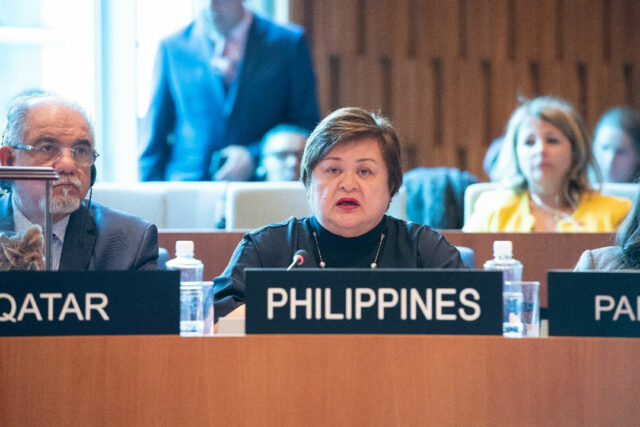
Foreign Affairs Secretary Ma. Theresa P. Lazaro — DFA.GOV.PH/UNESCO PHOTO

By Adrian H. Halili, Reporter

MANILA is looking to strengthen its bid for a non-permanent seat at the United Nations Security Council (UNSC) during the UN’s general assembly this month, the Department of Foreign Affairs (DFA) said on Tuesday.

“The Philippine delegation will also ramp up efforts to pursue the country’ s bid for a non-permanent membership in the United Nations Security Council for the term 2027-2028,” the agency said in a statement.

Foreign Affairs Secretary Theresa P. Lazaro will lead the Philippine delegation, the agency said, after the Presidential palace announced that President Ferdinand R. Marcos, Jr. will skip the assembly next week as he focuses on local issues.

The DFA said that the Philippine delegation will reaffirm the country’s strong commitment to multilateralism and a rules-based order.

“She will highlight the Philippines’ role in addressing complex challenges as well as the country’s call for a stronger UN — one that promotes peace, security, climate action, migrant protection, and sustainable development,” it added.

The country has been actively campaigning for a non-permanent seat on the UNSC, amid growing concerns of Chinese aggression in the South China Sea. The election will be held next year, with members serving a two-year non-permanent term.

Relations between Manila and Beijing have been strained in recent years due to frequent confrontations in the South China Sea, where China has expanded its presence despite a 2016 arbitral ruling by a UN-backed tribunal that voided its sweeping claims. Beijing has ignored the decision.

Ms. Lazaro, along with other agency heads, will also conduct high-level discussions on issues that include artificial intelligence, climate financing, migration, biodiversity, and maritime security.

“She will also meet with foreign ministers to strengthen bilateral and multilateral ties, promoting Philippine interests and advancing national priorities,” the DFA said.

Chester B. Cabalza, founding president of Manila-based think tank International Development and Security Cooperation, said that the Philippines’ bid for the UNSC seat could allow the country to acquire a central role in the Indo-Pacific region.

“The bid for another seat for 2027-2028 is crucial and important is the Philippines plays a central middle power role in the Indo-Pacific region amid the South China Sea tension,” Mr. Cabalza said in a Messenger chat.

He added that if Manila succeeds in its plan, the seat could be used to leverage its national interest for international lobbying on maritime security.

“This opportunity is an echo chamber of persuasion for the code of conduct since China is a permanent member of the UNSC,” he said.

Separately, Palace Press Officer Clarissa A. Castro dismissed claims President Marcos canceled his trip to New York due to the planned protest against corruption on Sept. 21, noting it was not a factor.

“Protesting is natural. That is normal in every country if our countrymen have sentiments. The President is not afraid because he knows that the people’s protests are about fighting corruption,” Ms. Castro told a news briefing on Tuesday.

Mr. Marcos is focusing on managing the newly formed Independent Commission for Infrastructure, that will investigate irregularities in flood control projects, she said.

Apart from that he will still focus on the people’s needs, the price of goods still needs to be reduced, and many others,” Ms. Castro told a news briefing. “As the President, (Mr. Marcos) has many jobs.”

Marcos approves wage hike, health benefits for GOCC employees

President Ferdinand R. Marcos, Jr. led the recognition and awarding of Government-Owned or -Controlled Corporations in a ceremony in Malacañan Palace on Tuesday — PHILIPPINE STAR/NOEL B. PABALATE

PHILIPPINE PRESIDENT Ferdinand R. Marcos, Jr. on Tuesday approved new salary increases and medical benefits for Government-Owned and -Controlled Corporations (GOCC) employees.

“In support of the hardworking men and women who make this possible, I have approved the Compensation and Position Classification System II that would increase the salaries of GOCC employees,” he said during the GOCC Day event in Malacañang.

“I have also approved the provision of a tiered medical allowance for GOCC employees depending on the capacity of the GOCCs.”

The move comes as the government continues its probe into corruption within its ranks, with Mr. Marcos stressing the higher pay for GOCC employees reflects the government’s commitment to fostering a motivated public sector workforce.

He noted that for corporations that already adopted the Compensation and Position Classification System (CPCS) 1, the adjustments would be applied retroactively.

“For GOCCs that implemented CPCS 1, the increases will retroact to Jan. 1, 2025, upon receipt of their Authority to Implement from GCG (Governance Commission for GOCCs),” he said.

He said the measure guarantees fair recognition for workers who consistently demonstrate efficiency, transparency and accountability in public service.

Budget Secretary Amenah F. Pangandaman said the salary adjustments came as a surprise to many GOCC workers, who have been requesting an increase for some time.

Unlike national government employees, who began receiving gradual pay hikes under the CPCS last year and are due for a third tranche in 2026, GOCC workers have yet to benefit from the program.

“At the same time, as you may have heard, there was a medical allowance for national government agencies. Now, they also have a medical allowance,” she told reporters in Filipino during the celebration of the GOCC Day in Malacañang.

“The amount depends on the tiers, since our GOCCs are classified into different tiers,” she added. “They have their own funds. Once the executive order is signed and released, they can compute it and then provide it.”

Mr. Marcos challenged the GOCCs to modernize, simplify processes and slash red tape to benefit every Filipino.

“For the rest of the bureaucracy, our job is to ensure that the dividends of our GOCCs will redound to better services,” he noted. “We need to spend these funds with utmost transparency and accountability. Public trust is our most valuable currency. Once lost, rebuilding it becomes far more difficult.” — Chloe Mari A. Hufana

SC orders temporary halt to redistricting of Bangsamoro Parliament ahead of polls

PHILSTAR FILE PHOTO

THE SUPREME COURT (SC) en banc has issued a temporary restraining order (TRO) against the enforcement of a law reorganizing parliamentary districts in the Bangsamoro Autonomous Region in Muslim Mindanao (BARMM) ahead of its first parliamentary elections on Oct. 13.

In a special session on Sept. 15, the SC ordered the Commission on Elections (Comelec), the Bangsamoro Transition Authority (BTA), and their agents to stop implementing Bangsamoro Autonomy Act No. 77, pending resolution of the cases. The TRO takes effect immediately.

BAA No. 77, the Bangsamoro Parliamentary Redistricting Act of 2025, reallocates the seven parliamentary districts, initially assigned to Sulu. The law was passed on Aug. 19, just five days after the election period started.

The two cases, which have been consolidated, argued that the act is unconstitutional and in violation of election rules. Petitioners said the law disrupts voting arrangements in the mid-election period and undermines the constitutional guarantee of free and credible polls.

The redistricting followed the high court’s 2024 ruling that Sulu is not a part of BARMM after the province rejected the Bangsamoro Organic Law’s ratification.

The law, enacted on July 27, 2018, established BARMM as a political entity and its governmental structure. The majority of the Autonomous Region in Muslim Mindanao (ARMM) ratified it, except for Sulu. Sulu filed the petition as it was included in BARMM despite not ratifying the law.

The SC gave the Comelec and BTA five days, without extension, to respond.

Comelec Chairman George Erwin M. Garcia on Tuesday said the commission will immediately tackle the TRO to study its impact to the October polls and determine whether preparations need to be halted.

“We need to discuss this TRO in the En Banc tomorrow,” he told reporters in Filipino over Viber.

“We will promptly study its effect on the Oct. 13 elections and whether we need to pause preparations.” — Erika Mae P. Sinaking

House panel OKs OVP budget

VICE-PRESIDENT Sara Duterte-Carpio, in this Aug. 27, 2024 photo, attended the deliberations on the proposed 2025 budget for the Office of the Vice-President at the House of Representatives in Quezon City. — PHILIPPINE STAR FILE PHOTO/MIGUEL DE GUZMAN

CONGRESSMEN on Tuesday approved the Office of the Vice-President’s (OVP) proposed P902-million budget for next year with minimal opposition, a stark contrast to last year’s contentious deliberations amid budget use concerns. 

The House of Representatives appropriations committee extended its so-called parliamentary courtesy to Vice-President Sara Duterte-Carpio, giving a pass to the country’s second highest official, who faced intense questioning over allegations of secret fund misuse last year.

Ms. Duterte appeared solo and opted to skip an opening statement, instead launching directly into a brisk presentation of the OVP’s proposed 2026 budget.

She waived the traditional courtesy privilege exempting her from questioning, after which she was asked about her alleged secret fund misuse.

“This is the subject of an impeachment trial, and I would not like to discuss the defense for the impeachment trial,” Ms. Duterte told lawmakers.

Last year’s congressional discussions into the OVP’s proposed budget drew heated exchanges over Ms. Duterte’s alleged misuse of confidential and intelligence funds, prompting scrutiny from minority lawmakers and civil groups. 

She has been subjected to congressional probes into the alleged misuse of P612.5 million worth of secret funds from her office in 2022 and the Department of Education in 2023, which has been used by lawmakers as indictment for her impeachment.

The House impeached Ms. Duterte, a likely contender in the 2028 presidential race, in February on charges of budget misuse, unexplained wealth, and allegedly conspiring to assassinate President Ferdinand R. Marcos, Jr., his wife and Speaker Ferdinand Martin G. Romualdez. She has denied all accusations.

The impeachment complaint against the Vice-President has since been archived by the Senate, which was constitutionally mandated to try the case.

Ms. Duterte said she still expects ouster efforts to continue despite the impeachment charges being shelved.

“Because if it doesn’t push through now, in 2025, I’m sure it will be revived in 2026, in 2027, or maybe even in 2028 right before the presidential elections,” she told reporters after her office’s budget hearing, which lasted an hour. — Kenneth Christiane L. Basilio

Higher budget to support Philippine health system

X.COM/WHOPHILIPPINES

The Philippines saw its first increase in health budget allocation in four years backed with higher commitment in the proposed budget in 2026, which is expected to boost the country’s healthcare system, Fitch Solutions unit BMI said.

“Commitments to improving health infrastructure in the 2026 State Budget will support development of the health system across all regions,” BMI said in a report on Tuesday.

It added that improvement to healthcare facilities has become a budget priority for 2026, as the government aims to promote equitable access to quality healthcare.

In the report, BMI said it revised its compound annual growth rate (CAGR) for government health expenditure to 7.9% and cut private health CAGR to 7.5% over the 2024-2029 period.

Meanwhile its CAGR for total health expenditure is unchanged at 7.6%.

“The upward revision in government expenditure is also supported by the State budget for 2026, which sees the first increase in health budget allocation for four years,” it said, noting that this signal growing priority for healthcare in the country even within limited fiscal resources.

These revisions were supported by a strong increase total health spending in 2024, according to the local statistics agency, where total health expenditure rose over 17% reaching 5.9% of the gross domestic product in 2024.

The 2026 National Expenditure Plan showed that the Department of Health was earmarked P320.5 billion under next year’s budget, up by 29% from this year’s P248 billion.

State hospitals in Metro Manila were allotted P27.7 billion, while regional hospitals will receive P99.5 billion to boost healthcare capacity. — Aubrey Rose A. Inosante.

Parking on nat’l roads banned

In this Aug. 3 photo, vehicles occupy both sides of Escolta Street in Manila, reducing the road to a single lane for passing motorists.

THE METRO MANILA COUNCIL (MMC) on Tuesday signed a resolution prohibiting street parking on national primary roads, with localized bans on secondary roads, ahead of the Christmas rush.

Metropolitan Manila Development Authority (MMDA) Chairman Romando S. Artes announced the measure during a press conference following the MMC meeting.

Mr. Artes said that national secondary roads may also be covered by the parking ban in accordance with the ordinance of each local government unit (LGU).

The ban may be enforced during rush hours—between 7 a.m. and 10 a.m., and 5 p.m. and 8 p.m. Parking ban on national tertiary roads is also up to the LGU’s discretion.

The holiday alternate routes, known as Mabuhay Lanes may be exempt from the parking ban provided that the road is wide enough or serves as a key commercial area, like Recto Street in Manila.

Mr. Artes said the street parking ban is set to be implemented before the Christmas rush, and the affected roads will be announced soon.

The penalties under the new resolution will follow the existing Traffic Code, Republic Act (RA) 4136.

MMC President and San Juan City Mayor Francis M. Zamora clarified that the measure will not impose a full parking ban, acknowledging the reality on the ground, that the capital lacks enough parking space. — Edg Adrian A. Eva

11,425 complete bar exams

Family members and student supporters gathered along Mendiola to welcome Bar takers on the last day of the examinations, Sept. 14. — PHILIPPINE STAR/RYAN BALDEMOR

THE SUPREME COURT (SC) on Tuesday announced that 11,425 candidates completed the 2025 Bar Examinations, the largest number of finishers in Philippine history.

Out of 13,193 admitted applicants, the first-day turnout was 11,437. The exams were held over three days in 14 local testing centers (LTCs) nationwide, with provisions for examinees with disabilities.

The high court also appointed Associate Justice Samuel H. Gaerlan as Chairperson for the next Bar Exams.

Sandiganbayan Associate Justice and newly appointed SC Administrator Ma. Theresa Gomez-Estoesta presented statistics and highlighted the record turnout during the turnover ceremony at the University of Santo Tomas (UST).

Justice Lazaro-Javier pointed out Question #20, referred to as the “magical question,” which focused on the Strategic Plan for Judicial Innovations (SPJI) 2022–2027.

She said, “It is more than just a test item — it is a tribute, a nod to the SPJI. Its goal is to raise awareness among our new lawyers.”

She added that examinees are encouraged to align with the SPJI’s principles and expected outcomes. “The SPJI is a gift from the Supreme Court. It must be nurtured by this generation and passed on to the next,” she said.

The 14 LTCs, represented by law deans, as well as personnel from UST, local government units, SC offices, and law enforcement agencies were recognized for supporting the administration of the exams.

Ms. Lazaro-Javier formally handed over responsibility for administering the Bar Exams to Justice Gaerlan, who said he would “carry on the ideals, adopt the best practices, and continue the legacy of my predecessor.”

Senior Associate Justice Marvic MVF Leonen, speaking on behalf of Chief Justice Gesmundo, said, “the work of shaping lawyers does not stop here. We must continue to mentor those who aspire to join our ranks into becoming socially committed lawyers.”

“The nobility of this profession does not lie in the mastery of the law and doctrines, but in the integrity, competence, and compassion with which this profession is practiced and lived,” he added. — Erika Mae P. Sinaking

DBM clarifies independent body funding

The members of the Independent Commission for Infrastructure—Justice Andres Bernal Reyes Jr. (Chairperson), Rogelio “Babes” Singson, and Rossana A. Fajardo—took their oath of office before Court of Appeals Justice Pedro Corales, Sept. 15. They were joined by Baguio Mayor Benjamin B. Magalong, who will serve as Special Adviser to the Commission. — PCO

THE NEWLY established Independent Commission for Infrastructure (ICI) will be funded through the Office of the Executive Secretary, the Secretary of the Department of Budget and Management (DBM) said, clarifying that allocations for the Department of Public Works and Highways’ (DPWH) flood control projects will not be diverted to the new body.

“Executive Secretary [Lucas P.] Bersamin and I discussed that if their office’s budget can still cover it, they will provide the funding,” Budget Secretary Amenah F. Pangandaman told reporters in Filipino during the Government-Owned and -Controlled Corporations (GOCC) Day in Malacañang.

“But if not, they will request assistance from us. In that case, we will charge it to the contingent fund for MOOE (Maintenance and Other Operating Expenses) and capital outlays for their operations,” she added.

The ICI, barely a week-old agency, will probe irregularities in flood control after President Ferdinand R. Marcos, Jr. ordered an investigation as typhoons and monsoon rains inundated several parts of the country.

The investigation so far has revealed that some DPWH officials are involved in corruption, also implicating certain lawmakers, including Mr. Marcos’ cousin, Speaker Ferdinand Martin G. Romualdez.

According to Ms. Pangandaman, the barest minimum the department has computed for the personnel services is about P21 million. She noted they have not yet finalized how much funding the body needs, as the heads are yet to convene.

“As for the MOOE and capital outlays, those have yet to be determined since we still need to wait for the appointment of at least the Executive Director,” she said.

“Bare minimum we computed P21 million pesos. [That is just] personnel services. No amount yet for MOOE and [capital outlays],” she told BusinessWorld via Viber separately.

She clarified that while Mr. Marcos shelved the flood control project budget from DPWH, it will not be allocated to the ICI as the President’s order would be for next year, while the ICI needs funding now.

The Philippine Congress is currently deliberating the spending plan for 2026, including the DPWH, which historically is one of the top-funded agencies.

In a separate briefing, Palace Press Officer Clarissa A. Castro said the ICI would most likely name the Executive Director this week.

The body also conducted its first meeting on Tuesday, according to the Presidential Communications Office. — Chloe Mari A. Hufana

PAGCOR eyes AI vs illegal e-gambling

REUTERS

THE PHILIPPINE Amusement and Gaming Corp. (PAGCOR) said that it is considering the use of artificial intelligence (AI) in monitoring illegal gambling websites, as lawmakers call to either regulate or ban these platforms.

“We will be launching an AI tool that will detect illegal gambling websites every second,” PAGCOR Assistant Vice-President for Offshore Gaming Licensing Department Jessa Mariz R. Fernandez told senators on Tuesday.

The Senate Committee on Games and Amusement is currently conducting a probe into the proliferation of online gambling platforms, which has led to a rise in gambling addiction and debt.

Ms. Fernandez added that the PAGCOR will sign an agreement with the Cybercrime Investigation and Coordinating Center (CICC), the National Telecommunications Commission (NTC), and the Department of Information and Communications Technology (DICT) to implement the program.

“We are also coordinating with CICC, NTC, and DICT so that these websites can be blocked quickly,” she said. “Now, with the help of AI-powered tools, we can monitor illegal gambling websites.”

PAGCOR added that since the delinking of electronic wallets (e-wallets) and banks, to online gambling operations, its revenues from online gambling operations dropped by nearly 50% after the first two weeks of the order.

“We confirm that there was an effect. This is based on income for the two weeks after the delinking, so we experienced around 40% to 50% decline in income after delinking from the payment platforms,” Ms. Fernandez said without providing exact figures.

The Philippines central bank, last month, ordered all electronic wallets, banks and other supervised institutions to remove in-app gambling assets, including any links that direct users to gaming or gambling websites.

Meanwhile, the Senate committee had also issued a show cause order for Meta Platforms, Inc. after its public policy manager for Facebook Philippines and Representative Officer did not attend the hearing.

“I want his attendance here, otherwise this committee will be forced to send a subpoena for him,” Senator Erwin T. Tulfo, who heads the committee, said.

Mr. Tulfo had earlier questioned why online gambling advertisements were still present on Facebook.

In a letter, Facebook Philippines Representative Genixon David informed the committee that their experts won’t be able attend the public hearing, they had proposed a meeting with the senator instead.

“Why are they dictating this committee, when will they attend? If they need to be subpoenaed, subpoena their country representative,” Mr. Tulfo said. — Adrian H. Halili

ADVERTISEMENT
ADVERTISEMENT