

Home Blog Page 9936

Obsession

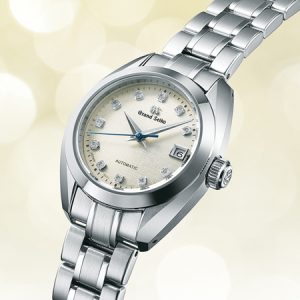
Grand Seiko celebrates 60 years of handcrafted watch precision, elegance, and Japanese authenticity. Grand Seiko is a luxury brand that offers timepieces made by skilled craftsmen by hand in two exclusive watchmaking studios, using parts produced in-house.

JAPAN SEEMS to have an obsession with time: its trains hardly ever come late, and when they do, the transportation authorities find it so atrocious that they feel the need to issue an apology. When BusinessWorld asked Grand Seiko Craftsman Takuya Nishinaka about the relationship between Japanese people and time during the 60th anniversary celebration of Grand Seiko held in the Lexus Showroom at BGC last week, Mr. Nishinaka chose not to answer the question. This is understandable — in order to answer the question, Mr. Nishinaka would have to delve deep into the history of the Japanese empire: including its meeting with the West, its navy, its school system, and its trains.

Grand Seiko exists as a brand under the Seiko holding company, which made its name in watches. The company’s history is tied to the Meiji Era, which saw Japan as an emerging power in the world stage. Scholars place the start of the Meiji period in 1868, the year the Emperor Meiji was crowned. Seiko, meanwhile, was founded in 1881. Grand Seiko, as a watch and as a brand, was first launched in 1960 to challenge the dominance of Swiss watchmakers in the market. It is still hand-assembled to this day, and all its parts come from its own manufacture. Mr. Nishinaka, through an interpreter talked about this as an advantage. “If something wrong happens, we can solve it by ourselves, because all the parts are from us, and all parts are assembled by ourselves. It’s one of the merits of manufacture.”

The brand has three collections, each designed with the premium craftsmanship combined with timekeeping technology: The Heritage Collection offers a selection of classic watches that once again brings to life the designs and style of the earliest Grand Seiko timepieces, re-interpreted with the very latest movements, manufacturing techniques and craftsmanship. The Elegance Collection has the strength and resilience to be worn every day while offering a special level of refinement that makes them the perfect choice for those landmark occasions in life where everything has to be just right. The Sports Collection diversifies the Grand Seiko brand to reach those who want to reflect a more active lifestyle, offering from divers to chronographs.

With a global theme that brings thoughtfulness to The Nature of Time, the launch also highlights the latest sought-after timepiece by global enthusiasts, the GS Snowflake. The luxury watch, familiar to collectors as the SBGA211, has a distinct dial inspired by the beauty that surrounds the dial workshop of the Grand Seiko Shinshu Watch Studio in Japan. This unique pattern resembles the snow surface blown by the rough wind in the severe winter of the Shinshu area, where the watch is made. This aesthetic, in addition to the Japanese precision movement that Grand Seiko is known for, offers a gorgeous timepiece that has a glide motion which mimics graceful movement.

Asked about the marriage between hand-assembly and the constant new technology frequently the hallmark of Japan, Mr. Nishinaka said, “It’s very difficult to answer your question here because this is also our challenge.”

Seiko’s longtime business partner in the Philippines, Timeplus Corp. President Karl Dy, meanwhile, announced in a press release, “We are proud to bring in the Grand Seiko concept store to the country, especially with the expertise that has been shared with us by Craftsman Nishinaka, to demonstrate the technology that goes inside each timepiece. Aside from the Snowflake, we are planning to bring in more styles in the future for our collections from the proud 60-year history of the brand.”

Previously, watch enthusiasts have had to search for the watches abroad. Some pieces are in the country, sold under Seiko boutiques (such as the one in SM Aura).

But back to time: According to a paper titled “Japanese Clocks and the History of Punctuality in Modern Japan” by Takehiko Hashimoto in the East Asian Science, Technology and Society International Journal, the Japanese obsession with time began in the tail end of the aforementioned Meiji period. Opening Japan’s borders brought in many engineers and professionals from the West, who were frustrated with the Japanese indifference to time as governed in the West: through cogs in clocks. Japan, prior to that period, measured time according to incense, temple bells, and the seasons (although clocks have been present in Japan at least since the 16th century). Punctuality was achieved through the government’s strict policies on time, starting them early by enforcing them in the new public school systems, the sudden large numbers of factories, the newly constructed railways, and government offices.

Mr. Nishinaka has won several awards and certificates for his craft, like the Gold Medal on Japan Technical Skill Olympics in Watch Repairing in 2012, and the 1st Level National Certificate of Skilled Watch Craftsman. As part of his job, he also trains new craftsmen for the company. He can be said to have time on his hands: he makes watches that show humankind’s attempts to grasp the concept of time — and each attempt costs hundreds of thousands of pesos The Snowflake, for example, can cost €6,000, or P339,000.

Answering a question about his own relationship with time (and not Japan’s), he had this to say: “Time is very important. We cannot buy time.” — Joseph L. Garcia

Do you really need an international driver’s license?

With very few exceptions, you don’t. I’ve rented cars and driven in several countries with only my Philippine driver’s license.

Yesterday I saw an ad on my Instagram feed from a website that offers international driver’s permit (IDP). They’ll mail you a printed one, and a digital one in two hours with the fees going from $56 (one year) to $66 (three years) for both.

Two things irked me about this ad. One, it felt like I was being spied on because I had just googled car rental rates in a particular country on Sixt where I already have an account. Two, as a Filipino tourist, I’ve never been asked to present an international driver’s permit. I’ve rented cars — and driven those cars just to be clear — in several countries with only my valid Philippine driver’s license and passport. (For other nationalities who use characters — and not Roman alphabet — in  their language, an IDP is required for translation purposes in addition to their local license).

These websites might be the biggest and longest-running scams targeting independent travelers who don’t take organized tours and are unsure about driving abroad, because when you inquire if you need one, they never give you a straight answer. I was given a link to a list of countries, which I knew was wrong based on my own experience of renting cars there. So you end getting an IDP for a country that doesn’t require it.

With few exceptions — like Japan, I am told — you really don’t need it.

But, all right, I’m playing. I went to the website on my laptop and immediately a chat box popped up. “I’m online! Let me know if you need any help,” Sara the customer service rep said. 

“Do you really need an international driver’s permit for, say, Turkey or the Czech Republic?” I wrote. I already knew the answer because I’ve driven in those two countries as a tourist.

“It’s highly recommended to have an international driver’s license with you when you travel as many car leasing companies and authorities require you to have one,” she said.

See how she didn’t answer with a yes or no? “It’s highly recommended…”

It’s like asking someone selling magic diet pills if they would make you lose weight faster and they respond with, “They’re highly recommended…”

Deniability. They’re not exactly saying yes because the true answer is probably no. They’re also putting doubt in your mind about using your local driver’s license on two counts — that car-leasing companies would deny you rental, and that cops require you to have one.

I’ve rented cars from Sixt, Budget, Dollar, Europcar and Enterprise in Istanbul, Antalya and Bodrum in Turkey; in Prague, Santorini and Paris; and in the Balkans in Sarajevo, Bosnia, and Herzegovina; Tivat in Montenegro; and Dubrovnik in Croatia. Not a single one of these companies in these cities asked me for an international driver’s license.

You do have to have the actual driver’s license card with you, not the receipt. In 2016 or 2017— that Jurassic Period in LTO when issuance of the actual cards was delayed from months to a year — a rental in Istanbul had to be transferred to a friend’s name because all I had was the LTO receipt. He laughed at me, saying, “What the hell is that paper?”

On whether authorities would require you to have an international permit, well, if the rental company isn’t requiring you to have an IDP for them to release a vehicle to you, the cops won’t either. In 2017, I drove in three Balkan countries that were beside each other because I didn’t want to depend on buses (they don’t have cross-country trains like most European countries). Besides, I wanted my own schedule, to stop where and when I wanted to, and to skip tourist sights I wasn’t interested in.

I collected my first car at Sarajevo airport and me being a Manila driver beat the red light two intersections later. Two Bosnian cops pulled me over. In my head, I was like, “Oh shit! Tanya, you’re not in Manila anymore. You’re in Bosnia where your phone doesn’t work (apparently Globe has no telco partners in Bosnia, Montenegro and Macedonia — I don’t remember about Serbia — but in Croatia it did).” 

Anyway, the cops did not ask me to show an international driver’s license. I handed over the rental agreement and my Philippine driver’s license.

They didn’t speak English, I didn’t speak Serbo-Croatian, so I played the stupid tourist and apologized. I showed them the address I was looking for, and in the end they not only let me go, they also convoyed me to my airbnb because I was truly lost.

Oh, the misadventures when driving abroad! Maybe I’ll write about that in the next column.

* * *

Tanya T. Lara is the Philippine Star’s Property Report editor and Lifestyle assistant editor. When she’s not getting depressed over Metro Manila traffic, she writes about her travels on her blog at www.findingmyway.net. Follow her on Twitter and Instagram @iamtanyalara.

Vivant allots at least P1B for energy projects this year, expects to break P2-B profit mark

THE energy unit of Vivant Corp. is setting aside at least P1 billion in capital expenditure this year as it plans to bid for power generation projects in off-grid areas, including those in Palawan.

The budget this year comes as the listed company is bullish about its financial performance in 2019 when its new power plant projects started to turn in revenues.

“For the first time, there’s a good sense we could break the P2-billion mark,” Emil Andre M. Garcia, chief operating officer of Vivant Energy Corp., told reporters last week. He was referring to the expected income of Vivant Corp., in which he is one of the directors.

“But again, the numbers are still being finalized but it was a good year,” he added.

Mr. Garcia is also optimistic about 2020 as the company embarks on new projects.

“We’re joining the bid for Paleco (Palawan Electric Cooperative). There’s an invitation to bid for El Nido which we’ll join as well,” he added about plans to enter the popular tourist destination in Palawan, the off-grid island province in Luzon.

Mr. Garcia said the subsidiary is also bidding for projects in the island of Marinduque.

“With all of that, I’m sure we can get at least one or two more projects,” he said. “We hope to groundbreak within this year.”

He placed the target capacity for the Paleco bid at 20 megawatts (MW), while that of El Nido at 10 MW. He said the Marinduque bid could reach a total capacity of 16 MW, which is broken to three projects with the biggest component at 8 MW.

Asked about the budget for the projects, he said: “We could go over a billion [pesos].”

Aside from the projects that are up for bidding, Vivant Energy targets to start this year a diesel-fired power facility in Bantayan, an island town north of Cebu City.

“We’ll start construction there in April,” Mr. Garcia said.

The project involves the construction and operation of a 23-MW power generation facility, namely: two bunker fuel-fired units each with a capacity of 7.5 MW; and three bunker fuel-fired units each with a capacity of 2.8 MW.

The facility is under a 15-year contract to supply 15 MW of net dependable capacity to Bantayan Electric Cooperative, which awarded the project to partners Vivant Integrated Diesel Corp. and Gigawatt Power, Inc. in Oct. 2019.

The company is also building a facility using a hybrid of solar, diesel and battery technologies to serve the municipalities of Linapacan and Culion in Palawan.

The project is under Culna Renewable Energy Corp., a partnership among Vivant Renewable Energy Corp., Gigawatt Power and WEnergy Global Pte. Ltd.

In Culion, the facility is a diesel-solar-battery hybrid with a respective capacity of 2.42 MW, 2.8 MW, and 4.78 MW, respectively, at a cost of P632 million.

In Linapacan, the diesel-solar hybrid will have a respective capacity of 540 kilowatts and 330 kilowatts. The cost is placed at P125 million.

Shem Jose W. Garcia, Vivant Corp. head corporate communications and business development innovation, described 2019 as a “really good year” for the listed company. — Victor V. Saulon

ADM sees no significant coronavirus impact

CHICAGO — The coronavirus that is quickly spreading across China and beyond is not expected to have a significant business impact on global grain trader Archer Daniels Midland at this point, Chief Executive Officer Juan Luciano said on Thursday.

The company, which operates in China, however, could be impacted if the coronavirus outbreak impacts the global gross domestic product, Luciano said during a post-earnings conference call with analysts.

“We are in a very fundamental business, which is the business of food,” Luciano told analysts. “So I think that we will be impacted to the extent that GDP, the global GDP will be impacted — and that will depend on the magnitude” of the outbreak.

Luciano said that consumer dining and entertainment habits will likely shift, where people will stay at home instead of going outside.

“Maybe pulp consumer products could be impacted in demand, but people will have to eat inside anyway. So in that sense, more the packaged goods will probably pick up a little bit,” Luciano said.

“At this point in time, we don’t expect a significant impact in our business,” he said.

The International Monetary Fund said it is closely monitoring China’s coronavirus outbreak, but it is too soon to quantify the global potential economic impact.

Oreo cookie maker Mondelez International Inc. expects its first-quarter revenue to be impacted by the virus while Starbucks Corp. has closed thousands of restaurants in China.

Infections from coronavirus spread to more than 8,100 people globally on Thursday, surpassing the 2002-2003 SARS epidemic’s total in a fast-spreading health crisis forecast to pummel the world’s second-largest economy.

The vast majority of patients are in China where the virus originated in an illegal wildlife market in Wuhan city and has also claimed 170 lives, latest official data showed.

ADM has approximately 1,100 employees in China, and no employees have fallen ill, Luciano said.

The Chicago-based company also holds a significant stake in the Asia-focused Wilmar International Ltd., which shuttered its two facilities in Wuhan for the Chinese Lunar New Year. Its facility in Shanghai is closed until Feb. 9, Luciano said.

It is unclear when those facilities will reopen, he said.

On Wednesday, Wilmar said it has sufficient inventory to meet normal business demand, and is working with its suppliers and distributors to ensure a stead supply of products.

ADM reported its fourth-quarter earnings on Wednesday after markets closed. — Reuters

Yields on government debt drop on virus, rate cut bets

YIELDS ON benchmark government securities (GS) dropped last week amid continued concerns on the impact of the novel coronavirus acute respiratory disease (2019-nCoV ARD) on the global economy, dovish statements from the US Federal Reserve and the market’s anticipation of further rate cuts by the Bangko Sentral ng Pilipinas (BSP) this year.

Bond yields, which move opposite to prices, fell by an average of 7.2 basis points (bps) week on week, according to data on the PHP Bloomberg Valuation Service Reference Rates as of Jan. 31 published on the Philippine Dealing System’s website.

At the secondary market, rates of the 91- and 182-day Treasury bills (T-bill) fell by 0.4 bp (to 3.303%) and 4.4 bps (to 3.474%), respectively. The 364-day T-bills went the opposite direction, increasing by 2.6 bps to fetch 3.896%.

At the belly of the curve, the two-, three-, four-, five-, and seven-year Treasury bonds (T-bonds) rallied, with their yields declining by 4.1 bps (4.062%), 2.5 bps (4.232%), 3.8 bps (4.328%), 6.9 bps (4.382%), and 13.6 bps (4.427%), respectively.

Long-term debt papers also rallied with rates of the 10-, 20-, and 25-year T-bonds declining by 14.2 bps (4.456%), 16.9 bps (5.051%), and 15 bps (5.161%).

“Local yields fell broadly, mainly driven by market fears over the possible economic impact of the novel coronavirus to global economic activity. Moreover, yields likewise declined following dovish remarks from the Federal Reserve with its strong commitment to bring US inflation within the two-percent target,” a bond trader said in an e-mail interview, noting the declines were “amplified toward the long-end of the yield curve.”

“Yields were down across-the- board [last] week on speculation that the BSP will soon cut rates, and due to lower US Treasury yields,” Security Bank Corp. First Vice-President and Head of Institutional Sales Carlyn Therese X. Dulay said in a separate e-mail.

Ms. Dulay noted that yields also went down due to the “resounding success” of the government’s 23rd offer of retail Treasury bonds (RTBs).

The coronavirus outbreak started in Wuhan, China, with the death toll rising to 304 as of Feb. 1, with more than 14,000 cases recorded.

On Sunday, the Department of Health (DoH) reported the first 2019-nCoV ARD death outside of China, as another patient positive for the virus died on Feb. 1. This brought the confirmed cases in the Philippines to two.

The DoH said the first 2019-nCoV ARD fatality in the country was a 44-year-old man who traveled to the Philippines from Wuhan, China with the 38-year-old woman who was confirmed positive for the virus last week.

As of Sunday, the DoH said there are 36 persons under investigation for the virus.

Meanwhile, the Bureau of the Treasury awarded P134 billion worth of three-year RTBs at the rate-setting auction for the papers out of the total bids worth P149.827 billion. This was almost five times the initial offer of P30 billion, which prompted the government to upsize the acceptance.

The papers were quoted at a coupon of 4.375%, higher compared to the 4.25% coupon fetched for the three-year RTBs issued last April 2017 or RTB 3-08. Proceeds from the issue will be used for general budgetary purposes including the state’s critical infrastructure projects and social services.

The three-year RTBs are now being offered to the general investing public for minimum denominations of P5,000, with the public offer period set to run until Feb. 6, unless the Treasury closes it earlier.

On the other hand, BSP Governor Benjamin E. Diokno said the central bank is still looking to cut rates by at least 50 bps this year, with a 25-bp cut possible as early as this quarter.

The BSP’s Monetary Board will hold its first policy meeting for the year this Thursday. Its other review for the quarter is on March 19.

Mr. Diokno said the BSP’s policy decision will mainly depend on inflation and other data and need not follow the US Federal Reserve’s move to keep rates steady at their first review on Jan. 28-29.

Moving forward, Security Bank’s Ms. Dulay expects GS yields to continue its downward trend this week “as market players reposition.”

For the bond trader: “Local yields might show an upward bias amid likely stronger local inflation report for January 2020, which might be offset by the impact of a possible policy rate cut from the BSP and likely weaker US labor reports.”

“The increase in yields, however, might be capped by lingering concerns over the novel coronavirus and rising bets of a US rate reduction this year,” the bond trader added. — Edwin C. Aruta, Jr.

Nike’s carbon-fiber running shoes get clearance for Olympics

NIKE, INC.’s high-tech running shoes will be permitted in competitions like the Olympics and World Championships, following a landmark ruling from track and field’s international governing body.

World Athletics said Friday, however, that there is “sufficient evidence to raise concerns that the integrity of the sport might be threatened by the recent developments in shoe technology.” It issued a few new restrictions on shoe construction and said it would do more research to see if more parameters are needed.

The two main new guidelines: Shoes cannot have more than one carbon-fiber plate, and the height of the sole cannot exceed 40 millimeters. All of Nike’s Vaporfly shoes currently available to the public satisfy both those criteria. It’s unclear whether prototypes like the ones worn recently by elite marathoner Eliud Kipchoge would also be allowed under the new rules.

“It is not our job to regulate the entire sports shoe market, but it is our duty to preserve the integrity of elite competition by ensuring that the shoes worn by elite athletes in competition do not offer any unfair assistance or advantage,” World Athletics President Sebastian Coe said in a statement. “As we enter the Olympic year, we don’t believe we can rule out shoes that have been generally available for a considerable period of time, but we can draw a line by prohibiting the use of shoes that go further than what is currently on the market while we investigate further.”

LIGHTNING ROD
Friday’s ruling is at least a short-term boon to Nike and its professional athletes. Since the first Vaporfly shoe debuted in 2017, the technology has been a lightning rod for debate in the running community. Featuring thick foam, a steep forefoot and a carbon-fiber plate within the sole, the shoes were promised to increase efficiency — and therefore speed — by at least 4%. Over the course of a two-hour, 10-minute marathon, that’s a difference of more than five minutes.

The five fastest official marathons of all time have come in the shoes, all within the last two years. Two of the five fastest women’s marathons were also in Vaporfly. When the Kenyan runner Kipchoge last year became the first person to run 26.2 miles in under two hours — not an official time but nonetheless a barrier some thought impossible — he was wearing the latest prototype of the shoe.

The Nike shoes, which sell to the public for $250, also became popular among serious amateur runners. The starting lines at marathons across the country are speckled with the neon orange, green, and pink of Nike’s Vaporfly models.

The shoes worn by Kipchoge aren’t yet on sale to the public and it’s unclear if they’ll be allowed in the Olympics, since Nike hasn’t given the sneakers’ specifications. It’s also not clear how the ruling might affect other companies that are close to releasing similar shoes of their own.

The success of runners in those Nike shoes put pressure on pros to sign with the Beaverton, Oregon-based sportswear giant. It also put pressure on smaller shoe companies to create sneakers with similar properties.

LITTLE IMPACT
Analysts don’t expect the approval to make much difference to Nike’s bottom line. “Nike has not made a lot of these shoes,” said Matt Powell, NPD Group’s senior industry adviser for sports, before the decision was announced. “Impact will be minimal.”

A move of this sort by World Athletics, formerly the International Association of Athletics Federations, isn’t without precedent. About a decade ago, Speedo International Ltd. unveiled a full-body swimsuit that radically changed competitive swimming. More than 100 world records were broken in the Speedo suit or those like it, leading some to compare it to doping. The Federation Internationale de Natation, swimming’s governing body, voted overwhelmingly in 2009 to ban the high-tech suits, imposing restrictions on the materials and the amount of the body they could cover.

For decades, World Athletics has been intentionally vague about what footwear is and isn’t allowed. The governing body’s guidelines said only that shoes “must not be constructed so as to give athletes any unfair assistance or advantage.” It later added that the shoes must be “reasonably available” to the public.

Facing heat over the Vaporfly shoes, World Athletics’s Technical Committee formed a working group last year to help clarify the rules. The group, which included athletes, scientists, and ethics experts, sought a middle ground between innovation and fairness.

Nike isn’t the only company making shoes that might be affected. In the wake of the Vaporfly’s success, a number of other companies have released shoes with similar properties. Deckers Outdoor Corp.’s Hoka released its own $180 carbon-fiber shoe last May. Berkshire Hathaway, Inc.’s Brooks is planning a $250 elite running shoe this year; Saucony, Inc. has had one in the works for more than two years. — Bloomberg

Expectations of profitability boost PhilWeb’s stock price

By Jobo E. Hernandez

PHILWEB Corp. was among the most actively traded stocks last week with traders taking their cue from news regarding the firm being in talks with an online gaming provider in a bid to return to profitability this year.

A total of 166.27 million PhilWeb shares worth P720.59 million were traded from Jan. 27 to 31, data from the Philippine Stock Exchange showed. This makes the stock the 12th most actively traded in last week’s session.

PhilWeb’s shares closed at P3.45 per share on Friday, down nine percent from P3.79 a week ago. Since the start of the year, the stock’s price has risen by 36.9%.

“PhilWeb almost hit its ceiling on Jan. 24, on the news that it will be profitable again this year, and [that] it will be having a strategic partnership with a local firm working with the ‘biggest POGO (Philippine Offshore Gaming Operators) operator in the world,’” Philstocks Financial, Inc. Research Associate Claire T. Alviar said in an e-mail last Friday.

“These boost optimism in the investors’ sentiment that, after almost three years of losses, it will be able to turnaround into profits. This means that PhilWeb can declare dividends again,” she added.

Ms. Alviar noted that following the news, investors started to take positions and bargain hunt, causing a short-term rally of the stock. “This optimism [continued last week], reaching an intraday-high of P5.17 per share last Jan. 27, almost 37% up versus Jan. 24’s P4.12 closing price,” she said.

“However, profit taking prevailed as traders await further plans of PhilWeb for its recovery this year and to know the details on a strategic partnership. Some investors are waiting for the full year 2019 results to see if PhilWeb were able to continue to trim losses,” Ms. Alviar said.

Regina Capital Development Corp. Head of Sales Luis A. Limlingan shared this assessment, saying in a phone interview that investors are still speculating on the company’s profitability as the reported partnership “is still on the table.”

PhilWeb Vice-Chairman Crisanto Roy B. Alcid told reporters on Jan. 23 that the company was “officially in negotiations” with a local firm for a “strategic partnership” in order to expand its e-games and e-bingo business. He declined to identify the firm, but noted it to be working with “one of the biggest POGO operator in the world.”

PhilWeb is owned by Gregorio Ma. Araneta III after Roberto V. Ongpin sold all his shareholdings in the firm in 2017. The company draws the bulk of its revenues from about 66 e-Games outlets and more than 20 e-bingo outlets.

The company aims to have at least 100 e-gaming locations within the year.

Starting this month, PhilWeb will be under the leadership of Senior Vice-President for Gaming Brian K. Ng, who is replacing President Dennis O. Valdes as he moves to Ongpin-led Alphaland Corp.

The company trimmed its attributable net losses by 82.1% to P4.5 million in the third quarter last year from P25.2 million in the same period in 2018. In the nine months to September, its net loss was at P26.79 million, 62% less than P70.53 million in January-September 2018.

PhilWeb previously had 288 operating e-Games cafés licensed by the Philippine Amusement and Gaming Corp. (Pagcor), but the regulatory authority declined to renew the firm’s license in 2016, hampering its operations.

PhilWeb was able to resume operations with an initial 16 electronic gaming locations in December 2017 following the resolution of issues with Pagcor. The firm was then allowed to fully resume its operations in March 2018.

Regina Capital’s Mr. Limlingan placed the stock’s support at P3.30 and resistance at P4.80.

For Philstocks’ Ms. Alviar: “We see support around P3.20 and at psychological support of P3.00, while resistance is at P4.00 and second resistance is at P4.50.”

Raw sugar prices seen extending advance

LONDON — Raw sugar futures are expected to rise a further 3% by the end of the year boosted by a tightening in supplies, a Reuters poll of 12 traders and analysts showed on Friday.

Prices were seen ending 2020 at 15 cents per lb, up 3% from Thursday’s close and 12% above levels at the end of 2019, according to the median forecast.

The poll consensus was for a global deficit of 1.15 million tonnes in the 2020/21 season following a deficit of 6.72 million in the current season.

The smaller deficit was driven by an expected rise in Indian production with a median forecast for 2020/21 of 31.10 million tonnes, up from 26.55 million seen for the prior season.

Several respondents cited the extent to the recovery in India’s sugar production as a driver of prices in 2020.

Production in the Centre-South region of Brazil in 2020/21 was seen at 29.40 million tonnes, up from about 26.60 million in 2019/20.

Supplies of sugar are influenced heavily by relative prices of sugar and biofuel ethanol in Centre-South Brazil, both of which use cane as a feedstock.

The poll forecast that 36.5% of cane would be used to produce sugar although respondents noted that trends in energy markets could trigger significant shifts in production.

An all-time low of about 34.1% was allocated to sugar in the 2019/20 season.

One participant said the tightening in supplies had resulted in a premium for nearby delivery, known as a backwardation, which could encourage funds to further expand their current net long position.

Funds need to roll positions forward during the course of the year as they do not generally want to receive physical products. Rolling a long position forward when the market is in backwardation yields a profit.

Prices for white sugar were seen ending 2020 at $400 per tonne, down 2% from Thursday’s close but 11% above levels at the end of 2019 after a sharp rise this month, according to the median forecast. — Reuters

Peso seen to strengthen on possible BSP easing

THE PESO is likely to strengthen this week with a rate cut possibly on the table and with inflation still manageable despite a possible uptick.

The local unit ended at P50.83 on Friday, strengthening by 13 centavos from its P50.96-per-dollar finish on Thursday, according to data from the website of the Bankers’ Association of the Philippines.

However, it was weaker by 1.50 centavos from its P50.815 a dollar finish on Jan. 24.

UnionBank of the Philippines, Inc. Chief Economist Ruben Carlo O. Asuncion said there was positive sentiment in the market, with authorities calling for a stronger response against the novel coronavirus outbreak.

“Investors can be seen as still weighing the potential short-term impact of the virus spread. However, it seemed tilted to the positive with the WHO (World Health Organization) declaration including the commendation of China’s efforts to stop the disease,” Mr. Asuncion said in a text message.

Rizal Commercial Banking Corp. (RCBC) Chief Economist Michael L. Ricafort also said that market worries “somewhat eased” with WHO expressing “confidence on China’s ability to control the outbreak.”

Reuters reported that China’s new confirmed infections from the coronavirus outbreak increased by a daily record, up by 2,590 cases on Saturday to top 14,000, as the quickly growing epidemic prompted global travel restrictions and evacuations.

The death toll from the coronavirus outbreak in China had reached 304 as of the end of Saturday, state broadcaster CCTV said on Sunday, citing the country’s National Health Commission.

All the new deaths and most of the new infections on Saturday were in central Hubei province, the epicenter of the flu-like coronavirus outbreak.

The WHO this week declared the outbreak of the virus — officially called 2019 novel coronavirus acute respiratory disease (2019-nCoV ARD) — a public health emergency of international concern, but said global trade and travel restrictions are not needed.

On Sunday, the Department of Health (DoH) reported the first 2019-nCoV ARD death outside of China, as another patient positive for the virus died on Feb. 1. This brought the confirmed cases in the Philippines to two.

The DoH said the first 2019-nCoV ARD fatality in the country was a 44-year-old man who traveled to the Philippines from Wuhan, China with the 38-year-old woman who was confirmed positive for the virus last week.

As of Sunday, the DoH said there are 36 persons under investigation for the virus.

Analysts said markets will continue to track both local and international developments this week.

“This week, uncertainties may still be expected due to the 2019 coronavirus outbreak,” UnionBank’s Mr. Asuncion said.

Meanwhile, RCBC’s Mr. Ricafort said factors that may affect peso trading this week will include inflation, the central bank’s decision on policy rates, as well as developments related to the coronavirus.

“Major catalysts next week include the latest inflation data on Feb. 5 and the BSP’s (Bangko Sentral ng Pilipinas) monetary policy-setting meeting on Feb. 6, as well as developments related to the coronavirus especially on measures to contain it,” he said.

BusinessWorld’s poll of 13 economists yielded a median estimate of 2.7% for January headline inflation, with analysts citing upside risks from the Taal Volcano eruption and a rise in some food prices still due to the African Swine Fever.

If realized, the reading will mark the third straight month of an uptick in inflation and will be faster than the 2.5% seen in December. However, this is still slower compared to the 4.4% pace in January 2019 and also falls closer to the lower end of the 2.5-3.3% range given by the BSP. This is also well within the 2-4% target for the year.

Meanwhile, 10 out of the 13 economists who joined the inflation poll were of the view that the Monetary Board will ease rates by another 25 basis points (bps) this Feb. 6.

BSP Governor Benjamin E. Diokno last week said the central bank is still looking to bring down rates by around 50 bps in 2020. He said a 25-bp cut could also be considered as early as this quarter.

The BSP last year cut rates by a total of 75 bps, partially unwinding the 175 bps worth of hikes implemented in 2018 to quell multi-year high inflation.

Key policy rates currently stand at four percent for the overnight reverse repurchase facility, while overnight deposit and lending rates are at 3.5% and 4.5%, respectively.

For this week, UnionBank’s Mr. Asuncion gave a forecast range of P50.70-P51, while RCBC’s Mr. Ricafort said the peso may play around the P50.60-P51 levels. — L.W.T. Noble with Reuters

UNIQLO focuses on 1920’s style in latest special collection

AT the beginning of the year, BusinessWorld predicted that fashions from the 1920s would come back in style, thanks to Laver’s Law.* Japanese global retailer Uniqlo, in its latest collaboration with model and author Ines de la Fressange, has coming out with a collection based on the year 1924.

Uniqlo’s Ines de la Fressange 2020 Spring/Summer collaboration line features fashion inspired by the Summer Olympics of 1924, which was held in Paris. By then, the pre-World War strictures prescribed on women (in clothing, at least) were being chipped away. The corset, for example, was on its way out permanently. In certain contexts, trousers were seen on women (only at sea or at the beach, anywhere else would have been scandalous). But especially, the freedom of movement given to women by the ’20s also allowed them to participate in some sports (women had played sports in previous decades, but sportswear looked remarkably as heavy as daywear).

This is reflected in the loose, flowy garments suggestive of the gamine from the collection, rendered either in pastels, soft earth tones, or florals. Other pieces are inspired by French cowboys in Arles (the denim), as well as outdoor life in the 1920s (garden parties!).

There’s more than a touch here of the early styles that made Gabrielle “Coco” Chanel a household name in the 1920s. There are sweaters and jackets with contrast piping, beige and black cardigans, pussy bows, white cuffs on shirts, and a fit recalling relaxation in power. It’s an affectionate recall, as Mlle. De la Fressange, daughter of a marquis and a model, embodied the early Lagerfeld period of the Chanel brand. Rumor has it that she was selected as a model due to her resemblance to the house’s founder, Coco herself.

The complete 54-piece 1924-themed collection will only be available at the Uniqlo Flagship Store, Glorietta 5, and through uniqlo.com. A few pieces will be made available in stores nationwide. — Joseph L. Garcia

* https://www.bworldonline.com/the-1920s-in-the-2020s/

AVID sales up 12% in Dec., but 2019 still dips 0.5%

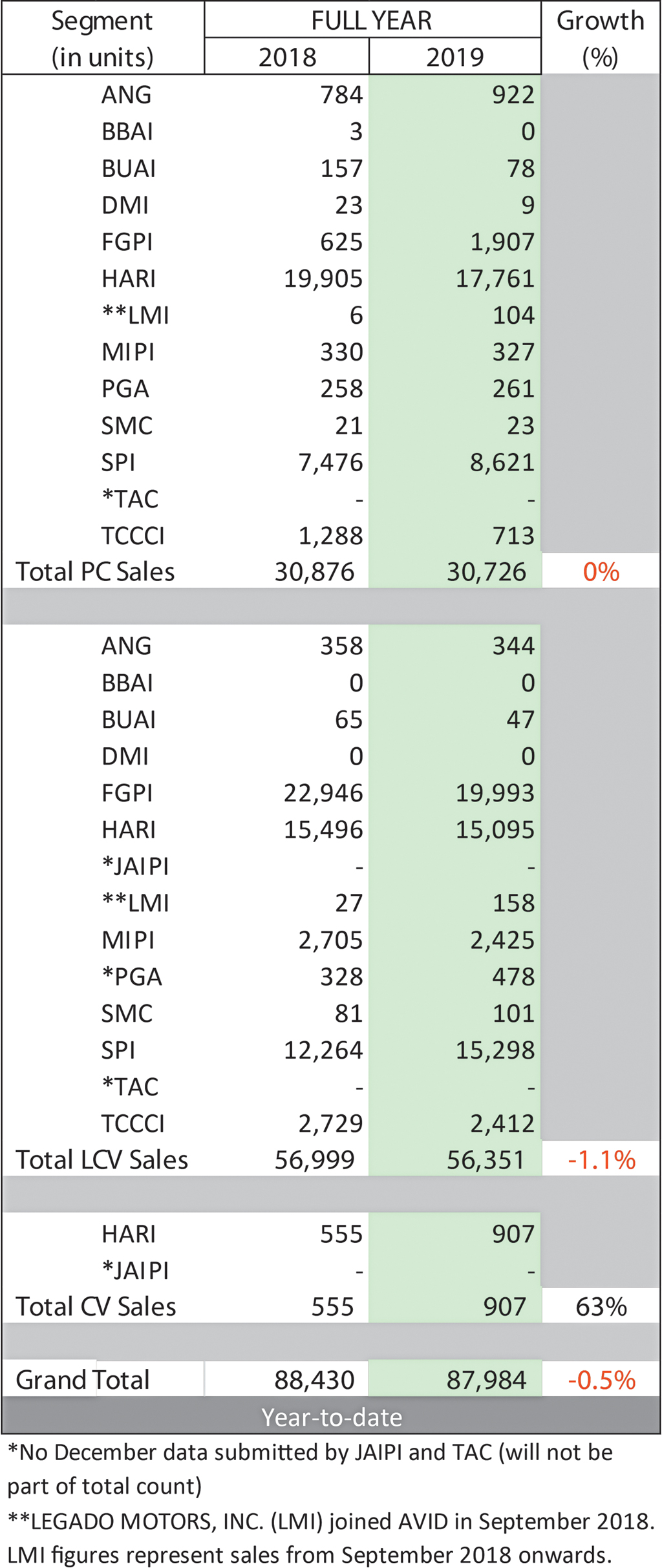
THE ASSOCIATION of Vehicle Importers and Distributors, Inc. (AVID) registered sales of 8,089 units in December 2019, representing a 12% increase versus the same month in 2018. The full-year total was 87,984 units — a decrease of 0.5% compared to 88,430 units sold the previous year.

Said AVID President Ma. Fe Perez-Agudo in a release: “AVID’s performance in the last month of the year augurs well for the automotive industry as we begin the Year of the Metal Rat and the new decade. The continued easing of inflation rates, lower fuel prices, and increased government spending will only bolster sales for the group. We will complement these positive indicators with new models, value-packed service offerings, and easier ownership schemes.”

Passenger car (PC) sales were lower by 0.5% from 30,876 units sold in 2018 to 30,726 last year. Hyundai sold the most in the segment — surpassing all reporting AVID members combined — with a total of 17,761 units in 2019. Suzuki followed with 8,621 units. The PC segment climbed by five percent in December 2019 alone with 2,608 units versus the same month in 2018.

In the light commercial vehicle (LCV) segment, AVID recorded a 1.1% dip in 2019 sales — from 56,999 units sold in 2018 to 56,351 units in 2019. December performance, however, was encouraging as sales increased by 16% in December 2019 alone with 5,362 units sold versus the same month last year. Ford led the segment with a total of 19,993 units sold, followed by Suzuki (15,298), and Hyundai (15,095).

AVID collectively recorded a 63% year-on-year increase in commercial vehicle (CV) sales, led by Hyundai trucks and buses.

The association said that with the approval of the P4.1-trillion national budget for 2020, and with the public works and highways department having one of the largest shares of the budget, “it is expected that industry performance will gain traction in the new decade with the help from its importers bringing in more models that meet the requirements of various markets for the Filipino people.”

Ms. Agudo asserted, “It is appropriate that the recent budget carries the theme ‘Continuing the journey to a more peaceful and progressive Philippines’ since it focuses on critical infrastructure, human capital development, and peace and order initiatives. AVID hopes to contribute to this aim by offering better mobility solutions for both public and private sectors.”

Kiehl’s offers skin checks at special set-up

AMERICAN beauty brand Kiehl’s is encouraging people to start the new year right with better skincare as it promotes its Ultra Facial and Ultra Facial Oil-Free Moisturizers to keep skin hydrated and protected from the elements.

“It doesn’t matter what skin type you have, you need a good moisturizer to keep your skin healthy,” Kaila Nicdao, business unit director for L’Oreal Luxe, told BusinessWorld during an event on Jan. 29 at the Glorietta Activity Center in Makati City.

The experience at the Glorietta Activity Center, which runs until Feb. 4, encourages visitors to have their skin checked by Kiehl’s customer representatives so they can “best determine the ideal skincare routine for your needs,” according to a press release.

Moisturizers are products that protect the skin from transepidermal water loss from the skin’s moisture barrier — in short, it helps the skin retain moisture. The skin’s moisture barrier — the skin’s outermost layer — protects the body against bacteria and environmental damage. If the barrier loses too much moisture, environmental aggressors can penetrate the skin.

The Kiehl’s Ultra Facial cream, which has been a company staple since the 1970s, and Oil-free formula both contain Antarcticine, a “glacial glycoprotein extract” meant to moisturize dry skin and hold even in extreme cold. It also contains Imperata Cylindrica roots said to contain high concentrations of potassium which provide “immediate and lasting hydration for the skin,” and the Kiehl’s signature product: squalane, a botanical lipid similar in molecular structure to natural skin lipids. Squalane is said to absorb easily in the skin and help restore the skin’s moisture balance.

Ms. Nicdao noted that while Kiehl’s original Ultra Facial Cream has always sold well, they noticed that in the past year that the oil-free gel formula has gotten more popular which is “a good sign that even people with oilier skin are starting to use moisturizers.”

“In the past, people with oily or combination skin shies away from moisturizers because they’d feel it makes them oilier, but with our oil-free formula, it provides moisture without making you feel oilier,” she said.

Both products claim to provide “24-hour hydration.” The Ultra Facial Cream is priced at P995 for a 28 ml tube, and P3,600 for 125 ml. The Oil-free gel cream is priced at P1,850 for 50ml. — Zsarlene B. Chua

ADVERTISEMENT
ADVERTISEMENT