Home Blog Page 9933

Musings on Identity and the Internationalization of Higher Education Institutions

Internationalization “at the national, sector, and institutional levels is defined as the process of integrating an international, intercultural, or global dimension into the purpose, functions or delivery of postsecondary education” (Knight, J. 2015).

As the wave of internationalization sets its course and positions Higher Education Institutions (HEIs) in the developing world, we pose questions that are felt but not directly answered: Does internationalization collide against the identity and mission of, particularly, HEIs in the global south? Do the forces of internationalization, enveloped by the rules and the norms that govern HEIs in the global north — actors that currently lead the discourse and practices on global rankings — diminish, alter, or hybridize the identities of HEIs in the global south? How do HEIs respond?

HEIs with religious affiliation may present an additional concern: Does internationalization infringe upon the objectives of teaching as mission and as formation? Educators from HEIs in the global south have argued that formation programs are not one of those that are counted in the global rankings, but instead, metrics based on the number of inbound and outbound students, faculty mobility, number of visiting professors, faculty-to-student ratio, amount of external grants, and the number of research collaborations, etc. are surveyed to quantify and measure internationalization.

To answer the question of how internationalization impacts on the HEI’s identity is not an easy task. Defined as one’s conception of the self, identity is concurrently formed by how others perceive the self. The notion of multiple identities, in which each role attaches differing expectations is illustrated in the role of a professor, who is at the same time a parent at home and a volunteer in his/her community. One’s identity, is thus constructed and shaped by context. While the context dictates, the actor plays a primary role in configuring and re-configuring one’s identity (Wendt, A. 1992).

Multiple layers of self-identification — the global, national, and organizational/university levels on which the HEI is anchored — interact with each other. At the global level, identity, anchored on one’s global position, shapes the HEI’s practice of internationalization, and is recursively shaped by it. Accordingly, a disparity in the motivations to internationalize between the global north and global south HEIs exists, where HEIs in the global north pursue internationalization to advance global citizenship education. They differ from the motivations of HEIs in the south, which internationalize, by and large, in order to promote mobility (Morosini, M.C., et al, 2017).

Global south countries also assume the role and identity as “senders” of outbound students to mainly English speaking and “branded” HEIs of the global north, namely, the US, UK, and Australia. This characteristic flow of international students from south to north among global south HEIs is reinforced in ASEAN countries where intra-regional student mobility remains low (UNESCO 2013). In further illustrating the influence of internationalization on identity, the cases of Malaysia and Singapore, on the one hand, are illustrative of their role transitions in international student mobility from senders to receivers or “exporters” of higher education in Asia (Malaysia) and Australia, Europe, and the US (Singapore) (UNESCO, 2013).

The impact of internationalization on identity is further shaped by the HEI’s location in the hierarchy of HEIs at the national realm. Ranked and seeded by global rankings, “first tier” HEIs (in the north), refer to research-based universities. They are differentiated from “second tier” counterparts in terms of their orientation to applied learning, reputational and academic ranking, curriculum, prestige and selectivity (De Wit, H., et al, 2015). However, these definitions do not necessarily resonate in the first tier universities of the global south, some of which are relatively smaller when measured in terms of population and size of program offerings.

As a consequence of globalization, first tier universities in the global south experience tensions caused in balancing the benefits and costs of internationalizing higher education. At the national level, regulatory regimes on internationalization are viewed to have institutionalized certain elements of managerialism (Holmes, C. and Lindsay, D., 2018): standardization and increased roles of business and technology in learning have evolved as the prerequisites for international and regional assessments and accreditation. Emergent transnational higher education (TNE), ushering the beginnings of branch and international branch campuses, is perceived to have marketized higher education or the competition by HEIs for an international student market share (UNESCO, 2013).

How have specific HEIs in the Philippines responded? A type of response at the organizational/university level is based on the assertion of “traditional identity.” For HEIs with religious affiliations, this may include the following responses: reflexive measures that seek to assess levels of mission and/or religious tradition-based identification as reflected in the institution’s vision, governance, instruction, assessment, research and service; a related response is anchored on the deepening of conversations between lay leaders and networked religious order-based organizations on topics centered on the notion of “global identifiers” and how these translate to “institutional identity” (ICAJE, 2019); identity assertion is also demonstrated in the institution of a “core” curriculum anchored on social formation and mission and reflective of a specific educational philosophy; and, integration of social formation in a curricular framework that includes the core, major, and co-curricular courses.

These meaningful and continuing exercises on self assertions are designed to address the homogenizing impact of educational globalization on identity.


Alma Maria Salvador, PhD is an Assistant Professor of Political Science in Ateneo de Manila University. This piece is inspired by an article written by one of the university’s educational leaders as a framed response to global rankings in 2006.
Power security and competition

Last week I attended two energy fora where some important data and issues were discussed. First the “Market Operations 2019,” a media briefing by the Independent Electricity Market Operator of the Philippines (IEMOP), on Jan. 30 at the trading floor of the Wholesale Electricity Spot Market (WESM). Second, the Keynote Speech of Senator Sherwin Gatchalian, Chairman of the Senate Committee on Energy, at the “Forum on Competition in Developing Countries” on Jan. 31 at Sofitel Philippine Plaza, sponsored by the Philippine Competition Commission (PCC).

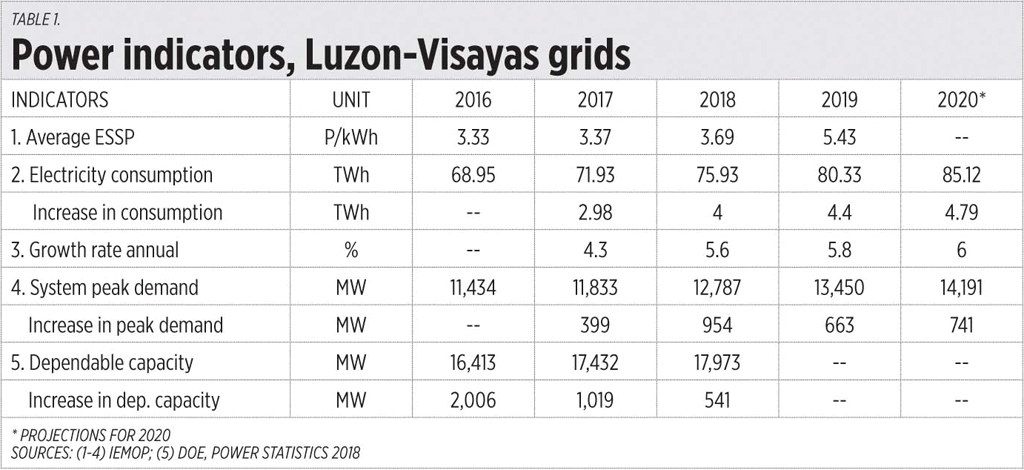
During the IEMOP briefing, an important chart was shown where power undersupply relative to rising power demand in April-July 2019 resulted in high generation prices expressed as Effective Spot Settlement Price (ESSP) in WESM of P5 to P6+ per kWh, vs average prices of P2-P4/kWh in non-peak demand months.

See that the rising average ESSP from 2016 to 2019 in the Luzon-Visayas grids as both annual electricity consumption and system peak demand keep rising. I added here data from the Department of Energy (DOE) on dependable capacity (see Table 1). The bottom line — insufficient supply when demand is high and rising would lead to both higher prices and frequent “yellow-red” alerts by the National Grid Corp. of the Philippines (NGCP).

At Mr. Gatchalian’s presentation, he focused on “limited competition” by the few big domestic players, and that retail electricity suppliers (RES) and distribution utilities (DUs) are supposed to compete with each other by offering more affordable rates but does not happen in some cases. I summarized his three charts here (see Table 2).

Other competition issues during the good and cool PCC conference, I will discuss in the next few weeks.

Now, three points to clarify in Mr. Gatchalian’s claim of limited competition from the “big five.”

One, prices spike mainly because of power undersupply thanks to old, ageing baseload plants that go on unscheduled or extended shutdowns and no new peaking plants to provide the sudden big supply gap. This was very clear in March-July 2019, five months of occasional, sometimes daily, “yellow-red” alerts by NGCP.

Two, DUs are already highly regulated by the Energy Regulatory Commission (ERC), the Department of Energy, and even Congress because they need a Congressional franchise to operate. RES are less regulated but Retail Competition and Open Access provision of the Electric Power Industry Reform Act of 2001 — better known as the EPIRA law — remains suspended by the Supreme Court for three years now.

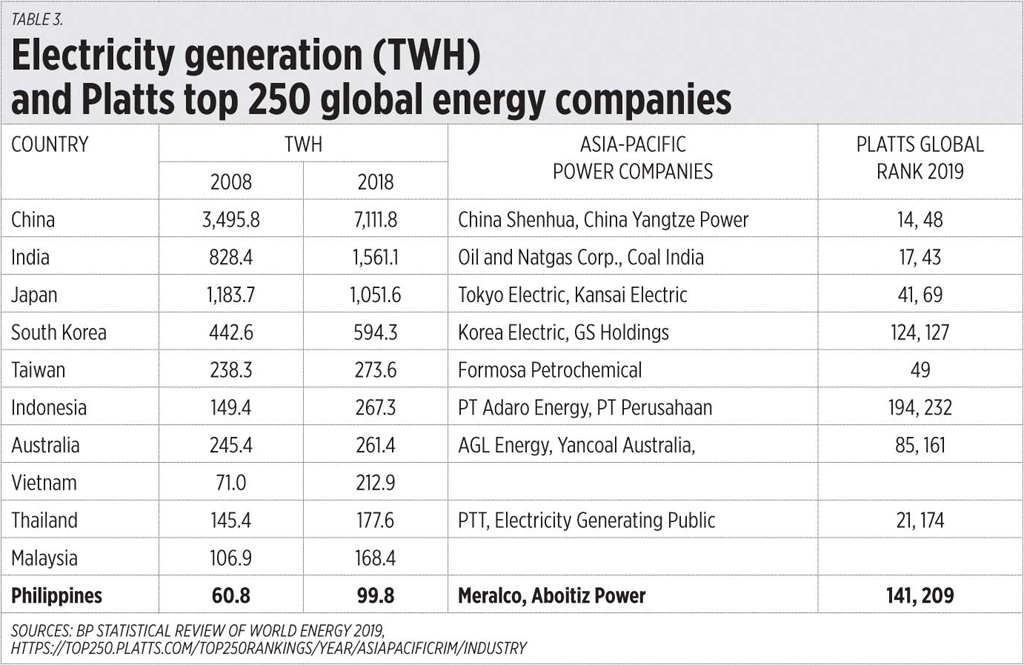
Three, the Philippines’ “big” power companies are actually medium-sized, even small, when compared with energy companies in the region. See the total power generation in terawatt-hours (TWH) of the Philippines in 2018, which was only 47% to 59% of our neighbors Malaysia, Thailand, and Vietnam. I include here portions of Platts’ 250 biggest energy companies in the world, I did not include largely oil-gas producers and manufacturers (see Table 3).

We need to significantly expand our power generation capacity, from conventional, stable, reliable, and dispatchable power sources, baseload to peaking plants. To do that, government, especially the ERC, should step back from too much regulation especially in pricing.

Sector deregulation will allow the small and medium companies to become big, the big companies to become bigger — without state favoritism via subsidies and climate cronyism — and the Philippines’ overall power generation will significantly expand.

Finally, bottlenecks from the biggest power monopoly in the country, the NGCP, should be relaxed so that more power plants, baseload to peaking plants, will be positioned near the high demand cities and provinces.


Bienvenido S. Oplas, Jr. is the president of Minimal Government Thinkers.

minimalgovernment@gmail.com

Preventing climate change is a human rights issue

BRGFX / FREEPIK

By Andrew Gilmour

EVERY SOCIETY in the world is going to pay a price for global warming. But it’s the poorest countries and communities who will suffer the most from rising seas and burning lands — and likely also from any drastic measures taken to prevent climate change. The environmental crisis is closely linked to the humanitarian one, and requires the joint action of climate and human rights activists.

They’d seem to be natural allies. They both regard (with good reason) today’s situation as the worst in their movements’ existence. Second, they share common foes: Leading climate change deniers and environmental despoilers tend to be dismissive of human rights (Presidents Rodrigo Duterte, Donald Trump, or Jair Bolsonaro, to name but three). Third, both movements are accused of being “elitist” by their opponents, a charge neither group of activists has done enough to overcome. But the two groups haven’t historically worked closely together.

The early conservation movement promoted nature at the expense of people (even to the extent of expelling native populations from Yellowstone and Yosemite in the late 19th Century). And while there’s much more understanding today that the two movements are complementary, this has not translated into enough concrete joint actions.

Human rights must be at the front and center of every effort to fight climate change. Not just because climate change will threaten the rights to food, water, housing, livelihood, and health for hundreds of millions of people, exponentially increasing the number of refugees. But also because, sooner or later, world leaders will finally wake up to the scale of the impending disaster. At which point they will likely respond with “states of emergency” that hugely undermine human rights, as with the internment of Americans of Japanese descent in the 1940s or justification of torture after 9/11. In a seminal UN report last spring, Philip Alston castigated the human rights community for its failure to face up to the fact that “human rights might not survive the coming upheaval.” The idea that democratic systems failed to prevent global heating may well take hold, with a resulting urge to strengthen state powers at the cost of rights and freedoms.

To prevent this from happening, human rights advocates and environmentalists both need to broaden their mobilization campaigns by reaching out to groups who have traditionally not been allies of either movement.

From Europe to the US to Australia, an alliance of populist leaders, corporate lobbyists, and the Murdoch-owned press have pushed the idea that any gains for human rights or environmental protection will come at the expense of jobs. For example, the “gilets jaunes” protests in France were provoked, in part, by a fuel tax hike designed to reduce carbon emissions. (“Fin du monde, fin du mois” was one rallying cry — stop talking about the end of the world, when we’re just trying to get to the end of the month.)

Fossil fuel workers, cattle farmers and others need to know that they will still have livelihoods after serious measures have been taken to reduce global heating. Governments, NGOs, and the private sector can offer such assurances through reskilling programs and subsidies for alternative land management and carbon sequestration. Without job security, too many people will remain vulnerable to wealthy climate science deniers — such as the Koch brothers — who have been able to convince them that climate change is basically a hoax against the “people” perpetrated by the “elite.”

Activists and sympathetic local officials must also work harder to win over indigenous people. In many countries, including Brazil, the Philippines, and Honduras, there are examples of indigenous groups resisting renewable energy projects. Not because they are politically opposed to renewable energy, but because they have traditionally not been consulted about enterprises inflicted on them within their traditional lands and waters.

Climate and human rights activists should be reaching out to these groups to get their buy-in. Governments should be transferring ownership of forested land back to the indigenous communities who have proven time and again to be the most effective guardians of their own ecosystems. Instead, indigenous people are being attacked — literally. In 2017, an average of three indigenous, environmental, or land rights defenders were killed every week.

Collaboration between human rights advocates and environmentalists will make it more likely that we come together to reduce emissions and mitigate the worst effects of climate change — and that we do so equitably. But the first step is to create far stronger bonds between the leaders and activists of each cause. Until both sides have fully recognized that neither agenda can be achieved without the other, they will continue to under-perform against their powerful opponents.


BLOOMBERG OPINION

Djokovic beats Thiem in 5-set thriller

MELBOURNE — Novak Djokovic endured a fierce challenge to his Melbourne Park reign before overhauling Dominic Thiem 6-4 4-6 2-6 6-3 6-4 in a thriller on Sunday to clinch an eighth Australian Open crown and reclaim the world number one ranking.

Under siege for much of a riveting four-hour slog, the defending champion found himself behind after three sets for the first time in eight finals at Rod Laver Arena.

But as he so often does, the steely-eyed Serb found a way to win, defying a crowd that was shamelessly behind the underdog Austrian.

He captured the decisive break in the third game of the final set, then locked down the match to secure his 17th Grand Slam title as a tiring Thiem bowed out with guns blazing.

“This is definitely my favorite court, my favorite stadium in the world and I am blessed to hold this trophy again,” said Djokovic after being handed the Norman Brookes Challenge Cup by 2005 winner Marat Safin.

Claiming the win when the fifth seed fired wide, Djokovic dropped his racket, spread his arms wide and walked to the net in a subdued celebration.

It had easily been his toughest battle in a Melbourne decider since the near six-hour epic against Rafa Nadal in 2012.

“I was on the brink of losing the match,” he told reporters. “Could have gone a different way.”

The Serb’s triumph meant tennis’ Big Three of Djokovic, Nadal and Roger Federer have now shared the last 13 majors between them — dating back to the Swiss’s 2017 Melbourne win.

Thiem was consigned to his third defeat in a Grand Slam final following losses in the last two French Open deciders to Nadal.

REVENGE SOON
“Unreal what you are doing through all these years. You and two other guys have brought men’s tennis to a completely new level,” the 26-year-old told Djokovic at the trophy ceremony.

“Well I fell a little bit short but I hope I can get revenge soon.”

While Thiem started heavy-legged after needing a combined eight hours to beat Nadal and Alexander Zverev in his previous two matches, Djokovic charged out of the blocks to take the first set.

But the match turned on its head at 4-4 in the second when he became flustered after being called twice for breaching the service clock.

As he returned to his chair fuming, he paused to sarcastically pat chair umpire Damien Dumusois’s sneaker, telling the Frenchman: “Great job man, you made yourself famous in this match, especially for the second one. Well done.”

Conceding the set with a terrible backhand, a shellshocked Djokovic lost six games in a row as Thiem, blasting winners virtually at will, roared to a 4-0 lead in the third.

Djokovic appeared listless and sapped of energy, and he called for the trainer after holding serve. But he underwent no treatment and resumed after an exchange of words.

He later left the court for a medical time-out which prompted tennis pundits to accuse him of gamesmanship, not for the first time in the Serb’s decorated career.

It looked gloomy for Djokovic as an energized Thiem took the third set, but the match turned again when the Austrian double-faulted to concede two break points, then blasted a forehand long to fall 5-3 behind in the fourth.

In a flash, Djokovic had served out the set to love, sealing it with an ace.

Having spent about six hours more on court than Djokovic at the tournament, the strain of a long campaign took its toll on Thiem — but he refused to crumble in the fifth.

He had two chances to break back in the fourth game but Djokovic nervelessly cancelled the threat before grinding to the finish.

He became the third man to win the same Grand Slam at least eight times, joining Nadal with his 12 French Open crowns and Federer who has triumphed eight times at Wimbledon. — Reuters

Chiefs end 50-year Super Bowl drought

MIAMI — The Kansas City Chiefs ended a half-century Super Bowl drought with a dramatic 31-20 comeback win over the San Francisco 49ers on Sunday in a breathtaking finish to the National Football League’s 100th season.

With the Chiefs trailing 20-10 in the fourth quarter, quarterback Patrick Mahomes engineered three scoring drives in just over five minutes, hitting Travis Kelce and Damien Williams with short touchdown passes to take the lead.

Williams then raced 38 yards for the clinching score, sparking wild celebration for long-suffering Chiefs fans who had not seen their team hoist the Lombardi trophy since their victory over the Minnesota Vikings in Super Bowl IV.

“We never lost faith, I mean that’s the biggest thing,” said Mahomes. “Everybody on this team, no one had their head down and we believed in each other and that’s what we preached all year long … we found a way to get it in the end.

“Those guys around us, the leaders of this team, they have the mindset that we never give up.

“We’re going to fight to the end.”

San Francisco had looked well on their way to a first Super Bowl in 25 years, holding a 10-point advantage and with time running down, but few leads are ever safe from Mahomes and the explosive Chiefs offense.

In the divisional playoffs, the Chiefs fought back from 24-0 down to beat the Houston Texans and then erased a 10-0 Tennessee Titans advantage in the AFC championship.

The 24-year-old Mahomes becomes the second-youngest quarterback to win a Super Bowl adding to his credentials as the NFL’s next superstar.

Mahomes, who completed 26 of 42 attempts for 286 yards and two touchdowns, appeared out of sorts for nearly three quarters of the game but stepped up and took charge when it mattered to earn the Super Bowl Most Valuable Player (MVP) honours.

Mahomes is the youngest to win both the NFL and Super Bowl MVP awards.

The win was also validation for Chiefs coach Andy Reid, who had more career regular-season wins (207) than any coach without a Super Bowl win until Sunday. — Reuters

Generational sports heroes to be feted by Philippine Sportswriters Association

By Michael Angelo S. Murillo
Senior Reporter

FILIPINO sports heroes, both old and new, will be celebrated at the Philippine Sportswriters Association (PSA) Awards Night in March.

Billiards legend Efren “Bata” Reyes and Tokyo Olympics-bound gymnast Carlos “Caloy” Yulo are among those to be feted in ceremonies organized to channel well-deserved focus on the athletes who brought so much to the country in the year that just passed.

In the case of Mr. Reyes, 65, he is to be honored with the Lifetime Achievement Award in recognition of his illustrious career spanning five decades.

The Pampanga native Reyes recently competed at the 30th Southeast Asian Games held here.

And while he admitted to have struggled with his eyesight throughout the men’s carom (1 cushion) competition, it did not stop him from winning a bronze medal and add to the 12 total medal haul of the Philippine billiards team, four of which were gold.

The bronze was not the elusive first-ever gold medal he was angling for in his SEA Games career but it was nonetheless a testament to the winning mindset he has always embodied throughout his legendary career.

Mr. Reyes will serve as special guest speaker during the gala night, which many are anticipating since the billiards legend is not one big on talking.

But he is no stranger to being honored by the PSA as he was named Athlete of the Year by the sportswriting body for 1999, 2001, and 2006.

The long list of achievements of Mr. Reyes include being the best player to win world championships in two different pool disciplines — eight-ball and nine-ball — becoming the first non-American to win the US Open 9-Ball Championship, the inaugural winner of the World Cup of Pool in tandem with good friend Francisco “Django” Bustamante, acknowledged as the winningest player in the history of the Annual Derby City Classic with five titles, and won the largest prize money in the history of pocket billiards after topping the IPT World Open 8-Ball Championship worth $500K.

Mr. Reyes follows bowling legend Bong Coo and cycling champion Paquito Rivas, who were bestowed the Lifetime Achievement Award last year.

PRESIDENT’S AWARD
Meanwhile. Mr. Yulo will receive the President’s Award at the PSA Awards Night in recognition of a stellar 2019 outing, highlighted by his qualification for the Olympic Games later this year.

Nineteen-year-old Yulo made history by becoming the first Filipino gymnast in half a century to qualify for the Summer Games after winning the gold in the men’s floor exercise of the World Artistic Gymnastics Championships in Stuttgart, Germany.

He capped the historic year by winning seven medals — two gold and five silver — in gymnastics at the 30th SEA Games.

With the winning momentum he is having, many are optimistic that he could well deliver the first-ever gold medal for the country in the Olympics, including his mother federation, the Gymnastics Association of the Philippines (GAP).

“We are confident of his chances and hopefully he stays healthy all the way to the Olympics. Given the preparation he is having and the mindset he has now as well as the support of the government, the federation, his family and others, he has all the ‘tools’ going in and just needs to go for it and give his best shot,” said GAP secretary-general Bettina Pou in an interview.

“In winning gold in the world championships he showed what he is capable of and the Olympics could be the next thing,” the GAP official further said.

Apart from Messrs. Reyes and Yulo also to be recognized is Team Philippines as “Athlete of the Year” for winning the overall championship in the SEA Games after 14 years.

The Philippines won 149 gold medals, to go along with 117 silver and 121 bronze in the biennial regional sporting meet.

The PSA Awards Night is set for March 6 at the Centennial Hall of the Manila Hotel.

Karateka Tsukii determined to make it to the Olympics

By Michael Angelo S. Murillo
Senior Reporter

WHILE a spot in the 2020 Olympic Games in Tokyo, Japan, is not yet guaranteed for her, Filipino-Japanese karateka Junna Tsukii is in no way deterred by it and still very much focused on seeing her push completed.

Speaking to reporters at the launch last week of sports nutrition brand AminoVital, which she is one of the ambassadors, Ms. Tsukii shared that she is still in the thick of her Olympic push and touted that she has a strong chance of making it to the global sporting spectacle provided things go her way.

“There is a strong chance of me qualifying. I still have to go through the qualifiers but with hard work and determination we will get there,” said Ms. Tsukii, 29.

It will be a busy stretch for the bemedalled karateka beginning this month till April with Olympic qualifying tournaments coming in succession.

Ms. Tsukii, ranked 10th in the World Karatedo Federation list, is to see action in Karate 1 Premier League tournaments in Dubai (Feb. 14–16), Austria (Feb. 29–March 1), Morocco (March 13–15) and Spain (April–19).

Through these tournaments she hopes to gain valuable points to emerge on top of her division in Asia and earn a spot in the Olympic Games. Currently she is number four in Asia.

She is also preparing for the last Olympic qualifier in Paris, France, in May if ever she falls short in her quest to emerge on top in the continent in the prior qualifying tournaments.

Ms. Tsukii recently won two bronze medals in a Premier League competition in Paris.

Prior to that, she won gold at the 30th Southeast Asian Games.

The Philippine Sports Commission has vowed to support her in her mission to make it to the Olympic Games.

Stephen Loman named Brave fighter of the year

BOOSTED BY two quality victories in 2019, bantamweight champion Stephen “The Sniper” Loman of Team Lakay was adjudged “fighter of the year” in Brave Combat Federation for the second year in a row.

Won the Brave bantamweight title in 2017, Mr. Loman (13-2) fortified his position in the division by winning his two fights last year on his way to becoming the longest-reigning champion in the promotion.

The Sniper took on former featherweight champion Elias Boudegzdame and ran through the French-Algerian fighter in their title clash in Brave’s first-ever live event in the Philippines on March 15.

Mr. Loman stopped his opponent in the fourth round with a violent TKO that sent shockwaves through the division.

He then travelled to India in November and came away with a unanimous decision victory over Canadian Louie Sanoudakis.

To date he is the only champion in bantamweight the promotion has seen with no signs of slowing down.

Mr. Loman said after his fight with Mr. Sanoudakis that he has no immediate plans to move up in weight, saying that he will stay in bantamweight and battle whoever is lined up for him.

“Right now, I have a lot of people to fight still [in the division], maybe one day [I’ll go up in weight],” he said. — Michael Angelo S. Murillo

Caruana wins Tata Steel Masters

82nd Tata Steel Masters
Wijk aan Zee, Netherlands
Jan. 10–26, 2020

Final Standings:

1. Fabiano Caruana USA 2822, 10.0/13

2. Magnus Carlsen NOR 2872, 8.0/13

3. Wesley So USA 2765, 7.5/13

4.–5. Jorden Van Foreest NED 2644, Daniil Dubov RUS 2683, 7.0/13

6–9. Anish Giri NED 2768, Viswanathan Anand IND 2758, Jan-Krzysztof Duda POL 2758, Alireza Firouzja FIDE 2723, 6.5/13

10–11. Jeffery Xiong USA 2712, Vladislav Artemiev RUS 2731, 6.0/13

12. Nikita Vitiugov RUS 2747, 5.0/13

13. Yu Yangyi CHN 2726, 4.5/13

14. Vladislav Kovalev BLR 2660, 4.0/13

Average Rating: 2740 Category 20

Time Control: 100 minutes for the first 40 moves, then 50 minutes for the next 20 moves followed by 15 minutes for the rest of the game with 30 seconds added to your clock after every move starting move 1

The chess tournament in Wijk aan Zee, Netherlands is traditionally the first Super GM (Grandmaster) event of the year. The main sponsor of the chess festival, which started in 1938, remains the steel factory in Ijmuiden, which is now part of the Tata Group, one of India’s oldest and largest business empires with subsidiaries involved in steel, power, chemicals, communications, beverages, motor vehicles, hotels, and many more.

There is the Masters’ Tournament where the world no. 1 (Magnus Carlsen) and no. 2 (Fabiano Caruana) will be taking part, a Challengers’ event which will qualify the winner to next year’s Masters’ Tournament, several Qualifier’s events to determine the participants in next year’s Challengers’ tournament, and several other opens for amateurs, club players and top professionals to compete in.

All these events are held in the giant De Moriaan sports hall in the center of town. You can walk around the tournament hall during playing time and maybe even bump into Magnus Carlsen or other members of the chess elite similarly wandering around the hall.

This is a great attraction of the annual Wijk aan Zee event — almost without exception chess players welcome each other in a close-knit chess brotherhood and in no time you might be chatting with Vishy Anand or drinking coffee with Svidler, elbow-to-elbow with other chessplayers talking about anything under the sun.

This year, aside of course from world champion Magnus Carlsen, two players are under the microscope — Fabiano Caruana, the world no. 2, and Anish Giri. These two will be playing in the March Candidates’ Tournament in Yekaterinburg. As BW readers know whoever wins the Candidates’ will then challenge world champion Magnus later this year for the world title. Most people did not expect Fabiano Caruana or Anish Giri to be showing their best. Normally the soon-to-be competitors in such an important tournament as the Candidates’ would hide the openings and the special developing schemes that they would use and instead resort to safe and solid openings just so as to avoid loss.

It started out that way too. Caruana had a pretty normal first half of the tournament with two wins (against a totally out-of-form Yu Yangyi and Daniil Dubov) but then came his game with Viswanathan Anand.

Caruana, Fabiano (2822) — Anand, Viswanathan (2758) [D38]
Tata Steel Masters Wijk aan Zee (8.6), 19.01.2020

1.d4 Nf6 2.c4 e6 3.Nf3 d5 4.Nc3 Bb4

Queen’s Gambit Declined + Bb4 = Ragozin’s Defense. I mention this because a lot of us were brought up in the Fred Reinfeld and Irving Chernev generation of chess books in the 60s when the Ragozin Opening did not exist. Ragozin is the Russian GM who sacrificed his career to serve as full-time second to world champion Mikhail Botvinnik. He was also the 2nd World Correspondence Chess Champion.

5.cxd5 exd5 6.Bf4 0–0 7.e3 Bf5 8.Qb3 Nc6 9.Bg5 a5

Can’t White win the d5–pawn?

10.Bxf6 Qxf6 11.a3

Timing is not right yet. If 11.Qxd5 right away Black has 11…Rfd8 12.Qc4 (12.Qb3? a4 13.Qd1 a3 Black will win material; 12.Qb5 Nxd4! followed by …c7–c5 whichever way White recaptures on d4) 12…b5! 13.Qxb5 Nxd4! 14.Nxd4 c5 White’s weakness on the long diagonal a1–h8 will cost him. 15.Nf3 Bxc3+ 16.bxc3 Qxc3+ etc.

11…a4 12.Qxd5 Bxc3+ 13.bxc3 Na5 14.Qe5 Qc6! 15.c4 Nb3

The threat to the rook is not so easy to parry. If 16.Rd1? then simply 16…Bc2. This, plus the fact that obviously Anand is still within his preparation made Caruana look for something more complicated. After half an hour’s thought he decides to give up the exchange.

16.Qxf5!? Nxa1 17.Bd3 g6 18.Qf4

For the exchange Fabi gets to castle his king into safety and go on the attack.

18…Nb3 19.0–0 Qd6 20.Qh6 Qf6 21.c5 b6 22.cxb6 cxb6 23.Ne5

White’s plan is now Bd3–c4 followed by f2–f4–f5. Anand eases the tension a bit by forcing an exchange of rooks.

23…Rfc8 24.f4 Rc1! 25.Rxc1 Nxc1 26.Bc4 Ra7 27.Ng4 Qd6 28.Qg5 Qe7

Taking the pawn on a3 would clear the way for his passed a-pawn, but at this time it is not feasible: 28…Qxa3 29.Qd8+

29…Kg7? 30.Qf6+ Kf8 31.Qh8+ Ke7 32.Qe5+ Kd7 (the king has to stick to the 7th rank otherwise Qb8 is check and the rook on a7 is lost) 33.Qb8 Rc7 34.Ne5+ followed by mate).

29…Qf8 30.Qxb6 Ra8 31.Qf6 Ra7 (31…a3 is met by 32.Bxf7+ Qxf7 33.Nh6+) 32.f5 Qg7 33.Qd8+ Qf8 34.Nh6+ Kg7 35.f6+ wins the black queen.

29.Qb5 Kg7 30.f5 f6 31.Qd5 Qf8 32.fxg6 hxg6 33.e4

With everything defended Anand is the one who can play for the win.

33…Qc8 34.h3 Rd7 35.Qe6 Qd8 36.e5 [36.d5? Rd6 traps the queen]

36…f5 37.Qf6+?

After the game Fabi remarked that this move was a mistake. He should have played 37.Nf6 On the surface 37…Re7 looks safer but it fails because of some spectacular chess: 38.Qd6! Qxd6 39.exd6 Rb7 40.Ne8+ Kf8 41.Nc7 (this is really impressive — the Black king cannot approach white’s passed pawn because all squares are covered by the white knight and bishop) 41…Rb8 42.Ne6+ Ke8 43.Bb5+ Kf7 44.d5 Nb3 45.d7 Ke7 46.Kf2 Nc5 47.d8Q+ Rxd8 48.Nxd8 Kxd8 49.Ke3 White is clearly better, if not winning;

37…Rxd4 38.Bd5 Ne2+ 39.Kf2 Nc3 40.Qf7+ Kh6 41.Qh7+ Kg5 42.g3 Rd2+ 43.Kf1 Rd1+ 44.Kf2 Rd2+ with a draw. If White tries to avoid the repetition then 45.Ke3? Nxd5+ 46.Kxd2 Nxf6+ with a horrible death.

37…Qxf6 38.exf6+ Kh7

Not 38…Kf8? 39.Ne5 Rc7 40.Nxg6+ Ke8 41.Ne5 Black has to give up his rook for the bishop.

39.Ne5 Rd6

[39…Rxd4 40.f7 Rd8 41.Nd7 Kg7 42.f8Q+ Rxf8 43.Nxf8 Kxf8 44.Bb5 followed by Bb5+ and equalizes material by taking the a4–pawn.]

40.f7 Kg7 41.Nf3 Nb3! 42.Ng5 Nd2! 43.Be6

Only move. If 43.Ba2 Nb3! the bishop’s all-important diagonal is blocked.

43…Rd8 44.Kf2 Kf6? <D>

Anand had to neutralize white’s passed d-pawn with 44…Nb3! 45.d5 (45.Bxf5 intending Ne6+ is refuted by 45…Rd5) 45…b5 46.d6 Nc5! Black is clearly winning.

POSITION AFTER 44…KF6

45.Bd7!

Perhaps Anand had counted on 45.f8Q+? Rxf8 46.Nh7+ Kxe6 47.Nxf8+ Kf7 48.Nd7 Nc4 49.Ke2 b5 50.Kd3 Nxa3 with a win.

45…Ne4+

[45…Kxg5 46.Be8 the pawn queens]

46.Nxe4+ fxe4?

[46…Kxf7!! 47.Bxa4 fxe4 48.Ke3 Ra8 Black is playing for a win]

47.Be8 Ke7 48.Ke3 Rb8 49.Bxa4 b5?

I don’t understand why Viswanathan Anand did not take the f7 pawn. Now he will pay.

50.Bb3 Ra8 51.Kxe4 Rxa3 52.Be6 Ra1 53.d5 Rd1 54.Ke5 Rf1 55.d6+ Kf8 56.Kd5 Rf6 57.d7 Ke7 58.Kc6! Rf2

[58…Rxe6+ 59.Kc7 Rd6 60.f8Q+ Kxf8 61.Kxd6]

59.Kxb5 Rb2+ 60.Kc6 Rb8 61.Kc7 1–0

The finish after 61.Kc7 would have been 61…Ra8 (61…Rf8 62.h4 Rd8 [62…Kxe6? 63.d8Q Rxd8 64.Kxd8 Kxf7 65.g4 White wins] 63.g4 Rf8 64.g5 Rd8 65.h5 gxh5 66.g6 h4 67.f8Q+ Rxf8 68.g7 Ra8 69.g8Q) 62.Bd5 Rd8 63.Kc6 g5 64.g4 Ra8 65.h4 gxh4 66.g5 h3 67.g6 h2 68.g7 h1Q 69.f8Q+ Rxf8 70.gxf8Q+ Kxf8 71.d8Q+ Kg7 72.Bxh1.

After this very satisfying win Fabi took a short draw with Vitiugov and then, completely revived, won his four remaining games (against Alireza Firouzja, versus Kovalev, vs. Duda, and against Artemiev) to run away with the tournament. He tied Magnus Carlsen (2013) and Garry Kasparov (1999) with a dominating final winning score of 10/13, 2 full points ahead of runner-up Magnus Carlsen.

The Tata Steel Masters victorious Fabiano Caruana’s final tally of seven wins and six draws in a category 20 tournament equals an awesome performing rating of 2943. Mr. Caruana is starting to resemble Caruana of 2014 where he started off with 7-0 in the Sinquefield Cup and finally finished with 8.5/10, a performance rating of 3080, possibly the best tournament result of all time. It looks like he is on target for the March candidates.


Bobby Ang is a founding member of the National Chess Federation of the Philippines (NCFP) and its first Executive Director. A Certified Public Accountant (CPA), he taught accounting in the University of Santo Tomas (UST) for 25 years and is currently Chief Audit Executive of the Equicom Group of Companies.

bobby@cpamd.net

Comeback masters

The Chiefs headed into Super Bowl LIV as the favorites, however slight, backed by a solid defense and an offense that had hitherto proven its capacity to score in bunches. In fact, their road to yesterday’s winner-take-all affair was marked by a couple of improbable from-behind triumphs. They won the divisional round 51-31 after spotting the Texans 23 points, and then the AFC championship 35-24 despite having been down by double digits. For much of yesterday, though, it appeared as if they finally ran out of luck. And behind by 10 with 11:57 left in the final period, they looked just about ready to fold after yet another interception gave the Niners the ball.

And then the Chiefs got a new lease on life. For some reason, the Niners, otherwise solid with head coach Kyle Shanahan keeping coverages guessing on the strength of egalitarian production, became tentative as the end drew near. Quarterback Jimmy Garoppolo, a model of efficiency through three quarters, tightened up, able to keep the ball for only five possessions that included a poor throw landing nowhere near any receiver down the middle. Instead of using the clock (a decided must against competition with a reputation for producing quickly), they wound up burning only three minutes and four seconds.

Enter Chiefs counterpart Patrick Mahomes, who buckled down to work and did exactly what fans believed him capable of when given another chance. Of 10 lightning-fast plays, four without a huddle, he connected on half of the eight times he went on the air; of particular note were a superb pass under pressure to an open Tyreek Hill for 44 yards and a short throw while on the move to Travis Kelce for a touchdown. Just like that, a mere possession separated them from the Niners. And he wasn’t done. A punt off the minimum three plays had him with the ball anew, and, again, he led a touchdown drive on seven connections off seven plays.

By this time, the Chiefs knew the Super Bowl was theirs. The 49ers still had ample time to recover, but collapsed instead; Garoppolo followed up a completed 16-yard pass to Kendrick Bourne on the initial play with two failed gambles to intended receivers, a bum throw, and a sack on fourth down. The rest, as the cliche goes, is history. Damien Williams’ subsequent 38-yard run proved to be icing on the cake. Mahomes once again went through the wringer with aplomb, and, in the process, handed head coach Andy Reid the only achievement missing from an outstanding resume.

Needless to say, the Chiefs celebrated in the aftermath, with Mahomes paying due respect to the Niners’ gallant stand, but arguing all the same that the outcome was as it should be. “We never lost faith,” the Most Valuable Player argued. “No one [on the team] had their head down. We believed in each other.” Most tellingly, he believed in himself. Once again, he gave notice that no lead is safe for as long as he’s under center with time on his hands. And, once again, he delivered.


Anthony L. Cuaycong has been writing Courtside since BusinessWorld introduced a Sports section in 1994. He is a consultant on strategic planning, operations and Human Resources management, corporate communications, and business development.

PSEi sinks to 7,100 level on increasing concern

By Denise A. Valdez, Reporter

THE MAIN INDEX sank to the 7,100 level on Monday as it continued to take a hit from the novel coronavirus scare.

The Philippine Stock Exchange index (PSEi) lost 63.76 points or 0.88% to retreat at 7,137.03 on Monday. The broader all shares index also gave up 35.38 points or 0.82% to end at 4,256.83.

“Philippine stocks fell sharply as investors grew increasingly worried about the potential economic impact of China’s fast-spreading coronavirus,” Regina Capital Development Corp. Head of Sales Luis A. Limlingan said in a mobile message.

The Health department said yesterday it was studying 80 persons for possible infection to the novel coronavirus, a day after it announced the death of a Chinese man in Manila who tested positive for the disease.

Of the 80 cases, it said two already tested positive, 30 tested negative and 48 were pending results. The two that tested positive are the 44-year-old Chinese man reported dead on Sunday and the 38-year-old Chinese woman reported as the first confirmed coronavirus case in country last week.

Across the globe, the virus has killed more than 360 people and infected 17,384 people as of Monday, where 361 of the deaths and 17,205 of the confirmed cases are in mainland China, CNN reported yesterday.

In China, some local authorities decided to defer the resumption of work yesterday after an extended Lunar Holiday break to help limit the spread of the virus. China’s CSI 300 and Shanghai SE Composite indices, which both reopened after more than a week-long break on Monday, dropped 7.88% and 7.72%, respectively.

Back home, five of six sectoral indices ended lower on Monday. Mining and oil erased 332.15 points or 4.33% to 7,331.11; financials lost 36.12 points or 2.09% to 1,688.81; property shaved off 45.52 points or 1.18% to 3,793.22; services dropped 5.84 points or 0.39% to 1,469.32; and holding firms decreased 25.57 points or 0.37% to 6,874.74.

The only gaining sub-sector was industrials, which added 44.78 points or 0.50% to 8,966.22.

“While index heavyweights dragged the market today, a few non-index stocks gained double digits as market participants focused on second and third liner issues,” Timson Securities, Inc. Trader Darren T. Pangan said in a text message on Monday.

Some of the top gainers yesterday were SFA Semicon Philippines Corp. (+50%), Ionics, Inc. (+42.37%), Cirtek Holdings Philippines Corp. (+23.60%), Alliance Select Foods International, Inc. (+13.73%) and Jackstones, Inc. (+13.64%).

Value turnover on Monday stood at P5.87 billion with 833.36 million issues changing hands. This is lower than previous session’s P8.30 billion worth of 2.89 billion issues.

Decliners beat advancers, 129 to 73, while 39 names ended unchanged.

Foreign investors remained sellers on Monday, but net selling was trimmed to P289.06 million from Friday’s P1.70 billion.

Peso ends higher ahead of inflation, BSP

THE PESO ended stronger against the dollar on Monday as the market expects a strong inflation reading and a possible rate cut from the central bank on Wednesday.

The local unit ended trading at P50.80 versus the greenback, appreciating by three centavos from its P50.83-to-a-dollar close on Friday, according to data from the website of the Bankers’ Association of the Philippines.

The local currency opened at P50.95 against the greenback. Its weakest was at P51.05 while its strongest showing was at its close of P50.80 against the dollar.

Dollars traded rose to $1.073 billion from $956.8 million on Jan. 31.

A trader attributed the local currency’s strength to market expectations of “stronger inflation” for the previous month.

“The peso appreciated today as market players anticipated the release of stronger Philippine inflation report for January 2020 due to be released on Wednesday,” a trader said in an e-mail.

A BusinessWorld poll of 13 analysts yielded a median estimate of 2.7% for January inflation mainly due to uptick in food prices and some supply side shocks from the eruption of the Taal Volcano.

If realized, the estimate will fall close to the lower end of the 2.5% to 3.3% estimate range given by the BSP last week.

Meanwhile, UnionBank of the Philippines, Inc. Chief Economist Ruben Carlo O. Asuncion said that Monday’s trading shows the peso’s “resiliency amid market scares due to the coronavirus.”

“The peso is showing some resilience despite the colossal rout in markets all day as China markets opened since the coronavirus outbreak,” Mr. Asuncion said.

Reuters reported that the Shanghai Composite index fell by nearly 8%, its biggest daily decline in more than four years. With market fears about the spread of the coronavirus and its impact, $393 billion from the benchmark stock index was lost on Monday.

Deaths in China due to the virus have risen to 361 as of Sunday from the 17 on Jan. 23, the previous trading day before the Lunar New Year holidays.

Meanwhile, the offshore yuan began trade at its weakest for 2019 and was down by 1.2% by afternoon, going below the seven-per-dollar level to 7.0155.

“Market is [also] largely expecting a rate cut from the BSP (Bangko Sentral ng Pilipinas) this week as the potential easing may just be a much needed sigh of relief as most markets were negative,” Mr. Asuncion added.

BusinessWorld’s poll showed 10 out of 13 economists were of the view that the Monetary Board (MB) will opt to cut rates on its first policy meeting for the year this Feb. 6.

BSP Governor Benjamin E. Diokno has said they are still looking to cut rates by 50 basis points (bps) in 2020, with a 25-bp reduction possible as early as Feb. 6.

Key policy rates currently stand at four percent for the central bank’s overnight reverse repurchase facility, while overnight deposit and lending rates are at 3.5% and 4.5%, respectively.

For today, the trader gave a forecast range of P50.70-50.90, while Mr. Asuncion expects the local unit to play around the P50.70-50.90 levels. — L.W.T. Noble with Reuters

ADVERTISEMENT
ADVERTISEMENT