SOUTH KOREA’S status as a cultural juggernaut just got a serious shot of international credibility.
Parasite, a dark comedy about the divisions of wealth and class, became the first foreign-language film in history to win the coveted Oscar for best picture. The movie — made for $11 million by Seoul-based Barunson Entertainment & Arts Corp. — beat out Hollywood competitors made for nine times as much.
The win, which ignited celebrations online in South Korea, could mark a watershed moment for its entertainment industry that’s become a key form of soft power for the Asian nation with the explosion of K-Pop and Korean soap operas. Cultural exports are also becoming more vital to South Korea’s economy, which is pivoting away from the manufacturing-focused industries that helped it emerge from the ruins of the Korean War.
Parasite has so far grossed $165 million at the box office, a number that’s likely to jump after the movie’s surprise victory, which will likely lead to a re-release in the US where its theatrical run is already almost over. In 2017, winning best-picture prize bolstered the commercial prospects of the American coming-of-age drama Moonlight, which made about $65 million on a similarly modest production budget of about $4 million.
The past decade has seen an evolution in South Korea’s status as an entertainment powerhouse, with the world’s most popular boy band, BTS, driving a global embrace of the K-Pop music genre. The country’s television industry is responsible for a wave of romantic dramas that have achieved cult status throughout Asia, particularly in the hard-to-crack, but immense Chinese market. The success of Baby Shark, a viral YouTube hit targeted at children that spawned a merchandise empire, also showed South Korea’s growing foothold in online content.
PRESIDENTIAL PRIDE
Smaller in scale, the South Korean film industry still brought in about $2 billion in 2018, according to the latest available data from Korea Creative Content Agency — a body linked to the nation’s culture ministry.
South Korea erupted in collective celebration at the news of Parasite winning the Oscar, with messages of congratulations and joy trending on social media platforms such as Twitter. The country’s president, Moon Jae-in, tweeted his pride at the film’s success. Shares of Barunson Entertainment surged as much as 17% Tuesday in Seoul, extending their 19% rally the previous day. The stock of the chief investor and marketer of the film, CJ ENM Co., rose as much as 4.3% on Tuesday.
“This will become a turning point for Korean movies to grow globally,” said Kim Young-ho, spokesman for the Korean Film Council. “It’s the most splendid achievement.”
Parasite tells the story of a family of unemployed people that entrenches itself in the life of a wealthy clan to gain access to things they can’t afford. A foreign film winning the best-picture prize marks a break from tradition at a time when the Academy of Motion Picture Arts and Sciences, which awards the Oscars, is under fire for failing to diversify its ranks and the recipients of its awards.
Parasite beat competitors such as Once Upon a Time in… Hollywood, which had a budget of about $95 million and 1917, the favorite to win the award, which cost a similar amount to make.
Besides best picture, Parasite took home several other top prizes, including for best director, best international feature film and best original screenplay.
“This is definitely an event that will raise global attention on Korean content, expanding the boundary into movies — not only TV drama or K-Pop,” said Sang-Woung Han, an analyst at Eugene Investment & Securities.
Industry executives partly credited Miky Lee, vice-chairman of CJ Group — South Korea’s largest purveyor of TV programs and movies as well as food and home-shopping services — for the movie’s success. CJ ENM said it would continue to help Korean movies break into the global market.
Lee, the 61-year-old granddaughter of Samsung Group’s founder has been a relentless promoter of Bong and other Korean directors and actors.
“Parasite won the best picture because the movie has successfully delivered on the universal issue of economic polarization,” said Jeon Chanil, a long-time Korean film critic.
Parasite director Bong Joon Ho’s two prior movies, Snowpiercer and Okja did not do well at the box office in the US, but they are now two of the most popular movies on Netflix. Accepting the best director award late Sunday in Los Angeles, he said he never thought he would win.
Later, speaking to reporters backstage, he said he hoped a non-English film winning such top prizes won’t be rare in the coming years.
“It’s very surreal,” Bong said. “I feel like something will hit me and I will wake up from this dream.” — Bloomberg
HOLLYWOOD’S latest power couple hail from opposite sides of the world.
Samsung scion Miky Lee is one of the backers of a $275 million investment in Skydance Media, the company founded by Larry Ellison’s son David, 37, in 2010, according to a statement. The deal brings together the $62 billion Ellison fortune and South Korea’s $29 billion Samsung clan, the Asian nation’s richest.
Lee, 61, the granddaughter of Samsung founder Lee Byung-chull, oversees CJ Group’s entertainment and media business, a separate conglomerate from Samsung Group. It opened her homeland’s first multiplex, invested in the DreamWorks studio and funded Parasite, the South Korean comic thriller that won four Oscars Sunday, including best picture.
With Lee’s avid support for the film industry, CJ has financed and distributed three other films made by Parasite director Bong Joon Ho, including Snowpiercer and Okja.
David Ellison’s Skydance is best known for franchises like the Mission: Impossible films and the upcoming Top Gun sequel. It courted controversy last year after it hired Pixar pioneer John Lasseter to lead its animation business, scooping up the former Walt Disney Co. executive who was dismissed for workplace misconduct.
The tie-up underscores the entertainment world’s enduring appeal to the world’s richest people. In 2004, former Ebay Inc. executive Jeff Skoll started Participant Media, which makes movies targeting social issues. David Ellison’s sister Megan is also a film producer, whose credits include Zero Dark Thirty and Phantom Thread.
The Skydance deal, led by investment firm RedBird Capital Partners, values the company at $2.3 billion, according to Tuesday’s statement. Other investors include Tencent Holdings Ltd. and the Ellison family.
Lee’s involvement is an even bigger coup after Parasite took home the top award at the Oscars. Her acceptance speech suggests she won’t be diluting the sometimes challenging output of her media empire.
“I really want to thank our Korean film audience,” she said at the ceremony in Los Angeles. “That made us really never be able to be complacent and keep pushing the directors, the creators, keep pushing the envelope.” — Bloomberg
How a piece of paper tacked to a bulletin board fueled a rumor mill
By Sam L. Marcelo,Associate Editor
THE memo that started a firestorm in Ballet Philippines.
A PALL OF uncertainty, fear, and evaporated dancers’ tears still hangs over the rehearsal halls of Ballet Philippines (BP) days after it was suddenly announced that National Artist for Dance Alice Reyes would be replaced as artistic director (AD) of the company she founded in 1969, by Mikhail “Misha” Martynyuk, a star dancer of The Kremlin Ballet theater — a young company compared to the giants of Russian ballet (Bolshoi, Mariinsky) as it was founded only in 1990 — and Honored Artist of the Russian Federation.
Mr. Martynyuk’s appointment was announced through an internal memo dated Feb. 8. Signed by BP President Kathleen “Maymay” Lior-Liechtenstein, it read, in part: “We anticipate your warm welcome and full support as Misha starts an exciting season for the company.” The memo was the first time that BP dancers and Ms. Reyes, whose term as artistic director ends in March, officially heard that Mr. Martynyuk — who was nominated by the Russian Embassy — was assuming the role of AD.
Ms. Lior-Liechtenstein and the rest of the BP Board didn’t anticipate how much havoc could be wreaked by an innocuous-looking piece of official stationery tacked to a bulletin board.
On Sunday evening, Feb. 9, former Cultural Center of the Philippines (CCP) president Nestor O. Jardin, who served BP in various capacities, including lead soloist and artistic director, denounced the move in a Facebook post that went viral in cultural circles: “I am appalled to learn that National Artist Alice Reyes who is currently artistic director of Ballet Philippines did not get the full support of its board of trustees and president causing her to resign from the company she co-founded with Eddie Elejar. And more appalling is that she was not at all consulted on the choice of her successor. When the board of trustees exercises its legal power over artistic matters, it is bound to kill a performing arts company. I do hope this doesn’t happen to Ballet Philippines.”
Asked what he thinks of Mr. Martynyuk and how his appointment will affect BP, Mr. Jardin told BusinessWorld in an e-mail: “He [Mr. Martynyuk] doesn’t know Ballet Philippines, what it stands for, its repertoire of uniquely Filipino contemporary pieces, and its legacy to Philippine dance. What this signals to me is a shift in artistic direction of Ballet Philippines to a Russian style classical ballet company.”
It is common knowledge is that Mr. Martynyuk has performed with Ballet Manila (BM), the dance company headed by Lisa Macuja-Elizalde, on at least two occasions: the first in 2013, as Solor in BM’s production of La Bayadere; and again in 2017, as Basilio in Don Quixote.
In contrast, he has never performed with Ballet Philippines. Former BP soloist Edna Vida, in a Feb. 9 Facebook post, asked: “Does he know our repertoire? Does he know our brand of classical ballet and modern dance? What does this man know about our beloved company? Who is he?” (In addition to sharing dance as their vocation, Ms. Vida and Ms. Reyes also share the same blood — they are sisters.)
“We want to stay uniquely Ballet Philippines and not become Ballet Russe de Manila. We don’t want Ballet Philippines to look like any other ballet company. Why should we allow it after 50 years of being a unique trailblazer? What a shame!,” ended Ms. Vida’s post.
Ballet Philippines’s repertoire, which is composed of about 500 pieces, is vast and varied. Insiders are worried that the appointment of Mr. Martynyuk means that ballet buns, pointe shoes, tights, and tutus will take over a company that has always prided itself on its versatility.
Ms. Reyes is known for groundbreaking pieces such as Amada, a wild-haired tribute to feminine power based on Nick Joaquin’s “The Summer Solstice”; Carmina Burana, a monumental piece that combines the lines of classical ballet and the freedom of modern dance; and Itim Asu, a reinterpretation of Virginia Moreno’s play The Onyx Wolf, which is slated to be remounted this February. Danced with bare flexed feet and grounded bodies, these pieces are outside Mr. Martynyuk’s wheelhouse.
Although he won a prize for best performance of modern dance choreography in 2002, Mr. Martynyuk simply has not put in the time with the Ballet Philippines. “This company [Ballet Philippines] is a Filipino cultural institution. It can do ballet, modern, contemporary, and everything in between,” said a member of the Ballet Philippines community. “The unforeseen appointment of Mr. Martynyuk as artistic director blatantly and disrespectfully ignores the proper process of succession… People are livid because he has no knowledge and zero connection to the company and its history.”
The appointment of Mr. Martynyuk — with his ties to Ms. Macuja — also birthed rumors that Ballet Philippines would eventually be merged with Ballet Manila, which recently lost its home to the fire that destroyed Star City. It didn’t help that Ballet Manila knew about Mr. Martynyuk’s appointment before Ballet Philippines did. (Ms. Macuja was a professional reference and, at one point in Mr. Martynyuk’s interview, the BP Search Committee had to call Ms. Macuja and ask her to translate, over the phone, what Mr. Martynyuk was saying. Mr. Martynyuk later stopped by BM to say hello to Ms. Macuja, who initially had no idea that he was in the Philippines. In hindsight, the optics of that visit did nothing to quell talks of a merger.)
Ms. Macuja, a proponent of the Russian Vaganova technique just like Mr. Martynyuk, denied these rumors. In a Feb. 9 Facebook post, the Ballet Manila CEO and artistic director said: “I am very happy where I am.”
Ms. Macuja had to face the online onslaught by herself because the BP Board — caught flat-footed by the speed and the ferocity of the cultural community’s response — chose to stay silent.
TOO LITTLE, TOO LATE
It took the BP Board three days — an eternity considering the churn of social media — to address the rumors surrounding Mr. Martynyuk’s appointment. First, through a brief statement posted on Facebook on Feb. 11, which barely addressed issues raised, and then through a face-to-face meeting between BP dancers and BP vice-chair Marianne “Maan” B. Hontiveros, who was also part of the Search Committee tasked with looking for Ms. Reyes’ successor. By then, hashtags such as #LiechtensteinResign (referring to the BP President) had already proliferated on social media. The meeting was too little, too late.
In a Feb. 11 phone interview with BusinessWorld, Ms. Hontiveros assuaged fears that BP would turn into a Russian clone. “We had emphasized to Mr. Martynyuk that it is important that Filipino choreographers be engaged to continue choreographing works with Filipino themes and motifs. And he’s very happy to do that,” she said, “We’re not here to redo the entire company. We’re just here to enhance the training of the talent of the Philippines and to grow it.”
She also refuted that Ms. Reyes was not consulted. “Alice Reyes actually had recommended candidates: an American, Adam Sage; and a Filipino, Ronelson Yadao. They were both invited for an interview, but they did not make themselves available for the interview.”
Mr. Sage, the current ballet master and associate director of BP, was the first foreigner to join Ballet Philippines and danced with the company from 1981 to 1983. Mr. Yadao, meanwhile, is a BP soloist and choreographer who returned to the company in 2017, after five years with Cloud Gate Dance Theater of Taiwan.
Both of Ms. Reyes’s candidates were informed of their interview with the BP Search Committee through an e-mail sent two days ahead of the appointed date. Neither Mr. Sage nor Mr. Yadao could make it due to prior commitments; their requests for alternative dates were refused.
The unwillingness to compromise on scheduling matters is symptomatic of the rift between BP’s executive department and its artistic department. The lack of communication manifested itself in myriad ways before reaching this point: staffing requests to fill vacated positions in the artistic department went ignored while the executive department beefed up its own team; dinner parties at Ms. Lior-Liechtenstein’s home, where BP dancers were expected to attend, conflicted with actual performances; and finally, the piece of paper announcing Mr. Martynyuk’s appointment, which fomented the unrest in the dance community.
These developments have all but squashed the jubilant spirit of BP, which should be celebrating its 50th season. Instead of basking in the glory of BP and its founder — a living legend held in high esteem — the dancers feel lost and upset, questioning the fate and the future of the company that raised them.
BP dancers are protective of the company and its legacy, built on the bodies of those who came before them. They have nothing against Mr. Martynyuk, a man they barely know, but they are wary of him. What grates is the callous disregard shown by the Board in their tone-deaf announcement of Mr. Martynyuk’s appointment — and, to add insult to injury, the Board’s expectation that the company wouldn’t react badly.
The Board decides who gets to be artistic director. It also decides how to convey this decision to the dancers who have dedicated their lives to an art and institution they love. Clearly, a piece of paper tacked to a bulletin board wasn’t the way to do it. The Board did Mr. Martynyuk no favors by releasing a memo before talking to the dancers. There will be no “seamless transition” as the Board hoped — there is already an online petition to rescind or revise Mr. Martynyuk’s contract.
Liliane “Tats” Rejante Manahan, a noted supporter of culture and the arts, summed up the fiasco in a Feb. 12 Facebook post:
“The cause of tears was a simple case of protocol gone awry, disregarding not just the propriety of including the artistic director’s opinion, but also, the respect for the heart and soul that fuels the impetus that defines the essence of this well-loved and established dance company.
“It is my fondest hope and prayer that all will be well, because to lose these beautiful dancers, and break this dance company’s genealogy, will indeed be a tragedy.” — with Michelle Anne P. Soliman
THE strong liquidity position of airports in the Asia-Pacific region will enable them to withstand the impact of the coronavirus disease 2019 (COVID-19) outbreak that has forced several airlines to suspend their flights to and from China and its administrative regions, Moody’s Investors Service said.
“Asia-Pacific airports are generally well-positioned to manage the challenges posed by a quick containment of the coronavirus because of their strong liquidity,” Moody’s Investors Service said in its report e-mailed to reporters on Thursday.
Moody’s noted that airport revenues are likely to be affected by the coronavirus epidemic, which is “curtailing” the region’s airline traffic.
It said the crisis brought by the coronavirus, which has killed more than a thousand people and sickened tens of thousands more in China, is a “credit negative” for Asia-Pacific-based airports.
Rated airports in the region, according to Moody’s, face more “acute risks” than their global peers because of the bigger number of their Chinese passengers and their proximity to countries with confirmed cases of the virus.
For an example, Australia Pacific Airports (Melbourne) Pty Ltd., which has been assigned A3 ratings, “is more exposed to the disruptions resulting from the coronavirus outbreak, reflecting the airport’s relatively high exposure to China in combination with its large investment pipeline,” Moody’s said.
But such risks are “balanced by the airport’s track record of maintaining its credit profile as well as its strong liquidity position,” it added.
Moody’s explained further: “While the coronavirus poses immediate challenges to airport revenue growth, the fundamentals of these businesses are likely to remain intact and sustainable over the long term, reflecting their strong market positions as providers of essential services and leverage to rising incomes in the Asia-Pacific region.”
Most of the rated airports in Asia-Pacific region, according to Moody’s, generate solid free cash flows and are able to defer their investment programs.
“This factor provides a buffer to manage a short-term decline in aviation demand,” Moody’s said.
The impact will also depend on the duration of the coronavirus-related disruptions in the industry. Moody’s said the coronavirus outbreak could continue disrupting flight operations in the region even in the next two to three quarters, basing it on “past experiences from the manifestation of event risks — such as the Severe Acute Respiratory Syndrome (SARS) outbreak in 2003.”
Air Carriers Association of the Philippines, Inc. (ACAP) has said it was expecting to lose around P3 billion from ticket refunds in the next two months following the China travel ban.
Moody’s has also said that banks in the Asia-Pacific region could suffer from potential loan defaults if the borrowers, specifically the companies involved in these sectors, will face prolonged suspensions in their operations.
ABACORE Capital Holdings, Inc. is building a P1-billion cement plant and silo through a joint venture agreement with Honghui Pioneer S-Cement International, Inc.
In a disclosure to the stock exchange yesterday, the listed company said its board of directors had approved the joint venture agreement between its subsidiary Omnilines Energy International Network, Inc. and Honghui Pioneer S-Cement, which covers the establishment and operation of the cement plant project.
It likewise approved the sale of the company’s land in Mabini, Batangas to a subsidiary of Honghui Pioneer S. Cement, Lifthigh Development Corp. The transaction is valued at P225 million.
The board also authorized AbaCore to invest and buy shares in Honghui Pioneer S-Cement worth up to 10% of its authorized capital stock.
The company’s wholly owned subsidiary, Montemayor Aggregates & Mining Corp., has also been granted authority to sell a 50,000-square meter property to local real estate developer Carino Development and Management Corp. The land is priced at P5,000 per square meter for a total of P250 million for the sale.
“[The] transactions are geared towards the implementation of the board’s annual dividend policy of up to 10% for the benefit of all shareholders,” AbaCore said in the disclosure.
It noted the sale of land to Lifthigh, the acquisition of shares in Honghui Pioneer S-Cement, and the property sale to Carino Development are still subject to conditions precedent in the contract signed by the parties.
Last year, AbaCore also announced it was selling a 30,117-square meter land in Batangas to Subic-based Premiere-Slag International, Inc. for P225.88 million. It said then that it was subscribing to 10% of Premiere-Slag’s proposed authorized capital stock of P1.02 billion for P102 million, with the intention of being a direct owner of the cement manufacturer.
AbaCore’s current business interests span across financial services, real estate, gold mining and coal mining. Its attributable earnings in the nine-months to September 2019 stood at P231.67 million, down 27% from a year ago amid a 14% decline in revenues to P334.58 million.
Shares in AbaCore at the stock exchange were flat on Thursday at P0.87 each.
NEWS that a Russian will become the new artistic director of Ballet Philippines (BP), replacing National Artist Alice Reyes after her term ends in March, has sparked a social media uproar in cultural circles, inspiring a Change.org petition and a demand that the appointment be rescinded.
“We the Ballet Philippines community, dance artists, alumni, and artistic team, are united in the belief that Ballet Philippines is Filipino, for the Filipinos, and by Filipinos,” declares a statement addressed “To the Ballet Philippines Foundation, Inc. Board of Trustees,” which has been spread through social media with the hashtag #WeAreBalletPhilippines.
“We call on the Board to revoke the appointment of the foreign national Mr. Mikhail Martynyuk as Artistic Director,” it continues.
There is also a Change.org petition asking the BP Board to “to rescind or revise the contract offered to a Russian artist from a position as Artistic Director to another honored artist position in Ballet Philippines and to keep the position of Artistic Director Filipino.” It has garnered 2,558 signatures as of posting.
THE RUSSIAN
BP’s Board of Trustees announced the appointment of Mikhail “Misha” Martynyuk in a memo dated Feb. 8. Mr. Martynyuk is a star dancer of The Kremlin Ballet theater and holds the honorary title of People’s Artist of the Russian Federation which was given to him in 2011.
While Mr. Martynyuk is no stranger to the Philippines, having performed as a guest artist with Ballet Manila on several occasions since 2012, he has never performed with Ballet Philippines.
And it is this unfamiliarity with BP’s DNA which has raised both eyebrows and voices.
Ballet Philippines has unique status in the local ballet world. Founded by Ms. Reyes, with the support of Eddie Elejar, in 1969, it is both a classical and contemporary dance company, with a vast and varied repertoire of about 500 pieces, from full-length classical ballets to uniquely Filipino contemporary classics like Amada and Itim Asu. The Cultural Center of the Philippines’ website — BP is one of its resident companies — describes the company as “widely recognized today as a cornerstone of the Filipino cultural identity” and as being “globally recognized as the country’s flagship company in ballet and contemporary dance.”
Ms. Reyes, a National Artist for Dance who served as BP’s artistic director for its first 20 years until 1989, returned to BP in 2017 to supervise the celebration of the company’s 50th season.
What has cultural workers most dismayed is that a resolutely Filipino company will be led by a non-Filipino.
As educator Cecilia Manika wrote in a Facebook post: “… the Artistic Director (AD) as soul and inspirational leader of the whole company must be Filipino! That has been and always will be because we own the right to be Filipino in theme, style, and inspiration. All foreign artists are welcome to collaborate as ballet masters, guest artists, what have you… but the company’s soul cannot be relinquished to another nationality. How can foreign nationalities dig deep into our own literature, our own historical past, or immerse themselves into the life and culture of indigenous tribes so as to derive inspiration for a new dance that expresses culture or heritage? Artistic Directors do that… Will he be as passionate as an Agnes Locsin or Alice Reyes or for that matter Rolando Tinio or Ryan Cayabyab, national artists who have collaborated with Ballet Philippines for original Filipino works?”
Sharifa Pearlsia P. Ali-Dans, assistant secretary at the Department of the Interior and Local Government, commented on one of the many posts on the matter: “The name is Ballet Philippines so why in heaven’s name has the Board appointed a foreigner? In other countries, they are so nationalistic. Don’t we have a Filipino First policy? Are we so bereft of Filipino talents that we have a foreign national as artistic director and still call it Ballet Philippines?”
Dance scholar Ricca Bautista, who worked with Alice Reyes on her book on BP, wrote: “We do not need a Russian artistic director to legitimize Ballet Philippines. Philippine ballet belongs to the Filipinos… I maintain that appointing a RUSSIAN director for Ballet Philippines after its 50th year is a blatant RECOLONIZATION of a dance form that has flourished in the country for over a century through Filipinization… It reeks of the belief that a Filipino is not good enough to lead our own ballet.”
“Ballet Philippines should celebrate and promote Filipino talent in order to be the national flagship in ballet and contemporary dance,” the #WeAreBalletPhilippines statement says. “By appointing Mr. Martynyuk, the Board overlooks the legacy, essence, and artistic mandates of Ballet Philippines, which has resonated with countless artists and audience members globally for the past 50 years.
“We ask the Board of Ballet Philippines Foundation, Inc. for a dialogue with the community, dance artists, alumni, and artistic team, who have created and continue to create this legacy, so that we may all work together towards further cementing Ballet Philippines’ place in the international stage,” it ends.
BALLET PHILIPPINES has announced that it has canceled performances of Itim Asu and Other Dances as “a precautionary measure undertaken in the interest of public well being against the risk of spreading or contracting the 2019-nCoV ARD or COVID-19.” The show was supposed to run from Feb. 21 to 21 at the Main Theater of the Cultural Center of the Philippines. Tickets to the show may be used in the ballet company’s next show, Rama, Hari.
PACIFIC Online Systems Corp. has divested its shares in wholly owned subsidiary Lucky Circle Corp. (LCC) to focus on its online gaming business.
The listed gaming company told the stock exchange yesterday it has concluded selling its 125 million shares in LCC at P1.082 each to Maison Noble Holdings, Inc. The transaction will be paid for in cash once the sale documents are executed.
“With the online gaming business fast becoming a more challenging environment owing to the proliferation of other forms of gaming, legal or otherwise, it has been decided by the board of directors that the Pacific Online Group should focus its resources to its principal business of providing modern and efficient online gaming facilities and equipment to its customers,” it said.
It added LCC has been posting net losses in the past three to four years, dragging Pacific Online’s bottomline. “With LCC no longer part of the Pacific Online Group, its losses will no longer be taken up by Pacific Online after the sale thereof,” it said.
LCC is in the business of operating outlets that sell Lotto, Keno and other instant scratch tickets from the Philippine Charity Sweepstakes Office (PSCO). It has been part of the Pacific Online Group since October 2007.
“The divestment from LCC, which is engaged in the retail business, has been decided in furtherance of this directive for the Pacific Online Group to focus on its core business,” the listed firm said.
Pacific Online will focus on being a lessor of an online lottery system to the PCSO, as its other subsidiary, Total Gaming Technologies, Inc., focuses on leasing equipment for PCSO’s Keno game.
Pacific Online reported an attributable net loss of P200.6 million in the first nine months of 2019, a reversal of the previous year’s earnings of P291.25 million. Its shares at the stock exchange closed flat on Thursday at P2 each. — Denise A. Valdez
(WARNING: plot twists and story discussed in close and explicit detail)
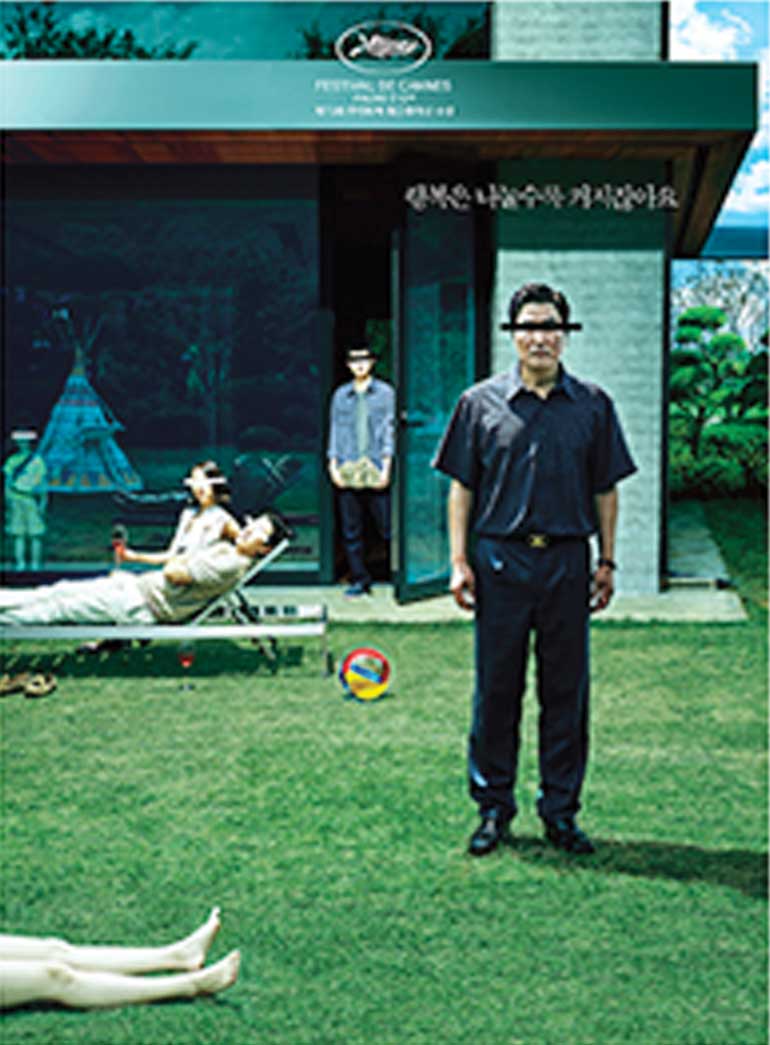
BONG JOON-HO’s Parasite hums along nicely, a Rube Goldberg thriller whose parts are polished to a shine, slide over and into each other with lubricated precision.
The title sums up the film quite nicely: the struggling Kim family encounters the comfortably situated Park family and one by one the former are able to install themselves in the latter as tutor (Kim son Ki-woo [played by Choi Woo-shik], teaching English to Park daughter Da-hye [Jung ji-so]), art therapist (Kim daughter Ki-jeong [Park So-dam], using art to calm the Parks’ ADHD son Da-song [Jung Hyeon-jun]), housekeeper (Kim matriarch Chung-sook [Jang Hye-jin], cooking for Park matriarch Choi Yeon-gyo [Cho Yeo-jeong]), and chauffeur (Kim patriarch Ki-taek [Song Kang-ho] driving for Park patriarch Dong-ik [Lee Sun-kyon]). The Kims in effect sink their tendrils into the Parks, sucking questionably earned income from the latter’s considerable disposable budget.
Or do they? Bong suggests that the Parks do some leeching of their own, with the young Da-hye throwing herself at Ki-woo, and Ms. Park demanding that Ms. Kim prepare a hot noodle dish (ram-don) in the brief time before the Parks arrive home by car. The dish, a hybrid of two types of instant noodles (manufacturer Nongshim’s Chapagetti, or Chinese-style jajang ramen noodles in black-bean sauce, and Neoguri, Japanese-style udon noodles with a spicy seafood flavor — English translator Darcy Parquet simply used the syllables of the two prime ingredients) topped with Hanwoo, or the Korean equivalent of pricy Wagyu beef (Mr. Parquet opted to for the easier-to-comprehend “sirloin”). Cheap noodles topped with an extravagant luxury item — that’s basically the Park family right there, with a hint of anti-Japanese resentment thrown in (Neoguri being a way of appropriating Japanese udon and making it a Korean staple, culinary retribution for the way the Japanese once colonized Korea and is currently waging a trade war against them).
With the Kims securely installed they suddenly discover they aren’t the first: the Parks’ previous housekeeper Moon-gwang (Lee Jung-eun) has kept her husband Gook Geun-sae (Park Myung-hoon) in a hidden bunker all along, in an attempt to escape loan sharks. Kims battle fellow proles for the privilege of living off the Parks; the Parks, oblivious of the war seething below, continue their pettily eccentric lives.
Upstairs/downstairs comedies and parasitic relationships aren’t anything new — one thinks of Robert Altman’s Gosford Park and before that Jean Renoir’s Rules of the Game; one also thinks — when thinking of social spongers — of Renoir’s Boudu Saved From Drowning and, before that, Moliere’s Tartuffe.
Bong’s Kims aren’t quite like Boudu; they work under false pretenses but they do work, and hard — Dong-ik doesn’t hire Kim-taek straightaway but auditions him first, testing the latter’s driving skills by sitting in the back with a drink in hand (Kim-taek doesn’t spill a drop); Chung-sook swiftly complies with Ms. Park’s demands, producing steaming hot noodles topped with a glossy dark sauce, and slices of decadently fatty beef. On the other hand the Parks aren’t totally contemptible — there’s something poignant about their total defenselessness once the Kims get past the initial defensiveness, the way the rich seem helpless without their servants. Despite the title there’s a symbiotic element to this hilariously knotty relationship.
Moon-gwang seems to have operated the more cunning, more manageable (being simpler) scam, by holding back from the Parks the existence of the bunker, and maintaining her husband in there for years; when the Kims overthrow her, she and her husband fall back to being bottom feeders on a steep ladder, with the bunker door sealed tight shut between the haves and the almost-haves against the have-nots.
That bunker incidentally adds another political angle: the architect (the fictitious Namgoong Hyeonja) built it as protection against a North Korean attack; turns out it would hide a secret that would destroy all three families.
The climax is appropriately chaotic, but two details feel bothersome:
1.) I can appreciate Ki-taek’s resentment of Dong-ik, down to the way the latter’s nose wrinkles when he catches Geun-sae’s smell, and I understand Ki-taek’s anger at Dong-ik prioritizing his son’s trauma over Ki-jeok’s mortal wound, but I still can’t quite buy any of this leading to Ki-taek’s homicidal impulse. Call it a failure of staging, a failure of characterization, or a failure of empathy on my part, but there it is.
2.) I can’t quite appreciate Ki-taek’s ultimate fate. Agree, there’s a beautiful symmetry to where he ends up, but give or take a month (and there seems to be enough provisions in the bunker to hide for at least a month) he can easily sneak out, or get caught in the attempt. That’s not a situation that should last very long, despite Bong’s attempt to present it as otherwise.
A great film? I don’t know; I do consider it great entertainment. Bong has done better I think — the tightening despair of Mother, the haunted ambiguity of Memories of Murder — Bong sails skillfully enough through fantasy and science fiction, but soars in his realist dramas. Parasite doesn’t quite have the chaotic class fury of Luis Bunuel’s Viridiana, with its broadsides at religious hypocrisy (an upstairs-downstairs comedy involving religion would I think work, strangely enough, in puritan America), nor does it have the dance-at-volcano’s-edge metaphorical power of Renoir’s Rules of the Game (arguably the masterpiece of the genre). It does inspire consistent glee, however, and the occasional guffaw, and one drools at the thought of a bowl of shining ram-don noodles with thick slices of Hanwoo beef — of convenience fare elevated, by whatever vulgar means, to the level of haute cuisine. The image alone is worth the price of a ticket.
A COMPANY led by businessman Enrique K. Razon Jr. has started operating a gas-fired power plant in Iraq initially with a capacity of 29.3 megawatt (MW) but scalable by nearly five times.
“We are delighted to start our greenfield power plant in Umm Qasr Port. It is a testament to the potential of Iraq,” Mr. Razon, chairman and chief executive officer of Prime Power Middle East, said in a statement on Thursday.
The plant, which started its commercial operation on Feb. 9 in Umm Qasr, Basra Governorate, is run by Prime Power, a wholly owned subsidiary of Prime Metro Power Holdings Corp. It is designed to deliver 24/7 baseload power to the Umm Qasr Ports Authority Zone.
Prime Power’s discussions with the government of Iraq on its intention to operate a power plant began in 2016. A 23-year agreement with the General Company for Ports of Iraq (GCPI) was signed in 2018.
“Under a joint operation framework with GCPI, we were able to leverage the Basra Governorate’s natural gas resources to develop a first class state of the art facility that adds vital power generation infrastructure and services to state of Iraq,” Mr. Razon said.
Prime Power said the power plant is the first phase of a multi-phase development program. The company is looking to launch the second phase in the fourth quarter of the year.
“We see this plant as the first phase of many as we continue to be long term investors in Iraq and to contribute to its economic and social development,” Mr. Razon said.
Phase one’s current operational capacity is targeted to reach 68.4 MW in the second phase. The plant has room to increase capacity up to 150 MW in the coming years. Its operation will be integrated with a distribution system to support the port industrial zone and surrounding cities.
For his part, Prime Power President and Chief Operating Officer Guillaume Lucci said: “We are pleased to have delivered such critical infrastructure and services to GCPI and the Port of Umm Qasr.”
He said the completion of phase one in less than a year : “is a significant milestone in Prime Power’s strategy to build up an infrastructure portfolio that delivers fast and critical investments to regions in need. We will continue to rest on our strong presence on the ground as we work hand in hand with the government and the communities we serve.” — Arjay L. Balinbin
Concert Review Seventeen World Tour: Ode To You in Manila Feb. 8 Mall of Asia Arena
A VIRUS scare could have easily have deterred regular concertgoers from going to an arena where they would have breathed the same air as at least 10,000 others.
Not the fans of Korean pop group, Seventeen. The news on the 2019 novel coronavirus did not stop Seventeen’s fans — who refer to themselves as Carats — from filling up the Mall of Asia Arena to see the Manila leg of the Ode to You World Tour. To manage any related health risks, the show’s local producer Pulp Live World required all spectators to wear masks and took their temperature before letting them enter the venue.
With a recent spate of cancellations and postponements of events featuring K-stars, Seventeen’s fans were relieved that the show went on without a hitch. When Pledis Entertainment announced on Feb. 9 — the day after the concert — that Seventeen would no longer perform overseas until March, the Philippines abruptly became the last stop of the world tour. The entertainment agency had no choice but to cancel the upcoming shows in Malaysia, Taipei, and a number of European cities such as Paris, London and Berlin thanks to the virus scare.
Woozi, Wonwoo, Mingyu, Hoshi, DK, Jeonghan, Dino, Seungkwan, Vernon, Joshua, The8, and Jun made it a memorable night even with the absence of their leader, S. Coups, who is on hiatus while undergoing treatment for his anxiety.
Dishing out 23 songs in all, the 13-member ensemble treated the audience to three hours of powerfully choreographed and synchronized dances, impressive singing, and the delightful fan service that Seventeen is truly known for.
It was their fourth time to perform in the Philippines but they apologized for making their followers wait for their return. Seventeen was scheduled to be part of a Korean concert festival last year, which was canceled.
“The passion of Manila is insane!” the group shouted, further stirring the already electrified crowd.
While the world tour was anchored on Seventeen’s latest album, An Ode, the baker’s dozen sang only two songs from their third studio CD which was released in September. They came on strong in their opening set with “Fear.” In “Happy Ending,” the fans accompanied them with a mix of chants and singing worthy of a videoke session. In between sets, Seventeen sang a portion of “Snap Shoot” acapella.
They, however, indulged their Filipino Carats by performing many of their hits such as “Clap,” “Adore U,” “Pretty U,” “Oh My!,” and “Thanks,” from their previous albums, Love & Letter and Teen, Age, with several numbers remixed to bring a different flavor to the songs.
The spectators came prepared with light sticks, fan chants, and relentless shouting. The mood at the MOA Arena was a pleasant mix of happiness and hysteria. There was a sing-along portion where Filipino fans, when prompted, impressively showcased their Korean singing and chanting prowess.
Seventeen is divided into sub-units — the vocal, performance (dance), and hip-hop groups. The hip-hop team sang “Trauma” and “Chilli” in their special set, while the performance unit danced to “Lilili Yabbay” and “Shhh.” Not to be outdone, the group’s vocalists sent chills through the audience with “Hug” and “Don’t Listen in Secret.” The vocal unit performed while seated on the hydraulics-operated platform, visibly relaxed though on key the whole time.
There were a number of fan favorites that did not end up on the set list, including “Home,” “Manse,” “Boom Boom,” and even “Chuck,” although Seventeen carefully picked songs from their full discography for Ode To You.
There was also a point in the concert when the audience coaxed the group to dance to the viral Sarah Geronimo hit, “Tala,” but it appeared that they were not briefed before hitting the stage so the request was lost in translation. The closing was heartwarming, with the boys singing the “Aju Nice,” which seemed to be never ending as they returned to the main and extended stages again and again until the curtain finally closed.
Ode To You In Manila was supported by Globe, which continues to bring the K-Pop experience to Filipino fans by sponsoring concerts and other events featuring Korean artists.
With the worldwide health risk from the coronavirus still to be contained, the staging of future shows — by both of foreign and local artists — will likely be carefully monitored. But Seventeen’s over-the-top and give-it-all performance last Saturday certainly provided their fans with sweet memories to go back to until their next visit. It was surreal not just to smell but to experience Seventeen’s high spirits.
THE Senate Public Services Committee will look into the allegations against the ABS-CBN Corp. that were cited as the roadblock in granting the 25-year extension of its franchise.
Senator Grace S. Poe-Llamanzares, who chairs the committee, filed Senate Resolution No. 322 to give a venue to all parties while waiting for the House Committee on Legislative Franchises to begin tackling the franchise.
“Due to the gravity of the allegations and its possible effects, the Committee has deemed it appropriate to lay the groundwork for a possible inquiry in the spirit of public interest,” she said in a statement on Thursday.
She said the inquiry is well within the Senate’s oversight function on franchises, but noted it does not preclude any action in the House of Representatives or the Supreme Court.
“The issue on sub judice regarding legislative inquiries has long been resolved by the Supreme Court,” she said, citing the Sabio versus Gordon case, which said “On-going judicial proceedings do not preclude congressional hearings in aid of legislation.”
Senate Minority Leader Franklin M. Drilon supported the resolution, which he said would allow the Senate to make a judgment on the renewal of the franchise.
The Office of the Solicitor General earlier filed a quo warranto petition to forfeit the existing franchise of ABS-CBN and its subsidiary ABS-CBN Convergence, Inc. even as the franchise is set to expire on March 2020.
Some lawmakers asserted that the media giant may still continue its operation until 2022 as long as its franchise renewal is pending in Congress. The franchise was first granted in 1995, under Republic Act No. 7966.
Senate President Vicente C. Sotto III supported the resolution so as to be clarified on ABS-CBN’s alleged violations. — Charmaine A. Tadalan


 SOUTH KOREA’S status as a cultural juggernaut just got a serious shot of international credibility.