Home Blog Page 987

Remolona named as one of world’s top central bankers for second straight year

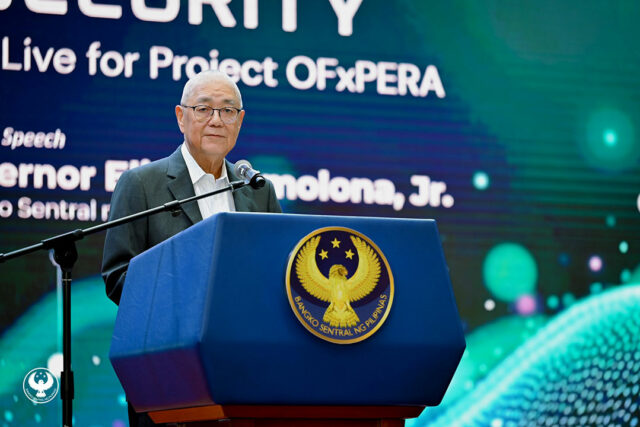
BANGKO SENTRAL ng Pilipinas Governor Eli M. Remolona, Jr. — BANGKO SENTRAL NG PILIPINAS

BANGKO SENTRAL ng Pilipinas (BSP) Governor Eli M. Remolona, Jr. has again been recognized as one of the best central bank chiefs worldwide.

Mr. Remolona received an “A-” rating from Global Finance magazine;s Central Banker Report Cards 2025.

The BSP chief debuted on the report card last year with the same grade.

“We thank Global Finance for recognizing the Bangko Sentral ng Pilipinas’ efforts in keeping prices stable, the financial system sound, and payments running smoothly,” Mr. Remolona said in a statement on Thursday. “This recognition is really a credit to the entire BSP team and their commitment to our mandates.”

Global Finance publishes its Central Banker Report Cards annually and evaluates the central bank chiefs of nearly 100 key countries, territories and districts, grading them between “A+” and “F.”

“The ratings are based on inflation control, economic growth, currency stability, interest rate management, and independence,” the BSP said.

“Our annual Central Banker Report Cards recognize those leaders who have not only delivered results but done so with independence, discipline, and strategic foresight,” Global Finance Founder and Editorial Director Joseph Giarraputo said.

Mr. Remolona was appointed as BSP chief in June 2023 for a six-year term, when the central bank was in the middle of a tightening cycle to help rein in inflation and normalize their policy stance as the Philippine economy reopened following the coronavirus pandemic.

That rate-hike round ended with an off-cycle increase worth 25 basis points (bps) in October 2023 that brought cumulative hikes to 450 bps and the key rate to 6.5%.

As inflation went down, the Monetary Board in August 2024 then began its current easing cycle. It has now cut benchmark borrowing costs by a cumulative 150 bps, with the policy rate now at 5%.

Mr. Remolona has signaled that this round of policy loosening is nearing its end, with just one more reduction possible within this year to support the economy if needed as global trade uncertainties continue to cloud the outlook.

Others who received an “A-” rating this year are the heads of central banks from Cambodia, Czech Republic, Dominican Republic, Egypt, Ethiopia, European Union, Guatemala, Mongolia, Serbia, Singapore, South Africa, Taiwan, and Uganda.

Meanwhile, the US Federal Reserve’s Jerome H. Powell, Denmark’s Christian Kettel Thomsen and Vietnam’s Nguyen Thi Hong received the highest “A+” grade.

The full list will be published in October. — KKC

Lopez healthcare unit partners with OLFU to boost medical education programs

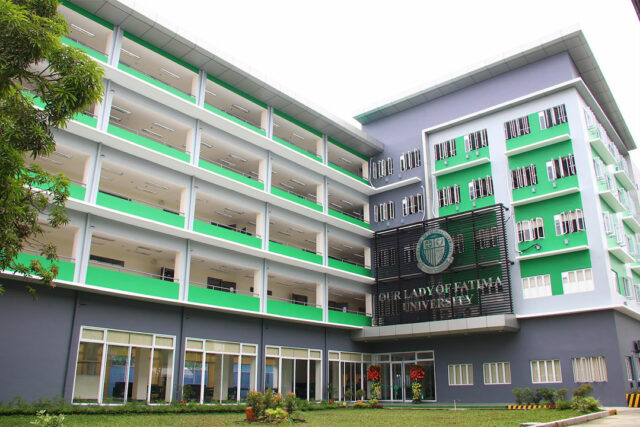
FACEBOOK.COM/OUR.LADY.OF.FATIMA.UNIVERSITY

LOPEZ-LED Medical Services of America Philippines, Inc. (MSA-PH) has signed a memorandum of agreement (MoA) with Our Lady of Fatima University (OLFU) to provide scholarships, internships, and career development support to respiratory therapy students.

In a MoA signed on Aug. 14, MSA-PH and OLFU’s College of Respiratory Therapy will provide scholarships, internships, research, and conduct academic events to help align students with industry standards.

“This MoA not only supports OLFU students in their professional journey but also strengthens the pipeline of skilled respiratory therapists in the Philippines, ensuring that local healthcare keeps pace with international standards,”  OLFU College of Physical Therapy, Respiratory Therapy, and Radiologic Technology PT Dean Hernan C. Labao said in a statement.

Under the agreement, MSA-PH will provide support for OLFU’s scholarship programs, participate in career talks and recruitment sessions, and offer internship centers for students.

“This landmark partnership positions OLFU and MSA-PH at the forefront of respiratory therapy education and clinical practice that will build bridges between the academe and the healthcare industry and nurture the country’s next generation of respiratory care professionals,” MSA-PH General Manager and Chief Operating Officer Erwin Chuaunsu said.

MSA-PH is a subsidiary of Lopez-led First Philippine Holdings Corp. (FPH), which provides outsourced cardiopulmonary services, equipment rentals, and home care services. At present, the conglomerate has partnerships with 40 hospitals nationwide.

FPH shares on Thursday rose by 0.13% or 10 centavos to close at P77.50 apiece. — Beatriz Marie D. Cruz

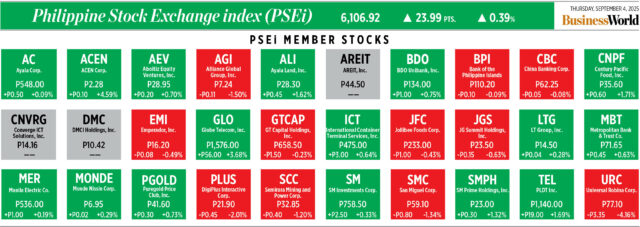
How PSEi member stocks performed — September 4, 2025

Here’s a quick glance at how PSEi stocks fared on Thursday, September 4, 2025.


Stocks up on bargain hunting after five-day slide

REUTERS

PHILIPPINE STOCKS inched up on Thursday as investors picked up bargains following the market’s five-day slide.

The Philippine Stock Exchange index (PSEi) increased by 0.39% or 23.99 points to close at 6,106.92, while the broader all shares index rose by 0.39% or 14.30 points to end at 3,677.92.

“The local market saw a technical bounce this Thursday backed by bargain hunting after five straight days of decline. Trading was still lethargic, however, with net value turnover at P4.74 billion, below the year-to-date average of P5.97 billion. This reflects weak confidence towards the market amid lingering headwinds,” Philstocks Financial Inc. Research Manager Japhet Louis O. Tantiangco said in a Viber message.

Value turnover declined to P4.81 billion on Thursday with 1.06 billion shares traded from the P5.37 billion with 705.16 million shares that changed hands on Wednesday.

“The market saw a slight relief as investors engaged in bargain hunting, taking advantage of cheaper stock prices,” Regina Capital Development Corp. Head of Sales Luis A. Limlingan likewise said in a Viber message.

“US equities showed signs of stabilizing as a tech sector rebound helped curb recent losses. A less-than-stellar jobs report is bolstering the case for future interest rate cuts, which has also provided a measure of support for investor sentiment,” he added.

Wall Street stocks recovered some ground on Wednesday after technology conglomerate Alphabet rose on a favorable antitrust ruling, but gains were muted as investors digested softer-than-expected labor market data and a selloff in long-term global government bonds, Reuters reported.

Job openings, a measure of labor demand, dropped 176,000 to 7.181 million by the last day of July, the Labor Department’s Bureau of Labor Statistics said in its “JOLTS” report. With the Fed focused on employment, Friday’s crucial jobs report will help set expectations for the central bank’s next few policy meetings.

Traders are pricing in a near-100% chance of the Fed cutting interest rates later this month, up from 89% a week ago, CME FedWatch showed. They are also pricing in 139 basis points of easing by the end of next year.

All sectoral indices closed in the green on Thursday. Property went up by 1.08% or 26.11 points to 2,444.33; mining and oil climbed by 1.07% or 116.59 points to 10,928.22; services rose by 0.78% or 16.82 points to 2,171.49; financials increased by 0.27% or 5.57 points to 2,051.38; holding firms inched up by 0.1% or 5.27 points to 5,067.28; and industrials added 0.05% or 5.33 points to end at 8,988.14.

Advancers beat decliners, 111 to 88, while 53 names were unchanged.

Net foreign selling dropped to P237.92 million on Thursday from P921.7 million on Wednesday.

Mr. Limlingan said the Philippine August inflation data to be released on Friday, Sept. 5, will be a key trading driver for the market. — Alexandria Grace C. Magno with Reuters

Manila and allies stage naval drills near Scarborough Shoal, draw China rebuke

VESSELS from the Philippines, Australia and Canada hold drills off the Zambales coast near the China-occupied Scarborough Shoal in the South China Sea. - ARMED FORCES OF THE PHILIPPINES

By Kenneth Christiane L. Basilio, Reporter

THE PHILIPPINES held joint naval exercises with Australia, Canada and the US in the South China Sea earlier this week, a move seen as reinforcing security cooperation amid heightened Chinese assertiveness in the contested waters.

In a statement on Thursday, the Armed Forces of the Philippines (AFP) said the drills were held on Sept. 2–3 off Zambales province, facing Scarborough Shoal, one of the most volatile flashpoints in the maritime dispute. Exercises included sea logistics, maneuvering drills, and anti-submarine warfare training.

It was the 10th multilateral maritime cooperative activity (MMCA) involving the Philippines and its allies, which have consistently supported Manila’s maritime claims. Participating assets included the Philippine frigate BRP Jose Rizal, Australian destroyer HMAS Brisbane, Canadian frigate HMCS Ville de Quebec and a US maritime patrol aircraft.

“Just days after the successful conclusion of Exercise Alon, the 10th MMCA reaffirms our collective resolve to protect our seas and uphold a rules-based international order,” Philippine military chief General Romeo S. Brawner, Jr. said in the statement.

The exercises came shortly after the Philippines and Australia wrapped up their largest bilateral war games, underscoring closer defense ties between Manila and its partners.

China continues to assert sovereignty over nearly all of the South China Sea using its “nine-dash line” map a claim voided by a 2016 United Nations-backed tribunal ruling. Despite the decision, Beijing has expanded its presence across disputed features, including the Spratly Islands and Scarborough Shoal, fueling repeated confrontations with Manila.

The Philippine Navy confirmed that Chinese warships monitored the two-day drills. Rear Admiral Roy Vincent T. Trinidad, navy spokesman for the South China Sea, said a Chinese missile destroyer and a frigate were spotted about 40 nautical miles (74 kilometers) southeast of Scarborough.

“They were observed following the international task group,” he told reporters. However, he noted the Chinese vessels were not conducting “synchronized movement” typical of joint patrols, rejecting claims from China’s Southern Theater Command that its forces were engaged in routine operations at the shoal.

“Such messages are part of their malign influence operations to justify their illegal presence in the country’s exclusive economic zone,” Mr. Trinidad said.

The Chinese Embassy in Manila did not respond to a Viber message seeking comment.

China’s Southern Theater Command, through spokesman Tian Junli, accused the Philippines of undermining regional stability by holding joint patrols with foreign militaries.

“Any attempt to stir up trouble in the South China Sea and create tensions is doomed to fail,” he was quoted as saying by state-run China Military Online.

The Philippines has relied increasingly on multilateral cooperation to bolster maritime defenses, frequently conducting joint patrols and exercises with the US, Japan and other partners.

Officials in Manila have argued that such engagements are needed to deter aggression and safeguard sovereignty.

China’s dispatch of warships to shadow the latest drills coincided with its largest military parade in years on Sept. 3. The timing highlighted Beijing’s military reach and willingness to project power even as tensions rise in the region.

Chester B. Cabalza, founding president of think tank International Development and Security Cooperation, said the parade underscored the urgency for Manila to accelerate defense upgrades.

“The parade of weapons is made to poke the US and its allies,” he said in a Messenger chat. “It means that we have to fast-track the alteration of the military modernization program and widen joint naval drills with allies for a deterrence-centered policy.”

The AFP has repeatedly said it would pursue cooperative activities with like-minded nations to strengthen interoperability, enhance security and reinforce the Philippines’ position in the South China Sea.

Senate eyes 2026 budget purge amid DPWH red flags

Portions of the revetment wall along the Tullahan River collapsed in North Fairview, Quezon City, Aug. 29, 2025. — PHILIPPINE STAR/MIGUEL DE GUZMAN

THE PHILIPPINE Senate will prioritize removing questionable items from the proposed 2026 national budget after senators raised concerns about anomalous projects under the Department of Public Works and Highways (DPWH).

“The first order of business is assuring that the 2026 budget is corruption-free, and the projects are indeed well-studied and with feasibility studies, and the projects will be felt by the people,” Senator Sherwin T. Gatchalian told Money Talks with Cathy Yang on One News on Thursday.”

During a Senate budget hearing earlier in the week, lawmakers flagged the DPWH’s spending plan, citing projects with similar costs and those that reappeared in the 2026 National Expenditure Plan despite already being funded under the 2025 General Appropriations Act.

Mr. Gatchalian, who heads the Senate finance committee, said some projects divided into phases had identical funding figures, while others seemed to resurface in the new budget.

Senator Panfilo M. Lacson also pushed an executive session with the Department of Budget and Management (DBM) after identifying more than 500 flood control projects in the National Capital Region, Ilocos, Cagayan Valley and Central Luzon that had the same budget allocations.

He noted that 88 projects carried P150 million each, amounting to P13.2 billion; 373 projects were priced at P100 million each for a total of P37.3 billion; and 11 were listed at P120 million each, amounting to P1.32 billion.

The DPWH has one of the largest proposed allocations in the 2026 budget at P881 billion.

“You cannot go to the macroeconomic assumptions, alignment with the Philippine Development Plan,” Mr. Gatchalian said. “If you have projects that are spurious and anomalous — for example, ghost projects — then that will not redound to anything at the end.”

The Department of Finance earlier estimated that corruption tied to flood control projects had cost the country as much as P118.5 billion in economic losses since 2023.

‘IT STARTS WITH THE SYNDICATES’
Mr. Gatchalian warned that syndicates within the DPWH continue to play a role in anomalous transactions.

“It really starts with the syndicates, because the syndicates are conniving with the contractors and these people,” he said. “If you look at the budget process, it’s the district engineer that suggests all those line items that we see in the national expenditure program. If those people are conniving with one another, that connivance will end up in our national expenditure program.”

The DPWH has been under close watch since President Ferdinand R. Marcos, Jr. flagged questionable flood control projects in his fourth State of the Nation Address in July.

Since 2022, about P544 billion has been allocated nationwide for flood control, with the top 15 contractors cornering P100 billion of that amount, according to the President. Both the Senate and the House of Representatives have launched investigations.

Mr. Gatchalian said the Senate aims to complete budget deliberations before the year ends to avoid a reenacted budget. “A reenacted budget will definitely have some effects on our economic growth, considering that you cannot spend for capital outlay. So as much as possible, we have to do everything we can to get our budget approved by the end of the year.”

Mr. Marcos earlier warned that he was ready to veto any spending bill that did not align with the administration’s priorities. His economic team, however, cautioned that vetoes or reenacted budgets could stall growth.

Mr. Gatchalian noted that a reenacted budget would block new infrastructure projects and dampen expansion.

The most serious effect would be the absence of capital outlays, which means no new projects — no roads, no classrooms, nothing additional could be built, he pointed out. Since government spending makes up about 15% to 20% of the economy, the impact would be significant.

“If you take out infrastructure spending, that will impact economic growth because government is one of the biggest drivers of economic growth,” he added.

The Development Budget Coordination Committee has proposed a P6.793-trillion budget for 2026, up 7.4% from this year and equivalent to 22% of economic output.

Also on Thursday, Palawan Rep. Jose C. Alvarez told reporters on the sidelines of a budget hearing that the House has withdrawn its request to return the proposed 2026 budget to the Budget department.

The DBM promised to resolve what lawmakers earlier flagged as “erroneous entries” in the spending plan, the congressman, who is vice-chairman of the House appropriations committee, said.

“They (Transportation Secretary Vivencio “Vince” B. Dizon and Budget Secretary Amenah F. Pangandaman) will be the ones to come here and sort things out,” Mr. Alvarez said. “The deliberations will continue so we don’t run out of time.”

On Wednesday, senior party leaders forming the House majority bloc urged their colleagues to suspend participation in hearings until the DBM clarified what they described as “questionable” line items.

The Marcos administration faces pressure to approve a clean and transparent budget amid allegations of fund diversions, questionable public works allocations, and blank entries in this year’s budget.

Reports of substandard flood-control projects amounting to billions of pesos have fueled public outrage and prompted congressional inquiries, eventually leading to the removal of a Public Works secretary.

“The budget is riddled with mistakes,” Mr. Alvarez said.

Nueva Ecija Rep. Mikaela Angela B. Suansing, who heads the House appropriations committee, said hearings for next year’s proposed agency budgets would proceed as scheduled. “We also want to make sure that the budget is passed on time.” — Adrian H. Halili and Kenneth Christiane L. Basilio


DoH says it needs P450 billion yearly for free healthcare

PHILIPPINE STAR/ MICHAEL VARCAS

THE PHILIPPINES needs P450 billion every year to provide free healthcare services in government hospitals, according to the Health secretary.

“When the Legislature passed the Universal Healthcare Act, health economists made estimates of how much the DoH (Department of Health) would need annually to implement universal healthcare, and the figure they provided was P450 billion per year,” Health Secretary Teodoro J. Herbosa told congressmen at a budget hearing on Thursday.

This year, the government allotted P320 billion to the health sector, covering both the DoH and Philippine Health Insurance Corp. (PhilHealth), according to Budget department data.

Mr. Herbosa noted that while an additional P100 billion could make a “significant impact,” the agency would not immediately request the full amount because of absorptive capacity constraints.

“We’ll only ask for what we can realistically utilize each year,” he said, noting that the rollout of universal healthcare would be phased.

Despite reforms under the Universal Healthcare Act of 2019, Filipino households continue to face high medical costs. A Congressional Policy and Budget Research Department report released in February showed out-of-pocket healthcare payments reached P550.2 billion in 2023, accounting for 44.4% of total health spending.

State-funded and compulsory contributions amounted to P528.8 billion or 42.6%, while voluntary healthcare payments totaled P161.3 billion or 13%.

President Ferdinand R. Marcos, Jr. highlighted the government’s “zero-balance billing” program in his fourth State of the Nation Address in July, promising that patients at government hospitals would no longer pay out-of-pocket expenses for medical services.

Budget Secretary Amenah F. Pangandaman said sustaining the program requires at least P20 billion in annual funding.

Mr. Herbosa warned that costs could rise further as medical prices increase.

“The cost of diagnostics, cost of medicine, continues to rise,” he said. “The equipment is becoming more modern, but it’s becoming more expensive. Medicines are becoming more innovative, more effective, but more expensive.” — Kenneth Christiane L. Basilio

Senate issues subpoenas vs contractors, DPWH officials amid flood control probe

PHILIPPINE STAR/JOHN RYAN BALDEMOR

SENATE PRESIDENT Francis “Chiz” G. Escudero on Thursday said that he has issued subpoenas to summon contractors and Public Works officials allegedly involved in anomalous flood control projects, as the Senate continues its probe next week.

“No stone should be left unturned in the inquiry into these highly questionable flood control projects that cost taxpayers in billions of pesos and caused nightmares and sufferings for many Filipinos.” Mr. Escudero said in a statement.

“Let the axe fall on all the personalities found guilty of scheming, conniving and carrying out fraudulent acts in the guise of legitimate taxpayer-funded flood control projects,” he added.

Mr. Escudero issued subpoenas against five contractors and three officials of the Department of Public Works and Highways (DPWH) to attend the next Blue-ribbon Committee hearing into the anomalous flood control projects on Sept. 8.

The summons was signed at the recommendation of Committee Chairman Senator Rodante D. Marcoleta.

About P544 billion in public funds have been allocated for flood control nationwide since 2022, of which about P100 billion were cornered by the top 15 contractors named by President Ferdinand R. Marcos, Jr.

The Senate chief also signed a subpoena duces tecum for the highlights on Commission on Audit’s (CoA) report on the country’s flood control projects, as well as the copy of the responses of the respondents to the findings.

Earlier, CoA Chairperson Gamaliel A. Cordoba ordered the initiation of a performance audit on government flood control projects across the country.

The Senate is currently investigating flood control projects after Mr. Marcos revealed in August that more than 6,000 flood control projects launched since 2022 lacked key details.

LOOKOUT BULLETIN
Also on Thursday, the Department of Justice said it has issued the initial batch of immigration lookout bulletin orders (ILBOs), which includes 43 individuals, including DPWH officials and contractors.

The ILBOs consolidated requests from the Blue-ribbon Committee and Public Works Secretary Vivencio “Vince” B. Dizon’s office.

“The Secretary has signed the initial batch of ILBOs. This is the request of Senator Marcoleta from the Blue-ribbon Committee,” Justice Assistant Secretary and Spokesperson Jose Dominic F. Clavano IV told reporters on Thursday.

Mr. Clavano added that Mr. Dizon’s request for additional ILBOs has now been processed and issued.

The named individuals are now prevented from leaving the country without clearance.

Meanwhile, Palace Press Officer and Undersecretary Clarissa “Claire” A. Castro on Thursday confirmed that Mr. Dizon already dismissed the district engineer involved in a “ghost” project in Bulacan.

She added the dismissal of two other district engineers from the same province are also being processed.

She said that Mr. Dizon also recommended filing appropriate cases before the Office of the Ombudsman against the three officials, who have also been named in the Bureau of Immigration’s lookout bulletin.

Mr. Dizon is set to issue a perpetual blacklisting order against Wawao Builders, the contractor behind the P96.5-million flood control project, and SYMS Construction Trading, which handled a P55-million project, both in Bulacan, Ms. Castro said. — Adrian H. Halili and Erika Mae P. Sinaking

16 more Discaya cars seized

The Bureau of Customs seized 16 more vehicles linked to the Discaya family, allegedly involved in “ghost” flood control projects.

THE Bureau of Customs (BoC) has taken custody of 16 additional vehicles, bringing the total confiscated Discaya-owned vehicles to 28, it said on Thursday.

In a statement, Customs said as of 3:30 p.m., it secured 16 additional vehicles of the flood control corruption-tied contractors, Cezarah Rowena “Sarah” Discaya and Pacifico “Curlee” Discaya II.

This was on top of 12 cars seized earlier through a court-ordered search operation in Pasig City.

“The 16 vehicles are now undergoing processing by the BoC for sealing and documentation and will be guarded by Customs personnel, pending verification of importation records and assessment of duties and taxes,” the BoC said.

The Omega & Alpha Construction and St. Timothy Construction, allegedly owned by the Discayas were among the top 15 flood-control contractors earlier identified by President Ferdinand R. Marcos, Jr.

Mr. Marcos earlier said that some P100 billion of the total P545 billion in government funds that were allocated for flood control projects nationwide since 2022 were cornered by just 15 contractors.

The seized vehicles include a Mercedes Benz GLE, Land Rover Range Rover LWB, Land Rover Defender, Cadillac Escalade ESV, Ford Bronco and Mercedes Benz GLS 350.

The list also includes a BMW X5 30D, Jaguar F-Pace 2.0D, Porsche Cayenne V6, Volvo XC90, Mercedes Benz Avant, LAND Rover Range Rover Evo-F, Mercedes Benz Sprinter, ATV Quicksand, Yukon Denali, and ATV Gray.

The agency said it will continue its thorough investigation with the help of the Land Transportation Office. — Aubrey Rose A. Inosante

DepEd issues new RH policy

PHILSTAR FILE PHOTO

THE Department of Education (DepEd) on Thursday said it will no longer implement Comprehensive Sexuality Education (CSE), as it issues a new policy on Reproductive Health Education (RHE) in line with President Ferdinand R. Marcos, Jr.’s directive to protect learners’ welfare.

“The goal of our new policy is to educate our students about reproductive health in a manner appropriate to their age,” Education Secretary Juan Edgardo “Sonny” M. Angara said in a news release.

“We are also emphasizing that the implementation of this new policy will be culturally sensitive and contextually relevant,” he added.

DepEd said that RHE is anchored on Republic Act No. 10354, the Responsible Parenthood and Reproductive Health Law of 2012, and will focus on teaching health, personal responsibility, and respect in relationships to adolescent learners aged 10 to 19, starting in Grade 5.

“We want to ensure that our adolescent learners are equipped with the right knowledge on RHE,” Mr. Angara said. “This policy is not just about disseminating information — it is about shaping responsible learners who uphold Filipino cultural values, traditions, and beliefs.”

The department added that teachers who will implement RHE will undergo “sufficient training and continuous professional development, supported by adequate resources to ensure competence and sensitivity” during lectures.

It also commits to using scientifically accurate and evidence-based instructional materials that promote gender sensitivity to avoid gender-based violence, myths, misconceptions, and misleading ideologies.

According to the advocacy group Philippine Legislators’ Committee on Population and Development (PLCPD), CSE became a target of disinformation at the beginning of the year.

“Suddenly, groups emerged recycling misleading arguments from Western organizations,” it said in a statement on Thursday.

PLCPD added that in other countries, similar efforts have fueled policies and campaigns against gender equality and reproductive health rights and dignity.

“CSE upholds Filipino values such as protecting and guiding children so they can grow up able to stand for what is right and make responsible decisions,” said Au Quilala, executive director of PLCPD and convenor of the Child Rights Network, in a statement.

During a House budget briefing on Wednesday, Mr. Angara was questioned about Project Dalisay’s claims that CSE has “inappropriate concepts” and allegedly threatens the “moral, societal, and spiritual values” of young learners.

“I think the materials they were quoting from were not DepEd materials,” Mr. Angara said. “I don’t know what the source of the video was. But definitely, we do not promote, we do not teach those practices.”

Latest data from the Pulse Asia survey in August revealed that 73% of surveyed participants agreed to teach CSE in schools, while only 13% disagreed. Meanwhile, the remaining 14% are undecided. — Almira Louise S. Martinez

Higher pay for dentists sought

Health Secretary Teodoro J. Herbosa addressed questions of lawmakers during the brifing on the Department of Health’s 2026 budget, Sept. 4.

A PHILIPPINE lawmaker on Wednesday urged higher entry-level salaries for public dentists, citing a shortage that leaves only one dentist serving every 48,130 Filipinos.

During the Department of Health’s budget hearing before the House Committee on Appropriations on Thursday, Assistant Minority Leader Rep. Jose Manuel T. “Chel” Diokno raised the issue of public dentists’ relatively lower salaries to Health Secretary Teodoro J. Herbosa.

Mr. Diokno noted that while a Nurse I receives Salary Grade 15, equivalent to a starting monthly salary of P36,619, government dentists start at Salary Grade 13, equivalent to P31,320, despite having longer years of study.

“Why are dentists at entry-level earning less?” Mr. Diokno said in Filipino.

The Health chief responded that the lower salary of dentists compared to Nurse I is based on the Salary Standardization Law of 2019 and as mandated by the Philippine Nursing Act of 2002.

Mr. Herbosa also noted that uncompetitive salaries are not limited to dentists but affect other government health workers as well.   

“If you compare nurses’ salaries with those of other allied health professionals like medical technologists and radiologic technologists, the difference is significant,” Mr. Herbosa said.    

“This salary grade I only discovered now, so I guess that is to be corrected as well.”   

To address these issues, Mr. Herbosa is seeking additional funding from the Department of Budget and Management for dentists and other allied health professionals.

He has also assigned an undersecretary to oversee the country’s dentistry program and the proposal to revive the dental program amid the ongoing shortage of public dentists.

In August, Rep. Roman T. Romulo filed the Public Dentist Salary Modification Act, which seeks to increase the salary grades of public dentists.   

Under House Bill 4051, entry-level Dentist I positions would be upgraded to Salary Grade 17, equivalent to a starting monthly salary of P43,030 based on the 2023 salary schedule.

Senator Francis G. Escudero also filed the Senate counterpart bill in June, which seeks to increase the current number of 2,369 public dentists. — Edg Adrian A. Eva

DoST finds way to predict dengue outbreak

STOCK PHOTO | Image from Freepik

AS THE Philippines continues to grapple with dengue, a local scientist is developing a computer-based model that can forecast potential outbreaks and help strengthen the country’s dengue prevention efforts.

Developed by the Department of Science and Technology (DoST) Balik Scientist and Institute of Biological Control Director Dr. Thaddeus M. Carvajal, the computer-based model combines environmental data, mosquito activity, and dengue case records to allow the prediction of dengue outbreaks.

“His work aims to give communities and health authorities the tools to act faster, smarter, and more effectively against one of the country’s most persistent public health threats,” DoST said in a statement.

From January to June 2025, the Department of Health has already recorded more than 123,000 dengue cases and 437 related deaths nationwide, underscoring the urgent need for stronger prevention measures, especially during the rainy season when spikes in cases often occur.

“Fighting dengue is more than a health concern — it is a national priority,” DoST Secretary Renato U. Solidum, Jr. said in a statement.   

“Through R&D projects led by our Balik Scientists, we are developing innovations that stay ahead of dengue,” he added.   

Mr. Carvajal has been studying the hidden patterns of mosquito-borne diseases in the Philippines over the years, particularly focusing on Aedes aegypti, the main culprit behind dengue outbreaks.

He found that mosquitoes in busy areas like ports are genetically similar, suggesting they spread through human travel, a finding that could help track and prevent dengue outbreaks before they worsen.

Mr. Carvajal’s model was presented at the John Gokongwei Innovation Center at De La Salle University (DLSU)-Laguna and is currently being developed for future adoption. — Edg Adrian A. Eva