

Home Blog Page 9821

Ready, aim, fire out!

Text and photos by Aries B. Espinosa

WHERE there’s smoke, there’s fire. And where there’s fire, there will most likely be a red Isuzu fire truck hard at work dousing the flames.

The Bureau of Fire Protection (BFP) just gave itself a much-needed boost in its daunting fire prevention campaign and modernization program, acquiring no less than 74 brand-new fire trucks comprised of 54 Isuzu FVR34, 20 CYZ52 heavy duty trucks, and three rescue trucks to be deployed to local governments across the country.

The 74 fire trucks have been specially equipped for firefighting by Korean-based body builders Hanseo (for the FVR34) and Nanomedics (for the CYZ52). The FVR34 has a 1,000-gallon capacity water tank, while the CYZ52 carries with it a 2,500-gallon tank.

The fire trucks were formally turned over Feb. 11 at the Camp General Emilio Aguinaldo military headquarters in Quezon City, with no less than President Rodrigo R. Duterte witnessing the proceedings.

In his speech, Mr. Duterte said, “I hope that with these fire trucks, the BFP will become more capable and effective in ensuring the safety of our communities and industries. I am confident that with your help, we can further boost our people’s confidence in their government and create an environment where our people can live and work in peace.”

IPC President Hajime Koso, who attended the ceremonies, said, “IPC, and the Isuzu brand in general, has always been on a mission to contribute to society by providing the most durable, reliable trucks — may it be for building bridges, airports, and this time in protecting the community against fire. With the upcoming Fire Prevention Month in March, we feel that these trucks may be in the right timing, as BFP now more than ever needs to continue to protect and serve the country against fire and other calamities.”

Isuzu Motors Limited (IML) General Manager Koichi Ito, who flew in from Japan to witness the proceedings, remarked, “Isuzu has always been supportive of providing the best vehicles to society. In Japan, in particular, you will see lots of private and government trucks produced by Isuzu, like these fire trucks and, recently, high-performance ambulances for Covid-19 prevention, which is why we are very happy the Philippines is doing the same.”

BFP Director for Logistics Senior Superintendent Jerry Candido told Velocity that the new fire trucks would be deployed to local governments that, up to now, don’t have their own firefighting vehicles.

“Since we started modernizing the BFP in 2009 with the enactment of the 2008 revised Fire Code of the Philippines, we had been updating our firefighting equipment. We have already ordered 191 brand-new fire trucks from Isuzu, to be distributed all throughout the Philippines. We are prioritizing the local fire departments that still use old fire trucks, and the almost 300 local government units with fire stations that still do not have any fire trucks.”

IPC Sales Division Head Joseph Bautista confirmed to Velocity that this would be the single biggest transaction between IPC and BFP. “We are very happy to support the modernization program of the BFP. These fire trucks not only provide the latest technology in firefighting equipment, but also makes sure that the firemen are transported in much more comfortable conditions,” he said.

The FVR34 16-tonner trucks are powered by the 6HK1TCL engine producing up to 240ps of power and maximum torque of 706Nm, while the CYZ52 33-tonners are powered by the Euro 5-compliant 6WG1TCN Isuzu direct-injection common rail engine that delivers maximum power of 420ps and maximum torque of 1,863Nm.

According to data provided by the Bureau of Fire Protection, a total of 2,269 fires in January and February this year were recorded. Since 1966, March had been declared Fire Prevention Month, as most fires have occurred during this period.
Adidas moves to reframe meaning of ‘fast’ with latest campaign

SEEKING TO give a new meaning to the word “fast,” adidas recently unveiled the “Faster Than_” campaign.

The thrust attempts to have “fast” go beyond as denoting mere “speed,” but also one invoking a personal feeling of self-betterment.

It is backed by a comprehensive new trend study from adidas Running, which saw insights gathered from 6,000 runners across the world with the end view of helping bring in a new era in running.

The trend study produced key findings which led adidas to come up with the Faster Than_ campaign which also aims to move people to pick up running and explore its positive effects.

Among the findings of the study is that two-thirds (66%) of runners run with a focus on personal betterment and transformation; 60% of respondents agreed that regular running provided mental health benefits, with 47% saying it allowed them to switch off from everyday stresses of modern life, and with 68% admitting it’s the only time their phones are left behind; and 18% of runners feel more inspired after a run, with 14% saying it gave them a sense of pride and 32% confessing to having increased confidence immediately after a run.

The social aspect of running was also revealed as part of the study, with 34% of those surveyed admitting they have met a future friend while running and 20% even meeting a future partner, showcasing the more unexpected social benefits that the activity can bring.

The positive repercussions of running were put to light as well, with respondents linking their post-running “high” to successes, including finally achieving something they had been putting off (34%), finding their creative flair and best ideas (30%), and even working up the courage to ask someone out on a date (17%).

To drive home what it wants to accomplish, the campaign spotlights a number of inspirational runners and their stories, which underscores that “fast” is a personal feeling whatever that might be.

Among the featured runners are Martinus Evans, a 300-lb distance runner who turned his doctor’s negative body comments and laughter into a motivational tool; Noah Lyles, the current Men’s 200-meter World Champion; emergency liver transplant survivor turned World Champion runner Ellie Lacey; and marathon legend Kathrine Switzer, who famously became the first female numbered entrant to the Boston Marathon in 1967 and was controversially pushed off the course by male runners but battled on and finished the race.

NEW SHOES
In conjunction with the campaign, adidas also came up with a range of shoes, which were made available in the country last week.

These are the 4D Run 1.0 shoes (P14,000), Ultraboost 20 shoes (P9,500), and SL20 shoes (P5,800).

The 4D 1.0 shoe features a uniquely designed and ultra-supportive 3D-printed midsole while the Ultraboost 20 provides maximum energy return in every step. The new lightweight SL20 design, meanwhile, has a cutting-edge Lightstrike midsole for explosive movements and enduring speed.

“‘Fast’ is, and always has been, a personal feeling: unique to whoever is experiencing it. Performance running will always be in adidas’ DNA with our rich history of 168 marathon wins, world records and personal bests,” said Alberto Uncini Manganelli, General Manager, adidas Running, in a release.

“For many people — including myself — the dream of a world record on the track or the marathon course probably isn’t something achievable. This does not disqualify me — or anyone else — from ever feeling ‘Fast.’ We want to celebrate that ‘Fast’ means something different to everyone — whether it’s the feeling of being faster than yesterday, the feeling of running for a cause, or the feeling of being faster than people expect. Through our diverse range of products and creations, we want to inspire as many runners as possible to go out and achieve their own personal feeling of ‘Fast’.” he added.

The 4D Run 1.0 Shoes, Ultraboost 20 Shoes, and SL20 Shoes (P5,800) are available at https://www.adidas.com.ph/.

Follow the Faster Than_ conversation on Instagram, Facebook and Twitter and using #FasterThan and @adidasrunning. — Michael Angelo S. Murillo

Court sides with FPIC on tax liabilities

THE Court of Tax Appeals (CTA) granted the petition of First Philippine Industrial Corp. (FPIC), canceling the firm’s alleged tax liabilities of P160.2 million because the waivers extending the period for its tax assessment for 2009 are void.

In a 45-page decision on Feb. 24, the court’s second division ruled that the waivers that were executed did not state the kind and amount of taxes to be assessed or collected, which should be indicated there.

“Such being the case, the same did not effectively extend the prescriptive period under Section 203 of the NIRC of 1997 on account of their invalidity,” the ruling penned by Associate Justice Cielito N. Mindaro-Grulla.

According to the Tax Code, internal revenue taxes are to be assessed within three years after the last day prescribed by law for the filing of return. However, assessment period may be extended if both parties agreed in writing.

The said waiver should indicate the nature and amount of tax due, the court said, citing jurisprudence.

The tax assessment of the Bureau of Internal Revenue (BIR) is void since the tax liability remains indefinite.

The court cited a Supreme Court decision which states that an assessment according to the Tax Code indicates due tax liability that is “definitely set and fixed.” Lack of which does not show the demand for payment.

“Correspondingly, the subject FLD-FAN (Formal Letter of Demand-Final Assessment Notice) hardly falls under the jurisprudential definition of a tax assessment under the NIRC, considering that it lacks a due tax liability that is there definitely set and fixed,” the ruling read.

“Clearly, the subject tax assessments are void, and thus, bear no valid fruit,” it added.

FPIC was found liable by the BIR for deficiency in income tax, value-added tax, withholding tax on compensation, final tax, fringe benefits tax, and documentary stamp tax.

The company claimed that the BIR’s right to assess it has already prescribed as the waiver FPIC executed is invalid and did not extend the prescriptive period. The assessment against it is also a clear violation of due process, making the assessment void.

The BIR, on the other hand, claimed that the waivers were duly executed by FPIC’s VP-Comptroller, and the company was not deprived of its right to due process. It also said that the bureau complied with auditing rules and procedures and petitioner’s right to speedy disposition of cases was not violated. — Vann Marlo Villegas

Brazil beef companies face reduced Chinese demand due to coronavirus

SAO PAULO — China’s beef imports will fall in the first half of 2020 due to fallout from the coronavirus outbreak, which is complicating the circulation of people and trade globally, Rabobank said in a report released on Thursday.

The situation may rein in Brazil’s meat export bonanza, as domestic food processors were among the biggest winners of additional Chinese food import demand after African swine fever has disrupted local meat suppliers since around August 2018.

The bank said China’s high inventory of frozen beef stored in local markets in preparation for the country’s Lunar New Year holiday was not used in January due to the outbreak of coronavirus, which caused restaurants to close.

Some could remain closed until March as people continue to avoid eating out, Rabobank said.

“Quick service restaurants may be impacted the least, while hotpot and full-service restaurants will see sales decline markedly in the first quarter,” the report said.

Citing uncertainties around to what degree coronavirus can be contained in the first quarter, Rabobank mentioned the possibility that the food service and tourism industries would remain disrupted through April or May.

“This lower sales volume means beef demand will be weaker than normal years in the first half,” the bank said.

Brazil’s total beef exports hit a record $7.5 billion in 2019 driven by strong demand from China, which accounted 26.6% of the volume exported by domestic beef packers, according to data compiled by meat association Abrafrigo.

If sales to Hong Kong are included, the combined volume rises to 45%. Some of Brazil’s main beef exporters include Minerva, JBS and Marfrig.

Still, after a 2019 marked by record exports and prices, the Brazilian beef industry “is experiencing a moment of rebalancing of supply and demand,” Rabobank said.

Brazil registered unprecedented price levels late last year due to strong beef exports, making the domestic market retract when the price increases reached the local consumer. Meanwhile the rainy season generated pasture growth, which lowers production costs but limits the supply of animals sent for slaughter, the bank noted.

“With [Brazil’s] domestic consumption still considered weak and China reducing purchases due to the coronavirus, abattoirs are unwilling to pay higher prices to attract increased volumes,” Rabobank said.

Although still 27% higher than in January 2019, Brazilian cattle prices in January dropped 9.8% from 211.97 reais per 15 kilograms in December, Rabobank data showed.

Aside from rise in the cost to buy cattle, rising animal feed costs constitute another challenge for Brazilian beef-packers, the bank noted. — Reuters

T-bill, bond rates to drop

RATES OF government securities on offer this week are expected to drop amid a sluggish global economic outlook due to emerging risks, which has prompted investors to flock to safe assets.

The Bureau of the Treasury (BTr) will offer P20 billion worth of Treasury bills (T-bills) on Monday, broken down into P6 billion each for the 91- and 182-day T-bills and P8 billion via the 364-day securities.

On Tuesday, the Treasury will look to raise P30 billion via five-year Treasury bonds (T-bonds) with a remaining life of four years and seven months. The tenor was changed to five years from the initial plan to offer three-year papers, which the BTr said is meant to spread its debts in different tenors after it raised P310.8 billion via three-year retail Treasury bonds last month.

A bond trader said over the weekend that rates of the T-bills will likely decline by at least 10 basis points (bps), while the yield on the five-year securities may range within 4.05-3.95%.

“Same reason (for both tenors), growth outlook just deteriorated for the global economy as travel restrictions, work stoppages and less discretionary spending sends global yields to drop on flight to safe haven,” the trader said in Viber message.

Michael L. Ricafort, chief economist at Rizal Commercial Banking Corp., likewise expects the T-bills’ rates to decline by around five basis points, while yields on the five-year notes may settle within 4-4.1% level.

The Treasury fully awarded the P20-billion T-bills it auctioned off last week as rates of the 91- 182- and 364-day papers declined to 3.003%, 3.365% and 3.787%, respectively.

For the five-year T-bonds, the tenor fetched a coupon rate of 4.25% after the issue was first offered on Oct. 16 last year. The BTr raised P20 billion as planned during that auction.

At the secondary market on Friday, the five-year notes were quoted at 4.117%, while the rates for three-month, six-month and one-year securities were at 3.076%, 3.407% and 3.846%, respectively, based on the PHP Bloomberg Valuation Service Reference Rates.

Mr. Ricafort said local benchmark yields were again mostly lower week on week as benchmark yields in US and globally continued to decline.

He attributed this to “increased global market risk aversion with the huge sell-off in US/global stock markets and some shift to the safest assets such as US Treasuries/fixed-income markets amid lingering concerns that the coronavirus (COVID-19) could spread to other countries worldwide and could further slow down global economic growth.”

As the number of infected cases continue to rise and spread across the globe, the Philippine government has imposed temporary travel bans to most affected countries in an attempt to contain the COVID-19.

The most recent one was a ban on Filipino tourists going to South Korea imposed late last week after confirmed cases there shot up. Authorities have earlier imposed temporary travel bans to and from mainland China, where majority of cases were recorded, as well as for Hong Kong and Macau.

COVID-19 has killed more than 2,900 and infected over 85,000 people across the globe, with majority of which in China.

The World Health Organization recently placed the risk and impact of the new disease, which has yet to have an antidote or vaccine, at a “very high” global level.

Think tanks and economists have said the impact of the disease will likely drag global economic growth as attempts to contain it, such as travel prohibitions, and growing fears of contracting it have stalled economic activities for affected countries.

Back home, the country’s businesses were not immune as affected businesses reported a slowdown in sales and demand. Philippine Airlines announced last week it will likely lay off 300 workers as part of its business restructuring plans to recover business losses.

Mr. Ricafort said the market will also take its cue from February inflation data due on March 5, as this could affect local interest rates.

The Treasury has set a P420-billion local borrowing program this quarter, broken down into P240 billion in T-bills and P180 billion via T-bonds.

The government plans to raise P1.4 trillion this year from local and foreign lenders to plug its budget deficit, which is expected to widen to as much as 3.2% of gross domestic product. — Beatrice M. Laforga

A hot car for the hottest place on earth

Text by Angel Rivero; Photos by Jakob Kurc

THERE’S a strange kind of beauty that one can admire in the barren expanse of Death Valley National Park. It is the largest national park in the USA’s lower 48 states — offering beyond three million acres of protected wilderness, with some parts accessible via approximately 1,000 miles of road. Death Valley’s national park status was established on October 24, 1994, and the park’s borders run from California to Nevada. As the name alludes, this is a land of extremes — the hottest, driest, and lowest national park there is.

Why then, should one even care to visit a land so dry and harsh to life? Well, in my opinion, for that very reason — it is otherworldly and almost absent of life.

Well, almost.

As we all know, life is resilient and fascinating, with creatures managing to survive in the harshest of conditions. There’s one depicted in one of our favorite childhood cartoons — the road runner. It is also only here that one can find the Devil’s Hole pupfish, the world’s rarest fish, able to withstand high salinity and high average temperatures.

Inevitably, there are dangers when visiting this place — primarily related to heat stroke and dehydration. Therefore, as a rule of thumb, it is important to choose the appropriate season for visiting, based on your tolerance of high temperatures. One may also choose to visit the sights found in areas of higher elevation (and relatively milder temperatures). Otherwise, all visitors just need to be vigilant and to bring plenty of drinking water. More sensitive people can choose to stay within the air-conditioned shelter of their car.

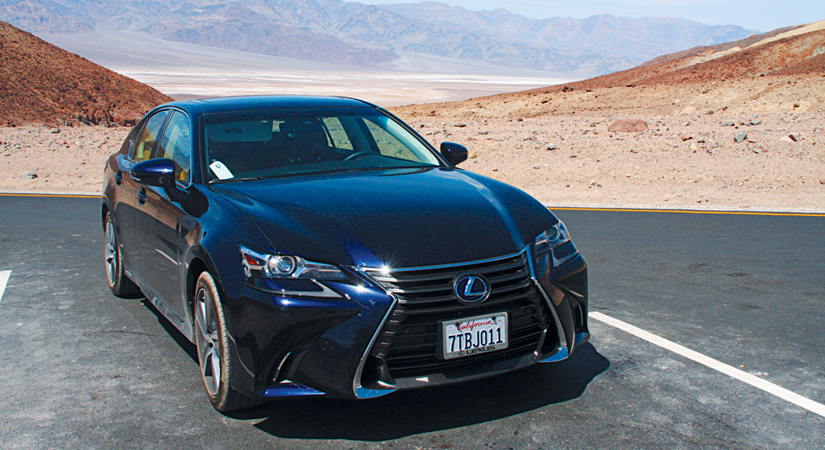
Which brings me to declare how important it is to choose a comfortable and mechanically reliable vehicle for visiting a place like this. Mine was the Lexus GS 450h — a hybrid version of the conventional GS sedan — particularly because the Lexus badge is a fail-safe guarantee of superior vehicle comfort. In this case, it was a premium I did not want to compromise for a rather logistically tricky adventure.

A vessel that exuded the Lexus brand’s legendary refinement, the GS 450h proved impeccably quiet, comfortable, and luxurious on the inside. The seats were wrapped in soft, fine leather, and the seat cushions had perforations that could ventilate or heat your behind, based on your climate control settings. Both front seats offered 10-way power adjustments, and I loved the thoughtful thigh support as my legs tend to feel uncomfortable after long driving hours without them.

The GS 450h uses a 3.5-liter V6 engine mated to a hybrid CVT; in my opinion, it is one of the most fuel-efficient luxury sedans available. Fuel consumption begins to matter a bit more when you know you’re traveling large distances; and it also helps to know that while admiring nature, you’re keeping your carbon footprint at bay.

The Lexus GS 450h is a well-rounded and attractively priced rear-drive hybrid sedan that pampers with the accoutrements of the GS while offering the generous torque of a hybrid drivetrain.

The car demonstrated versatility with three easily interchangeable drive modes that varied the throttle input and steering response, depending on the selection: Eco, Normal, or Sport. It also had great forward visibility; and did very well in the darkness of the desolate landscape, with its intelligent, high-beam headlights.

Among the sights one must certainly not miss while visiting Death Valley are the Mesquite Flat Sand Dunes. It is easy to reach, and is practically the only place where sand boarding is allowed in the park. Revel at, and take pictures of, the smooth dunes that rise up to a hundred feet high from the flat. And if you’re lucky, listen to the songs of the sand (yes, they sometimes sing) if you’re high enough on a dune cliff, and the wind comes blowing the sides.

Next, do not fail to walk the lowest point in North America, Badwater Basin, at approximately 282 feet below sea level! The basin is so low, that it serves as the final catch of rainwater that erodes minerals dissolved from surrounding rocks. The result? A surreal, thick layer of salt on the valley, as if it were snow — salty snow.

Then there’s Devil’s Golf Course, except that it isn’t a golf course at all. It’s a bizarre, vast, rugged terrain that looks like it was tilled by some behemoth, and then sprinkled with salt. The salt crystals have hardened around the edges of the soil, that they’re actually sharp and can easily slice through skin. It’s tricky and evil; only the Devil could play golf here.

Zabriskie Point, with amazing vistas of golden-colored badlands with chocolate marbling, is best viewed and hiked under the gentle, morning sun.

One of my ultimate favorites in this park, however, is Artist’s Drive — a one-way, nine-mile drive that tours you through some absolutely beautiful, multi-hued hills. It is as if an artist painted a masterpiece on them. The truth is, they’re actually oxidized, natural mineral deposits — so mother nature was the true artist here. Do not miss at all cost.

Finally, you must know that Death Valley has some of the darkest skies accessible to modern man, far away from light pollution. It is actually rated as one of the premier night-sky viewing points of the world. Go stargazing when there’s a new moon. You’ll practically be able to view our beautiful Milky Way, and perhaps even realize how insignificant we really are in the vastness of the universe.

Denial of Nokia’s tax refund claim affirmed

THE Court of Tax Appeals (CTA) affirmed the denial of the P24.9-million tax refund claim of Nokia (Philippines), Inc.

In a four-page resolution on Feb. 20, the court, sitting en banc denied for lack of merit the motion for reconsideration of Nokia for not raising “meritorious argument.”

“In sum, petitioner failed to raise meritorious arguments to warrant the reconsideration of the assailed Decision. Hence, the denial of the same is in order,” said the resolution penned by Associate Justice Juanito C. Casteñeda, Jr.

Nokia is claiming refund or issuance of tax credit certificate allegedly representing its unutilized creditable input value-added tax (VAT) allocated to its zero-rated sales for 2012.

The court’s third division in October 2017, denied for insufficiency of evidence the petition of Nokia, saying that the company failed to establish that it is a VAT-registered entity.

The court en banc in its decision in August last year affirmed the decision and resolution of its division.

Nokia maintained that its alleged Certificate of VAT Registration, Exhibit P-34, should be considered by the court because it is a “certified faithful reproduction of its original and a public document which is self-authenticating.”

However, the appellate court affirmed that it cannot be considered, noting that the court in division did not commit error when it found that the evidence was not admitted since it was not identified by a competent witness during trial. The court in division also said that it was not a certified true copy as it was a “mere color-printed scanned copy.”

The court also said even granting that the evidence is a public document, which does not need to be identified, it will still be rendered inadmissible for not being a certified copy issued by a public officer with its custody, as stated in the Rules of Court.

“Hence, considering that petitioner’s Exhibit ‘P-34’ is not a certified copy issued by the public officer in custody thereof, the same cannot be accorded any probative weight,” the court said.

According to the court, to be entitled for refund of excess of input VAT traced to zero-rated sales, the taxpayer should be VAT-registered and engaged in zero-rated sales. The input taxes should have been paid, are not transitional input taxes, and have not been applied against output taxes. The proceeds for the sales should also be accounted for in acceptable foreign currency in line with rules of the central bank.

The court also said that the input taxes cannot be directly attributable to the sales and are to be proportionately allocated based on sales volume, and the claim was filed within two years after the close of the quarter when the sales were made.

Associate Justices Erlinda P. Uy, Cielito N. Mindaro Grulla, Ma. Belem M. Ringpis-Liban, and Jean Marie A. Bacorro-Villena concurred in the decision while Presiding Judge Roman G. del Rosario, Associate Justices Catherine T. Manahan, Maria Rowena Modesto-San Pedro dissented. Associate Justice Esperanza R. Fabon-Victorino was on leave. — Vann Marlo Villegas

Shanghai Fashion Week to go ahead online as virus spreads

BEIJING/SHANGHAI — Shanghai Fashion Week, initially postponed due to the coronavirus outbreak, will go ahead as scheduled online in a tie-up with Alibaba Group’s Tmall marketplace, its organizers said.

The event, which last October hosted eight couture shows in its Spring/Summer season, was among numerous trade and business events in Asia that announced changes to their dates this month due to the coronavirus.

The recent Fashion Weeks in London, Milan, and Paris have been hit by the absence of many Chinese attendees.

However, the Shanghai Fashion Week committee said on Thursday in a statement on their official WeChat account the event will go ahead as planned between March 24-30. It told Reuters that people can participate by watching livestreams.

It said it was currently accepting applications from brands and expects that more than 100 Chinese designers and brands will eventually display their 2020 Autumn/Winter designs and also use livestreaming to market their Spring/Summer products.

“We hope this new form will allow designers to try different ways to display their design and different channels to market and sell,” the vice-secretary of Shanghai Fashion Week Committee, Lu Xiaolei, told industry publication Business of Fashion.

Alibaba’s Tmall marketplace has cooperated closely with emerging Chinese designers and commercial brands in past years. Last year, a collection of Chinese brands showcased their products at New York, Milan and Paris’ Fashion Week events via China Cool, a project initiated by Tmall.

Selling through livestreaming, which sees telegenic and chatty hosts market products to consumers on e-commerce platforms, has surged in popularity among Chinese consumers in recent years. Besides Alibaba, JD.com and Pinduoduo also have livestreaming offerings. — Reuters

Vietnam coffee prices edge up on scarce supply

HANOI/BANDAR LAMPUNG, INDONESIA — Domestic coffee prices in Vietnam edged higher this week on scarce supply, while trading activities in Indonesia remained sluggish, traders said on Thursday.

Farmers in the Central Highlands, Vietnam’s largest coffee-growing area, sold coffee at 32,000 dong ($1.38) per kg, up from 31,500 dong last week.

Coffee shipments from Vietnam were estimated at 150,000 tonnes in February, slightly higher than last month’s 145,000 tonnes, traders said. However, exports would be lower in the next two months.

“We are struggling to buy beans for the upcoming deliveries,” said a trader based in Ho Chi Minh City.

“Farmers are not willing to sell at current prices but we couldn’t offer higher given the low London prices and the coronavirus epidemic that has shaken global markets.”

May robusta coffee settled up $22, or 1.73%, at $1,295 per tonne on Wednesday.

“Prices have been exceptionally low, staying below $1,400 per tonne for nearly three months,” said another trader based in the Central Highlands.

Traders in Vietnam offered 5% black and broken grade 2 robusta at a premium of $130 per tonne to the May contract on Thursday, compared with $125 last week.

Meanwhile, traders in Indonesia’s Lampung province said Sumatran robusta was offered at a $350 premium to the May contract this week and a $250-$270 premium to the July to December contracts. That compared with a $340–$400 premium offered last week for the May contract.

Traders in Sumatra island are still waiting for coffee harvest. — Reuters

Debt yields decline on BSP easing bets

By Marissa Mae M. Ramos
Researcher

YIELDS ON government securities (GS) fell across-the-board last week following comments by Bangko Sentral ng Pilipinas (BSP) Governor Benjamin E. Diokno on the possibility of cutting key policy rates by more than 25 basis points (bps) to shield the economy from the negative economic impact of the coronavirus disease 2019 (COVID-19) outbreak.

Debt yields went down by an average of 5.8 bps week on week, based on the PHP Bloomberg Valuation (BVAL) Service Reference Rates as of Feb. 28 published on the Philippine Dealing System’s website.

At the secondary market last Friday, yields were lower than week-ago levels across-the-board. In the short end of the yield curve, the 91-, 182-, and 364-day Treasury bills (T-bills) declined by 2.4 bps, 1.3 bp, and 2.3 bps to fetch 3.076%, 3.407%, and 3.846%, respectively.

At the belly of the curve, rates of the three-, four-, five-, and seven-year Treasury bonds (T-bonds) fell by 8 bps (3.863%), 10.5 bps (3.956%), 9.4 bps (4.037%), 6.7 bps (4.117%), and 3 bps (4.249%).

In the long end, yields on the 10-, 20-, and 25-year T-bonds went down by 4.3 bps (4.309%), 9.4 bps (4.763%), and 6.5 bps (4.864%).

“Philippine benchmark interest rates continued to ease week-on-week…after BSP Governor Diokno signaled possible further cuts on local policy rates and on banks’ RRR (reserve requirement ratio) if economic conditions worsen due to coronavirus concerns,” Rizal Commercial Banking Corp. (RCBC) Chief Economist Michael L. Ricafort said in a mobile phone message.

Mr. Ricafort noted how benchmark bond yields in the US and other developed economies easing to record lows as investors sought safer investments amid the expected negative effects of COVID-19 on the global economy.

“Local interest rate benchmarks also eased amid lower global crude oil prices to among 14-month lows as the coronavirus concerns could also slow down demand for oil,” he added.

This view was shared by a bond trader, which attributed last week’s bond rally to “safe-haven buying” amid growing concerns over the spread of COVID-19 outside China.

South Korea reported 376 new confirmed coronavirus cases on Sunday, raising the country’s total number of infections to 3,526, the Korea Centers for Disease Control and Prevention (KCDC) said, Reuters reported.

Sunday’s new cases follow the 813 infections recorded on Saturday, the biggest daily jump in South Korea, which is grappling with the largest outbreak of the virus outside China. KCDC said it will update numbers later in the day.

Other cases have been reported in countries such as Italy, which has the highest incidence of the virus in Europe with 888 cases, while Brazil also confirmed its first case of infection last week.

Back home, BSP’s Mr. Diokno said last Thursday they will reassess how the virus could hit the Philippine economy as the outbreak worsens.

He told reporters that there would “definitely” be another 25-bp cut in key rates and said they were not ruling out a cut of as much as 50 or 75 bps. The central bank chief also said additional cuts in the RRR are on the table.

Mr. Diokno earlier said the central bank will likely trim rates by another 25 bps as early as the second quarter.

The BSP’s Monetary Board already moved to slash key interest rates by 25 bps on its Feb. 6 policy meeting after its 75-bp reduction last year which partially reversed the 175 bps worth of hikes in 2018 to stem strong inflationary pressures that time.

For this week, the bond trader said yields might continue to fall amid growing concerns over the COVID-19 outbreak and increasing expectations of more easing moves from the BSP and other central banks.

“Likely weaker US economic data releases may also weigh down on interest rates. However, this decline could be capped by likely stronger local inflation in February,” the bond trader said.

The Philippine Statistics Authority will report February inflation data on Thursday.

Likewise, another bond trader interviewed anticipates local GS yields to go down further to mirror the decline in US Treasuries as investors “flock to safer assets.”

For RCBC’s Mr. Ricafort: “Lower oil prices could ease inflationary pressures and support lower interest rates,” he said, adding that markets will also look to inflation results as a source of new leads for this week’s trading session.

Peso to weaken further on virus

THE PESO may continue to weaken this week with markets following developments related to the spread of the coronavirus disease 2019 (COVID-19) outside China and as they factor in key local data to be released this week.

The local unit finished trading at P50.97 versus the dollar on Friday, shedding 15.50 centavos from its Thursday finish of P50.815, according to data from the website of the Bankers’ Association of the Philippines.

Week on week, the currency also depreciated by three centavos from its P50.94-per-dollar close on Feb. 21.

Analysts attributed the weaker local unit to risk-off sentiment in the market amid fears due to new cases of the COVID-19 outside China.

“The peso seems to be tracking global markets again as fears continue to heighten with fresh evidence that COVID-19 is spreading outside China,” UnionBank of the Philippines, Inc. Chief Economist Ruben Carlo O. Asuncion said in a text message.

South Korea reported 376 new confirmed coronavirus cases on Sunday, raising the country’s total number of infections to 3,526, the Korea Centers for Disease Control and Prevention said.

Several cases and deaths have also been reported in other countries in Europe, Middle East and in the United States.

In China, infections rose by 573 on Feb. 29 which is the highest daily increase in a week, from 427 new cases on Feb. 27, according to the National Health Commission on Sunday. Nearly 99% of the new cases were concentrated in Wuhan.

Meanwhile, Rizal Commercial Banking Corp. (RCBC) Chief Economist Michael L. Ricafort noted that market worries have caused a sell-off in many parts of the world.

“The peso exchange rate weakened today to close at the weakest in a month amid latest declines in the stock market [and] continued global risk aversion amid lingering concerns that the coronavirus…that caused further sell-off in riskier assets worldwide such as global stock market and in other emerging markets,” he said in a text message.

For this week, the peso’s movement will depend on the market’s reaction to developments related to COVID-19 as well as the release of some local data, according to analysts.

“The local currency is still expected…to be resilient as the coronavirus continue to wreak havoc on market sentiments worldwide,” UnionBank’s Mr. Asuncion said.

RCBC’s Mr. Ricafort also cited the coronavirus as a major catalyst for peso movement this week as markets monitor its “effects on the riskier assets such as the global stock markets.”

“The markets will also take cue on the latest inflation data due on March 5, as a source of new leads.”

A BusinessWorld poll of 17 economists yielded a median estimate of three percent for February headline inflation, which is within the upper end of the 2.4-3.2% forecast range given by the Bangko Sentral ng Pilipinas (BSP).

If realized, the print will be slightly quicker than the 2.9% logged in January but still slower compared to the 3.8% in February 2019. The BSP targets 2-4% headline inflation for the year, forecasting an average of 2.9%.

UnionBank’s Mr. Asuncion sees the peso moving within P50.70-P51 agains the dollar this week, while RCBC’s Mr. Ricafort expects the local unit to end within the P50.80-P51.20 levels. — Luz Wendy T. Noble with Reuters

Coronavirus stings world’s top honey makers in China

BEIJING — Beekeepers in China, the world’s top honey producer, are bracing for a bleak start to the key spring pollinating season as travel curbs aimed at containing a coronavirus outbreak keep them at home while their bees go without food for weeks.

Jue, a beekeeper from Xinjiang in northwest China, said he has not slept for days, worrying about his 300 beehives that are stuck in wooden boxes about 200 miles from where he has been confined due to the curbs.

“I am really anxious,” said Jue, who wanted to be identified only by his family name. “If all my bees die, I will lose my entire year’s income,” the 55-year-old nomadic beekeeper added.

Jue’s pain is widely shared.

Bees missing the flowering phase of plants due to virus-related curbs, together with a drop in bee numbers, threatens to hurt the livelihood of China’s 300,000 beekeepers as well as the output of honey and crops that rely on bees for pollination.

Acknowledging losses due to virus measures, the Apicultural Science Association of China has urged beekeepers to contact local authorities if they need to move or arrange feeding trips.

“You must not take your life, no matter what,” it said after a beekeeper from China’s southwestern Yunnan province, Liu Decheng, recently hanged himself.

China makes about 500,000 tonnes honey annually, or about a quarter of global output, making it the world’s top producer.

It exports more than 100,000 tonnes to places like Europe and the United States.

But the outlook for production is grim this year.

Normally, beekeeper Jue would be tending to his bee colonies now to prepare them to pollinate apricots in Turpan in March, before they go on a flower-chasing journey starting from pear orchards of Korla, the No. 2 city of Xinjiang, in spring to Ruoqiang to collect nectar from the famous red dates in May.

Jue, however, said that this time he was running a “devastating” three weeks behind schedule.

“ALL BITTERNESS”
Like Jue, Zhang Miaoyan, from Jinhua in Zhejiang province south of Shanghai, is also struggling to reach her 120 cases of bees that have been starving for over 20 days.

“We beekeepers always say that we are in a bitter-sweet business. But this year, probably it is all bitterness,” Zhang said, noting the virus had also put a dampener on sales during Lunar New Year period.

China’s honey output has already been falling amid climate change, an ageing labor force and overuse of pesticides.

Jue, a 30-year veteran beekeeper, makes around 60,000–70,000 yuan ($9,982) in good years doing a job that entails driving in the evening and sleeping in a tent in barren places.

“None of the young people want to do this job. There is too much hardship,” Jue said.

TOO LATE?
Beijing has asked local governments to minimize disruptions to transportation of animal feed and livestock, and specifically mentioned bees. But implementation has been slow amid the severity of the outbreak.

The flu-like virus can be transmitted from person to person, and has killed more than 2,700 people and infected about 80,000, mainly in China.

Jue is still trying to coordinate with the local government to rescue his bees, while Zhang got a go-ahead from local authorities over the weekend to save her beehives.

But it might be too late.

“Wild osmanthus here are in their prime time now. You can smell the sweetness,” said Zhang.

“But the best flowering phase is passing now. Once you miss it, you can only wait for the next year,” Zhang said. — Reuters

ADVERTISEMENT
ADVERTISEMENT