Home Blog Page 9815

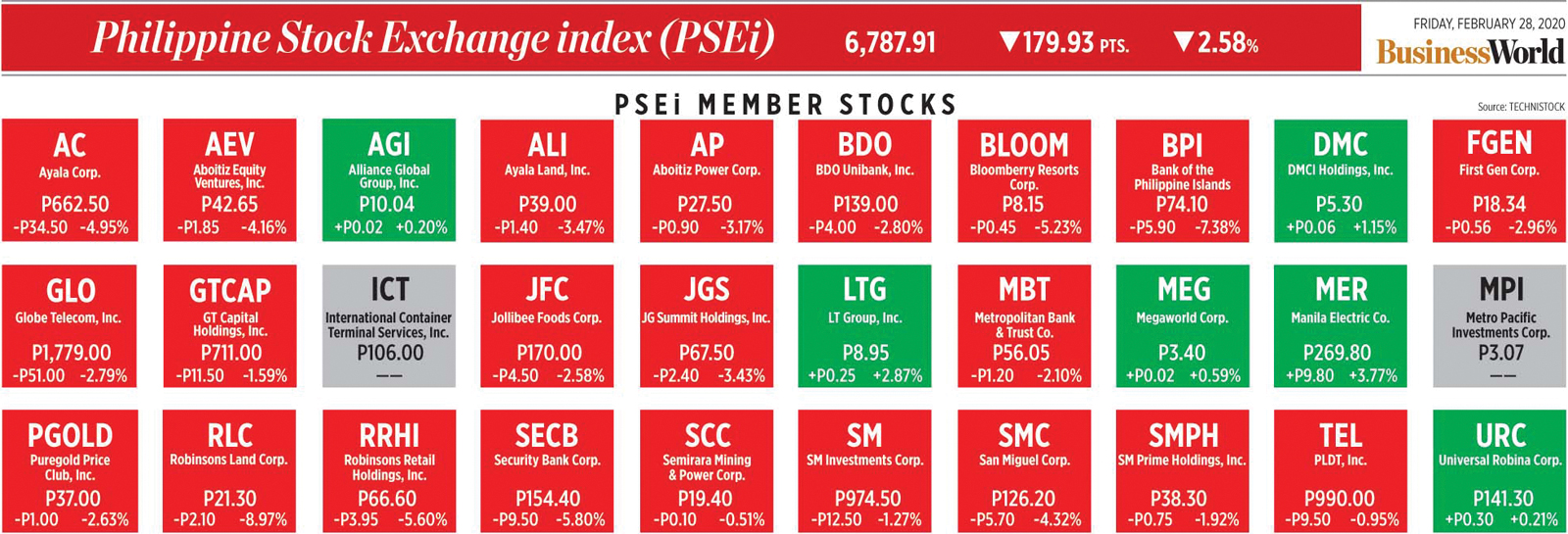
How PSEi member stocks performed — February 28, 2020

Here’s a quick glance at how PSEi stocks fared on Friday, February 28, 2020.
 

Can Singapore save the world from sinking?

By Andy Mukherjee

NEARLY a third of the global financial center of Singapore sits less than five meters above sea level. If global warming continues unabated, an area as large as 3,400 football fields in the center of the small city-state could be inundated by 2100, flooding the vital business district and some of its most valuable infrastructure.

Many coastal cities share a sinking feeling nowadays, but Singapore’s example stands out for a couple of reasons. First, the island is choosing fight over flight. Second, the fiscally conservative nation is asking current taxpayers to share the cost of an expensive battle, even though the worst of the threat will only materialize if Antarctica and Greenland lose their ice in the second half of the century.

Most other vulnerable countries aren’t as rich as Singapore, or as space-constrained. The Philippines is moving government offices from disaster-prone Manila to the higher ground of a former US Air Force base in Clark City. Indonesia is erecting a new capital in the jungles of Borneo, even as it aims to put up a giant wall to shield Jakarta from ocean waves. But where will Singapore, a sovereign state packed in an area three-fifths the size of New York City, go?

One option is to emulate the Pacific Ocean island of Kiribati, which has bought land 2,000 kilometers away in Fiji. The Maldives has explored resettling its population in Australia. But how does Singapore leave behind a strategic port, the world’s best airport, humming refineries and data centers, and gigantic underground reservoirs of crude oil? How does it recreate a megalopolis for 5.7 million residents and several times as many visiting bankers, businessmen and tourists?

Sitting at the mouth of one of the world’s busiest shipping lanes, separating peninsular Malaysia from the island of Sumatra in Indonesia, Singapore has nowhere to go. What it has are money and a forward-planning DNA, both of which it has used successfully in the past to stop getting its arm twisted over the supply of raw water from Malaysia. But as existential threats go, climate change will be a lot trickier. “We cannot lose a big chunk of our city and expect the rest of Singapore to carry on as usual,” Prime Minister Lee Hsien Loong said in his national day speech last August, in which he gave an indication of how costly the fight could get: S$100 billion ($72 billion) over 100 years, possibly more.

Put another way, Singaporeans will invest what it cost the US in today’s money to build its first transcontinental railroad in 1869; and they will keep repeating that feat every year and a half for a century. A survey found that for 21% of citizens and permanent residents, the emphasis on climate change was the most “impressive” part of Lee’s address.

The investment will be high as the ocean tries to wrest back what the island’s planners took from it to accommodate their outsize growth ambitions. Some of the priciest real estate is standing on soft marine clay in reclaimed lands in downtown Singapore and the central business district, according to a recent study. This clay is subsiding. The combined effect, the scientists say, could be to flood as much as 18 square kilometers — 21% more area than rising sea levels alone would.

So what’s to be done with all that spending? Options include “empoldering,” a Dutch system of reclamation in which newly drained land sits lower than the sea, protected by a dike. Rainwater gets pumped out into an inland water body, which throws its excess into the surrounding sea. When Singapore embraced this innovation to expand an outlying island — the main city is surrounded by 62 of them — the idea was to save on sand costs. But polders are now being seen as a technique to arrest the sinking of Singapore.

Next comes financing. Six months after the prime minister’s speech, the government put S$5 billion into a coastal and flood protection fund. That’s a bold commitment when the coronavirus epidemic is threatening to disrupt trade and tourism and destroy jobs. Yet, Singapore wants to make an early down payment and go ahead and raise a politically sensitive consumption tax to 9% from 7%, sometime between 2022 and 2025. Earlier, aging-related healthcare costs were the main reason to marshal resources. Now, taxpayers are also on the hook to protect future generations from the sea.

It’s a delicate balance between survival in 2100, votes in the next elections that are likely later this year, and sustaining long-term competitiveness. Singaporeans aren’t exactly happy with their rising retirement age. But the government has already increased income taxes on top earners to five percentage points more than arch rival Hong Kong. Any more and they might leave. Higher consumption taxes are the only solution.

Still, not all of the burden can be front-loaded. Inter-generational justice will be important in allocating climate costs. Yet-to-be-born Singaporeans won’t get a free pass. Laws make it difficult for the government to raid the nation’s substantial past reserves, whose size is a state secret. But converting financial assets into improved land, which is what empoldering will entail, is allowed more easily because it isn’t a depletion of coffers. Any funding gaps could be filled with long-term borrowings to be repaid by future taxpayers. Climate bonds are a small but growing asset class. If AAA-rated Singapore issues a steady supply, it will be lapped up by global pension managers starved of yields.

The city last year imposed a S$5-a-ton tax on greenhouse gases, though its own emissions are just 0.1% of the world total. It’s the large economies whose behavior will determine how boldly Singapore must spend. Just as the city with no resources became a global role model for recycling dirty water for drinking, what it does to fight climate change and how it finances the investment could show other countries a way. At a minimum, Singapore’s seriousness will give investors a good idea of whether coordinated global action against rising temperatures is a realistic goal, or a pipe dream. Think of the world as a rickety coal mine, and tiny Singapore might be its canary. With a S$100 billion song on its lips.


BLOOMBERG OPINION

The winners and losers in POGO’s Demise

The crackdown on Philippine Offshore Gaming Operators (POGO) has begun. Last week, China announced that it would cancel the passports of Chinese nationals working in the POGO industry for crimes relating to telecommunication fraud.

Gambling is illegal in China and cross-border gaming is viewed by Beijing as a means of by-passing Chinese laws. It is considered a telecommunications-related crime used to embezzle money out of China. It also propagates illegal recruitment and human trafficking, said the Chinese Embassy in Manila.

Last year, Beijing caused the shutdown of Cambodia’s I-Gaming industry by cancelling the passports of Chinese workers who refuse to return to China before a designated deadline. Simultaneously, it called upon the Cambodian government to declare I-Gaming illegal. In August, Cambodian Prime Minister Hun Sen succumbed to Chinese pressure and signed a government order that outlawed offshore gaming. Today, the Cambodian hubs for I-Gaming, Sihanoukville and Chaibu, are virtual ghost towns.

Beijing has asked President Duterte to declare POGOs illegal but the Chief Executive has resisted Beijing’s request citing economic losses. Despite the resistance, however, PAGCOR is no longer issuing new online gaming licenses and requirements for working visas for POGO workers have been tightened.

China’s move to cancel the passports of its nationals working in the POGO industry is seen as the last blow to shut-down POGOs for good. POGO workers whose passports are canceled face immediate deportation and will be prohibited from leaving China for 10 years. With punishment as severe as this, we can reasonably expect a mass exodus of online gaming workers.

While POGO operators can still hire Mandarin-speaking Malaysians and Indonesians, it is unlikely that they can replace the thousands of job vacancies. Hence, it is safe to assume that POGOs will go the way of the Cambodian I-Gaming industry in a matter of months.

The biggest loser will be the real estate industry. As much as 1.14 million square meters of office space will be vacated in Metro Manila alone, representing 10% of total leasable space. POGOs consume more space than the IT-BPO industry. Lease rates are seen to decline as a result.

The city of Pasay is the biggest host of POGO operators with 300,000 square meters of office space taken up. They will be hit the hardest. Makati is second, followed by Quezon City and Alabang. Clark, Subic and Cebu will also experience vacancies, albeit to a lesser extent. The cities of Taguig and Pasig do not allow POGO operators, hence, will be immune to the crash.

The residential market will also be affected since about 30,000 condominium units are being leased by POGO workers. All these will be vacated.

The big boys in the property sector will feel the crunch. Ayala Land appropriates 10% of its office space portfolio to POGO operators, most of whom are located in Circuit Makati. Megaworld and Megawide have whole buildings dedicated to POGOs as they opt not to mix them with regular office lessees. ASEANA, Filinvest, and Alphaland maintain a high ratio of POGO tenants, many of them operating in their buildings in Pasay, Makati, and Alabang.

The good thing is that these property firms are secured by 18 to 24 months advance rent and deposits (combined). This will serve as a cushion before the true impact of the POGO’s exodus is felt.

As far as tax revenues are concerned, the government collected P6.42 billion last year, the bulk of which are attributed to withholding taxes. The BIR estimates that some P27.35 billion remain uncollected due to tax evasion.

Unfortunately, the POGO industry is so loosely regulated that the government has no clear idea on how many POGO firms are actually operating. In a hearing held by the congressional committee on games and amusements last December, PAGCOR said there were 72 licensed POGO operators, 49 of which were operational. For its part, the Bureau of Internal Revenue (BIR) said that there are only 10 operators who were paying franchise taxes. Others government agencies assert that there are as many as 218 POGO operators, the majority of whom operate without licenses.

As for the number of POGO workers, the BIR pegged the figure at 44,798, the Department of Labor and Employment at 71,532 and PAGCOR’s figure was 93,697. Leechiu Property Consultants, a private firm, puts the number at 400,000 to 500,000. Most POGO workers do not pay income taxes and the Department of Finance estimates that uncollected income tax is between P27 to P50 billion.

Government will also be a loser with the demise of the POGOs but to what extent, no one really knows.

The winner, however, will be the residents of the Metro Manila, Clark, Subic, and Cebu. Our streets will be safer with the demise of the POGOs.

According to Teresita Ang-See, the chair of the anti-crime watchdog, Movement for the Restoration of Peace and Order, “the Philippines has become a haven for Chinese criminals and criminal syndicates.” In fact, records show that 634 Chinese fugitives were confirmed operating in the Philippines through POGO firms.

These syndicates are involved in all sorts of criminal activities ranging from investment scams, to prostitution, beatings, knifings, ambushes, grenade throwing, illegal immigration, money laundering, bribery, human trafficking, torture, kidnapping, and murder.

Making matters worse is that many Chinese POGO workers have been disrespectful of our laws and customs. They have been caught on video displaying blatant insolence towards our law enforcers. This has caused racial antagonism between Filipinos and mainland Chinese.

POGOs, and the criminal activities that come with it, have put the Filipino people in harm’s way. This is why the social costs of POGOs far outweigh their economic benefits. Safety and security comes first. I see it as a blessing that POGOs are on the way out.


Andrew J. Masigan is an economist.

CITIRA’s passage: Light at the end of the tunnel

Senate Ways and Means Committee Chair Senator Pia Cayetano has filed Senate Bill 1357, the Committee Report on the Corporate Income Tax and Incentives Rationalization Act or CITIRA, and has sponsored it in the Senate’s plenary session. Nine of the 15 regular members and all three ex-officio members signed the committee report. Of the 12, one signed with reservation, three said they will interpellate, and six said they might introduce amendments. One of those who did not sign said he would interpellate. There are no disclosed reasons for the other five not signing, except that they were not physically present (truest for a controversially detained Senator) at the time.

This is the first time since the 13th Congress that a fiscal incentives reform bill has reached this far in the Senate. Reaction to the bill seems more muted now (especially compared to the last two years). Is CITIRA finally seeing the light at the end of the tunnel?

SB 1357 addresses most of the concerns raised against CITIRA, with a few remaining issues. These concerns revolve around the fear of scaring away investors and job losses because of the changing investments incentives regime. Enterprises in economic zones are also apprehensive about losing their insulation from local government interference, and having to deal with a new authority.

The first part of CITIRA partly addresses the job loss worry as well as the loss of investments. The corporate income tax (CIT) rate will be cut by one-percentage point every year starting 2020 until it settles to 20% in 2029. It puts a brake to cuts beyond 25% or starting 2025, subject to meeting the deficit target. (Note that the House version cuts the rate by two-percentage points every two years starting 2021 until 2029, and provides for the possibility of advancing the scheduled reduction if adequate savings are realized from the rationalization of fiscal incentives.) This will benefit 300 times more enterprises than those that receive fiscal incentives

We at Action for Economic Reforms (AER) reiterate the need for more prudence in the CIT rate reduction. We recommend that the tax effort (of not lower than 16%) be an additional criterion. This safeguards against future fiscal adventurism that could encourage increasing deficit targets to accommodate further tax cuts. It is also an incentive to be more mindful of our tax performance and for tax authorities to beef up efforts to improve collection. A one-percentage decrease in the CIT rate will cost the country P23-30 billion a year. Further, starting 2022, the national government will experience a huge loss in its share of national revenue in favor of the LGUs’ internal revenue allotment (IRA). In 2019, the Supreme Court ruled (in a case popularly known as the Mandanas case) that Congress erred in its restrictive definition of national taxes to only include national internal revenue taxes as the base for computing the IRA. According to the Supreme Court, the base should also include tariffs and customs duties, and portions of the VAT and tobacco excise tax, among others. This means that the national government will have to yield 40% of collections from all these to the LGUs. To illustrate how huge an impact this will have, in 2018 customs collection alone reached almost P600 billion. Notwithstanding the hoped-for positive economic impact of lower tax rates and greater fiscal autonomy for LGUs, the contraction of revenues at the disposal of the national government will hurt, and will have to be covered some other way.

Given international and regional tax competition, the Philippines (which has a 30% top rate) faces tremendous pressure to lower CIT rates. In ASEAN, Indonesia has the next highest rate at 25% and is planning to lower it to 20%. Next are Malaysia and Lao PDR at 24%, then Thailand and Vietnam at 20%. It is tempting to bite the bullet and match what our closest competitors offer. Considering the potential impact, it pays to have a more judicious approach. It may well be that things will work out, our tax effort will increase, and the deficit will remain stable. But let’s not be too hasty. Let’s first make sure that systems are in place to manage adjustments and to maximize the gains from the initial CIT rate cuts before we push further.

On the reform of fiscal incentives, SB 1357 is much clearer and more generous. The sunset period for existing incentives includes the remaining years of income tax holiday (ITH) previously granted and a maximum of five years for the special tax rate of 5% on gross income earned, with additional two years for special cases (e.g. 100% exporter, more than 10,000 jobs, or footloose investment). Availment of incentives under the new regime will be for five to eight years, with ITH for two to four years and a special (reduced) CIT for three to four years. The SCIT will be 8% in 2020, 9% in 2021, and 10% from 2022.

The SCIT is in lieu of all local and national taxes, which addresses concerns about LGU interference, with national government’s share progressively increasing from 6% (2020) to 8% (starting 2022). Qualified enterprises also get duty exemption on the importation of capital equipment, raw materials, spare parts, or accessories, VAT exemption on importation, and VAT zero-rating on local purchases.

If a qualified firm so chooses, it can receive enhanced deductions in lieu of ITH and SCIT. These include: depreciation allowance on qualified capital expenditure (an additional 10% for buildings and an additional 20% for machinery) for assets directly related to the production of goods and services; a 50% additional deduction on labor expense; a 100% additional deduction on R&D expense; a 100% additional deduction on training expense; a 50% additional deduction on domestic input expense; a 50% additional deduction on power expense; a 50% deduction for reinvestment allowance in manufacturing industry; and, enhanced net operating loss carry-over.

To qualify for incentives, a registered enterprise should be engaged in a project or activity included in the strategic investments priorities plan (SIPP), meet agreed performance targets, install an adequate accounting system, and comply with e-receipting and e-sales. It should also file an annual tax incentives report.

The SCIT is lower than the estimated equivalent of the 5% on GIE (15% of net) currently enjoyed, but it expires in three to four years. Nevertheless, if an enterprise continuously innovates and qualifies in successive SIPP, it can enjoy incentives on the new qualified product or operation.

A good possible amendment is the inclusion of training provided to student trainers or immersees from public educational institutions. With the K to 12 reforms and various enhancements in the techvoc and higher education programs, students have been required to render from 80 to several hundred hours of practical work training. As it is, there are more students than there are spaces available in enterprises and offices for them. Including this in the possible enhanced deductions (i.e., training to direct employees and student trainees accepted by the enterprise) will increase collaboration between industry and the education sector, and will provide better training opportunities for our students. For this, approval of the program by the Department of Education, Commission on Higher Education, and Technical Education and Skills Development Authority will be helpful.

Finally, CITIRA enhances the policymaking, oversight and reporting functions of the Fiscal Incentives Review Board (FIRB). That the FIRB is co-chaired by the Department of Trade and Industry and the Department of Finance ensures the complementation of revenue and industrial policy objectives.

The FIRB is clear on the publication responsibility of the FIRB of the tax incentives, tax payments and benefits data and related information by industry group. We at AER would like to have this enhanced by clarifying benefits data to include actual availers and their compliance to performance targets.

With the enhancements introduced by CITIRA, the Philippines approximates what are on offer in other ASEAN countries, especially when both the ITH and SCIT periods are considered. The incentives are also available to both domestic and foreign enterprises.

CITIRA is a strong bill. With a few more refinements as discussed above, CITIRA will be a much stronger bill.


Jenina Joy Chavez is a trustee of Action for Economic Reforms and heads its industrial policy program.

www.aer.ph

Open arms for the Foreign Investments Act

At the AmCham Legislative and Trade & Investment Committees forum last week in Makati, the recommended easing of constitutional restrictions on foreign equity amendments was the hot topic. Hot, because a joint statement of major Chambers of Commerce and business and trade organizations had already been submitted in July, 2019 to the 18th Congress and to President Rodrigo Duterte for their consideration and enactment, recommending a list of priority legislation for business. This included the much-debated, top two laws, the Foreign Investments Act (FIA) and the Retail Trade Act (RTA) that would necessitate amendments to the 1987 Constitution.

The speakers at the AmCham forum were Dr. Bernardo Villegas, head of the Center for Research and Communication (CRC) at the University of Asia and the Pacific (UA&P), and Margarito “Gary” Teves, former Finance Secretary in the time of President Gloria Macapagal Arroyo, who both pushed for economic liberalization in the Constitution to accommodate what would be the revised FTA and the RTA allowing expanded, up to 100% foreign ownership in certain economic activities, including the ownership of land.

Dr. Villegas, a member of the Constitutional Convention that drafted the 1987 Constitution under President Corazon Aquino, reiterated at the AmCham conference what he said in his columns in the Manila Bulletin (on Jan. 10 and 17) that “a serious error we made was to enshrine in the present Constitution too many restrictions against Foreign Direct Investments (FDIs), provisions which have brought us to the bottom of Southeast Asian countries in FDIs.” He decried the fact that in 2019, FDIs hardly exceed $7 billion, a “precipitous drop” of 30% after peaking at $10 billion in 2017. How this has deprived the poor, even as the national poverty incidence dropped from the revised 23.3% in 2015, the year before the present administration was voted into power, to 16.6% in 2018! He is not impressed that National Economic and Development Authority (NEDA) Secretary Ernesto Pernia thinks we can attain a poverty incidence of 10 to 11% instead of the formerly targeted 14% by 2022. A poverty incidence of 10% by 2022 would still mean that some 12 million Filipinos (10% of an estimated population of 115 million by that year) would still be living in dehumanizing poverty, Villegas said.

Gary Olivar of the Foundation for Economic Freedom (FEF), and a member of the Duterte administration’s inter-agency task force on constitutional reform, said the amendment to the Constitution would be needed as the country is “one of the heavily restricted and protectionist economies in the world.” In the OECD FDI Restrictiveness Index 2018, the Philippines is highest of 72 countries in shunning foreign investors. Look at how FDIs have helped our nearest neighbors, Dr. Villegas pointed out. Vietnam still has a lower per capita income than the Philippines, but ended last year with more than $35 billion in FDIs, attracting most of the manufacturing enterprises that were fleeing from China as a result of its trade war with the US.

Amidst the hard sell for economic reforms for the Constitution, a question was asked from the floor at the AmCham forum — But how are we going to isolate the economic provisions only, when many legislators seem inclined towards a radical change in government to federalism, while even at one time unabashedly proposing term extensions for themselves under a tailored new constitution? Will the common people understand the cerebral macroeconomics for allowing foreigners to own land in our crowded country to entice FDI, and will the FDI surely translate to more jobs and a better life for the Filipino?

Gary Teves replied that it takes just our very popular President to say so, and it will happen. “Maybe we can tinker with the Constitution now about changing or amending the 60-40 to make them (foreign investors) comfortable,” then-presidential candidate Rodrigo Duterte told Rappler in a live interview after the closing of polling precincts on Monday, May 9, 2016. “(But) I cannot accept the selling of the lands of our country. I cannot take that. I will object,” he said back then. Unfriendly minds might think that he might yet change his attitude, as Duterte is controversial for “giving away” Philippine territory to China by ignoring the clear and final UNCLOS award of the West Philippine Sea territory that defined the boundary of what belongs to the Filipinos. President Duterte is generally known for changing his mind.

But that is an aside. Still, the West Philippine Sea victory recalls its staunchest fighter, “Almost Chief Justice” Antonio T. Carpio, who was ponente for a Supreme Court decision on a “request for reconsideration” for the Court’s definition of the term “capital” in the Constitution, as regards a case filed by the “heirs of Wilson P. Gamboa vs. Finance Secretary Margarito B. Teves, et al.”

“As we emphatically stated in the 28 June 2011 Decision, the interpretation of the term ‘capital’ in Section 11, Article XII of the Constitution has far-reaching implications to the national economy. In fact, a resolution of this issue will determine whether Filipinos are masters, or second-class citizens, in their own country. What is at stake here is whether Filipinos or foreigners will have effective control of the Philippine national economy. Indeed, if ever there is a legal issue that has far-reaching implications to the entire nation, and to future generations of Filipinos, it is the threshold legal issue presented in this case,” Justice Carpio stated ab initio.

In summary, Justice Carpio stated, “The Constitution expressly declares as State policy the development of an economy ‘effectively controlled’ by Filipinos… defined in the Foreign Investments Act of 1991 as Filipino citizens, or corporations or associations at least 60% of whose capital with voting rights… (gives them) full beneficial ownership.

“Filipinos have only to remind themselves of how this country was exploited under the Parity Amendment (which expired in July 1974), which gave Americans the same rights as Filipinos in the exploitation of natural resources, and in the ownership and control of public utilities in the Philippines. (Relaxing the 60-40 definition of the 1935, 1973, and 1987 constitutions) effectively giving foreigners parity rights with Filipinos… opens up our national economy to effective control not only by Americans but also by all foreigners, be they Indonesians, Malaysians or Chinese, even in the absence of reciprocal treaty arrangements,” Justice Carpio concluded.

Another interesting aside gleaned from the oral arguments in the June 2011 Decision on FIA:

“JUSTICE CARPIO: I would like also to get from you Dr. Villegas (amicus curiae or resource person at the oral arguments) if you have additional information on whether this high FDI countries in East Asia have allowed foreigners x x x control [of] their public utilities, so that we can compare apples with apples.

DR. VILLEGAS: Correct (meaning these countries have not ceded control to foreigners), but let me just make a comment. When these neighbors of ours find an industry strategic, their solution is not to “Filipinize” or “Vietnamize” or “Singaporize.” Their solution is to make sure that those industries are in the hands of state enterprises. So, in these countries, nationalization means the government takes over. And because their governments are competent and honest enough to the public, that is the solution. x x x”

Is the Philippine government as competent, and honest enough to the public, when it comes to offering exuberant open arms for foreign direct investments?


Amelia H. C. Ylagan is a Doctor of Business Administration from the University of the Philippines.

ahcylagan@yahoo.com

Chats and conversations

By Tony Samson

CHAT GROUPS usually have a common bond. They are members of a civic club, homeowners’ association, alumni group, or family (one side of it). The chat is a way of keeping in touch, disseminating news (like meetings and required costumes), as well as sharing posts, which include homilies, jokes, cartoons, and fake news on prophecies of future eruptions and the spread of a virus — decimating half of the world’s population.

Is chatting the same as a conversation?

Before digital exchanges of thoughts and opinions, which is how a conversation is defined, there was the physical setting of being in the same room, taking turns to speak up — can we hear from the gentleman in the crimson cape?

Conversations in business conferences can involve strangers (Do you have a calling card?) and limited by proximity. The search for a familiar face can entail tearing out place cards from their taped positions and appropriating an empty seat in another table. (Sir, your number is the one near the washroom.) The randomly tabled conversation-mates may have little to say to each other, limiting themselves to small talk like the phase-out of jeepneys and the effect of the virus on cruise ships.

Corporate meetings are not conversations. There’s little give and take or jumping from one topic to another. Meetings involve an agenda and a series of presentations by designated resource speakers. Even the pre-meeting conversation over coffee is not as freewheeling as it looks. There may be some lobbying going on prior to a proposal to be taken up. The casual conversation ends abruptly — can we start the meeting?

The hierarchy for turn-taking is observed. The rule is simple: never interrupt someone who outranks you. (A client, even with a lowly rank, tops the service provider regardless of his exalted title.) When a CEO is talking, even if only commenting on the state of national badminton, lower life forms need to just listen, and continue patting butter on their soft rolls and nod.

Do status rules apply in chat groups?

The chat is a free-for-all forum. Anyone in the group can jump in and post without waiting for others to stop typing. There is no such thing as hogging a conversation as the posts can be as lengthy as they need to be (or do not need to be). They don’t have to be original thoughts and include opinions from the empire of fake news. They just pop up in sequence.

Everyone in the chat is part of the conversation. Woe to the one who forgets who’s in the thread and talks about that person thinking he is not part of the group. And opinions can be forwarded to others not in the group, especially personalities mentioned in passing or holding views being excoriated. Someone not in the group can jump and crash into a discussion.

What about offensive material? The capacity to be offended varies with each person. Praising one public figure too fulsomely may offend those who puke at the mention of his name. An online “word war” takes off. Cooler heads chime in or people just opt out and meditate on their belly buttons in private. (No videos please.)

Only for greetings on birthdays and occasions like People Power Day or Ash Wednesday does everyone chime in. The same goes for good wishes for ailing chat-mates — hope the lump in your groin is just a cellphone.

Unlike in real conversations where an offended party calls attention to himself when he huffily walks out, chatters simply exit without drama.

So, a chat is not quite a conversation. There are no clues on emotional impact and reactions in the body language. Squirming in the seat, cringing at somebody’s peroration, rolling of eyes, raising of eyebrows (just one or both), and simply being quiet when the conversation is in full throttle are missed out in the chat.

Somebody who hardly chimes in is still part of the chat group. He just has nothing to say or has had enough of the brown stuff being flung around in every direction. He can decide to stay clear or throw some of his own. Some consider it a sport.

Chats and conversations are the same in one aspect. They are easy to start as well as end. In both cases expletives are hard to delete or take back after they’ve been posted. In digital conversations, prolonged silence is called ghosting… and can be just as haunting.


Tony Samson is Chairman and CEO, TOUCH xda.

ar.samson@yahoo.com

Stocks tumble 2.6% amid investor fears

THE main index fell by 2.6% on Friday to close the week in the negative territory as investors moved to keep their investments safe.

The 30-member Philippine Stock Exchange index (PSEi) dropped by 179.93 points to end the session at 6,787.91, while the broader all-shares index decreased by 85.35 points or 2.1% to 4,064.32 at the close.

Manuel Antonio G. Lisbona, president of PNB Securities, Inc., said local stocks fell because investors tried to safeguard their investments.

“The market broke below the 6,800 support level today, as investors rushed to preserve their capital,” Mr. Lisbona said.

Philstocks Financial Inc. Research Associate Claire T. Alviar said the market’s decline was a result of the fears among investors over the impact of the coronavirus (COVID-19) outbreak.

“Today’s drop mirrors the performance of the US markets as investors covered with fears over the impact of COVID-19 on the global economy,” Ms. Alviar said.

According to the latest situation report by the World Health Organization (WHO) on Thursday, up to 1,185 new cases of infected people were counted, increasing the total global number to 82,294 cases.

On Friday, most sectoral indices at the PSE fell, with mining and oil registering the biggest decline at 302.13 points or 4.5% to 6,451.44.

Ms. Alviar noted that the mining and oil index had the steepest drop because most of the mining companies are exporters.

“With lower growth outlook, demand for its exports would also decline and this results in lower earnings,” she said.

Property shrank by 103.92 points or 2.8% to 3,633.18; holding firms dwindled by 163.75 points or 2.4% to 6,627.08; financials declined by 64.52 points or 3.9% to 1,605.99; industrials waned by 79.69 points or 0.9% to 8,351.48; services fell by 30.17 points or 2.2% to 1,351.38

Ms. Alviar blamed the decline of the indices to the systemic risk in the market and external factors that corporations cannot control.

After the close of the trading day, decliners bested advancers, 160 against 50, with 36 names closing unchanged.

Net foreign selling increased to P4 billion from P1.4 billion on Thursday.

Among the companies that reported their full-year financial figures on Friday are SM Investments Corp., Belle Corp., Manila Water Co., Inc. and Philex Mining Corp.

PXP Energy Corp. reported a net loss attributable to equity holders of the parent firm of P272.1 million, bigger than the previous year’s P77 million. Consolidated petroleum revenues fell by 32.8% to P72.5 million resulting from slightly lower output and a 15% drop in crude oil price in a service contract, among others.

Manila Water posted a 16% decrease in 2019 net income to P5.5 billion, saying its performance was dampened by the impact of a regulatory penalty, a one-time bill waiver, and higher expenses caused by the water shortage in the first half.

Philex Mining registered P647.79 million in net loss attributable to equity holders of the parent firm in 2019, reversing the earlier year’s income of P608.46 million, the copper and gold producer’s financial report to the stock exchange shows. — Revin Mikhael D. Ochave

Palace extends public-smoking ban to vaping products

REUTERS

Malacañang has formally banned public use of electronic cigarettes and other vapor products, the Department of Health (DoH) said Friday.

The DoH said that in Executive Order 106, dated Feb. 26, President Rodrigo R. Duterte expanded the ban on public smoking from tobacco products to Electronic and Non-Nicotine Delivery System (ENDS/ENNDS).

The new EO amends EO 26, issued May 2017, which originally imposed the ban on public smoking of tobacco products.

Mr. Duterte issued the new EO at the recommendation of the DoH, which found that ENDS/ENNDS, heated tobacco products (HTPs) and regular cigarettes expose users and bystanders to similar levels of risk for respiratory illness, cardiovascular disease, addiction and cancer, among others.

“These regulations were benchmarked against international standards for novel tobacco product regulation which signifies that we are committed to aligning our rules with meaningful public health policies that save millions of lives yearly,” Health Secretary Francisco T. Duque III said in a statement Friday.

The EO also imposes a ban on the manufacture, distribution, marketing or sale of unregistered or adulterated ENDS/ENNDS, HTPs and other tobacco products.

Such products must register with the Food and Drug Administration (FDA), while related devices are subject to standards set by the Department of Trade and Industry (DTI) and the FDA.

Industry participants are also required to secure a License to Operate from the FDA, and are banned from selling to or buying from persons below 21 years old, regardless of whether the transaction was entered into without knowledge of the other party’s age.

The EO banned advertiseing outside the premises of the point of sale and prescribes health warnings for the packaging.

Industry participants “have to be enrolled in a notification scheme for traceability. Heated tobacco and similar products must undergo pre-market approval and post-market surveillance to ensure compliance with updated product safety and marketing standards,” FDA Director Rolando Enrique D. Domingo said in the statement.

“We are committed to ensure that tobacco marketing is not aimed at children.” — Charmaine A. Tadalan

One-stop registration launched for single-person corporations

Facebook/@qclocalgovernment

THE government launched Friday its National Business One-Stop Shop (NBOSS), which offers end-to-end business registration for one-person corporations.

The Anti-Red Tape Authority (ARTA) and the Department of Information and Communications Technology (DICT) launched NBOSS at the Securities and Exchange Commission building in Pasay City.

The project consolidates the business-registration requirements of the SEC, Bureau of Internal Revenue (BIR), Social Security System (SSS), Philippine Health Insurance Corp. (Philhealth), and Home Development Mutual Fund (Pag-IBIG) for one-person corporations.

ARTA said in a statement that it hopes the program will improve the Philippines’ standing in the Starting a Business indicator of the World Bank’s Doing Business Report.

ARTA oversees national policy for reducing red tape and facilitating ease of doing business.

“In the 2020 Doing Business Report, the Philippines improved its ranking to 95th out of 190 economies from the 124th spot in 2019. The country, however, dropped to the 171st from the 166th in 2019 on the Starting a Business indicator. In order to address this slip in ranking, ARTA sped up the establishment of the NBOSS, among other initiatives,” the agency said.

NBOSS, ARTA said, promotes the use of electronic payment systems for registration and filing fees.

ARTA also said NBOSS will soon be made available in more locations.

World Bank urges conflict-affected countries to preserve poverty-reduction gains

THE World Bank said low and middle-income countries impacted by conflict and violence, including the Philippines, should invest in institutional reform to preserve any gains made in poverty reduction.

According to the bank’s Strategy for Fragility, Conflict and Violence 2020-2025 report published Thursday, “by 2030, up to two-thirds of the world’s extreme poor” will likely live in countries prone to fragility, conflict and violence (FCV).

“Fragile and conflict-affected situations take a huge toll on human capital, creating vicious cycles that lower people’s lifetime productivity and earnings and reduce socioeconomic mobility,” the bankr said in a statement Thursday.

In the Philippines, the report said around 62% of people in Mindanao have been impacted by conflict.

The World Bank considers the Philippines to be among those with subnational conflicts, which it said tended to happen in middle-income countries with “strong institutional capacity, regular elections and capable security forces.”

It said these types of conflict are usually linked to “a lack of political and economic inclusion and equity” as well as to perceptions of injustice.

The report said countries with subnational conflicts must develop “FCV awareness and training… to ensure that conflict and fragility issues do not become overshadowed by standard development interventions.”

“Without swift and effective action, FCV risks could both erode gains made in the fight against poverty and undermine the prospects for further progress,” it said.

The bank said that in order to avert full-blown crises, the root causes of conflict should be “proactively addressed,” citing issues like social and economic exclusion, climate change and demographic shocks.

“To end extreme poverty and break the cycle of fragility, conflict, and violence, countries need to ensure access to basic services, transparent and accountable government institutions, and economic and social inclusion of the most marginalized communities. These kinds of investments go hand in hand with humanitarian aid,” World Bank Group President David Malpass was quoted as saying in the statement.

The bank said long-term support will also help countries transition out of vulnerability, citing increased investment in small and medium enterprises, creating jobs to spur economic growth.

The World Bank’s proposed FCV strategy framework proposes measures for conflict-stricken countries to provide “effective and tailored support” to governments, the private sector and citizens.

In 2005, the World Bank established a $29 million Mindanao Trust Fund to support basic services to more than 650,000 beneficiaries in conflict-affected areas over 12 years.

Closed in 2017, the fund was followed by a $3-4 million grant from donor partners which supported a two-year follow-up project in 2018-2019. — Beatrice M. Laforga

ADB sets up Clark office to support bank-funded projects in Central Luzon

THE Asian Development Bank (ADB) said it set up a satellite office in Clark to support infrastructure projects it finances in Central Luzon.

In a statement Friday, the bank said the satellite office will serve as a hub for region for ADB-backed infrastructure projects under the government’s Build, Build, Build program.

“We have a large and growing portfolio of projects to strengthen road, rail, and other transport links in Central Luzon. This new office will further improve our coordination with government agencies, especially the Department of Transportation (DoTr), and support effective implementation of these important projects,” ADB Vice-President Ahmed M. Saeed was quoted as saying.

The Clark office will provide support for administering the $2.75-billion Malolos-Clark Railway Project, the largest project finance facility used by the bank so far.

Malolos-Clark, alongside the South Commuter Railway Project, which is also ADB-backed, are part of the proposed North-South Commuter Railway which will connect the New Clark City in Tarlac province and Calamba, Laguna via a 163-kilometer suburban railway network.

The Clark office will also support the Bataan-Cavite Bridge Project, the financing for which is being prepared.

“It will help ADB continue to provide transaction advisory services to the Bases Conversion and Development Authority as the agency develops New Clark City, a smart and liveable city designed to help ease traffic congestion around the national capital region of Metro Manila,” it said.

ADB is planning to lend a record $3.3 billion to the Philippines, around half of which will be used to fund infrastructure projects.

The Manila-based bank’s sovereign lending to the Philippines hit a record $2.5 billion in 2019, against $1.4 billion a year earlier. — Beatrice M. Laforga

Palay farmgate prices rise in mid-Feb.

THE average farmgate price of palay, or unmilled rice, rose 0.2% week-on-week to P16.00 per kilogram in the second week of February, bringing the grain to a 18.5% price decline year-on-year, the Philippine Statistics Authority (PSA) said.

In its weekly update on palay, rice, and corn prices, the PSA said however that the average wholesale price and retail price of well-milled rice (WMR) fell 0.2% week-on-week to P37.06 and P41.22 respectively.

The average wholesale price of regular-milled rice rose 0.2% week-on-week to P33.02 per kg, while the average retail price was flat at P36.33 per kg.

Average farmgate prices reflect the prices paid by all traders to farmers for their harvest, which typically comes in unmilled form. At P16, the indicator remains well below the P19 support price offered by the National Food Authority (NFA), the government’s grains procurement agency.

The Rice Tariffication Law, which passed in the wake of the 2018 inflation crisis caused in part by limited supplies of subsidized rice for the poor, removed restrictions on rice imports, which were charged tariffs of 35% if from Southeast Asia. The law also stripped the NFA of its importing function, while giving it marching orders to focus on procurement from domestic farmers.

The NFA has limited funds or warehouse space to buy or store the entire domestic harvest, leaving farmers to sell much of the crop to private traders, whose bargaining power over the farmers has grown due to the availability of imported inventory. In some provinces, private traders have been reportedly making offers to buy palay for less than P10, severely depressing farmer incomes.

The average farmgate price of yellow corn grain fell 1% week-on-week in the second week of February to P12.44 per kg. It was down 9.7% year-on-year.

The wholesale and retail price of yellow corn grain fell week-on-week by 2.4% to P21.54 per kg and 1.6% to P24.87 per kg respectively.

The average farmgate price of white corn grain fell 0.9% week-on-week to P13.36 per kg, and was down 6.7% year-on-year.

The average wholesale price of white corn grain fell 6.8% week-on-week to P15.48 per kg while the retail price fell 0.9% to P26.72. — Revin Mikhael D. Ochave

ADVERTISEMENT
ADVERTISEMENT