Home Blog Page 9785

ASF confirmed in 9 barangays in Solana

AFRICAN SWINE Fever (ASF) cases have been confirmed in nine villages in Solana, Cagayan, acting Provincial Veterinarian Noli V. Buen said on Saturday. In a statement released by the provincial government, Mr. Buen said set procedures have immediately been taken to isolate the affected barangays and cull the affected hogs. So far, 54 pigs have been culled and properly disposed, he reported to the provincial management committee meeting Friday. Apart from road checkpoints, Mr. Buen recommended tapping naval forces to help monitor riverside areas on the movement of hogs and pork products.

CoA orders Makati City gov’t to pay Aquasolv for service

THE COMMISSION on Audit (CoA) has “partially granted” the petition of Aquasolv Philippines, Inc. against the Makati City government for a claim of almost P1 million involving the maintenance of sewerage treatment plants and water treatment. In its decision dated January 29, state auditors ruled that “the city cannot evade payment and unjustly enrich itself, especially when it admitted in its Answer that petitioner actually rendered services.” Aquasolv provided services to Makati from May 1, 2015 to June 30, 2015. However, the city refused to pay due to the absence of approved contracts and the company’s failure to go through the required procurement process. “On the above premises, this Commission believes that the petitioner should be compensated, based on quantum meruit, which entitles a party to payment as much as he reasonably deserves, for the services rendered to the city,” it said. On the other hand, CoA denied Aquasolv’s claim for legal interest due to “lack of legal basis.” “The City Government of Makati is liable to pay Aquasolv Philippines, Inc. the amount of P983,656.80, subject to availability of funds and the usual accounting and auditing rules and regulations. The claim for legal interest is denied,” CoA said. — Genshen L. Espedido

Sablan identifies potential ecozone site under Metro Baguio

A 10-HECTARE property in the small town of Sablan is being eyed for development as an information technology (IT) economic zone as part of the BLISTT (Baguio-La Trinidad-Itogon-Sablan-Tuba-Tublay) growth strategy. Baguio City Benjamin B. Magalong, chair of the BLISTT Council, announced last week that the lot owner has already expressed willingness to discuss the venture. Another potential site for development has also been identified in the town of Tublay. The creation of the BLISTT zone, informally referred to as Metro Baguio, is intended to spread economic growth in areas adjacent to Baguio City, specifically the five towns under Benguet province. The council is tasked with the coordination of projects and programs, including those relating to traffic, infrastructure, and tourism. “We can’t just concentrate or focus on Baguio alone. We have to help our neighbors develop and sustain their growth,” Mr. Magalong said in a statement. Last March 6, the Philippine Economic Zone Authority (PEZA) briefed local leaders on the benefits of setting up ecozones and determining what industries are suitable for their respective areas. PEZA representatives also committed to assist with the promotion of the growth area to investors. The council is also preparing to pass a resolution authorizing Mr. Magalong to represent BLISTT members in discussions with potential investors. Bills on the creation of the BLISTT Development Authority are pending in Congress.

BAGUIO P4 RULES
Meanwhile, Baguio City announced on Friday that the implementing rules and regulations (IRR) of its local public-private partnership code has been completed. The IRR for the city’s Public-Private Partnership for the People Initiative (P4) Code is contained in an executive order issued by the mayor. It spells out the revised P4 selection committee membership, procedures, and eligible projects, which include power generation, various infrastructure, water supply and distribution, and processing facilities, among others. All recommendations of the P4 selection committee will be subject to the assessment and approval of the mayor with prior authorization from the city council.

20 buses to be deployed for Cebu interim system by March 15

TWENTY BUSES are set to ply the streets of Cebu City for the Interim Bus Service (IBS) starting March 15. Cebu City Mayor Edgardo C. Labella said the IBS will introduce the riding public to a more systematic transport system wherein buses have a strict departure schedule and designated stops. “This will serve as a training or an orientation because the system will provide that the interim bus would stop in certain areas and at certain times,” said Mr. Labella. The IBS is being rolled out pending the implementation of the Bus Rapid Transit (BRT) system. Rey Gealon, executive director of the Cebu City Transportation Office, said among the designated routes are: from Fuente Osmeña to N. Bacalso, South Bus Terminal to SM Seaside then South Road Property (SRP); and from Fuente Osmeña to Capitol- Escario, to IT Park. These routes, he said, will be part of the BRT system. He added that there will be 17 bus stops along the routes. Cebu City Councilor Antonio V. Cuenco, committee on transportation chair, said the IBS is a good start to help ease the traffic congestion in the city. “I appeal to the people to be dedicated to follow the correct instructions for the bus stop,” he said. The BRT is expected to be partially operational before December 2021. — The Freeman

COVID-19 regional updates

Iloilo City bars ships from China, HK, Macau

ILOILO CITY Mayor Jerry P. Treñas has issued an order prohibiting ships from China and its administrative regions, Hong Kong and Macau, from entering ports in the city amid the coronavirus disease (COVID-19) outbreak. The directive was issued last week after a cargo vessel from Xiamen, China sought entry into Iloilo. The ship carrying fertilizer was first barred by the Bacolod City government when it arrived in the last week of February. “There is a need to address the threat of COVID-19 and its potential risk and danger to the health of the inhabitants of Iloilo City,” Mr. Teñas said in Executive Order No. 042. He added that the city government is in close coordination with the Philippine Ports Authority (PPA) for the implementation of the order. Bacolod and Iloilo are among the main cities in the Western Visayas Region. As of Friday last week, there were no patients under investigation (PUI) in the region, based on the Department of Health (DoH) tracker. The DoH regional office has recorded 41 PUIs, with 40 already discharged while one remains under observation in a hospital. All had negative results for COVID-19. — Emme Rose S. Santiagudo

2 patients under monitoring at SPMC isolation facility

TWO PATIENTS are currently under monitoring and being tested at the Southern Philippines Medical Center’s (SPMC) isolation facility in Davao City after showing symptoms of the coronavirus disease (COVID-19), hospital chief Leopoldo J. Vega told media Saturday. Mr. Vega reiterated that their Airborne Infection & Protective Environment Isolation Facility is prepared to admit up to 12 patients at a time, and that health personnel are continuously being trained and updated on the virus. “We have to make sure also that we will be able to train our personnel, especially the medtechs (medical technologists) and have the necessary resources because COVID-19 is something new and we need training in a parallel with WHO (World Health Organization),” he said. There were previously 20 patients admitted and tested negative for the virus. Mr. Vega said they are also in step with the Department of Health’s declaration of a public health emergency following the first case of a local transmission in the capital. “It means we need to contain as much as we can the transmission of the disease… the containment of the (infected) person must be ensured,” he said. — Maya M. Padillo

Bohol governor bats for agri-based ‘creative industries’

BOHOL Governor Arthur C. Yap aims to bring more support to the province’s agricultural sector through the development of “creative” products. “I wanna go big on creative industries,” he said on his social media page following a consultative meeting in late February with officials of the Department of Trade and Industry (DTI) provincial office. Mr. Yap, who served as Department of Agriculture Secretary in 2004-2007, said the meeting was intended to look into how they can bring “proper” assistance for local crops such as coffee, cacao, and bamboo, among others. He also proposed that the local offices of DTI and the Department of Science and Technology (DoST) work on a more synchronized budget for programs that will help farmers and entrepreneurs. The DoST has a provincial science and technology center in the capital Tagbilaran City, which provides trainings and assistance for various industries. Among these are cacao and chocolate processing, weaving and handicrafts, wood furniture, and food processing.

Nation at a Glance — (03/09/20)

News stories from across the nation. Visit www.bworldonline.com (section: The Nation) to read more national and regional news from the Philippines.

Nation at a Glance — (03/09/20)

Downgrading GDP growth (COVID-19 impact)

I am pleased to share with readers the March 3 report of Christine Tang and I for GlobalSource Partners (globalsourcepartners.com) subscribers.

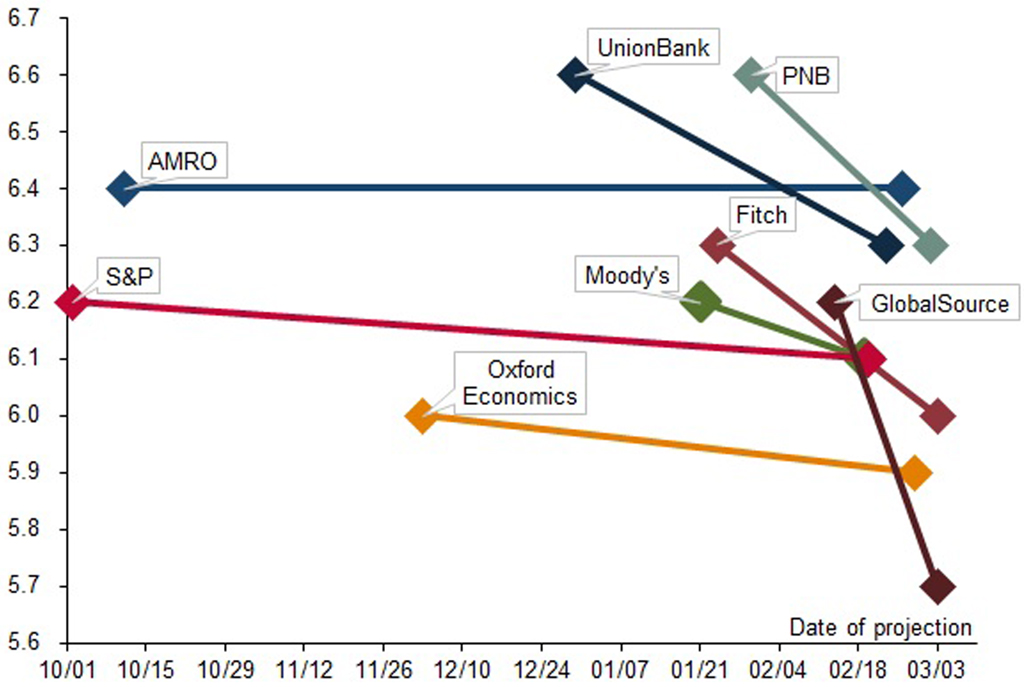
Since our quarterly outlook issued a little over two weeks ago, the Philippines reported three new cases of the COVID-19 disease in addition to the three cases detected at the time of our report (with one death). In the meantime, travel ban for inbound travelers from certain regions of South Korea has been imposed, alongside that for China and its administrative regions. With the virus spreading rapidly in different continents, the fear is that the virus is spreading undetected within the country. Analysts in the meantime have started to increase their estimates of the adverse impact of the COVID-19 on local growth with some shaving 0.3 percentage points (ppt) off their original forecasts. (See Chart)

We think the impact would be larger. Our view is mainly based on what we’ve learned from experts who have tracked the virus’s spread and impact on China and the global economy. The IMF for instance has cut its GDP growth forecast for China by 0.4 ppt based on the assumption that activities will return to normal by Q2, at the same time hinting of “more dire scenarios.” The East Asian Institute, in a commentary co-written by a former World Bank Country Director for China, presented several worst-case scenarios where full-year Chinese GDP growth averages anywhere from 2% to 5.6%, compared with a 6% baseline, depending on the sharpness of the slowdown in Q1 and the speed of subsequent recovery. A McKinsey report takes the analysis a step further, taking account of the virus’s global spread and its knock-on effects on confidence. The report presents three scenarios with the base case assuming that activity will be back to normal in China by Q2, but confidences elsewhere from East Asia to the Middle East and Europe will be dampened by the growth of new infections which then leads to global economic growth that is lower by 0.5-0.7% from the company’s 2.5% baseline forecast. Other analysts have also highlighted the fact that the virus struck at a time when the global economy was still grappling with the fallout from the ongoing US-China trade spat, putting at risk a tenuous recovery and potentially engendering more protectionism.

The above estimates tell us that given the Philippine’s external linkages and particularly its increased closeness in recent years to the Chinese economy by way of tourism and exports, the negative impact on local growth would be in the range of 0.1 ppt to as much as a full percentage point. While the actual outcome ultimately depends on a number of unknown factors about the disease’s transmission, including how people get infected, the common view now seems to be that COVID-19 will be around longer and fears of contracting the disease will limit activity, especially travel, possibly beyond Q2. Hence, we think the McKinsey base case scenario of a global slowdown is plausible, in which case we think the impact on Philippine GDP would be closer to the mid- to top end of the range rather than the low end.

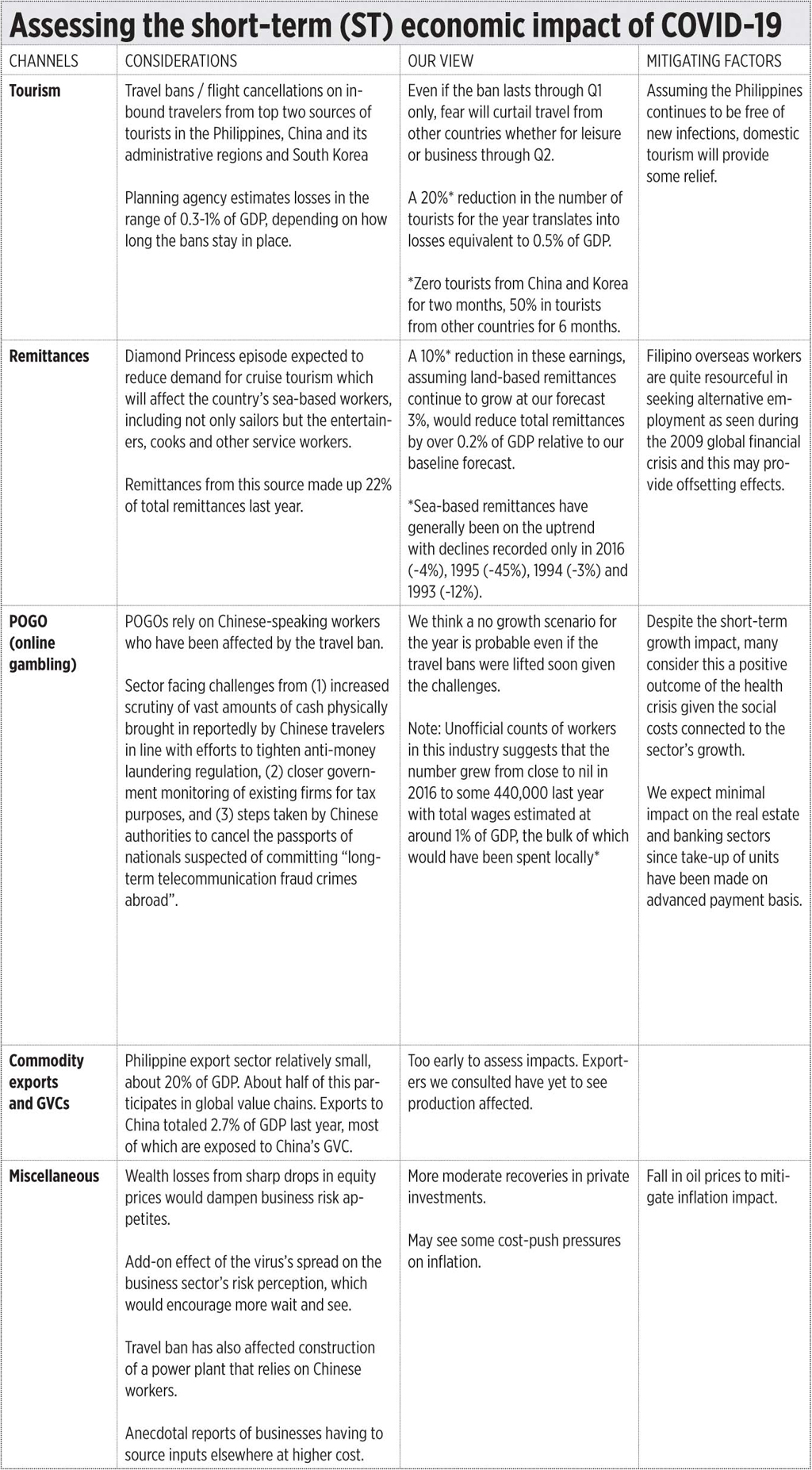
For now, after tracing the probable impact of the COVID-19’s spread through various channels (see the Table), we are cutting our growth forecast for 2020 from 6.2% to 5.7%, with further reductions possible depending on how the crisis evolves globally. We think that under the current environment of fear and uncertainty, more policy interest rate cuts are unlikely to have much impact. We worry too that, considering new data showing a substantial burst in public spending in December last year that resulted in a full-year budget deficit of 3.5% of GDP, fiscal stimulus this year would be less than initially expected, especially if government intends to stay within its 3.2% of GDP budget deficit cap.

Finally, it is an opportune time for our Congress to pass the CITIRA (Corporate Income Tax and Incentives Rationalization Act) to remove uncertainties that have affected FDI’s flows in the past two years. The bicameral conference committee can use Senator Pia Cayetano’s approved Senate version as the basis, as proposed by the principal House sponsor, Joey Salceda, Representative of Albay’s 2nd District.

As the Foundation for Economic Freedom (FEF), FINEX (Financial Executives Institute of the Philippines), Management Association of the Philippines (MAP), Makati Business Club (MBC), Subdivision and Housing Developers Association (SHDA), UP School of Economics Alumni Association (UPSEAA) and other business and professional organizations said in a March 5 statement: “This structure of the CITIRA under SB 1357 will help create an enabling environment for Filipino businesses, generate quality jobs, and spur growth that is felt throughout the entire archipelago… It is also timely. The current disruptions in supply chains bring opportunities for the Philippines to attract foreign direct investments.”


Romeo L. Bernardo was finance undersecretary during the Corazon Aquino and Fidel Ramos administrations.

romeo.lopez.bernardo@gmail.com

Water, transparency and mining concerns in the Philippines

The communities of Didipio, Nueva Visacaya have been up in arms against the operation of Oceana Gold Philippines, Inc. (OGPI). OGPI has been operating a copper-gold mine in Barangay Didipio in Kasibu, Province of Nueva Vizcaya. A Financial or Technical Assistance Agreement (FTAA) was awarded to OGPI in 1994, but the company only started its full operations in 2011. The first commercial production was reported in April 2013. Now, the FTAA has expired and is up for renewal.

The negative social and environmental impacts of the mine have been one of the concerns of the local stakeholders. More recently, the communities living near the Didipio mine claimed to have water supply problems including access to potable water, and availability for use in their homes and farms. Media releases from OGPI stated that it has been responsible for water management. The extent of water recycling at the Didipio mines is almost 75% at present, according to Oceana Gold Corp.

Since water is vital in mining, John Morillo, a graduate student of the National Institute of Geological Science of the University of the Philippines, and I decided to do an analysis of the water use of large scale mining in the Philippines. This study was supported by the Natural Resources Governance Institute (NRGI).

The Didipio Mine was one of the large-scale mines we examined. Using publicly available data, we estimated the available surface and groundwater resources of the area and compare these with water consumption at mines to determine if there is over extraction. We also tried to understand the impact of water consumption based on the mining activities and their rate of extraction and timing (i.e. which activities or events possibly correspond to an increase or decrease in consumption) by carrying out statistical analyses to establish correlation. We identified areas affected by water consumption using existing climate and land use data and its short-term and long-term impact to the water use of local communities.

This is what we have learned:

• Looking at the relationship between population and water use, we can see that there has been an increase in water extraction vis-à-vis the increase in population of Didipio. By 2020, the projected population in Didipio will reach 4,000. Based on our estimates, Didipio households are expected to spend 73,000,000 liters or 73,000 m3 of water per annum by 2020. This is roughly 0.4% of the total water extraction by the Didipio Mine operations in 2018 and barely 0.15% of the total projected water budget in the Didipio watershed. Hence, while a significant positive relationship can be seen between water extraction and population, households still have a relatively smaller“ significant consumption compared with the operations of Didipio Mine.

• The most significant positive relationship with water use is the disturbed area of the mine. “Disturbed area” refers to altered land cover by the mine due to operations or mine development such as construction of facilities and roads, tunnels, and removal of rocks from the surface. Increased demand for water may be attributed to commercial production, which began in 2013, and the expansion of operations to underground mining in 2014. It is noteworthy that water extraction increased almost tenfold from 2010 to 2011 when full-swing mine development was commencing. Water extraction also doubled from 2013 to 2014 during the time when OGPI was starting its underground operations and environmental spills were recorded (from the reports of Oceana Gold Corp.).

• The correlation between water extraction and rehabilitation is not as high compared with operations-related activities, but still statistically significant due to water demands in reforestation.

• At times when mine development commences or a significant environmental spill is recorded, a major increase in water extraction arises. On the other hand, while gold and copper production maintained a nearly stable pattern, these did not necessarily lead to increased water extraction (compared with mine development or during an environmental spill), possibly because fresh water is not much used during recovery processes.

Overall, we observed that the operational expansion, mine development, and occurrence of environmental spills in the Didipio Mine are significant contributors to the use of underground water in Didipio. These activities present a certain level of threat to the communities relying on groundwater as a source of potable water. The increase in the use of underground water by Didipio Mine and the expansion of its operation coincide and validate the water problem experienced by the host community. This is a concrete example why communities hosting mining operations vehemently oppose mining activities in their area. While we drool over the potential dollar revenues these minerals may bring us, we overlook the negative environmental and social impacts of these operations to the host communities.

The study is not without limitations. The lack of public disclosure and accessibility of data and inconsistency of reports from private companies limited the methodology that we can use in analyzing this data. It also limited the scope of our analysis. Public availability of relevant, reliable, and up-to-date data help in producing more robust, evidence based studies to support public policy. This brings me to another relevant policy issue.

In 2013, the Philippines joined the Extractive Industries Transparency Initiative (EITI). We were among the first countries to meet the requirements of the 2013 EITI Standard. However, not much has happened in terms of progress of the initiative in the country since then. EITI is not just about disclosure of revenues. It is an opportunity to create spaces for dialogue between stakeholders of the extractive sector. While the relationship between the stakeholders may not always be friendly, it facilitates an opportunity for dialogue. Disclosure of data and dialogues will not immediately solve the problems of the extractive sector. But it contributes to objective, evidence-based conversations and greater accountability of stakeholders.

The Philippine EITI started to publicly disclose information about the large-scale metallic mining sector. This is supported by the Chamber of Mines of the Philippines. In fact, disclosure went beyond what was required by the 2013 Standard. Albeit incomplete, the Philippines was a model in disclosing environmental and social data. The next logical step would have been more systematic disclosure of latest disaggregated data to allow monitoring and independent analysis by communities and the public. Another logical step is to replicate the national level multi-stakeholder conversation and disclosure at the sub-national or local level to also cover the small-scale mining industry. The stakeholders from civil society and the mining industry support this track. But the most important support for good governance in the extractive sector to continue should come from the government.

The commitment of the government has waned since the first validation. Semirara Mining Co., the biggest coal mining company in the country, is still not participating in EITI. Talk about the peak of government regulatory ineffectiveness. The Department of Energy cannot even make a coal company comply with public disclosure. The PH-EITI data are also outdated. Some of the data and information, like the water rights and tree cutting permits of companies, have not been disclosed. The auditor of the 2018 and 2019 PH-EITI reports and other contractors have not been paid. I am sure the waning interest in good governance of the extractive sector is not because of the lack of enthusiasm from the civil society and the extractive companies. The lack of interest and leadership to prioritize good governance in the sector comes from the national government.

The Philippines will again undergo validation of its compliance with the EITI Standard in October 2020. And this time, the commitment of civil society and industry may not be enough to salvage what remains of the reputation of the country in promoting good governance in the extractive sector. If there is anything we learned from this experience, some initiatives are better legislated so that even with the change in government leadership, we are able to institutionalize the gains of reforms. It is time for a law creating the EITI in the Philippines.


Cielo Magno, PhD is an Assistant Professor at the UP School of Economics. She is a member of the EITI International Board, the Management Collective of Action for Economic Reforms, and a board member of the Bantay-Kita/Publish What You Pay-Philippines.

In retail, evolve or die

In the early 2000s, the rise of fast-fashion brands like Zara, Mango, H&M, and Topshop caused a bloodbath among traditional fashion retailers. Unable to compete in price, style turnover, and vastness of selections, brands like Nine West, Diesel, and The Limited either filed for bankruptcy or were absorbed by bigger firms. Years later, when fast fashion brands hit the Philippines, local clothing retailers such as Regatta, Tab, Monakiki, Tyler and many others were either bought-out or closed.

Online shopping hit the mainstream some 10 years later, offering quick browsing through the flick of a finger, convenient (and reliable) delivery and secure payment platforms. Traditional brick and mortar retailers who were slow to adapt lost customers in droves. As a result, giants like Toys R’ Us, Barney’s New York, Radio Shack, Sears, Borders Book Store, and Gymboree all declared bankruptcies.

Technology has been the great disruptor of the retail industry. With technology, retailers are able to make the shopping experience more affordable, more convenient, more experiential and more exciting. Technology pushed the standards of retailing upwards. As a result, there is no more room for retailers who still display their goods on racks in a square box to be paid for at a cashier’s counter. The retail business is evolving so rapidly that those unable to adapt are doomed to fail.

A study by the Chicago based retail consultant, McMillan Doolittle, asserts that the 2020’s will usher-in a new wave of innovations in the retail scene. One of the more notable evolutions is that customers will no longer make a distinction between on-line shopping and store shopping. Both are expected to work in tandem to offer more excitement and more personalization. The seamless interface between online and physical shopping is the new “given” and should be part of every retailer’s strategy.

A Berksha store in Italy provides an excellent example of how online and traditional shopping can marry. In this store, customers can download an app where they can browse through the items for sale and place those that are of interest to them in a virtual shopping basket. They can opt to try-on the items or pay for them straight away. Upon pressing the send button, the store staff prepares the goods which will be waiting for the customer in the dressing room or the cashiers counter when he or she arrives at the store.

Inside the dressing rooms, there are tablets on which customers can request for alternative sizes, colors or styles. The app will also recommend complimentary pieces to the garment that is being fitted. For excitement, there are smart mirrors that can zoom in/out, rotate, and take still-shots or videos of the customer wearing the outfit which can be immediately shared on social media.

Berksha’s interface between online and traditional shopping allows customers to browse through the store without carrying a basket full of merchandise. Moreover, it makes the tedious process of fitting clothes much easier and allows customers to immediately share their photos on their social media accounts.

Another emerging trend is to provide “extreme convenience” while shopping. Recognizing that customers these days are busy, progressive retailers are eliminating the friction points in the shopping process. Friction points are factors that prevent a customer from purchasing. This includes grappling with the selection process, paying, having to physically carry the product home, among others.

IKEA Spain shows us how to provide “extreme convenience” through its new store format called IKEA Diseña. This particular store model is not a typical IKEA store with massive retail space. It is a store that can be as small as 25 square meters.

Inside the store is a team of interior designers who attend to customers. Through 3D graphics, they design the customer’s space using IKEA products, all of which are available in the online store. Once the customer is satisfied, the order is made and goods are delivered to the customer for which assembly services are free.

With this model, the customer is relieved from the tedious process of selection and physically hauling the product home. On top that, customers benefit from the expert advise of a professional. The model has been so successful that there are now 12 IKEA Diseña stores around Spain.

Another emerging trend is creating “extreme experiences.” It is all about creating instagrammable moments through lavish displays and grand gestures.

The rationale behind “extreme experience” is that customers do not choose products solely for necessity or value — but more so, for emotion. The higher the emotion, the higher the probability of a purchase and level of brand loyalty.

Hi Panda in Japan provides a perfect example. Hi Panda is a sportwear retailer that is the anti-thesis of Hello Kitty. Hi Panda is a brand that depicts itself as tough, angry and with an attitude. It is focused on consumer below the age of 30.

In its flagship store in Japan, Hi Panda uses augmented reality to heighten the customer’s experience. On the street level, customers are pulled into the store by an angry bear that jumps out at passersby when they point their phones at the store’s façade. Inside the store, augmented reality and light interaction create the illusion of the bear’s ghost appearing between racks of clothes. The ghost also makes an appearance in the fitting rooms.

Visiting the store has become an event for which everyone leaves with a bag of merchandise as a remembrance of their extreme experience.

The fourth trend has to do with sustainability. Today’s customers are extremely conscious about the environment and the food they eat. Customers are looking to align their values with retailers. Consumers connect at a deeper level with brand that makes them feel like they are making a difference.

Lush, a bath and spa retailer, built a store in the United Kingdom with the goal of increasing education around the impact of single use plastic cups. It offers free coffee or tea to all customers who bring their own coffee cup or those who purchase compostable or biodegradable ones. It covered its walls with educational facts about waste reduction to send the message that Lush is all about sustainability.

Through its initiative, Lush demonstrated its commitment to saving the planet. It has since attracted customers who share the same ideals.

The retail industry is a cutthroat business that is evolving at lightning speed. It would be interesting to see how local retailers like SM, Bench, Penshoppe, and Abensons keep up.


Andrew J. Masigan is an economist.

The impunity of money laundering

Nulla poena sine lege (Latin for “no penalty without a law”).

It was painfully frustrating to watch the Senate Blue Ribbon Committee hearing last week where incensed legislators skewered and charred the Bureau of Customs (BoC), Department of Finance, Bangko Sentral, Bureau of Immigration, Bureau of Internal Revenue, the Philippine National Police and the overseer Anti-Money Laundering Council (AMLC) for their delayed reaction on the alleged $447 million (P22.68 billion) that entered the Philippines from September 2019 to February 2020, suspected to be from online gambling operations (Philippine Offshore Gaming Operators or POGOs). AMLC chief Mel Racela said that the multimillion-dollar inflows that were flagged by Committee Chair Senator Richard Gordon as “suspicious” were “not unlawful” just yet.

Is there not an Anti-Money Laundering Act of 2001, RA 9160, “An Act Defining the Crime of Money Laundering, providing penalties therefor and for other purposes”? Yes — but read SEC. 4. Money Laundering Offense: “Money laundering is a crime whereby the proceeds of an unlawful activity are transacted, thereby making them appear to have originated from legitimate sources.” SEC. 3.i. defines “Unlawful activity” as “any act or omission or series or combination thereof involving or having relation to the following”: kidnapping, drugs, graft and corruption, plunder, robbery and extortion, jueteng and other banned gambling, piracy on the high seas, qualified theft, swindling, smuggling, violations of the Electronic Commerce Act of 2000, hijacking, securities fraud, and felonies punishable under the penal laws of other countries. Fourteen specific “predicate crimes” are listed whereby “Any person may be charged with and convicted of BOTH the offense of money laundering and the unlawful activity as defined (SEC. 6.a).”

“We cannot establish money laundering as long as we do not establish the unlawful activity.” Racela said (Inquirer, March 5). “The law that created the AMLC puts the burden of proof on the government and not the alleged money launderer… We need to establish… that these proceeds are proceeds of unlawful activities and the objectives of bringing that into the country is to launder it,” Racela pointed out at the Senate hearing (Rappler, March 5).

Gordon showed a list of suspected “mules” (couriers) who have been regularly bringing in foreign currency in bulk, declaring such huge amounts upon entry at the Ninoy Aquino International Airport. Customs representatives at the Senate hearing said they cannot confiscate amounts brought by inbound passengers, as long as these are outrightly declared. But the BoC said earlier that syndicates were able to bring in P18.7 billion in dirty money to the country with the “help of some police, military, and airport security personnel.” (Rappler, March 3). They knew “who’s who” in suspected money laundering, confirming that a certain “Rodriguez group” brought in around P10.2 billion. The same names were in Gordon’s list presented to the Senate plenary last week.

Yet the BoC could do nothing. And the AMLC just has to wait until concerned government functionaries have done their work, and a case has been filed with the Regional Trial Court for the primary crime (separate, and prior to the money laundering case), which court, upon weighing merits of both cases might issue an authority to look into the bank accounts of the suspects — a critical step in the whole procedure, because there is that formidable “Bank Secrecy Law” that exists in only the Philippines aside from Lebanon, in the whole world. Gasp! And a small detail — who is the “affected” party, the complainant who will file the initial, separate criminal case (chosen from among the 14 qualifying unlawful activities in SEC. 3.i. of the Anti-Money Laundering Law) that will trigger the money laundering case?

The US Bureau of International Narcotics and Law Enforcement Affairs, in its International Narcotics Control Strategy Report, Volume II, “Money Laundering” (March 2020) knows the legislative and regulatory deficiencies of the anti-money laundering programs in the Philippines:

“Philippine law limits the AMLC’s investigative authority to money laundering and terrorist financing cases, not the underlying predicate acts, which must be investigated by other agencies. But these agencies, unlike AMLC, do not have authority to obtain bank records. AMLC’s cooperation with other law enforcement agencies is minimal, limiting the flow of information and making it harder to connect the predicate act with the money laundering.”

Republic Act 1405, the Philippines’ bank secrecy act, limits disclosures of and inquiry into financial information held at banking institutions within the Philippines. The act’s strict guidelines impede law enforcement investigations and remain a significant deficiency in the current AML regime.

“Tax evasion, the falsification of public documents, and non-currency forgeries are not listed as predicate offenses to money laundering.”

And the US AMLA says there must be a connection between the POGOs and money laundering:

“The single-transaction reporting threshold for gaming transactions remains high at $100,000. The online gaming industry, which targets offshore players, has grown rapidly over the past three years, and authorities have expressed concern regarding potential money laundering through these operations, although there have been no money laundering cases related to online gaming.”

Senate Minority Leader Franklin Drilon said last week that it was “stupid” for the Philippine Amusement and Gaming Corporation (Pagcor) to allow Chinese-run online gambling operations in the Philippines just for government revenues (Rappler, March 05, 2020). At the Senate hearing, he “scolded” Pagcor AVP Dave Sevilla, citing the crimes on the rise linked to POGO operations aside from money laundering, such as the favored passport and visa “arrangements” with immigration, the sex trafficking and kidnapping.

But while the Senate Blue Ribbon Committee was turning blue in the face ranting and raving about the POGOs and money laundering, Presidential Spokesman Salvador Panelo, announced on simultaneous nationwide TV that President Rodrigo Duterte “cannot be rushed” into deciding on calls to suspend POGO operations over supposed crime links. Why not, when “in July 26, 2019, Duterte ordered the closure of all gaming schemes operated, licensed, and franchised by the Philippine Charity Sweepstakes Office (PCSO) due to ‘massive corruption,’ but restored lotto operations four days later amid widespread criticism over the inclusion of the state-sanctioned numbers game,” Rappler taunted on March 5.

“You don’t want POGOs? Pass a law!” Finance Secretary Carlos Dominguez III boomed at legislators in fiery challenge (Philippine Daily Inquirer, March 06). “We are not the ones who make things legal or illegal — it’s the legislature,” Dominguez said using “we” to refer to the Executive branch.

In a speech before new local treasurers on Friday (March 6), Dominguez reiterated that the DoF and the Bangko Sentral ng Pilipinas (BSP) had been pushing for amendments to AMLA and the Bank Secrecy law to “strengthen our ability to fight tax evasion and other financial crimes.”

The Legislature has best to look into amending and upgrading the laws on Money Laundering and ending the Bank Secrecy Act that coddles and protects wrongdoers.

Otherwise, it will always be “Nulla poena sine lege.”


Amelia H. C. Ylagan is a Doctor of Business Administration from the University of the Philippines.

ahcylagan@yahoo.com

To understand the world today, read Thucydides

FREEPIK

By Andreas Kluth

IN 416 BCE a mighty army from Athens, the superpower of the day, showed up on the small and neutral island of Melos in the Aegean Sea. The Athenians told the Melians to submit and pay tribute or be obliterated. Stunned, the Melians appealed to morality, justice, law, even the gods. There’s been a misunderstanding, the Athenians replied: You simply have a choice between doing as you’re told and being destroyed, so please stop wasting our time. This isn’t fair, the Melians insisted.

So the Athenians “put to death all the grown men whom they took, and sold the women and children for slaves, and subsequently sent out 500 colonists and inhabited the place themselves.”

With this final sentence, perhaps the tersest in world literature, the Greek historian Thucydides concludes the Melian dialogue in his History of the Peloponnesian War. (I’ve abridged the dialogue here, the full version is here: https://www.mtholyoke.edu/acad/intrel/melian.htm.) The text is a classic in international relations — and a good guide to understanding our world today.

That’s because it was the first expression of two traditions that have run through world politics ever since. The Athenian mentality Thucydides described is called realism. It views the world as a stage organized only by power and self-interest. Might makes right.

The Melian approach is called idealism. This tradition hasn’t always been as weak as the Melians were. It developed over time into the notion of international law, as it was later embodied, for example, in the United Nations and the European Union. Here rules are supposed to take precedence over — or at least to temper — power to protect the weak from the strong for the ultimate benefit of all.

The Western world after World War II was shaped largely into an architecture the Melians would have admired. A big reason was that it was led by a superpower, the US, which was realist in military preparedness but idealist in vision and values. The UN stood for legalism and conflict resolution without war. Other institutions, from the International Monetary Fund to the forerunner to today’s World Trade Organization, signaled that rules existed to constrain naked power in world affairs.

Nobody embraced this Melian mentality more eagerly than the war-traumatized Europeans, and especially the Germans, who had only recently committed a genocide the Athenians couldn’t have imagined. Rhetorically, the Germans renounced hard power and self-interest altogether, which is one reason why they still disdain and underfund their own army.

For more than a decade after the end of the Cold War, idealism seemed to be the future. Some authors celebrated the “end of history” as the liberal international order prevailed. Many were especially enthusiastic about the EU, the pinnacle of legalistic and post-national multilateralism, predicting that “Europe will run the 21st century,” that “the European way is the best hope,” and that the EU will be become “the new superpower.”

What’s been happening instead is a sharp turn away from idealism and back to realism. Some ancient-but-modern powers, such as post-Soviet Russia, post-Ottoman Turkey, and post-imperial China, have at different times felt spurned or humiliated by the West and its idealist dogma. Newly ascendant (China) or newly assertive (Russia and Turkey), they are now arch-realists.

When Russian President Vladimir Putin invaded Georgia in 2008 and annexed Crimea in 2014, for instance, he did so with the mentality of the Athenians in Melos, caring not a whit that he was breaking international law. After all, who was going to stop him? When Putin’s warplanes drop bombs on Syria to help his crony Bashar al-Assad, he regards the human beings below with Athenian disdain, turning millions into refugees who will, he hopes, make their way to the EU to cause chaos.

It’s with the same dark realism that Chinese president Xi Jinping views his neighborhood. Where he can assert his power and get away with it, he will — for instance, by taking a few islets in the South China Sea to turn them into Chinese aircraft carriers. Where he calculates that his power isn’t sufficient yet or could provoke a (still) superior force like the US, he waits, as in Taiwan.

We don’t know how Thucydides personally felt about the Melian episode; he merely described and interpreted it. Realism may indeed be the default state in nature. But the world is more bearable when those in power also have ideals.

Europe, unfortunately, seems destined only to have values but no power. Meanwhile, the US under President Donald Trump seems temporarily to have lost interest in ideals, putting “America first,” whatever that means. That could change again this year, of course, after the presidential election. Let’s hope it does. For the US remains the only nation today that potentially has both power and ideals, and that can prevent a world in which, as the Athenians told the Melians, “the strong do what they can and the weak suffer what they must.”


BLOOMBERG OPINION

ADVERTISEMENT
ADVERTISEMENT