Home Blog Page 9773

‘Precursor’ service to Cebu Bus Rapid Transit launching next week

THE Department of Transportation (DoTr) said Wednesday that a bus service meant to serve as an interim form of transport ahead of the completion of the Cebu Bus Rapid Transit (BRT) system will begin operations next week.

“The Cebu Interim Bus Service (CIBUS), a trunk service that will be used to augment the transport system in Cebu City until the completion of the Cebu Bus Rapid Transit (BRT), will start operations on March 16,” the department said in a statement.

It said the service will be the “precursor project” intended to “mimic the BRT System, so as to allow Cebu commuters to readily adapt to the new culture of instilling predictability in their daily commute.”

The interim bus service will initially operate in southern Cebu City in preparation for the BRT, which is scheduled for completion by the last quarter of 2021.

The interim bus service will have 17 bus stops, connecting the Fuente Osmeña rotonda to the SRP (South Road Properties) area.

Transportation Secretary Arthur P. Tugade said: “After a long wait, the CIBUS will be operational. It will serve for the convenience of Cebu commuters until the Cebu BRT, which is designed to accommodate a larger passenger volume is established and is up and running.”

The department said the P17-billion World Bank-funded BRT system is part of its integrated intermodal transport system for Metro Cebu.

The DoTr said the BRT project is currently undergoing “review and validation” of documents and detailed engineering design by the on-board technical support consultant.

It said 250 buses will be deployed upon the completion of the BRT, which will have at least 21 stations.

“Timelines of the project include Phase 1 (Cebu South Bus Terminal to Capitol) for partial operations by December 2021 and Phase 2 (Bulacao/Talisay to Talamban) for partial operations by March 2022,” it said. — Arjay L. Balinbin

Rice inventory increases 10.9% in February

THE NATIONAL rice inventory rose 10.9% year-on-year to 2.375 million metric tons (MT) in February, the Philippine Statistics Authority (PSA) said, following a substantial increase in holdings by the National Food Authority (NFA).

In its Rice and Corn Stocks Inventory report, the PSA said rice held by households rose 1.3% to 1.045 million MT while those of commercial warehouses rose 3.7% to 841.15 thousand MT.

NFA inventories rose 64.2% to 488.68 thousand MT.

On a month-on-month basis, the national rice inventory was down 11.2%, with household stocks falling 12.7%, those of commercial warehouses down 11.6%, and NFA stocks declining 6.9%.

Meanwhile, corn inventories in February fell 16.3% year-on-year to 654.52 thousand MT.

Stocks of corn held by households rose 4.9% year-on-year to 153.10 thousand MT, while commercial warehouses held 501.42 thousand MT, down 21.1%.

The NFA has not stocked corn in the past two years.

Month-on-month, the household corn inventory declined 27.1% while commercial stocks fell 16.7%.

Separately, the United States Department of Agriculture (USDA) said the Philippines’ milled rice production is projected to be stable at 12 million metric tons (MT) in March.

In its Grain: World Markets and Trade report, the USDA added that rice imports for the month will also be steady at 2.5 million MT, as will estimated consumption at 14.4 million MT.

It said demand for feed-quality wheat in the Philippines has increased, with Russia as one of the major suppliers.

“Improvements in Russian wheat quality have also stimulated recent discussions with the Philippines, a market that has generally purchased most of its milling wheat from the United States,” the report said. — Revin Mikhael D. Ochave

One-hour test to detect ASF hurdles pilot evaluation

THE Bureau of Animal Industry (BAI) said a test kit for African Swine Fever (ASF) co-developed with Central Luzon State University has become available, promising more rapid detection of the disease in hogs suspected of being ill.

BAI Director Ronnie D. Domingo told reporters previous efforts to identify ASF cases had been hampered by bottlenecks at government laboratories, adding that the new test kit was developed over six to 10 months, costs P300, a tenth of the price of the old one, and can return a result in under an hour.

The new kit was pilot-tested two weeks ago and “have been accurate and very satisfactory,” Mr. Domingo said.

The rapid confirmation and low cost means the kits can be widely distributed to other government agencies and hog traders, providing earlier warning of disease detection.

“We have conducted pilot tests in areas in Cebu; with Davao and Bicol regions to follow,” Mr. Domingo said.

The Department of Agriculture released P10 million to BAI for production, distribution, and training to use the test kits.

Secretary William D. Dar told a House committee recently that as of March 2, ASF has been confirmed in 625 barangays across eight regions. As a precaution, 237,406 animals have been culled.

He called for local government units to take the lead as “first responders” in efforts to contain ASF and to prevent further spread of the disease. — Revin Mikhael D. Ochave

‘Modest’ oil price decline impact on emerging markets

PLUNGING global oil prices could boost oil-dependent emerging economies like the Philippines and possibly serve as a “modest global offset” to the adverse impact of the coronavirus disease 2019 (Covid-19) outbreak, according to Oxford Economics.

“Under the current period of extreme uncertainty, the economic boost from a decline in oil prices will be modest,” the think tank said in a research note dated March 10.

Its simulations showed that the Philippines, along with China, India and Indonesia, are the economies expected to benefit the most if global oil prices drop to $30 per barrel in the second quarter and remain at these levels for the rest of the year, before recovery to $65 by end-2021.

“Of the larger economies considered here, those that benefit the most from the oil price decline are mainly Emerging Market oil-consumers such as China, India, and Indonesia. Advanced economies tend to use oil less intensively and so are less positively affected,” the report read.

According to its analysis, this scenario will likely boost the Philippine economy by less than 1% from baseline gross domestic product (GDP) levels in 2020-2021.

To assess the impact of oil price drop in selected economies, it conducted simulations of price changes across global transmission channels, taking into account “cross-country differences in fuel use, elasticity of demand, exchange rate changes and fuel taxes.”

“Predictably, the most adversely affected economies are oil exporters: Russia, Saudi Arabia, and UAE,” it added.

For global economic growth, Oxford Economics said the impact “averages +0.3% over 2020 and 2021, with a peak impact in 2021 of +0.4%,” “while global inflation would ease significantly, dipping 1.1 percentage point below baseline” this year.

The think tank said lower global oil prices could dampen prices but the $30 scenario would result in negative inflation for “14 out of 44 economies” this year.

“This prompts concerns that low inflation expectations could become entrenched,” it said.

Reuters reported that the price of Brent crude fell to $36.81 per barrel Wednesday, continuing a downtrend following a nearly 25% plunge on Monday to record lows.

Finance Undersecretary Gil S. Beltran has said that cheaper oil prices could pull down inflation moving forward.

Inflation eased to 2.6% in February on softer price increases of food, transport and utilities, from 2.9% in January. This brought year-to-date inflation to 2.8%, well within the central bank’s 2-4% target for the year.

Oxford Economics noted that “monetary authorities will find it difficult to respond to the negative demand shock as deflationary pressures mount” given that monetary policy easing is being eyed by many economies to offset the adverse impact of the outbreak.

The Bangko Sentral ng Pilipinas Monetary Board (MB) will meet for the second time this year on March 19,and is widely expected to deliver a 25-basis point (bps) reduction in policy rates.

On Feb. 6, the MB slashed benchmark interest rates by 25 bps.

Oxford Economics added: “A difficult global financial environment may undermine investment. Downgrades and defaults may lead energy producers to slash investment, which could spill over to other vulnerable pockets of the economy.” — Beatrice M. Laforga

House passes amendments to retail trade law on 3rd reading

THE House of Representatives approved on third and final reading a priority measure that aims to further open up the retail sector to foreign companies on Wednesday.

With 156 affirmative votes, 30 negative and three abstentions, the lower chamber passed House Bill (HB) 59 which seeks to amend Republic Act (RA) No. 8762 or the Retail Trade Liberalization Act (RTLA) of 2000.

The measure lowers the required minimum paid-up capital for foreign retail investors to $200,000 (around P10 million). Under the present law, enterprises with a minimum capital of $2.5 million or more may be fully owned by foreigners.

HB 59 also reduced the required locally manufactured products of foreign retailers to 10% of the aggregate cost of their stock inventory, from the current 30%.

The approved measure also removes the requirements under RA 8762 for foreign investors to acquire shares of stock of local retailers and for a public stock offering to be conducted by foreign-owned retail companies.

HB 59 also eased qualifications for foreign retailers to enter the Philippines. It removed the current law’s required net worth, number of retailing branches and five-year retailing track record conditions for foreign firms to enter the country’s retail industry.

At the same time, the bill allows only nationals “from/or judicial entities formed or incorporated in countries which allow the entry of Filipino retailers, to engage in retail trade in the Philippines.”

The Joint Foreign Chambers of the Philippines (JFC) have expressed their support for the bill, saying that “this will increase competition, create jobs, support tourism, and improve consumer choice, to the benefit of the economy and the Filipino consumer.”

“The amendments proposed by HB 59, such as lowering of the minimum paid-up capital requirement to $200,000 from $2.5 million, will attract new foreign investment in the retail sector on par with that received by our ASEAN neighbors. The $200,000 minimum investment required will protect the over 400,000 micro and small retail and wholesale businesses comprising more than 90% of all Philippine-owned retail and wholesale businesses in the country,” the JFC said in a statement.

However, House Minority Leader and Manila Rep. Bienvenido M. Abante, Jr. said that the amendments to the RTLA is “a drastic approach” which will have “unintended consequences.”

“The slide from $2.5 million to a measly $200,000 or a reduction equivalent to 92%… a very big number, is not a mere cause for concern. It’s not a cut above the knee, it’s cutting the head off! Why would we want to do this? Coupled with the 20% reduction on required locally manufactured products, and whatever Filipino retailers we have will fall to the ground,” he said in a speech during the plenary session.

Mr. Abante further argued that HB 59 will not follow the “Filipino First” policy which was designed for the “collaboration and establishment of special foreign relations, all the while promoting Filipino participation in our own national economy.”

“Instead, whatever Filipino participation we have, will most likely be marginalized and left unprotected. Instead of passing HB 59, we should pass a law that will protect our own, one that will help our Filipinos,” he said.

Counterpart measures in the Senate are still pending at the committee level. — Genshen L. Espedido

VAT refunds: Is the government unjustly enriched?

One of the well-known and time-honored principles in the Law on Obligations and Contracts is solutio indebiti. The rule is that no person shall unjustly enrich himself at the expense of another. Accordingly, if something is received when there is no right to demand it, and it was unduly delivered by mistake, the obligation to return it arises. In such a situation, a creditor-debtor relationship is created under a quasi-contract. The payor becomes the creditor with the right to demand the return of payment made by mistake while the payee, who has no right to receive the payment, is obligated to return it.

As decisional law teaches, even the government is not exempt from the application of this doctrine. If a person has unduly delivered payment to the government by mistake, the government is obligated to return it. Arguably, if a tax payment was made erroneously, a refund must be granted following the principle of solutio indebiti.

There are two common types of tax refunds in the Philippines. The first one is for erroneously or illegally assessed and collected taxes under Section 229 of the Tax Code. The second one is for unutilized input value-added tax (VAT) regarding zero-rated sales under Section 112 of the Code. These two types of refunds are different in a lot of ways, such as in the procedure and the prescriptive periods for filing the refund application, among others.

To differentiate, both the administrative claim and judicial claim for refund under Section 229 of the Tax Code must be made within two years from the date of the erroneous payment of the tax. On the other hand, the administrative claim for refund of unutilized input VAT must be filed within two years after the close of the taxable quarter when the sales were made. In case of denial of the claim, the tax authorities must state in writing the legal and factual basis for the denial within 90 days from the submission of the application. Upon receipt of the denial, the taxpayer has 30 days to institute the judicial claim for refund.

One of the most significant distinctions between these two types of refunds, according to the Supreme Court, is the application of the principle of solutio indebiti. Under the law, there is solutio indebiti when: (1) there is absence of a right to collect the payment, and (2) the payment was made by mistake, and not through liberality or some other cause. In one case, the taxpayer erroneously paid VAT to the government, without any obligation on its part, on the mistaken belief that it is not exempt from the payment of the VAT. Since both the elements of solutio indebiti were present, the taxpayer’s application for erroneously paid VAT was granted.

However, such is not the case for refunds of unutilized input VAT related to a taxpayer’s zero-rated sales. In another decision, the Supreme Court ruled that the elements of solutio indebiti were absent to be entitled to the refund of unutilized input taxes. The first element was unsatisfied since a binding relationship between the taxpayer and the local tax authorities existed arising from the legal obligation of the taxpayer to pay the VAT. For the second element, the payment of the input taxes was not a mistake, since the taxpayer was legally obligated to pay for such liability. The entitlement to a refund of excess input tax is solely based on the nature of the VAT system; however, in this case, the amount paid as input tax was correct and proper.

Nonetheless, in both cases, the Supreme Court said reliance on the principle alone is not sufficient. Apart from proving their entitlement to the refund, claimants must also comply with the procedural due process, which includes the observance of the prescriptive period for filing the administrative claim, and if necessary, the judicial claim for refund. Since a tax refund partakes the nature of an exemption, which cannot be allowed unless granted in the most explicit and categorical language, it is strictly construed against the claimant who must discharge such burden convincingly. In case of failure to observe the procedures, particularly the deadline for filing the refund application, the claim may be barred by prescription.

In the words of Supreme Court Justice Sandoval-Gutierrez, substantial justice, equity, and fair play are on the side of the taxpayers who erroneously paid the tax. Mere technicalities and legalisms, however exalted, should not be misused by the government to keep money not belonging to it, thereby enriching itself at the expense of its law-abiding citizens.

However, considering that the principle of solutio indebiti does not apply to refunds of unutilized input VAT, the leniency recognized by the High Court may not be applied in this instance. Instead, the claimants must ensure that they comply with the requirements set forth by the law. More so, because of the Enhanced VAT Refund System implemented last year where refund claims are decided within a 90-day processing period, it is best to plan and prepare before bringing about any claims against the government.

The views or opinions expressed in this article are solely those of the author and do not necessarily represent those of Isla Lipana & Co. The content is for general information purposes only, and should not be used as a substitute for specific advice.


Abigael S. Demdam is a Manager at the Tax Services Department of Isla Lipana & Co., the Philippine member firm of the PwC network.

(02) 8845-27 28

abigael.demdam@pwc.com

Only the lonely

It is perhaps the loneliest and not the fittest, that are most likely to avoid COVID-19. “Lockdowns,” social distancing, and “independent” living are nothing new to people who live isolated, hermit-like lives. They live off-grid, away from crowds, and keep to themselves. They put a premium on privacy, and rarely use the internet or social media accounts.

Their neighbors barely know them as they are uninclined to socialize. They see relatives only occasionally, if ever, and maintain only a small group of friends. They probably grow some of their own food in a small garden, and maintain a compost pit for their garbage. A bi-monthly drive to the bank and the grocery is enough to sustain them, for they are usually well-stocked.

They have no interest in shopping malls, the movies, or dining in restaurants. They do not like crowds and noisy gatherings. They are more comfortable with a book and soft music, and maybe a glass of wine or two. Even at work, if at all they are still in the race, they practically keep to themselves. They avoid company social functions and skip after-work drinks. And their work areas are almost always “clinically clean and clear,” and lack personal effects.

We scoff at their strict standards for personal hygiene. They wash too often, we say. We also note that they spend a lot of time cleaning and clearing and straightening their work station, and are easily bothered even by hints of dust or strong smells. We refer to some of them as “Obsessive-Compulsive.” Often, however, we simply call them weird or “eccentric.”

But with what is happening now around the world, it seems they knew something most of us did not. Apparently, isolation — or getting used to being alone for long periods of time — and the obsession with cleanliness have their merits. Being “generally clean” is no longer enough nowadays, obviously. The present situation calls for extra measures, and perhaps not only in the short term.

Even the wealthiest are not expected to fare any better than the loneliest in living in the time of corona. That at least one private hospital, the expensive kind, is rumored to already be turning away COVID-19 patients is enough indication to me that our healthcare system is about to be overwhelmed. And that access to medical care is no longer just a matter of cost and having money.

They way we live our lives is surely going to change. Some initiatives will have to give way to the needs of the present. For instance, we may have to reverse or temporarily halt the initiative to do away with disposable cups and throw-away cutlery as measures to address environmental concerns, particularly the negative impact of widespread plastic use and the shortage in landfill space.

Lucky for those with weekend homes outside the capital region, or those with relatives in nearby provinces and residences in the mountains or by the beach, away from madding crowds. If they can afford to be away meantime, that is. I reckon those in densely populated urban areas are at most risk of getting sick with COVID-19.

But for the most of us stuck in the metropolis, pretty much like those stranded in the capital every time a calamity hits, then we just need to make the best of the situation. If the situation worsens, and it probably will, then a lockdown of the National Capital Region is a possibility. And, if that happens, I am certain even the government will have difficulty containing civil unrest. There may be dire consequences for both the government and the public.

To avoid that possibility, and to help curtail the spread of COVID-19, perhaps there is merit in taking “social distancing” to the next level. It will take a lot of discipline, and will require much sacrifice, but people should just avoid other people, meantime. Staying home, if possible, especially for children while school is out, should be encouraged if not strictly observed.

It has been said about guns that it is better to have them and not need them, than to need them and not have them. In the same line, taking hygiene precaution to an extreme is perhaps called for in our present situation. Cancel events, miss gatherings, and put off unnecessary travel, even locally. Washing hands, disinfecting, and avoiding physical contact should be the norm, meantime.

The use of disposable cups, plates, and cutlery — even those made of plastic — should be tolerated meantime in restaurants, coffee shops, and other food service establishments. Or, at the very least, temporarily go back to the old practice of wrapping clean utensils in napkins, or leaving them submerged in hot water, prior to taking them out for use by diners.

In schools and offices with cafeterias, students and workers should be required to bring their own food containers and utensils, even disposable ones, just to avoid the sharing of contaminated wares. Coffee shops should temporarily suspend the use of washable cups and mugs, and all food service personnel should use gloves.

The other day, I was pleasantly surprised to find a parking cashier donning rubber gloves, but was disappointed to hear that her employer supplied her with only one pair. I think all cashiers, even in supermarkets, and all bank tellers, should be regularly supplied with rubber gloves and masks by their employers if they are expected to continue manning service front lines.

And, for companies that can operate with employees working from home, this should be the norm while the public health emergency remains. Meantime, all corporate travel, branch and site visits, gatherings and functions, meetings and conferences should be postponed to later dates. The same goes for schools, and perhaps even for churches.

My greatest concern, however, is with public transportation. I am at a loss as to how we can effectively curtail COVID-19 transmission particularly in jampacked trains, jeepneys, buses, and even tricycles. At best, people can wear masks and keep their hands clean, as they also refrain from touching their faces. The secondary approach is to limit travel itself by allowing people to work from home and children to do home study meantime.

In my opinion, social distancing, or temporarily keeping away from other people, is the most effective way of limiting transmission of COVID-19. But it is also among the most difficult initiatives to take. People, by nature, are social beings. However, extreme situations call for extreme measures. This is one step that we should all be ready to undertake, unless we wish to leave the metropolis to only the lonely.


Marvin Tort is a former managing editor of BusinessWorld, and a former chairman of the Philippines Press Council.

matort@yahoo.com

A TV network for the common good (Part Two)

ABS-CBN’s franchise says that it should “provide at all times sound and balanced programming; …assist in the functions of public information and education; [and] conform to the ethics of honest enterprise…” In line with this, I believe the network needs to provide more balanced and independent reporting and analysis of important social issues to help Filipinos become critically engaged citizens.

Informing and educating the citizens of a republican democracy is a sacred function of media. Democracy can work for the common good of citizens only when the latter understand how their society works and their role in it. Moreover, because the Constitution states that “sovereignty resides in the people and all government authority emanates from them,” media must help in making the powerful accountable to the public.

Because of its influential and independent role in society, media is often referred to as The Fourth Estate, or even the fourth branch of government.

Filipinos who want to be critically engaged need good news information and analysis. This is where sound media institutions and a broadcast network like ABS-CBN become vital. Citizens should not merely criticize problematic social structures and people in power for its own sake; they must know and deeply understand the truth behind important social issues.

Issues that need more critical reporting and analysis from ABS-CBN include corruption, child pornography, human trafficking, poor utility services, the plight of workers in the cities and countryside and, of course, the mother of all issues, which is inequality and poverty. In reporting on such issues, the network must help people know what is happening and why this is happening. Importantly, citizens need help in understanding who are responsible for addressing these issues and whether they’re doing their jobs.

The network’s reporting and analysis on these issues have been disappointing. On the Metro Manila water supply issue, for example, reportage has focused on the opposing views of the government and the water companies on the terms of the concessions. However, the causes of the water shortage and how they can be addressed have hardly been explained. Fights between the government and the concessionaires make for colorful news, but is this more important than water supply itself?

I am most disappointed in the reportage on inequality and poverty in our country. International organizations have long pointed out that we have one of the slowest rates of poverty reduction in the region despite our strong economic growth. Yet, the network accepts the government’s official stance that poverty has gone down, based on the P10,727 monthly poverty line for a family of five, without any critical comment. This is a superficial approach to this devilish problem. Tough questions need to be asked: Where has the growth been going, and why isn’t it being shared more?

To answer such questions, the network needs news and current affairs professionals whose highest goals are to report the truth and to help the public in understanding these truths. Competent broadcast journalists, such as the late American broadcaster Edward Murrow, can separate facts from hearsay or opinion. They can reveal and analyze the cause-effect relationships among actors, structures, resources, rules, culture, and beliefs that are behind complex social problems. I often think that the network’s news anchors weigh in with more opinion than analysis and don’t do a good job of getting all sides. Given their influence on the public mind, this is not responsible journalism.

Beyond competence, the network needs to work on its news ethics, especially its independence. The commercialization of news has naturally led to conflicts of interest. This all started when news programs changed their formats to go after ratings. The action-oriented and bombastic style of news delivery has replaced the more rational and analytic styles of decades past. News anchors have become popular not because of the quality of their reportage but because of their image and style of reporting: a triumph of form over substance. The worst part is that some of these anchors leveraged on the popularity they gained from delivering popular news programs to win public office! How can news anchors be credible independent critics of government when they can choose to become public servants and then return to newscasting?

News commercialization also takes other annoying forms. For example, the network promotes its shows and talents under the guise of impartial “news” and juicy tidbits about its talents in revealing swimwear.

I am still kapamilya and want the network’s franchise to be renewed. But I hope that ABS-CBN will take its duties under the law more seriously by helping restore our socio-cultural fabric and educating citizens to be informed and critically engaged.


Dr. Benito L. Teehankee is the Jose E. Cuisia Professor of Business Ethics and Head of the Business for Human Development Network at De La Salle University.

benito.teehankee@dlsu.edu.ph

Cheap oil, gas, and power stability

One of the consequences of the COVID-19 scare is the huge decline in global oil demand and low oil prices because oil supply remains high, thanks to Trump’s policy of “energy dominance”: from only 5 million barrels per day (mbpd) at the end of Bush, Jr.’s term in 2008, to 8.8 mbpd at the end of Obama’s in 2016 (a 3.3 mbpd increase after eight years), and 13.1 mbpd by February 2020 (a 4.4 mbpd increase in just three years and two months).

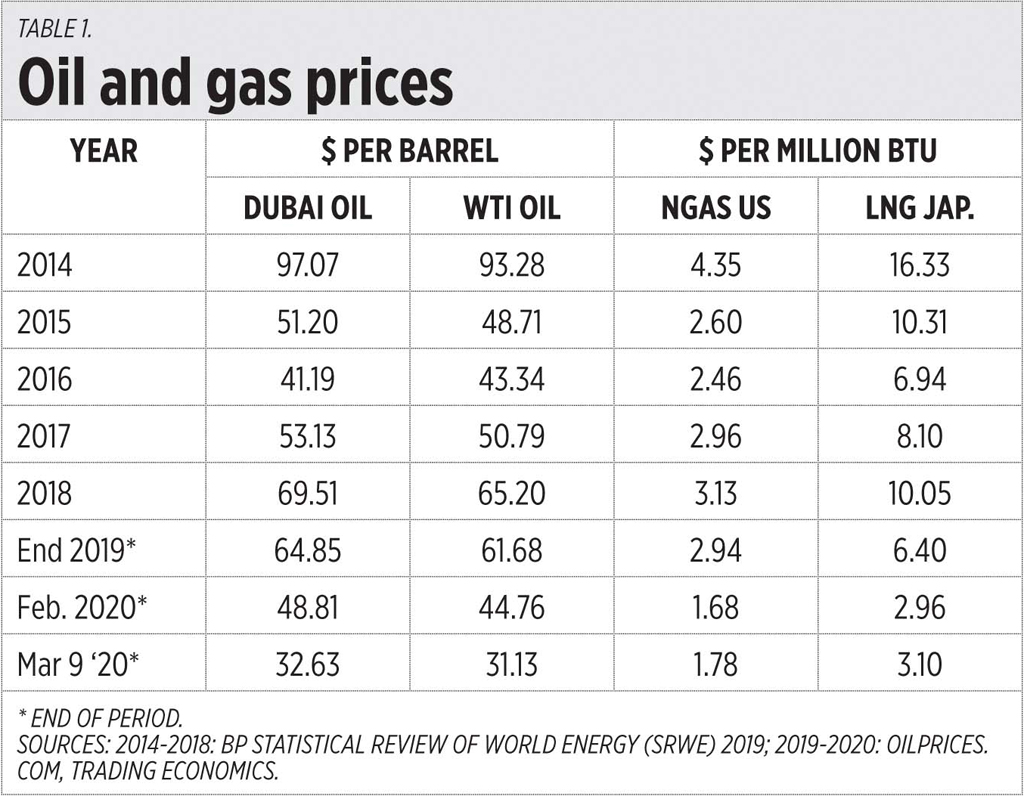
The OPEC + Russia conspiracy to prop up oil prices via joint a production cut for about three years ended last week when OPEC pressured Russia to have a joint output of 1.5 mbpd by the 2nd quarter 2020 and Russia said “no.” Since then, the already low price of $45/barrel in end-February went down further to $31, with an intra-day low of $27 last Monday.

Natural gas prices also showed significant decline, only $1.78 per million British Thermal Units (BTU) last Monday. The implied percent decline though is not as big as oil price decline (see Table 1).

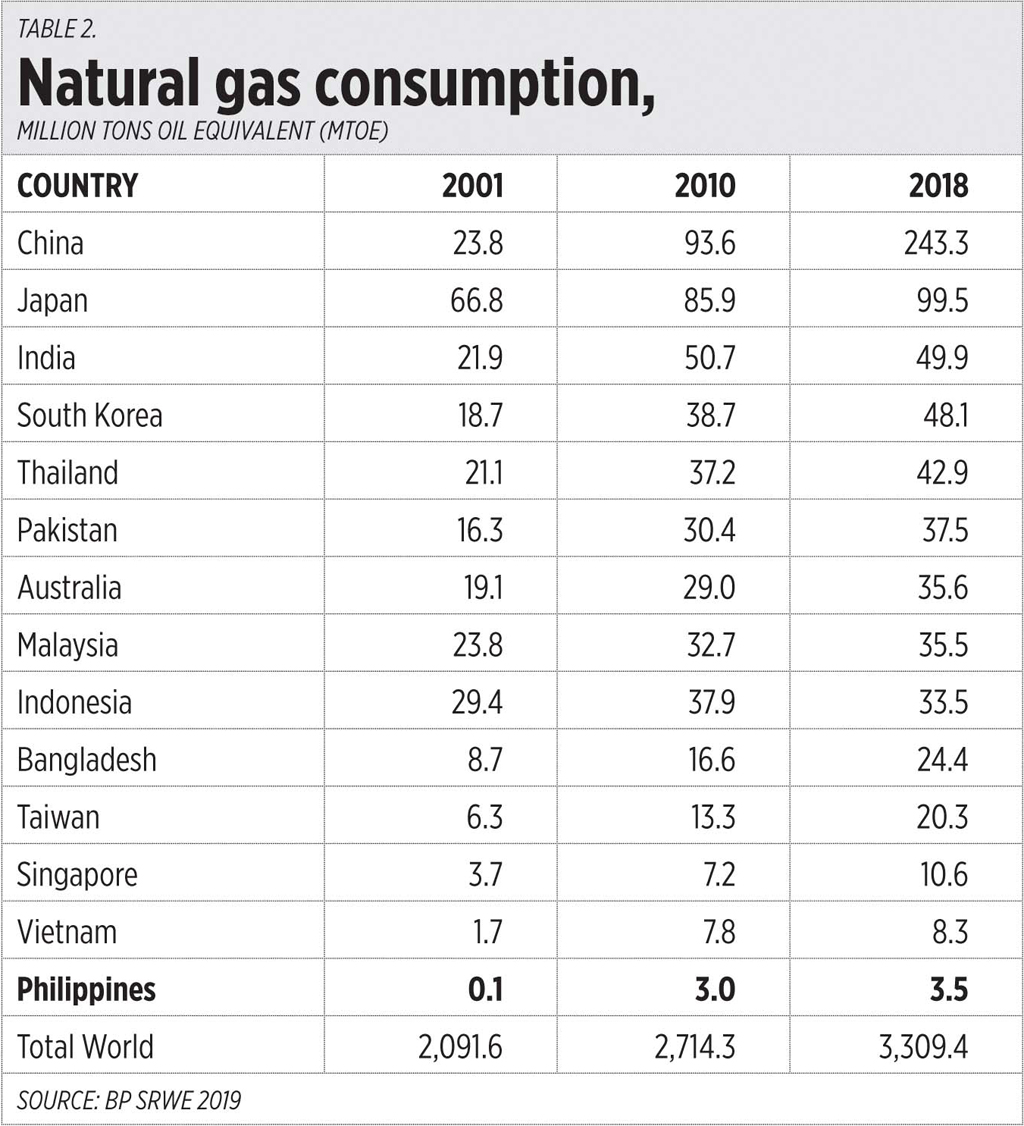
The Philippines is not a big consumer of natural gas and we are using only indigenous natgas from the Malampaya field in offshore Palawan, no imported liquefied natural gas (LNG). China, Japan, South Korea, and Thailand, on the other hand, have big and rising consumption of natgas (see Table 2).

Certain sectors are pushing to develop facilities for imported LNG, preferably with fiscal sweeteners like some Department of Energy/Philippine National Oil Co. support in building the facilities, and the usual take-or-pay provisions or guaranteed income.

Aside from these expectations, natgas is favored because it was exempted from tax hike under the TRAIN (Tax Reform for Acceleration and Inclusion Act) law of 2017. So, if imported LNG is brought here, it will be exempted from excise tax but imported oil and imported coal are still slapped with high excise tax.

The reason for natgas favoritism is the belief that natgas is a “clean” fossil fuel. If people are really allergic to fossil fuels for causing “man-made” global warming/climate change (CC), then they should demonize all three — coal, oil and gas — and not just the first two.

AGHAM Party list, headed by Congressman Angelo Palmones, is among the groups that reject the “natgas is clean” hypothesis.

Last month, the Gas Policy Development Project (GPDP) at the UP School of Statistics submitted its report, “Market Profiling with Emphasis on the Use of Liquefied Natural Gas (LNG) to Power Economic Zones,” to the energy department and project donor, the US State Department. It was jointly authored by Drs. Majah-Leah Ravago, Raul Fabella, and Karl Robert Jandoc.

Among the conclusions of their paper are:

a.) LNG as alternate energy source would allow for more competitive electricity costs owing to the current oversupply of natural gas in the world market; and,

b.) Natgas can lower the Philippines’ carbon emissions since it emits 60% less carbon dioxide than coal, and transition to more renewable future as it can ease the intermittency problem of solar and wind. I agree with a. but not b.. More competitive and lower electricity prices, yes, natgas can do that. But demonizing CO2 is wrong. CO2 is the gas that we humans and our animals exhale, the gas that our crops, flowers, and trees use to produce their own food via photosynthesis. CO2 is a useful gas, not an evil-pollutant gas that must be demonized and over-taxed. And climate change is largely natural (“nature-made” not “man-made”) and cyclical (warming-cooling) for the past 4.6 billion years since planet Earth was born.

And now the hot months of March to June are here. There are no new peaking plants to provide extra power during peak hours of weekdays so the move now is to help reduce demand via an interruptible load program (ILP) by the energy department and peak/off-peak (POP) program by Meralco. ILP is good because it will mobilize hundreds of gensets of big companies, sort of “backyard peaking plants” in voluntary scheme. But the Department of Energy’s plan to make it mandatory with fines and penalties is not good.

The POP program is good because it is largely voluntary, with 6,000+ private participants observing time of use electricity consumption. Private sector initiatives are cool and useful, not mandates and coercion.


Bienvenido S. Oplas, Jr. is the president of Minimal Government Thinkers.

minimalgovernment@gmail.com

Postpone CITIRA due to the coronavirus!

Days before the spike of local cases of infection with the SARS-COV-2 coronavirus which causes COVID-19, the Senate Ways and Means Committee was ready to approve its version of CITIRA (the Corporate Income Tax and Incentives Rationalization Act). The proposed law is the second phase of tax reform of the government, which reduces the corporate tax rate and reforms the investment incentives laws of the country.

The Department of Trade and Industry and the Department of Finance organized a consultation on it on March 3 at the Philippine International Convention Center, a prelude to its final push at the Senate. The proposed law was to be passed in the Senate this month or before Congress goes into recess until May of this year.

There is good basis to put off for now the enactment of CITIRA because of the coronavirus. While the WHO has yet to declare this outbreak as a pandemic, recent developments strongly indicate the world is in it already. As I finished this column, about 114,430 persons had been infected and 4,027 had died from the disease, according to Worldometer. While the fatality rate is low, it is however rising each day. When I started this article last week, Worldometer reported 85,721 infections and 2,933 fatalities.

COVID-19 has been regarded as a far more serious health crisis than the SARS outbreak in 2002 and 2003. The present coronavirus has, as of end of February, infected about 10 times more people in twice as many countries. While the final SARS fatality rate was 9.6% and current fatality rate of COVID-19 is estimated at 3.5 %, it is still too early to compare the two.

As more countries catch up with the COVID-19 testing, the health emergency may rapidly deteriorate to a situation that authorities have to take very drastic moves to save lives.

And these measures, like lockdowns and travel bans, would limit mobility of people, prohibit congregating, and disrupt economic activities world-wide, generating a global economic crisis and unemployment.

IMF Managing Director Kristalina Georgieva had recently said that the coronavirus crisis now gripping the world threatens to derail global economic growth. Her dire projection may not be a threat anymore. We are witnessing the unfolding of another global economic crisis of a dimension far more concerning than the 2008 financial and economic crisis or the economic slump in the early 2000s due to the SARS virus.

The markets reflect this outlook with equity prices plunging by nearly 8% in just one day. Investors are already considering an economic recession worldwide as likely just months away. Oil prices likewise have precipitously declined due to sharp cuts in demand, which in turn mirrors the slowing down of productive activities in the major economies of the world.

Information gathered as of last week here in our country is that exporters of electronic products, which employed their workers in six days per week, had reduced work days by a day because raw materials from abroad are not coming in on time.

A large export company of electronic products, which employs thousands of workers, had to contend with the problem of rising freight rates. Cathay Pacific had to cancel flights going to China. Most of this company’s raw materials of come from China, and it exports to China. Its business is part of the global value chain in electronic products, which is now disrupted by the virus. Indeed, a quarter of the country’s imports come from China according to the Philippine Statistics Authority.

In February, this company had to honor its contractual obligations, and how costly that was. Last month, its freight cost increased by $171,188 because of the virus.

How many more of our country’s exporters are already in this situation? And titirahin pa sila ng CITIRA (And they will still be hit by CITIRA).

I am for reducing the corporate tax rate, and it can even be made better for the economy if the Congress considers cutting the rate in two or three steps.

I have, however, a strong reservation of the changes it is proposing on the investment incentives. These are not just fiscal measure. They are also trade promotion measures. Most of our exporters are locators in PEZA (Philippine Economic Zone Authority) zones. More than half of our exports come from the electronics and semi-conductor sector. The incentives the firms enjoy insulate them from the uncertainties that firms selling to the domestic market contend with.

Why should we give them special treatment? Because they are exporting. They compete with firms in other countries which have likewise treatments that make them competitive. By taking that treatment away from our exporters, we reduce our exports.

If authorities are concerned that some locators in these zones are no longer exporters, then PEZA should clean their ranks and exile the firms that do not deserve to be among the country’s exporters.

Others may disagree with me that exports are placed at risk with CITIRA. If their concern is that the government is getting a raw deal with the 5% special income tax in PEZA zones, then let us recompute the special income tax rate so that the locators pay their due income tax rates. But it is important for the economy to spare these exporters from having to lose that special treatment. Because if they did, these businesses can relocate elsewhere. Look, Honda has left us and Vietnam gains from our loss. Once electronic or manufacturing exporters are gone, they are difficult to attract back.

These points are debatable, of course. I focus instead on the wrong timing of CITIRA and l go back to the virus. There are still many things we don’t know about it. The little we do know so far is that this can be worse than the global financial crisis and global economic crisis we had 10 years ago.

COVID-19 is complicated because the productive and logistics capacities worldwide are adversely affected. We live now in a world where countries are interconnected to produce anything of value. China now counts for a fifth of the world’s GDP, and millions of its people, most of them workers, have been told not to leave their houses to prevent the further spread of the virus.

The PSA reported that in January, our exports grew by 9.7%, year-on-year. But imports grew by only 1%. The January growth was better than in 2019, where the country’s exports contracted by 6.7%. While electronic products continue to be the top commodity exports of the country, the January spike in exports largely came from minerals and mineral products.

Electronics are highly dependent on imports. If import growth slowed down in January, then we are likely to see a decline of exports in electronic products very soon. That would be 55% of our country’s exports. The delays of imported raw materials are traceable to the COVID-19 outbreak.

The world is likely now to be at the start of a more complicated global economic crisis, the duration of which cannot be cut short by some financing or economic stimulus, but by the knowledge gained by humanity, with the help of the world’s scientists and health experts, in containing the virus. CITIRA introduces another dimension of uncertainty to our exporters. Let us put this off for now and let the authorities like the PEZA and the other investment promotion agencies monitor the deteriorating situation and assist our country’s exporters save jobs.


Ramon L. Clarete is a professor at the University of the Philippines School of Economics.

Why America’s strategic presence will remain in the Philippines beyond the VFA

By Rasti Delizo

THE GEOGRAPHICAL LOCATION of the Philippines on the world map permanently defines its inimitable strategic position and geopolitical role in relation to America’s overall foreign policy framework and agenda. This principally means that the recent abrogation of the 1998 RP-US Visiting Forces Agreement (VFA) by the current Duterte Regime will inevitably give way to a potential VFA-2, or another similar bilateral defense arrangement, in the future. Such a scenario is a near certainty given two complementary conditions which continually press upon our country. One is internal, while the other remains external to the Philippines.

A major internal factor is that the 1951 RP-US Mutual Defense Treaty (MDT) still prevails after nearly 70 years. Fundamentally, the MDT persists as the principal bilateral instrument which continues to operationally bind Manila to Washington’s external policy thrusts aimed toward this area of the globe. In fact, even after the Philippine Senate voted to abrogate the much earlier 1947 RP-US Military Bases Agreement (MBA) in September 1991, US military forces were still able to conduct joint training exercises with the Armed Forces of the Philippines (AFP) on Philippine soil. Indeed, this happened even prior to the VFA getting signed into existence!

Undeniably, the MDT is the chief pact which opened the door for the VFA’s entry into our diplomatic terrain less than a decade after the US military bases were shut down in the early 1990s. Yet, it is also critically important to remember that even without the VFA, Malacañang still continues to retain other dangerous spawn of the MDT — the 2002 RP-US Mutual Logistics Support Agreement (MLSA) and the 2014 RP-US Enhanced Defense Cooperation Agreement (EDCA). Ominously, the latter allows for US military forces to assert relatively wide operational control over at least five Philippine military bases across the country today, and almost three decades after the MBA was terminated.

This perturbing arrangement is a part of both countries’ joint obligations to further deepen the scope of the MDT’s bilateral defense objectives which were set in motion since the last century’s Cold War phase. Indeed, the Philippine state’s tactical sacrifice of the VFA is merely a ploy to keep the MDT-MLSA-EDCA cornerstone in place to help secure America’s so-called “freedom of navigation operations” across the wider Asia-Pacific region. Thus, the Duterte Regime’s silence on the three war instruments truly exposes his real intention to protect his own political flanks from any American retaliation by ensuring such leverage with Washington through Manila’s retention of the age-old “Mother Defense Treaty” (MDT) itself.

On the other hand, the principal external pressure bearing upon the Philippines is the overall direction of American foreign policy as outlined by the 2017 US National Security Strategy paper. As the world’s leading superpower, America identifies both China and Russia as its foremost long-term challenger-competitors, together with Iran and North Korea. From this perspective, Washington believes that it must always be in a position to constantly assert its dominant hegemonic might to secure and advance its strategic interests worldwide by keeping a commanding edge over its main rivals for access and maneuver across the global commons.

And to maintain a strategic advantage over its core competitors, America’s central task must be to “retain overmatch… to ensure that American military superiority endures” throughout the world. Accordingly, Washington’s latest military strategy to retain its global overmatch is now defined as the Joint Concept for Access and Maneuver in the Global Commons (JAM-GC) — the highly evolved version of the Pentagon’s earlier Air-Sea Battle Concept — aimed at overcoming the anti-access/area-denial (A2/AD) countermeasures of China and Russia.

Therefore, the critical role played by America’s EDCA bases will crucially shape US imperialism’s future interventions in the Philippines under the JAM-GC’s doctrinal guidance to ensure America’s global overmatch against China. Within this setting, it is vital for the Philippines to be held as a critical security link to guarantee Washington’s forward force projection posture within and beyond Southeast Asia. Hence, we should once again expect the US to protect its foreign policy imperatives by pressuring Malacañang into accepting a post-VFA arrangement in the coming period. And such a scenario is geopolitically inevitable as the Philippines is forcibly sucked into the intensifying vortex of the “Neo-US-Sino Cold War” that is already raging across the broader Asia-Pacific region at the present time.


Rasti Delizo is an international affairs analyst. He used to work with the Presidential Management Staff-Office of the President as the Lead International Affairs Analyst and as the Deputy Executive Director of The Center for Strategic Studies. Delizo was also a foreign policy consultant to the Senate Committee on Foreign Relations, House Committee on Foreign Affairs, and the Department of Foreign Affairs. He is currently a Vice-President of the socialist labor center Bukluran ng Manggagawang Pilipino (BMP) and the National Coordinator of Laban ng Masa (LnM), a socialist political center.

Main index climbs further despite cautious trade

THE MAIN INDEX marked its second consecutive day of increase yesterday, but is yet to break into the 6,400 level as investors remained cautious of the coronavirus outbreak’s economic impact.

The 30-member Philippine Stock Exchange index (PSEi) picked up 34.88 points or 0.55% yesterday to close at 6,353.26, while the broader all shares index gained 20.21 points or 0.53% to 3,808.73.

“While the market ended on a positive note gaining 34 points today, I don’t think we’re out of the woods just yet,” PNB Securities, Inc. President Manuel Antonio G. Lisbona said in a text message on Wednesday.

“The outbreak has not yet shown any signs of slowing and the economic effects of large scale lockdowns such as that of Italy’s is yet to be observed,” he added.

The months-long spread of the coronavirus disease 2019 (COVID-19) had already led to the impairment of several business operations across the world. To others, the impact was as grave as a nationwide lockdown, like that in Italy since Monday.

While the PSEi saw some improvement yesterday, most of its regional peers still closed lower. Japan’s Nikkei 225 and Topix indices fell 2.27% and 1.53%, respectively. China’s Shanghai Shenzhen CSI 300 index dropped 1.33%, Hong Kong’s Hang Seng index declined 0.63% and South Korea’s Kospi index lost 2.78%.

Wall Street roared back to life on Tuesday, rebounding from the brink of bear market confirmation as bargain-hunting and hopes of government stimulus calmed investors’ fears surrounding the coronavirus and growing signs of imminent recession.

All three major indexes jumped nearly 5% the day after equities markets suffered their biggest one-day losses since the 2008 financial crisis. Still, the S&P 500 and the Nasdaq ended the session about 15% below the record closing highs reached on Feb. 19. Sinking beyond the 20% mark would confirm a bear market.

Trading at the local bourse was initially stronger, but its gains were tempered at the market’s close “as investors weighed the prospects of fiscal stimulus to curb slower economic growth,” Regina Capital Development Corp. Head of Sales Luis A. Limlingan said.

Four of six sub-sectors ended in green territory yesterday. Industrials rose 168.63 points or 2.27% to 7,598.56; holding firms added 66.24 points or 1.07% to 6,225.11; services climbed 3.59 points or 0.29% to 1,236.22; and property inched up 6.62 points or 0.19% to 3,433.39.

On the other hand, mining and oil gave up 87.89 points or 1.52% to 5,687.52, and financials slipped 15.19 points or 0.99% to 1,517.51 at the close of Wednesday’s session.

Value turnover stood at P6.62 billion with 687.59 million issues switching hands, lower from P7.36 billion with 774.46 million issues in the previous session.

Advancers beat decliners, 107 versus 84, while 48 names ended unchanged.

Foreign investors turned buyers yesterday, with net inflows of P350.50 million from a net selling of P835.86 million the previous day. — Denise A. Valdez with Reuters

ADVERTISEMENT
ADVERTISEMENT