Home Blog Page 9663

123 inmates in Philippine jail infected with coronavirus

A prison in the Philippines is suffering from a major outbreak of the new coronavirus with 123 infected inmates, officials said on Wednesday, adding to concerns among activists about contagion risks in some of the world’s most overcrowded jails.

The mayor of Cebu City said a new building in the prison capable of handling 3,000 people would be used as an isolation facility to contain an outbreak that accounts for 40% of cases in the Philippines’ second biggest city.

There were no details about the possible source of the outbreak. Eighteen cases have been found at a jail in Quezon City, among them nine staff members. Nineteen more inmates and a worker at a women’s prison in Mandaluyong City near the capital were also infected.

New York-based Human Rights Watch (HRW) was among several groups that called for inmates held for minor, non-violent offences, or those with health conditions, to be freed from Philippine prisons to create more space.

Activists globally have been urging governments to free political prisoners.

HRW this month warned of the likelihood of a serious coronavirus outbreak in the Philippines “threatening the lives of prisoners whose health the authorities have a duty to protect.”

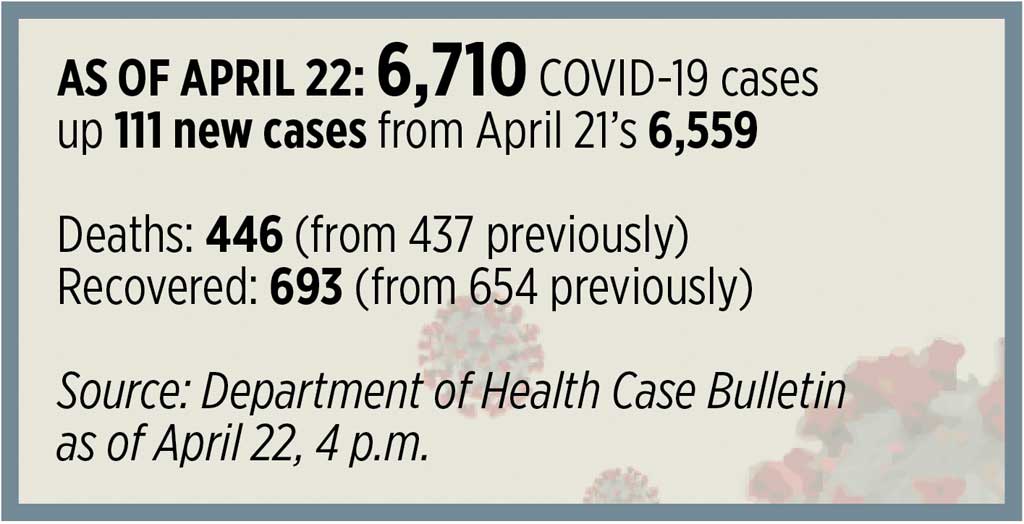
The Cebu jail outbreak is among the biggest known coronavirus clusters in the Philippines, which as of Wednesday had 6,710 infections and 446 deaths. About 70% of cases are in the capital, Manila.

Philippine prisons are notoriously overcrowded due to a combination of poverty, high crime rates and a judicial system unable to cope with a huge case volume.

A shortage of public defenders, overwhelmed judges and insufficient funds to post bail means suspects typically spend long periods — sometimes years — in detention awaiting court hearings that often end up with acquittals.

As of December, nearly 90,000 people in the Philippines were detained awaiting trial, corrections bureau data showed.

President Rodrigo R. Duterte’s war on drugs has exacerbated the problem, each year adding tens of thousands to jails, with 71% of inmates held on drug-related charges.

The Supreme Court urged trial judges on Monday to free prisoners eligible for temporary or early release. — Reuters

#COVID-19 Regional Updates (04/22/20)

Partial bus, train operations up for task force approval

THE DEPARTMENT of Transportation (DoTr) on Wednesday said it was awaiting the decision of the Inter-Agency Task Force for the Management of Emerging Infectious Diseases (IATF-EID) to allow buses and trains to operate partially in Metro Manila. “Naumpisahan nang pag-usapan sa IATF ‘yan. Noong Lunes nagbigay ng statement ang bagong kalihim ng NEDA (National Economic and Development Authority), kung magbabalik-operation dapat hindi full capacity kundi 30% lang (The IATF has started addressing the matter. Last Monday, the new acting secretary of NEDA made a statement that the capacity should be limited to just 30%),” Transportation Secretary Arthur P. Tugade said in a briefing. The partial operability is for the continued enforcement of physical distancing protocol to avoid the spread of the coronavirus disease 2019, he added. Mr. Tugade also said they are exploring the possibility of resuming inter-island ferry operations. The Management Association of the Philippines has proposed to the DoTr that a “demand-driven” transport system be implemented in the National Capital Region to allow workers to “gradually” return to work and avoid business closures and layoffs. — Arjay L. Balinbin

Cebu provincial gov’t cuts exemptions as independent cities continue to record new COVID-19 cases

PERSONS exempted from border restrictions in Cebu will be reduced, the provincial government announced on Wednesday as the number of coronavirus disease 2019 (COVID-19) patients continues to increase in the independent cities of Cebu, Lapu-Lapu, and Mandaue. The Department of Health regional office in Central Visayas, where there are now 203 cases, reported 12 new cases on April 21 with seven in Cebu City, three in Mandaue, and two in Lapu-Lapu. Cebu, the business center, has the highest total cases in the region at 173. “Since it would seem that Cebu City continues to increase its numbers in the positive cases… I find it more prudent that aside from a general classification or a general sector (that are) exempted, we will now have to go down to specifics,” Gov. Gwendolyn F. Garcia said in a meeting with government line agencies, banks, telecommunication companies, utility providers, power producers, petroleum suppliers, and money remittance centers. These sectors will be submitting their list of exempted workers, which will be assessed for reduction by the provincial government. The provincial government, with its headquarters in Cebu City, will also be trimming its skeleton workforce. Members of the diplomatic corps and consulates, which are mostly in Cebu City, will no longer be exempted. “We will have to implement even stricter controls now. That is why we will go through each and every exemption and we would need your help in identifying because the province will now issue a pass,” she said. The enhanced community quarantine measures in Cebu province are on an open-ended implementation.

Zamboanga agri laboratory accredited as COVID-19 testing center

REPRESENTATIVES from the Research Institute for Tropical Medicine, World Health Organization, and Department of Health during the site inspection of the Department of Agriculture-Zamboanga Peninsula’s laboratory for accreditation as a COVID-19 testing center. — @DA-ZAMPEN

THE DEPARTMENT of Agriculture-Zamboanga Peninsula’s (DA-9) diagnostic laboratory for animal diseases has been reconfigured as a testing laboratory for the coronavirus disease 2019 (COVID-19) and is now accredited by the Department of Health (DoH). “We express our support in this endeavor knowing that we have the facility and the equipment to possibly qualify to test COVID-19. Utilizing it is in our utmost agenda right now apart from ensuring the continuous food supply in the region to help in this COVID-19 crisis,” DA9 Regional Executive Director Rad Donn L. Cedeño said in a statement on Tuesday. Mr. Cedeño signed a memorandum of agreement on April 21 with DoH Regional Director Emilia P. Monicimpo for the use of the facility with management under the Zamboanga City Medical Center, a designated COVID-19 referral hospital. DoH-9 Infectious Disease Cluster Head Maryrose B. Rendon said the facility will serve not just the Zamboanga Peninsula Region but also neighboring localities, including the island provinces under the Bangsamoro Region. “We will also be accepting samples from the region’s neighboring provinces such as Basilan, Sulu and Tawi-Tawi,” Ms. Rendon said. The DA laboratory, located in Zamboanga City, was established in 2008 originally for Avian flu detection and it acquired a new RT-PCR machine in 2017. As of April 21, there were 10 confirmed COVID-19 cases in the region, with six in Zamboanga City and four in Zamboanga del Sur. — Marifi S. Jara

Politics and Crisis: A discussion seriesGlobal health governance and COVID-19 pandemic

By The Ateneo de Manila Department of Political Science

Part 6 of an eight-part series

RECENT POLITICAL EVENTS such as Trump’s withdrawal of US funding for the World Health Organization (WHO) on April 14 and the challenges raised against the legitimacy of the Tedros Adhanom-led WHO obstruct collective action on the pandemic. Nonetheless, they must be addressed if the global governance of health is to succeed in this time of crisis.

Undeniably, the WHO is vested with the key role of monitoring the pandemic preparedness of national public health systems through surveillance, detection, and response (IHR 2005). However, the United Nations (UN) system must be viewed as only one of the myriads of mechanisms responsible for global governance. In terms of the WHO, its soft authority is reinforced mainly by the domestic states’ execution of core capacities mentioned above and by a large extent, donor funding.

A framework based on global governance, thus opens up to the analysis of the role of a plurality of other agents, beyond the WHO, in shaping the processes and outcomes of governance of health at the time of the COVID-19 pandemic.

BEYOND THE WHO: DEFINING GLOBAL GOVERNANCE
James N. Rosenau’s (1995; 2009) global governance framework provides for an understanding of the range of actors, scale, intensity, and complexity of interactions that characterize governance at the global level.

Globalization sets the context of global governance, with technological change playing a key role in linking actors and processes to economic and cultural interdependencies and asymmetries. Through global trade, actor-sensitivity and vulnerability to external shocks is heightened. Media and travel act as globalization agents that blur physical distances and geographies and further the conflation of the local with the global.

Decentralized and interconnected settings thus set the platform for the participation of actors other than the state. Non-state actors (NSA) such as NGOs, transnational corporations (TNCs), social movements, civil society organizations, citizen groups, etc. act as the “steering mechanisms of governance.” As opposed to a “command” center that typically describes central domestic authority, steerers are self-regulating and may be autonomous from the state. Credible and as capacitated as states and their national governments, specific NSAs shape and create rules by iterating practices and customs, internalizing (or opposing) norms and institutionalizing regimes through enforcement or contestation.

FIRST PHASE: FROM PUBLIC HEALTH EMERGENCY TO A PANDEMIC
It has become evident in the 21st century, that with the occurrences of SARS in 2003, swine flu in 2009, Ebola virus in 2014, and Zika virus in 2016, globalization serves as the “transmission belt” for propelling the spread of infectious diseases.

In early January, the WHO collaborated with regional and country offices to respond to the outbreak in Wuhan, China. On Jan. 30, it declared the outbreak a Public Health Emergency of International Concern (PHEIC). By March 11, as the virus spread outside of China, WHO announced the COVID-19 pandemic (WHO 2020).

Succeeding responses of actors to WHO’s pronouncements marked the first phase of global health governance in the context of COVID-19. Referred by Steven and Evans (2020) as the “public health emergency” phase, this foremost “layer” includes the containment and suppression measures taken by China to respond to the outbreak at epicenters in Wuhan city and Hubei province. Due to their proximity at source, the subsequent responses of China’s neighbors, Hong Kong, Taiwan, and South Korea in January, were immediate and timely, permitting them to resort to pharmaceutically based interventions of testing and tracing, while averting the onerous lockdowns that was the result of China’s intransigence.

At the onset of the pandemic in Europe, cross-jurisdictional actors (such as states/ sub-states/regions/ multilateral/ scientific/ medical/ business) evolved a continuum of responses to interlocking objectives of global health governance at a time of crisis. The race to meet these objectives is shaped by “micro-macro” and “national-local” issues and dynamics: (i) flatten the pandemic curve; (ii) break the transmission chain; and, (iii) lessen the economic, social, and human rights impacts (WHO 2020).

Flattening the pandemic curve: lockdown, closures, and social restrictions

National-local government efforts based on lockdowns, quarantine, school closures, business stoppage, and border controls constitute worldwide responses to the pandemic.

While particular cases reflect strong-state coercion, as in the case of France, state-sponsored pandemic responses, in general, have been disjointed and at times unsynchronized with their subnational governments.

As recent events have shown, different governmental models posed as barriers to cohesive central-local action. In unitary systems, the Philippine Pasig City mayor was conflicted by the central government’s directive to implement a tricycle transport ban that prevented the mobility of the sick during the Luzon wide lockdown in March. Different courses of action taken by the regional governments in Italy — Veneto, which delivered mass testing, and Lombardy, which opted to delay it characterized the rather “quilted” approach to crisis management.

Other cases involving federal states are unique. In the US, it involves intra-state competition for popular mobilization. In Michigan, North Carolina, and Ohio, constituents have intensified their protest of social distancing policies enforced by their local governments. In the same vein, intra-executive agency competition for public support for social distancing has been the focus of the conflict between the President of Brazil, Jair Bolsonaro and his health minister.

BREAKING THE TRANSMISSION CHAIN: TEST AND TRACE, ACCESS TO MEDICAL SERVICES, AND HOSPITAL CARE
While the WHO recommends social distancing, it highly enjoins the state and private actors to carry out testing for COVID-19. It attempts to narrow down the testing gaps between developed and developing countries by collaborating with companies to ensure the supply of testing kits. Increasing forms of TNC collaborations with governments have also supplanted WHO’s efforts. These global actors have penetrated the production of testing kits as well as the construction of makeshift hospitals for additional beds. Central and sub-national governments have played key roles in converting big venues to makeshift lying in beds as shown in the practices of New York City, the Philippines, through the Department of Public Works and Highways (DPWH) and Wuhan, the site of massive fangcang shelter hospitals.

LESSENING OVERLAPPING HEALTH, ECONOMIC, SOCIAL, AND HUMAN RIGHTS IMPACTS
Globally, public and private actors have had to address the “second order” consequences of quarantine measures and of travel bans on vulnerable sectors. Transnational civil society actors have called governments to confront the human rights dimensions of confinement, specifically police brutality and the issues of unequal medical, food, water and sanitation access that impact on the vulnerable in developed and developing countries.

Actions vary particularly at the scale with which states and regional groupings have chosen to allocate their resources. At the lead is the US, with $2 trillion worth of economic stimulus for individuals/ families, small/ big businesses, public services and subnational governments. The EU’s “rescue plans” have been contingent on the individual EU state provisions for safety nets. In Asia and the Pacific, governments have committed to extend fiscal support for SMEs, wage support for workers, and subsidies for the affected services sectors of tourism, civil aviation, and food. Additionally, ASEAN+3’s resolve to protect regional job security is conditional to the region’s continuing trade and business (UNESCAP 2020).

THE CHALLENGES OF GOVERNING THE “SECOND PHASE”
The practices that actors have evolved to respond to the crucial first phase of the pandemic will definitely shape the governance of the “second phase” (Steven and Evans 2020). Largely unknown, it is predicated on when the virus plateaus and on when infection rates decline across places, globally. How this phase unfolds, though will not be consistent across sectors and jurisdictions.

Governing health during “post lockdown” will be as demanding. Enrique Dans (Forbes 2020) asserts: “From now on, we must prepare for life in a world where a vaccine for COVID-19 is going to take a long time to arrive…”

What may be certain is how actors mark the beginning of their post lockdown histories, incorporating and embedding practices such as “security distancing,” mask wearing, rapid testing, as well the arrangements for remote working and online learning, that have contributed to global health objectives during this period of crisis.

Forward steps should include rule creation and implementation of the hard lessons learnt due to limited pandemic preparedness, particularly the need to scale up government capacity for testing, contract tracing and treatment of confirmed cases.

This period will require the strengthening of practices that bridge worldwide divides in basic needs and health access and in digital and information technologies.

As we know it to be true by now, the SARS epidemic experience has helped East Asia to redefine understandings of what matters most for their people’s health security and personal safety. The emergent norms of the COVID-19 pandemic response should help us to reconstruct the ideas and practices that should define an equitable and just global health governance.


Previous columns in this series can be accessed here:

https://www.bworldonline.com/politics-and-crisis-a-discussion-series-framing-the-crisis-conversation/

https://www.bworldonline.com/politics-and-crisis-a-discussion-series-governing-the-pandemic/

https://www.bworldonline.com/politics-and-crisis-a-discussion-series-power-from-below-social-policy-for-the-people-by-the-people/

https://www.bworldonline.com/politics-and-crisis-a-discussion-series-re-imagining-asean-in-a-time-of-crisis/

https://www.bworldonline.com/politics-and-crisis-a-discussion-series-covid-19-lessons-in-east-asia-the-good-the-bad-and-whats-just-right/


Life or money?

I am certain the COVID-19 lessons from Taiwan, Korea, and Hong Kong, as well as Japan and Singapore, and even in the United States, Italy, and the rest of Europe are not lost on our public officials and business leaders. I am likewise certain that many factors are now under consideration as the country decides on the next course or phase of action.

The Luzon-wide ECQ (Enhanced Community Quarantine) is scheduled to end April 30, Meantime, even local governments in the Visayas and Mindanao have implemented quarantine protocols or procedures because of COVID-19 cases in their localities. So, in effect, practically the entire country is on some form of lockdown to date.

And this has resulted in much discussion and debates, in public and private fora, inside and outside the corridors of power, with groups and individuals all weighing in on the choice between life or money (economy). In my opinion, however, this is not an “or” but an “and” question, as one cannot do without the other. Both population and economy need to survive and endure, side by side.

What started as a public health emergency in early March in the Philippines, resulting from a COVID-19 global pandemic that started in China in January, has now also become an economic emergency. Or, as United Nations World Food Program Director David Beasley put it, “We are on the brink of a hunger pandemic.” He noted the economic impact of the COVID-19 pandemic could lead to a “humanitarian catastrophe.”

Locally, it is safe to assume a rise in hunger incidence particularly in urban poor communities in the metropolis. Daily wages are in short supply, with many small and medium businesses on lockdown for almost 40 days now, and with that the means for the poor to avail themselves of much needed basic necessities. Government assistance is not enough to sustain them, more so if the lockdown continues.

The wealthy may have less to worry about in terms of daily living costs, and the poorest of the poor may get some relief through government aid. But, the ever-shrinking middle-class has become even more endangered and has inched closer to extinction. And even while the government initiates efforts to assist them as well, for sure, the aid will likewise be insufficient.

I believe that neither the government nor the private sector have enough resources, even combined, to indefinitely sustain people and to keep most of us out of poverty, and to keep hunger at bay, in a prolonged lockdown. We are moving towards 45 days now, and looking at the possibility of another 15 to 30 days getting added to the ECQ

While an expected increase in consumer demand after the lockdown period, perhaps towards the third and fourth quarters of the year, is anticipated to move the economy forward, I am concerned that by the time consumers come knocking, many suppliers will no longer be around. Small and medium enterprises will find it difficult to remain in business after 45-60 days of zero revenues.

Moreover, one cannot expect consumer demand to go back to pre-COVID-19 levels after the lockdown. Personally, I think demand will climb significantly only after maybe two to three years or until about 2022 or 2023. Small businesses will go under, and big businesses will undergo a period of consolidation. Meantime, more overseas Filipino Workers (OFWs) will come home and possibly be jobless for a while.

As businesses go through recovery, tax revenues will go down as well. But government spending will have to go up to pump prime the economy once more, while more public funds will go to social amelioration, welfare assistance, and economic assistance to businesses. Infrastructure spending may have to be calibrated, or at least adjusted to ensure the creation of more jobs and business opportunities.

Foreign reserves will drop, with OFW remittances going down and exports possibly slowing. And with limits on foreign currency supply, importation of food and other raw materials may go down as well. Unless local sources, particularly for food and manufacturing and processing inputs, are developed and sustained, then significant economic growth will be difficult to sustain.

The middle-class, in particular, has always been left to fend for itself. Despite not being wealthy enough to be comfortable but not poor enough to deserve government help, it has managed to sustain itself mainly through opportunities in retail and services, and a strong spirit. Many have ventured out to become OFWs, while others risked going into business for themselves.

This particular class is about to be decimated by COVID-19 and its consequences, including lockdowns. None of them are about to go up. Some will manage to stay where they are. But most will most likely go down. And there is not enough assistance out there, either from the government or the private sector, that can keep them up. They are now on the canvas, and the count has begun.

When consumers return, will their suppliers be still around? Not all, for sure, especially the more affordable ones. The middle class managed to survive in the past, but maybe not this time around. Unless, the government soon restores their right and freedom to earn a living, to fend for themselves, and to be less a burden to the public and private sector.

Give a man a fish or teach a man to fish? SMEs, in fact, know how to fish. Many of them actually fish very well. But, take away their fishing ground then how do you expect them to feed themselves? The middle-class can skip a dole out if they are given the opportunity to find new means and ways to do business under a “new” normal.

Allowing SMEs to restart soon can help ease the government’s burden of providing for them. Allowing even the poor to start fending for themselves in a way, by restoring their freedom to earn a daily wage, will likewise limit government assistance to only those in dire need. This way, more resources can be channeled back to addressing the public health emergency, rather than having to sustain people in a prolonged lockdown.


Marvin Tort is a former managing editor of BusinessWorld, and a former chairman of the Philippines Press Council.

matort@yahoo.com

End the lockdown, no more extension

The Philippines remains among the more mildly affected countries by the China virus, a.k.a. SARS-Cov-2 which causes COVID-19, compared to many countries in Europe and North America.

In Table 1, I divided selected countries into four groups: Group A, top 10 with the largest ratio of deaths per 1 million population, they happen to have old and ageing population; Group B, also with an old population but low death ratio; Groups C and D, low death ratio and young population, Asia and Africa, respectively.

The numbers in Table 1 show that: One, countries with an old and ageing population are more vulnerable to the virus while countries with a young population have more immunity against it, including the Philippines. Group B countries are exceptions though.

Two, African countries known to have more malaria cases have more immunity from this virus, they also have very young population.

These extended lockdowns, March 15 to April 30, should end as scheduled and not be extended. A modified quarantine can still be implemented, the oldies and those with existing or underlying diseases should remain at home but the young and healthy should be allowed to work.

In previous pandemics, many oldies and those with weak immune system died soon while the rest of the population developed herd immunity, natural immunity after some time. Notice that in pandemics from 1900s, they lasted only two years on average despite having no modern medicines, no vaccines. The big recent pandemics and their estimated global deaths are:

Russian flu 1889-90, 1 million dead; Spanish flu 1918-19, 50 million dead; Asian/China flu 1957-58, 1 million; Hong Kong flu 1968-70, 1 million dead; H1N1 2009-10, O.57 million dead.

Of these, perhaps only H1N1, which is a variant of the Spanish flu, was partly controlled by vaccines and modern medicines. For the previous ones, herd immunity mostly among the young/healthy controlled the viruses, and human population expanded again.

The lockdown hysteria has created its own fiscal hysteria. I summarize below three proposals on huge government spending to be financed by huge borrowings and to be paid by huge taxes later on.

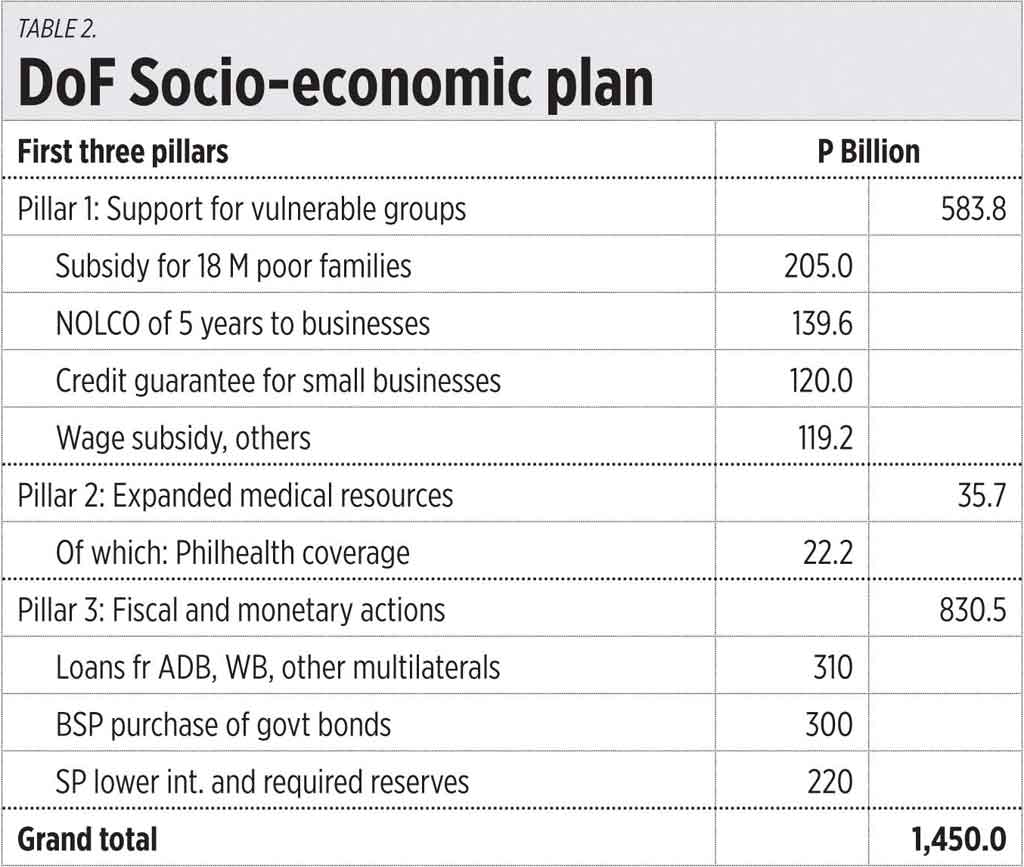
Department of Finance (DoF) Secretary Sonny Dominguez proposed “Four pillars” to economic recovery costing P1.45 trillion, generally on top of the approved 2020 budget of P4.1 trillion (see Table 2).

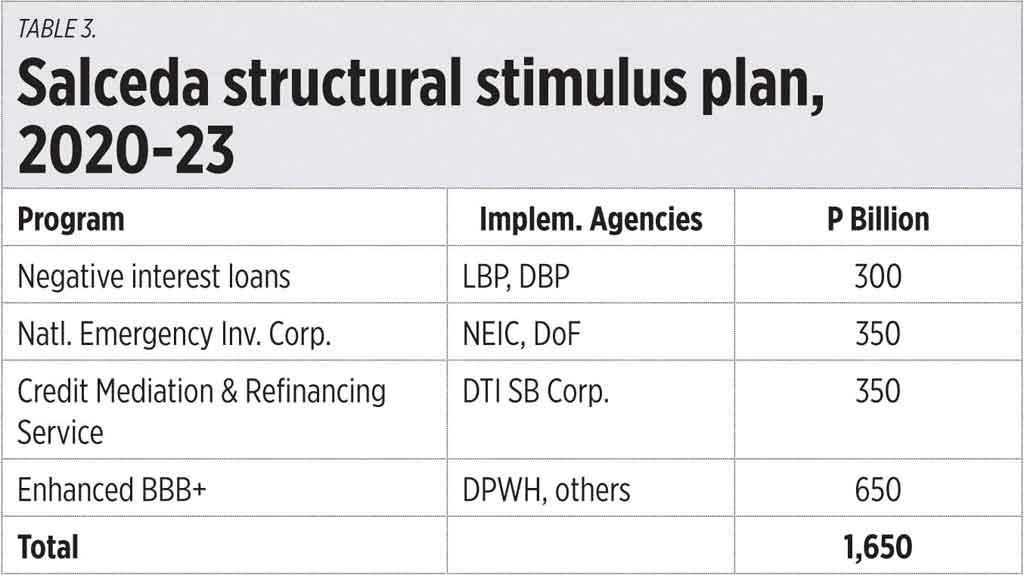
The Chairman of the House Committee on Ways and Means, Congressman Joey Salceda has his own central planning that is much larger than the DoF plan (see Table 3).

Then Congwoman Stella Quimbo, head of the House Sub-Committee on Economic Stimulus Package, made a more modest stimulus plan, assuming a fiscal multiplier of 1.53 and proposed an amount just one-half of the DoF plan (see Table 4).

The longer the lockdown — where even the young and healthy are forced to stay home — lasts, the bigger the economic damage. Which will require even bigger government spending and must be paid later by bigger, higher taxes, regulatory fees, fines and penalties.

The lockdown should end April 30 as scheduled, no more extensions. People have the freedom and right to work and be productive, hysteria and paranoia should not prevail over economic needs and realities.


Bienvenido S. Oplas, Jr. is the president of Minimal Government Thinkers.

minimalgovernment@gmail.com

Embracing technology more tightly during a pandemic

The national Association of Certified Public Accountants (CPAs) in Education (nACPAE) scheduled its 28th Accounting Teachers’ Conference (ATC) for this summer. Had there been no COVID-19, the ATC working committee would have been at its busiest right now attending to both logistical and non-logistical matters in time for the opening ceremony on April 27. But until this quarantine is lifted and the situation approximates what it was before the pandemic, eager accounting teachers will have to wait until June or even longer.

I am certain that other professional organizations are experiencing the same predicament as most annual conferences are scheduled during the summer break. Similarly, examinees who have been preparing to hurdle their respective licensure examinations have to wait as dates are postponed until further notice. Likewise, athletes who have long been training for their respective sport events need to stay in their dugouts for at least a year longer as the 2020 Tokyo Summer Olympics has been postponed.

Inasmuch as we hope that this pandemic will end soon, the facts, figures, and analyses by experts tell us otherwise. Until scientists come up with a vaccine, which usually takes months or years to develop, we are left with boosting our immune systems, embracing hygienic lifestyles, staying at home, and practicing physical distancing as precautionary measures against this virus.

However, just because there is a pandemic does not mean that we cannot continue organizing conferences. I am a believer of the cliché: when life gives you lemons, make lemonade. Online learning, either synchronous or asynchronous, can be an effective alternative at this time. We can use social media and webinars to bring conferences online. Although the experience will not be exactly the same as face-to-face sessions, experiencing something new online to achieve the same objectives can be equally exciting.

This year’s ATC would have bannered the theme “Living the Role of Learned Accounting Teachers in Shaping a Learned Accounting Profession,” which sums up the projects and initiatives of the nACPAE board for fiscal year 2019-20. Just as timely and aptly related to the theme, leveraging on technology to move forward can enable a profession to be “learned.” However, issues and concerns need to be addressed such as the level of technology readiness and the availability of equipment and accessibility of the internet.

As to the level of technology readiness, I think it is high time for accounting teachers to embrace technology to perform a number of tasks not only at work but also in home life. Mindful that physical distancing may be the new normal, we are already preparing ourselves for the huge probability of an upcoming academic year in which classes will be delivered in either online or hybrid mode. Although discomfort and insecurities will surface during the transition, let us be calmed by being intentional in getting used to it if we want to stay relevant. As Alvin Toffler puts it, “The illiterate of the 21st century will not be those who cannot read and write, but those who cannot learn, unlearn, and relearn.”

As to equipment and internet access, we can acquire them, let our employers provide them for us, or do both. Let us not consider them as expenses, but as assets, as tools of our trade that will benefit us for more than a year, and invest in them substantially. And to ensure that no one is left behind, let us financially support others who do not have enough resources, and provide technical assistance to those who are not yet proficient in using online learning platforms.

The chances of our emerging as victors in this pandemic are increased by support being accorded by government. Government should incentivize businesses and service providers that cater to technology-related needs by relaxing their cost of doing business and decreasing their taxes, among others. It should also appropriate more funds to the Department of Information and Communication Technology for infrastructure projects that will improve the country’s overall internet connectivity.

As we think of how we can move forward, let us not forget to ask God for wisdom and discernment. Pressing on, let us remind ourselves that this is more than an individual battle. This is, rather, a community battle that can be won only if we commit ourselves to becoming part of the solution and not the problem. And a good start, I believe, is to embrace technology more tightly today.


Dr. Florenz C. Tugas is a full-time faculty member of the Accountancy Department of the Ramon V. Del Rosario College of Business of De La Salle University. He specializes in Basic Accounting, Auditing and Assurance, and Management of Information Technology courses.

florenz.tugas@dlsu.edu.ph

Nationwide round-up

DoJ approves simplified parole, clemency procedures

BW FILE PHOTO

THE DEPARTMENT of Justice (DoJ) has approved the resolution of the Board of Pardons and Parole simplifying the application procedures for parole and executive clemency. DoJ Undersecretary Markk L. Perete said the resolution waives most of the documentary requirements for applications, along with the Court Certifications of No Pending Case and No Pending Appeal and a check on the records of the Person Deprived of Liberty (PDL) at the National Bureau of Investigation. The resolution also directs board members to double their caseload for review and deliberation to expedite the processing of applications. The resolution also discards the requirement for those who are granted pardon and parole to report to parole and probation officers while the State of National Emergency is in effect. Those who are qualified for parole and executive clemency are inmates aged 65 years old and above who have served more than five years of their sentence and whose imprisonment is detrimental to their health as recommended by the physician at the Bureau of Corrections (BuCor). Convicts of heinous crimes or illegal drug-related crimes and classified by BuCor as high-risks are excluded from eligibility under the rules. Several groups have called for the release of inmates who are vulnerable to contracting the coronavirus disease 2019 (COVID-19). Twenty two political prisoners who are among the vulnerable population earlier asked the Supreme Court to allow their release through bail. The Office of the Court Administrator has also reminded the first and second level courts to release those who have served the minimum imposable penalty for the charge against them and those who have no witnesses for their case and their hearing have been postponed twice. So far, 19 inmates and one worker at the Correctional Institution for Women tested positive for COVID-19.

QUARANTINE FACILITIES
Meanwhile, the Bureau of Jail Management and Penology(BJMP) will be setting up more quarantine facilities within public jails to prevent COVID-19 transmissions. In a briefing Wednesday, BJMP Spokesperson Xavier A. Solda said they have already built isolation facilities in several jails such as in Pampanga and Quezon. A BJMP COVID-19 isolation in the Payatas area in Metro Manila currently houses 40 inmates. — Vann Marlo M. Villegas and Gillian M. Cortez

BI speeds up deportation process to decongest holding facility

BUREAU of Immigration (BI) Commissioner Jaime H. Morente has ordered the agency’s legal division and other offices to expedite the resolution of deportation cases to decongest the holding facility for foreigners near the Philippine capital to avoid a coronavirus disease 2019 (COVID-19) outbreak. Mr. Morente said overcrowding increases the risk of infection among inmates and guards. “We don’t want COVID-19 transmissions to happen in our facility,” Mr. Morente said, “We will work double time to deport aliens, especially for wards that are considered health risks.” BI spokesperson Dana Krizia M. Sandoval said there are currently 418 held at the facility designed for 140. Ms. Sandoval, however, said the compound has big open spaces, allowing inmates to freely move within the compound. Mr. Morente also said they might consider granting bail and release to foreigners who cannot be deported yet due to pending cases. Three pregnant inmates were identified as high-risk, and two of them were released on bail while the other has been deported. — Vann Marlo M. Villegas

Gov’t streamlines releasing of confiscated goods

GOVERNMENT agencies have approved a circular that will speed up the release of confiscated goods, which is particularly crucial for medical supply needed as the country battles the coronavirus disease 2019 (COVID-19) pandemic, an official from the Department of Justice (DoJ) said. DoJ Undersecretary Markk L. Perete said the circular is based on the provisions of Republic Act (RA) No. 7581 or the Price Act and RA No. 10863 or the Customs Modernization and Tariff Act. “More than reminding prosecutors to rely on the two laws, it provides the basis for inter-agency coordination and sets out the procedure for the transfer of custody of the goods,” he told reporters in a mobile-phone message. The signatories of the inter-agency circular are the DoJ, Department of Trade and Industry (DTI), Bureau of Customs (BoC), Department of Health, Department of the Interior and Local Government, and Department of Agriculture. “It also reiterates the requirement under both laws for the inventory of the goods to be transferred, seized, forfeited, and disposed of,” he added. The National Bureau of Investigation on April 17 said it seized medical supplies worth P41.7 million following its operations against profiteering, hoarding, and overpricing. The DoJ spokesperson said procedure requires confiscated goods to be turned over to the DTI or BoC, depending on the basis for confiscation, and that they will conduct the seizure proceedings. Mr. Perete said the goods are either forfeited in favor of the government or disposed of according to the Price Act or Customs Law. For disposition, the government will be given preference. “Once the goods are forfeited or disposed to the government, these will be distributed to hospitals after confirmation with the Food and Drug Administration that the goods are safe to use,” he said. He further explained that the confiscated goods should have been used as evidence in prosecution of the offense. — Vann Marlo M. Villegas

Duterte orders agencies to issue guidelines on interruptions

PRESIDENT Rodrigo R. Duterte has ordered all government agencies to release their respective guidelines on interruption periods for transactions or proceeding cancellations amid the coronavirus disease 2019 (COVID-19) crisis. The Palace on Wednesday released Administrative Order No. 30 directing all government officers to come up with rules on the interruption of periods for the filing of documents, payment of taxes, charges and other fees and also on cancellations of proceedings during the period of the enhanced community quarantine. Government agencies who have moved the timelines of any benefit grants, suspended deadlines for any money obligations, and issued acceptable justifications for litigants to comply with reglementary period for legal proceedings are also required to come up with guidelines. “The foregoing directive shall apply only in relation to areas where community quarantine was declared,” the AO said. — Gillian M. Cortez

Food pass covers a maximum of three persons inside vehicle — DA

AGRICULTURE Secretary William D. Dar said a maximum of three personnel are allowed to be on board vehicles that have been issued a pass to carry basic food commodities such as fresh produce and farm inputs. Food transport vehicles must only be occupied by a driver and two helpers, based on the latest guidelines from the Inter-Agency Task Force for the Management of Emerging Infectious Disease (IATF-EID). “The IATF decided to limit the number of passengers allowed to join the delivery and reduce the possibility of contracting the coronavirus disease 2019 (COVID-19) virus,” Mr. Dar said. “We want unhampered movement of agricultural products to ensure food supply to residents in the metro cities, but we also want to ensure that Filipinos remain healthy,” he added. Since the implementation of the enhanced community quarantine in Luzon and similar policies enforced by other local governments, free movement of agricultural cargoes was streamlined by the issuance of “Food Passes” from the Department of Agriculture. “The Food Pass serves as a stamp which allows the smooth mobility of farm produce and other agri-fishery products, including farm inputs and implements, thereby benefiting farmers and consumers alike,” Mr. Dar said. — Revin Mikhael D. Ochave

Wong, Lim join forces in fight against COVID-19

FILIPINO sports fans followed and cheered for them when they compete for flag and country and now national athletes Agatha Wong and Jamie Lim are giving back to the country, coming on board and doing their share in the country’s fight against the coronavirus disease 2019 (COVID-19) pandemic.

Gold medallists in the 30th Southeast Asian Games last December, Misses Wong and Lim are collaborating and tapping Instagram to raise funds for the fight against the highly contagious respiratory disease, which as of this writing has 6,559 confirmed cases in the country.

Their initiative, “Puso: The Battle Against COVID-19,” started on Wednesday, April 22, is a five-episode IG Live session by the athletes where they answer questions from their followers and discuss health, wellness, and sports all in the hopes of engaging and inspiring people especially in this time of enhanced community quarantine and uncertainty.

Each episode runs for 30 minutes every Wednesdays and Saturdays and is streamed on the athletes’ official IG handles @agathawongy and @jamiechristinelim.

Ms. Wong, a Consular and Diplomatic Affairs (CDA) alumna student-leader from De La Salle-College of Saint Benilde, and Ms. Lim, a BS Mathematics summa cum laude from the University of the Philippines Diliman, are angling to raise funds for the benefit of the frontliners of the Philippine General Hospital (PGH) and other health facilities, plus other COVID-19 patients and persons under investigation (PUIs).

Both athletes also hope that through the sessions, apart from helping they also get to share added information about their respective sports and generate interest in them.

Ms. Wong won two gold medals in wushu in last December’s SEA Games held here in the country while Ms. Lim won top hardware in the 61-ky division in karate.

For those who want to donate to Puso: The Battle Against COVID-19, you may do so through BPI (Account name: Jamie Christine B. Lim/Account number: 2900008743), BDO (Account name: Jamie Christine B. Lim/Account number: 7018006040) and GCash (Account name: Jamie Christine B. Lim/Number: 09178820947).

To ensure transparency, weekly updates will be posted on the athletes’ Instagram accounts. — — Michael Angelo S. Murillo

Tennis world working on relief fund for players

TORONTO — The ATP and WTA, along with the International Tennis Federation and organizers of the four Grand Slams, said on Tuesday they are creating a coronavirus relief fund to help players affected by the sport’s current shutdown.

The specifics about how much money will be collected and how it will be distributed among the lower-ranked players were not disclosed in a joint statement that said details are in the process of being finalized.

“These discussions have been progressing well and details are being finalized with an announcement expected in the near future,” the statement said.

The tennis season was halted in early March due to the coronavirus pandemic, which makes it difficult for those in the lower echelons of the sport who depend solely on tournament winnings to earn a living.

According to the statement, both the men’s ATP Tour and the WTA, which runs the women’s circuit, will administer the players relief program and each of the seven stakeholders will make a significant contribution.

“We know that for our players, as well as for so many people worldwide, there is the need for financial support for those who need it most and we look forward to finalizing and sharing the further details of a plan in due course,” the statement said. — Reuters

Memorable endgames

We continue our discussion from where we left off last Tuesday — nowadays we have the benefit of the endgame tablebases to assist us in the analysis of endgames. As explained then an endgame tablebase is a computerized database that contains precalculated exhaustive analysis of chess endgame positions. They are generated by working backwards from a checkmated position. Thus, the tablebase acts as an oracle, always providing the optimal moves.

By 2005 all chess positions with up to six pieces (you include the Kings when you count pieces, therefore KRP vs KRP is considered a six-piece ending) had been solved. By August 2012, tablebases had solved chess for every position with up to seven pieces.

The solutions have profoundly advanced the chess community’s understanding of endgame theory. Some positions which humans had analyzed as draws were proven to be winnable and some positions thought to be winnable were proven to be drawn.

Before the development of the tablebases, chessplayers had to work out the do’s and don’ts of endgame play with their own brains. Last Tuesday I showed you the Torre vs. Portisch game which illustrated a critical idea in a difficult knight+pawns vs. knight endgame. Here is another Torre contribution to the theory of endgames.

The most important chess events of the year bring out the very best in the players. Eugene Torre won the 1972 Asian Zonal and represented the region in the 1973 Interzonals from which the top 6 players will go on to the Candidates’ Matches. The final winner of the Candidates’ matches will challenge Bobby Fischer for the world title. You will recall that ultimately Bobby Fischer refused to defend his title and the winner of the Candidates,’ Anatoly Karpov, was declared world champion in 1975.

Anyway the 36 interzonal qualifiers were split into two. Half of them played in Petropolis, from which Henrique Mecking (Brazil), Lev Polugaevsky (USSR) and Lajos Portisch (Hungary) advanced to the Candidates, and the other half in Leningrad, where Viktor Korchnoi (USSR), Anatoly Karpov (USSR) and Robert Byrne (USA) dominated.

Eugene played in Leningrad. One of the favorites, Bent Larsen, started off the tournament with 3/3, defeating Josip Rukavina (Rumania), Ivan Radulov (Bulgaria) and Jan Smejkal (Czechoslovakia) in impressive fashion. Everyone expected him to dust off Eugene Torre, not yet even a grandmaster at that time and a debutante in this level of competition, but Torre held tight in an endgame which was widely thought to be an easy win.

Larsen, Bent (2620) — Torre, Eugenio (2430) [A27]
Leningrad Interzonal (4), 1973

1.c4 g6 2.Nf3 Bg7 3.Nc3 e5 4.d4 exd4 5.Nxd4 Nc6 6.Nxc6 bxc6 7.g3 Ne7 8.Bg2 0–0 9.0–0 d6 10.Bg5 f6 11.Bd2 Be6 12.Qa4 Bd7 13.c5!

Torre: A typical Larsen move. The idea is to break Black’s pawns in the center, at the same time eyeing to bring his queen to the kingside.

13…d5 14.e4 f5 15.exd5 cxd5 16.Qh4

Threatening Bg5.

16…Bf6 17.Bg5 Bxg5 18.Qxg5 c6

Torre: White has a slight edge in space and has strong pressure along the open king’s file and also the half open queen’s file. White’s strategy is to place both his rooks along two open files and then try the thematic advance b2–b4–b5 splitting Black’s center pawns.

19.Rfe1 Rf7 20.Re5

During the game GM Eugene suddenly saw the possibility of 20.Nb5 but then determined that 20…cxb5 21.Rxe7 Rxe7 (21…Be6! is even stronger) 22.Bxd5+ Kg7 23.Bxa8? is refuted by 23…Re1+, winning White’s queen.

20…Kg7 21.Rd1 f4!

Torre: Black’s only chance to get some counterplay, otherwise White plays Qf4 followed by b2–b4–b5 with crushing initiative.

22.gxf4 h6 23.Qh4 Qf8

With the idea of Nf5.

24.Qg3 Rb8?

[24…Rxf4? 25.Rxe7+; Better is 24…Nf5 25.Qd3 Rb8]

25.Ne2! Kh7

[25…Rxb2? 26.Qc3]

26.Qc3 a5

[26…Nf5 is better]

27.Rd4 Rb5

[27…Nf5! 28.Ra4 Nh4 29.Rxa5 g5 Black has an initiative going on]

28.Ra4 Qb8 29.b3 Qa7 30.b4 Qb8 31.a3 axb4 32.axb4 Nf5 33.Bh3 Rb7 34.Bxf5 Bxf5 35.Qa3 Ra7 36.Nd4 Rxa4 37.Qxa4 Ra7 38.Qb3 Be4

I hope you noticed that Black is threatening …Ra1 mate.

39.f3 Ra1+ 40.Kg2 Rb1 41.Qa4 Rb2+ 42.Kg3 g5!

Torre: Again Black found the only move to complicate the game. To retreat the bishop loses at once to Re7+ and Qxc6. The game was adjourned at this stage with Larsen sealing the move.

43.Qxc6

Torre: The best move to retain winning chances. 43.fxe4? would lead to a draw after 43…gxf4+ 44.Kxf4 Rf2+ 45.Nf3 Rxf3+ 46.Kxf3 Qxe5.

43…gxf4+ 44.Kxf4 Qf8+ 45.Nf5

[45.Ke3? Rb3+ 46.Nxb3 Qxf3+ 47.Kd2 Qd3+ with at least a draw]

45…Bxf5 46.Rxf5 Qe7

[46…Rxb4+? 47.Ke5 Qe7+ (47…Qg7+ 48.Ke6 Qg6+ 49.Rf6 Qg8+ 50.Rf7+ Kh8 51.Ke7 the game is over) 48.Qe6 Qg7+ 49.Kxd5 Rb7 (49…Qd4+ 50.Kc6 Black has no more checks) 50.Rf6 and the threat of Qf5+ is decisive]

47.Rf6! Rxb4+ 48.Kf5 Rh4 49.Qe6 Rh5+ 50.Kf4 Qc7+ 51.Qd6 Qg7 52.h4!

Torre: This is White’s winning move as we had seen in our analysis. Larsen played this move very fast and we thought he had analyzed this variation completely. He walked around the stage and smiled at some of his friends.

52…Rxh4+ 53.Kf5 Rh1

Torre: We saw in our analysis that this move would lose. But there is nothing else that could give White some problems. The idea is to place the rook on e1.

54.Qf8?

[54.c6! Re1 (54…Qg5+ 55.Ke6 Re1+ 56.Kd7 Qg7+ 57.Kd8 Ra1 58.c7 is decisive) 55.Rg6! Qf7+ (55…Re5+ 56.Kf4 White wins) 56.Qf6 Qxf6+ 57.Rxf6 Rc1 58.Ke5 Kg7 59.Re6 White wins because his opponent’s king is cut off from the c6–pawn]

54…Qxf8 55.Rxf8 Kg7?

[55…Rc1! holds the draw. For example 56.Rc8 h5 57.c6 d4 58.Ke4 h4 59.Kxd4 h3 60.Rc7+ Kg6 61.Rc8 h2 62.Rh8 h1Q 63.Rxh1 Rxh1 64.Kd5 draw]

56.Rd8 d4?

[56…h5 57.Rxd5 h4 58.Rd7+ Kh6 59.c6 Rc1 60.Rd4 h3 61.Rh4+ Kg7 62.Rxh3 Rxc6 This endgame is a book draw]

57.Rd7+ Kf8 58.Kf6 Ke8 59.Rxd4 Rc1 60.Rd5 Rf1 61.Rf5

Larsen is now completely winning but accuracy is still required.

61…Kd7 62.f4 h5 63.Kg5 h4 64.Kxh4 Ke6 65.Re5+ Kf6 66.Kg4 Rc1 67.Rh5 Kg6 68.Rd5 Kf6 69.Kf3 Rc3+ 70.Ke4 Rc4+ 71.Ke3 Ke6 72.Rh5 Kd7 73.Kf3 Ke7 74.Kg4 Rc1 75.f5 Kf8

[75…Rxc5?? 76.f6+]

76.Rh8+ Ke7 77.Rh7+ Ke8 78.Rc7

The way to win this endgame is to transpose from a R+2P versus R endgame to an easily winning R+P versus R. He could accomplish this by 78.Kg5! Rxc5 79.Kg6 with the idea Rh8+. White has a simple win because the black king is on the long side. 79…Rc1 80.Rh8+ Kd7 81.f6 Rg1+ 82.Kf7 Rf1 83.Rh6 Rg1 84.Rg6 Rf1 85.Kf8 Ra1 86.f7 Rf1 87.Rg7 (87.Kg7?? Ke7=) 87…Ra1 88.Kg8 the end. The move chosen by Larsen does not give anything away yet. That comes later.

78…Kd8 79.Rc6 Kd7 80.Rd6+ Ke7 <D>

Position after 80…Ke7

81.f6+?

Torre: SuperGM Larsen again played very fast at this point and did not realize that his last move was a serious mistake. Correct is 81.Re6+! Kd7 (81…Kf7 82.c6 Rf1 83.Kg5 Rf2 84.Rd6 Black would have had no alternative but to resign.) 82.c6+ Kc7 83.Kg5 Rg1+ 84.Kh6 Rg2 85.f6 Rf2 86.Kg7 Rg2+ 87.Kf8 Kd8 88.Re7 Rh2 89.c7+ Kc8 90.f7 Rg2 91.Ke8.

81…Kf7 82.c6 Kg6 83.Kf3 Re1

This is White’s problem. If he advances the c-pawn then 84.c7 Rc1 forces him to give up one of the pawns with a dead draw. The Black rook cuts off his king from the queenside and also on the kingside Larsen’s king cannot approach his own pawn. Now it is clear that White cannot strengthen his position.

84.Kf4 Re2 85.Rd5 Rc2

[85…Kxf6? is erroneous: 86.Rc5 Re8 87.Rf5+! Kg6 (87…Ke7 88.Re5+ Kf7 89.Rxe8 Kxe8 90.Ke5+–) 88.Re5! Rc8 89.Re6+ Kf7 90.Ke5 wins]

86.Rd6 Re2 87.f7+ Kxf7 88.Kf5 Ke7 89.Rd7+ Ke8 90.Kf6 Re1 91.Rd5 Rc1 92.Rd6 Rf1+ 93.Ke6 Re1+ 94.Kd5 Rd1+ 95.Kc5 Rxd6 96.Kxd6 Kd8 ½–½

So, finally, the “Great Dane” was halted. Torre got a tremendous ovation from the gallery and received flowers from his new fans.

GM Joey Antonio told me a story of the 1998 Elista Olympiad, held in Kalmykia, Russia (take note that this is 25 years after the Leningrad Interzonal). During the rest day the Philippine team went to a nearby marketplace and, to their surprise, the market vendors recognized Torre, and remembered him as the one who stopped Larsen. Yes, Russians take their chess seriously.


Bobby Ang is a founding member of the National Chess Federation of the Philippines and its first Executive Director. A Certified Public Accountant, he taught accounting in the University of Santo Tomas for 25 years and is currently Chief Audit Executive of the Equicom Group of Companies.

bobby@cpamd.net

RapidPassPH turned over to government agencies for full adoption

Created to streamline movement for frontliner workers and essential goods, RapidPassPH enables frontliners to easily acquire quarantine passes that can be used to quickly move through quarantine checkpoints. The system also ensures that only authorized frontliners, skeletal workforces, and essential goods will be able to pass through.

This week, the operations of RapidPassPH was formally handed over to the Department of Science and Technology (DOST), the Department of Information and Communications Technology (DICT), and the Philippine National Police (PNP), following the successful completion of RapidPassPH 1.0.

The platform was built in under 30 days through the efforts of the volunteers of the DEVCON Community of Technology Experts (DCTx) together with its partnership with the DOST, DICT, AFP, and PNP.

The PNP Joint Task Force COVID Shield, led by Police Lt. General Guillermo Lorenzo Eleazar, will enforce RapidPassPH’s full implementation throughout the Quarantine Control Points (QCPs) of Metro Manila. PLDT facilitated the implementation by donating 540 phones as scanners for the checkpoints.

“We would like to thank the DEVCON volunteers for coming up with this innovative solution which has eased the burden for our personnel in quarantine checkpoints,” said DOST Secretary Fortunato T. de la Pena.

“We would like to thank our partners, DICT, PNP, and DOST-NCR for working together in deploying RapidPass,” he said. “We also thank our partners from the private sector – Microsoft, PLDT, and SM – for donating phones to be used by PNP personnel at QCPs and bandwidth for the operation of RapidPass.”

The RapidPassPH Coordination Group, formed by the DOST, DICT, PNP, and DEVCON, will ensure the continuous and effective operation and implementation of RapidPassPH.

RapidPassPH will continue to receive updates and system improvements from DCTx as the country continues to implement different versions of community quarantines. DCTx in particular will continue to focus on other projects still in the works that will support the frontliners and the Filipino people against the coronavirus.

HK Filipino domestic workers turn to digitalization for employment

Foreign domestic workers are an often overlooked part of the Hong Kong landscape. But as COVID-19 continues to spread across the local population, this group is among the most at risk. Since the beginning of the crisis, the 400,000 domestic workers currently living in the city have been subject to new regulations, compromises, travel bans, and contract terminations.

In response to these restrictions is a pronounced shift towards digital solutions.

HelperChoice.com, the leading online platform for the recruitment of domestic helpers, has witnessed a strong increase of its traffic since the implementation of social distancing. New users on the platform jumped up by 150% between late March and early April. 

Mahee Leclerc, Head of HelperChoice in Hong Kong, said “Hong Kong residents are limiting unnecessary travels as much as possible right now, most of them are working from home, so it’s logical to switch to an online solution to hire their domestic helper instead of going to an agency.”

According to a study conducted by the platform in December 2019, 84% of migrant workers in Hong Kong use digital tools (such as online transfers or e-wallets) to transfer part of their wages to their country of origin. After months of political turmoil followed by a public health scare, Hong Kongers and foreign domestic workers, who used to favor traditional employment agencies, are now also turning to online services for recruitment – seemingly ushering in a structural change in the industry.

Empowering migrant Filipinos

HelperChoice is part of a community of social impact startups in Hong Kong. The service offers transparent access to the job market and more flexibility for both foreign domestic workers and employers in the city. The team is currently helping hundreds of domestic workers whose contracts have been terminated due to the relocation of their employers amid the Covid-19 crisis, while working on the expansion of their services.

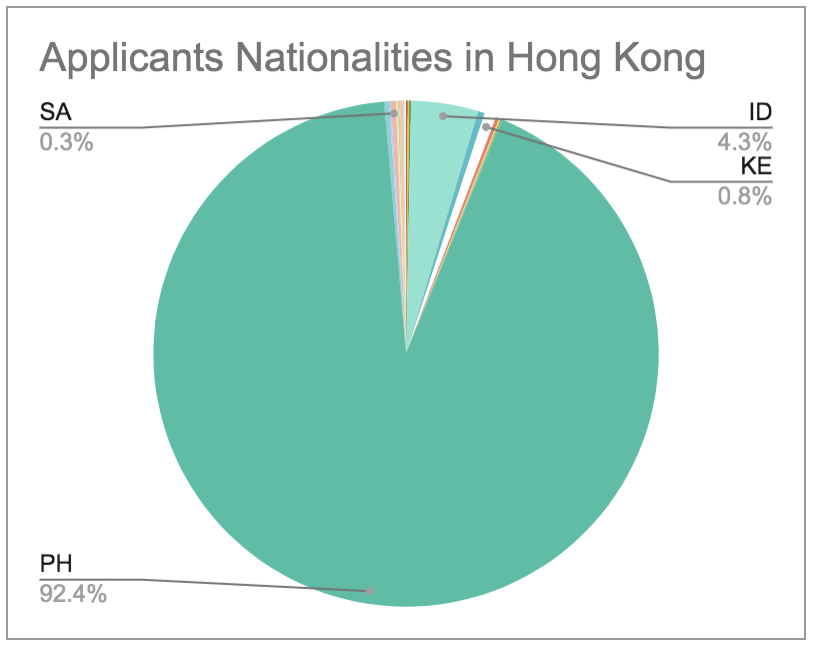
Based on data shared by the company, since January, 92% of the 15,000 applicants looking for a job in Hong Kong were Filipinos.
Of those applicants, 60% had a finished contract, whereas 13% had a terminated contract. Amongst those with terminated contracts, 92% were Filipinos.

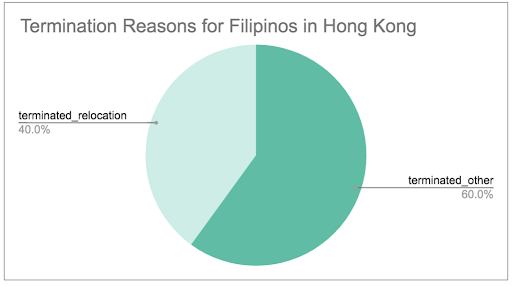
Relocation was the reason 40% of Filipinos saw their contracts terminated, making the data “linked to the COVID-19 situation,” says Leclerc:

Safe and fair working conditions

Technologies like these are mitigating the economic impact of this pandemic among one of Hong Kong’s most at-risk populations, migrant workers.

But HelperChoice has also put in place systems to ensure domestic workers are safe even beyond the current crisis.

HelperChoice provides support to both helpers and employers in order to ensure safe and fair working conditions during the contract of employment. These are guaranteed through the establishment of an ethical charter for all employers. The platform also carries out surveys on working conditions and monitors local regulations to inform domestic helpers of their rights.

ADVERTISEMENT
ADVERTISEMENT