

Home Blog Page 9662

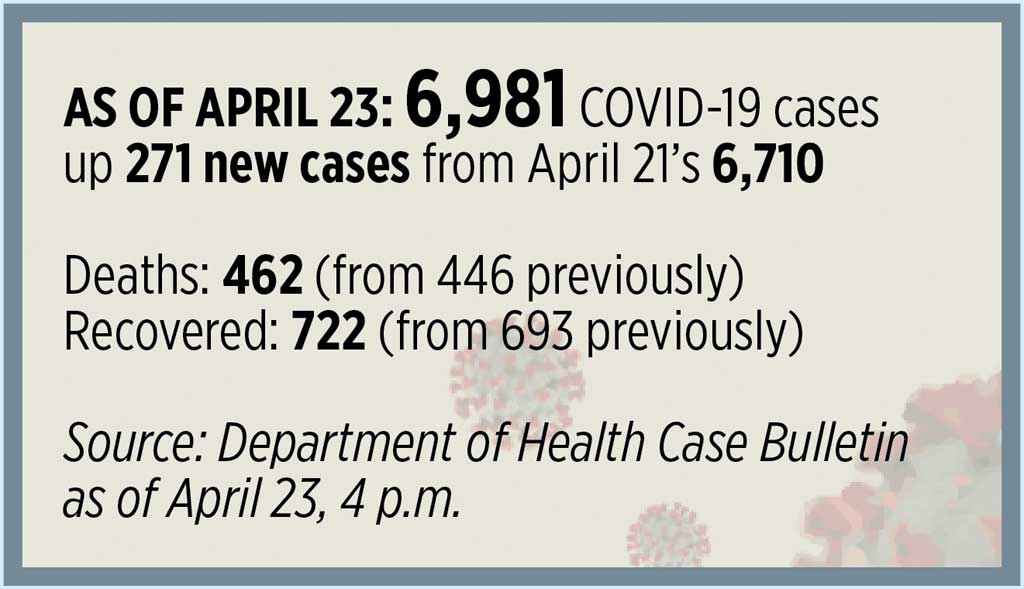
#COVID-19 Regional Updates (04/23/20)
Electric co-ops blast Solar Para Sa Bayan’s recent rate hike in Mindoro

CONSUMERS in an Occidental Mindoro town have raised concerns on the alleged recent electricity rate hike imposed by Solar Para Sa Bayan Corp. (SPSB), according to the Philippine Rural Electric Cooperatives Association, Inc. (PHILRECA). In a statement late Wednesday, PHILRECA said it received complaints from residents in Paluan town over SPSB’s rate increase to P18 per kilowatt-hour (kWh) from P8/kWh. The rural utilities group alleged that SPSB did not secure the approval of the Energy Regulatory Commission (ERC) to raise rates, which took effect beginning in the March billing period. It shared with BusinessWorld a copy of a customer’s April billing statement showing a household that consumed 91 kWh was charged P1,638. “By increasing the tariff to a rate that is almost double the existing rates in surrounding electric cooperatives — without proper public hearing and without approval by the ERC, Solar Para sa Bayan has violated all of its responsibility to the public as set in R.A. (Republic Act) 11357,” PHILRECA claimed. PHILRECA was one of the organizations that opposed SPSB’s franchise, which was granted in July 2019. SPSB is owned by Leandro L. Leviste, the son of former senator and now Antique Rep. Loren B. Legarda. The company is controlled by renewable energy firm Solar Philippines Power Project Holdings, Inc. Mr. Leviste was sought for comment but has yet to reply as of press time. — Adam J. Ang

ADB-funded lab equipment to be set up in Pampanga hospital

LABORATORY equipment procured through an Asian Development Bank fund will be set up at the Jose B. Lingad Memorial Regional Hospital in Pampanga for coronavirus disease 2019 (COVID-19) tests. Department of Health (DoH) Undersecretary Maria Rosario S. Vergeire said the facility is expected to handle up to 5,000 samples per day coming from the Central Luzon region and nearby areas. “Mas bibilis ang turnaround time at mas makakapagtanggap pa tayo ng mas maraming mga tests dito sa mga laboratoryo natin dito sa (The turnaround time will be faster and we will be able to receive more tests here in our laboratories in) Metro Manila,” she said in a virtual briefing on Thursday. The DoH on Tuesday announced the arrival from China of laboratory equipment worth US $2.5 million, which can do up to 45,000 tests daily. There are currently 17 DoH-accredited COVID-19 laboratories nationwide. — Vann Marlo M. Villegas

Cebu City lockdown extended to May 15

IMPLEMENTATION of quarantine measures in Cebu City has been extended to May 15, Mayor Edgardo F. Labella announced late Wednesday after the number of coronavirus disease 2019 (COVID-19) patients in the city was reported to have shot up by 80% to 312. There were 139 new cases on April 22, including 123 within the Cebu City Jail. Another big cluster of cases is in Barangay Luz with over 140. “There is a need to extend our ECQ (enhanced community quarantine) in Cebu City as COVID-19 cases continue to rise due to the fact that we have been doing targeted, massive testing in the barangays, where there are positive cases,” Mr. Labella said in a statement. “We have been hoping for the best, but at the same time, expecting the worst that could happen in order for us to be prepared in addressing this pandemic,” he added. Cebu City is the center of the Central Visayas Region, which had a total of 346 COVID-19 cases as of April 22. — Marifi S. Jara

Iloilo City eyes P15M COVID-19 mobile testing laboratory

THE Iloilo City government is looking at purchasing a P15 million mobile testing laboratory for coronavirus disease 2019 (COVID-19). “We are checking if this can be made possible. If we can use this, we will purchase it,” Mayor Jerry P. Treñas said. The laboratory will use a 40-footer container van that will be fitted with medical equipment and supplies. Mr. Treñas said they have also sought comment from the Department of Health (DoH) if such a facility could possibly be accredited by the Research Institute for Tropical Medicine (RITM). “If this van can be accredited by RITM, then we will conduct our COVID-19 testing here and we can purchase more test kits. DoH said they can help us with the accreditation and training of medical personnel,” he said. The fund will be sourced from the one-month Internal Revenue Allotment (IRA) granted to the city worth P94 million for COVID-19 response under the Bayanihan Grant. The Western Visayas Medical Center, located in the city, is currently the only accredited COVID-19 testing laboratory for the Western Visayas Region. The West Visayas State University Medical Center is still in the first stage of the accreditation process. — Emme Rose S. Santiagudo

Davao City locks down several villages as it grapples with COVID-19 local transmission cases; DoH boosts contact-tracing

PARTS of several villages or barangays in Davao City have been locked down following the confirmation of coronavirus disease 2019 (COVID-19) cases in these areas. “The difference between them (and other areas) is that they needed to be placed on lockdown because they are densely populated areas. We know that if an area is densely populated, the virus will spread faster,” Mayor Sara Duterte-Carpio said over the city government-run radio station. In one of the barangays, 23-C, 56 people identified to have had exposure to the COVID-19 patient were moved to a quarantine center. Medical teams have also been deployed to conduct random testing to determine the extent of the transmission. City Police Director Kirby John B. Kraft, in a text message, said he has ordered the setting up of checkpoints around the affected areas to prevent residents from leaving or visitors from coming in. Meanwhile, the Department of Health-Davao Region office (DoH-11) is tapping the new Contact Tracing Teams (CTTs), led by the Department of Interior and Local Government, that will be formed in line with the government’s plan for nationwide expanded testing procedures. DOH-11 Assistant Regional Director Lenny Joy J. Rivera told media in a virtual presser on Tuesday that the CTTs can help resume contact tracing for the those linked to participants of a series of cockfighting events, which has been determined as a major source of local transmission cases. “DoH will still be helping and these agencies will be assisting us when it comes to carrying out the interim guidelines for the conduct of the expanded testing for COVID- 19,” Ms. Rivera said. — Carmelito Q. Francisco and Maya M. Padillo

Nationwide round-up

President’s spokesperson hints on ‘conservative’ decision on lockdown

PRESIDENT Rodrigo R. Duterte’s decision will be “conservative” on whether the Luzon-wide lockdown will be lifted, extended, or modified after April 30, according to his spokesperson. Mr. Duterte was scheduled to make the announcement late Thursday. Presidential Spokesperson Harry L. Roque, in a briefing earlier on Thursday, said the decision will take into account the Department of Health’s assessment that the country is not yet at a point of flattening the curve in terms of the number of coronavirus disease 2019 (COVID-19) cases. “Pasimula palang po ang pagbaba, so sabi ni Health Secretary (Francisco T.) Duque, nagsisimula palang ang plateu pero hindi pa ito (The cases are just starting to go down, so Health Secretary Duque said the plateu is just starting, but this is not yet the) flattening of the curve,” Mr. Roque said. Before making the announcement, Mr. Duterte was to meet with the Inter-Agency Task Force for the Management of Emerging Infectious Diseases (IATF-EID), where he is expected to make clarifications on the decision tool presented to him earlier for a possible modified community quarantine policy wherein some restrictions could be lifted. “They (IATF-EID) have submitted the recommendation. It has been with the President and, if at all, perhaps in this meeting, baka meron clarifications gagawin ng Presidente (the President might have clarifications to make),” he said. — Gillian M. Cortez

Lacson bats for higher R&D budget

PHILSTAR

SENATOR Panfilo M. Lacson on Thursday said a bigger budget should be allocated to research and development (R&D) after President Rodrigo R. Duterte offered a P10-million reward for a Filipino who will be able to develop a vaccine to treat the coronavirus disease 2019 (COVID-19). “It would mean much more if the government invested more on research and development than the token annual average share of 0.4% from the General Appropriations Act,” Mr. Lacson said in a statement Thursday. Mr. Lacson, vice chair of the finance committee, is looking at increasing R&D funding by 1-2% in next year’s budget. “Even if we bump up the percentage to 1 or 2 percent of the national budget, it would make a major difference.” The President’s spokesperson said aside from the reward, a “substantial grant” will also be given to the University of the Philippines-Philippine General Hospital for the development of the vaccine. — Charmaine A. Tadalan

ARTA orders gov’t agencies to set up one-stop shops

THE Anti-Red Tape Authority (ARTA) called on government agencies to set up one-stop shops for their services to minimize the potential transmission of the virus causing the coronavirus disease 2019 (COVID-19) and improve the movement of goods. In a statement Wednesday, ARTA said a centralized site will minimize public health risks by limiting the number of places that people need to go to. The Inter-Agency Task Force for Emerging Infectious Diseases (IATF) has also approved ARTA’s call for a Bayanihan One Stop Shop for agencies working on accreditation and logistics. ARTA, along with the Finance department and the Bureau of Customs, released a memorandum circular on April 2 to streamline the importation of medical and protective products needed to contain the virus. ARTA Advisory No. 2 signed April 15 expands this streamlining process by suggesting the creation of a single window systems where individuals can submit application forms and required documents. The advisory applies to all government agencies under the executive department, including local government units and government owned or controlled corporations. ARTA also suggested a fully online application system to replace on-site application procedures. ARTA further urged government agencies to move to post-audit or post-verification procedures for transactions that do not directly affect public safety and health. “The current system requires deep assessments of applications prior to the issuance of the certificate, license, franchise, registration, etc. In the meantime, while the assessments are being conducted, the applicant is left helpless and under the mercy of the efficiency of the system,” the advisory said. “ARTA stands ready to assist government agencies that wishes to adopt these reform guidelines. During this trying time, it is our mandate that red tape shall be one less burden that the people need to worry about,” ARTA Director General Jeremiah B. Belgica said. — Jenina P. Ibañez

DICT reminds LGUs, homeowners’ groups that telecom personnel under ‘essential’ sectors

THE DEPARTMENT of Information and Communications Technology (DICT) reminded local government units (LGUs) and homeowners associations of private residential areas not to block telecommunications personnel as they are part of what are considered as “essential” services. In a briefing Thursday, DICT Spokesperson Adrian G. Echaus said reports on telecom workers not being allowed to go through checkpoints and denied access in subdivisions are among the issues brought up by the sector to them and the National telecommunications Commission (NTC). “They are critical in ensuring availability in internet and mobile service during this pandemic,” Mr. Echaus said. The NTC has ordered all telecom companies to closely monitor and ensure uninterrupted service, which is particularly crucial amid the enhanced community quarantine. — Gillian M. Cortez

DILG tells local governments to allow passage of OFW service vehicles

INTERIOR and Local Government Secretary Eduardo M. Año on Thursday reminded local government units (LGUs) to allow the passage of vehicles carrying returning overseas Filipino workers (OFWs) following an incident in Batangas province. Mr. Año, in a DZBB radio interview Thursday, said guidelines set by the Inter-Agency Task Force on Emerging Infectious Diseases order the “unhampered” passage of OFWs who have just come back to the Philippines and are arranged to undergo a 14-day quarantine in designated facilities. In a separate interview with DZBB, Batangas Governor Hermilando I. Mandanas said the bus carrying the OFWs was temporarily held because he was not informed of their arrival and protocols dictate the protection of residents from health risks. The Overseas Workers Welfare Administration leads the coordination work. Mr. Mandanas assured that the provincial and other local governments in Batangas are prepared to give assistance. — Genshen L. Espedido

Towards the new normal

The journey to the new normal has many alternative routes. One of them is the attempt to achieve herd immunity against the pandemic. Seen as an alternative to a prolonged lockdown, the strategy involves exposing the majority of a community’s population to the pathogen. When the infected have recovered, herd immunity is said to be attained. Theoretically, this approach involves less economic dislocation. But it may entail greater human suffering as the disease is given more space. Suggested by some Princeton researchers, the herd immunity strategy is expected to work in India given its relatively young population. They will be allowed to return to work and to assume a “normal” life while continuing with social distancing, mandatory wearing of masks, and a ban on large gatherings.

According to Bloomberg, while the strategy was discarded by the UK, India is contemplating its use. This is because lockdowns and social distancing measures are not likely to produce positive results in a country where living conditions are cramped and crowded. Perhaps India is banking on the fact that its young people may be at a lesser risk of hospitalization and death. Of course, our initial experience with the lockdown is quite favorable.

But how would one in the Philippines feel being an intentional or even an accidental, guinea pig? Expected to achieve a 60% immunity rate in seven months, the herd immunity strategy appears to be sensible for the 60% who would make it. But what about the other 40%? What are the consequences and costs of getting as much as 82% of India’s huge population infected before herd immunity is established?

These are not just percentages or numbers, these are human lives — grandparents, parents, siblings and children.

As the pandemic rages on, the likelihood that India’s health care system will prove inadequate is quite high. It is not clear how much immunity will be imbibed by those exposed and compromised in what Bloomberg describes as a country with the “worst-in-the-world pollution” and “poor health conditions.” The global economy and national economies are also making painful and difficult transitions towards the new normal.

This month, the International Monetary Fund (IMF) admitted that the impending global recession could be the deepest for the best part of a century. Both the duration and the impact of a standstill conspire to make the recession defiant of usual business cycles that define the dynamics of real sector and financial market performance. This is totally a new game.

Up until now, the Philippines has enjoyed a record of 84 quarters of sustained positive economic growth. This consistent record was achieved through 30 years of strategic policy and structural reforms underlying the renewed confidence of both foreign and domestic investors. We have scored periodic upgrades to investment credit rating. These gains are now threatened by the pandemic. So our economic managers do acknowledge that at best, the Philippine economy would be stagnant.

Will the Duterte Administration’s four-pillar “We Will Rise as One” socioeconomic strategy against COVID-19 be able to arrest the pathogen and address its impact on economic recovery very quickly?

Pillars 1 and 2 are for containment purposes. The first pillar is for emergency support to vulnerable groups amounting to P590 billion. This should help avoid mass hunger and a maintain reasonable level of domestic consumption. Two items are also covered: small business support programs and increased local government assistance.

For Pillar 2, given that the health sector has suffered from long years of neglect, we hope the current allotment of P58.6 billion would suffice to ensure the safety of health officers and establish public hospitals with their own research and testing facilities in every province.

Pillar 3 consists of P843 billion in both fiscal and monetary actions. This component includes the peso equivalent of the Bangko Sentral’s previous easing of the policy rate and the drop in RRR which infused greater liquidity into the system.

Pillar 4 is focuses on promoting economic recovery, “bouncing back” after COVID-19. It judiciously recognizes that saving human lives, for now, takes precedence over our economic woes. While the economy and businesses are important, reviving them can wait. The plate is just too full.

What do we need to look at this year and the years ahead?

Data granularity on each sector most affected by the standstill would be very useful. Labor-intensive industries must be the hardest-hit. Small and medium businesses are among them. Housing and infrastructure construction companies will show some losses. Airline, tourist, hotel, and hospitality establishments are also suffering. Unlike in Switzerland where 45% of jobs including banking and consultancy services can be executed at home, quite a limited number of jobs in the Philippines may be accessed remotely.

The Philippine corporate profile shows the preponderance of small business, invariably scarred by the long shutdown. In a study by researchers from the University of Chicago, Harvard, and the University of Illinois, about a quarter of small businesses in the US do not have enough cash on hand to last a month. The same is true in the Philippines.

Fiscal stimulus may have limited impact in 2020. So far, the infra program has lost nearly two months. Absorptive capacity may be constrained to allow for completion of scheduled projects especially big-ticket items. Rather than granting new allocations and increasing borrowings from the capital markets or from the Bangko Sentral, it would be great to realign the budget from high-hanging infra fruits to the more immediate four-pillar strategy.

Moreover, while wage support is desirable to assist workers during the lockdown, employers themselves should partly shoulder the onus. Rehiring could be costly.

Big bailouts should also be avoided because not all business pains are created equal. Social media posts remind us, “we are all caught in the same storm, but we are in different boats.” Thus, instead of wholesale bailouts, access to loans can be further enhanced by the banks, especially with lowered policy rates and the several RRR reductions.

Finally, in the new normal, one can expect civil society to have a stronger voice and bolder opinions. The pathogen has infected people from all walks of life but the impact is very much differentiated across income groups. There is growing discontent in many barangays. Instead of the promised cash, many households have received bags with a few small cans of sardines, packets of instant noodles and some kilos of NFA rice.

In Brazil, they banged pots and pans from their windows. In Lebanon, the prisoners staged a riot in their penitentiary centers.

Social media is a channel awash with anger, frustration and near desperation. Comments and posts expressing hunger, bewilderment at selective rationing, and countless surveys run side by side with calls for stricter lockdown implementation, opposition to premature ECQ lifting and conflicting demands to permit public transportation and some business reopening. It is a cacophony of opinions, harmonized only by uncertainty.

Yet, It is hope that brings us to another day. Hope for a vaccine, as Israel scientists achieve great strides. Hope for a cure, even locally, as the Palace inquires into the effectivity of the Fabunan antiviral injections. Hope for a new normal that is more fair and equitable. We all hope for a new normal with a more respectful attitude to life. A trending quote by Dave Hollis could be a good guidepost: “In the rush to return to normal, use this time to consider which parts of normal are worth rushing back to.”


Diwa C. Guinigundo is the former Deputy Governor for the Monetary and Economics Sector, the Bangko Sentral ng Pilipinas (BSP). He served the BSP for 41 years. In 2001-2003, he was Alternate Executive Director at the International Monetary Fund in Washington, DC. He is the senior pastor of the Fullness of Christ International Ministries in Mandaluyong.

Human Rights post-COVID-19

In the aftermath of the Sept. 11, 2001 terrorist attacks on the World Trade Center in New York and the Pentagon headquarters of the US Department of Defense came the virtual reversal of the global trend towards liberalization and democratization that had characterized the last two decades of the 20th century.

Combating terrorism became the excuse in a number of countries for warrantless arrests, detention without charges, discrimination on the basis of racial and ethnic profiling, and the practice known as rendition, in which suspected terrorists in a country whose laws prohibited torture were transported to others less finicky.

Protesters, political dissidents, and government critics were silenced by labeling them terrorists. The word “terrorism” is still being used for the same purpose today in many countries including the Philippines, which is, in fact, on the verge of enacting an even more restrictive version of its 2007 Human Security Act that, among other provisions, prolongs the detention without charges of alleged terrorists.

As fears of terrorism, often with the encouragement of right-wing and Islamophobic groups, escalated, what followed was the election of illiberal and even fascist demagogues who continued to exploit those fears to keep themselves in power.

The use of terrorism as an excuse to suppress human rights and expand government powers is still ongoing. But the world is witnessing what could be the second wave of that anti-democratic process, as governments impose further restrictions on movement and mass assembly to combat the spread of the COVID-19 contagion. As real and as urgent as the threat is, it is also being used by many governments across the globe to tighten their grip on power by restricting free speech and intimidating and even arresting protesters and critics.

As the British journalist David Gilbert points out in a recent online article, authoritarian leaders in some 30 countries are “taking advantage of the outbreak and the ensuing chaos to give themselves extraordinary new powers, while elections get delayed or forced to go ahead depending on what suits the incumbent rulers. Security forces have been empowered to conduct brutal crackdowns, free expression has been censored, and privacy has been eroded.”

Gilbert quotes Allie Funk of the US-based human rights group Freedom House. Funk is convinced that certain countries’ “exploiting the crisis to expand their power and undermine human rights” could just be “the tip of the iceberg.” Alarmed over that possibility, the United Nations has urged world leaders not to use the crisis to curtail human rights and to instead limit restrictions on such rights as the right to privacy and to make them less intrusive.

But among the countries that have ignored the UN’s warning are Vladimir Putin’s Russia, which has devised a number of monitoring systems to track citizen movements, among them by accessing data from mobile phones and credit card transactions.

Meanwhile, Poland’s leaders want to hold presidential elections next month despite the current ban on campaigning, because it would favor the incumbent president.

In Hungary, a new law empowers that country’s president to rule by decree and has left the decision of when those powers will end to his own discretion.

In Israel, those who violate home quarantine rules face up to six months in prison, while in Serbia, before it was revoked, had a decree that gave government total control on information about the crisis.

Neither Africa, Latin America, nor Asia have been immune to the same efforts of incumbent governments to tighten and expand their grip on power at the expense of human rights.

In Uganda, the government arrested 20 individuals on the allegation that they were violating rules against the assembly of more than 10 people. Egypt recently canceled the credentials of two of its own journalists for reporting that the number of infections in that country had passed 19,000.

In Chile, the military has been deployed in the streets to silence protests, while Bolivian law has empowered the government to arrest critics of government policies.

Nearer to home, in Bangladesh, a dozen people critical of the government’s handling of the COVID-19 crisis have been arrested, while in Cambodia, a so-called emergency bill allows the government to censor all media and to monitor telephone communications.

In “the biggest democracy in the world,” India, some states are collecting data on citizens without any legal basis. One state even requires people quarantined at home to upload a selfie every 30 minutes to prove they’re in isolation.

Thailand’s emergency laws enable the government to impose curfews and censor the media, while the government files charges against journalists for criticizing the government’s response to the crisis.

Myanmar has blocked a number of websites supposedly to combat disinformation, and arrested three street artists for painting an image of the grim reaper spreading the virus that Buddhist fundamentalists said looked like a Buddhist monk.

And of course, Gilbert continues, there’s the Philippines, where, in a fit of pique over hungry protesters’ taking to the streets to demand government help, President Rodrigo Duterte, over national television, ordered the police and military to “shoot them dead.” Gilbert doesn’t mention that some of the protesters were arrested and charges were filed against them. Barangay officials also held several young men in dog cages for violating curfew. The crisis has also been used to penalize the dissemination of false information and to publicly shame violators of the rules of the Enhanced Community Quarantine. There is even talk of a “martial law style” lockdown.

These are only a few of the dozens of governments that are intruding into the privacy of their citizens, curtailing free expression, and gathering information that can be used against protesters and critics. At least in some countries, if not in benighted Philippines, the measures being used to supposedly combat the pandemic would have been condemned in normal times for their audacious contempt for human rights. Fear of the virus has instead allowed these methods to pass with little or no challenge. But what is even more disturbing is that most of them contain no “sunset clause,” or limits on until when they will be in effect, which makes their remaining in force likely even when the pandemic ends.

The measures being implemented in the Philippines are presumably effective only for the duration of the emergency. But they were, in the first place, introduced and adopted in the context of government and its supporters’ antipathy to human rights and preference for extra-Constitutional shortcuts in governance, which, among others, includes playing fast and loose with due process, and the imposition of excessive penalties not only against those who dare exercise their rights to free expression and press freedom, but even for petty crimes. There is every possibility that with little or no public protest, current restrictions will remain in place even after the pandemic.

Because of the threat to what little remains of Philippine elite democracy, free expression and press freedom groups, human rights defenders and civil society, despite the urgency of combating the spread of COVID-19, must closely monitor government, hold it to account, and forewarn the public on the continuing danger of the return of authoritarian rule during as well as post-COVID 19.

The defense of human rights and the Constitution should be as much a part of the road map to Philippine recovery as the revival of the economy and assuring the health, safety, and welfare of every citizen. This much is clear if the country is to survive the coming months, free expression and citizen engagement being the only antidotes to the blunders of ineffectual, self-serving governments.


Luis V. Teodoro is on Facebook and Twitter (@luisteodoro).

www.luisteodoro.com

The Philippines: Not ready for federalism

A glaring thing this pandemic exposed is that not many actually understand federalism. And this is so even among those advocating for federalism here in the Philippines.

To reiterate, many wrongly believe federalism is merely a division of governmental functions: one layer but of two levels. That’s not federalism. That’s what we have right now under the present Constitution and the Local Government Code. And our Constitution has enough flexibility for governance to be implemented top-down or bottom-up depending on Congress’ legislation.

What federalism actually is are two competing layers of government. Or to be precise: two parallel authorities each equally exercising sovereign power over the citizenry.

A good illustration of federalism (rather than merely highly empowered local governments) is the United States. Contrary to the impression given by mainstream media, primary responsibility to deal with the pandemic in the US is not with the national government or president Donald Trump. The lead officials are the individual State governors.

Trump can close US borders to foreigners and financially assist local governments. But as to the 50 States making up the US, the power lies with the State governors. The decision to close or open local government borders, measures to control the COVID-19 virus, the application of police powers on citizens — all belong not to Trump but to the individual States.

Had federalism been truly applied here, the lead officials confronting this pandemic would be (for example) the Manila or Pasig mayors, and the governors of Rizal and Cebu, regarding their respective local territories. President Duterte would be relegated to a supporting role, unable to do anything unless asked by the local government.

So, again, Berkeley law lecturer, former US Deputy Attorney General, and expert on executive power John Yoo’s instructive comments: “Under our federal system, Washington, D.C., has only limited powers to respond to a pandemic. The Constitution grants the national government a limited set of enumerated powers. Stopping the spread of disease is not among them.” Thus, under the US constitutional system, while “Washington, D.C., controls the national borders and regulates interstate traffic,” the “primary authority to fight the pandemic rests in the hands of our state governors.” Only the States “can impose quarantines throughout an entire population, close institutions and businesses, and limit movement and travel.”

Another expert US federal system commentator is The Federalist’s John Daniel Davidson: “Federalism means the separation of powers between the federal government and the states”; and the “proper role of states during a pandemic is to issue lockdown orders, close businesses, and restrict travel for the sake of public health,” while the national government’s role is to “work with state governments to contain the virus.”

This is what’s meant by The Atlantic’s article: “Why There’s No National Lockdown”: “in the US … the approach has been more piecemeal. Many states and localities have ordered businesses, schools, and workplaces to close and limited the number of people that can gather in public. At least 24 states have directed all residents to shelter in place, or stay home. But other states have allowed businesses such as bars and restaurants to remain open to the public, or let their school districts decide whether to close schools.”

Hence, even though some State governors have issued relaxed or (vice-versa) ridiculously draconian measures (e.g., Michigan or Minnesota), Trump is nearly powerless to do anything.

But as pointed out here in a previous article (“China coronavirus killed Federalism,” March 26), when push came to shove, the instincts of most Philippine government officials, including federalism’s most ardent supporters, was for the National Government to take control of the situation.

It’s not correct to say the national government had no choice but to take the lead due to our unitary government system. Our Constitution and Local Government Code (Secs. 444 and 465) actually empowers governors and mayors to carry out emergency measures to confront the pandemic.

Yes, it’s good the national government recently pronounced it’s allowing local executives to take a greater role regarding this pandemic. But the key word is “allow.” Which means the power can be taken back. There is no “allow” in federalism, there’s just equal power sharing between local governments and the national government.

But from what we’ve seen so far, the mere idea of such equal sharing is incomprehensible to many. Rooted and seared deep in the governance psyches of our political class and citizenry is the belief that the national government must ultimately “call the shots.”

Bottomline, this pandemic revealed that the Philippines is not ready for a federal government. Perhaps it never will be.

It doesn’t mean though that everything need be concentrated within the national government. The present Constitution and the Local Government Code (the latter with some future adjustments) are more than enough for subsidiarity, greater local participation, and good governance to reign.

All that’s left needed is for government to summon the integrity and political will to apply our constitutional system as written.


Jemy Gatdula is a Senior Fellow of the Philippine Council for Foreign Relations and a Philippine Judicial Academy law lecturer for constitutional philosophy and jurisprudence.

https://www.facebook.com/jigatdula/

Twitter @jemygatdula

Flaws and claws

The marine world has a diverse population of fishes, predator sharks, mammals such as whales and dolphins, algae, corals, crustaceans, microscopic organisms and amphibians.

On land, there are humans who are like crustaceans. In a success-driven, materialistic society that adulates celebrities’ excesses and promotes conspicuous consumption, these crawlers with claws thrive. Keeping up with the Joneses, one-upmanship, social climbing, rubbing elbows with the rich, famous, notorious, and powerful are some of the favorite sports. The tenacious crabs drag at anyone who gets attention.

The negative energy excreted is draining. Rumors — fabricated or exaggerated half-truths — and fault-finding cause ripples that become destructive tidal waves. Sparks turn into scorching fires.

In recent years, another species emerged — the invisible trolls that prevail in social media. These numerous anonymous creatures criticize tear down, destroy reputations, and attack insidiously. Fake news goes viral and it is difficult to verify the truth. Because they do not have the structure and editors of a credible established newspaper, anyone can scribble a story and pretend and become a pseudo-journalist.

During a crisis, the collective hysteria is fueled by the sensational fake news. The vicious mercenary trolls thrive in politics.

A major vice is obvious — envy. Everything or everyone looks bad. Food tastes bitter. Music sounds off-key. Aroma smells sour. Texture feels scratchy. Movement is awkward. Balance is askew.

A distorted perception of life has the self as the center of the universe. Nothing comes close to his/her own sense of perfection. It is narcissism.

The warped mind and sharp tongue is destructive.

When a deserving, hard-working, persevering person reaps a measure of success and recognition, there is immediate criticism and he is cut down to size. The nasty one applauds another person’s failure or misery. Schadenfreude. Celebrating someone else’s failure or defeat.

Gore Vidal once wrote, “It is not enough to succeed. Others must fail… Whenever a friend succeeds, a little something in me dies.” It is a flaw of human nature.

If an accomplished individual launches a best-selling book, or a civic group mounts an SRO concert/play/exhibit, the claws appear to pull them down. There is a tinge of malice as he grudgingly bestows insincere comments. The “put-downs” range from the thinly veiled left-handed compliment to the nasty aside. The assault could be a verbal confrontation or a backstabbing snide remark, a slanderous white paper or mysterious e-mail.

The Pharisee, the self-righteous pious person is “holier-than-thou.” He prays, goes through the motions of blessing others but makes disparaging remarks. He bullies helpless victims into submission. He follows tradition and makes a big show. When it is convenient, he breaks rules to the point of unethical behavior. (As long as he is not found out.) Double standards.

Positive feedback can overturn the negative critique. That is, if people care enough to discern the truth and see the nuances and differences. Positive + negative = neutral? Not necessarily.

In the workplace, a colleague wins a coveted position. Someone nearby frowns. When a friend receives a windfall, the other person seethes. Meanwhile, he/she offers the peremptory fake plastic smile and a reluctant handshake or an air kiss. One can almost see the steam exhaled.

Most people have experienced the ups and downs, the bright and dark sides of reality. Praise and criticism. Anonymity and recognition.

As we undergo the ever-changing fortunes in life, there are upheavals as well as triumphs, wins and losses.

The worst kind of person is the one who kicks another person who is down or depressed. Instead of offering support and comfort, this creature insults and humiliates the other person, trying to provoke him. The subject of the attack can retaliate or take it on the chin. Ignoring him is better. A petty individual who is unhappy about many things — personal or professional is said to be suffering from sour grapes.

The delusional person is in denial about reality. When she craves for attention, she cuts up another person. She fails to examine her own flaws and faults. She tells tall tales to convince others of her superiority. She has contempt for others who seem to be beneath her level. She lives in her own sphere of illusions.

Gullible, impressionable people believe rumors blindly — without discernment. There are always two sides that are often ignored. Such is human nature. The distorted, inaccurate version with malice seems to be sensational and more attractive to the audience.

Fairness is not in the equation.

Nothing can ever be perfect.

People who live in glass houses should not throw stones. There is a saying, “When you point at another (in accusation), remember that three fingers point back at yourself.”

There is a mystical law that neutralizes this vicious force,

Karma. What goes around comes around.

The French have the appropriate quote, “Maudit soit qui mal y pense.”

“Cursed be he who sees evil.”


Maria Victoria Rufino is an artist, writer and businesswoman. She is president and executive producer of Maverick Productions.

mavrufino@gmail.com

Running seizes the spotlight amid coronavirus lockdown

NEW YORK — It’s not that amateur runner Forrester Safford ever planned on running an entire marathon by himself in his four-car driveway — but this month, rather like George Mallory sizing up Everest, he decided to do it simply because the opportunity was there.

“It was totally on a whim, just to see if I could,” said the Culpeper, Virginia resident.

With a mix of high- and low-tech approaches, running is quickly emerging as the fitness routine of choice amid the US coronavirus lockdown, which has shuttered gyms and forced the suspension of contact sports.

For Safford, this new normal meant lacing up his sneakers at 2 a.m. and completing the 26.2 miles (42.16 km) in loops and figure-8s outside his house with a cooler of water, energy blocks and Red Bull by his side.

“I figured I’d give it a mile and see what happened. And after a mile, I was like ‘I can do it, so let’s just try.’”

The accomplishment, documented in a map that tracked his GPS movements, went viral on Twitter with some 125,000 likes, with many on social media speculating that he had lost his faculties.

“My sister-in-law was hitting me up, like, ‘Hey,… people are saying you’re nuts and stuff like that.’ You know, it’s fine, I’m not,” the 38-year-old said.

With communal sports events on hold for the near future, Safford is one of many going either solo or online.

“As long as you’ve got the right shoes, it’s one of the easiest ways to just get out of your house and go get some exercise,” said Ajee Wilson, who took bronze in the 800 metres in the 2019 World Championships in Doha in worlds and competed in the Rio Games.

Wilson is part of a group of current or aspiring Olympians leading no-cost digital workouts for children in Manhattan through the Armory indoor track’s CityTrack and Little Feet programs.

The 25-year-old, who was gearing up for the US Olympic Trials before the postponement of the Tokyo Games, told Reuters she jumped at the opportunity to lead one of the online classes.

“It’s super important to try to be active and try to have things to take your mind of the fact that we’re all kind of in the same boat, quarantined inside,” she said.

Other athletes participating include Olympic sprinter Natasha Hastings and shot putter Joe Kovacs, who won silver in Rio and gold in Doha.

With its in-person races on hold through June 30, New York Road Runners has launched a ‘virtual’ 5K race running through April 30 that allows athletes to compete against one another on their own time and on the course of their choosing.

It has generated a friendly online rivalry between 2018 Boston Marathon champ Des Linden and top woman distance runner Stephanie Bruce, who are both competing.

“(Now) it’s more important than ever to keep in touch with family, friends, and fellow runners,” said NYRR President and CEO Michael Capiraso.

For marathon man Safford, virtual events and off-the-cuff runs are affirmations of what can be accomplished in trying times.

“We have to get this over with,” said Safford. “I can run a marathon in my driveway, I figure people can find other stuff to do too at their house.” — Reuters

Athletes share sports values to apply to life during ECQ

THE SPORTING world has been forced to a halt by the ongoing coronavirus disease 2019 (COVID-19) pandemic but values learned from sports would go a long way in helping one cope up with the prevailing conditions under the enhanced community quarantine (ECQ).

It is something local athletes firmly believed in and pushing others to take cue from during this time of crisis.

For Ateneo Blue Eagles standouts and Philippine Basketball Association rookies Matt and Mike Nieto, teamwork is a value that is key amid COVID-19; that is for everyone to come together and have their efforts done in the collective to carry one another.

The Nieto twins, also members of Smart-sponsored Gilas Pilipinas, showed their push on such front by organizing donation drives for the city of Cainta in Rizal, whose mayor is their uncle Kit Nieto.

The two said their Gilas family and PBA mother clubs helped in the drive, something they are very thankful for.

“Our Gilas Pilipinas family helped us, as well as our mother teams in the PBA — Rain or Shine Elasto Painters (Mike) and NLEX Road Warriors (Matt) — who gave relief goods for the people of Cainta,” Mike shared.

And being able to do so brought a lot of gratification on their part, seeing the joy in their chosen beneficiaries.

“We saw the faces of the people when they received the donation — they were thankful. Some even cried,” Matt shared. Adding, “All the hard work really paid off after seeing their reaction.”

The brothers ended their University Athletic Association of the Philippines journey by helping Ateneo to a third straight league title last year.

Discipline is also another sports value that the Nietos are high on, in particular heeding the call to stay at home to mitigate the spread of COVID-19, which, as of this writing, has 6,710 confirmed cases in the country.

“Stay disciplined. We already know that we can’t go out of our homes so that we can prevent the spread of the virus. Let’s be disciplined, and let’s encourage others to stay home as well,” Mike said.

Discipline is being pushed by members of esports team PLDT-Smart Omega as well, highlighting that doing so we are ensuring the safety and wellbeing not only of ourselves but also those around us.

“Hadjizy” Salic Imam and “Haze” Jniel Bata-Anon assured that they are safe and healthy inside their camp since the ECQ was declared in March.

Then there is staying healthy.

While the ECQ has rendered outside movement limited, it should not stop one from being active and working to continue to be healthy even inside one’s home.

“Of course, we need to eat healthy food like vegetables and fruits, so that we can boost our immunity. If we can take vitamins daily, and work out [the better],” said volleyball hitter Maria Shola Alvarez, who plays for the PLDT Fibr Hitters in the Philippine SuperLiga.

To help others on this end, the Nieto twins have tapped on Instagram, engaging their followers on the need to stay healthy and how to protect them from COVID-19.

“You can follow us on Instagram. We uploaded exercise tips so that people can stay healthy despite the lockdown… It’s important that we don’t infect other people, and always wear your face masks,” Matt said.

“Even if we’re inside our houses, we can do a lot to help our fellow Filipinos, especially those in need. We will do all these for the country,” Mike, for his part, said. — Michael Angelo S. Murillo

Woods, Mickelson, Brady confirmed for charity match

NORTH CAROLINA — Tiger Woods and Phil Mickelson will join American football quarterbacks Tom Brady and Peyton Manning in a charity golf match next month, media company Turner Sports said on Wednesday.

“The Match: Champions for Charity is coming soon exclusively on TNT. All proceeds will benefit COVID-19 relief,” Turner Sports said.

No more details of the event were given, but it is expected to be a two-on-two contest, and there is widespread speculation it will be held at a Florida course.

Florida Governor Ron DeSantis recently expressed support for the event.

“You wouldn’t have a gallery there. You wouldn’t have crowds, but to put that on TV, I think people have been starved for content,” he said.

Woods and Mickelson are the two most successful golfers of their era, with 15 and five major championships to their names respectively.

Neither has played since the PGA Tour cancelled the Players Championship due to the coronavirus pandemic after the first round on March 12, shutting down the tour indefinitely.

Woods and Mickelson previously played a pay-per-view exhibition in November 2018 that was beset with technical difficulties and ultimately streamed for free.

Mickelson won the $9-million event in Las Vegas in 22 holes in a contest largely devoid of the trash talk that many viewers were hoping to witness.

But the addition of Brady and Manning is likely to spice things up, and be a big television draw for a national and international audience starved of live sport due to the coronavirus shutdown.

Brady is a six-time Super Bowl champion who has just signed for the Tampa Bay Buccaneers after spending his entire career with the New England Patriots.

Manning, who retired in 2016, is the only starting quarterback to win Super Bowls with different teams — the Indianapolis Colts in 2006 and Denver Broncos in 2016. — Reuters

Sardines brand takes care of its MPBL family

By Michael Angelo S. Murillo
Senior Reporter

PART OF THE Maharlika Pilipinas Basketball League with the Zamboanga team, Family’s Brand Sardines is coming to the aid of employees of the fledgling league affected by the coronavirus disease 2019 (COVID-19) health crisis.

Treating them as family and one of its own, the sardines brand moved to donate one box of different Universal Canning Incorporated (UCI) products per staff and referee of the MPBL, with each box containing 48 cans.

The group said it was its way of giving back to the league and in line with its push to underscore the need for everyone to their part in the fight against the highly contagious respiratory disease.

“That is what family is for. We don’t just show our compassion in good times, but more during difficult times. We treat MPBL as a family, too,” said Family’s Brand Sardines head of marketing Tonet Roque, who is also in charge of the Zamboanga team’s day-to-day operations.

“We are representing the City of Zamboanga, and as the sardines capital of the Philippines, we felt the need to support the staff of the MPBL, they are the true Manok ng Bayan,” she added.

The Family’s Brand Sardines officials said that they recognize that the fight against COVID-19 may linger for a while, hence, the need to have each other’s back in forging ahead.

“In this time of crisis, nothing matters most than our family. Whatever happens or however long this will take, we will get by with the help of our family,” Ms. Roque said.

Zamboanga Family’s Brand Sardines made it all the way to the semifinals of the MPBL Lakan Cup, losing to Davao Occidental, 2-0, in their best-of-three series.

The MPBL was forced to suspend the division finals of the Lakan Cup in accordance with the government’s declaration of state of public health emergency and enhanced community quarantine last month.

Under the declaration, mass gatherings, like sporting events, are prohibited.

At the time of the suspension, the best-of-three finals between San Juan and Makati (North) and Davao and Basilan (South) were tied at a game apiece.

Gronk’s impact

Not a few quarters have seen fit to take the Patriots to task in the aftermath of the deal that had them sending hitherto-retired Rob Gronkowski and a seventh-round pick to the Buccaneers for a fourth-round pick. The three-time Super Bowl champion had already put up a body of work that placed him in rarefied air when he felt compelled to hang up his cleats in 2018; while fresh off a successful run to the top of the National Football League, he spoke of being worn down by the physical nature of the sport, needing a whopping 12 surgeries since being chosen 42nd overall in 2010 just to stay on the active roster. At the time, he left the titleholders hanging, with one season still left on his contract. Now, he gets to be reunited with quarterback Tom Brady while his erstwhile employers seemingly get little in return.

In truth, the Patriots had no choice but to give in to Gronkowski’s trade request. He certainly didn’t want to play for another franchise; it was the Buccaneers or bust for him. Which meant that they would have been left with nothing had he stayed retired, or forced to take a salary cap hit of $10 million had he suited up for them anew. True, he would have been a huge upgrade at tight end even if his heart lay elsewhere. On the other hand, they had only $2.1 million in space available, and would have had to do no small measure of financial calisthenics to make the numbers jibe — work more fit for use to address shortcomings in other positions.

Did the Patriots bend over backwards to accommodate Gronkowski? Perhaps. Did they, in the process, give the Buccaneers more ammunition to be used against them? Certainly. In any case, there can be no denying the motivation of head coach Bill Belichick: He finally gets the opportunity to prove that he can exceed expectations even without Brady under center. Given his trademark competitiveness, he has, no doubt, seethed over the contention that more of their accomplishments can be attributable to his longtime Hall-of-Fame-bound partner. And, yes, he figures to put the fourth-round pick he got to good use in this regard.

There can be no glossing over Gronkowski’s short-term value, though. His arrival fits perfectly with Brady’s timeline and the Buccaneers’ win-now mentality under coach Bruce Arians. His body, fit enough to claim a World Wrestling Entertainment title belt, doesn’t need to last long — just long enough for him and his good friend to produce results anew. And they will, though how much is anybody’s guess. They’re casting moist eyes on the hardware with reason. Meanwhile, the Patriots are looking farther down the road, confident of being proven right in the end.


Anthony L. Cuaycong has been writing Courtside since BusinessWorld introduced a Sports section in 1994. He is a consultant on strategic planning, operations and Human Resources management, corporate communications, and business development.

PGH calls for blood donations from COVID-19 survivors

Since April 15, the number of people who have recovered from the coronavirus disease 2019 (COVID-19) has surpassed the nationwide death toll. As of April 23, there are a total of 722 recoveries and 462 deaths. While the situation is improving, there is still much to do.

“Filipinos continue to suffer and some eventually die from COVID-19 everyday. There is no proven treatment yet for this although different medications and regimens are being investigated. And the vaccine against the novel coronavirus is not yet available. That is why we are calling for plasma donations from COVID-19 survivors. Their antibodies may help save patients who are still battling the disease, especially the severe and critical cases,” said Dr. Jonas Del Rosario, spokesperson for the Philippine General Hospital (PGH).

Known as convalescent plasma therapy, the treatment is a century-old technique that has been tried and tested on numerous illnesses, most recently for diseases such as Ebola, Sars, Mers, and Swine Flu. It involves the transfusion of plasma, the liquid component of blood, from a recovered patient to a sick patient.

Much like other organizations around the world, the PGH sees plasma therapy as a possible stop-gap to hold the virus at bay while more complex treatments are developed. “A vaccine is a year out, but what if we can use the antibodies of those who have already survived to strengthen the immune system of those still battling the virus,” said Dr. Del Rosario.

Since beginning the experimental treatment very recently, the PGH has received over 90 inquiries with more than 21 passing the criteria and at least 19 having already donated plasma. At least five COVID-19 patients were able to receive transfusions.

“Right now, we are taking care of over 100 COVID-19 patients in the PGH, and some of those are severe and critical cases who have exhausted all other treatment options with no success. For them, plasma therapy could be the last resort. That’s why we’re looking for more donors,” said Dr. Del Rosario.

The plasma donation process for COVID-19 survivors is fairly straightforward. When a prospective donor calls the PGH hotline, he or she is first evaluated over the phone. Once found eligible to donate, PGH personnel will conduct a home visit to get informed consent and a blood sample. After that, the donor is invited to the College of Medicine in UP Manila to donate.

To all COVID-19 survivors who want to donate blood, you may call the PGH hotline at 155-200.

ADVERTISEMENT
ADVERTISEMENT