Home Blog Page 9642

Globe forges deal to acquire US technology firms

AYALA-LED Globe Telecom, Inc. said it has entered into an agreement to acquire for $4 million (P200 million) substantially all of the assets of US-based technology companies Cascadeo Corp. and Cascadeo Partners.

The telecommunications service provider said the purpose of the agreement is to speed up the development of its Information and communications technology (ICT) capabilities and solutions, and to provide a full suite of cloud-native products and services to its customers.

In a disclosure to the stock exchange, Globe said the executive committee of its board of directors approved on Friday the acquisition of the assets of Cascadeo Corp., Cascadeo Partners, and Cascadeo’s Philippine unit Cascadeo, Inc.

Globe said the committee also approved the creation of new entities through which the acquisition will be made.

“Globe, along with Cascadeo, will make follow up investments for growth capital to fund the company’s expansion strategies,” it said.

Cascadeo was founded in 2006 and focuses on automation, cloud-native platform, data analytics, serverless infrastructure, and programmatic security.

The company, headquartered in Seattle, Washington, also provides professional consulting services.

Globe said further that Cascadeo operates a Cloud Operations Center of Excellence in Manila, which serves its customers in both the US and the Philippines.

Globe President Ernest L. Cu said: “The joint venture with Cascadeo will further strengthen our ability to invent, innovate, and experiment. We will be leveraging on Cascadeo’s Cloud-Native Consulting and Managed Services capabilities to further solidify our credibility as a cloud solutions provider for enterprises and small and medium business customers who are ready to digitally transform.”

Meanwhile, Cascadeo Corp. Chief Executive Officer Jared Reimer said: “We’re excited to have a partner like Globe in the next stage of our growth journey. Their commitment to cloud-first and speed of adoption are rare to see in large organizations.”

He also cited Globe’s “balanced achieving business goals with taking care of their people.”

“We continue to be amazed by the talent of the Filipino workforce and partnering with Globe will be instrumental in helping us become an employer of choice as we broaden our footprint in the Philippine market,” Mr. Reimer said. — Arjay L. Balinbin

Robinsons Land raises oversubscription option for P15-B bonds

ROBINSONS LAND Corp. (RLC) has doubled the over-subscription option for its P15-billion fixed-rate bonds, a move that is usually prompted by greater demand for its debt offering.

In a stock exchange disclosure on Friday, the Gokongwei-led property developer announced that its board agreed to raise the over-subscription option for its latest bond offer to P10 billion from P5 billion.

RLC did not provide further details as these are yet to be finalized.

In March, the company offered its peso-denominated issuance, which has an aggregate principal amount of P10 billion.

The bond offer is subject to the requirements of the Securities and Exchange Commission and the rating process of the Philippine Rating Services Corp.

RLC is the real estate and hotel arm of listed JG Summit Holdings, Inc. The company posted a 6% increase in net income in 2019 to P8.69 billion as its revenues jumped to P30.58 billion.

On Friday, shares in RLC grew by 5.83% to close at P15.26 each. — Adam J. Ang

SMC seeks more farms for raw materials

SAN MIGUEL Corp. (SMC) is studying how it can tap more farmers to source raw materials for its food products while helping farms stay profitable, the company said, as the country grapples with the health emergency brought about by the coronavirus disease 2019 (COVID-19).

“We are looking for ways to be able to tap more farmers for rice production, corn, cassava, coconut oil, pork, chicken, among others,” said SMC President and Chief Operating Officer Ramon S. Ang in a statement on Friday.

“Through this, we hope to be able to support the livelihood of our farmers and secure our future supply of food,” he added.

He said the move would also spur economic activity across the food value chain that includes farmers and other participants such as suppliers of agricultural inputs, processing facilities, and shipping to retailers.

The diversified conglomerate said that in recent weeks, it had “intensified” buying of cassava from more than 17,000 farmers nationwide through 130 assemblers.

SMC’s food unit San Miguel Foods Inc. is among the country’s biggest producers of fresh meats, poultry, processed meats, flour, dairy products, spreads, and coffee. It said it was willing to buy products at guaranteed prices for the benefit of farmers.

“We want to make sure that farmers will directly benefit. It’s not only people in Metro Manila who are in need of help but also, our kababayans in the provinces, including our farmers,” Mr. Ang said.

“Our local farmers have long been a major part of San Miguel’s supply chain. We source many of the raw materials for a lot of our products from them. They are even more important and critical now, especially given the tight competition for products in the global market,” he added.

He urged more farmers to plant and assured them of a ready market for their produce.

“Right now, we have more than enough inventory for our present needs, up to over six months. But we will still buy their produce, so we can further ensure supply. This will also allow us to start preparing for the succeeding months,” Mr. Ang said.

The company said that since the start of the Luzon-wide enhanced community quarantine in March, it had been expanding food production to ensure supply in store shelves.

SMC has so far donated nearly P1 billion to support the response to COVID-19. Of that amount, P227 million worth of its food products has been distributed to so-called vulnerable sectors in Metro Manila and provinces in the Visayas and Mindanao.

“At this point, lives are more important than profits. Once all of this is done, we can always go back to business and start anew. Once a life is lost, you can never bring it back. It’s gone forever. We choose life over anything else,” Mr. Ang said.

PCPPI names new president, CEO

PEPSI-COLA Products Philippines, Inc. (PCPPI) has appointed Frederick D. Ong to lead the beverages and snacks manufacturer as president and chief executive officer, the publicly listed company said on Friday.

“I feel honored to have been chosen to lead a dynamic team of ethical and purpose-driven individuals who are leading the industry to transition into a more sustainable business model that puts priority on the people, environment, and the future of the world,” Mr. Ong said in a statement.

PCPPI, which described its new head as a “seasoned industry professional,” said his appointed took effect on Feb. 16, 2020.

Before joining the company, Mr. Ong was the vice-president, group general manager and chief marketing lead for the Yokohama Group of Companies and Century Motolite Battery Sdn Bhd based in Kuala Lumpur, Malaysia.

With more than 25 years of senior-level experience, Mr. Ong’s expertise is in commercial management in various sectors, including fast-moving consumer goods in food, personal care and pharmaceutical, consumer electronics, and automotive supply industries.

PCPPI said his “signature” leadership style demonstrates the ability to manage, coach and lead high performance teams across cultures. It said Mr. Ong is also known for driving innovative business improvements, which is aligned with the sustainable business approach of the company.

“I hope to add the most value in leading PCPPI, while considering the impact of our decisions and activities on our ability to achieve our long-term goals to Win as One,” he said.

PCPPI is the exclusive manufacturer of PepsiCo beverages and snacks in the Philippines.

Stocks up nearly 5% on news of an interest rate cut

THE LOCAL market ended on a positive note on Friday on news that the Bangko Sentral ng Pilipinas (BSP) cut its policy rates by another 50 basis points (bps) to support the economy, which is struggling from the impact of the coronavirus disease 2019 (COVID-19) pandemic.

The 30-member Philippine Stock Exchange index (PSEi) rose by 4.78% or 264.37 points to 5,789.97 on Friday, while the broader all shares index increased by 3.62% or 122.3 points to 3,492.43.

Darren Blaine T. Pangan, trader and head of online trading at Timson Securities, Inc., said in a text message that the market ended in green territory as reports circulated that the BSP slashed interest rates.

“The move by BSP was to further support the economy amid the COVID-19 pandemic,” he said.

Claire T. Alviar, research associate at Philstocks Financial, Inc., said in a text message that the local bourse gained by almost 5% after the central bank cut policy rates by another 50 bps to bring interest rates to record lows.

“According to the BSP, it aimed to encourage lending to different sectors particularly to those most vulnerable during this time,” she said.

Ms. Alviar added that the market shrugged off the 6.8% year-on-year fall of China’s first quarter gross domestic product (GDP). It was its first GDP decline since 1992.

However, the unemployment rate in China’s urban areas was at 5.9% in March, lower than the 6.2% recorded in February.

“Investors were anticipating it already on the back of COVID-19 pandemic and disappointing data including a fall in retail sales by 19% and a decline of industrial production by 8.4%,” Ms. Alviar said.

However, Mr. Pangan said that the decline in China’s GDP might affect market sentiments.

“This may affect market sentiment negatively in the local bourse as investors price in its effect on companies that have operations in China,” he said.

On Friday, all sectoral indices registered an increase. Financials rose by 3.1% or 37.19 points to 1,235.72; industrials went up by 3.43% or 251.58 points to 7,566.82; holding firms increased by 4.84% or 265.05 points to 5,731.72; property climbed by 5.67% or 159.15 points to 2,963.69; services picked up by 4.2% or 52.21 points to 1,294.84; mining and oil improved by 0.36% or 16.97 points to 4,688.22.

“Investors reacted positively, and mostly banking on properties — with an increase of 5.67% and was the top gainer — It is one of the sectors to benefit the most when interest rates are reduced given its expansion plans,” Ms. Alviar said.

Advancers outnumbered decliners 142 to 63, while 27 names ended unchanged. Net foreign selling was at P814 million.

“With the index on a short-term uptrend, we may have to observe if support at 5,500 holds, and if so, nearest resistance to test is the 6,000 level,” Mr. Pangan said.

Robinsons Land Corp. (RLC) was among companies that disclosed corporate moves on Friday. It announced receiving greater demand for its P15-billion fixed-rate bonds as it moved to double its over-subscription option.

The Gokongwei-led property developer said its board had agreed to raise the over-subscription for its latest bond offer to P10 billion from P5 billion. Shares in the company rose 5.83% to close at P15.26 each.

Meanwhile, Manila Water Co., Inc. held its annual stockholders meeting on Friday. The meeting resulted in amendments to its seventh article of its Articles of Incorporation.

Stockholders approved the increase in the company’s authorized capital stock to P4.4 billion from P3.5 billion, creating an additional 900 million common shares.

The meeting also approved the increase in Manila Water’s carved-out shares to 900 million unissued common shares, from its previous 300 million common shares.

Last month, Manila Water disclosed details of Enrique K. Razon, Jr.’s P10.7-billion investment in the firm. The businessman’s Prime Metroline Holdings, Inc. will own 28% in the firm once it completes its acquisition of 820 million shares priced at P13 each.

“The signing of the subscription with the Razon group is just the beginning. Definitely bringing him (Razon) is important to the group,” said Manila Water Chairman Fernando Zobel de Ayala during the annual meeting, which was held online.

On Friday, shares in Manila Water rose by 0.18% and closed at P11.08 apiece. — Revin Mikhael D. Ochave

Important lessons in disaster and risk management

By Adrian Paul B. Conoza
Special Features Writer, BusinessWorld

AIM professor shares leadership principles in responding to the present crisis

Unlike natural disasters that the country has learned to brace for, the coronavirus disease 2019 (COVID-19) was an unprecedented disaster that has affected communities in numerous ways.

As the world continues to grapple with this pandemic and its effects, leaders can pick up from the COVID-19 crisis a lot of lessons on how to better prepare for disasters.

Prof. Kenneth Y. Hartigan-Go, head of the Stephen Zuellig Graduate School of Development Management at the Asian Institute of Management (AIM), shared these lessons on an online masterclass held at the institution’s Facebook page last April 17.

“Those who are prepared for it (disasters) would be in a better chance of bouncing back. This is the concept of resilience,” Mr. Hartigan-Go said at the beginning of the masterclass.

Mr. Hartigan-Go began his lecture by pointing out that while disasters raise the question of whether they bring out the best or worst in people, there is ‘another enemy’ leaders need to process.

“In leadership and understanding human behavior, we need to understand that we ourselves can also be the enemy,” he noted, adding that according to Sun Tzu’s Art of War, one does not need to fear the result of a hundred battles if he knows both the enemy and himself.

Mitigating risk

The professor then presented a framework in which one can better understand how certain factors contribute to a disaster risk, and in what ways can those factors be manipulated in order to reduce risk.

Risk is explained as the probability of loss, injury, death, and other consequences, Mr. Hartigan Go explained, and it is a product of hazard (in the present case, the virus), vulnerability, exposure, and capacity.

“Hazard, exposure, and vulnerability placed together will intersect and create what is known as potential loss or disaster risk,” he continued, “But we as citizens, as well as the government and private sector, can play a large role in reducing the [impact] of these three.”

Hazard, for instance, can be decreased by early monitoring. Exposure can be managed through the use of personal protective equipment (PPEs) such as face mask and goggles. Vulnerability, on the other hand, can be reduced through preparedness, engineering, and planning of enterprise (for businesses).

Lessons being learned

Moreover, the professor explained the lessons that have surfaced so far in the country’s and the world’s fight against the COVID-19.

First, he observed heroism among those in the frontlines battling against the spread of the virus. Patients were said to misinform and not declare their history of travel or exposure to other people out of fear.

He also observed the business sector and civil society creating innovations in the midst of necessity, like homemade or improvised face masks, PPEs, and tents.

The private sector has also been noted for coming forward with their “bayanihan spirit” to contribute to the effort of government in decreasing further infection.

An important lesson on fostering credibility is being learned as well by the government. “This credibility must be created through transparency long before any crisis hits,” Mr. Hartigan-Go said.

He also noted that other countries, especially those with strong health care institutions, are doing better with contact tracing and primary health care.

While the country has a Universal Health Care law, it has to come into implementation through adequate financing, integration of primary and hospital care, as well as the integration of the efforts of national and local government units.

“This is a wake-up call for us to invest in universal health care during this pandemic and beyond this,” he said.

Shielding against ‘infodemic’

The professor also noted that during this pandemic, the spread of fake news is likewise rampant. He advised to always validate information if they are received from trusted people or sources.

“We do have an obligation to report back information that are fake because these can harm the community through creation of anxiety and panic,” Mr. Hartigan-Go added.

He further stressed that in validating information, it is important to go deeper than the event being reported and find out if there are apparent patterns and trends that explain the events and structures that would explain the pattern.

“Information…that is wrong can be an enemy. You can’t make a proper management plan and strategy if you’re mislead by information,” he said.

Preparing to lead during crisis

Mr. Hartigan-Go also taught in the masterclass the seven Cs essential in crisis leadership.

To begin with, leaders should learn to keep calm and have grace under pressure. They should also have the confidence to take the lead in dealing with crises.

“The person should be learned and has studied [the situation], and if he doesn’t have all the information, [he] is willing to ask his people to help him and guide him so that he gains the confidence in crafting the strategic policies and management tools to deal with the crisis,” he explained.

The importance of communication must not be forgotten by leaders, since many people who are hungry for proper information will greatly benefit from communication allays their anxiety and fear.

Since leaders do not possess all the information, collaboration is a must, especially with science policymakers and management experts in the community.

The community is also vital in crisis leadership, and trust must be built within it. Compassion is also an important factor as it brings further balance to decisions being made. Lastly, cash completes the requirements of crisis leadership.

When it comes to creating an exit strategy once the enhanced community quarantine ends, Mr. Hartigan-Go stressed that leaders must learn from the best practices from other countries, especially from our neighbors.

Taiwan, for instance, was observed to have a strong UHC system that a lockdown was not needed to be ordered. South Korea, meanwhile, has invested in testing to identify those at risk.

Credibility and transparency are also noteworthy lessons learned from other countries. “Constant communication allaying the fears, and telling our society what exactly is happening, who is doing what, and the coordinated action of different government agencies is a very important tool that we learned [from] Singapore and Vietnam,” he said.

For businesses, Mr. Hartigan-Go suggested creating plans that prepare for the onslaught of pandemics.

“It’s not too late. I think we should still encourage enterprises and businesses to learn to integrate their SOP, human resource policy, finance policy, legal obligations, dealing with suppliers, maintaining customer loyalty and branding, [which] are all part of the disaster executive armamentarium,” he said.


Bayanihan to Heal as One Act


UP’s study on ECQ ‘flattening the curve’


Handling disinfectants with care


Tourism stakeholders, travel agencies set to receive aid amid COVID-19 crisis

The Department of Tourism (DoT) recently announced its recovery plans to aid the private tourism sector in light of the coronavirus pandemic.

Following appeals by the Philippine Travel Agencies Association (PTAA) to provide aid to local travel agencies bearing the brunt of the pandemic, Tourism Secretary Bernadette Romulo-Puyat said that the government’s Tourism Response and Recovery Program has been outlined and is underway.

“To cushion the impact, the DoT and its attached agencies, even before the lockdown, laid out the response and recovery plan during the initial stages of the COVID-19 outbreak in the country with the tourism sector taking a direct hit early on,” Secretary Puyat said, noting that the DoT will be extending a wide range of assistance not only to tour operators but to the entire travel and hospitality sector.

Ms. Puyat noted that some points and suggestions raised by the PTAA have been incorporated in the program, along with additional incentives lined up by the DoT and its attached agencies to help tourism-related businesses and their workforce get back on their feet.

The country’s tourism sector has recently made headlines for its outstanding contributions to the Philippine economy, with the World Travel and Tourism Council (WTTC) commending the sector last year for its significant growth in recent years, emphasizing its large contribution to the economy.

Based on results from the WTTC’s Benchmarking report, it said the travel and tourism sector was the largest sector in the Philippines in 2018, contributing $82 billion to the country’s economy or contributing nearly 25% share to total gross domestic product.

Among the government’s recovery plan for the sector is the implementation of a moratorium on the collection of accreditation fees from new and renewing applicants from Tourism Enterprises (TEs) and Tourism-Related Enterprises (TREs) for the year 2020. The DoT and the Tourism Promotions Board have also waived the participation fees in international fairs and exhibitions between now and the end of 2021.

The DoT also led 20 sweeper flights as assistance to embassies helping many of the travel trade’s clients leave the country. As of April 14, 2020, the DoT was able to extend assistance to 19,898 foreign tourists and 1,456 domestic tourists.

Overseas Filipino Workers (OFWs), Business Process Outsourcing companies, and bank workers weathering the crisis, meanwhile, were provided rooms in collaboration with the Overseas Workers Welfare Administration. As of April 13, 2020, the DoT was able to find a total of 13,116 rooms in the National Capital Region for OFWs and 25,687 rooms for BPO agents, bank workers, and health frontliners.

As part of the recovery program, the Department of Labor (DoLE) was notified of the list of displaced workers from various tourism-related enterprises for cash assistance. Along with other industries, employees of tourism enterprises will be provided with a P5,000 – P8,000 wage subsidy per worker under Department of Finance’s program.

Tourism frontliners were also recommended to become eligible for Hazard Pay for the duration of the enhanced community quarantine, especially those who work at accommodation establishments that house health workers and repatriated OFWs and risk contamination to COVID-19.

The DoT has also been communicating with the Development Bank of the Philippines (DBP) and the Land Bank of the Philippines (LBP) to provide rehabilitation financing support like extending low-interest loans for tourism enterprises severely affected by the COVID-19.

Relative to this, the DBP has identified the tourism industry under COVID-19 as qualifying under its program called Rehabilitation Support Program on Severe Events or RESPONSE, which aims to provide rehabilitation financing support through low-interest loans to business, which have been adversely affected by calamities. The LBP will also assist tourism stakeholders under its program called: Rehabilitation Support to Cushion Unfavorably Affected Enterprises by COVID-19 (I-RESCUE) Lending Program.

Workers in the sector are also set to receive aid as part of the government’s response. Appropriate representation has been made with the Social Security System (SSS), PAGIBIG Fund, and PhilHealth for the deferment of tourism workers’ contributions. Upon these representations, PhilHealth has agreed to extend the deadline to remit the members’ savings/contributions until two weeks after the lifting of the ECQ without any penalty.

PAGIBIG has also agreed to extend its deadline of payment of premium contributions for the first quarter of 2020 to 30 April 2020. SSS agreed to extend the deadline for the remittance of contributions until June 1, 2020.

On the other hand, for the requested deferment of corporate income tax payments by the Bureau of Internal Revenue, as well as other interventions which require the action of other government agencies, the DoT has made the necessary representation with the proper government agencies for these interventions and will follow up on behalf of the travel industry.

And while concerns regarding rent and utility discounts, and travel agency commission from airlines are normally matters governed by contracts between private parties, and not subject to government intervention, they can be subject to legislation that can provide financing or subsidies.

Such matters are to be raised by the DoT to Congress, which is also currently considering a bill granting a fiscal stimulus package to the tourism industry. – BJORN BIEL M. BELTRAN


Stay productive at home with Aruba Remote Access Solutions

Offices have gone into what is considered as the greatest experiment in work when the COVID-19 (coronavirus disease 2019) pandemic has forced organizations to shift into a remote work setting. As the perks and challenges of working from home are being explored by multiple workforces during this crisis, enabling and maximizing productivity at home is a very significant thing to discover by many employees.

Remote work has been noted for its benefits to employees. In fact, it has been considered to be more productive than office work.

Gig economy platform Airtasker has found out from its survey (https://www.airtasker.com/blog/the-benefits-of-working-from-home/) that remote employees worked 1.4 more days every month (or 16.8 more days every year) than those who worked in an office. Within those workdays, they spent more time getting things done.

While office workers reported an average of 37 minutes each workday not getting work done (outside of lunch and standard breaks), remote employees only lost 27 minutes of each workday to distractions.

It cannot be denied, nonetheless, that getting productive at home is not easily achievable for many.

Airtasker’s research showed that more office workers (71%) find it easy to focus during the workday than remote workers (61%).

Another study (https://www.cnbc.com/2020/03/12/study-how-working-from-home-boosts-and-hurts-productivity-creativity.html) also suggests that working in a less-structured remote environment makes one better at creative tasks and worse at what is considered “dull” tasks.

Considering as well that employees are not working from home on their own and that their environment at home might not be usually conducive to perform tasks compared to an office, it is crucial to find ways on how one can be productive at home.

Experts advise, among other things, finding a dedicated space for work, setting a daily work strategy, and making use of tools that can enhance a team’s communication and productivity.

Aruba believes that maintaining productivity in a disrupted business environment is a must. That’s why it offers network solutions that let companies ensure business continuity safely, securely, and connectively.

Aruba Remote Access Solutions helps employees stay connected and productive wherever they work and through any device they work with.

With an easy plug-and-play installation for non-IT and business users, Aruba Remote Access Solutions can be pre-configured to let employees use access points by simply plugging in to any internet connection.

Also, it lets IT departments of offices securely extend the corporate enterprise network or internal network connection to any mobile devices, laptops, or even in-home network.

Through the solution’s Seamless Application Access, your corporate applications can work remotely without the need for user retraining or additional software.

Ensuring security, it has role-based policy enforcement and authentication for each user and device.

Its system and management tools feature built-in reporting and compliance auditing to help meet regulatory mandates.

For its key features and capabilities, Aruba Remote Access Solutions is massively scalable to meet the needs of even the largest workforce.

Aruba Remote Access Solutions comes with a single-gang wall-box accessory for primary hospitality deployment and a desk mount accessory for primary remote/branch deployment.

Get value-for-money connectivity with Aruba Remote Solutions Bundles for as low as P10,800.

Learn more about Aruba Remote Access Solutions by talking to your contact person at Integrated Computer Systems, Inc., Aruba’s partner in the Philippines.

You may also e-mail at info@ics.com.ph, or visit the ICS website, www.ics.com.ph.

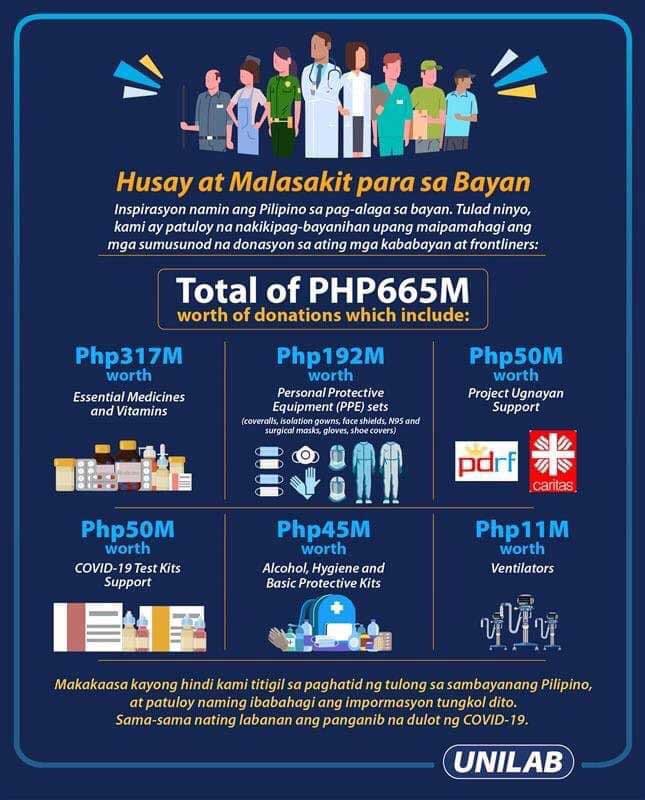
Unilab donations for COVID response already at P665 million and counting

Unilab Inc. has quietly released some P665 million worth of donations to its partner-institutions, with the amount seen to surge to a billion pesos in the next few weeks as the Campos Hess-led Filipino pharmaceutical firm commits to continue sharing its resources for the country’s COVID-19 response.

In its recent Facebook advisory for its stakeholders, Unilab updated its employees and partners on the company’s COVID-19 initiatives, anchored on its core corporate values of Husay (Excellence in execution) and Malasakit (Compassion).

Its Facebook post showed that the country’s leading pharmaceutical and healthcare company already delivered to its partners P317 million worth of essential medicines and vitamins; personal protective equipment (PPE) sets which consist of coveralls, isolation gowns, face shields, N95 and surgical masks, gloves and shoe covers worth P192 million; alcohol, hygiene and basic protective kits worth P45 million; support for COVID-19 test kit development worth P50 million; and P11 million worth of ventilators.

It also supported the fundraising drives of civil society groups for the underprivileged communities with donations worth P50 million.

Netizens cited Unilab for working with government agencies, local government units (LGUs), non-government organizations and the private sector even without getting media attention, in keeping with the company’s low-key policy for its philanthropic works as espoused by its founders.

It also demonstrated its excellence in execution by closely coordinating with the Department of Health and the COVID-19 Inter-Agency Task Force (IATF) in identifying the types of critical support required by priority recipients, especially the frontliners and vulnerable sectors. Currently, more than 400 hospitals nationwide have already received support from the company.

By partnering with the Department of Science and Technology (DOST), University of the Philippines-National Institutes of Health (UP-NIH) and other government and private organizations, Unilab is also working on the possibility of significant increase in the country’s capacity to do testing, which is an important component of the drive to contain the spread of COVID-19.

ADVERTISEMENT
ADVERTISEMENT