First, the health frontliners in hospitals, clinics, and laboratory centers; and their “support cast” — the people in the groceries and fast food chains, the delivery boys on motorcycles like Grab Food and Delivery, Foodpanda, etc. For the doctors and nurses, patients and their caretakers who have no more time to cook or cannot buy from cheaper carinderias that are also closed, food delivery boys save the day.
Second, the various private citizens and corporate groups that give seemingly endless donations to both poor households and public hospitals. I want to mention our University of the Philippines (UP) School of Economics Alumni Association (UPSEAA). When UPSEAA President Jeffrey Ng called for cash donations from members, deposits quickly and spontaneously came. Among the beneficiaries are: a.) the UP Medical Foundation which received P370,950 worth of PPEs (personal protective equipment) for health workers; b.) the UP Philippine General Hospital which received 200 suit cover gowns and 110 boxes of examination/clean gloves and 460 pieces level 3 PPEs; and, c.) the UP Infirmary/Health Service, P37,500.
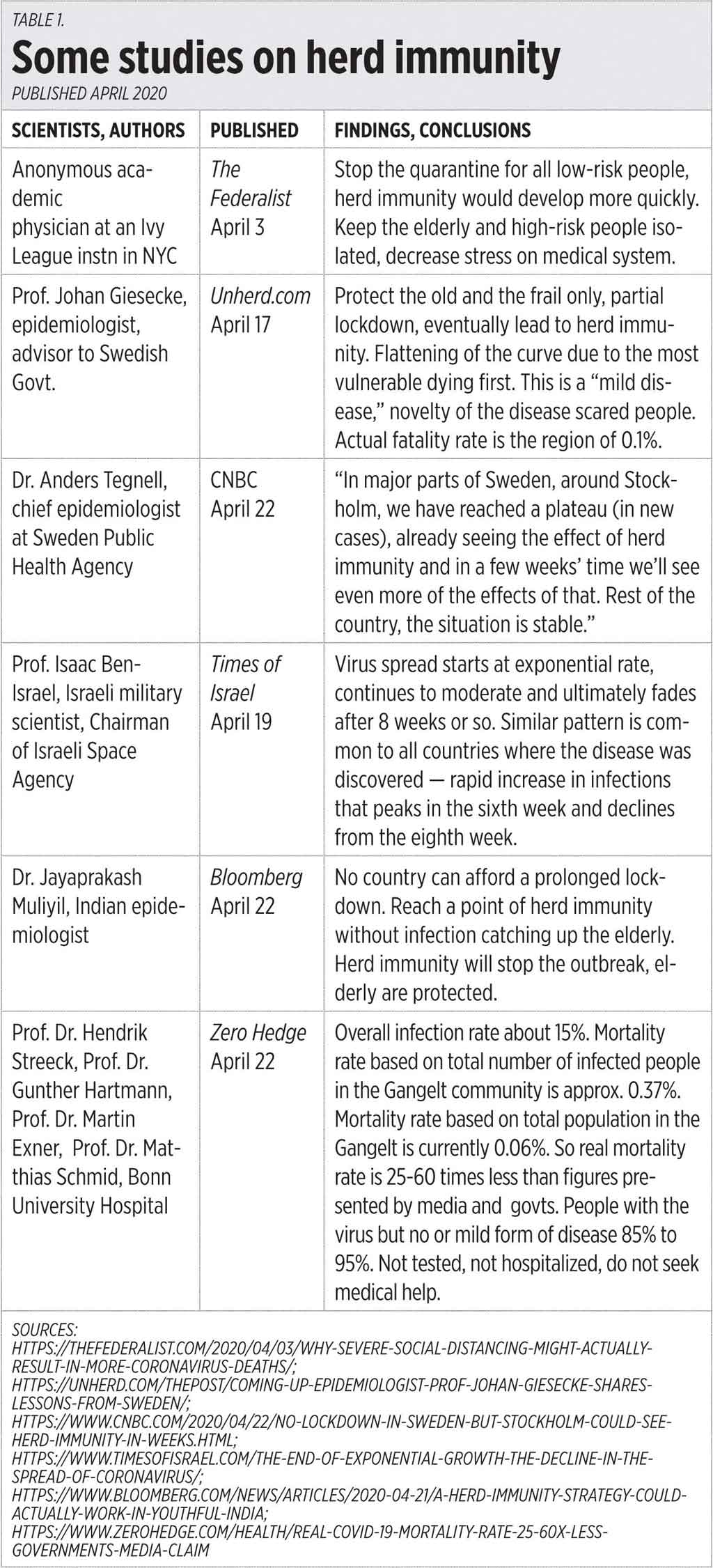
Third, some scientists and health officials abroad who produced more realistic findings and conclusions about the China virus (The virus which causes COVID-19 is officially called SARS-Cov-2. — Ed.), particularly focusing on attaining herd immunity or herd protection — which is when most of the population is immune to an infectious disease, providing indirect protection to those who have weaker immune systems (see Table 1).
I am curious to see if the 501 deaths due to the virus which have been reported in the Philippines as of April 26 is a big number compared to projected natural mortality. The first reported death was on Feb. 1, the second was March 11. If we count from Feb. 1, that is 86 days to April 26 or 5.8 deaths/day; if we count from March 11, that is 46 days or 10.9 deaths/day.
I got mortality statistics from the Philippine Statistics Authority (PSA). The latest data is from January-September 2019 with 447,735 deaths over nine months, or an average of 49,748 per month. Extrapolating to 12 months, the estimated number of deaths last year was 596,976.
We need to estimate or project the monthly and daily mortality for 2020. One way to do this is to get the average annual increase of the last four years, 2016 to 2019, which is 9,094. Then use this to project the 2020 numbers (see Table 2).
The projected mortality of 1,684 per day in 2020 is just from regular causes like dengue, cancer, hypertension, accidents, etc. Someday it should be established that six or 11 deaths/day are due to the China virus, all or portion of it is on top of the projected 1,684. With virus comorbidity, these may be deaths from cancer, hypertension, etc. but are counted as ostensible deaths due to the virus. Which were used by the national and local governments to justify all the hysteria, business shutdowns, community dictatorship, huge public spending and the coming high taxes.
We still wait for new medicines and vaccines against this virus. Meanwhile, herd immunity should not be hampered via endless lockdowns. The extension of quarantine for all until May 15 is wrong, a partial quarantine for the elderly and those with existing serious diseases should have been the policy. The continuing hysterical lockdown is a “cure” that is worse than the problem it intends to solve
Bienvenido S. Oplas, Jr. is the president of Minimal Government Thinkers.
There is no turning back. This is the NEW NORMAL. We must accept it and get used to it and most of all, adjust our business, job, or career to adapt to it.
When the lockdown was announced for the National Capital Region (NCR), I thought to myself: This is IT! This is the day we should have prepared for many years ago. Part of our preparation was our business partner’s pronouncements that the “end of A world” was forthcoming. Call it ethereal or weird, we often are tempted to look to those stars when we want to know where the business climate is headed.
As the events were coming to a head — traffic getting worse, the state of the climate getting our environmentalists angrier each day, the Slow Food Movement of consuming good, clean and fair food, Sustainable Tourism, Boracay’s closure… they had to build up to something, and now here it is.
As soon as the malls started confirming their closure, one after another, I was thinking of how to make our business bounce back since most of our stores are located in malls. Was there an end to this? Will we ever reopen again? Meanwhile, the multi-tasking me was directing our staff to pull out sensitive inventory like food — as we did not know how long the closure would take.
Then my partners and I sat down, albeit virtually and told each other: “we knew this day would come somehow.” And that was it. But we had to be the stronger force and calm our staff to just carry on, as much as we could.
What is a retailer to do?
1. Go ONLINE. Many years ago, we started our e-commerce presence and envied how the big players run their sites. Now our online business is doing much better than our brick and mortar stores.
2. Use an inventory system software. We invested in software which everyone thought was so expensive for an MSME like ours. Today, we are thankful, we know exactly what we have and where it is located.
3. Learn tech. I had to understand terms like User Experience (UX), Interface, Traffic, and other techie terms used by IT people, especially for an e-commerce and website or Search Engine Optimization.
4. Understand your supply chain. I was tutored by a very respected Supply Chain Professional (thanks to MAP) and was assured I had the right ingredients for a distribution system.
I am speaking for MSMEs. We cannot afford top-notch supply chain executives. We cannot afford a CFO or a COO. We are just simple people managing a social enterprise and making sure we have stocks that arrive just in time and that we are able to manage cash flow. All these while conducting our NGO work on our non-profit organization teaching MSMEs how to reach new markets.
Today, we have to learn how to manage our business without a back office or having many locations.
Pivot to another side of the business or a new way of doing business.
HYPERLOCAL IS THE TREND. What has happened for the last month? I joined Viber marketplaces and introduced our products to a hyperlocal market — that’s your next door neighbor, your apartment mates, your village colleagues and friends you never though lived near you.
VIRTUAL MEETINGS. People will be scared to go back to the traditional ways — malling, dining out, and having personal meetings or meet-ups. Learn to use Google Hangouts, Zoom and other meeting platforms.
STRAT PLANNING — is it still relevant? We have to take it a week at a time but imagining the long haul — maybe six to 12 months. We have to be on our toes and ever ready for whatever may come.
DIVERSIFY and RESKILL. We can no longer be what we used to be. We have to learn new skills or hone the ones we have put off so many times before. “I will learn that someday!” you used to say. It’s time to do it now — learn how to pay your bills online, learn how to transfer money with GCash or PayMaya. There is no secretary or accountant to do it for you.
And remember, age is not or never will be a barrier to learning something new, except maybe learning a foreign language or playing the piano. But not making your own letters, and using Google for almost anything.
Everyone must bounce back and pivot. Learn to call Grab or hail a Lalamove. There are no assistants, only children who themselves are learning new skills (how not to get bored with parents).
And accept the new reality. Most of all, pray and think of how this is changing our world.
Everything we have been working on as an advocacy is now a reality — cooler temperatures, no traffic, a greener planet. Maybe this is what we have all been waiting for, albeit in a very precarious manner.
And best of all, pray and be thankful we are alive to see this new world. Stay safe and stay COVID-19-free.
This article reflects the personal opinion of the author and does not reflect the official stand of the Management Association of the Philippines or the MAP.
Pacita “Chit” U. Juan is the President of the Philippine Coffee Board, Inc.
THE MAIN INDEX closed lower on Monday as investors kept assessing the economic effect of the extended enhanced community quarantine (ECQ) and the earnings reports of listed companies.
The bellwether Philippine Stock Exchange index (PSEi) dropped 14.53 points or 0.26% to close at 5,450.45 on Monday. The broader all shares index also slid 8.01 points or 0.23% to 3,342.72.
“Local shares logged in another loss as investors digested economic data, mixed corporate results, and the extension of the ECQ past April 30,” Regina Capital Development Corp. Head of Sales Luis A. Limlingan said in a mobile message yesterday.
Bangko Sentral ng Pilipinas Governor Benjamin E. Diokno said Monday the central bank is still considering further monetary easing to support the economy amid the extension of the ECQ until May 15.
Since the government announced the ECQ extension in Greater Metro Manila and the nearby regions of Central Luzon and Calabarzon on Friday, investors continued digesting its effect on the economy on Monday, which resulted in profit taking at the market.
The PSEi opened at 5,493.21 and shed gains intraday to hit a low of 5,390.97 before it closed at 5,450.45.
The PSE also extended the implementation of shortened trading hours at the market for the duration of the extended ECQ. The market will open at 9:30 a.m. and close at 1 p.m. until May 15.
Earnings season kicked off yesterday, starting with UnionBank of the Philippines, Inc. and Manila Electric Co., which reported mixed results in the first quarter. These financial results are being evaluated by investors to assess how the coronavirus disease 2019 (COVID-19) pandemic is affecting business performance amid operational and demand disruptions.
“Some investors expect either lower earnings or losses in most companies’ books due to the rapid spread of coronavirus, which adversely affected its businesses, so this pushes investors to profit take for now,” Philstocks Financial, Inc. Research Associate Claire T. Alviar said in a text message.
Despite a drop in the PSEi, four out of six sectoral indices closed higher after Monday’s session: mining and oil rose 242.41 points or 5.27% to 4,834.86; services gained 17.66 points or 1.35% to 1,318.23; property picked up 16.98 points or 0.62% to 2,732.44; and industrials added 40.19 points or 0.55% to 7,249.67.
On the other hand, financials lost 26.08 points or 2.19% to 1,162.61; and holding firms slipped 49.20 points or 0.91% to 5,312.58.
Some 568.77 million issues valued at P4.07 billion switched hands on Monday, lower from 829.26 million issues worth P5.24 billion in the last session.
Decliners outnumbered advancers, 112 against 88, while 32 names ended unchanged.
Net foreign outflows dropped to P823.64 million yesterday from P1.02 billion on Friday.
THE peso strengthened on Monday on positive market sentiment as there were fewer new cases of coronavirus disease 2019 (COVID-19) in some countries and as investors await further aid for businesses amid the pandemic.
The local unit ended trading at P50.695 per dollar on Monday, strengthening by 14.50 centavos from its previous close of P50.84 on Friday, according to data from the Bankers Association of the Philippines.
The peso opened the session at P50.75 per dollar. Its weakest showing was at P50.77 while its intraday best was at its close of P50.695 against the greenback.
Dollars traded went down to $213.82 million on Monday from the $391.68 million seen on Friday.
The stronger peso came on the back of positive sentiment due to lower COVID-19 cases in some global hotspots, according to Michael L. Ricafort, chief economist at Rizal Commercial Banking Corp.
“The peso exchange rate closed stronger amid some improvement in global market risk appetite after new coronavirus cases and deaths already slowed down in some hard-hit countries, especially those in Europe,” he said in a text message.
Meanwhile, a trader said investors are awaiting additional stimulus to support the US economy during this pandemic.
“The peso strengthened from prospects over the eventual approval of the $484-billion stimulus package for small businesses and the medical sector,” the trader said in a text message.
The stimulus was passed by the US House of Representatives on Thursday and will expand federal loans to small businesses hit hard by COVID-19. Part of this will also go to hospitals that have been overwhelmed with patients sickened by the virus.
The said bill is now awaiting the signature of US President Donald J. Trump.
For today, Mr. Ricafort gave a forecast range of P50.60 to P50.80 while the trader expects the peso to move around the P50.60 to P50.80 band. — L.W.T. NoblewithReuters
A PHILIPPINE senator on Monday filed a resolution seeking legal and diplomatic approaches to force China to stop its “destructive” reclamation activities in the South China Sea.
Senator Risa N. Hontiveros-Baraquel also said the government should force China to pay the Philippines P200 billion for damages on reefs within its territory in the past six years.
“China’s sense of entitlement to our seas has caused severe and irreparable harm to our ecosystems,” Ms. Baraquel said in a statement.
She estimated damages caused by China’s reclamation activities at P33 billion a year, assuming the value per hectare of a coral reef is $353,429 based on a 2012 study by Ecosystem Services.
Under Senate Resolution 369, Ms. Baraquel asked the Executive branch to exert “legal and diplomatic pressure” on the Chinese government to stop its island-building activities and pay for the damages.
She said the government could use the money in its battle against the novel coronavirus pandemic, which has sickened more than 7,000 and killed at least 501 people in the Philippines.
“If China pays the reparations owed to us, we can further improve our COVID-19 response and help more Filipinos against the disease,” the lawmaker said.
Ms. Baraquel also accused China of taking advantage of the pandemic when it announced a plan to set up two districts on Paracel and Spratly Islands in the disputed waterway.
Rival Southeast Asian claimant nations and the United States have criticized China’s recent assertive moves in the disputed waterway as the world battles the coronavirus pandemic.
The two administrative units are under the control of Sansha City, the Chinese People’s Liberation Army said on its news website on April 17.
“China has taken advantage of this global chaos by constructing artificial islands, installations, and structures in our own territory. This aggression must stop immediately,” she said.
The United Nations Permanent Court of Arbitration in the Haque favored the Philippines in its lawsuit against China in 2016, rejecting the latter’s nine-dash line claim to most parts of the South China Sea.
Foreign Affairs Secretary Teodoro L. Locsin, Jr. last week filed twin diplomatic protests at the Chinese Embassy in Manila — one for China’s declaration of the districts and another for aggression after a Chinese ship allegedly pointed a radar gun at a Philippine Navy ship on Feb. 17.
The military earlier said the gun-pointing incident within the Southeast Asian nation’s exclusive economic zone violated international law and Philippine sovereignty. — Charmaine A. Tadalan
THE Department of Health (DoH) reported 198 coronavirus disease 2019 (COVID-19) infections on Monday, bringing the total to 7,777.
Ten more patients died, raising the death toll to 511, it said in a bulletin. Seventy more patients have gotten well, bringing the total recoveries to 932, it added.
Also yesterday, senators said they agreed with a government plan to allow the gradual reopening of certain industries after April 30, when the lockdown on some parts of Luzon island will be lifted amid a novel coronavirus pandemic.
“I agree with the proposal to allow industries in the construction, manufacturing and agricultural sectors to resume operations after April 30, subject to social distancing and DoH guidelines and protocols,” Senator Franklin M. Drilon said in a statement.
An inter-agency task force made up of Cabinet secretaries earlier identified sectors that will be allowed to operate in areas that will be placed under a more loose general community quarantine.
Category 1 industries will be allowed to fully open, while category sectors will be allowed to open 50% to 100%. Industries under the third category may operate with 50% of their workers on site and the rest at home.
Category 1 industries include agriculture, fishery, forestry, food manufacturing and its entire supply chain, while Category 2 sectors include electronics and export manufacturing, and e-commerce. Category 3 industries cover financial services and other non-leisure wholesale and retail trade.
President Rodrigo R. Duterte on March 17 locked down the entire Luzon Island, suspending work, classes and public transportation to contain the outbreak. He extended this by two more weeks until April 30 and again until May 15, with some changes.
Mr. Drilon said he was concerned about the agriculture, manufacturing and construction sectors, whose workers are mostly daily wage earners.
“The workers in these sectors are mostly daily paid workers who had no income and were affected by the six-week lockdown,” he said.
Senator Ralph G. Recto agreed with a phased-in resumption of business operations, adding that employers should ensure protocols are in place to protect both workers and consumers.
“We will have to open the economy little by little,” he said in a separate statement, adding that establishments should observe social distancing and proper disinfecting measures.
Mr. Recto said the government should improve its ”health capability” as he expects consumers and investors to struggle with “confidence” issues.
The Department of Labor and Employment said on Sunday the COVID-19 outbreak had displaced more than 2 million workers nationwide.
“Expect higher unemployment knowing that the consumer would have confidence issues. Investors will adopt a wait and see attitude,” Mr. Recto said.
Meanwhile, the presidential palace said it was working on a master plan for areas that will undergo a general community quarantine after April 30.
“The guidelines will be approved today and this will be discussed tomorrow,” presidential spokesman Harry L. Roque said at a briefing.
Under the general community quarantine, conditions will be relaxed while social distancing measures are maintained in the absence of a cure for the coronavirus disease 2019.
Metro Manila, Central Luzon, Calabarzon (Cavite, Laguna, Batangas, Rizal and Quezon), Antique, Iloilo, Aklan, Capiz, Cebu province, Cebu City, Davao del Norte, Davao City and Davao de Oro will remain under the stricter enhanced community quarantine until May 15.
It would probably take as long as one-and-a-half years to develop and commercially release a vaccine against the novel coronavirus, Socorro Escalante, COVID-19 incident manager of the World Health Organization-Western Pacific Region, said at a briefing yesterday.
Research and development could take up to six months, she said, adding that the vaccine must first be tested on animals. — Vann Marlo M. Villegas, Charmaine A. TadalanandGillian M. Cortez
RAMON R. Jimenez, Jr., the Tourism chief behind the “‘It’s More Fun in the Philippines” global campaign, has died. He was 64.
The death of Mr. Jimenez, an advertising expert whom then President Benigno Simeon C. Aquino III appointed in 2012 as his Tourism secretary, was not related to COVID-19, ABS-CBN News reported on Monday, citing a statement released by his family.
“Mon J was a beloved husband, father, brother, friend and public servant. He will be greatly missed,” according to the statement.
The Tourism department in a separate statement paid tribute to Mr. Jimenez, “who laid down the foundation for the country’s most famous tourism campaign.”
Tourism Secretary Bernadette Romulo-Puyat retained the “It’s More Fun in the Philippines” slogan unlike her predecessors, who started their terms with fresh catchlines.
Ms. Puyat said Mr. Jimenez had helped shape the government’s National Tourism Development Program for 2016 to 2022.
“Today, we mourn the loss of Mon Jimenez but we will be forever grateful to him for the growth of the tourism sector, and for promoting the Philippines as a place that is wonderful, joyous and fun,” she said.
Jimenez began his career at Saatchi & Saatchi in the creative department, and then formed a start-up boutique agency in the late 1990s called Jimenez & Partners. After several mergers, the firm became known in 2011 as Publicis JimenezBasic.
He was the senior consultant and joint chief executive officer of WOO (Winning Over Obstacles) Consultants, and helped build JimenezBasic Advertising into one of the biggest creative advertising agencies in the country.
Mr. Jimenez helped Mr. Aquino’s election campaign in 2010 and was a marketing consultant for the Ninoy and Cory Aquino Foundation.
He studied at the University of the Philippines, majoring in visual communications at the College of Fine Arts. — Norman P. Aquino
Iloilo City braces for budget cuts with delayed local tax collection
ILOILO City’s finance committee will present this week a fund realignment and economic measures program as the local government braces for the delayed collection in local taxes that cover about 60% of its annual budget.
“We (city government) don’t have any income since March. We are worried because we have already extended the payment of our business taxes. We also have upcoming bills that need to be managed,” Mayor Jerry P. Treñas said.
The remaining 40% of the city’s funding is sourced from the internal revenue allotment (IRA), the local government’s allocation from the national budget.
“We are one of those cities that are not IRA dependent. If we have very low (local) income, the city will be really affected,” Mr. Treñas said.
In this year’s budget, P1.546 billion or 57. 21% of the total is originally programmed to be taken from local tax collection, while P1.141 billion or 42.23% would come from the IRA.
The mayor said the new budget plan being finalized is also redirect more money towards the coronavirus disease (COVID-19) response program.
Among the priority items that will be cut are contractual job hiring, vehicles, travels, and sports and other events. — Emme Rose S. Santiagudo
WB-funded agri projects in Mindanao face delays due to quarantine measures
DAVAO CITY — Agricultural infrastructure and enterprises funded under the Philippine Rural Development Project (PRDP) are facing delays in implementation due to lockdown measures in response to the coronavirus disease 2019 (COVID-19) outbreak.
“COVID-19 is really affecting our operations, especially in implementing our sub-projects that involve field work since there are quarantine measures implemented in different cities, provinces and municipalities,” PRDP Deputy Project Director for Mindanao Danilo T. Alesna told BusinessWorld through e-mail.
Construction projects not directly related to the health crisis are among the activities banned by most local governments.
Mr. Alesna said the PRDP, a World Bank-funded program with the Department of Agriculture as lead implementer, has also adopted a “skeletal workforce and alternate work arrangements among our employees” in compliance with “the government’s efforts to flatten the curve.”
He said they are looking at ways to get the projects back on track once restrictions are eased.
“We will do our best to cope with the challenges resulting from the delays after this pandemic,” he said.
There are 274 PRDP infrastructure projects in Mindanao with a total cost of P19.5 billion, mostly farm-to-market roads, and 118 enterprise development projects with a funding of P751.777 million.
Among the delayed projects are those in Davao de Oro, which was granted P968.88 million for 19 projects.
In a statement, PRDO said seven projects in the province worth P255.72 million, with six infrastructure and one enterprise on tablea processing, were completed before the COVID-19 crisis.
The pending projects include farm-to-market roads, rubber processing and marketing, cardava banana consolidation and marketing, cow’s milk processing and marketing, and an enhancement of virgin coconut oil and by-product processing and marketing.
For the completed projects, the PRDP statement quotes rice farmer Peter Jumigop of Compostela town on how the new road connecting their area to the capital Nabunturan has improved their market access.
In the past, he said, the road was just a “pathway for carabaos that carry our produce. The road was muddy and the depth would reach our knees.”
Fellow beneficiary Raul Bogani Sr. said nowadays, buyers are able to go directly to them and haul their products.
“The buyers’ vehicle can now reach our farms and collect our produce by the side of the road, unlike before where we used to pay P15 per sack (for hauling),” said Mr. Bogani.
The transport of agricultural produce are among the exemptions in travel restrictions imposed nationwide. — Carmelito Q. Francisco
NTC regional office tells companies to send complaints over poor internet service
THE National Telecommunications Commission-Davao Region office (NTC-11) urged companies that implement work-from-home (WFH) arrangements to send them their complaints for alleged poor internet services of telecommunication companies.
NTC-11 Regional Director Nelson T. Cañete, in a text message, said these service providers have been required by the agency’s central office to submit their assurance of uninterrupted connectivity as well as Business Continuity Plans and other measures amid the quarantine protocols nationwide.
“On the issue of slow internet connection, maybe it is because many are using internet nowadays. However, if they have complaints they can write us and we will forward your complaints to the telcos for action,” Mr. Cañete said.
Davao City Chamber of Commerce and Industry Inc. (DCCCII) President John Carlo B. Tria, in a statement last week, cited internet speed and intermittent signal quality as major complaints of many companies that are implementing WFH schemes.
In the group’s proposed Business Recovery Agenda, DCCCII Executive Vice President and ICT leader Belinda Torres emphasized the need to have a fast and reliable internet service to ensure productivity.
“If we want more people to work from home, we will need solutions at the regional level to improve internet service, both the speed and quality,” Ms. Torres said. — Maya M. Padillo
THE Commission on Audit (CoA) is temporarily relaxing rules on donations received by the government in support of its coronavirus disease 2019 (COVID-19) response efforts.
Under CoA Circular 2020-009 dated April 21, donations in kind could be immediately repacked and distributed in all areas that are placed under quarantine measures.
“The acknowledgement of the donations in-kind and accounting of distribution and balances by the recipient agencies will suffice during this period,” CoA said.
The costing and recording of the donations could be done after the quarantine and only the remaining balance will be recorded in the books.
Government agencies are allowed to transfer the responsibility of distributing the goods to the local government units (LGUs), based on the validated list of affected families.
“During the quarantine, the goods need not be released by the agency directly to the intended beneficiaries, but it may be done through the LGUs, particularly if the concerned agencies lack the resources or facilities to do so,” CoA said.
The commission is also allowing the use of an “electronic tracking platform” to facilitate recording, monitoring, and utilization of donations, whether in cash or in kind, provided that the date of receipt, name of donor, nature of donation, and amount or volume are included.
Instead of a monthly report, agencies are now only required to submit a one-time report, separately for cash donations and in-kind donations, within 10 working days after the end of the quarantine to the National Disaster Risk Reduction and Management Council, Office of the Civil Defense and the respective CoA auditors.
The circular will be in effect for the duration of the state of calamity declared under Proclamation No. 929 last March 16, “unless sooner revoked or amended by the Commission.”
COA said these measures are aimed to “support the efforts of the government in providing the needs of the citizens and health workers” during the COVID-19 pandemic.
While there is a need to relax rules on donations, the commission assured that the “basic controls to ensure that the donations are properly accounted for” will not be disregarded. — Genshen L. Espedido
28K Filipinos should be tested daily with reopening of economic activities
PRESIDENTIAL Adviser for Entrepreneurship Joey A. Concepcion said 28,000 Filipinos should be tested daily for the coronavirus disease 2019 (COVID-19) to mitigate health risks as the country moves towards resumption of economic activities.
“Para mabuksan ang ekonomiya natin (To reopen our economy), we need to test as much as 28,000 Filipino people daily,” he said in a briefing Monday.
Project ARK (Antibody Rapid test Kits), a private sector initiative, will roll out soon to help address the limited testing capacity of government facilities.
It aims to test thousands of Filipinos before restrictions are lifted under the current enhanced community quarantine policy.
Mr. Concepcion said over 200 companies will take part in the program.
Project ARK will also help up to seven provincial hospitals expand their testing capabilities for COVID-19.
“Our whole objective is to focus on test, test, and test. It will give us more visibility in the Cabinet and the government will be able to open up more of the economy,” he said. — Gillian M. Cortez
Filipino COVID-19 cases in Saudi Arabia rises to 119, death toll at 5
THE Philippine Embassy in Saudi Arabia on Monday said 119 Filipinos have contracted the coronavirus disease 2019 (COVID-19), five of whom have died.
“Meron na kaming na-receive na report na lima sa 119 ang pumanaw (We have received a report that five of the 119 have died),” Ambassador Adnan V. Alonto said in the Laging Handa virtual briefing Monday.
The Kingdom of Saudi Arabia has reported 17,522 cases, 139 deaths and 2,357 recoveries.
Mr. Alonto said the embassy is also monitoring the situation of overseas Filipino workers (OFWs) under a “no work, no pay” policy.
The embassy, in coordination with the Department of Foreign Affairs, repatriated on Sunday 257 distressed OFWs from Saudi Arabia.
“They are the second batch of Filipinos sent home aboard a special flight following Saudi government order to employers to allow their foreign workers to go home during this time of pandemic,” the DFA said in a social media post, Sunday evening. — Charmaine A. Tadalan
Lawyers’ groups ask SC to allow release of 22 political prisoners
TWO lawyers’ groups urged the Supreme Court (SC) to grant bail to 22 political prisoners vulnerable to the coronavirus disease 2019 (COVID-19) based on humanitarian grounds.
The Public Interest Law Center and National Union of Peoples’ Lawyers, replying to the Office of the Solicitor General’s (OSG) comment on the bail request of the political prisoners, said the measures applied by jail and prison authorities to address COVID-19 in penal institutions is “not commensurate to the gravity of the pandemic,” and are standard compliance only.
They cited efforts by the Bureau of Jail Management and Penology (BJPM) to set up a 150-bed center in Payatas in Quezon City and the Bureau of Corrections’ (BuCor) coordination with the Department of Public Works and Highways for a site inside the New Bilibid Prison (NBP).
The lawyers groups said while the BJMP submitted a list of 14 health practitioners, five of whom are physicians, under the institution, it was unclear if they are attending to the over 30,000 inmates in Metro Manila or the 120,843 nationwide.
They also noted that 41 out of 44 jails under the BJMP are congested while the average congestion rate at the seven facilities under the Bureau of Corrections is at 314%.
“Given these figures, it is impossible for the PDLs (persons deprived of liberty) to observe physical distancing, a crucial element in the COVID-19 response,” the lawyers said.
The groups also said that the 22 political prisoners are not covered by the Office of the Court Administrator Circular No. 91-2020, which is cited by the Office of the Solicitor General as an effort to decongest jails, as it does not include sick and elderly inmates.
“As earlier mentioned, the release of herein petitioners — as those of others similarly vulnerable on account of age and health — will actually benefit the jails, the government and the public at large in the move to combat and lower the risk of rapid spread of COVID-19,” they said, adding that their cases are either still undergoing trial or have not yet reached trial stage.
The OSG in its reply asked the court to dismiss the petition, saying the petitioners are not qualified for bail and health protection and safety measures are being implemented in penal colonies.
The OSG also said the petition violates the equal protection clause as they are “not a unique class that should be treated differently” and should be treated like all other prisoners regardless of age, health, and status.
BuCOR reported 48 inmates and one worker tested positive for COVID-19 while the first confirmed case in the NBP has already died.
Nine inmates and nine staff at the Quezon City Jail have also been infected with COVID-19 while 210 in Cebu City Jail also have the virus. — Vann Marlo M. Villegas
Majority of senators endorse teleconferencing for sessions
FIFTEEN of the 24 senators have endorsed plenary sessions and committee hearings through teleconference when Congress resumes on May 4 amid the coronavirus disease 2019 (COVID-19) outbreak.
Under Senate Resolution No. 372, the senators asked Senate Secretary Myra Marie D. Villarica to recommend the information and communications technology system that will be needed as well as provide security measures for the online meetings.
The resolution was signed by Senators Ralph G. Recto, Juan Miguel F. Zubiri, Franklin M. Drilon, Juan Edgardo M. Angara, Ma. Lourdes Nancy S. Binay, Pia S. Cayetano, Ronald M. dela Rosa, Sherwin T. Gatchalian, Manuel M. Lapid, Imee R. Marcos, Emmanuel D. Pacquiao, Grace S. Poe-Llamanzares, Ramon B. Revilla, Jr. Emmanuel Joel J. Villanueva and Cynthia A. Villar.
Senate President Vicente C. Sotto on Sunday said he is open to teleconferencing, but noted the legislators will have to physically convene at the Senate hall on May 4 to discuss the legislative calendar.
Mr. Sotto placed the Senate premises under restricted access starting March 12 after a resource person in a March 5 hearing tested positive for COVID-19. — Charmaine A. Tadalan
DoST to look into 2 medicinal plants as supplement for COVID-19 patients
THE Department of Science and Technology (DoST) will be studying two known medicinal plants — tawa-tawa (Euphorbia hirta) and lagundi (Vitex negundo) — as possible herbal supplements for those infected with the coronavirus disease 2019 (COVID-19).
Palace Spokesperson Harry L. Roque, in a briefing Monday, said the DoST will do research and tests if the plants used as traditional medicine will also be “effective” on COVID-19 patients.
Last week, the DoST said it will conduct studies on the effects of virgin coconut oil as a food supplement that can help fight the virus. Clinical studies will be conducted soon. — Gillian M. Cortez
The Enhanced Community Quarantine (ECQ) order in the National Capital Region (NCR), Central Luzon (Region 3), Calabarzon (Region 4A) and other high-risk areas is further extended until May 15, Malacañang announced last Friday, April 24.
President Rodrigo Duterte announced the quarantine extensions and other government efforts to combat the COVID-19 epidemic, as recommended by the Inter-agency Task Force for the Management of Emerging Infectious Diseases (IATF-EID).
HIGH-RISK AREAS UNDER EXTENDED ECQ
Presidential Spokesperson Harry Roque enumerated the areas covered by the extended ECQ until May 15: Metro Manila, Calabarzon, Bataan, Bulacan, Nueva Ecija, Pampanga, Oriental Mindoro, Occidental Mindoro, Albay and Catanduanes, while the status of Benguet, Pangasinan, Tarlac and Zambales may change by April 30.
Meanwhile, the situation in Antique, Aklan, Iloilo, Capiz, Cebu, Cebu City, Davao del Norte, Davao de Oro (formerly Compostela Valley) and Davao City will be re-checked. These areas were considered high-risk based on the rising number of cases and the shortfall in medical facilities.
Because of the ECQ order in these areas, public transportation will remain suspended and business establishments ordered closed, except those giving essential services like supermarkets, pharmacies and banks. Classes in all levels are still suspended while residents are ordered to remain indoors.
GENERAL COMMUNITY QUARANTINE, THE NEW NORMAL
Starting May 1, a less stringent form of lockdown — General Community Quarantine (GCQ) — will be in place in areas with low to moderate risk. “All provinces not under the ECQ will be included in the ‘new normal’ called the GCQ,” Roque said.
Moderate-risk provinces include Negros Occidental, Negros Oriental, Siquijor, Davao del Sur, Davao Oriental, Sultan Kudarat and Lanao del Sur.
Meanwhile, the following provinces are considered low-risk areas: Apayao, Mountain Province, Ifugao, Kalinga, Ilocos Sur, Batanes, Quirino, Aurora, Palawan, Romblon, Camarines Norte, Masbate, Sorsogon, Guimaras, Bohol, Biliran, Eastern Samar, Leyte, Northern Samar, Southern Leyte, Zamboanga del Norte, Zamboanga Sibugay, Bukidnon, Camiguin, Davao Occidental, Sarangani, Agusan del Sur, Dinagat Island, Surigao del Norte, Surigao del Sur, Agusan del Norte, Basilan and Sulu.
SUBJECT FOR EVALUATION
Meanwhile, there are provinces classified as moderate-risk areas that will be subject to evaluation. They can either be placed on ECQ or GCQ depending on the recommendations of the IATF. These are Abra, Ilocos Norte, La Union, Cagayan, Isabela, Nueva Vizcaya, Marinduque, Camarines Sur, Samar, Western Samar, Zamboanga del Sur, Lanao del Norte, Misamis Occidental, Misamis Oriental, North Cotabato, South Cotabato and Maguindanao.
In areas placed under GCQ, the “new normal” will be as follows:
– Restricted movement but work is allowed in some sectors
– The general population may go out to acquire basic necessities, except those under 20 and over 60 years old must remain indoors
– Non-leisure stores in malls and shopping centers may partially open
– Restaurants may open for takeout and delivery only
– Airports and seaports may operate to allow unhampered movement of goods
– Full operation recommended for essential industries like agriculture, forestry, fisheries, food manufacturing and all supply chains, supermarkets, hospitals, logistics, media, and utilities like water, power, internet and telecoms
– 50 – 100 percent opening is recommended for electronics, exports, e-commerce and delivery, repair and maintenance services, housing and office services
– 50 percent onsite and 50 percent remote work is recommended for financial services, BPO, non-leisure wholesale trade and non-leisure service
– Priority and essential government construction projects may continue
– Higher education institutions may continue online classes to finish the academic year and issue credentials to students. School and universities should consider opening classes in September
WHILE ADMITTING to having his hands full with the many challenges that the coronavirus disease 2019 (COVID-19) pandemic present, Filipino mixed martial arts star Joshua “The Passion” Pacio is staying strong, turning to the values he has learned from the sport and his faith to get him through.
Currently stuck at home much of the time as action in ONE Championship has been temporarily put to a halt over concerns on the spread of the highly contagious COVID-19, and outside movement limited with mitigating measures by the government in place, reigning world strawweight champion Pacio said one could easily be swamped by everything that has been happening, especially if not dealt with accordingly.
From his end he is dealing with the current situation by keeping himself busy despite not being able to go through his regular regimen at the Team Lakay gym.
“The hardest part is that we can’t go to the gym to train, that’s why we find ways to train inside our homes. In the past years, we were lacking training equipment in the gym. This is not new to us, so we find ways to stay sharp. Luckily, I have punching mitts and manong (older brother) Kevin [Belingon] and I are in the same barangay so we hold pads for each other,” said 24-year-old Mr. Pacio, who last fought in ONE on Jan. 31 this year where he successfully defended his title against former champion Alex Silva of Brazil.
He is also drawing strength and guidance from his teammates during these tough times.
“My teammates inspire me every day, they are the reason why I’m a champion, they helped me get to where I am today, they motivate me in down times and help me realize what my mistakes are,” he said.
Amid COVID-19, Mr. Pacio is also turning to a higher power to get a better perspective in viewing things.
“The important thing for me in this kind of situation is praying to God. He is the only one who knows what’s going to happen, trusting in God in this kind of situation is important and of course we should trust Him not only in these situations but in good times or bad,” Mr. Pacio said.
CHASING HIM
Meanwhile, ONE came out with its first official athletes rankings in different weight categories, including those for Mr. Pacio’s division, giving some clarity on the fighters hot chasing him.
Ranked number one is former strawweight champion Yosuke Saruta of Japan from whom Mr. Pacio reclaimed the title from in April last year.
Second is another former champ in Japanese Yoshitaka Naito, followed by Filipino fighter Rene Catalan, who Mr. Pacio defeated by submission in November 2019.
At fourth is Mr. Silva while sitting at number five is Mr. Pacio’s Team Lakay teammate Lito Adiwang.
Mr. Pacio (17-3) said he is ready to take on all comers but expressed no preference on who he would battle next, focusing instead on getting ready when the time comes they are called back to action.
“Honestly I’m not the guy who has a dream opponent. I just focus on improving every day and every bout. I am a champion and I need to prove that every time I step inside the Circle,” said Mr. Pacio.
RAFA NADAL has said he is very pessimistic about the possibility of tennis returning to normal any time soon because of the new coronavirus pandemic that shut down the sport last month.
Professional tennis has been suspended until the end of July, at the earliest, and the Spaniard said on Sunday that serious problems stand in the way of a resumption.
“From my point of view, I’m very pessimistic that the circuit can resume normal activity,” the world number two said in an online chat organized by the Spanish Tennis Federation.
“In tennis, you need to travel every week, stay in hotels, go to different countries.
“Even if we play without an audience, to organize any event you need a lot of people involved, which cannot be ignored. At an international level I see a serious problem.”
The coronavirus outbreak has decimated the world sports calendar, forcing the postponement of the Olympic Games, which includes tennis, and the cancellation of Wimbledon.
French Open organizers have rescheduled that event for the end of September, shortly after the US Open, although Nadal said public health took priority over tennis tournaments.
“We have already said many times we are in a very difficult moment, for everyone,” Nadal added.
“Step-by-step it looks like things are slightly less bad, but we’ve been through one and a half very tough months, lots of irreparable losses and other losses that are less important, but without doubt will cause suffering in society in the following months.
“I hope it will be months not years because it’s also an economic issue as well. Lots of people are going to lose their jobs. These are sad moments when you see so many people dying.”
Nadal, 33, said that even when tennis does resume the players will need to recover their fitness levels.
“It will be a very tough job to regain fitness and you will need lots of discipline and lots of suffering,” he said. “The sooner we can resume activity the better. From the point of view about going back to competitions, I’m pessimistic.
“But there are many other things more important than tennis.” — Reuters