Home Blog Page 957

TSMC, chip design software firms tap AI to help chips use less energy

THE TSMC (Taiwan Semiconductor Manufacturing Company) Museum of Innovation is located within Hsinchu Science Park, around 72 kilometers outside of Taipei. — CATHY ROSE A. GARCIA

SANTA CLARA, California — The computing chips that power artificial intelligence consume a lot of electricity. On Wednesday, the world’s biggest manufacturer of those chips showed off a new strategy to make them more energy efficient: Using AI-powered software to design them.

At a conference in Silicon Valley, Taiwan Semiconductor Manufacturing Co, the contract manufacturer that fabricates chips for Nvidia, showed off a range of ways that it is hoping to boost the energy efficiency of AI computing chips by about 10 times.

Nvidia’s current flagship AI servers, for example, can consume as much as 1,200 watts during demanding tasks, which would be the equivalent of the power used by 1,000 U.S. homes if run continuously.

The gains TSMC is hoping to achieve come from a new generation of chip designs in which multiple “chiplets” – smaller pieces of full computing chips – using different technologies are packaged together to make one computing package.

But to make use of those technologies, the firms that design chips are increasingly relying on AI-powered software from providers such as Cadence Design Systems and Synopsys, both of which rolled out new products on Wednesday that had been developed in close coordination with TSMC.

For some of the complex tasks in designing chips, the tools from TSMC’s software partners found better solutions than TSMC’s own human engineers – and did so much faster.

“That helps to max out TSMC technology’s capability, and we find this is very useful,” Jim Chang, deputy director at TSMC for its 3DIC Methodology Group, said during a presentation describing the findings. “This thing runs five minutes while our designer needs to work for two days.”

The current way of manufacturing chips is hitting limits, such as the ability to move data on and off chips using electrical connections. New technologies, such as moving information between chips with optical connections, need to be made reliable enough to use in massive data centers, said Kaushik Veeraraghavan, an engineer in Meta Platforms’ infrastructure group who gave a keynote address.

“Really, this is not an engineering problem,” Veeraraghavan said. “It’s a fundamental physical problem.” — Reuters

Fitch revises Thailand’s outlook on fiscal risks amid political uncertainty

REUTERS

Ratings agency Fitch on Wednesday revised Thailand’s outlook to “negative” from “stable”, citing increasing risks to public finances amid ongoing political uncertainty.

Thailand’s Constitutional Court recently removed Prime Minister Paetongtarn Shinawatra from office over a leaked telephone call with former Cambodian leader Hun Sen, which was seen as a violation of ethics amidst heightened border tensions.

Anutin Charnvirakul took over as prime minister earlier this month after striking a deal with the opposition People’s Party to hold general elections within four months in exchange for its support.

Fitch said political uncertainty could drive short-term spending and deepen policy unpredictability in Thailand, while delayed tourism recovery and high household debts are adding to increasing fiscal risks.

Thailand’s tourism ministry said that foreign tourist arrivals from January 1 to September 21 fell 7.44% from the same period a year earlier.

A sharp drop in Chinese visitors, in particular, compared to 2019, raises concerns about the pace of Thailand’s tourism recovery, according to Fitch.

Fitch affirmed Thailand’s rating at ‘BBB+’ on the back of strong capacity to finance its government debt. — Reuters

US opens tariff probes into medical equipment, robotics, industrial machinery

CITIGROUP.COM

WASHINGTON – The US Commerce Department said on Wednesday it has opened new national security investigations into the import of personal protective equipment, medical items, robotics and industrial machinery.

The “Section 232” investigations, which were opened on September 2 but not publicly disclosed previously, could be used as a basis for even higher tariffs on a wide swath of medical and industrial goods including imported face masks, syringes, and infusion pumps as well as for robotics and industrial machinery like programmable computer-controlled mechanical systems and industrial stamping and pressing machines.

The probe asks companies to detail projected demand for robotics and industrial machinery and the extent to which “domestic production of robotics and industrial machinery, and their parts and components can meet domestic demand” as well as the role of foreign supply chains in meeting US demand.

The tariffs could also cover surgical masks, N95 respirators, gloves, gowns and other medical and surgical instruments and supplies including IV bags, gauze/bandages, sutures, wheelchairs, crutches and hospital beds.

The US Commerce Department wants companies to detail projected demand for personal protection and medical equipment and devices and the extent that domestic production can meet US demand, as well as the role of foreign supply chains, particularly of major exporters like China in meeting US medical needs and the “impact of foreign government subsidies and predatory trade practices.”

The probe also covers pacemakers, insulin pumps, coronary stents, heart valves, hearing aids, prosthetics, blood glucose monitors, orthopedic appliances, computed tomography scanners and magnetic resonance imaging machines.

Pharmaceuticals including prescription drugs as well as drones are part of separate 232 probes.

The robotics probe includes machine tools for cutting, welding, and handling workpieces, autoclaves and industrial ovens. Laser and water-cutting tools and machinery are also included.

The department has opened numerous probes into the national security ramifications of imports of wind turbines, airplanes, semiconductors, heavy trucks, polysilicon, copper, timber and lumber and critical minerals. — Reuters

Gov’t asked to let communities co-design public transport, spaces

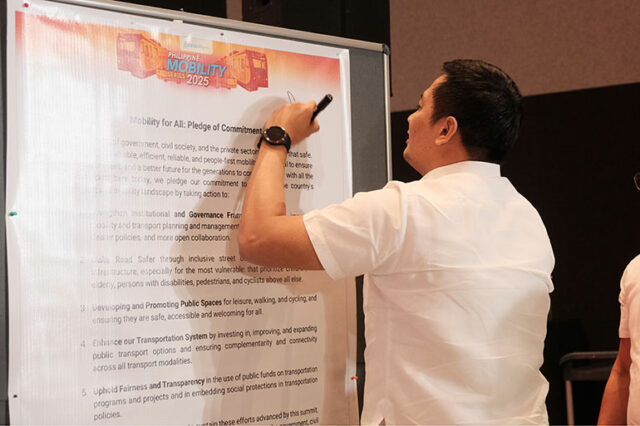
Department of Transportation (DoTr) Usec. for Road Transport and Infrastructure Mark Steven Pastor signs the “Mobility for All: Pledge of Commitment” during the first-ever “Philippine Mobility Summit 2025” in Makati City on Sept. 15, 2025. The Philippine Mobility Summit 2025 is presented by AltMobility PH and co-presented by the DoTr. It was supported by the Move As One Coalition; and sponsored and co-sponsored by Grab, Ayala and GIZ, and The Asia Foundation and Ayala Land, respectively.

Amid calls to improve road safety and accessibility in the Philippines, stakeholders urged the government to increase people’s participation in co-designing public transportation systems and urban spaces.
 
At the “Philippine Mobility Summit 2025,” advocates from the academe, civil society, nongovernment organizations, and private sector sought the commitment of government transport agencies to work with them towards a “safe, inclusive, sustainable, efficient, reliable, and people-first mobility.”
 
The Philippine Mobility Summit held Sept. 15 at One Ayala in Makati City is the culmination of the “Philippine Mobility Series,” which discussed road safety, inclusive urban public spaces, low-cost mass transit, and transport transformation from April to August.
 
The first-ever such summit in the country was presented by AltMobility PH and co-presented by the Department of Transportation (DoTr). It was supported by the Move As One Coalition; and sponsored and co-sponsored by Grab, Ayala and GIZ, and The Asia Foundation and Ayala Land, respectively.
 
During the summit, stakeholders and government officials such as DoTr Usec. for Road Transport and Infrastructure Mark Steven Pastor, LTFRB Director Joel Bolano, and Quezon City Assistant Administrator Alberto Kimpo signed the “Mobility for All: Pledge of Commitment.”
 
The commitment pledge cited five key points:
 
1) Strengthen institutional and governance frameworks towards improving mobility and transport planning and management through stronger institutions, clearer policies, and more open collaboration.
 
2) Make roads safer through inclusive street design and climate-resilient infrastructure, especially for the most vulnerable: that prioritize children, elderly, persons with disabilities, pedestrians, and cyclists above all else.
 
3) Developing and promoting public spaces for leisure, walking, and cycling, and ensuring they are safe, accessible, and welcoming for all.
 
4) Enhance our transportation system by investing in, improving, and expanding public transport options and ensuring complementarity and connectivity across all transport modalities.
 
5) Uphold fairness and transparency in the use of public funds on transportation programs and projects, and embedding social protections in transportation policies.
 
“The Philippine Mobility Summit was a timely and pivotal gathering of stakeholders from across sectors,” said Grab Philippines’ Booey Bonifacio.
 
“The output of this summit is groundbreaking because it promotes a co-development framework, which means people’s involvement in the crafting and designing of the government’s transportation and mobility plans — providing not only alignment but also accountability,” she added.


Spotlight is BusinessWorld’s sponsored section that allows advertisers to amplify their brand and connect with BusinessWorld’s audience by publishing their stories on the BusinessWorld Web site. For more information, send an email to online@bworldonline.com.

Join us on Viber at https://bit.ly/3hv6bLA to get more updates and subscribe to BusinessWorld’s titles and get exclusive content through www.bworld-x.com.

Gov’t plans to raise P437 billion from domestic mart

THE GOVERNMENT is looking to borrow P437 billion from the domestic market in the fourth quarter, the Bureau of the Treasury (BTr) said.

In a notice on its website, the BTr aims to borrow P262 billion through the issuance of Treasury bills (T-bills) and P175 billion from Treasury bonds (T-bonds).

The borrowing plan for the fourth quarter is 36% lower than the P690 billion borrowing plan for the third quarter..

Of the third quarter borrowing program, the government was able to raise P637.448 billion.
Based on its notice, all T-bond auctions will be dual offers to account for the holidays during the quarter. — Aaron Michael C. Sy

Infrastructure spending declines in July amid weak DPWH disbursements

Work continues at the Sta. Cruz Pumping Station as part of the Department of Public Works and Highways-National Capital Region's flood control project in Quezon City, Aug. 21. PHOTO BY MIGUEL DE GUZMAN, THE PHILIPPINE STAR

Government infrastructure spending declined by 25% in July, weighed down by sluggish disbursements from the Department of Public Works and Highways (DPWH), the Department of Budget and Management (DBM) said.

In its latest disbursement report on Thursday, the DBM reported that expenditures on infrastructure and other capital outlays fell by 25.3% to P93.3 billion in July from P124.9 billion in the same month last year.

Month on month, it dropped by 37.3% from P123.8 billion in June.

This was a reversal of June’s annual 6.5% increase amid lifting of the election ban in early May.

The DBM attributed the year-on-year decline in infrastructure spending to weak disbursements from the DPWH, which is currently embroiled in a controversy over anomalous flood control projects.

The Budget department noted the slow DPWH disburements were due to project implementation schedules, including the timing and phasing of infrastructure activities, as well as delays in procurement, incomplete submission of progress billings and required documents by contractors.

Spending in July was also affected by contractors’ compliance with the new tax clearance requirement of the Bureau of Internal Revenue (BIR) for the release of final payments.

The BIR earlier said failure to present clearance will result in the suspension of contract settlements and the imposition of a tax line over the contract amount in favor of the government.

The updated clearance guarantees that every contractor has no outstanding tax liabilities and has duly filed and paid all applicable taxes.

“Disbursements for the Revised Armed Forces of the Philippines Modernization Program (RAFPMP) of the DND were also lower in July 2025 attributed to the timing of releases, as big-ticket items were scheduled in August,” the DBM said.

At the same time, the DBM said lower spending was partly offset by higher disbursements from the Department of Transportation, driven by local counterpart funding for foreign-assisted projects and the settlement of outstanding payables.

For the January-to-July period of 2025, overall infrastructure and capital outlays disbursements stood at P713.5 billion, 3.2% down from P736.7 billion in the same period last year.

Based on the 2026 Budget of Expenditures and Sources, the government set its full-year infrastructure spending program at P1.51 trillion, equivalent to 5.3% of the GDP. — Aubrey Rose A. Inosante

Philippines sees corruption crackdown slowing state spending

BUDGET SECRETARY AMENAH F. PANGANDAMAN — PHILIPPINE STAR/KRIZ JOHN ROSALES

Philippine government spending may slow amid ongoing probes into alleged corruption in flood-control projects, according to Budget Secretary Amenah Pangandaman.

Investigations being carried out by lawmakers and an independent body created by President Ferdinand Marcos Jr. as well as the decision by the new public works chief to briefly pause bidding for infrastructure projects could temper spending, she said.

Ms. Pangandaman made the comments on Wednesday on the sidelines of a forum arranged by international organization Innotech.

The scrutiny could also send a chilling effect on how other agencies utilize their budget, she added.

Allegations of widespread corruption in flood-mitigation projects in the Southeast Asian nation have triggered mass demonstrations and implicated some lawmakers who have denied any wrongdoing.

But Ms. Pangandaman said any slowdown in state spending is unlikely to be significant enough to affect output in the next quarters. Government spending has historically accounted for less than a fifth of the nation’s economic output.

She also expects Congress to pass the proposed 2026 national budget of P6.793 trillion ($118 billion) on time. — Bloomberg

Palace, LGUs suspend classes, work as Storm Opong nears

PAGASA.DOST.GOV.PH

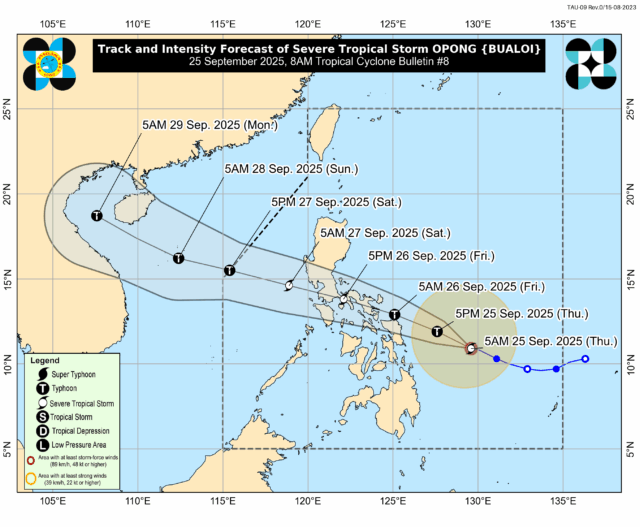
Malacañang and more than a dozen local governments suspended classes and government work on Thursday as Severe Tropical Storm Bualoi, locally named Opong, threatened to bring torrential rains and strong winds.

In a memorandum circular, the palace ordered the suspension of classes at all levels and government work in Sorsogon, Masbate, Northern Samar, Eastern Samar, Samar and Biliran. Similar directives were issued in Quezon province, Marinduque, Camarines Norte, Camarines Sur, Catanduanes and Albay.

In Metro Manila, several local governments followed suit. Valenzuela City halted all face-to-face classes, while Caloocan, Malabon, Taguig, and Pateros suspended preschool levels. Quezon City canceled in-person sessions for public preschools only.

Across the Bicol region, classes at all levels were also suspended in Albay, Naga City, and parts of Camarines Norte, Camarines Sur, Catanduanes, Masbate, and Sorsogon. In Eastern Visayas, Biliran, Tacloban City, Northern Samar, Eastern Samar, and other parts of Samar also suspended classes.

In Calabarzon, suspensions covered Laguna and parts of Batangas, Cavite, and Rizal, including the cities of Batangas, Calaca, Santo Tomas, Tanauan, Bacoor, Tagaytay, Lucena, and Antipolo. Other areas such as Dagupan City, parts of Pangasinan, Naujan in Oriental Mindoro, and Romblon also suspended classes at all levels.

The Philippine Atmospheric, Geophysical and Astronomical Services Administration (PAGASA) said in its 8 a.m. bulletin that Bualoi might intensify into a typhoon by Thursday. The cyclone could pass close to Northern Samar or make landfall over the Bicol Region by Friday morning or early afternoon.

Packing maximum sustained winds of 110 kilometers per hour (kph) and gusts of up to 135 kph, Bualoi was last spotted 365 kilometers east of Guiuan, Eastern Samar, moving west-northwest at 20 kph.

The Department of the Interior and Local Government placed more than a dozen local government units on heightened alert following orders from President Ferdinand R. Marcos, Jr. — Edg Adrian A. Eva

Ex-DPWH official tags more senators in flood-control scam

PHILIPPINE STAR/EDD GUMBAN

A former Public Works undersecretary has implicated more Philippine lawmakers in a multibillion-peso kickback scheme tied to flood-control projects.

At a Senate blue ribbon committee hearing on Thursday, former Public Works Undersecretary Roberto R. Bernardo named Senators Francis “Chiz” G. Escudero, Ramon “Bong” B. Revilla, Jr., and former Senator Maria Lourdes Nancy S. Binay as among those who benefited from budget insertions.

The lawmakers had demanded as much as 20% in commissions, he said, while also accusing Party-list Rep. Elizaldy S. Co of getting a cut from project funds.

Mr. Bernardo admitted his role in the scam. “I made a mistake and allowed myself to be used as a tool in wrongdoing,” he told senators.

Mr. Escudero was replaced as Senate president earlier this month after he admitted receiving campaign donations from a contractor but denied influencing contract awards.

Mr. Revilla has also denied any hand in the flood control scam, while Mr. Co, who is overseas, has called the allegations against him “false and baseless.”

Justice Secretary Jesus Crispin C. Remulla told reporters Mr. Bernardo has been granted provisional security as a “protected witness” while his application to the Witness Protection Program is under review.

Mr. Remulla urged senators to allow the Justice department to complete its assessment, citing the seriousness of the allegations. He said a protected witness is entitled to security and benefits while testifying, even before full admission to the WPP.

Becoming a state witness, however, requires a separate process and depends on the significance of the testimony in securing convictions.

The agency earlier provisionally accepted five others as protected witnesses: contractors Cezarah Rowena C. Discaya and her husband Pacifico F. Discaya and three former DPWH engineers — Henry C. Alcantara, Brice Ericson Hernandez and Jaypee Mendoza. The engineers remain under Senate custody pending evaluation, though Mr. Remulla said they would also be given security.

The Philippine Senate is investigating irregularities in the Department of Public Works and Highways’ (DPWH) flood-mitigation projects, which have received about P500 billion since 2022.

Critics have warned that corruption undermines disaster preparedness at a time when the Philippines, battered by an average of 20 storms annually, is ranked the world’s most disaster-prone country in the world. — Adrian H. Halili and Erika Mae P. Sinaking — Adrian H. Halili and Erika Mae P. Sinaking

Trump plans ‘America First’ foreign aid funding shift, document show

RAWPIXEL.COM-FREEPIK

WASHINGTON – The Trump administration intends to shift $1.8 billion in foreign aid funding toward “America First” initiatives such as pursuing investments in Greenland and countering “Marxist, anti-American regimes” in Latin America, according to a document sent to Congress.

“The national security interests of the United States require that the United States utilize these foreign assistance funds to meet new challenges in ways that make America safer, stronger, or more prosperous,” according to the Congressional Notification reviewed by Reuters on Wednesday.

The administration’s plan to shift the funding from programs previously authorized by Congress was first reported by The Washington Post.

A State Department spokesperson said the department looked forward to working with Congress “on America First Foreign Assistance,” saying foreign assistance programs must align with administration policies.

“The United States will prioritize trade over aid, opportunity over dependency, and investment over assistance,” the spokesperson said in an emailed statement.

President Donald Trump’s administration has been pursuing a massive overhaul of foreign assistance since the Republican began his second term in January. The strategy is a departure from the long-held assumption that food, medical and economic assistance is an important “soft power” component of US global influence.

In the notification, dated September 12, the administration says the $1.8 billion would be obligated for programs to “strengthen US global leadership,” to focus on several areas central to Trump administration policy.

These include diversifying critical mineral supply chains, promoting strategic infrastructure investment and development, countering China’s influence and “addressing the immigration crisis.”

The document says $400 million would support efforts involving Europe, including energy and critical minerals programming in Ukraine and economic development and conservation work in Greenland.

Trump has said he wants to take control of Greenland, a semi-autonomous territory within the Kingdom of Denmark. The strategically located island is rich in oil, natural gas and many minerals needed for high-tech industries.

In the western hemisphere, the document says, $400 million would support activities to end illegal immigration to the US, counter China’s dominance in critical minerals and artificial intelligence and “confront the Marxist, anti-American regimes of Venezuela, Cuba and Nicaragua.”

USAID DISMANTLED
Since January, the administration has dismantled the US Agency for International Development, frozen and then slashed billions of dollars of foreign aid, saying it wants to ensure US taxpayer money goes only to programs aligned with Trump’s “America First” policies.

The cutbacks effectively shut down USAID, leading to the firing of thousands of its employees and contractors. That jeopardized the delivery of life-saving food and medical aid and has thrown global humanitarian relief operations into chaos.

Senator Jeanne Shaheen of New Hampshire, the top Democrat on the Senate Foreign Relations Committee, said the plan outlined in the notification subverted Congress’ power, outlined in the Constitution, to control how government money is spent.

“Funding politically driven, unaccountable, pet projects in place like Greenland or using aid to pressure African governments on immigration is out of step with America’s foreign policy interests and an abuse of Americans’ tax dollars,” she said in a statement.

Aides to Senator Jim Risch, the committee’s Republican chairman, did not immediately respond to a request for comment.

In July, as he marked the formal transfer of USAID to the State Department as part of Trump’s unprecedented push to shrink the federal government, Secretary of State Marco Rubio said the US was abandoning what he called a charity-based model and would focus on empowering countries to grow sustainably.

Foreign aid traditionally has accounted for only about 1% of the federal budget. — Reuters

China plans 7-10% greenhouse gas reduction by 2035, Xi tells UN

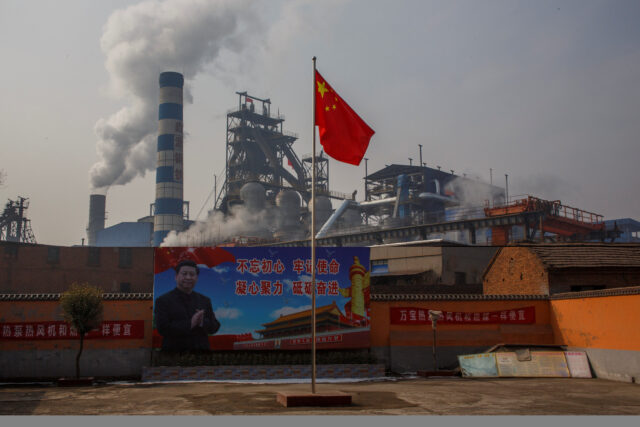
A poster showing Chinese President Xi Jinping is seen in front of the Xinyuan Steel plant in Anyang, Henan province, China, Feb. 19, 2019. REUTERS/THOMAS PETER

WASHINGTON/BEIJING – Chinese President Xi Jinping on Wednesday told the United Nations that by 2035, his country plans to reduce its greenhouse gas emissions by 7%-10% below its peak, and called out “some countries” for moving against the global clean energy transition.

Xi addressed a climate leaders’ summit hosted by UN Secretary-General Antonio Guterres in a live video message from Beijing, announcing China’s national climate plan ahead of the COP30 climate summit in Brazil in November.

Alongside the economy-wide emission-reduction goal, Xi said that within 10 years, China plans to increase its installed capacity of wind and solar power to over six times its 2020 levels. It also plans to boost its share of non-fossil fuels in domestic energy consumption to over 30%.

At the same time, he called on the world’s developed countries to take the lead in stronger climate actions. He referred, though not by name, to the U.S. for moving away from the goals of the Paris Agreement on climate.

“Green and low-carbon transformation is the trend of our times. Despite some countries going against the trend, the international community should stay on the right track, maintain unwavering confidence, unwavering action, and undiminished efforts,” Xi said, calling for increased global climate cooperation.

On Tuesday, U.S. President Donald Trump used his UN General Assembly speech to blast climate change as a “con job” and criticize EU member states and China for embracing renewable energy technologies.

Trump ordered a second withdrawal by Washington from the 10-year-old Paris Agreement on climate, which aimed to prevent global temperatures from rising beyond 1.5 degrees Celsius through national climate plans. The U.S. is the world’s biggest historical greenhouse gas emitter and second biggest current emitter behind China.

Environmental groups and observers said the announcements by some of the world’s biggest economies fell well short of where they should be in emissions reductions, given the rapidly worsening impacts of climate change.

Brazilian President Luis Inacio Lula da Silva, host of the upcoming UN climate summit, warned fellow leaders that the Belem gathering and the updates of national climate plans will show the world “whether or not we believe in what the science is showing us.”

Brazil has committed to reducing emissions by 59%-67% by 2035 and stepping up efforts to combat deforestation.

“Society is going to stop believing its leaders,” he said. “And all of us will lose because denialism may actually win.”

Guterres hosted the summit on the sidelines of the UN General Assembly. He has asked countries to announce their new climate targets.

“The Paris Agreement has made a difference,” Guterres said in prepared remarks. He added that since it was adopted in 2015, the projected rise in global temperature is now 2.6 degrees C, down from the projected rise of 4 degrees C before the Paris conference.

“Now, we need new plans for 2035 that go much further, much faster,” he said.

The European Union has not reached agreement on its new UN-mandated climate target in time for Wednesday’s summit, and has instead drafted plans to submit a temporary goal, which could change.

EU President Ursula Van der Leyen said at the summit that the EU is on track to reach its 2030 target of slashing emissions 55% by 2030 and said its 2035 reduction goal would range between 66% and 72%.

Australia, which plans to host a 2026 UN climate summit, announced a pledge that by 2035, it would slash greenhouse gas to between 62% and 70% below 2005 levels.

“We want to bring the world with us on climate change, not by asking any nation to forego the jobs or security that its people deserve, but by working with every nation to seize and share those opportunities,” said Australia Prime Minister Anthony Albanese.

Palau, representing the 39-member Alliance of Small Island States, announced its own goal of slashing emissions to 44% of 2015 levels by 2035. It reminded leaders of the advisory opinion issued by the International Court of Justice earlier this year that affirmed an “obligation grounded in international law” for governments to take stronger measures to curb their greenhouse gas emissions.

Surangel Whipps, president of Palau, called on major economies to take more aggressive action.

“Those with the greatest responsibility and the greatest capacity to act must do far more,” he said.

AMBITION FALLS SHORT
Li Shuo, director of the China Climate Hub at the Asia Society, said China’s announcement underwhelmed in light of its rapid production of renewable energy and electric vehicles.

“Beijing’s commitment represents a cautious move that extends a long-standing political tradition of prioritizing steady, predictable decision making but also hides a more significant economic reality,” he said.

But China’s dominance as a green technology superpower and Washington’s retreat from the clean energy transition could push China toward a more proactive role on the global stage, he said.

Teresa Anderson, Global Lead on Climate Justice at ActionAid International, said the EU’s “lowball statement of intent” signals a “deeper political sickness” reflecting a lack of will to push back against corporate polluters.

“Rich polluting countries like the EU must go much further in practice than these lowball statements of intent,” she said. — Reuters


US implements EU trade deal, 15% autos tariffs retroactive to Aug 1

REUTERS

WASHINGTON – President Donald Trump’s administration said on Wednesday it was formally implementing the US trade agreement with the European Union, confirming that a 15% duty rate for EU autos and auto parts began on August 1 and listing tariff exemptions for generic pharmaceuticals, aircraft and aircraft parts.

In a Federal Register notice, the Commerce Department and the US Trade Representative’s office said they have amended the tariff schedule to implement the framework agreement reached with the EU in July that lowers the Republican president’s tariffs to 15% on most imports from the EU, including autos.

The deal was subsequently modified to make the duty rate retroactive to August 1, but European automakers have been waiting for weeks for the formal US notice.

The US notice also specifies hundreds of products from the EU that are exempt from Trump’s new tariffs, including natural resources such as cork lacking in the United States, all aircraft and aircraft parts, and generic pharmaceuticals and their ingredients and chemical precursors.

The notice is in line with a previous Trump executive order that offered certain exemptions from his “reciprocal” tariffs and so-called Section 232 national security duties to countries that negotiate trade deals with the United States.

Among items that would be exempted for EU exporters are graphite, nickel, rare earths, magnesium and certain other metals, as well as hundreds of electronic and mechanical components that are used in aircraft production.

For EU autos and auto parts, the tariff rate dropped to 15% from 25% effective August 1, easing anxiety in an industry that had been waiting for the long-delayed confirmation in order to make sourcing decisions.

Shares in German automakers rose following the confirmation, reflecting relief over the formal implementation of a move announced almost two months ago.

Oliver Blume, CEO of Volkswagen, Europe’s largest carmaker, had said last week that the actual lowering of US auto import tariffs from August was still subject to talks between the United States and EU, and could take several weeks.

Shares in luxury sportscar maker Porsche , which has no production sites outside Europe, were up about 2.2%, while BMW and Mercedes-Benz rose 1.4% and 1.1%, respectively. — Reuters