Home Blog Page 9545

SMC delivers donated testing booths, kits to LGUs

SAN MIGUEL Corporation (SMC) said it has started donating COVID-19 testing booths to the cities of Mandaluyong, Pasig, and Manila, as part of its commitment to boost the testing capacities of all Metro Manila local government units (LGUs).

In a statement, the conglomerate said it turned over 24 testing booths to Mandaluyong, Pasig and Manila.

More testing booths will be delivered to other LGUs next week.

SMC is also donating 34,000 or P3 million worth of rapid tests using the technology called PCR (polymerase chain reaction) to the LGUs.

“With these donations, we hope to help boost testing particularly in our less-fortunate communities where many underprivileged families are extra vulnerable, due to their living conditions,” SMC President Ramon S. Ang said.

Mr. Ang said testing should be free for all poor families. He said the price of testing should be regulated to make it more affordable for Filipinos and small companies that need to test employees before they can go back to work.

Phoenix unit to start selling US-made gensets

A UNIT of Phoenix Petroleum Philippines, Inc. will start selling gas-powered generator set (genset) units, targeting companies in hospitality and manufacturing sectors.

In a statement, Phoenix Pilipinas Gas and Power, Inc. (Phoenix Gas) said it will bring the first batch of the gas-powered gensets to the country in June.

The gensets are manufactured by US-based Mesa Natural Gas Solutions, LLC., and will be distributed by Phoenix Gas in the Philippines.

The three gensets each have a 350-kilowatt maximum capacity. It will use liquified natural gas (LPG) to be supplied by Phoenix LPG Philippines, Inc.

The company said the gensets are designed to enable remote performance monitoring on a real-time basis, sporting also on-site troubleshooting features.

“We are happy to share that amid the ongoing crisis, Phoenix Gas and Mesa have finished developing our gas-powered gensets, which are now en route to the Philippines for utilization. We are optimistic about the future of these types of gensets in the country, and we hope that this will signal the revolution towards a cleaner and more reliable power source,” Phoenix Gas President Henry Albert Fadullon said in the statement. — A.J. Ang

IC outlines regulatory relief for insurers

THE Insurance Commission (IC) eased rules on insurance firms’ quarterly compliance with the minimum net worth requirement and also announced other relief measures to help companies stay afloat amid the coronavirus crisis.

The IC issued Circular Letter No. 2020-60 on Friday relieving insurance companies from quarterly compliance with the P900 million minimum net worth requirement.

However, the IC said only those already compliant with the requirement as of end-December are immediately to avail of this regulatory relief measure.

Meanwhile, those that have failed to comply before the enhanced community quarantine was declared last March 17 can only avail of the relief once they “put up additional funds to cover the net worth deficiency.”

Under Republic Act No. 10607 or the Insurance Code, insurers must have a net worth of at least P900 million by Dec. 31, 2019 and P1.3 billion by Dec. 31, 2022. New players must have at least P1 billion in paid-up capital.

While insurers still need to comply with the minimum risk-based capital (RBC) ratio, the IC also relaxed the levels of regulator intervention based on the company’s level of compliance.

For instance, companies with RBC ratio of over 100% will no longer require regulatory action but if the ratio falls below 25% level, IC can still, and is required to, take control of the company.

IC said the submission of 2020 RBC2 reports will be on Aug. 31 for the period ending June 30, Nov. 30 for the period ending September and on April 30, 2021 for the period ending December 2020.

The insurance regulator said the economic fallout from the coronavirus disease 2019 (COVID-19) pandemic is expected to impact policyholders, counter-parties and agents.

“Insurance companies may be affected in a variety of ways such as exposure to declining revenues, unprecedented volatility in the stock market, interest rate changes, increased claims, credit risks, supply chain and service disruptions, and the overall decrease in the value of assets and investments,” the circular, issued by IC Commissioner Dennis B. Funa, read.

“These events could depress the solvency position of insurance companies. This Commission values the importance of insurance companies to stay in business as they provide a primary source of financial protection to the society and economy,” it added.

In a separate directive, the IC also extended the period agents sell online or via information and communication technology (ICT) until the end of the year from the initial end-June rule to give both life and non-life insurance companies more selling options amid the ongoing COVID-19 pandemic.

The insurance industry’s premiums rose 2.76% to P224.97 billion at the end of September 2019.

The life insurance sector accounted for P172.05 billion of net premiums written in the period, while the non-life sector generated P44.02 billion. — B.M. Laforga

Inflows boost PHL net external liability position

CONTINUED investment inflows pushed the country’s net external liability position wider in the fourth quarter of 2019, backed by optimism among foreign investors.

The country’s international investment position (IIP) stretched to a net external liability of $34.8 billion as of end-December 2019 from the $33.5 billion logged as of end-September, the Bangko Sentral ng Pilipinas (BSP) said in a statement.

On the other hand, net external liability dropped 28.3% compared to the $48.6 recorded as of end-2018.

The IIP takes stock of a country’s financial claims and liabilities.

The BSP said the 2.2% rise in total external financial liabilities to $231.9 billion — which surpassed the 1.9% growth in total external financial assets — boosted the net external liability position of the country.

“The increase in the country’s net external liability position reflected continued inflows on the back of investor confidence in the Philippine economy,” the BSP said.

The country’s total external financial liabilities rose by $5.1 billion as of end-December 2019 on a quarterly basis. This was on the back of transaction inflows, particularly in the form of foreign direct investments (FDI) in equity capital and debt instruments, coupled with positive exchange rate and other valuation adjustments, according to the central bank.

Total foreign financial assets also inched up by $3.7 billion quarter-on-quarter backed by the accumulation of reserve assets, combined with the increase in the amount of residents’ direct investments abroad.

As of end-2019, only the BSP posted a net external asset position of $86.8 billion. Other sectors including the general government and deposit-taking corporations recorded a net external liability position.

The BSP also continued to keep the largest stock of the financial assets of the Philippines at $88.1 billion or 44.7% of the total as of end-2019.

Meanwhile, other sectors held 38.5% or $75.8 billion of the country’s external financial assets. Banks held the remaining 16.8% or $33.1 billion.

According to the central bank, 44.6% of the foreign assets were reserves held by the BSP at $87.8 billion.

“Direct investments accounted for about a third of the country’s external financial assets in the form of debt instruments amounting to $32.7 billion (16.6%) and equity capital and investment fund shares totalling US$25.2 billion (12.8%),” the BSP said.

Rizal Commercial Banking Corp. Chief Economist Michael L. Ricafort said the ongoing coronavirus pandemic may affect the country’s financial claims and liabilities.

“In view of COVID-19 (coronavirus disease 2019) lockdowns that led to economic contractions and risk of recession globally, foreign investments into the country could potentially slowdown amid reduction in capital expenditures by some of the biggest global companies caused by reduced economic activities,” Mr. Ricafort said in an email. — L.W.T. Noble

Peso weakens on oil, remittances

THE PESO weakened against the greenback on Friday after the latest correction in oil prices and the slower growth in cash remittances in February.

The local unit finished trading at P50.76 per dollar on Friday, weakening by 31.5 centavos from its P50.445 close on Thursday, according to data from the Bankers Association of the Philippines.

Week on week, it also shed 34 centavos from its close of P50.42 last May 8.

The peso opened the session at P50.76 per dollar, which was also its weakest showing for the day. Meanwhile, its intraday best was at P50.46 against the greenback.

Dollars traded rose to $849.9 million from the $565.51 recorded on Thursday.

The local unit’s depreciation came after correction in global oil prices, according to Rizal Commercial Banking Corp. Chief Economist Michael L. Ricafort.

“The peso closed weaker after the latest increase in global oil prices to near 1.5 month highs amid record output cuts,” he said in a text message.

Reuters reported that oil prices continue to mark gains after crude demand starts to recover in China amid easing of curbs to prevent the virus spread.

Brent crude was up 39 centavos, or 1.3% at $31.52 a barrel by 0333 GMT on Friday, after rising nearly 7% on Thursday. The global benchmark is going further for a 1.8% gain on the week after rising for the previous two weeks.

Moreover, West Texas Intermediate (WTI) oil was up 19 centavos, or 0.7%, at $27.75 a barrel. WTI is heading for a third weekly increase, up more than 12%.

These higher prices came amid supply cuts by the Organization of the Petroleum Exporting Countries (OPEC) and other major producers as well as the higher demand specifically in China.

Meanwhile, cash remittances rose by 2.6% to $2.358 billion in February from the $2.648 billion seen a year ago, according to data from the Bangko Sentral ng Pilipinas. This is slower compared to the 6.6% pace seen in January.

On the other hand, a trader said the peso’s weakness came after risk-off sentiment following US data on job claims.

“The peso depreciated following the stronger-than-expected US initial jobless claims report overnight which elevated concerns over persistent weakness in the US labor market,” the trader said in an email.

A US Labor Department report on Thursday showed that initial claims for state unemployment benefits amounted to a seasonally adjusted 2.981 million for the week ended May 9.

This is in comparison to the 2.5 million applications forecasted by Reuters. The higher-than-expected number was partly boosted by Connecticut, which incorrectly reported data for last week. — L.W.T. Noble with Reuters

Local shares decline on fresh US-China tensions

THE main index gave up its gains on Friday and settled at the 5,500 level, as increasing tensions between the United States and China pushed investors away from the local bourse.

The 30-member Philippine Stock Exchange index (PSEi) erased 112.75 points or 1.99% to close at 5,541.95 on Friday. The broader all shares index shed 52.04 points or 1.52% to 3,356.61.

“The market shed almost 2% today as investors reacted to the implications resulting from the latest developments in the US-China telenovela,” PNB Securities, Inc. President Manuel Antonio G. Lisbona said in a text message.

“This time, the US extended sanctions on Huawei on top of it blaming China for the pandemic, which in turn caused worries that another cycle of retaliatory actions will worsen an already weakened global economy,” he said.

US President Donald Trump further stretched the country’s already brittle relationship with China as he said he was looking at cutting off relations with the Asian economic giant.

In an interview with Fox Business on Thursday, the American president said he doesn’t want to talk to Chinese President Xi Jinping as he blames the country for supposedly mishandling the coronavirus disease 2019 (COVID-19) pandemic.

The US has been the epicenter of the COVID-19 pandemic since March, which now has 1.4 million cases and more than 85,900 deaths due to the virus. US Federal Reserve Chair Jerome Powell said earlier that the economic toll of the pandemic to the country is seen to last for an extended period, which has already seen a historic job loss of more than 20 million in April.

In the Philippines, gross domestic product (GDP) hit a snag in the first quarter as the economy contracted 0.2% for the first time since 1998. The government expects GDP to fall as much as 3.2% this year as the COVID-19 pandemic lingers.

“Looking at the charts, the market has been consolidating in a tight range between 5,500 and 5,680 for May and could be indicative that investors have already priced in gloomy results for 2Q (second quarter) 2020,” Mr. Lisbona said.

“Our more pragmatic clients have actually written off 2020 altogether, with some opting to observe and react to developments as the country eases out of quarantine into a new normal,” he added.

Sectoral indices at the PSE were mostly in red territory on Friday. Property shaved off 94.15 points or 3.23% to 2,815.65; holding firms removed 116.19 points or 2.09% to 5,437.09; financials dropped 22.06 points or 1.91% to 1,129.40; mining and oil fell 45.07 points or 0.99% to 4,505.48; and industrials slid 63.51 points or 0.83% to 7,506.67.

The services index was the sole gainer with an increase of 2.32 points or 0.17% to 1,314.04 at the end of trading.

Volume on Friday was thinner at 660.43 million issues from 1 billion the previous session, but value turnover grew to P4.53 billion from P3.77 billion.

Decliners outnumbered advancers, 103 against 70, while 46 names ended unchanged.

Net foreign selling rose to P654.56 million from P367.02 million a day ago, marking the eight day offshore investors exited the local bourse. — Denise A. Valdez

Lessons from the Valley: Twitter allows work from home indefinitely

While Twitter has long offered work-from-home arrangements to its workforce, the COVID-19 pandemic has seen a significant expansion of that model, with more employees conducting more critical functions remotely. In an internal email sent yesterday, Twitter CEO Jack Dorsey announced that employees looking to continue working from home may do so indefinitely.

“We were uniquely positioned to respond quickly and allow folks to work from home given our emphasis on decentralization and supporting a distributed workforce capable of working from anywhere,” Twitter representatives confirmed in an email to TechCrunch.

“The past few months have proven we can make that work,” they said. “So if our employees are in a role and situation that enables them to work from home and they want to continue to do so forever, we will make that happen. If not, our offices will be their warm and welcoming selves, with some additional precautions, when we feel it’s safe to return.”

Jennifer Christie, Twitter’s chief human resources officer, outlines the company’s plans:

  • Opening offices will be our decision; when and if our employees come back, will be theirs.
  • With very few exceptions, offices won’t open before September. When we do decide to open offices, it also won’t be a snap back to the way it was before. It will be careful, intentional, office by office and gradual.
  • There will also be no business travel before September, with very few exceptions, and no in-person company events for the rest of 2020. We will assess 2021 events later this year.

Twitter’s move is in line with similar setups being extended by other major companies like Google and Facebook, all towards building more resilient systems for the current pandemic. Beyond COVID-19 and in the years to come, these may lead to new opportunities for global tech workers interested in joining top firms but unable or unwilling to relocate to expensive US cities.

Women leaders shaping AI honored by IBM

You hail rides using your phone; you rely on algorithms to decide what food to order; you get help from Siri and Alexa with your tax computations—artificial intelligence (AI) has become as regular a part of our days as the Internet. But despite its prevalence in the lives of nearly every person in the world today, the development of this technology is hardly inclusive.

A global study by Morning Consult of more than 3,200 AI professionals found that women in AI worldwide were nearly five times as likely as men to say their career advancement was negatively impacted by their gender. Moreover, 74 percent of AI professionals who believe diversity hasn’t improved say the industry must become more diverse to reach its potential.

In a Think Digital 2020 pre-conference event, Rob Thomas, Senior Vice President of IBM Cloud & Data Platform, noted the current gender gap: “Only 26% of professionals in AI are women, according to the World Economic Forum, and that needs to change. We need more diversity of thought.”

Women Leaders in AI

IBM’s Women Leaders in AI program was created last year to help provide visibility to women leading in AI, encourage increased female participation in the field of AI, and provide honorees a network for shared learning. Recognizing leaders spearheading AI initiatives and learning from their experiences in building AI that’s inclusive and transparent becomes even more crucial in this time of digital transformation.

This year’s Women Leaders in AI list recognizes 35 exceptional female business leaders from 12 countries who are using artificial intelligence to drive transformation, growth, and innovation across industries.

“Artificial intelligence will be at the center of business transformation over the next decade, and for us to mitigate bias moving forward we need women and diverse teams at the forefront of AI. That’s why we are proud to share the stories of 35 remarkable women who are driving progressive use of AI using Watson,” said Michelle Peluso, IBM’s Senior Vice President for Digital Sales and Chief Marketing Officer. “Their accomplishments are an inspiration to all of us.”

The 2020 women leader honorees include:

  1. Tiphanie Combre, Senior Director, AI Assisted Service and Automation, ADP (U.S.)
  2. Amy Shreve-McDonald, Lead Product Marketing Manager for Business Digital Experience, AT&T (U.S.)
  3. Mara Reiff, Vice President, Strategy and Business Intelligence, Bell Canada (Canada)
  4. Tammy Lucas, Vice President of Marketing, Best Western Hotels & Resorts (U.S.)
  5. Sheila Ambruster, Senior Manager, Strategic Architecture, The Boeing Company (U.S.)
  6. Claire Lucas, Head of Artificial Intelligence, Bouygues Telecom (France)
  7. Rosa Martinez, Cognitive Project Manager, CaixaBank (Spain)
  8. Michèle Brengou, Cognitive Factory Business Leader, Crédit Mutuel (France)
  9. Ashley Lawrence, Research and Innovation Project Manager, Defense Counterintelligence and Security Agency (U.S.)
  10. Maiga Bishop, Director of Business Intelligence and Analytics, Dillard’s (U.S.)

The full list can be found here.

BUSINESSWORLD INSIGHTS: Philippine stock market amid COVID-19 crisis

By Adrian Paul B. Conoza
Special Features Writer, BusinessWorld

At the beginning of the year, many were looking forward to a very productive stock market.The coronavirus disease 2019 (COVID-19), however, has brought these expectations down.

This has been the observed sentiment among the panelists in the third leg of the phase 1 of BUSINESSWORLD INSIGHTS held last May 13. Moderated by BusinessWorld’s research head Leo Uy, the online forum had Ramon Monzon, president and chief executive officer (CEO) of the Philippine Stock Exchange (PSE); April Lynn Tan, CFA, vice-president and head of research at COL Financial; and Japhet Louis Tantiangco, senior research analyst at Philstocks Financial, Inc., in the panel.

While the panel recognized the drastic impact of COVID-19 on the stock market, they shared insights on where it can be headed to, as well as what investors and traders can do in order to deal with the present crisis.

Optimistic outlook


Mr. Monzon shared that at the start, the PSE was eagerly looking forward to a very good year, especially with the rules and regulations on real estate investment trusts (REITs) set in place.

The COVID-19 pandemic as well as the imposed Luzon-wide lockdown, however, have lowered this anticipation, as he pointed out in the market drop earlier in March.

“The market drop this year was so sudden and steep, resulting in PSE’s circuit breaker being triggered three times in one month alone: on March 12, 13, and 19,” he said.

In spite of the situation, however, the PSE president and CEO finds certain ‘silver linings’ that give the market hope.

“[A]n optimist will note one thing positive,” he said regarding the market drop. “That is the index has gone up 22.2% from its lowest close reach.”

Even as he found that the Philippine stock market has been the worst-performing market in Asia, Mr. Monzon remains optimistic, stressing that “when you’re at the bottom, there’s no other way to go but up.”

While he finds no silver lining in the drop of average value turnover to 12.8% last year, coupled with the decline in trading activity for April and May to more than the five billion level, Mr. Monzon finds one in the contribution of foreign selling (from net selling amount of 14.3 billion in 2019 to a “staggering” 52.5 billion in May 2020) to the big drop in the market.

“Local investors apparently have taken up the slack left by foreign investors in the market,” he explained. “For 2019, local investors accounted for 44.6% of the trading volume. Now, they account for 46.8%”

Increased local participation augurs well for the market, he stressed, as it will leave the market less vulnerable to the political or economic issues or events in the international arena.

Mr. Monzon further expressed his optimistic outlook for the market as he looked back at previous crises that have gravely impacted the market, namely the Asian financial crisis in 1997, the political crisis between late 2000 and early 2001 when there was a change in the president, the dot-com bubble in 2001, and the global financial crisis in 2008.

During the 1997 crisis, he recalled, the market declined by 69%. After the two following crises, the market further dropped by 62% in 2001. Then, during the 2008 crisis, the market dropped 57%.

The Asian financial crisis, he added, took 106 months to recover, since while on its way to recovery, the political crisis and the dot-com bubble suddenly hit the market. The 2000 political crisis took them 68 months to recover to the previous peak, while the 2008 crisis took just 23 months to recover.

“During the 1997 financial crisis, from the intraday low…after one month, the index was up by 23%; after three months by 68%; after six months by 81%; and 12 months by 95,” he further explained.

“For the 2008 global financial crisis, after hitting the low of 1,684 on October 28, the index after one month was up 17%; up 11% after three months; 23% after six months; and 73% after 12 months.”

Comparing these to the COVID-19 crisis, he pointed out that from an intraday high of 9,078 in January 2018, the market hit a low intraday of 4,039 last March 19, a drop of 56%.

In one month’s time, he nonetheless stressed, the market recovered 43%. “We’ve been able to always recover and even reach higher levels after we recovered,” he concluded.

Careful and patient buying
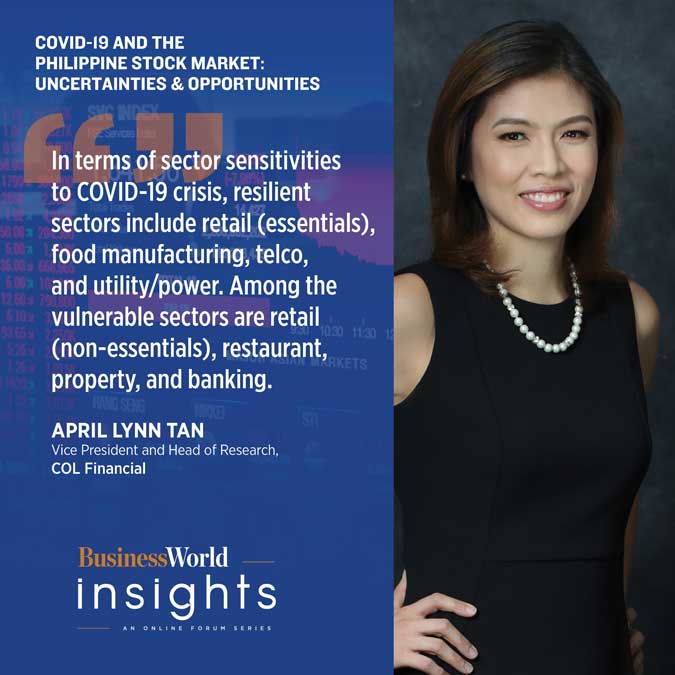

COL Financial’s Ms. Tan probed the stock market’s performance, especially its strong rally after hitting its low to reaching 5,651.67 on May 12.

She attributed this rally to the peaking of the number of cases, the showing of possible treatments to COVID-19, as well as the aggressive activity of central banks, especially the United States’ Federal Reserve.

This rally, however, is not expected by Ms. Tan to be sustained as she found that COVID-19’s economic impact will be severe, the valuations of stocks are cheap albeit still far from past bear market bottoms, and foreign investors remain net sellers.

“Our first quarter GDP was down 0.2%, disappointing a lot of investors and economists,” she explained on the economic impact. “Only government spending was strong. It was not even that strong. Going forward, we will still see household consumption and investments and exports remaining weak.”

The COL Financial executive advises investors to not chase prices and to buy slowly, since there is an apparent temptation to throw caution to the wind in a strong market.

“While the market’s going up, you stay on the sidelines and wait for them to go down again and buy,” she continued. “When you buy today, think long term. I don’t think you should try to make gains in the short term, or expect to be profitable right away.”

She also suggests diversifying and limiting one’s size to an amount which they should be ready to hold on to.

She also recommends sticking to resilient sectors at present, which include retail(essentials), food manufacturing, telecommunications, and utility/power.

On the other hand, she finds the retail (non essentials), restaurant, property, and banking as the vulnerable sectors.

For Ms. Tan, indicators that would point to the new normal will serve as the main catalysts that will help the market bounce back from the crisis. These indicators include a vaccine that will treat COVID-19 and herd immunity.

Climbing from the slide


A precipitous slide in the stock market was observed by Mr. Tantiangco of Philstocks Financial, pointing out to the crossing of the 50-day exponential average below the 200-day exponential average.

“The precipitous slide…will have a lasting impact on market psychology. Most investors, especially new ones, would choose to shy away from the market or either secure gains as quickly as possible as per the principle of loss aversion,” he later noted.

As the market entered the year with mixed narratives like the initial deal between US and China and fears experienced from regulatory risks, it maintained a sideways movement until COVID-19 came, he added.

“This pandemic and its expected adverse effects to the economy, which we already saw in the first quarter GDP, has brought us down year-to-date by about 50%. It’s almost a 50% decline in less than a quarter,” he said.

The market’s recent rally was also pointed out by Mr. Tantiangco, as it tried to bounce back from its bottom of a little above 4,600 and reached a high of a little above 5,900. He attributed this to the government’s efforts in curbing the economic impact of COVID-19, among other factors.

Another decline was observed, however, which is found to be giving the market a hard time breaching the 5,700 resistance level.

“To add insult to the injury, we’ve already broken below the lower bound of that uptrend channel, which is a bearish signal, indicating that in the near future, we would likely have a consolidation within that 5,300 to 5,700,” he added.

In comparison to previous crises, the senior research analyst finds the COVID-19 unique in being both a health and economic crisis.

“[When] before, we were only dealing with one problem…right now we’re getting hit by a twin dagger,” he said. “This calls for, of course, two solutions: the health solution and the economic solution.”

Given the situation, Mr. Tantiangco advises going back to the core guiding principles of the market.

“[T]here will always be opportunities as long as we employ the right strategies and manage our risks well and stick with the core principles, becauseat the end of the day, they are what matters most,” he said.

He also hopes that investors and traders have taken the opportunity to learn in terms of managing risks; to cut losses when needed; and to throw away market psychological biases such as overconfidence, herd mentality, and loss aversion.

Moreover, he recommended sectors to look into under three categories: companies whose products have elastic demand; companies that enjoy a lesser degree of competition; and stocks with silver lining opportunities, considering the new normal amplifying “a louder call for the use of digital space” for online transactions like e-commerce and e-learning.

“Those companies which will be able to find opportunities out of these, they will likely be the new favorites of the market, so just watch out for them,” he noted.

The phase 2 of BUSINESSWORLD INSIGHTS will tackle “Winning the Fight: COVID-19 Lessons,” starting May 27. The online forum can be viewed in the Facebook pages of BusinessWorld and The Philippine STAR.

BUSINESSWORLD INSIGHTS is made possible by sponsors SM, Megaworld Corporation, Globe Telecom, PayMaya, and National Home Mortgage Finance Corp.; eLearning platform partner Olern; partner organizations Management Association of the Philippines, Philippine Chamber of Commerce and Industry, Philippine Association of National Advertisers, and Bank Marketing Association of the Philippines; and media partner The Philippine STAR.


The view of young professionals on the COVID-19 landscape

Sharing ways to cope and post-pandemic expectations

For the millennial generation, this coronavirus pandemic would be considered the first crisis they have encountered as part of the workforce. Young professionals in the real estate industry from different parts of Asia shared their insights on how their countries and companies responded to the outbreak, ways to cope and stay connected, and what the ‘new normal’ would be like once quarantine is gradually lifted.

In a webinar held by Urban Land Institute Philippines (ULI) Young Leaders Group (YLG) on April 17 titled “YLG Philippines Webinar: Coping Up with a Global Crisis”, millennials in the real estate sectors discuss their thoughts and observation as well as guides on how to positively emerge from the COVID-19 crisis.

The webinar began with the presentations from ULI-YLG representatives in Hong Kong and Japan. Kelly Mai, co-chair of ULI-YLG Hong Kong, started by presenting how the Hong Kong government responded to the outbreak from January to April. She shared that companies have provided employees the necessary tools, equipment, and software to be able to work from home. As for what’s next, she stated to look for opportunities, “Because of time, we get to sit down and think about what would be the next opportunity for the young professionals.”

As for the status in Japan, ShinsukeNuriya, chair of ULI-YLG Japan and director of Head of Investment at Patience Capital Group K.K, gave an overview of the situation in the country and talked about the impact of COVID-19 on the real esatemarket in Japan. He shared that commercial tenants are mostly suffering from financial stress, office demand is declining, and there has been an increasing number of rent reduction requests. Mr. Nuriya’s thoughts and observations after the pandemic boils down to leveraging technology and digital transformation for a contact-free economy. “In order to take advantage of this opportunity, we need to be creative and also innovative,” said Mr.Nuriya as he ended his presentation.

During the roundtable discussion, MikkoBarranda, chair of ULI-YLG Philippines and associate director of Leechiu Property Consultants, provided his insights on the question of whether his company was prepared for the crisis or not. He shared, “At least for our firm, we believe that active and sometimes over-communication is key in situations that are uncertain. Early on, we put together a safety risk management group. We had representatives from different departments to be part of that platform and it’s used to disseminate, streamline information, reinforce and get people as much knowledge, security, and stability as possible. What we need to keep in mind in situations such as what we have today is really having flexibility.”

Responding to the same question, Founder and Managing Director of Plaza + Partners Inc. Rebecca Plaza expressed the difficulty of not having face-to-face meetings. She mentioned, “When we started the work from home, the pace of work is not the same as what it is like when you’re actually in the office.” Due to the lack of activity brought by the enhanced community quarantine in the Philippines, she and her team worked together during this period and proceeded to create their prototype quarantine facility.

As to how these young professionals stay motivated and cope through COVID-19 in their day-to-day life, leisure and wellbeing activities were at the top; meditation and yoga, playing Nintendo switch video games, online drinking parties via Zoom, among others. Harly Geraldine Pow, director of H.S. POW Construction and Development Corporation / Wellworth Properties and Development Corporation, explained how staying connected through social media platforms has allowed her to gain insight on the experience of people in other countries, “I also believe that technology keeps us not just only informed and productive but also connected. Because of technology, I’m able to stay in touch with my friends and contacts from other countries, and you actually learn from hearing their experiences.”

With regards to the question of staying motivated, Mr.Barranda advised: “It’s normal to not have all the answers today, it’s normal to feel confused or to feel sad during this time.” He stated that this period can be a time to reflect and look at it as an opportunity to build relationships with partners and clients.

Lastly, on their outlook on what new trends may emerge from this situation, they all similarly expressed aspects that would correlate to practicing social distance in public spaces, heightened safety protocols at work, and a new norm for working.

GT Capital Holdings, Inc. to conduct virtual stockholders’ meet on June 5

The 2020 Annual Stockholders’ Meeting of GT Capital Holdings, Inc. will be conducted virtually on June 5, 2020 at 2 p.m.

Metro Manila police chief faces charges for lockdown breach

PHILIPPINE police were readying charges against Metro Manila’s police chief for violating lockdown rules when he celebrated his birthday with friends amid a lockdown meant to contain a coronavirus pandemic, the presidential palace said on Thursday.

“The PNP is also getting clearance from the Office of the President regarding the filing of administrative charges in violation of quarantine rules against the alleged violators,” presidential spokesman Harry L. Roque said in a statement.

He was referring to National Capital Region police chief Debold M. Sinas and his well-wishers.

The clearance was needed because Mr. Sinas and the senior police officials at his birthday are presidential appointees, Mr. Roque said.

Mass gatherings are prohibited and physical distancing must be observed during the pandemic.

Police were finalizing the charges against Mr. Sinas, at least two one-star generals and members of the National Capital Region Police Office (NCRPO) command group in connection with the birthday bash, spokesman Brigadier General Bernard Banac said in a Viber message yesterday.

“The filing of charges will be done by the Internal Affairs Service (IAS), which is now finalizing its investigation,” he said.

The charges were likely to be filed at the Taguig Prosecutor’s Office on Friday, IAS Inspector General Alfegar Triambulo said by telephone.

Police would use photographs taken during the event as their main evidence, he said.

The pictures, which were uploaded on the NCRPO’s Facebook page but later taken down, had been authenticated by police officers who attended the event.

Mr. Roque said Executive Secretary Salvador C. Medialdea had separately ordered a probe by the Philippine National Police Internal Affairs Services.

Justice Secretary Menardo I. Guevarra earlier said the National Bureau of Investigation would probe the incident, adding that state agents must “enforce the laws fairly.”

Interior and Local Government Secretary Eduardo M. Año had called the event “uncalled for,” adding that government officials should observe “delicadeza.”

Mr. Año, who supervises the police, said he would leave it up to the Philippine National Police to investigate the event and find out if violations had been committed.

The PNP in a statement on Wednesday said police chief General Archie Francisco F. Gamboa had ordered the inspector general of the Internal Affairs Service to investigate alleged violations of quarantine protocols.

Mr. Sinas has issued an apology, saying it was a “traditional mañanita” conducted by some officers and the accommodation was done “with all cautiousness.” He said he never meant to disobey any quarantine protocols on the coronavirus. — GMC and Emmanuel Tupas, Philippine Star

ADVERTISEMENT
ADVERTISEMENT