Home Blog Page 9540

Durian sales suffer from lockdowns

DOMESTIC demand for durian, typically high during the harvest season in April and May, fell sharply this year due to lockdowns impose during the coronavirus disease 2019 (COVID-19) crisis.

“People are staying at home,” Candelario B. Miculob, former president of the Davao Durian Industry Association Council, said in an email interview.

He said growers had a good crop this season but sales have been low.

“The enhanced community quarantine and the subsequent lockdown due to COVID-19 have greatly affected our sales,” he said.

He added that vacuum-packed frozen durian exports to the US, which started in October, have been suspended as there are no flights to deliver the product.

“As of now, we cannot export to the US due to airport lockdowns,” Mr. Miculob said. Exporters are hoping to resume shipments during the August–October harvest season. — Maya M. Padillo

Stuff to do at home (05/18/20)

Ugnayan sa Sining: Perlas ng Silangan

CCP Online’s sixth week of online programming continues with the Ugnayan sa Sining: Perlas ng Silangan on May 19, 3 p.m. It features four prominent regional performing groups, namely the Integrated Performing Arts Guild (IPAG) of MSU-IIT in Iligan City, the Maskara Theater Ensemble of USLS Bacolod, the Sinukwan Kapampangan Performing Arts from Angeles City, Pampanga, and the Philippine Baranggay Folk Dance Troupe Rondalla from the National Capital Region. Watch for free at bit.ly/CCPOnlineYT.

Tanghalang Ateneo’s Lysistrata ng Bakwit

Tanghalang Ateneo’s Lysistrata ng Bakwit (2018), an adaptation of Aristophanes’ Greek classic, is available for viewing online at https://www.youtube.com/watch?v=S8HhUJTXE2A&feature=emb_title. Directed by Ricardo Abad, the story is set in a fictional war-torn Philippine province and follows the revolt of women evacuees fighting their own wars concerning territory, familial ties, and tribal disputes.

Ayala Museum online

Ayala Museum offers a week of online activities from May 18 to 23 in celebration of this year’s International Museum Day. The activities are as follows: the screening of the film Millennium of Contact on May 18 (is will be available for 48 hours); the Ayala Museum x Animal Crossing Island exhibition on May 20 to 22; Kids Curate: Make Your Own Exhibition on May 22; and a virtual tour of the exhibit Fernando Zobel: Toward Abstraction on May 23. For more information, visit https://www.facebook.com/ayalamuseum/.

Shelter fund’s photography

The Shelter Fund gives freelance photographers a venue to exhibit their art for sale amidst the challenges posed by the quarantines. Each print is an original signed artwork specially selected by the photographer for the Shelter Fund, and printed on archival, heavyweight paper in A2, A3, A4 and A5 sizes through Shutterspace Studios. Visit the Shelter Fund on Instagram at https://www.instagram.com/shelterfund and on Facebook at https://www.facebook.com/shelterfundph.

National Museum of the Philippines

The National Museum of the Philippines releases a new illustration by Larie Dianco featuring the dugong or “sea cow.” Download the coloring sheet at https://www.facebook.com/nationalmuseumofthephilippines/photos/a.195151237175869/3239298052761157/?type=3&theater.

Jagged Little Pill cast and Alanis Morrissette live

Enjoy performances with the cast of the musical You Live, You Learn: A Night with Alanis Morissette and Jagged Little Pill which will live stream on May 19 (8 p.m. ET). For more information, visit https://bit.ly/JLPLivestream

The National Theatre

Inua Ellams’ Barber Shop Chronicles is currently streaming on the National Theatre’s YouTube channel. Directed by Bijan Sheibani, the show will be available until May 21. To watch, visit (https://www.youtube.com/user/ntdiscovertheatre).

The Royal Opera House online

As part of its #OurHousetoYourHouse, the Royal Opera is now streaming Kenneth MacMillan’s Anastacia at its official Facebook page (https://www.facebook.com/royaloperahouse/). The show stars Natalia Osipova, Edward Watson, and Thiago Soares.

Portrait for a cause

THE Gateway Gallery brings back “ArtHeals Portrait for a Cause” to support Araneta City’s #TogetherWeHeal campaign and help families affected by the COVID-19 crisis. Get a free portrait in digital format upon donating a minimum amount of P1,050 to the #TogetherWeHeal donation drive from May 15 to 22. Gateway Gallery’s artist friends Cee Cadid, Raks Molata, Naning Molata-Gavin, Joem Chua, Ronald Lopez, Dave Temperamente, Joseph Espino, and Adrian Karl Gutierrez will render the donor’s portraits in gratitude for the support. To join: 1.) make a donation through http://bit.ly/AranetaDonationDrive; 2.) send proof of donation and a clear photo reference to gatewaygallery@aranetagroup.com; 3.) then portraits in digital format will be sent through e-mail. The #TogetherWeHeal campaign was launched by Araneta City on March 31 in partnership with J. Amado Araneta Foundation, Binibining Pilipinas Charities Inc., and TicketNet. It aims to help indigent Filipino families who have difficulty accessing basic food needs due to the COVID-19 pandemic. A donation of P350 translates into one food pack that contains two kilos of rice, canned goods, packs of noodles, and vegetable seed packets provided by the Department of Agriculture’s Bureau of Plant Industries. Interested donors may donate to the #TogetherWeHeal campaign until June 15.

Jerrold Tarog’s Senior Year

Written, directed, edited, and scored by Jerrold Tarog, the film Senior Year (2010) is now streaming on Vimeo (https://vimeo.com/404089376). Set in a Catholic school the story follows the struggles and anxieties of students during their final year in high school.

Dulaang UP’s Adarna

Dulaang UP’s play Adarna (2013) is now streaming online. Adapted by Vlad Gonzales and directed by José Estrella, the story is based on the narrative poem about three princes’ quest to save their ailing father by capturing the Adarna bird which is believed to have curative powers. To watch, visit https://www.youtube.com/watch?time_continue=1&v=hV2UPXi1wMA&feature=emb_title.

National Library of the Philippines

The National Library of the Philippines offers free scholarly eResources including research related to COVID-19. The list of resources come from the National Emergency Library, Cochrane Library (Medical & Health Science), De Gruyter — Journals (Multidisciplinary), and more. To view access links to eResources, visit https://www.facebook.com/NLP1901/photos/a.375779479606724/912930019224998/?type=3&theater.

Jenkins at Royal Albert Hall

Welsh mezzo-soprano Katherine Jenkins performed alone at The Royal Albert Hall. The online show is the first in a series of performances of the London Together initiative as a tribute to the COVID-19 frontliners. Watch the concert at The Royal Albert Hall’s YouTube channel at https://www.youtube.com/channel/UCugNt9gmBgZSFEv4lc4B6Zg.

Guggenheim artbooks

The Solomon R. Guggenheim Museum offers downloadable items from its archives for free. Titles include modern and contemporary art books about Vincent Van Gogh, Pablo Picasso, Vassily Kandinsky, Gustav Klimt and more. The archive is searchable by artist, year, medium and artistic style or movement. Visit the archives, https://archive.org/details/guggenheimmuseum.

Silverlens Galleries’ At Home With series

To keep in touch with art lovers, Silverlens presents Art Boost, an online drive to maintain engagement with art through social media, exhibition catalogues, and videos. The current At Home With series features Bernardo Pacquing, Hanna Pettyjohn, and Chati Coronel. Revisit contemporary artist Gary-Ross Pastrana’s notes on collage making; and Mit Jai Inn’s use of light, color, and structure in his Actantis exhibit. Visit Silverlens’ official social media accounts and its website (https://www.silverlensgalleries.com/) to view the exhibitions.

BenCab Museum online

Azor Pazcoguin’s solo exhibition, TAYP. RAYT. ER, which features oil paintings of items such as typewriters, phones, cameras, is now online from the BenCab Museum’s Facebook page at www.facebook.com/pg/bencabmuseum/photos/?tab=album&album_id=3024306460961023&__tn__=-UC-R.

BioBalance Wellness consultation

The BioBalance Wellness Institute offers the following services and features: free online consultation with its clinical nutritionist and nurse practitioners, wellness expert psychologist; online health and immunity risk assessment; and more payment options for availed services and products. For more information, contact 0917-521-4860 or concierge@biobalanceinstitute.com.

IkotMNL tour from home

The Museo de Intramuros, Ayala Museum, and Presidential Museum and Library in Malacañang Palace have partnered with Google to put their works online. Learn new things at home and visit the museums through a virtual tour: https://artsandculture.google.com/partner/malacanang-presidential-museum-and-library; https://artsandculture.google.com/partner/ayala-museum; and https://artsandculture.google.com/partner/intramuros-administration.

CAST recordings on Spotify

CAST PH offers CAST Recording, a collection of one act plays, recorded online and released as radio/audio drama. The first recordings are A Matter of Husbands by Ferenc Molnár, featuring Pinky Amador and Giannina Ocampo-Van Hoven; and Enemies by Neith Boyce and Hutchins Hapgood, featuring David Bianco and Jennifer Blair-Bianco. Listen at https://open.spotify.com/show/5bLSOsJPkZnlaEFDfSSHbl?si=fDsW-kNpT6iP89En-dWbog.

National Bookstore delivery

National Book Store has reopened its branch in Cubao, Quezon City and now offers delivery services for its supplies to selected areas around Metro Manila. For orders from Marikina, San Juan, and Quezon City, contact 0917-631-1374; Mandaluyong, Pasig, Pateros, and Taguig contact 0917-834-3224; Caloocan, Manila, Navotas, and Valenzuela, contact 0917-302-7475; Makati, Muntinlupa, Parañaque, Pasay, and Las Piñas, contact 0917-791-0916. Orders are accepted on weekdays from 9 a.m. to 4 p.m.

Film masterclasses

Learn film concepts through interviews and film retrospectives from more than 60 directors, producers, writers, and actors including Bong Joon-Ho, Abbas Kiarostami, Agnès Varda, Spike Lee, Werner Herzog (with Roger Ebert), Jane Campion, Jodie Foster, Todd Haynes, Ang Lee, Jessica Lange, and Clint Eastwood. To watch, visit https://walkerart.org/magazine/series/dialogues-film-retrospectives.

Fully Booked delivery

FULLY BOOKED is back in business for book orders (https://www.fullybookedonline.com/). In a Facebook post, Fully Book stated: “[O]ur Lazada and Shopee stores will be back online, too. Please do expect some delays and changes in our processes.” For advisories, visit bit.ly/fb-ecq-advisory.

English National Ballet shows online

ENGLISH National Ballet launched ENB at Home, releasing one show weekly for its Wednesday Watch Parties. The first in the lineup is Broken Wings, a Frida Kahlo-inspired production starring lead principal and ENB artistic director Tamara Rojo as Frida. It is available to stream for free for 48 hours. Watch at https://www.youtube.com/user/enballet or https://www.facebook.com/EnglishNationalBallet/.

Radiohead Concerts

BRITISH rock band Radiohead has been uploading some of its concerts via its official YouTube page (https://www.youtube.com/user/radiohead). Fans of the Rock and Roll Hall of Fame band, known for songs like “Creep” (1992) and “Fake Plastic Trees” (1995), can watch the concerts Live from a Tent in Dublin (2000) and Live in Berlin (2006).

David Guetta: United at Home

FRENCH DJ David Guetta, the man behind the song “Titanium” (2011) featuring singer SIA, held a live concert fundraiser inside his Miami home benefiting the World Health Organization and other charities. The two-hour concert is currently available on his YouTube page (https://www.youtube.com/user/davidguettavevo).

Josh Groban concerts

JOSH Groban brings his concerts to your home via online, streaming every Thursday on YouTube (https://www.youtube.com/user/joshgroban). The second concert in the series, Stages: Live (2016), premiered on April 30. The singer has also includes commentary throughout each film. For more information, visit https://www.facebook.com/JoshGroban/.

Worldwide Concert for Our Culture

JAZZ at Lincoln Center’s annual Spring Gala: Worldwide Concert for Our Culture is now available to stream online. The honorees of the event are Clarence Otis and Jacqueline L. Bradley (Ed Bradley Award for Leadership in Jazz) and Phil Schaap (Jazz at Lincoln Center Award for Artistic Excellence). Performers at the gala include: Wynton Marsalis, Cecile McLorin Salvant and Sullivan Fortner, Chucho Valdes, Nduduzo Makhathini, and Baqir Abbas. For more information, visit jazz.org/gala2020. Watch on YouTube: https://youtu.be/IjJbZetCvGw.

Dior’s Designer of Dreams exhibition

DIOR’S exhibition titled Christian Dior: Designer of Dreams is now available to view online. Originally held at Paris’ Musée des Arts Décoratifs from 2017 to 2018, the exhibition traces the evolution of the house of Dior from post-war Paris to the present through a behind-the-scenes in-the-making of the exhibition, plus a virtual tour of its rooms. Visit Dior’s YouTube channel to watch the documentary (https://www.youtube.com/watch?time_continue=1521&v=FLWDWzMrkBE&feature=emb_title).

Frank Lloyd Wright virtual tours

THE Frank Lloyd Wright Building Conservancy, in partnership with the Frank Lloyd Wright Foundation and Unity Temple Restoration Foundation is offering #WrightVirtualVisits every Thursdays (1 p.m. Eastern/10 a.m. Pacific time) in participating sites. Check the participating sites at https://savewright.org/news/public-wright-sites-swap-virtual-visits/.

Color Tolkien characters

THE official Facebook page of the late author J.R.R. Tolkien has uploaded an illustration of Smaug the Magnificent from The Hobbit Movie Trilogy Colouring Book. Download the coloring sheet at https://bit.ly/2wKY3lp.

MoMA free courses online

After offering virtual tours, the Museum of Modern Art (MoMA) is now offering free online courses. The courses include a series of five free classes for contemporary art, fashion, and photography. It includes readings and exercises which can be completed within 12 to 38 hours. For details, visit https://www.coursera.org/moma.

Print & Play activities for kids

Keep kids entertained with new curated Print & Play activities from HP. The activities from craft making, mazes, dot-to-dot drawing and puzzles are suitable for ages 2 to 12. With HP Print & Play, parents can choose from a range of activities that are best suited to their children’s needs to achieve the best possible learning outcomes. To try the activities, visit https://www8.hp.com/ph/en/printers/printandplay/index.html?jumpid=va_u19mhncewr.

Harry Potter exhibit online

The British Library’s Harry Potter: A History of Magic exhibition is available online through Google Arts and Culture. Its features include video clips and sketches, a Q&A with exhibit curator Julian Harrison. To view, visit https://artsandculture.google.com/project/harry-potter-a-history-of-magic.

The Nanny’s Pandemic Table Read

The cast of the ‘90s comedy sitcom The Nanny reunites for The Pandemic Table Read of the show’s pilot episode. It stars Fran Drescher as Fran Fine who finds a job as a nanny to the three children of wealthy widower and theater producer Maxwell Sheffield (played by Charles Shaughnessy). To watch, visit Sony Pictures Entertainment’s YouTube channel at https://www.youtube.com/watch?v=C3a6KuP1X14&feature=youtu.be&fbclid=IwAR1eEwvK0A7lrLMnt2GTXBPoDR7y8_Q5TXMexTLIo9es9Gei4W1Yi-asITM.

Science experiments at home

Enjoy 44 science experiments with the kids at home with the James Dyson Foundation Challenge cards. To download the challenge cards, visit https://www.jamesdysonfoundation.co.uk/resources/challenge-cards.html.

Hogwarts online

Hogwarts Is Here, an online version of the Harry Potter series’ magical school by Harry Potter fans that allows visitors to take courses like the characters from J.K. Rowling’s book series. Various courses include Astronomy, Herbology, History of Magic, and Transfiguration. The website also includes a forum, groups, and library feature. Visit http://www.hogwartsishere.com/.

Color Manolo Blahnik designs

Manolo Blahnik shares a selection of his original sketches for coloring. The shoe designs are downloadable at https://www.manoloblahnik.com/gb/smile.html.

Podcasts on Philippine crime

Stories After Dark features podcasts on Philippine true crime and mystery stories. It currently has 14 episodes including The Maguindanao Massacre (2009), The Ozone Disco Fire (1996), and Pepsi Paloma: Rape or Publicity Stunt? Suicide or Murder? (1982/1985). To listen, visit https://www.facebook.com/storiesafterdarkph/.

Palacio de Memoria virtual tour

Art and history enthusiasts can now go on a virtual tour of Palacio de Memoria, the resplendent Colonial Revival mansion, and marvel at its luxurious facilities and hundreds of Euro-Filipino paintings, sculptures, art displays, and historical pieces online. It features the showroom of Palacio de Memoria’s auction house, Casa de Memoria or the Casa, which houses the Lhuilliers’ unrivalled collection of antiques, the Mosphil Lounge, and a passenger plane that was refitted to be a lounge for special occasions. To view the complete Palacio de Memoria’s virtual tour, visit https://www.palaciodememoria.com/tours. For more updates, follow @thepalaciodememoria on Facebook and @palacio.de.memoria on Instagram.

E-coloring books

The Getty Museum and the Getty Research Institute of Los Angeles offers the Color Our Collections edition for 2020. To view, visit http://library.nyam.org/colorourcollections/page/11/.


Ingenuity launches online shopping mall for MSMEs

DAVAO CITY — Homegrown software firm Ingenuity has launched a virtual shopping mall called buylocal.ph where micro, small, and medium enterprises (MSMEs) can set up their online stores.

“Think of it as a virtual marketplace where local SMEs can sell their products and accept payments online, and shoppers can buy and pay for those products at the convenience of their homes using their laptops or smartphones,” Ingenuity Chief Executive Officer John Naranjo said in an e-mail interview.

The buylocal platform has three components: listing, website or online store, and mobile application.

With the project at its initial stage, the site currently has mainly listings of enterprises that have signed up, mostly based in Davao City with a few from the Visayas and Luzon. The shops range from food supplies to restaurants, clothes, computer supply, laundry service, and even fitness equipment.

The listing and Web site development are free for the first 50 businesses that will register.

Mr. Naranjo said the MSMEs can upgrade their site to an online store with e-commerce capability.

“They can opt to upgrade their Web sites to full-blown e-commerce sites so they can take orders and payments online, and avail of other advanced functionalities such as customer and loyalty tracking, sales reports, inventory management, customer chat, etc.,” Mr. Naranjo said.

Among the first to tap the e-commerce service is the United Kaibigan Cooperative, which is composed of over 500 employees of the Aboitiz Group.

“They are setting up their online store now to be able to sell online-grocery items and fresh produce, not only to the members of their cooperative but to the public as well,” Mr. Naranjo said.

Ingenuity together with project partners Department of Trade and Industry-Davao regional office and the Davao City Chamber of Commerce and Industry screen the enterprises to ensure that these are legitimate.

“This means the integrity of our platform is of topmost importance to us as we also want to protect the consumers and shoppers,” he said.

The buylocal project, also in partnership with the ICT-Davao, Inc. organization, is intended to help MSMEs shift faster to the online platform as shopping habits change in the face of the continued coronavirus threat.

“Take their businesses online quickly, connect them to the shoppers and make the buying experience easy, smooth, and convenient. This is our little gift to make the transition fast and easy,” Mr. Naranjo said.

The buylocal mobile app is expected to be launched within “the next couple of weeks. — Maya M. Padillo

Damosa Land’s Agriya sources produce from Davao farmer

DAVAO CITY — Damosa Land Inc.’s (DLI) mixed-use Agriya project has focused its efforts on a farm-to-community program tapping small-scale farmers after the coronavirus crisis brought the real estate and tourism sectors to a standstill.

Agriya Project Head Macy P. Bibat said direct-sourcing now involves corn and vegetables from farmers in Kapalong and Carmen, Panabo City, and Davao de Oro province. These are sold at Nestfarms’ kiosk at the Damosa Market Basket in Davao City.

“The program aims to provide a steady source of income for these farmers, which in turn secures the food supply of the community,” Ms. Bibat said via a Facebook messenger.

She said the company aims to sustain the program even after the crisis tapers down.

“We are hopeful that the program will be sustainable for as long as the farms are productive and as long as there are farmers that need an avenue for their produce to reach larger markets,” she said.

The Agriya complex in Panabo City is a township that highlights the agriculture industry with home buyers provided with starter kits for backyard farming and an agri-tourism facility called Naturetainment, which features working farms, including aquaculture.

DLI and Nestfarms, Inc., which handles livestock and landscaping operations, are subsidiaries of the Floirendo-owned Anflo Management and Investment Corp. — Maya M. Padillo

Yields on gov’t debt fall

By Marissa Mae M. Ramos
Researcher

MOVEMENTS OF US Treasury yields, coupled with bets of further easing from the Bangko Sentral ng Pilipinas (BSP), brought yields on government securities (GS) down across-the-board last week.

GS yields declined by 13.6 basis points (bps) on average week on week, according to the PHP Bloomberg Valuation Service Reference Rates as of May 15 published on the Philippine Dealing System’s website.

At the secondary market, the 91-, 182-, and 364-day Treasury bills ended lower by 29.4 bps, 31.9 bps, and 14.6 bps, respectively, to 2.405%, 2.454%, and 2.733%.

Rates at the belly of the curve also declined with the two-, three-, four-, five-, and seven-year Treasury bonds losing 7.3 bps (2.846%), 7.1 bps (2.909%), 8.2 bps (2.963%), 9.3 bps (3.019%), and 10.1 bps (3.148%), respectively.

At the long end, the 10-, 20- and 25-year debt papers fell 5.1 bps, 7.4 bps, and 19.3 bps, respectively, to fetch 3.299%, 4.226%, and 4.362%.

“Local GS yields have been declining across the curve, tracking the drop in US Treasury yields,” a bond trader said in an e-mail, which is due to the “lingering market fears” on the impact of the coronavirus disease 2019 (COVID-19) pandemic on the global economy.

“US Treasuries yields are also declining at the back of weak US jobs data and US Federal Reserve Chairman Jerome H. Powell’s cautious tone when he said the US economic outlook was ‘both highly uncertain and subject to significant downside risks’ amid the COVID-19 pandemic,” the trader said, noting the US central bank chief said more stimulus will be needed to offset a downturn in the US economy while rejecting the possibility of negative interest rates.

For ATRAM Trust Corp. Head of Fixed Income Jose Miguel B. Liboro, the lower-than-expected print of the domestic inflation rate and gross domestic product (GDP) growth “validated speculation on further potential easing from the BSP.”

“While not a key driver, a slight move lower in global yields was supportive of the adjustment in local yields as well with strong buying interest persisting,” he said in a separate e-mail.

On a virtual event on Wednesday, Mr. Powell warned of an “extended period” of weak economic growth after the US Department of Labor said the unemployment rate jumped to 14.7% in April, above the post-World War II record high of 10.8% in November 1982.

Mr. Powell said the committee remained firm on keeping interest rates from moving into negative territory, countering expectations of investors.

The US central bank has slashed key interest rates to near zero, a level not seen since the Global Financial Crisis of 2007 to 2008.

At home, earlier reports show domestic headline inflation easing to 2.2% in April from 2.5% in March. Meanwhile, economic output shrank by 0.2% in the first quarter – the first since the three-percent contraction in the fourth quarter of 1998 at the height of the Asian financial crisis.

BSP Governor Benjamin E. Diokno said the country still has “ample fiscal and monetary space” amid the COVID-19 pandemic as he expects a full-year contraction which could be less severe than other economies in the world.

The central bank already reduced interest rates by a cumulative 125 bps this year, with benchmark rates now ranging from 2.25% to 3.25%.

“The momentum in the market is difficult to deny; volumes continue to be strong with bulk of interest still on the buying side. However, we feel that the market is fairly priced at current levels and has partially priced ahead potential for further BSP action as well. Given this, we feel that risks are tilted towards potentially higher yields in the short term,” ATRAM Trust’s Mr. Liboro said.

“We see the future BTr (Bureau of the Treasury) auction schedule as a potential catalyst. While we believe the market could readily absorb the additional supply, given current levels, issuances on longer tenor securities may cause some retracement higher, particularly since the yield curve is very flat at the moment,” he added.

On the other hand, the bond trader is “anticipating bond yields to go down further (looking at 10-15 bps on the average) as concerns on the coronavirus continue to pose a threat to global economic growth.”

“Too much liquidity in the market and given the situation, there is a strong demand among investors for safe and liquid securities amidst the pandemic,” the bond trader said.

Volkswagen PHL extends warranties by 3 months

AMID the quarantine restrictions to the general public’s movement and the shuttering of businesses, Volkswagen Philippines announced that expiring vehicle warranties within the period of the extended community quarantine (ECQ) will be extended for three more months, or up to Aug. 31, 2020.

This is said to afford to Volkswagen owners “the opportunity to avail of the after-sales privileges covered by their vehicles’ warranties once the dealerships are allowed to reopen and accept customers under the general community quarantine (GCQ) business guidelines,” the company said in a release.

Covered in the three-month warranty extension are Volkswagen passenger and commercial vehicles bought through authorized dealers, and with warranties expiring between March 1, 2020 and May 31, 2020. The warranty extension will run from June 1, 2020 to Aug. 31, 2020 only.

Volkswagen also offers 24/7 emergency roadside assistance during the ECQ for the heightened convenience and protection of its customers.

For more information, visit www.volkswagen.com.ph. Volkswagen Philippines’ nine dealerships are located at Volkswagen BGC at 938 28th Street City Center, Bonifacio Global City, Taguig City (02) 8558-5888 or (02) 8558-5819; Volkswagen Quezon Avenue at 1229 Quezon Avenue, Quezon City (02) 8558-5818 or (0917) 501-7677; Volkswagen Pampanga at McArthur Highway, Dolores, San Fernando, Pampanga (45) 961-1895; Volkswagen Alabang at Madrigal Business Park, Alabang-Zapote Road (02) 8558-5807 or (0906) 508-6557 or (0998) 841-2925; Volkswagen Santa Rosa along the Santa Rosa-Tagaytay Road, Laguna (0917) 769-7676; Volkswagen Cebu at A. Soriano Avenue, North Reclamation Area, Cebu City (32) 517-8226 or (0906) 292-8315; Volkswagen Iloilo at Taft North, Mandurriao, Iloilo City, (33) 331-2622; Volkswagen Bacolod along Araneta Street, Singcang, Bacolod City, (034) 435-7575; and Volkswagen Cagayan de Oro at the corner of Mastersons Avenue and Paseo de Oro in Upper Carmen (088) 851-7960 or (0906) 416-2108.

Stocks to move sideways on US-China conflict

LOCAL SHARES are expected to move sideways this week as investors monitor the Sino-US conflict.

The bellwether Philippine Stock Exchange index (PSEi) closed at 5,541.95 on Friday, down 112.75 points or 1.99% from the previous session. On a weekly basis, the PSEi was lower by 1.4%, declining for a second week.

Value turnover slowed 19% to P4.6 billion as foreign investors remained sellers with net outflows growing 32% to P651.22 million.

Online brokerage 2TradeAsia.com attributed last week’s performance to the frailty of investor sentiment over the possible extension of the Metro Manila quarantine. The government decided to put the capital under “modified enhanced community quarantine” (MECQ) for another two weeks, which would allow for some movement but still no public transportation.

It also attributed the PSEi’s decline to the growing friction between the United States and China, putting on the line the two countries’ trade relations which have been challenged since 2018.

“Part of the weak tone stemmed from (US President Donald) Trump’s renewed trade tension with China, lack of clarity on fiscal support in the US to combat the coronavirus, as well as development of new clusters of COVID-19 infections from China, South Korea and Germany,” 2TradeAsia.com said in a market note.

China’s foreign ministry said on Saturday the United States needed to stop the “unreasonable suppression” of Chinese companies like Huawei, and a Chinese newspaper said the government was ready to retaliate against Washington.

The Trump administration on Friday moved to block global chip supplies to blacklisted telecoms equipment company Huawei Technologies, spurring fears of Chinese retaliation and hammering shares of US producers of chipmaking equipment.

China will firmly defend its companies’ legal rights, the foreign ministry said in a statement in response to Reuters’ questions on whether Beijing would take retaliatory measures against the United States.

For this week, Philstocks Financial, Inc. Research Associate Claire T. Alviar said investors may still react to the Sino-US tensions, given that Mr. Trump already threatened to “cut off the whole relationship” of the US with China.

“We’re expecting sideways movement with a downside bias this week given the renewed tensions between the US and China,” she said via text. “Given that we are facing a pandemic, this is not an ideal time for the two big economies to restart the tension. This will significantly drag the economy, and will further weigh on investors’ sentiment in the equity markets, including the PSEi.”

But on the upside, she said investors may be optimistic over the implementation of an MECQ in Metro Manila as establishments start to operate again to jumpstart the economy. “This could be the support of the market for this week. Trading range could be at 5,400 to 5,700.”

2TradeAsia.com is putting immediate support for the market within 5,400-5,500 and resistance within 5,700-5,800. — Denise A. Valdez

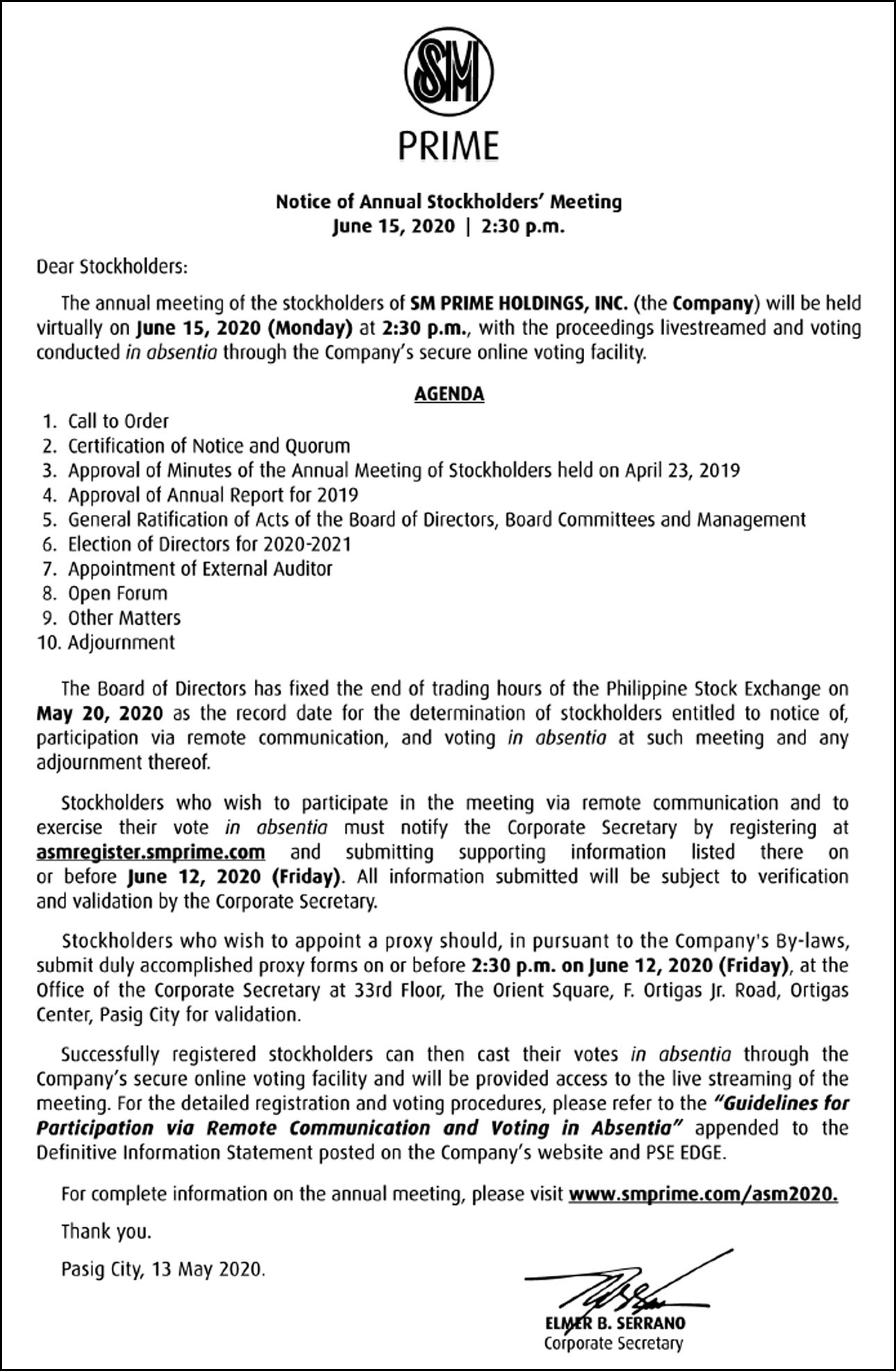
SM Prime Holdings, Inc. sets virtual stockholders’ meeting on June 15

SM Prime Holdings, Inc. announced that the annual meeting of its stockholders will be conducted virtually on June 15, 2020 at 2:30pm. For more details please visit https://www.smprime.com/annual-stockholders-meeting-2020

How PSEi member stocks performed — May 15, 2020

Here’s a quick glance at how PSEi stocks fared on Friday, May 15, 2020.


Defining the New Normal: Solidarity and structural change for a post-COVID-19 economy

By Marjorie Muyrong and Jerik Cruz

WHAT SHOULD our COVID-19 “new normal” look like? As economic stimulus bills for the pandemic are now being debated in Congress, questions on how the Philippine economy will be transformed in the coming months are asked. The shape of the country’s long-term development goals, as expressed in AmBisyon Natin 2040, is also uncertain.

These discussions should not be left only to policymakers. In the same spirit of bayanihan, all Filipinos have a role to play in defining this new normal for their communities and sectors. And we must also keep in mind that envisioning a post-COVID-19 future need not be an exercise in fear — but of solidarity in addressing long-running imbalances in the economy.

THE HEALTH IMPERATIVE
There is no doubt that community quarantines have succeeded in buying time for hospitals to meet the first surge in COVID-19 patients. According to Dr. Jarylle Chu, a training fellow at Makati Medical Center, “The next challenge is to pool funds for the future acquisition of the vaccine and to organize a fast country-wide vaccination plan early on.”

Yet in a real sense, COVID-19 has laid bare the vulnerabilities of the Philippine health system. As a country with one of the lowest per capita health expenditures among the ASEAN-5, addressing the pandemic in the long term demands that we not only pour resources for mass testing, treatment, and vaccines; for expanding production for COVID-19-related supplies in the garments and pharmaceuticals sectors; but that we also invest to enhance the effectiveness and accessibility of our public health services.

There is ample indication that such a “COVID-19 Keynesianism” strategy can also be a pillar of a long-term recovery plan. Our estimates using Input-Output analysis suggest that investing P1 billion in the health sector can support as many as 16,000 jobs. The same amount can also catalyze up to 7,000 jobs in the pharmaceuticals sector, or 19,000 jobs in the garments sector.

SUPPORT MSME ‘RETROFITTING’
With government’s social amelioration efforts still facing serial hurdles, numerous small business owners have stepped in to assist their workers, even when that means depleting their cash reserves.

“Fight to stay in business… Keep yourself and the company afloat so that you can continue to help others,” advises one business owner in Metro Manila. Indeed, we hear many anecdotes of entrepreneurs retrofitting their business, oftentimes by leveraging digital innovations, to keep themselves liquid and continue paying their employees.

But to support these efforts, assistance must not be limited to wage subsidies and “bounce back” loans; it should also include support to ensure these repurposing initiatives’ sustainability. Beyond capital and training support, investments to strengthen the country’s logistics and digital infrastructure, especially outside of Metro Manila, can expand opportunities for continued business operations during the pandemic.

REBALANCING TOWARDS AGRICULTURE
COVID-19 makes a revival of agriculture a national imperative — not only to maintain food supply in a disrupted trade environment, but to rebalance the Philippines’ Manila-centric economy, and to absorb displaced workers. In fact, in our Input-Output analyses, we find that agricultural sectors consistently have the most promising job-creating prospects, led by the “other crops” (23,500 jobs per P1-billion investment), “fisheries” (20,050), “sugar” (18,800), “corn” (14,670), and “coconut” (14,300) subsectors.

But the challenge will not be resolved simply by calling people to farm again. “Ang sinusulong nila ngayon, Balik Probinsya Program. Magbabalik-probinsya ka nga, pero pagdating naman doon sa probinsya, wala namang kabuhayan doon,” explains Gary Perlado of the Rice Watch Action Network (“The proposal they have now is the Balik Probinsya Program. But if people go back to the provinces, there are no jobs there”). Due to decades of neglect and misgovernance, farming and fisheries have been linked with high poverty levels nationwide.

And the sector has again been a victim of recent lockdown policies. Vegetable farmers, to take one example, have reportedly been unable to access needed farm inputs and sell their goods, because of restrictions that have been imposed during community quarantines. This has worsened their indebtedness.

Reinvigorating agriculture amidst the COVID-19 pandemic will require a dedicated public investment program on top of other policy changes. For example, investments are sorely needed in improving rural infrastructure; facilitating a shift to higher-productivity agribusiness; enhancing marketing and distribution systems; and addressing other long-standing problems in the rural economy, such as access to land and credit. These are hardly new issues, though the pandemic has made resolving them all the more pressing.

Even as COVID-19 hangs over us, Filipinos must confront the new normal, not only with clarity of mind, but also with solidarity. Despite its toll, the pandemic offers us an opportunity to reimagine the contours of our economies, communities, and workplaces, and to respond decisively to structural infirmities within them.

The spirit of bayanihan has been well and alive in donation drives for food aid and COVID-19 supplies — can it also be channeled to efforts to reorient our economy in a more resilient and inclusive direction?

As Dr. Jarylle Chu reminds us, “The real front-liners here are the people in the community.”


Marjorie Muyrong is a PhD Sociology student at La Trobe University. Jerik Cruz is an incoming PhD student at the Massachusetts Institute of Technology and a fellow of Action for Economic Reforms. Both are affiliated with the Ateneo de Manila University’s Department of Economics.

Managing the fallout from the COVID-19 crisis

After revising its GDP growth target to a more realistic -2 to -3.4%, the government is now crafting its economic recovery program in consultation with private sector stakeholders. I have been asked to provide feedback on the draft Philippine Program for Recovery with Equity and Solidarity (PH-PROGRESO), presented by Planning Secretary Karl Kendrick Chua in a virtual meeting with Manila’s top financial executives (FINEX). Below I share with readers my brief commentary.

I agree with Secretary Karl that the Philippines is better situated than many emerging countries to cope with this crisis given its stronger macroeconomic fundamentals, a product of building on past reforms across a wide front. I would particularly underline the tax reform law (TRAIN) and rice tariffication law, thanks to Secretary Carlos G. Dominguez and Secretary Karl.

However, this plague has changed the game radically. It would not be an exaggeration to call this the existential challenge of this generation, not just for the Philippines but globally. And while the Philippines has weathered past crises and learned from them, e.g. the 1997 Asian Financial Crisis, the 2008/09 Global Financial Crisis, and the debt-cum-political crisis of the mid-1980s, this one is arguably more fearsome.

The analogy made in the US is between “Main Street and Wall Street,” i.e., that a pox that affects the real economy will be more devastating to every Juan and Juana than one that originated from planet Finance. This is all the more true given: a) continuing uncertainties about the evolution of the virus, its spread and how long it will take for a cure or a vaccine to be developed; and b) the characteristics of the Philippines and our people, e.g. high density in Metro Manila, in particular the large number of slum communities, the most congested public transport system, the large numbers of people working in the informal sector, and difficulties in enforcing social distancing on a people who think traffic signs are just suggestions and on police officers who love to party.

Government working with the private sector seems to be finally getting its act together in implementing a T3 (testing, tracing, and treatment) strategy, after a poor start by the health department. It takes us out of the garbage-in-garbage-out (GIGO) testing and data collection path where we are forced to use blunt hammer solutions for a huge part of the economy on a prolonged basis. I note that our lockdown has been the longest and rated among the harshest in terms of people mobility, and therefore costly for the economy and most painful for our people. Hopefully, we are on the way out of that. The T3 program will provide the essential information going forward that can guide more granular actions on lockdowns, e.g., at the village or municipal rather than region-wide level as advocated by Presidential Adviser for Entrepreneurship Joey Concepcion.

Nevertheless, our experience so far suggests to me that it is more likely that the recovery will be a long U or W than a V. Our own forecast for GlobalSource Partners for GDP growth this year is south of the government’s downwardly revised low-end target of — 3.4%, i.e. -5 to -7%.

Government needs to play a key role in the survival, and later on, revival of the economy. Only the government has the “balance sheet,” the fiscal headroom, the huge reserves, the access to international financial markets. As the Central Bank Governor Benjamin Diokno said: “the political leadership and economic managers should focus on saving lives, saving livelihoods and saving jobs.”

I note that the exact modalities for some of the interventions are still being worked out. The following principles seem to underlie the planned support.

1. Use existing institutions rather than create new ones which will take time.

2. Where workable, employ risk sharing arrangements. E.g. between Philguarantee and banks. This both leverages government support and ensures credit discipline by requiring banks to have skin in the game. It also speeds up processing.

3. High selectivity in helping big firms.

4. Conserve fiscal resources, keep the powder dry; we don’t know how long this crisis may last.

I applaud the government’s readiness to provide more fiscal support than indicated earlier on. Though the elements are yet to be defined, this P846 billion (4.4% of GDP) is much higher than earlier numbers mentioned. The DBCC (Development Budget Coordinating Committee) assumptions talk about a fiscal deficit of 8% of GDP, after taking into account both the new spending and the drop in revenues with the GDP. This is sustainable and should not hurt credit ratings provided messaging is clear that this is temporary with a clear path to fiscal sustainability. Besides, most other countries’ fiscal deficit numbers will likewise crater and credit rating agencies will rate taking performance of other comparator sovereigns into account.

I am not too clear on support for micro and small firms, many of whom have no banking relationships. Perhaps there is a role for big government banks to partner with microfinance institutions. I have also come across an IMF blog that proposes that fiscal authorities and central banks cooperate to set up special purpose vehicles to partially buy loans of small borrowers from banks, something that in the past was a “no-no” for central banks but which now has become part of the “new normal” tool kit. (I commend the central bank for its innovative solutions in encouraging loans to MSMEs using the reserve requirement tool.)

In the meantime that these are being worked on, the government needs to continue providing direct support to poor families who live in communities that may continue to be under lockdown, or revert to one. Perhaps this can be done together with the T3 program at the barangay level. (It is most unfortunate that we still have no National ID system in place almost two years after the enabling law was passed).

Let me now offer some suggestions on the more medium-term reforms for economic revival. These are in the wish list of Foundation for Economic Freedom:

1. More flexibility in labor laws (working arrangements, minimum wages, firing policies, an apprenticeship law) as unemployment grows with the return of OFWs and loss of jobs, and to attract new investments in new activities. Such investment opportunities arise as countries and companies adjust to the plague-induced “new normal,” and earlier disruptions from the trade war and the digitalization under the 4th industrial revolution.

2. More reliance on PPP (public-private partnerships), including bringing to the finish line projects that have been under protracted negotiations to nurture hurt investor confidence, and so as to conserve now stretched fiscal resources. Government also needs to assure stability in regulation for ongoing projects and enact the long-standing PPP bill in Congress.

3. The following legislation should be prioritized to attract FDIs: the Public Services Act, the Retail Trade Act, the Foreign Investment Act.

4. Agricultural reforms: freeing the land market from agrarian reform rigidities, e.g. removal of restrictions on conveyance of CARP (Comprehensive Agrarian Reform Program) lands, removal of the retention limit of five hectares, amend the agri-agra credit law, amend the warehouse receipts laws.

5. Creating green jobs by stimulating forestry production through the liberalization of tree plantations.

6. Lifting the mining moratorium. Mining is a low-lying fruit for which the Philippines has a global competitive advantage.

Finally, the refinements in the CITIRA (Corporate Income Tax and Incentives Reform Act) bill are in the right direction to enhance the attractiveness of the Philippines as an investment destination, especially the drop in the corporate income taxes from 30% to 25% in the first year of implementation with leeway for the executive to reduce further.


Romeo L. Bernardo was finance undersecretary during the Cory Aquino and Fidel Ramos administrations.

romeo.lopez.bernardo@gmail.com

The changing face of retail

THE RETAIL TRADE is among the hardest hit industries in this COVID crisis. The bloodbath has cut across all sectors — from clothing to food, appliances to motor vehicles, electronics to gasoline. No sector is spared except for those relating to health, sanitation, and wellness.

I originally intended to paint a picture, through numbers, of how bleak the situation is in the Philippines. Unfortunately, up-to-date statistics on retail are still unavailable. Luckily, I was able to access the retail stats of the United States. While American statistics may not reflect the exact situation here at home, certainly, the trends are the same.

The month of March registered the steepest drop in American retail sales in recent history. The numbers speak for themselves.

Clothing and fashion accessories plunged by 50.5%; Furniture and home furnishings by 26.8%; Food and drinks by 26.5%; Motor vehicles and spare parts by 25.6%; Sporting goods, music and books by 23.3%; Gasoline and diesel by 17.2%; and Electronics and gadgets by 15.2%.

Note that America went into lockdown in the last week of March, unlike the Philippines whose lockdown started 10 days before. Hence, it is safe to say that the drop in retail sales in the Philippines is more severe.

We expect a further nosedive in the months of April and May for both countries.

Retailers are fighting for their lives. As of mid April, 70% of merchants reported not having enough capital to survive the lockdown should it last for more than one quarter. Meanwhile, 23% said that they only have enough capital to last one month of business stoppage. Last month, several iconic American retailers had already filed for bankruptcy including Neiman Marcus, J. Crew, JC Penny, GNC, Debenhams, Sears, and K-Mart, among others. Add to this thousands of small- and medium-sized retailers who were forced to permanently close their doors. More bankruptcies are expected in the months to come.

In the Philippines, we have not heard of any medium- or large-scale retailer going out of business yet. We can be sure, however, that there will be hundreds of retail and food brands either merging or permanently closing in the weeks to come.

According to American retail consultant Karen Gibbs, the majority of retailers who declared bankruptcies last March were those who cater to the middle income market. Retailers who cater to middle-income earners like JC Penny and J. Crew have been slowly eased-out by ultra high-end retailers like Bergdorf Goodman, Bloomingdales, and fashion house boutiques at the top and Walmart and Target in the bottom.

This has been happening for the last five year. In other words, middle-market retailers were already losing market share and accruing losses since 2015.

In addition, Ms. Gibbs says that the department store model is fast becoming a relic of the past. Consumers today prefer to purchase goods from retailers who specialize in a particular category. For instance, consumers are more inclined to shop at Decathlon for sporting goods and Best Buy for electronics, not at Sears.

Another development is that the COVID-19 crisis has pushed e-commerce to the mainstream. E-commerce comprised 16% of the retail market in 2019 but is seen to grow exponentially, post-COVID-19. Improvements in logistics and reliability of transactions have made e-commerce more convenient for the greater majority.

The COVID-19 crisis has permanently changed consumer preferences too. Whereas during pre-COVID-19 years, consumers preferred mass-produced products with a good balance of quality and affordability, in the post-COVID-19 world, consumers prefer products that are sustainable for the planet and/or healthier for the body.

Price is no longer the highest consideration for a purchase as sustainability and quality are. These trends are true worldwide.

This presents tremendous opportunities for Filipino artisans who manufacture garments, fashion accessories, toys, gifts and houseware, and food. As we move forward, Filipino manufacturers need not compete with China in the price game anymore. They now have a fair chance of attracting wholesalers and direct customers on the back of good design, ethical production practices, handmade craftsmanship, and the use of organic indigenous materials. Market preferences have finally shifted in favor of Filipino producers.

The shift in trends could not come at a better time. With thousands of small- and medium-sized shop owners, restaurateurs, and distributors losing their businesses, a shift in business focus towards manufacturing artisanal products for export is now a viable option. The Department of Trade and Industry, through its export promotions agency CITEM, should capitalize on this and encourage more entrepreneurs to pivot.

It augurs well for the economy as it hastens our evolution from being a consumer driven economy to one that is production lead.

For those tapping the export market, another emerging trend, says Ms. Gibbs, is a preference for purpose-driven products. In other words, a product should not only serve the purpose it was made for but also a socio-civic or environmental purpose as well. For example, handcrafted furniture should not only be well designed, impeccably handcrafted, and sturdy — they should also use wood from a sustainable tree farm that supports a community of indigenous people.

In the post-COVID-19 world, communicating the purpose of a company, with clarity, is just as important as the design, utility, and price of a product. Further, innovation by way of design, raw materials, and versatility will set Philippine-made products apart from those made in Vietnam or Thailand.

The COVID-19 crisis is a game-changer in that it displaced thousands of food and dry good retailers. But it comes with a silver lining. It gives specialty stores and boutiques the shot-in-the-arm that they need, it has made e-commerce hit the mainstream, and spawned a new demand for purpose-driven products. All these are good opportunities for entrepreneurs looking to pivot.


Andrew J. Masigan is an economist

ADVERTISEMENT
ADVERTISEMENT