Home Blog Page 9429

Workers’ rights seen crumbling as coronavirus threatens further setbacks

By Kieran Guilbert/Thomson Reuters Foundation

LONDON — Labor rights are being eroded worldwide as more countries deny workers the ability to strike, unionize and negotiate better terms, a global trade union said on Thursday, warning that the coronavirus pandemic could lead to further setbacks.

Violations of labor rights have hit a seven-year high as a rising number of governments have prevented workers from forming unions or collectively bargaining, the Global Rights Index by the International Trade Union Confederation (ITUC) revealed.

About 2.5 billion people — more than 60% of the world’s workforce — are informal workers, leaving them particularly at risk of being underpaid, overworked and abused, the ITUC said.

Bangladesh, Brazil, Colombia, Egypt, and Honduras were rated as the worst countries, according to the annual index, which ranked 144 nations on the degree of respect for workers’ rights.

“The index exposes a breakdown in the social contract that governments and employers have with working people,” Sharan Burrow, secretary general of the ITUC, said in a statement.

“We are already seeing some countries take things further, and under the cover of measures to tackle the coronavirus pandemic they are advancing their anti-workers’ rights agenda,” Ms. Burrow added. “This has got to stop, and be reversed.”

Activists and academics have warned of a rollback of labor rights in global supply chains, with workers forced to accept worse conditions with fewer jobs available and factory bosses accused of using coronavirus staff culls to fire union members.

Since the outbreak of COVID-19, many countries, including Brazil, India, and Mauritius, have amended labor laws in a boost for the private sector at the expense of workers, the ITUC said.

Several states in India, for example, are suspending laws on the length of the working day, minimum wage, and worker unions, while Brazil passed measures in March that deny millions of workers the right to collective bargaining.

“Unscrupulous governments and business are using the pandemic to break workers’ organizations, and intimidate their representatives,” Phil Bloomer, head of the Business and Human Rights Resource Centre, told the Thomson Reuters Foundation.

The index found at least four in five nations had violated the right to strike and collectively bargain in 2019, while workers had limited or no access to justice in 72% of countries. Laborers experienced violence in 51 nations, the ITUC said.

The ITUC, which has more than 207 million members, says it is the world’s leading body fighting for workers’ rights.

About 25 million people are estimated to be victims of forced labor, and companies are facing rising consumer pressure to clean up their supply chains with the issue in the spotlight since the United Nations set a target of ending slavery by 2030. — Thomson Reuters Foundation

BUSINESSWORLD INSIGHTS: Appreciating workers and MSMEs in the new normal

By Adrian Paul B. Conoza, Special Features Writer

The coronavirus disease 2019 (COVID-19) crisis has largely hit both businesses and their employees. The latest data from the Philippine Statistics Authority’s Labor Force Survey showed that there were 7.25 million Filipinos who were jobless last April compared to the same month last year. On the other hand, the Philippine government’s rapid assessment survey on micro, small, and medium enterprises (MSMEs) revealed that 77% of micro and small firms and 62% of medium ones are said to have closed down during the lockdown across Luzon.

As the economy reopens amid relaxed quarantine measures, MSMEs and their workforces are on a quest to bounce back from the drastic effects of the pandemic. While there are challenges left for them to tackle, there are opportunities for them to take advantage to the new normal and eventually thrive from the crisis.

The third leg of the second phase of BUSINESSWORLD INSIGHTS has looked further into these matters through the perspectives of Francis del Val, president and chief executive officer (CEO) of Cobena Business Analytics and Strategy, Inc.; Ghaye Alegrio, assistant vice-president for Mindanao at Philippine Chamber of Commerce and Industry (PCCI); and EJ Arboleda, CEO of tax filing platform Taxumo. The online forum, held last June 10, was moderated by Leo Uy, head of BusinessWorld’s research department.

Going digital in a reimagined future

Mr. del Val of Cobena emphasized the need for businesses to make a shift to digital, moving on from past means of doing business and adopting a mindset that reimagines the future.

“The future is going to be very different, but it’s a future that is going to be successful if we are mindful of the fact that we need to turn to digital to adapt and accelerate into what is going to be a reimagined future,” he said.

In reimagining the future, digital transformation serves as the key for businesses to survive and thrive, according to Mr. del Val. Out of monitoring social intelligence, the firm has observed the prevalence in digital as seen in the rise of e-commerce as well as an uptrend in using applications such as Viber and Instagram as mediums for commerce.

Reimagining the future also involves taking advantage of the fact that the country has a huge base of millennials and Generation Z, according to Mr. del Val.

“Digital natives who are there, who have the purchasing power, we just need to be able to work with them in terms of what they are familiar with; and those terms are really digital,” he said.

With digital removing physical barriers, he continued, plus the advent of telecommuting, offices may not be necessary. In this area, Mr. Del Val advises MSMEs to consider cutting rents and putting that money back to their working capital.

Travel agencies, he illustrated, can scale down their offices to a particular room, while providing laptops to other employees so that they could still perform their tasks even remotely.

While digital transformation has its perks, Mr. del Val shared that there are certain things that really get in the way including generational and geographic concerns.

In terms of generational concerns, businesses might have to reconcile digital natives such as millennials and Generation Z with digital migrants such as the Generation X. Geographic concerns about digital transformation, on the other hand, depend on whether businesses are located in the urban centers, where digital is much embraced, or farther from urban centers, where digital seems to be not critical and not even very accessible.

Nevertheless, in spite of these hurdles, a business’ mindset matters more. “We have to either say the hurdles are going to be there, or we’re going to say ‘Let’s do something about it’,” he said.

Moreover, going digital does not come without risk, Mr. del Val added, especially that such a transition heavily involves data that is collected and analyzed. Issues include compliance with the country’s Privacy Act, the security of their network, and the capability of their people in supporting their network.

These issues, nonetheless, don’t have to be solved by businesses themselves, as there are many organizations and experts who can help them out in these areas. Moreover, investments to digital can be done even at a minimal price.

“You don’t have to put up large amounts of capital at the beginning,” he said. “You just pay your investment so as you succeed as a business, then the amount of money that goes into it is proportionally increasing.”

Aside from reimagining the future and tapping digital transformation, Mr. del Val also advises MSMEs to go through a thought process where they seriously examine why did they start their businesses in the first place.

“You need to ask yourself: What spurred you to create that business? Is that still relevant today? And if it is, the next question has to be: Are you still very passionate about it? Because, if it’s relevant and you’re passionate about it, you need to think: What is the different model by which I can deliver the same product or service?” he advised.

Government’s actions
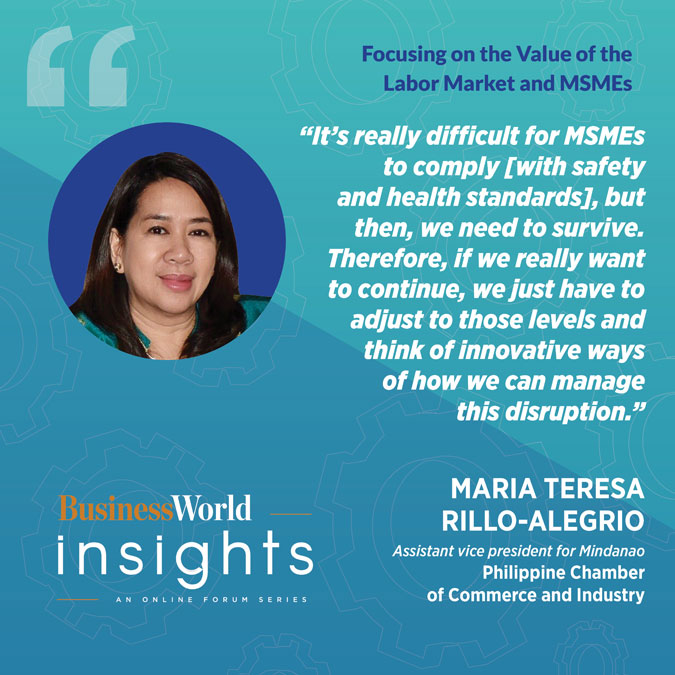
Ms. Alegrio of PCCI, meanwhile, looked into the policies being set in place to assist MSMEs during the crisis. She started by commending the government’s response to the chamber’s consolidated petition for relief from the constraints and uncertainties imposed on the livelihood, mobility, safety, and health of MSMEs and their employees.

Among its many recommendations include deferment of tax payments, the enjoinment of telcos to remove data capping in mobile broadband internet services, and the establishment of a rehabilitation fund for affected MSMEs in the areas of technical assistance and special financing for working capital.

“PCCI is very pleased that our national government has immediately responded to our call by instituting measures, programs, tax relief, and incentives laid out by the Bayanihan Act,” she said. “And moving forward on the road to recovery, the government’s economic managers have put together a comprehensive set of fiscal and non-fiscal measures just to ensure the continued operations of the MSMEs nationwide.”

Furthermore, the PCCI official noted that the most impacted businesses are in the service sector, which composes 60% of the economy. In particular, the wholesale and retail sector and non-essential businesses were badly hit.

In trying to save the predicament of its workers, she continued, most MSMEs resorted to advancing salaries, 13th-month pay, and social amelioration benefits to their employees when the lockdown took place. With the quarantine extended, however, a serious cash-flow problem emerged, causing further searches for calamity loans.

“Now, with the easing of restrictions and with the government’s assurances that there will be some bridge loans available, the real challenge now is the accessibility and timeliness of this assistance,” she noted, adding that the chamber is working closely with government institutions such as the Small Business Corporation to facilitate such things.

Ms. Alegrio added that there should be a structural adjustment on the part of the MSMEs in order for them to cope with the new normal. One way they could do this is by creating a business continuity plan, which the PCCI official observed MSMEs lacked.

That continuity plan, she continued, should cover a risk assessment of a business’ supply chain, including the workforce critical for continued operation. Logistics and financial resources needed to support short- to medium-term disruption should also be included, as well as compliance with health and safety standards that will protect employees and customers.

“It’s really difficult for MSMEs to comply, but then we need to survive. Therefore, if we really want to continue, we just have to adjust to those levels and think of innovative ways of how we can manage this disruption,” she said.

The PCCI official also said that the current situation necessitates private and government collaboration.

“[W]e really need to have active participation, especially as our government is also trying its best to cushion the impact by coming up with certain guidelines,” she said. “But sometimes, these guidelines may really not be suited to our needs, and therefore it takes a very active private sector to be able to tell them that maybe we need to adjust [those guidelines].”

Ensuring vibrancy among startups
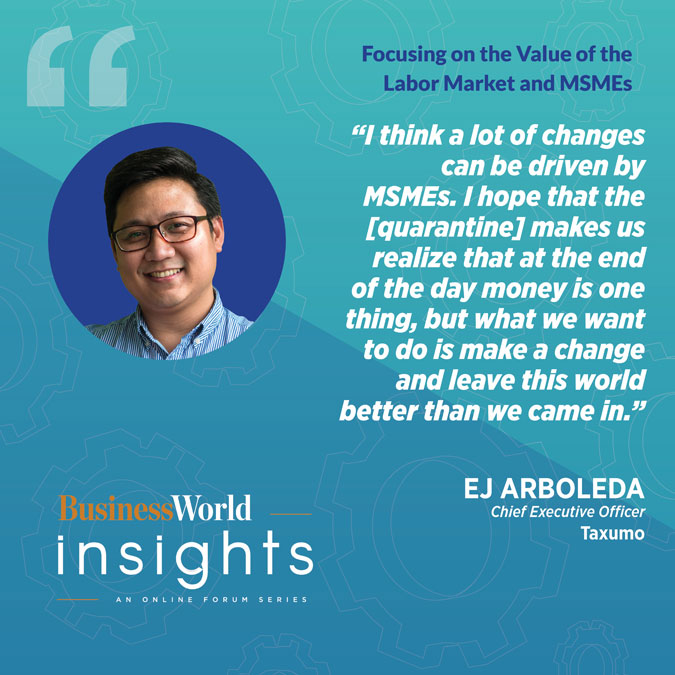
Out of the data his company gathered from its users, Taxumo’s Mr. Arboleda finds that many people are getting their minds open to digital and to new solutions.

“In our case in Taxumo, we had an increase of 150% over the normal volume of monthly sign-ups that we got before ECQ (enhanced community quarantine), he said. “ECQ was really a big driver for people to try out new services online.”

“I think what ECQ did that really helped MSMEs was that it forced customers, who normally would not have responded to digital services, to try them out,” he added.

From observing the uptrend in telemedicine nowadays, Mr. Arboleda noted that what was initially employed for overseas Filipino workers (OFWs) before the quarantine has finally been employed in the present context.

“The context before made sense for the OFWs, because they weren’t in the Philippines and [so] didn’t have access to someone they normally trust…That same context now applies to the normal Filipinos at home,” he said.

From this application, he challenges MSMEs to figure out services or strategies that were used before to reach out to people remotely and whether those strategies can also be applied to their businesses.

Understanding markets are also important to consider, Mr. Arboleda added, especially in light of digital transformation and the current crisis.

“I would advise that you look at that particular market and see how you can service that market right now and what are the unique needs of that market. How can you make sure that what you’re offering is something that appeals specifically to them?” he said.

Furthermore, Mr. Arboleda finds it timely for businesses to find out which markets they are presently reaching, as well as to try out other means of providing service to their current markets.

“I think it’s important for you to also use this time to understand the basic assumptions of your business. Do those still hold? The market you’re going after, are they still your market? How you’re going after them, is that still the way to go after? How you deliver the service, is that still the way to deliver the service?” he said.

Mr. Arboleda warned against going digital because people are saying to do so. He advised businesses to understand first the parts of their businesses, and which of them would probably be better with automated processes. For him, this is a means to mitigate risks in going digital.

“Go into digital because it makes sense in the context of your business,” he said. There are certain parts of your business wherein automating will be easier for you, then adopt that.”

Furthermore, regarding startups, the Taxumo CEO highlights the importance of ensuring that the startup industry is very much taken care of, especially as startups encounter challenges in financing.

“It is very difficult for a lot of small businesses and startups to get financing at this point. I think that’s something that I encourage the government to look because it’s very important to make sure that [startups are] still a vibrant part of the economy.”

After all, Mr. Arboleda finds that startups are driven by making a difference one solution at a time. “I hope that the ECQ made us realize that at the end of the day money is one thing,” he said, “but what we want to do is to make a change and leave this world better than we came in.”


Calls for cooperation as online child sex abuse soars in Europe

By Sophie Davies/Thomson Reuters Foundation

BARCELONA — Online child sex abuse has soared in Europe during coronavirus lockdowns, campaigners and lawyers warned, calling for greater international cooperation and better reporting tools to halt the scourge.

With schools in many European countries still shut to contain the pandemic, children are spending more time online, making them more vulnerable to abusers, who are also at home most of the day, human rights experts say.

“Parents are working from home and children are not at school, so they’re spending longer online,” said Almudena Olaguibel of UNICEF Spain, the children’s agency of the United Nations (UN). “Norms and limits on the use of the internet are being loosened.”

“Also, the abusers are at home more, bored, using the internet for longer,” the policy specialist told the Thomson Reuters Foundation.

National law enforcement authorities in 27 European Union states have reported a rise in paedophile activities during the COVID-19 pandemic, according to Europol, the block’s law enforcement agency.

These countries have seen increased access to illegal websites and shut more online platforms where child sex material is being exchanged, Europol said.

In March, calls to Spanish hotlines for reporting child sex abuse rose to a record level for that period of the year, a Europol report showed.

Also that month, Britain’s Thames Valley Police saw a 146% jump in reports of online child sex abuse compared with the same time last year. “Sadly, we believe that criminals have looked to exploit the fact that more children have been at home and online,” said Detective Chief Inspector Matt Darnell in a press release published last week.

MORE DATA
Tools for reporting child sex abuse are still not good enough in many European countries, cautioned Gioia Scappucci, executive secretary to the Lanzarote Committee, which works to protect children from sexual exploitation and abuse.

“States are aware of the risks of increased abuse — both online and off — during confinement and have been taking initiatives to raise awareness of these risks,” Mr. Scappucci said.

“Resources to deal with the increased reporting, however, are not always there and should be scaled up,” he added.

More official data needs to be collected in many countries on what is actually happening during the pandemic and how that is being handled, Mr. Scappucci stressed.

One trend experts are seeing is an increase in children producing sex material themselves, either unknowingly or in response to “sextortion” — a form of extortion that involves sexual acts or images as its currency.

“They are producing this material … in their bedrooms, at home, while their parents are in the next room,” said Ms. Olaguibel.

These kinds of images used to be shared predominantly on the dark web, a part of the internet which is accessible only with specific software or authorization, but are increasingly appearing on everyday platforms, she said.

Ms. Olaguibel and other campaigners say social media companies should be more proactive about searching out child sex materials on their sites.

Even though some companies self-regulate in these matters, it is not enough, she warned.

“It would be better if the government regulates what they are doing more strictly,” she said.

A spokeswoman for Twitter told the Thomson Reuters Foundation that the platform has “zero tolerance” for any material that features or promotes child sexual exploitation.

“We aggressively fight online child sexual abuse and have heavily invested in technology and tools to enforce our policy,” she said in e-mailed comments.

Once Twitter has removed the content, the company immediately reports it to the U.S.-based non-profit National Center for Missing and Exploited Children (NCMEC), as required by U.S. federal law.

The group then makes reports available to law enforcement agencies around the world to aid with investigations and prosecutions, the spokeswoman said.

Facebook and Instagram did not reply to requests for comment.

GLOBAL PROBLEM
Last year, Britain’s data protection watchdog published a draft code listing recommendations for online service providers, which it said would set a global standard for children’s privacy online.

Among the recommendations by the Information Commissioner’s Office was a ban on targeting under-18s with so-called “nudge” techniques — features that encourage users to stay online for longer so the app or site can collect data on them.

Manuela Torres Calzada, a judge and the vice president of Themis, a Spanish association of women lawyers, agrees that there needs to be stricter regulation of social media companies to tackle online child sex abuse.

But national governments face serious barriers in doing so, she said.

“The prosecution of these types of crimes is difficult because there isn’t sufficient international coordination, no international convention,” Ms. Calzada said.

“Most of the time, individuals who diffuse these kinds of images get sanctioned, but social media companies get away with it,” she added.

If a US-based social media company suspects a crime on its website was committed by a Spaniard, for example, it is under no obligation to share that information with the Spanish police, explained independent data security expert Marcelino Madrigal.

In addition, if the Spanish police need information from a US-based company, it has to make a formal request to American courts for judicial assistance, causing delays and often leading to cases being shelved, he said.

“I have been asking the (social) networks for more than 10 years to directly notify the cases and the data to the police or prosecutors in the pedophiles’ country of origin … They do not do it,” he stressed.

“They simply comply with US law by sending them to the NCMEC.”

Spanish judges often end up archiving cases citing a lack of cooperation by social networks, he said.

“Online child sex abuse material is not a national problem, it’s a global one,” Mr. Madrigal stressed. — Thomson Reuters Foundation

China’s COVID-19 vaccine candidate shows promise in human trials

BEIJING/SINGAPORE — China National Biotec Group (CNBG) said on Tuesday its experimental coronavirus vaccine has triggered antibodies in clinical trials and the company plans late-stage human trials in foreign countries.

No vaccines have been solidly proven to be able to effectively protect people from the virus that has killed more than 400,000 people, while multiple candidates are in various stages of development globally.

The vaccine, developed by a Wuhan-based research institute affiliated to CNBG’s parent company China National Pharmaceutical Group (Sinopharm), was found to have induced high-level antibodies in all inoculated people without serious adverse reaction, according to the preliminary data from a clinical trial initiated in April involving 1,120 healthy participants aged between 18 and 59.

CNBG said it is proactively seeking opportunities for late-stage and large-scale Phase 3 trials overseas. In a statement, the company said that it had “secured cooperative intent with companies and institutes in many countries.”

State media reported that the vaccine candidate, along with a different experimental shot developed by Sinopharm’s unit, has been offered to Chinese employees at state-owned firms travelling overseas as developers seek more data on their efficacy.

China has five vaccine candidates for COVID-19 in human trials, the most in any country.

China’s vaccine maker Sinovac Biotech (Sinovac) released over the weekend positive preliminary clinical trial results for its potential vaccine candidate, which is expected to be tested in a Phase 3 trial in Brazil. — Reuters

Infrastructure spending up in April

STATE SPENDING on infrastructure surged in April as the government ramped up construction of quarantine facilities and purchases of medical equipment in response to the coronavirus disease 2019 (COVID-19) pandemic.

The Department of Budget and Management’s (DBM) latest disbursement report showed infrastructure and other capital outlays jumped 42% to P40.1 billion in April from P28.3 billion seen in the same month last year. However, this was lower than the P62.2 billion spent in March.

The DBM attributed the spending spike to the construction of quarantine facilities for COVID-19 patients and the Health department’s purchase of medical equipment.

The government had converted the Ninoy Aquino Stadium at the Rizal Memorial Sports Complex, World Trade Center and Philippine International Convention Center (PICC) Tent Forum into quarantine facilities for mild and asymptomatic COVID-19 patients.

The DBM said the higher infrastructure spending was also due to “acquisition of transport equipment under the Revised AFP Modernization Program of the DND (Department of National Defense), and implementation of regular road infrastructure programs of the DPWH (Department of Public Works and Highways).”

Despite the spending spurt in April, infrastructure spending was still down by 4.9% to P196.2 billion in the first four months of the year from P206.4 billion a year ago.

The DBM said infrastructure spending was lower year on year due to high base effects and the temporary ban on all construction activity during the enhanced community quarantine (ECQ).

“Infrastructure spending was lower year on year due to the base effect of high infrastructure expenditures in the same period last year brought about by the payment of prior years’ accounts payables, and the temporary suspension of construction activities due to the implementation of ECQ,” DBM said.

Luzon and other parts of the country were placed under strict lockdown starting mid-March to contain the spread of the virus. The lockdown continued through May in Metro Manila while other areas that have lower reported cases started easing restrictions in mid-May.

“The year-on-year increase in overall government spending as well as in infrastructure spending in April 2020, which already reflected the full effect of the lockdown/ECQ in Luzon, may reflect priorities by the government to increase spending and funding for fiscal stimulus measures, COVID-19 programs, and other financial assistance for the most vulnerable sectors, as these are needed most at the height of the lockdowns,” Rizal Commercial Banking Corp. Chief Economist Michael L. Ricafort said via Viber.

Overall government spending more than doubled in April to P461.7 billion, bringing total spending for the four-month period to P1.31 trillion, up 31% year on year.

The DBM said it expects overall spending for the rest of the second quarter to be largely driven by pandemic expenses, particularly the second tranche of government’s subsidy programs.

As most of the country is now under general community quarantine, infrastructure-implementing agencies may soon be able to ramp up construction work.

“This should facilitate the resumption of construction activities of the DPWH, and the Department of Transportation so they can speed up the implementation of public infrastructure projects, with the intention to catch up with the unintended delays during the ECQ,” the DBM said.

In May, key infrastructure projects under the flagship “Build, Build, Build” program were given exemption to resume construction work while observing minimum health and safety standards, such as physical distancing and testing.

The infrastructure spending target for 2020 was slashed to P833 billion from the initial program of P989 billion as government’s funds were redirected for the COVID-19 response.

However, the government is eyeing a bigger, P1.131-trillion budget for infrastructure next year as it is touted to play a key role in economic recovery. — Beatrice M. Laforga

PLDT raises $600M in global bond float

PLDT, Inc. returned to the offshore bond market after 18 years. — REUTERS

By Arjay L. Balinbin, Reporter

STRONG investor demand welcomed PLDT, Inc.’s return to the offshore bond market after an 18-year absence.

The telecommunications giant on Wednesday told the stock exchange it raised $600 million from the issuance of 10-year and 30-year dual tranche senior unsecured fixed-rate notes.

PLDT said the notes drew combined final orders worth $10.2 billion, 17 times more than the amount it sold — the largest orderbook size for any Philippine issuer. Demand was strong, mostly from investors in Asia and Europe, it added.

“We are extremely gratified by the response of the international bond market to our return,” PLDT Chairman, President and Chief Executive Officer Manuel V. Pangilinan was quoted as saying in a statement. “The market’s overwhelming welcome only serves to validate PLDT’s record of resiliency and patented financial discipline over the years.”

IFR reported the $300-million January 2031 bond was priced at 99.39 with a coupon of 2.5% to yield 2.566% or Treasuries plus 180 basis points (bps).

The $300-million 30-year tranche was priced at 99.168 with a coupon of 3.45% to yield 3.495% or Treasuries plus 195 bps.

PLDT noted this was the “first ever 30-year offering for a non-government entity out of the Philippines.”

“Since we haven’t been around for such a long time, the interest then became very strong, that’s what we call the scarcity value. So because you are not there issuing all the time, it became quite an attractive investment opportunity for a lot of investors,” PLDT Chief Finance Officer Anabelle L. Chua said in a virtual interview.

On why it took 18 years for the company to return to the international capital market, Ms. Chua said: “What happened really in the last couple of years was … there were much more liquidity in the Philippine local market, longer tenors, and so it was easy to access.”

The rates in the local market had also been “quite attractive,” she added.

Now, Ms. Chua said PLDT wanted to take advantage of the historically low US interest rates.

“We also felt that we have a good story to tell. We are in a market which is very attractive for data take-up, and there’s the young population. A lot of Filipinos spend time online, and there’s a lot of growth in terms of data traffic. During the lockdown period, we saw how people really used a lot of data. Our traffic increased by about 25%,” she said.

Ms. Chua said PLDT is planning to use around $400 million from the bond proceeds to repay debt due in the second half of 2020 and in 2021, “and even selectively prepay some other debts.”

The remaining $200 million will fund PLDT’s capital expenditure (capex) requirements for this year and the following year, she added. The telco giant is allocating P63 billion in capex this year.

Ms. Chua said the company has no plans for another bond issuance for now.

“The good thing about this is in one exercise we were able to address the refinancing requirements for up to next year, so we have more time to plan how we want to tap financial markets after that,” she said.

Credit Suisse (Singapore) Limited and UBS AG Singapore Branch were the joint lead managers and joint bookrunners for the transaction.

PLDT is rated BBB+ stable by S&P, Baa2 stable by Moody’s and BBB stable by Fitch. S&P gave the dollar notes a BBB+ rating.

Shares in PLDT on Wednesday closed 0.25% lower at P1,220 apiece.

Hastings Holdings, Inc., a unit of PLDT Beneficial Trust Fund subsidiary MediaQuest Holdings, Inc., has a majority stake in BusinessWorld through the Philippine Star Group, which it controls.

Cojuangco, who built Southeast Asia’s biggest food empire, dies at 85

By Denise A. Valdez, Reporter

PHILIPPINE billionaire and San Miguel Corp. Chairman and Chief Executive Officer Eduardo “Danding” M. Cojuangco, Jr., who built Southeast Asia’s oldest and largest food and drink empire, has died. He was 85.

Mr. Cojuangco, an ally of the late dictator Ferdinand E. Marcos, died on June 16, San Miguel said in a disclosure to the Philippine Stock Exchange, without saying the cause of his death. He battled various ailments including lung cancer, according to ABS-CBN News.

“The board of directors and the entire San Miguel group deeply mourn the passing of our chairman and chief executive officer,” it said. “His contributions to our company’s history are numerous and indelible.”

Mr. Cojuangco survived political exile in 1986 and returned home to continue his political ambition, running for president in 1992 but lost.

He was governor of Tarlac province before Mr. Marcos came to power.

Mr. Cojuangco has held his seat in the listed group since July 1998. He led its growth from a food and beverage company into a diversified empire whose interests now include oil, infrastructure and power.

He emerged to be one of the wealthiest businessmen in the country, posting a net worth of $1 billion (about P50.61 billion) this year based on Forbes World’s Billionaires List.

Mr. Cojuangco founded the Nationalist People’s Coalition (NPC), the vehicle he used for his 1992 campaign.

Mr. Cojuangco was vital to San Miguel’s success as a conglomerate and “its pursuit of socioeconomic progress for the Philippines through its diversified corporate endeavors,” presidential spokesman Harry L. Roque said in a statement.

“He enabled the company to generate thousands of livelihood and employment opportunities, benefiting thousands of Filipino families,” he added.

“The legacy and vision of NPC’s big boss will continue with all its members, friends and especially among his family,” Senate President Vicente C. Sotto III who is a party member said in a statement.

“I have been with the NPC since the start of my political career and I witnessed how he has shaped, over decades, the ideals and objectives of the party that centered on love for country,” Senator Sherwin T. Gatchalian, another party member, said in a statement.

Mr. Cojuangco faced corruption charges for years because of his Marcos connection. He was accused along with other associates of conspiring with the dictator in pocketing taxes from coconut farmers.

The government of the late Corazon C. Aquino, Mr. Marcos’s successor and Mr. Cojuangco’s estranged cousin seized his stake in San Miguel, which he eventually got back during the presidential term of Joseph E. Estrada.

Since 2002, San Miguel has been led by Ramon S. Ang as president and chief operating officer. Mr. Cojuangco sold his stake to him and other allies in 2012.

“For the memories and all that you taught me, I will always remember you and keep you present,” Mr. Ang said in a Facebook post. “Thank you for always having my back, ECJ.”

Mr. Cojuangco was also a sports advocate, having supported professional basketball in the past four decades.

As San Miguel chairman, he “guided our expansion, diversification and transformation,” the company board said. “His vision for San Miguel — to be a beacon of hope for the Philippines and a partner in nation-building — remains at the core of everything we do.”

Mr. Cojuangco was the eldest child of Eduardo C. Cojuangco, Sr. and Josephine B. Murphy. His mother, the daughter of a US Army volunteer who married a Filipina, was born and raised in Baguio City. His father was of Chinese descent.

He attended De La Salle High School, University of the Philippines Los Baños and California Polytechnic College.

Mr. Cojuangco is survived by his wife Soledad “Gretchen” Oppen-Cojuangco with whom he had four children, and domestic partner Aileen Damiles with whom he had two children. — with Michael Angelo S. Murillo

Employment to rebound in 1-2 years, says Bello

Repatriated Filipino workers have their papers processed after being allowed to go home following weeks of quarantine amid the coronavirus outbreak, in Parañaque City, May 26. — REUTERS

THE Labor department chief expects the country’s labor market, battered by the coronavirus pandemic, to recover in one to two years.

“When we talk of rebound, my estimate is between one to two years. We cannot expect an immediate rebound in six months,” Department of Labor and Employment (DoLE) Secretary Silvestre H. Bello III said during “Flattening the Unemployment Curve,” a webinar hosted by human capital solutions provider Viventis on Wednesday.

“We are relying on our technology, BPO[s] (business process outsourcing), agribusiness, and especially the implementation of the ‘Build, Build, Build’ infrastructure project…, which is [under the industry of] construction,” Mr. Bello added.

Amid the pandemic, unemployment rate surged to 17.7% in April from a year earlier, the highest since the government adopted new definitions for the Labor Force Survey in 2005, according to the Philippine Statistics Authority’s latest round of the survey.

This translated to 7.25 million jobless Filipinos, more than three times from 2.27 million a year ago.

The statistics agency said the labor force size was about 41.02 million out of 73.7 million Filipinos aged at least 15 years, yielding the lowest labor force participation rate in the history of Philippine jobs market at 55.6%. In absolute terms, around three million Filipinos have left the labor force in April compared to the same month last year.

The government placed Luzon under an enhanced community quarantine starting mid-March to curb the spread of the coronavirus disease 2019 (COVID-19), resulting in the shutdown of all economic activity except essential services.

Unemployment was targeted to go down to 3-5% by 2022, according to the government’s Philippine Development Plan 2017-2022.

In the same webinar, Labor Undersecretary Benjo Santos M. Benavidez said retrenched employees are entitled to a separation pay and, if qualified, can apply for an unemployment insurance benefit from the Social Security System (SSS). By way of a long-term solution, government institutions and accredited agencies will also be opening training programs to re-skill the unemployed.

“We are in the process of profiling them, because we are just receiving the notices of the displaced,” he said.

A key feature of the Republic Act No. 11199 or the Social Security Act of 2018 is the unemployment benefit or involuntary separation insurance program, which was implemented in August 2019.

Under this program, the SSS allows qualified members who are involuntarily separated from work to claim for a cash allowance equivalent to a half of their average monthly salary credit for a maximum of two months

Members must not be more than 60 years old at the time of involuntary separation, except for underground and surface mineworkers, and racehorse jockeys whose age should not be more than 50 and 55 years old, respectively.

Laid-off applicants must submit a DoLE-issued certification establishing the nature and date of involuntary separation as well as the Notice of Termination from the employer or the Affidavit of Termination of Employment.

As for the private sector, Mr. Bello called on enterprises to facilitate digital retooling and upskilling of their employees. He also urged them to listen to the needs of their employees.

“Social dialogue is very important in these most challenging times. Consultation and tripartite collaboration are essential not only for us to understand the needs of various sectors, but also to build trust and commitment towards an effective and sustainable response,” he said. — Mariel Alison L. Aguinaldo

Iberdrola tops Ayala bid for Australia’s Infigen

By Adam A. Ang

AN AUSTRALIAN unit of electricity utility giant Iberdrola, S.A. presented an A$841 million takeover bid to acquire Australian renewables company Infigen Energy Ltd., beating the A$777 million offer by an affiliate company of Ayala-led AC Energy, Inc.

In a disclosure to the Australian Securities Exchange on Wednesday, Infigen said it entered into a bid implementation agreement with Iberdrola Renewables Australia Pty. Ltd. under which the latter lodges an A$0.86 per share bid to acquire the former.

Infigen noted the offer price represents a 70% premium to its three months volume weighted average price of securities.

Its board unanimously recommended its securities holders to accept the takeover offer, which is 7.5% higher compared to UAC Energy Holdings’s bid of A$0.80 per security.

“The Board unanimously recommends that security holders accept the offer from Iberdrola and each Director intends to accept the offer, or procure acceptance of the offer, in respect of all Infigen securities they control, in each case in the absence of a superior proposal,” the company said.

Iberdrola already gained an upper hand in taking over Infigen as it entered into a pre-bid agreement with Infigen’s biggest security holder London-based The Children’s Investment Fund Management (TCI), which agreed to sell 20% of its shares to the Spanish company if no higher bid emerges.

Its offer is still subject to the Foreign Investment Review Board’s approval and its move to acquire a relevant interest in more than half of Infigen’s securities, among other conditions.

“The offer from Iberdrola follows an extended period of engagement with Infigen regarding potential cooperation or a control transaction,” Infigen said.

Spanish group Iberdrola is one of the biggest global energy players having over 55 gigawatts (GW) of installed capacity in Spain, the United Kingdom, South America, and the United States. It serves around 34 million power consumers worldwide.

Meanwhile, UAC Energy is 75% owned by AC Energy. The remaining 25% is held by UPC\AC Renewables Australia, a joint venture of the Ayala unit and UPC Renewables Australia.

The joint venture is currently developing four renewables projects in Australia.

AC Energy on June 3 said it aspired to take over Infigen to boost its renewables portfolio with a goal to have 50% of its target capacity of over 5 GW to come from renewable sources in the next five years.

UAC Energy holds a 12.82% stake in Infigen.

Infigen said its board was pushing to reject UAC Energy’s offer. Full details on this recommendation will be disclosed next week, it said.

Infigen develops, generates, and sells renewable energy. It owns and operates 670 megawatts of wind farms in Australia, along with gas, battery, and contracted assets.

BusinessWorld reached out to AC Energy for comments but it has yet to respond as of press time. A spokesperson for UAC Energy said the company is “considering its position,” according to a Reuters report.

Jollibee in ‘precautionary’ fund-raising for pandemic impact

JOLLIBEE Foods Corp. (JFC) is planning to offer US unsecured securities to generate funds that will support it through the coronavirus disease 2019 (COVID-19) pandemic.

In a disclosure to the exchange Wednesday, the listed fast food operator said it had mandated several banks to arrange a series of fixed income investor calls starting June 17.

The banks are Citigroup, Goldman Sachs, J.P. Morgan and Morgan Stanley as joint global coordinators, and Citigroup, Goldman Sachs, J.P. Morgan, Morgan Stanley, BPI Capital Corp., Credit Suisse and UBS as joint lead managers and bookrunners.

“Proceeds from the contemplated offering will be used for general corporate purposes, intended as a precautionary measure from unforeseen eventualities that may be caused by the COVID-19 pandemic, as well as fund initiatives of the group,” it said.

The offering will be done by JFC subsidiary Jollibee Worldwide Pte. Ltd. After the banks arrange the plan, the company will proceed with a Regulation S only, dollar-denominated guaranteed, senior unsecured securities offering subject to market conditions.

A Regulation S offer means the securities are executed in countries outside the United States. It can be used for the issuance of equity or debt securities to raise capital.

JFC noted while it is preparing for a larger impact of the pandemic, the group currently has P26.5 billion or $522.3 million cash as of end-March. This gives the company enough liquidity to support its existing operations and meet all obligations.

JFC reversed its income to a net loss of P1.8 billion in the first quarter, falling from a net profit of P1.46 billion the same period last year, due to temporary store closures triggered by the COVID-19 pandemic.

It warned losses in the second quarter may fall deeper due to a longer lockdown covered in April to June, thus financial performance for the whole year “will not be a good one.”

Part of the company’s initiatives to tide through the pandemic is cutting its 2020 budget for capital expenditures by 63% to P5.2 billion. It is also allocating P7 billion to “rationalize and re-design” its business structure to adapt to new consumer habits emerging from the pandemic.

JFC owns food brands such as Jollibee, Chowking, Greenwich, Red Ribbon, Mang Inasal, Burger King, PHO24, Yonghe King, Hong Zhuang Yuan, Dunkin’ Donuts, Highlands Coffee, Hard Rock Café, Smashburger and Coffee Bean and Tea Leaf. It has 5,945 stores across the world, where 3,317 are in the Philippines.

Shares in JFC at the stock exchange gained P2.50 or 1.75% to P145 each on Wednesday. — Denise A. Valdez

Singaporean bidder not keen on taking First Gen cash dividend

A SINGAPORE-BASED holding firm buying some shares of Lopez-led First Gen Corp. refused to accept cash dividends in exchange for its offer price.

Last month, Valorous Asia Holdings Pte. Ltd., a unit of KKR Asia Pacific Infrastructure Holdings Pte. Ltd., publicized its tender offer to acquire 6% to 9% of the Philippine-listed energy company’s total issued and outstanding common shares at P22.50 each.

In its announcement posted in First Gen’s stock exchange disclosure on Wednesday, Valorous informed shareholders that it would close its bid on June 24 at noon.

“Valorous does not have any plan to either extend the tender offer or modify any of its terms (including the tender offer price),” the company added.

The KKR unit also said it would not accept cash dividends from them for its offer.

“Valorous hereby confirms that it will not be receiving that cash dividend on any [First Gen] shares tendered to Valorous under the tender offer,” it said.

Recently, First Gen said it would pay its shareholders their cash dividends of P0.28 per common share on July 20.

It told shareholders eligible for cash dividends that they may tender their shares to Valorous, “without prejudice to their receipt of the cash dividend.”

KKR Asia Pacific Infrastructure is owned by KKR Asia Pacific Infrastructure Investors SCSp based in Luxembourg. The latter is managed and advised by Kohlberg Kravis Roberts & Co. L.P., a unit of New York-listed investment firm KKR & Co., Inc.

Last month, KKR said its all-cash offer could bring immediate return on shareholders’ investments at an “attractive” premium.

“KKR has made this Tender Offer in good faith and would welcome the opportunity to be a minority investor available to positively engage with First Gen’s management team and the Lopez family as helpful in the future,” KKR Asia Pacific Infrastructure Head David Simon Luboff said.

On Wednesday, shares in First Gen inched up by 0.73% to close at P20.75 each. — Adam J. Ang

Grab to cut 360 jobs as pandemic hurts operations

SINGAPORE-BASED ride-hailing firm Grab said it would be cutting about 360 jobs or 5% of its employees due to the “stark impact” of the coronavirus pandemic on its operations.

Grab Philippines confirmed its employees are affected by the retrenchment move.

“It is with heavy heart that I share with you today that we will be letting go about 360 Grabbers, or just under 5 percent of our employees,” Grab Chief Executive Officer and Co-Founder Anthony Tan said in his note to employees posted on Grab’s website on Tuesday.

He said the company had tried “everything possible” to avoid cutting jobs.

“The difficult cuts we are making today are required, because millions depend on us for a living in this new normal,” he noted.

“Since February, we have seen the stark impact of COVID-19 on businesses globally, ours included. At the same time, it has become clear that the pandemic will likely result in a prolonged recession and we have to prepare for what may be a long recovery period,” he said.

Grab Philippines is affected, Grab Public Relations Manager Arvi P. Lopez told reporters via Viber late Tuesday.

“However, please note that we cannot disclose how many impacted Grabbers are from the Philippines,” he added.

He also clarified that the affected Philippine-based employees are office-based, “not driver-partners.”

Mr. Tan said the company had reviewed over the past few months all costs, cut back on discretionary spending, and even “implemented pay cuts for senior management.”

“In spite of all these, we recognize that we still have to become leaner as an organization in order to tackle the challenges of the post-pandemic economy,” he added.

At the weekend, Grab Philippines President Brian P. Cu said the rider demand for their GrabCar service had started to recover, with over 50,000 bookings made as of Saturday.

He said that in the first two weeks of the general enhanced community quarantine, Grab Philippines’ online drivers had received 10 to 12 trips per day.

The numbers were only around 15% of the average bookings made before the coronavirus pandemic, Mr. Cu said. “But we are growing quickly week on week.”

The rider demand is expected to increase in the second phase of the quarantine, he added. — Arjay L. Balinbin

ADVERTISEMENT
ADVERTISEMENT