

Home Blog Page 9368

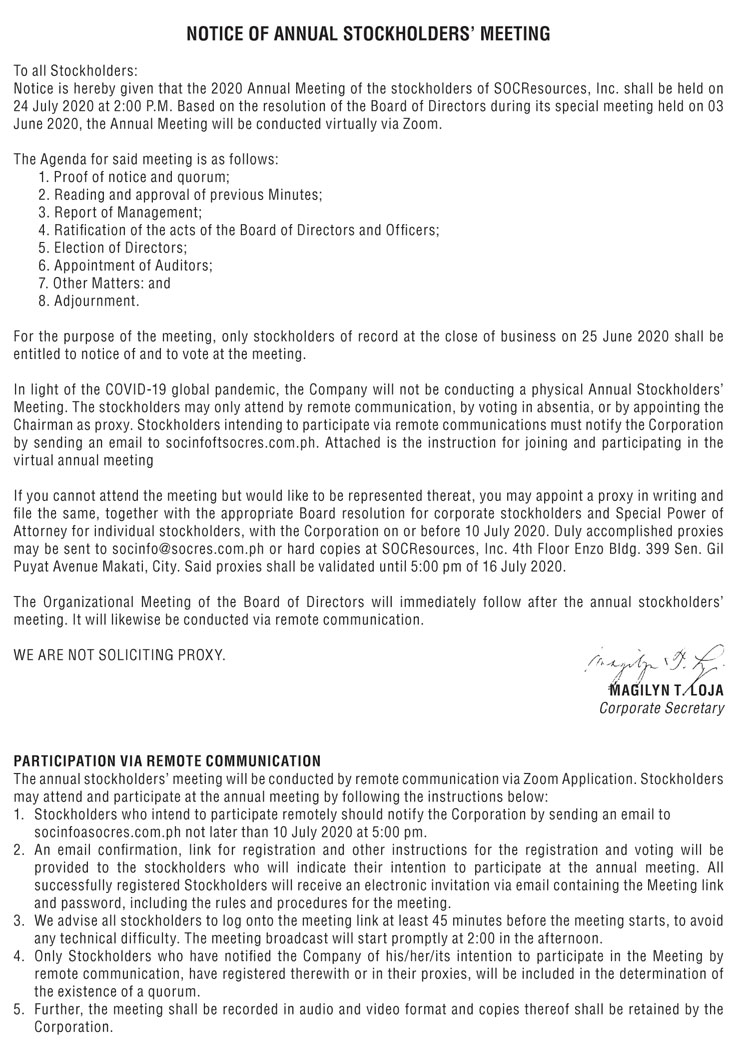
SOCResources to hold its virtual stockholders’ meeting on July 24

Nationwide round-up

DFA sends ship to bring home 97 seafarers stranded in China

THE DEPARTMENT of Foreign Affairs (DFA) has organized a ship that will bring home 97 Filipino seafarers stranded in another vessel docked in China. Foreign Affairs Undersecretary Brigido D. Dulay, in an online briefing Wednesday, said the crewmen have been stuck at their ship as China still restricts disembarkation of foreigners. “The way that our consulate in Xiamen devised is to bring them home via another vessel. Tuloy na itong vessel na ito, nandyan na ‘yung ibang seafarers, sinusubukan namin magsakay pa ng iba (This vessel is ready to go, some of the seafarers are there, and we are trying to get others on board),” he said. The DFA is also currently working on permits to allow the vessel to enter the Philippines. More than 63,000 overseas Filipinos have come home since February due to the global crisis brought about by the coronavirus disease 2019 (COVID-19). Mr. Dulay said they have been repatriating an average of 1,000-1,500 Filipinos per day, but the department is working to increase the capacity of airports to process more entrants.

REMAINS
Meanwhile, the remains of 274 overseas Filipino workers in Saudi Arabia are expected to be flown in this week, according to Labor Secretary Silvestre H. Bello III. In a separate briefing on Wednesday, Mr. Bello said “we are doing our best” to sort out the long list of requirements, including health protocols and consent from employers and next of kin. There were initially 301 remains to be brought home, but Mr. Bello said some of them were already either buried there or brought back by their respective families. — Charmaine A. Tadalan and Gillian M. Cortez

Police starts probe on J&T Express

THE POLICE Criminal Investigation and Detection Group (CIDG) has started its investigation on the alleged mishandling of cargo by delivery firm PH Global Jet Express Inc. (J&T Express). Brig. Gen. Rhoderick Armamento, CIDG deputy director for administration, on Wednesday said they have discussed with investigators on how to handle the probe. “We have met with our National Capital Region field unit and our legal department,” he said in a text message. President Rodrigo R. Duterte on Tuesday night ordered the CIDG and the National Bureau of Investigation to look into the complaints against the courier firm. J&T Express has been under fire following a viral video showing some of its workers mishandling cargo. Mr. Duterte threatened to close down the firm and “file charges” if needed. J&T Express, in an email to BusinessWorld on Wednesday, said it “appreciates” the President’s concern, particularly during in this time of the coronavirus crisis when delivery services have become crucial. “We appreciate the concern expressed by the President towards our customers’ welfare as well as the well-being of our many partners and employees. Furthermore, we will cooperate with the government in any investigation that it will conduct. We are committed to improving our services for the benefit of the public,” the company said. — Emmanuel Tupas/PHILSTAR and Gillian M. Cortez

Hog raisers told to be extra alert amid new swine flu strain

AN INFECTIOUS DISEASE specialist called on hog raisers and people who are constantly exposed to pigs to take extra caution after a new swine flu strain capable of triggering a pandemic was recently discovered in China. “We should be cautious everyday, especially with the discovery of this new type of influenza on pigs. There is really potential that the virus can infect humans,” San Lazaro Hospital Infectious Disease Specialist Rontgene M. Solante said in a radio interview on Wednesday. Mr. Solante also recommended that government agencies involved in the hog industry initiate testing on pigs to check if the virus strain is already in the country. Chinese researchers have discovered a new type of swine flu named G4. Their study published in the US science journal PNAS indicates that G4 genetically descended from the H1N1 strain that started a pandemic in 2009 and has all the “essential hallmarks” of being highly adapted to infect humans. The tests from the study also showed that the immunity gained by humans from exposure to a seasonal flu does not give protection from G4. Scientists involved in the study said the virus has already passed from animals to humans, but no evidence yet showing possible human to human transmission. “It is of concern that human infection of (the) G4 virus will further human adaptation and increase the risk of a human pandemic,” the researchers said.

LOCAL RESPONSE
The Department of Agriculture’s Bureau of Animal Industry (BAI), meanwhile, urged the public to report any unusual pig deaths to farm veterinarians or the nearest government veterinary or agricultural office. In a statement on Wednesday, the BAI also recommended farm owners to consult their licensed veterinarians to check farm biosafety and biosecurity programs. “Reports on flu-like symptoms have been increasing this rainy season and this could affect both agricultural workers and our swine production,” the agency said. “The public, especially those engaged in animal farming, is encouraged to report to the Department of Health any unusual sickness among farm workers,” it added. The agency also gave assurance that the country has been strictly implementing the ban on pork and swine products from China. — Revin Mikhael D. Ochave

Courts ordered to close based on positive swab test confirmation

THE OFFICE of the Court Administrator (OCA) has prohibited the closure or lockdown of courts if an employee tested positive for coronavirus infection based solely on a rapid antibody test. In a circular signed by Court Administrator Jose Midas P. Marquez, OCA said those who test positive for coronavirus infections should immediately undergo swab test for confirmation. “In the interim, courts exposed to subjects who tested positive using the rapid antibody test shall neither be closed down or locked down,” it said, citing guidelines from the Department of Health. Contact tracing must also be conducted for monitoring of symptoms, it added. Those with symptoms will be quarantined for 14 days or until they become asymptomatic, “whichever is longer.” If the confirmatory test is positive, the court will be closed for 14 days and immediately disinfected. As an additional safety protocol, all visitors and court users are required to register their contact information upon entry for contact tracing purposes. Individual branches and offices within the hall may also require the same. “Court users who are later confirmed for COVID-19 shall likewise immediately inform the court they have visited,” it said. Several courts in Metro Manila recently closed after employees either had a positive rapid test result or had contact with a coronavirus patient. — Vann Marlo M. Villegas

Manufacturing purchasing managers’ index of select ASEAN economies, June (2020)

FACTORY ACTIVITY fell for a fourth straight month in June, although the pace of contraction eased significantly as manufacturers were able to boost output for the first time since February, according to a survey by IHS Markit. Read the full story.

Manufacturing purchasing managers’ index of select ASEAN economies, June (2020)

Manufacturing contraction eases

By Beatrice M. Laforga, Reporter

FACTORY ACTIVITY fell for a fourth straight month in June, although the pace of contraction eased significantly as manufacturers were able to boost output for the first time since February, according to a survey by IHS Markit.

IHS Markit in a statement on Wednesday said the Philippines manufacturing Purchasing Managers’ Index (PMI) jumped to 49.7 last month from 40.1 in May, but still remained below the 50 neutral level separating contraction from expansion.

A PMI reading below 50 signals deterioration in operating conditions compared to the preceding month, while a reading above 50 denotes improvement.

Manufacturing purchasing managers’ index of select ASEAN economies, June (2020)

“June PMI survey data showed a further considerable easing in the downturn across the Filipino manufacturing sector, as operating conditions were close to stabilization and output levels increased for the first time since February,” IHS Markit said.

IHS Markit said this “signalled a further movement toward stabilization in the Filipino goods-producing sector.”

The headline PMI measures manufacturing conditions through the weighted average of five indices: new orders (30%), output (25%), employment (20%), suppliers’ delivery times (15%) and stocks of purchases (10%).

Easing of quarantine measures helped improve business confidence during the month, as companies hope sales will begin recovering, IHS Markit said.

Among the ASEAN region, the Philippines recorded the third-highest reading despite the slight contraction, trailing Vietnam’s 51.1 headline index and Malaysia with 51.

The country’s latest reading was just above Myanmar’s 48.7 and higher than the regional average of 43.7 for the month.

IHS Markit attributed the improvement in Philippine manufacturing conditions to higher output levels which expanded for the first time in four months, as firms ramped up production as the economy slowly reopened and others restarted operations after months of closure.

Overall demand also “notably improved, with new orders still falling but at a greatly reduced speed” locally, and more so overseas as restrictions were eased across the globe, IHS Markit said. Companies also saw a pickup in demand and orders from customers.

However, businesses said new work “remained weak” on pandemic fears and as other restrictive measures were still in place.

“The change in government COVID-19 (coronavirus disease 2019) rules to the general community quarantine helped the manufacturing sector make large strides towards stability in June,” IHS Markit Economist David Owen was quoted as saying.

Employment, meanwhile, continued to decline last month.

“Firms have noticeably held back from hiring as a result of weak demand, as employment numbers dropped at the steepest rate since March,” Mr. Owen said.

According to the survey, many firms decided to keep their workforce at a minimum and did not hire new workers to replace those who left. Some companies, on the other hand, increased their staff to boost capacity.

“The sharper decline in workforces suggests that manufacturers may need to see a strong rebound in goods demand before job levels can expand,” Mr. Owen added.

As demand remains slow, IHS Markit said factories were able to catch up with their backlog after shutting down during the lockdown.

“Signs from new orders and export orders data are encouraging, but the recovery may still be gradual as the pandemic continues and even accelerates in some regions,” Mr. Owen added.

Buying activity also dropped for four months in a row but at its slowest pace. Inventories of pre- and post-production goods were still curbed as the manufacturers only produced the volume needed to meet the orders.

“On the receipt of purchased items, manufacturers saw a further lengthening of lead times during June which signalled the eleventh monthly extension in a row,” IHS Markit said.

Delivery services were limited, it said, since suppliers were also working with minimal workforces to observe physical distancing.

Meanwhile, IHS Markit said input prices posted a sharp increase last month, with supplier prices rising faster due to difficulties in transportation and costlier freight charges.

While companies increased their selling prices slightly due to higher input costs, IHS Markit said there were companies that offered discounts to attract buyers and boost sales.

“The year-ahead outlook for manufacturing output rose to its highest since February, with companies seeing greater reason for optimism as the government relaxed COVID-19 quarantine measures,” it said.

For Ruben Carlo O. Asuncion of UnionBank of the Philippines, Inc., the higher headline reading in June was expected and will likely sustain the trend as the economy continues to reopen.

Mr. Asuncion said stricter restrictions are still imposed in some parts of the country such as in Cebu due to the rising number of new COVID-19 positive cases.

“With these recent developments, the effectiveness and consequent success of the NPIs (non-pharmaceutical initiatives) may spell the impact on the manufacturing sector’s recovery. Nevertheless, I posit that the potential recovery may be sooner rather than later because of the continued appropriate adjustment of work protocols following necessary health standards to allow the continuation of production without sacrificing health and safety,” he said.

For the Emerging Asia region, think tank Capital Economics said in a note that the improvement in manufacturing PMI across the region is still low, which shows companies are still struggling.

“It appears that the worst has passed for industry,” Capital Economics said, noting there was a “sizable rebound” for the sector in the region especially in the Philippines and Indonesia.

Capital Economics expects business conditions for the manufacturing sector to “continue improving gradually as external demand recovers,” while production will remain below pre-pandemic levels in the coming months on dampened demand.

“PMI readings suggest that a further easing of lockdown restrictions and a nascent recovery in external demand have helped improve conditions for manufacturers. But output is still likely to be well below normal levels for many months to come as domestic and global demand remains depressed,” it said.

BoP surplus widens in May

A bank employee counts US dollar notes in this file photo from May 16, 2016. — REUTERS

THE country’s balance of payments (BoP) saw a bigger surplus in May on the back of the National Government’s foreign borrowings and a narrower merchandise trade deficit.

Data from the Bangko Sentral ng Pilipinas (BSP) released Wednesday showed the country’s BoP position was at a surplus of $2.431 billion in May, its fourth successive month in surfeit. This is wider than both the $928-million surplus recorded a year ago and the $1.666-billion surfeit in April.

The May surplus is also the highest since January 2019’s $2.704-billion surfeit.

The BoP shows the country’s economic transactions with the rest of the world within a given period.

The central bank in June revised its BoP projection to a surplus of $600 million for 2020, slimmer than the $3-billion surfeit estimate it gave in November last year. The new projection represents 0.2% of the country’s gross domestic product.

“The BOP surplus in May 2020 reflected mainly the inflows arising from the National Government’s foreign currency deposits with the BSP as well as the BSP’s foreign exchange operations and income from its investments abroad,” the BSP said.

Inflows were partially offset by foreign currency withdrawals by the National Government meant to pay foreign currency debt obligations.

Year to date, BoP position remained at a surplus of $4.03 billion in May. However, this was thinner than the $5.19-billion surplus logged in the January to May 2019 period.

“The current BoP surplus was supported mainly by foreign borrowings by the National Government in April and May, coupled with lower merchandise trade deficit and by sustained net inflows of personal remittances from overseas Filipinos. These inflows fully negated the impact of lower trade in services receipts, the net foreign portfolio investment outflows and lower foreign direct investments inflows,” the central bank said.

Rizal Commercial Banking Corp. Chief Economist Michael L. Ricafort said in an e-mail the May surplus reflected “increased borrowings from multilaterals and commercial sources to finance stimulus spending and other COVID-19 (coronavirus disease 2019) programs.”

“Government has been aggressive in building its COVID financing war chest with roughly $5 billion in loans on top of a fresh RoP (Republic of the Philippines) [global bond] issuance, offsetting portfolio outflows linked to the risk-off sell down,” ING Bank N.V. Manila Senior Economist Nicholas Antonio T. Mapa said in an e-mail.

The government has so far secured $6.508 billion in loans, bond issuances and grants to fund its response for the pandemic, according to the Department of Finance.

Meanwhile, the trade deficit was at $499.21 million in April, much lower than the $3.8-billion gap in $3.8 billion seen a year ago and the smallest in five years or since the $257.18-million trade gap in March 2015 and the $64.95-million trade surplus in May 2015.

This, as merchandise imports declined 65.3% to $3.28 billion in April while exports fell 50.8% to $2.78 billion.

The BSP also said the BoP reflects the country’s gross international reserves at record high of $93.29 billion as of end-2020, surpassing the $90- billion buffer target for 2020.

“At this level, the GIR represents an ample external liquidity buffer, which is equivalent to 8.4 months’ worth of imports of goods and payments of services and primary income,” the central bank said.

The dollar reserves is also about seven times the country’s short-term external debt based on original maturity and 4.6 times based on residual maturity. — Luz Wendy T. Noble

PHL losses from tourism standstill could reach $22.6B

By Jenina P. Ibañez, Reporter

THE Philippines could lose up to $22.64 billion (P1.13 trillion) or seven percent of GDP if the tourism standstill caused by the pandemic extends to 12 months, the United Nations Conference on Trade and Development (UNCTAD) said in a report.

The country is already facing a loss of $7.7 billion (P383.7 billion) or two percent of the country’s GDP after the tourism industry was forced to shut down for four months so far this year. If the standstill extends to eight months, the Philippines could lose $15.19 billion (P792.3 billion) or five percent of GDP.

In its COVID-19 and Tourism: Assessing the Economic Consequences report released on July 1, UNCTAD said the world tourism sector’s losses may reach at least $1.2 trillion or 1.5% of the global gross domestic product over the four-month standstill.

UNCTAD said the coronavirus disease 2019 (COVID-19) pandemic has brought to a halt an industry that has tripled in value to $1.6 trillion in the last two decades.

“These numbers are a clear reminder of something we often seem to forget: the economic importance of the sector and its role as a lifeline for millions of people all around the world,” UNCTAD Director of International Trade Pamela Coke-Hamilton said.

An eight-month international tourism break spells a $2.2-trillion loss or 2.8% of world GDP, while a 12-month break increases this to $3.3 trillion or 4.2% of global GDP.

The Department of Tourism said revenues declined by 55% in the first four months of 2020 to P79.8 billion from P180.5 billion in the same period a year ago. Last year, tourism contributed 12.7% to the country’s GDP and employed 5.7 million people.

The decline in tourism arrivals has caused countless job losses. A 12-month standstill is expected to translate to an eight percent decline in skilled wages and a 10% drop in unskilled employment.

A four-month pause is seen to have already caused a three percent drop in skilled wages, and caused unskilled employment to slide by four percent.

The Philippines is the 14th most-affected country in terms of unskilled employment in the report looking at 65 countries and regions, and the third-most affected among Southeast Asian countries after Thailand and Malaysia.

The Philippines is currently under the longest and strictest lockdowns in the world.

But the Tourism department in a press release said that it expects the reopening of the industry as more areas shift to a relaxed lockdown or a modified general community quarantine (MGCQ).

Areas under MGCQ can have tourism activities up to 50% operational capacity.

“The anticipated resumption of business operations will bring about many opportunities for our kababayans, but we would like to remind our tourism stakeholders that the implementation of health protocols in the new normal should always be a priority because it is only by ensuring the safety of our guests can we regain the confidence of our traveling public,” Tourism Secretary Bernadette Romulo-Puyat said.

The government has, however, placed Cebu City under a stricter lockdown after a spike in COVID-19 cases. Cebu province was reported to have attracted the second-highest number of tourist arrivals in the country last year, after Boracay.

Tourism Congress of the Philippines (TCP) President Jose C. Clemente III in a mobile message said the projected losses would mean a catastrophic year for the tourism industry and the Philippine economy.

“It is near catastrophic already for the industry stakeholders with many companies already ceasing operations or seriously contemplating on doing so. Many in the industry, mostly MSMEs (micro, small, and medium enterprises), cannot survive longer without further assistance from the government,” he said.

Mr. Clemente said recovery will take time as the anticipated shift to domestic travel will depend on local governments, as some are still hesitant to reopen borders until they have adequate facilities and testing for visitors. TCP for now expects limited resumption of domestic travel in September.

“We have asked for the deferment of taxes, possible waiving of rentals and utilities, wage subsidies and more,” he added, noting that TCP expects 12-24 months before a return to “normalcy.”

Rizal Commercial Banking Corp. Economist Michael L. Ricafort in a mobile message said he expects tourism recovery after the pandemic to take longer than other industries.

While most industries may recover in 18 months, he cited the International Air Transport Association’s estimation that global air travel could return to its pre-pandemic levels in 2023. He said the decline in global tourism led to the repatriation of overseas Filipino workers.

“Some job losses and business closures around the world could also slow the recovery of the tourism industry locally and worldwide, on top of health considerations,” he said.

“Tourism accounts for at least 10%-20% of the local economy and could remain a drag on GDP amid social-distancing measures, travel restrictions/constraints, and other stringent measures as the risk of new COVID-19 cases remain, until a cure/vaccine is developed. Thus, recovery in tourism could be relatively slower and would take longer,” Mr. Ricafort added.

Governments should help protect workers, including offering wage subsidies for workers in enterprises that are not likely to recover, UNCTAD said.

The report also recommended offering low interest loans for tourism enterprises and applying quarantine procedures for travelers in a post-pandemic scenario.

But in the medium and long term, UNCTAD is suggesting that governments decrease reliance on a single industry.

“Governments should support economic diversification where possible. A high dependence on one sector increases vulnerability,” the report said.

“For some countries diversification away from tourism may be difficult. Avenues for economic diversification may include increased regional integration, education and training programs in targeted economic sectors to boost resilience and mitigate the cost of shocks.”

Mr. Clemente of the Tourism Congress said he believes the recovery of tourism can be “tremendous.”

“People are looking to travel after months of isolation and lockdowns. They want to go. It all depends on how we control our COVID-19 situation and how effective our protocols and guidelines are,” he said.

Central bank plans maiden securities offer within 3rd quarter

THE Bangko Sentral ng Pilipinas (BSP) is planning to conduct its maiden securities issuance within the third quarter.

“The BSP is looking forward to its first issuance of the BSP Securities this quarter. It took many years to finally amend the BSP Charter and with it, restore the BSP’s authority to issue its own freely negotiable securities,” BSP Governor Benjamin E. Diokno said during the signing ceremony on Wednesday.

“Thus, the prospect of an additional market-friendly instrument in the BSP’s policy toolkit is something to look forward to as we continuously enhance our monetary policy implementation and liquidity management under the Interest Rate Corridor framework.”

The BSP signed a memorandum of agreement to link its monetary operating system (MOS) and the National Registry of Scripless Securities (NRoSS) of the Bureau of the Treasury (BTr).

“The connectivity of the MOS and the NRoSS is the main infrastructure that would allow the issuance to be possible and would make the features of the BSP,” Mr. Diokno said.

BSP’s MOS is an electronic platform that allows counterparties to take part in the central bank’s liquidity tools. Meanwhile, the NRoSS of the BTr serves as an electronic registry system for government securities.

Reuters quoted Mr. Diokno as saying the central bank is looking to offer a small volume of securities with short-term maturities.

BSP Deputy Governor Francisco G. Dakila, Jr. said the amount of the initial issuance will be based on the BSP’s forecast of the total amount of excess liquidity that needs to be absorbed.

The BSP will coordinate with the BTr to ensure the issuance will not overlap with the schedule and tenor of government bonds.

“The determination of frequency of auction [of BSP issuances] will depend on market conditions,” Mr. Diokno said.

Mr. Diokno clarified that BSP securities are meant to manage liquidity “to support monetary policy transmission” which differs from the government securities issued by the BTr meant to fund government spending.

He said the BSP securities will form part of risk-free assets alongside government securities.

“The funds will remain locked away at the BSP until the securities….In particular, the issuance of BSP securities is expected to facilitate the construction of benchmark yield curve at the short end, which the market can refer to when pricing loans to finance debt instruments,” he said.

Once the central bank securities are issued, secondary market trading will be done through the Philippine Dealing and Exchange Corp.

The BSP’s authority to issue its own securities is provided under Republic Act 11211 or The New Central Bank Act signed into law in February 2019.

“By being able to issue debt securities, the BSP is empowered with a more targeted approach to achieving desired monetary policy outcomes. Should there be excess structural liquidity in the financial system, the BSP will be able to respond more effectively,” Finance Secretary Carlos G. Dominguez III said. — Luz Wendy T. Noble

IMF sees Asia’s pain persisting as virus curbs limit recovery

ASIA’S loss of economic output due to the deadly coronavirus will likely persist until 2022, according to the International Monetary Fund (IMF).

The assessment is a warning about the prospects for a global recovery after the pandemic tipped the world economy into its worst collapse since the Great Depression. The Asia region contributed about 68% of global growth in 2019, according to the IMF.

While regional growth is tipped to rebound to 6.6% next year, that won’t be enough to replace all of the output lost due to the crisis.

“We project Asia’s economic output in 2022 to be about 5% lower compared with the level predicted before the crisis; and this gap will be much larger if we exclude China,” according to Chang Yong Rhee, director of the IMF’s Asia and Pacific Department.

“Even when lockdown measures are fully relaxed, economic activity is not likely to return to full capacity, due to changes in individual behaviors and measures put in place to maintain physical distancing and reduce contagion,” Mr. Rhee said.

The fund said last week it expects global gross domestic product to shrink 4.9% this year, more than the 3% contraction predicted in April. For 2021, the fund sees growth of 5.4%, down from 5.8%. Asia is tipped to contract by 1.6% this year — the first such outcome in living memory according to Mr. Rhee and a downgrade from the fund’s April projection of output being unchanged.

Still, Asia continues to provide ballast. If the region’s growth was as negative as the rest of the world, then global growth forecasts would be at about -7.6%, according to Mr. Rhee.

Close coordination between central banks and finance ministries will be an important part of the policy response given the limited room to borrow that many emerging economies in Asia face, according to Mr. Rhee.

Policy options include making more use of central bank balance sheets to funnel lending to smaller firms. Temporary capital controls may be needed in the event of large outflows.

While portfolio outflows from the region have stabilized, net outflows compared to the global financial crisis remain high, Mr. Rhee said.

Governments will also need to keep an eye on their borrowing even as more crisis spending is needed.

“They must use fiscal stimulus in the short term, but complement it with a credible medium-term reform plan to mitigate debt overhang concerns,” Mr. Rhee said. “That will help to maintain sovereign credit ratings.” — Bloomberg

7-Eleven offers P711-M loan to franchisees

THE listed licensor of 7-Eleven convenience stores, Philippine Seven Corp. (PSC), has allocated P711 million as loan to its franchisees to prevent the closure of stores due to mounting losses from the coronavirus disease 2019 (COVID-19) pandemic.

In a statement late Tuesday, the listed firm said it had started disbursing funds on June 20 as part of a pandemic support program to 7-Eleven franchisees.

The loans are offered interest-free and franchisees may borrow as needed and pay when able.

“We recognized immediately that the country’s (and the world’s) battle with COVID-19 would be long and painful, so the first thing we did was request our bankers for an increase in our credit lines. Thankfully, they responded quickly and generously, and our next focus became how to deploy this access to capital strategically during the pandemic,” PSC President and CEO Jose Victor P. Paterno said in the statement.

“[W]e are in the same boat as our franchisees with regard to profitability challenges—just because you can borrow doesn’t mean you’ll make money, just that you’ll survive for longer until you do,” he added.

Through the loan program, PSC believes franchisees would not be out of pocket on a monthly basis. They may pay back when their situation improves, but if they decide to discontinue the franchise, all outstanding balances to PSC “will be forgiven.”

Earnings of PSC in the first quarter fell 7% to P103.82 million due to temporary store closures from the pandemic-related lockdown. Because of the crisis, it said 22% of its 2,916 stores were closed as of end April, and 11% were closed as of end May.

Aside from providing loans, Mr. Paterno said PSC is also calling on landlords to help franchisees in surviving the pandemic by “(sharing) the pain” in rent payments.

“We have a very long list of unprofitable stores right now, and we expect the situation to continue until December at the very least. If and when that happens, expect that space to be vacant for a very long time,” he said.

He added PSC was planning to open 400 new stores this year but such plan was suspended indefinitely because of the pandemic.

“Most of our 1,000+ franchisees have to pay rent, and we are doing our part to ensure they survive. We are now asking our landlords to do theirs,” Mr. Paterno said.

PSC shares at the stock exchange shed 10 centavos or 0.08% to P128.90 each on Wednesday. — Denise A. Valdez

PSE net earnings down 71% as shareholders turn to cash

THE Philippine Stock Exchange, Inc. (PSE) booked a 71% drop in its first quarter bottomline to P50.62 million as investors opted out of the market due to the coronavirus disease 2019 (COVID-19) pandemic.

In a statement Wednesday, the operator of the local bourse said its revenues during the three-month period dipped 0.4% to P294.72 million because of the ongoing crisis.

The huge toll on its net income came from the 184.3% plunge in other income, which it traced to lower fair value of investments and lower interest income.

“The COVID-19 pandemic definitely affected our revenues for the quarter. Investors opted to be liquid and hold on to cash, hence, the slowdown in trading activity,” PSE President and CEO Ramon S. Monzon said in the statement. “Issuers also opted to put on hold fund raising plans.”

He noted the PSE may continue struggling in the coming months as investors remain cautious over the COVID-19 pandemic and corporate earnings for the second quarter.

“Meeting our original target for capital raising will be quite a challenge as most companies would probably be reducing their capital expenditures and defer their expansion plans for the rest of the year,” Mr. Monzon said.

“The only silver lining would be if banks become more strict and selective in their lending policy and listed companies who need funds have no choice but to raise the same from the equities market,” he added.

Mr. Monzon told reporters in December the PSE was setting a capital raising target of P150 billion for 2020, up more than 50% from the P95.22 billion capital it raised in 2019.

In the first half of 2020, the PSE said it raised a total capital of P20.83 billion, coming from one initial public offering (IPO), one follow-on offering, one stock rights offering and two private placements.

Among the PSE’s initiatives to spur market activity is amending its listing rules, relaxing requirements to open the stock market to more corporations for fundraising. It said it was also exploring new digital services that would cater to new behaviors that are being born during the pandemic.

In a separate statement, the PSE said it hopes to see two to three more capital raising activities at the stock market this year. So far, there were only MerryMart Consumer Corp.’s initial public offering and Altus Property Ventures, Inc.’s listing by way of introduction.

“Hopefully, these two new listings will help prop up trading activity even as we await the listing of the first REIT (real estate investment trust) IPO,” Mr. Monzon said.

The bourse operator also said the PSE index slumped 20.6% in the first half of 2020 as an effect of the pandemic. But compared to the first quarter, the PSEi rose 16.7% as of end June and improved 34.3% from its lowest for the year of 4,623.42.

“While the index may have recovered from oversold levels it has not been able to climb back to its pre-COVID-19 levels indicating that investors are still quite wary about the full impact of the virus on the economy and are concerned that the number of cases continue to increase despite the various community quarantine regimes we went through,” Mr. Monzon said.

Daily average value turnover fell 15.9% to P6.59 for the six months. Foreign investors stood as net sellers with net outflows reaching P68.44 billion, a turnaround from last year’s net foreign buying of P21.26 billion.

“Even if there are attractive bargains in emerging markets, foreign institutional funds prefer to sit it out. Fortunately, local investors readily took over the buying momentum and kept our market resilient. In April and June, we noted that locals were responsible for 53.0 percent and 58.9 percent of value turnover,” Mr. Monzon said. — Denise A. Valdez

Sia’s listed companies post mixed results in first quarter

TWO listed companies led by businessman Edgar “Injap” J. Sia II posted mixed results in the first quarter, but both were insulated from the negative impact of the coronavirus disease 2019 (COVID-19) pandemic.

MerryMart Consumer Corp. recorded a 51% income growth due to the surge in demand for basic needs, while DoubleDragon Properties Corp. saw a 42% earnings drop after a one-off fair value gain in 2019.

In a statement to the exchange, MerryMart said its attributable net income rose to P8.35 million from P5.55 million last year. Consolidated revenues grew 40% to P794.91 million, accounting for seven operational branches during the three-month period.

The company opened four new stores in the first quarter: MerryMart Grocery in Calamba, MerryMart Store in Ayala Malls Manila Bay, MerryMart Grocery in Mayombo and MerryMart Grocery in Sorsogon.

It said it remains bullish for the rest of the year with a plan to open 18 more branches in strategic areas across the country. It is also targeting to launch an in-house online delivery platform by the third quarter to make over 3,000 MerryMart products available for delivery.

“[The pandemic] has made the MerryMart team realize the benefit of being light and nimble… Being a new player in the industry, it will not have to face the major issue of reconfiguring a big complex structure… [because it] has the flexibility to mold its expansion masterplan according to the new normal,” Mr. Sia said.

Shares in MerryMart at the stock exchange shed 14 centavos or 4% to P3.36 each on Wednesday.

On the other hand, DoubleDragon posted an attributable net income of P536.69 million in the first quarter, down from P919.41 million in the same period last year.

But it said the decline was due to one-off fair value gains last year from the completion of DoubleDragon Center East. Core net income, which excludes unrealized fair value gains, jumped 133% to P427.94 million with the sustained growth across its business segments.

Recurring revenues rose 21% to P927.91 million after a 24% increase in rent income to P774.97 million, a 16% improvement in real estate sales to P208.14 million and a 7% uptick in hotel revenues to P152.94 million.

This growth pushed recurring revenues to account for 48.46% of DoubleDragon’s consolidated revenues during the period, up from last year’s 28.93%, and moved it closer to its target of sourcing 90% of its topline from recurring revenues.

Consolidated revenues for the period fell 28% to P1.91 billion due to unrealized gains.

“DoubleDragon’s strong asset base, even without [fair value] gains, is already yielding a substantial amount of core revenues which are primarily recurring in nature,” DoubleDragon Chief Investment Officer Hannah Yulo-Luccini said in the statement.

She said this business format makes DoubleDragon poised to withstand economic challenges emerging from the COVID-19 pandemic, as it doesn’t rely on real estate sales, which she said are “more sensitive to economic downturns.”

DoubleDragon also maintains a plan to raise capital through a real estate investment trust offering in the fourth quarter, which Ms. Yulo said would “catapult the company’s consolidated equity to exceed the P50 billion ($1 billion) mark.”

The company is targeting to raise its leasable portfolio to 1.2 million square meters by 2022 across provincial retail leasing, office leasing, industrial leasing and hotels.

Shares in DoubleDragon at the stock exchange dipped four centavos or 0.23% to P17.08 each on Wednesday. — Denise A. Valdez

Locked-down stores pull down SSI’s income by 36%

SSI Group, Inc. saw its net income in the first quarter dwindled by 36% year-on-year as its physical stores were ordered shut during the nationwide quarantine imposed against the threat of the global pandemic.

Despite a “strong footing” in January and February, with sales rising by 12%, the listed specialty retailer said it booked a lower net income of P110 million in the first three months of the year, while sales were also down 13% year-on-year.

This was a result of the quarantine measures that led to the temporary closure of the company’s brick-and-mortar stores and the halt in fulfilling online orders starting mid-March.

In the midst of “extraordinary” operating conditions, SSI Group President Anthony T. Huang believes that its brand portfolio, store network, and customer base will be proven “resilient” throughout the rest of 2020.

The company reopened its network of specialty stores on June 1, ensuring health and safety protocols are in place. It also returned to fulfilling online orders in mid-May.

Last month, SSI added the online site of Marks and Spencer Philippines on its range of e-commerce sites. It plans to further expand its online segment with more site launches for the rest of the year.

SSI has also launched its concierge service The Specialist, which helps customers shop from home, then arranging payments and deliveries for them.

Mr. Huang said the company is “encouraged” with the “steady” growth of SSI brand’s sales, as well as with its e-commerce revenues which have “more than doubled.”

“We look forward to the gradual recovery of our operations as the country begins to reopen and build on the gains made so far in the struggle against the COVID (coronavirus disease 2019) health crisis,” he said.

SSI is the Philippine retailer of international brands such as Gucci, Prada, Kate Spade, Zara, Marks & Spencer, Gap, Lacoste, Banana Republic, Muji, Lush, TWG, SaladStop, and Shake Shack.

On Wednesday, shares in SSI were unchanged at P1.13 each. — Adam J. Ang