It’s high time for the government to integrate and normalize digital payments, according to executives and government officials.
Orlando B. Vea, PayMaya Founder and Chief Executive Officer, enumerated the benefits of digital payments, including ease of doing business and promotion of physical distancing and touch-free transactions, the latter being particularly helpful during the COVID-19 pandemic.
“The past few months have brought to fore how digital technology can help the government in the uninterrupted delivery of essential services and faster disbursements of financial aid. Pre-COVID-19, cash was king. Today, in the new normal, cashless is emerging as the preferred option,” he said during the first session of BusinessWorld Insights, a three-part online forum.
Mr. Vea cited some that have partnered with his company, such as the Social Security System, Bureau of Customs, and the local governments of Pasig City and Caloocan City.
Another example is Valenzuela City, which launched Paspas Permit prior to the pandemic. The end-to-end permit system is digitized, from application to delivery of permits via Grab Delivery. Through this system, citizens can pay their taxes and access civil registry details, such as wedding contracts.
“We wanted them to do it online, in their comforts of their own home, and they didn’t even have to brave traffic to be able to renew their business permit in ten seconds,” said Valenzuela City Mayor Rex T. Gatchalian.
Jeremiah B. Belgica, director-general of the Anti-Red Tape Authority, added that digitization will become necessary for the survival of government agencies. He cited units currently working with a skeletal force, saying that this may not be a sustainable arrangement.
To proceed with digitization, he recommended that government agencies first streamline and re-engineer their processes by removing practices that no longer serve a purpose.
“If we keep on refusing to give in to the wave of the new normal towards digitization, then government would cease to function in accordance to what the people actually need,” Mr. Belgica said. “We cannot automate something that is not first rational or streamlined, because the red tape that has been there for so long could end up still being in the automation.”
PayMaya is part of Voyager Innovations, Inc., whose portfolio includes PayMaya Enterprise for end-to-end merchant-acquiring solutions and Smart Padala, which has over 30,000 partner agent touchpoints nationwide.
Hastings Holdings, Inc., a unit of PLDT Beneficial Trust Fund subsidiary MediaQuest Holdings, Inc., has a majority stake in BusinessWorld through the Philippine Star Group, which it controls.
The local sporting community’s push to get back in the swing of things gained some headway on Friday after it was announced that the Inter-Agency Task Force for the Management of Emerging Infectious Diseases (IATF-EID) approved the resumption of practices and conditioning for professional and national basketball and football teams.
During his daily media briefing, Presidential Spokesperson Harry Roque announced the IATF decision to allow the conduct of health-enhancing physical activities and sports amid the coronavirus disease 2019 (COVID-19) pandemic as recommended by pertinent government agencies.
The decision paved the way for the return to some activities of sports organizations like the Philippine Basketball Association (PBA) and Philippines Football League (PFL).
“It was agreed upon in the IATF to adopt the decision of the technical working group. The Philippine Sports Commission, Games and Amusement Board (GAB) and the Department of Health approved the joint administrative order on the guidelines on the conduct of health-enhancing physical activities and sports during the COVID-19 pandemic,” said Mr. Roque.
“[That means] practices and conditioning of basketball and football are now allowed upon the request of the PBA and other football organizations,” he added.
In the lead-up to the decision, the PBA, along with other sporting bodies like the Philippine Football Federation (PFF), made representations to the GAB for guidance to convince the IATF, the lead body in the country’s fight against COVID-19, to allow sports to return gradually, first with practices and then for matches to resume in different leagues.
Their request was formally discussed by GAB with the IATF’s technical working group, and GAB Chairman Bahm Mitra said it was warmly received.
The PBA has been in hiatus since March 11 after it decided to suspend its season with COVID-19 taking further root in the country and mitigating measures by the government against the spread of the virus made it impossible to hold the staging of the matches.
The league said a lot hinged on the IATF decision for it to get the ball rolling towards resuming activities.
“It all depends on the IATF. We have sent our letter of request to IATF and we’re just waiting for the response. We’ll just wait for the response and see after. If even practices are not allowed, basketball may not push through at all. So, we’ll see,” PBA Commissioner Willie Marcial said.
In recent weeks, the PBA conducted meetings and consultations, including with players, to discuss health and safety protocols to be implemented once activities resume.
The PBA is set to make a final decision on the continuation of its season in August.
The PFF, for its part, is also bracing for a possible return of activities, crafting its own protocols and making adjustments to its calendar of events.
Parties who made payments for events that were canceled or scaled down prior to community quarantine have the right to demand a refund, according to the Department of Trade and Industry (DTI).
This is according toMemorandum Circular 20-30, issued on June 2 by DTI, which contains guidelines on the refund of event payments. The agency explained these guidelines further in a consumer care webinar held on July 2.
According to the agency, events are defined either as personal or business. Personal events include birthdays, christenings, weddings, anniversaries, thanksgiving, family reunions, and similar events. On the other hand, business events include conferences, seminars, workshops, team buildings, planning sessions, and similar events, such as forums, that are paid for by a company.
Those who have organized such an event are entitled to a refund if they made full or partial payment prior to any level of community quarantine (CQ). They can also be refunded if the event that they organized was supposed to be held during the CQ or if it had to be canceled or scaled-down — meaning the number of guests had to be reduced — because of social distancing directives.
However, a person isn’t entitled to a refund if the payment was made after imposition of CQ or if their contract with the venue owner states that any pre-payment made will be forfeited in case of a fortuitous event.
Furthermore, a venue owner is required to return the money spent on event expenses if these were incurred after the CQ was applied. However, only a portion has to be returned if the event was scaled-down in compliance with social distancing directions or if “valid and verifiable expenses” were incurred in preparation for the event prior to the imposition of CQ.
To kickstart the refunding process, parties covered by the stipulations may follow these steps:
1. Notify the venue owner or representative of your decision to cancel or scale down the event.
2. Wait within five days for the venue owner or representative to acknowledge receipt of your request. They should indicate the options available together with how they will execute each option.
The options are as follows:
Canceled events
Scaled-down events
Consume the amount paid at a later date within one year from the lifting of the government-imposed restrictions.
Get the net of the amount paid after deducting relevant actual expenses incurred before the imposition of restrictions. Proof must be presented by the venue owner or representative.
Get a refund in such amount proportionate to the agreed scaled-down event or function after deducting relevant actual expenses incurred before the imposition of restrictions. Proof must be presented by the venue owner or representative.
Get back the full amount regardless of expenses incurred after the imposition of restrictions.
Get a refund in such amount proportionate to the agreed scaled-down event or function regardless of expenses incurred after the imposition of restriction.
3. Notify the venue owner or representative of your option.
4. Wait within five days for the venue owner or representative for them to acknowledge receipt of your notification and your chosen option.
5. Send your acknowledgment of the venue owner or representative’s receipt.
6. If both parties come to an understanding, then the refunds should be implemented within the period and terms that were agreed upon. If there are no terms indicated, the refunds should be made within 30 days from your acknowledgment indicated in step 5.
7. If both parties fail to settle, request the DTI-Fair Trade Enforcement Bureau (FTEB) or the concerned DTI provincial office, via written letter, to direct both parties to go through an alternative dispute resolution proceeding.
8. Pending receipt of notice from the DTI, the requesting party should continuously update the DTI-FTEB or DTI provincial office of any relevant development. Otherwise, the concerned DTI office will presume that both parties have been able to settle.
While these guidelines are the recommended standard, the DTI stated that they will not stop any person who wishes to return the full paid amount without deduction of relevant actual costs or make a full or partial refund on pre-payment received. This is known as an act of goodwill.
“In the circular, we have requests for the supplier because we’re all affected. That’s where we hope goodwill will come in,” said Assistant Secretary Ann Claire C. Cabochan of DTI’s Consumer Protection Group, in Filipino. “If they want to be patronized because… they don’t look at the bottomline figures but rather at their relationships with their client, then they will hopefully provide the options to the consumer.”
Credit Information Corporation (CIC), the state-run public credit registry and central repository of credit information in the Philippines, officially welcomed Union Bank of the Philippines (UnionBank) as the first to gain access to the Credit Information System (CIS) in its paid phase access.
In its Memorandum of Agreement (MOA), the CIC authorized UnionBank to access its database either directly from the credit registry or through its accredited credit bureaus.
“We welcome UnionBank as our first accessing entity among universal banks. The decision to recognizing the value of the CIC database in credit decision-making, especially in the time of COVID-19 as a bank that prides itself in its innovations to serve the constantly changing needs of Filipino consumers, accessing credit reports from the CIC puts it first in line to deal with the financial impacts of COVID-19 on its borrowers,” said CIC President and CEO Jaime Casto P. Garchitorena.
“This move is part of our commitment to deliver superior customer experiences and promote inclusive prosperity in the country. Now that we are officially accessing the CIC database, we will gain a balanced view of an individual’s creditworthiness and grant them with the opportunity to be properly evaluated when availing our loans and other services,” said UnionBank Chief Risk Officer Ronaldo Peralta.
CIC Senior Vice President for Business Development and Communications Atty. Aileen L. Amor-Bautista commended UnionBank for its dedication to comply with the requirements for access.
“We recognize the challenges of seeing CIC not just as a regulatory entity but as an actual solutions partner and does require some innovative thinking. The CIC has always espoused looking beyond the compliance nature of engaging with a state-run enterprise and we are grateful that despite the logistical and technological challenges brought about by community quarantine, UnionBank made this engagement a priority,” Amor-Bautista said.
UnionBank President and CEO Edwin Bautista likewise expressed the bank’s commitment to support the economy by ensuring substantially broader access to financial services especially for micro, small and medium enterprises (MSMEs) amid the COVID-19 crisis.
“With our digital platforms in full swing and with the recent grant of access to the CIC database, I believe that UnionBank is all geared up to expand its loan portfolio and client reach, especially to MSMEs that have been adversely affected by the pandemic and are a vital component of our economy,” Bautista said.
Since the CIC opened the registration for paid phase access in July 2019, there has been an increasing number of requests across the country to become an accessing entity.
Application as an accessing entity of the CIC is open to all submitting entities in production or those financial institutions that are already submitting live or actual basic credit data of their borrowers to the CIC database, with at least six months’ continuous submission reckoned from the start date of access.
As part of efforts to cope with the COVID-19 pandemic and meet Anti-Red Tape Act (ARTA) requirements, the CIC recently launched the web-based application system called Covered Entity Portal.
This allowed UnionBank to register, update, and submit documents online including MOA, Accessing Entity Information Sheet (AEIS), and Secretary’s Certificate or Board Resolution.
Garchitorena cited that CIC Credit Reports are available to accessing entities at P10 per inquiry until December 2020, “making it the most affordable, complete credit report available” for financial institutions.
As of 30 March 2020, the CIC database contains 11.3 million unique individuals and 83,000 companies/proprietors, with 73.5 million contract data—52.8 million of which are installment transactions, 19.9 million are credit cards, and 767,177 are non-installment.
TAXES collected by the country’s two biggest revenue-generating agencies started to pick up in June, but this was not enough to help them meet collection targets for the first six months of 2020.
Citing preliminary data, the Department of Finance (DoF) said the Bureau of Internal Revenue (BIR) and Bureau of Customs (BoC) collected a total of P270.77 billion last month, 28% higher than the P211.5 billion logged in June 2019.
This is a reversal from the 52% and the 39% contraction reported in May and April, respectively.
The BIR collected P228.23 billion in June, a 42.47% surge from the P160.2 billion a year ago, but fell 19.86% short of the P284.8-billion target. The higher collection was attributed to the fact that the deadline for filing and payment of annual income taxes and other returns fell on June 15. The original April 15 deadline was pushed back several times to give relief to taxpayers during the lockdown.
The BIR’s Large Taxpayer’s Service (LTS) unit generated P145.81 billion in June, up 35.05% from P107.97 billion a year ago. Of the total, income taxes soared 82.5% to P83.7 billion from the P45.86 billion reported a year ago.
LTS collections from value-added tax (VAT) also rose 7% year on year to P24.25 billion from P22.68 billion and 11.7% above the target of P21.71 billion.
Meanwhile, BoC generated P42.54 billion in revenues in June, exceeding its collection target of P40.74 billion by 4.4%. No comparative data was provided.
The Customs bureau said in a statement the improvement was largely due to “intensified collective effort of all ports and the gradually improving volume of importation.”
Separate BoC data obtained by BusinessWorld showed volume of imports jumped 30% in June to 8.06 billion kilograms (kg) from the 6.2 billion kg of imports seen in May and also 7% higher than the 7.13 billion kg in April.
Imports last month, however, were still lower by 22% from the 10.38 billion kg logged in June 2019, but the contraction was smaller than the 41.22% year-on-year slump recorded in May.
“It can also be attributed to the government’s effort in ensuring unhampered movement of goods domestically and internationally considering the pandemic situation,” the statement read.
FIRST-HALF SLUMP
Despite the improved figures in June, the first-half collections of the BIR and BoC dropped by 16% to P1.15 trillion compared to the P1.375 trillion a year ago.
BIR’s collections declined 15.9% from a year ago to P901.96 billion in the six-month period, and fell 3.4% below target.
“This collection period includes the months when strict quarantine measures were imposed to contain the spread of the coronavirus disease 2019 (COVID-19) that led to a virtual economic standstill in Metro Manila and the rest of Luzon,” DoF said in the statement.
Of which, BIR collected P273 billion in income taxes of large taxpayers, 15.47% down from P323 billion a year ago and 7.61% short of its target for the period.
VAT collections from large taxpayers hit P112.35 billion, down 11% from a year ago but higher by around six percent of its P106.09-billion goal.
On the other hand, BoC revenues during the period slipped by 16.5% year on year to P253.04 billion and 0.47% lower than its reduced P254.25-billion goal.
DoF attributed the decline to lower import volumes as a result of the global economic slowdown.
Customs data showed import volume has been on a steady decline since January, bringing the total import volume to 48.13 billion kg in the first semester, down 17.74% from the 58.51 billion kg recorded in the same period last year.
BIR’s revenue target for 2020 was slashed to P1.744 trillion, 23% lower than its P2.205-trillion goal set in March.
BoC has a collection target of P542 billion this year, which has been reduced from the initial P730-billion goal set earlier this year.
Government’s overall revenues are projected to fall sharply to P2.612 trillion this year as tax collections weaken amid the economic downturn.
The economy is expected to contract by 2-3.4% this year. — Beatrice M. Laforga
Mass transportation continuing to operate at a limited capacity is seen as one of the constraints to a faster economic recovery. — REUTERS
By Beatrice M. Laforga,Reporter
ECONOMIC managers are hopeful the Philippines will begin its gradual recovery this month, as lockdown restrictions continue to be eased around the country.
At the same time, some economists forecast gross domestic product (GDP) would return to a growth trajectory in the third quarter.
National Economic and Development Authority Acting Secretary Karl Kendrick T. Chua told the House of Representatives Committee on Economic Affairs on Thursday the economic team’s projection of an 8-9% growth in 2021 hinges on a gradual recovery starting July and boost in government spending through a stimulus package.
“The outlook for 2021 is based on major assumptions. Number one, we have gradual recovery starting July of this year and the second is that we also see the public sector or the government increasing spending as a stimulus,” he said.
“If those two are achieved, then the target is (up to) 9% growth next year.”
Bangko Sentral ng Pilipinas (BSP) Governor Benjamin E. Diokno said in an online forum on Thursday the economy will recover as it slowly reopens but the pace would vary for different industries.
“The fact is that the economy will recover, but recovering will be uneven. Some sectors may take some time, but others may take quite shortly… Some activities may not be able to take off at this time but there’s some already (that can), maybe about 70% of the economy can move forward,” Mr. Diokno said.
He projected the economy to decline by 5.7-6.7% in the second quarter, after the -0.2% GDP recorded in the first quarter. If this is realized, the Philippine economy will officially enter into a recession for posting two consecutive quarters of contraction.
However, Mr. Diokno expects GDP to still shrink in the third quarter but less than the preceding three months, before bouncing back to growth trajectory by fourth quarter.
Q3 GROWTH?
Meanwhile, economists at the First Metro Investment Corp. (FMIC) and the University of Asia and the Pacific (UA&P) said ending quarantine restrictions for Metro Manila and Calabarzon regions by mid-July will allow companies and workers to return to their “normal daily tasks,” stimulating the economy and allowing for the recovery to begin this quarter.
“We expect positive GDP growth starting Q3,” their June report of The Market Call published Thursday read.
FMIC and UA&P economists said other factors that support their growth projection are the restoration of supply chains that were severely disrupted during lockdown, benign inflation, and the declining number of deaths due to coronavirus disease 2019 (COVID-19).
If positive GDP growth is realized in the third quarter, the economists said the economy could be “close to normalization by Q4” and with a “much brighter scenario” for 2021 if a vaccine will be made available by end-2020.
Metro Manila and some parts of the country remain under general community quarantine (GCQ), while Cebu City is under a strict lockdown.
Finance Secretary Carlos G. Dominguez III has said quarantine restrictions in Metro Manila should be eased further to a modified GCQ “as quickly as possible” to recoup jobs and stimulate the economy that has been in a near standstill since mid-March.
Meanwhile, FMIC and UA&P economists said constraints to faster recovery include mass transportation not operating at full capacity and caution among workers as the virus lingers.
The economists also said the second-quarter GDP data to be released on Aug. 6, the approval of stimulus package and the rate of new deaths will determine how fast the economic rebound would be.
“However, a V-shaped recovery may not ensue unless the government can start spending fast its new stimulus package of some P1.3-trillion (approval may come only by August) and ability of firms to restore and strengthen their supply chains and provide safe work environments for their workers,” they said.
Several stimulus bills to revive the economy are still pending in Congress, which is currently on break and will begin its next regular session on July 27. The proposed amount for spending ranges from P 140 billion under the Bayanihan II bill, up to P1.3 trillion in staggered spending under the ARISE bill or the Accelerated Recovery and Investments Stimulus for the Economy.
At the same time, FMIC and UA&P economists said remittances, a driver of growth as it fuels domestic consumption, will likely “remain bleak in the coming months” as other countries are also affected by the economic shocks caused by the pandemic. “Bigger declines” are expected during the peak of lockdowns overseas last quarter.
They also expect consumer spending to post slower recovery as Filipinos will likely save up for unexpected events such as a second wave of infection occurs, typhoons, and the slow release of financial aid from the government and companies.
“The magnitude in the loss of jobs reported in April will likely not show up again in the next employment survey in July (for release in early September). Indeed, firms have put up stringent health protocols in their workplaces and their workers,” they added.
The Development Budget Coordination Committee (DBCC) projected the economy to contract by 2-3.4% this year.
Across Asia, Fitch Solutions Asia Country Risk Analyst Hui Koon Koh said in a forum that the “second half of 2020 will show gradual improvement in Asian economic activity but the recovery will remain tampered by circumstances and the still present danger of COVID-19 outbreak globally.”
The think tank projects the regional economy to contract by at least one percent this year from the actual four percent growth posted in 2019.
For the Philippines, it maintained its -2% forecast for 2020. — with areport fromLuz Wendy T. Noble
THE Philippines should review its information-sharing mechanism to better address issues related to financial crimes, according to an analyst.
This as the country was recently dragged into the scandal involving Wirecard AG, after the German company initially claimed $2.1 billion of its missing funds were kept in two Philippine banks.
“Having in place a legal regime which allows for the transfer of information on financial crime-related data — both tactical and strategic — will greatly improve outcomes by allowing for a more targeted approach to identifying economic criminal activity,” International Institute of Finance (IIF) Senior Policy Adviser Matthew Ekberg said in an e-mail to BusinessWorld.
Mr. Ekberg said there could be improvements on understanding of the concept of beneficial ownership across public and private sectors, which for now, is “varied but generally weak.”
“By ensuring access — for both the public and private sectors — to reliable and verifiable beneficial ownership information, you can help mitigate the ability of criminals to shield their financial activity and misuse the financial system,” he said.
To crack down on financial crimes, Mr. Ekberg said the Philippines can learn from Hong Kong, Singapore, and Australia which have financial intelligence-sharing partnerships that involve financial institutions, law enforcement, and financial intelligence units.
Even as Wirecard now acknowledged the $2 billion in missing funds probably doesn’t exist, the National Bureau of Investigation and the Anti-Money Laundering Council are now investigating individuals linked to the scandal.
“The Wirecard issue does not pose a significant reputational impact on the Philippines. We also do not see negative impact on investor optimism,” Bangko Sentral ng Pilipinas (BSP) Governor Benjamin E. Diokno said on Thursday, saying market volatilities in the country are mainly attributable to the pandemic crisis and not the Wirecard scandal.
The Wirecard incident could be a turning point for the banking industry to further secure their operating procedures.
“[W]e have advised the Bankers Association of the Philippines (BAP) to tighten their operating procedures, because in the past we have instituted many reforms in promoting good corporate governance and effective risk management systems,” Mr. Diokno said in a television interview on June 29.
“And it worked because otherwise you won’t catch this scandal and I think this is the time to tighten it even more,” he added.
The BAP said the banking industry is already armed with strict rules on issuance of bank certifications.
“Some individuals may try to forge or falsify these documents, but their authenticity can be readily ascertained through careful scrutiny or verification by the appropriate institutions,” BAP said in a statement sent to BusinessWorld.
“We continue to work with the BSP and other government agencies to improve our processes and our member banks are regularly and proactively strengthening security checks and systems to ensure integrity at every level,” it added.
Bank of the Philippine Islands (BPI), which is one of two local lenders initially linked by Wirecard to the missing funds, said they have stringent measures in place in terms of issuance of banking certifications.
“Thus, we can readily detect when certifications are spurious, as in the case of the Wirecard-related documents presented to us,” BPI said in a statement sent to BusinessWorld.
“This was a case of bad conduct on the part of a very junior officer who has since been terminated, with further legal action to follow,” BPI added.
BDO Unibank, Inc. has also earlier denied that Wirecard is a client.
The country is facing a possible inclusion in a “gray list” of economies with lax laws on anti-money laundering (AML) and counter-terrorism financing (CTF) if it fails to amend some existing laws meant to strengthen its mechanisms against dirty money.
It is currently under an observation period by the Financial Action Task Force which was originally scheduled to end in October but was extended to February 2021 in light of the pandemic.
Proposed legislations to improve AML and CTF include the controversial Anti-Terror Act currently awaiting the signature of President Rodrigo R. Duterte, which revises the Human Security Act of 2007. Meanwhile, proposed amendments for the Anti-Money Laundering Act have yet to go beyond the committee level at both the House of Representatives and the Senate.
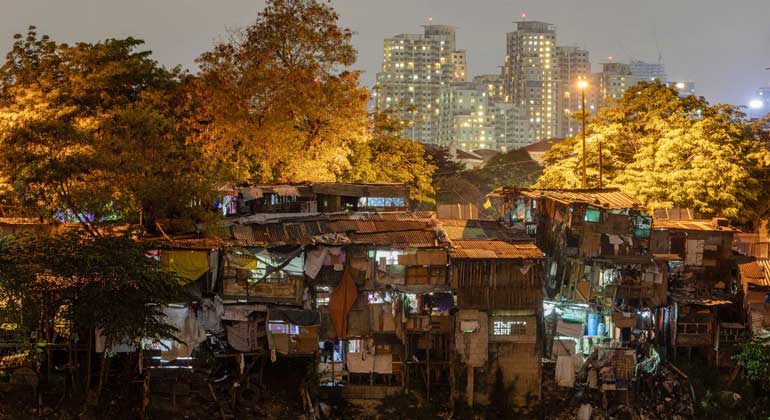
Shanty homes are pictured in a slum area, amid the coronavirus disease (COVID-19) lockdown, in Pasig City, May 19, 2020. — REUTERS
THE Philippines remained as a lower-middle income economy, according to the latest data from the World Bank.
The World Bank on July 1 updated the threshold for the four-income groups — low, lower-middle, upper-middle, and high-income countries — and reclassified the countries based on their 2019 gross national income (GNI) per capita.
The Philippines has a higher GNI per capita of $3,850 in 2019 than 2018’s $3,170, data from the World Bank showed.
But despite the increase, it still falls within the $1,036-$4,045 income bracket for the lower-middle income group that has been revised upwards from $1,026-$3,995 range in the previous update on July 1, 2019.
The government targets to graduate to the upper-middle income status by 2022. It is also eyeing to secure an “A” long-term credit rating by that year when the Philippines will eventually lose the concessional loans it now enjoys.
In a blog written by World Bank’s Umar Serajuddin and Nada Hamadeh, they explained the thresholds are adjusted annually to account for inflation.
“It is important to emphasize that the World Bank’s income classifications use the GNI of the previous year (2019 in this case). Thus, the GNI numbers that are used for this year’s classification do not yet reflect the impact of COVID-19 (coronavirus disease 2019),” they added.
With the update, the World Bank now defines upper-middle income economies to have a GNI per capita of $4,046-$12,535, higher than $3,996-$12,375 bracket used earlier.
Meanwhile, low-income countries are those with less than $1,036 GNI per capita, up from the previous $1,026 ceiling. Economies should have at least $12,535 GNI per capita to graduate to the high-income group now, which is slightly higher than the minimum requirement of $12,375 set previously.
There were eight countries that moved up to a higher category for the latest update, namely: Benin, Nepal and Tanzania to lower-middle income status; Indonesia to upper-middle income status; and Mauritius, Nauru and Romania to high-income bracket.
Meanwhile, Algeria and Sri Lanka moved down one notch to lower-middle income status while Sudan is now considered a low-income economy from lower-middle income economy previously.
Latest data showed GNI — the sum of the nation’s GDP and net income received from overseas -— declined by 0.6% in the first quarter, a reversal from the 5.8% growth in the previous quarter and 5% in 2019’s comparable three months. — Beatrice M. Laforga
MORE than 100 banks have utilized their loans to small businesses and large enterprises as alternative reserve compliance during the pandemic, according to Bangko Sentral ng Pilipinas Governor Benjamin E. Diokno.
“Latest data show that around P44.2 billion in MSME (micro- small-, and medium-sized enterprises) loans were used as compliance with the reserve requirement, a significant increase from the P9.9 billion in MSME loans used by 55 banks immediately after the effectivity of the measure,” he said in an online briefing on Thursday.
Mr. Diokno said around 88 banks have availed of the regulatory relief measure, most of which were rural banks.
In April, the Monetary Board through Circular No. 1083 allowed lending to MSMEs as alternative reserve compliance in a bid to encourage banks to boost lending to the struggling sector amid the crisis.
Meanwhile, take-up rate of alternative reserve compliance in the form of lending to large enterprises has been limited, Mr. Diokno said, citing that it is relatively recent as it only took effect in late May.
“Only 14 banks have utilized P534-million loans to qualified large enterprises as an alternative mode of compliance with the reserve requirement,” Mr. Diokno said.
Circular No. 1087 signed by Mr. Diokno in late May extended the alternative reserve compliance provided in Circular No. 1083 to count lending to large enterprises that are directly and adversely impacted by the pandemic as part of alternate reserve compliance. The regulatory relief measure will be available to banks until end-2022.
Mr. Diokno said recent feedback from the banking industry include a request to extend the period for availment of regulatory relief measures during the crisis.
“Overall, the BSP needs to assess the impact of the pandemic on the performance of the banking system and the extent of financial relief measures needed,” he said.
“A better understanding of the true state of health of the banking system will allow us to properly evaluate whether further easing of the relief measures is warranted,” he added.
BSP Managing Director for Policy and Specialized Supervision Lyn I. Javier said banks are specifically looking for extensions on operational relief measures granted during the enhanced community quarantine, including non-submission of certain prudential reports, notification for temporary closure of branches, among others.
Amid the crisis, the BSP rolled out regulatory relief measures for lenders including raising the single borrowers’ limit for big banks to 30% from 25%, reduced penalty imposition for reserve deficiencies, and lower credit risk weight for credit to MSME, among others.
SOURED LOANS
Meanwhile, the central bank is mindful of a likely increase in soured loans due to the crisis.
“The aftermath of COVID-19 may exert pressure to the current quality of bank loan portfolio but this will not go as high as the Asian Financial Crisis level,” he said, noting that bad loan ratio ranged from 3.4% at the first half of 1997 when the crisis started and peaked at 17.6% in 2002.
In June, Mr. Diokno said nonperforming loan ratio of banks inched up to 2.3% as of April from 2.2% as of March and the 2% seen in December last year.
The local banking industry has an overall capital adequacy ratio of 15.4% and 16.4% on stand-alone and consolidated bases, well above the 10% minimum requirement set by the central bank.
THE Inter-Guild Alliance, a group representing the various entertainment guilds in the country, has denounced the newest guidelines for production released by the Film Development Council of the Philippines (FDCP), calling out the council for “making moves detrimental to the industry’s welfare,” according to a statement posted online.
In particular, the alliance found it objectionable for the council to require production companies to register productions (film, TV, web, and other audiovisual content) seven days before shooting with the Department of Labor and Employment (DoLE) and FDCP, including “specific details of the planned production shoot including the people participating at the production site.”
The FDCP’s Advisory 06 was posted on June 27 on its website.
The requirement adds “additional and totally unnecessary layers of bureaucracy every production has to go through,” and they found it objectionable to disclose “confidential information that have absolutely no bearing on health and safety,” said the Inter-Guild Alliance in a statement posted on its Facebook page on July 1.
The alliance is composed of various groups from the film, television, and advertising industries in the Philippines. Its members include the Director’s Guild of the Philippines.
The alliance also decried the FDCP’s lack of consultation before publishing the advisory, and it called the council’s regulatory measures an overreach of its responsibilities.
“The FDCP is not a regulatory body. The FDCP is a developmental body,” the alliance said.
The FDCP was created by Republic Act 9167 in 2002. The council, under the Office of the President of the Philippines, is tasked to “promote and support the development and growth of the local film industry as a medium for the upliftment of aesthetic, cultural, and social values for better understanding and appreciation of the Filipino identity.” Its mandate includes encouraging the production of quality films and leading the film industry’s participation in local and foreign film markets and festivals.
But Malacañang said during a press briefing on July 2 that the guidelines set by the FDCP can be implemented because it’s “already registered with the National Administrative Registry of the UP Law Center” but that there will more discussions between the labor, trade and industry, health departments, and “various stakeholders in the film and TV industry.”
“We will see if there will be revisions of the guidelines,” Malacañang spokesperson Harry Roque said in the briefing.
The stakeholders included in the discussion are the Philippine Motion Picture Producers Association, the Inter-Guild Alliance, and the Directors Guild of the Philippines.
The Inter-Guild Alliance pointed out that it had already crafted a set of regulations in May which were certified by the DoLE and the Department of Health (DoH).
“Based on our meetings with DoH — and FDCP was present at these meetings — DoH said that as long as we meet the minimum health and safety guidelines set by DoH, we can follow our own safety protocol,” Patti Lapus, producer and spokesperson of the alliance, said at a roundtable discussion on July 1 streamed on the Facebook page of the Inter-Guild Alliance and Film Workers Unite.
Called the IGA PRO-Guide, the 39-page document outlines regulations on how to safely proceed with the production, from pre-production to post-production. The guidelines include limiting shoots to only 12 hours, having a health and safety officer on board, observing proper social distancing, and limiting the number of people on set.
The group said that the FDCP should listen to its constituents and Ms. Lapus said that while the FDCP claimed that it hosted several town hall meetings regarding the guidelines, none of the members of the alliance were present, therefore they were not consulted.
“We are really against any mandatory regulatory forms,” Paolo Villaluna, president of the Directors’ Guild of the Philippines, said in the Facebook roundtable.
As of this writing, the FDCP has not yet reacted to complaints on the published guidelines. — Zsarlene B. Chua
THE National Telecommunications Commission (NTC) has given Dennis A. Uy’s DITO Telecommunity Corp. more time for its “technical launch,” moving the July 2020 deadline to January 2021.
“In relation to the delay caused by the COVID-19 (coronavirus disease 2019) crisis, the NTC issued a resolution extending the July 2020 technical audit under the CPCN (certificate of public convenience and necessity) provisions,” the Department of Information and Communications Technology (DICT) said in a statement e-mailed to reporters on Thursday.
It said that DITO is given “within six months to deliver the commitments for the technical audit requirements — that is to provide a speed of 27 megabits per second (Mbps) to cover 37% of the population.”
Adel A. Tamano, DITO chief administrative officer, implied at a Senate committee hearing on Wednesday that the new telco player might miss the July 8 deadline for its technical launch.
“The COVID-19 and the lockdowns have prevented us from our full rollout. With the subsequent easing of the different lockdown situations, we are doing our best to get back on track,” he said.
Mr. Tamano said DITO’s CPCN requires 1,300 cell sites to cover 37% of the population for its technical launch. The DICT said DITO now has more than 250 operational tower sites nationwide.
Mr. Tamano also told the Senate on Wednesday that DITO intends to finish 2,000 cell sites this year, exceeding the 37% coverage requirement under its CPCN.
The DICT said only the technical launch schedule was moved.
During the so-called technical launch, the NTC will audit DITO’s compliance with the government’s requirement to cover 37% of the population nationwide with 27 Mbps.
DITO’s other commitments, such as the commercial launch in March 2021, will proceed as scheduled, the DICT quoted Mr. Tamano as saying in its statement.
DICT Secretary Gregorio B. Honasan II said: “DITO has informed us that they have, in fact, begun limited user testing and have discussed their plans of expanding this within the next few months under the friendly user test.”
“They have activated a significant number of sites wherein phone calls and connection to the internet are possible, and have put-up, in various stages of completion, a total of 1,300 towers on top of the Common Tower Agreements with Independent Tower Contractors they have secured,” he added.
IF I had known then that my dinner at Shanghai Saloon was the last nice meal I’d have for the next three months, I wouldn’t have rushed through the affair. Right after I left the restaurant on its March 12 opening, the president went on air to announce the community quarantine — which is still ongoing after four months.
This of course, closed down the restaurant at the Podium. But with some restrictions being lifted as Metro Manila entered the less restrictive General Community Quarantine, the restaurant is now open for takeout and delivery services. It takes orders from Monday to Saturday, from 11 a.m. to 5 p.m.
Four months after that first — and last — meal, I still remember the filling pork buns, the scallop with salmon roe sprinkled on top, and the very rich crab dumpling with a sticky red skin, as if a lantern. The restaurant had an East-meets-West flavor and aesthetic, inspired by the glamorous and cosmopolitan nature of Shanghai in the 1920s. It’s a shame that in the rush of takeout and delivery, the wine cellar, four meters tall, and the cocktail lounge glamor of the decor would have to be ignored.
We asked Shanghai Saloon owner Grace Lee how it felt to have to close so soon after opening. “Shanghai Saloon is a project we worked on for almost two years. So we were truly excited to finally open its doors last March. So to have had to close after merely a few days was very disheartening for all of us,’ she told BusinessWorld in an e-mail. “I have faith in my team and believe we have created a special dining space. Our Hong Kong chefs remained in Manila. Our staff also, thankfully, patiently waited with us, making it possible for us to reopen quickly.”
Former TV personality Ms. Lee is also behind the Kko Kko Korean chicken chain. Speaking about her other ventures and how they fared during the community quarantine, she said, “We can all agree that this pandemic is the biggest challenge the F&B business sector has had to face in recent history. It was a daily struggle to keep things afloat… to sustain our business so that there is work for our employees to come back to sooner or later. Kko Kko kept its commissary open to cater to take out and delivery demands. And in this time of difficulty, Kko Kko learned to adjust.”
She added, however, “All our branches are of course ready to welcome back our customers with proper protocols in place. We also created newly updated safety manuals to standardize added procedures to make sure our customers feel safe dining with us again.”
As we’ve mentioned, Shanghai Saloon had glamorous decors, and looking at my notes from March 12, it would seem that the decor had a hand in how the food tasted. I remember an unfortunately bland dish of braised noodles, saved by the sheer heft of the seafood toppings and the surroundings (hint: instead of that, get the dimsum and anything in the menu that says duck). With services limited to takeout and delivery, how will Shanghai Saloon still translate the experience of 1920s glam at home? Ms. Lee said, “We’ve definitely created a beautiful place that makes you want to linger, but our food has been delightfully appreciated by our customers from the beginning. Though not everyone has returned to the dining experience at restaurants, they have been recreating part of it in their homes, with their families.”
A complete menu is available on the Shanghai Saloon Facebook page, @shanghaisaloonph. Call to order at 0917-311-2569, 0917-128-2874 or 8426-5587.