Home Blog Page 931

Mike Hanopol brings back 2003 album Lagablab

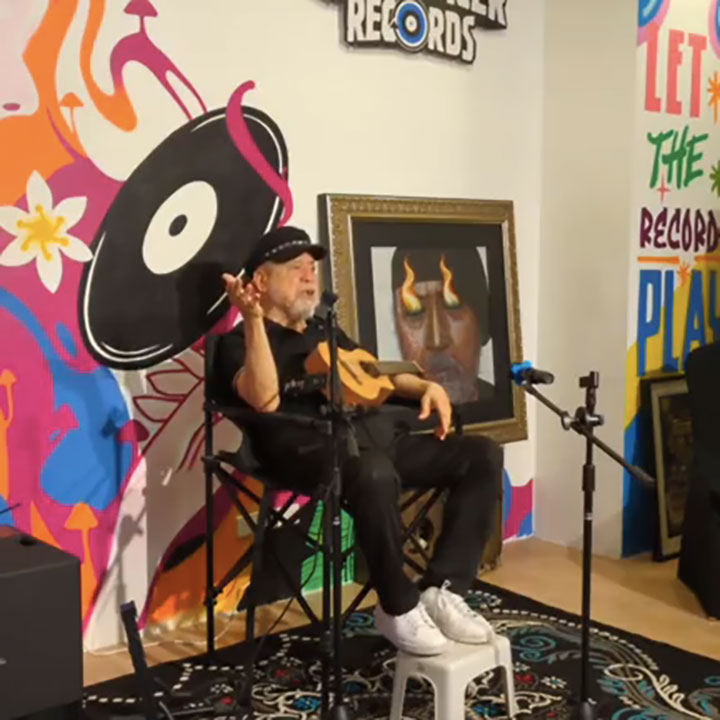
MIKE HANOPOL at Backspacer Records (above) for the launch of the vinyl version of his album Lagablab. — BACKSPACER RECORDS

Vinyl edition out via Backspacer Records

THE vinyl edition of Filipino rock legend Mike Hanopol’s album, Lagablab, is now available at indie vinyl record shop Backspacer Records in Pasig City.

First released in 2003 under Warner Music Philippines, the 10-track, guitar-heavy album is ultimately a message to younger generations of Filipinos who have yet to learn life’s lessons. It boasts different genres, like jazz, hip-hop, ballad, and fusion, but at the end of the day, “falls under Pinoy rock,” according to Mr. Hanopol.

“What are the ingredients for a sound to be considered Pinoy rock?” he asked at the launch on Sept. 28 at Backspacer Records.

“It’s the melody, the lyrics, and the timing — kung kailan pumapasok at tumatalakay ito sa panahon natin (when it comes in and dwells on the times we live in),” he explained.

Mr. Hanopol recalled how the album was inspired by Filipinos whom he saw lining up outdoors in Luneta to apply to go abroad.

Habang pinanonood ko sila, pumapasok sa akin ’yung mga letra. ’Yung mga taong ito, maraming mangiiwan at maraming maiiwanan. (While I was observing them, the words were coming to me. These people, many of whom will leave people behind, and many who will be left behind),” he said.

For the OPM icon who has been active since the 1970s, his motivation for making music has always been “ang masa (the people).”

Lagablab also boasts collaborations with many Filipino music icons: the late Francis Magalona, Hannah Romawac, and Aia De Leon, to name a few. Even the session musicians changed every track.

“I see to it that, in every song, there are two or three musicians who are different. I tried to give them opportunities to be named,” he said.

The vinyl edition features newly remastered audio by Shinji Tanaka and original artwork by contemporary painter Lynyrd Paras.

Among the standout tracks that Mr. Hanopol discussed at the launch were “Ang Magulang Mo,” “Sa Aking Pag-Uwi,” and “Namamasyal.”

Mr. Hanopol cited these tracks as examples of his songwriting that focused more on simple lyrics that could be understood by all. “Nahihirapan ang mga tao kapag lalaliman mo. Kailangan maintindihan nila (People will have a hard time if the words are too deep. They have to understand),” he said.

Meanwhile, “Namamasyal” was a track that showcased the brilliance of iconic Filipino rapper Francis Magalona, who he recalled took only 10 minutes to pen and record the rap verse for the song.

WHAT’S NEXT
At the launch, Mr. Hanopol welcomed fans who participated in the discussion and reiterated the album’s intentions.

He described his work as “rock na malungkot (rock that is sad),” keeping in mind younger generations who have forgotten how to be Filipino.

“They are just Filipino because they have a birth certificate, but they listen to, use, and wear everything foreign,” he lamented.

He feels his own music and lyrics deeply, telling the press, “Tinatamaan ako ng sarili kong gawa. Napakahirap. Madalas mangyari sa akin (I’m hit by my own works. It’s very difficult. It happens very often to me).”

He ended the session with a listen of Lagablab’s final track, “Talamak,” pointing out certain lyrics which he invited the audience to discuss amongst themselves before the album signing began:

Paiiralin ba natin ang masamang damo? / Ganito ba tayo habang-buhay? (Will we let the bad weeds grow? / Will we remain like this for as long as we live?)”

The vinyl record of Mike Hanopol’s Lagablab can be purchased exclusively via Backspacer Records’ official website and its physical store, located at the 2nd floor of D’Ace Plaza in Kapitolyo, Pasig City. — Brontë H. Lacsamana

RCBC Trust sees AUMs breaching P200 billion

THE TRUST ARM of Rizal Commercial Banking Corp. (RCBC) expects its assets under management (AUM) to surpass P200 billion this year.

“We’re moving towards P200 billion. So, I guess we are on track to achieve that…Profitability targets are also important, but bottom line, we do see ourselves reaching and exceeding the P200-billion mark for this year,” RCBC Trust Corp. President and Chief Executive Officer Robert B. Ramos told BusinessWorld on the sidelines of an event last month.

The stand-alone trust company’s AUMs rose by 14% year on year to P186.06 billion as of end-March. However, this was down from the P194.77 billion booked at end-2024.

Mr. Ramos said that RCBC Trust’s clients are looking at investing locally, specifically in government securities with tenors ranging from two to seven years to lock in still-high yields amid expectations that borrowing costs will ease further.

“That’s what a lot of clients are doing — taking advantage of the higher interest rates and maximizing them with the short-term viewpoint that interest rates are on the way down.”

He added that about 70% to 80% of their assets are fixed-income instruments. “When rates are on the way down, prices appreciate. So, it is an opportunity for clients to capitalize, make some gains… What we’ve done so far is, for at least our discretionary funds, what we advise certain clients is take advantage of the rates as they are now. Increase your duration and then see your bonds appreciate. That’s what we’ve been telling our clients and that’s what we continue to do.”

Last month, the Bangko Sentral ng Pilipinas (BSP) lowered borrowing costs by 25 basis points (bp) for a third straight meeting, bringing the target reverse repurchase rate to 5%. It has now slashed benchmark rates by a cumulative 150 bps since the start of its easing cycle in August 2024.

BSP Governor Eli M. Remolona, Jr. has said that the policy rate is now at a “sweet spot” in terms of both inflation and output, but left the door open to one last cut this year to support growth if needed, which would likely mark the end of its current easing cycle.

The Monetary Board will next meet on Oct. 9 to review their policy settings.

Investors also remain interested in putting their funds in offshore funds despite the market volatility stemming from the United States’ shifting trade policies, which have resulted in global growth concerns, Mr. Ramos added.

“Our clients have always been of the mindset that they’ve been able to access certain global funds. So, pretty much, there hasn’t been a big change. There are clients who still invest in US markets, there are clients who prefer investing in European and even Asian markets,” he said.

“For some clients, they’ve either stood back, or when the US markets corrected for a bit, some clients actually increased their exposure. Mostly, I would say that clients have stayed level.”

The company’s goal is to provide their clients with investment options that suit their risk appetite, he said.

“We want to make sure that, number one, we provide investment solutions for them — the investment solutions that they need, the investment solutions that they want, and products that are comparable to their risk palates. For those discretionary funds that we manage, we want to make sure that we manage them to the parameters that they provide us. We have to give them returns that satisfy them, given the market conditions,” Mr. Ramos said.

“As long as it meets the client’s risk parameters and investment needs, we’re always looking at making available certain investment outlets, whether they are fixed-income or equity or exchange-traded funds or mutual funds, as long as the client meets the standards.” — Aaron Michael C. Sy

What archeology can teach us about extreme inequality

STOCK PHOTO | Image from Freepik

By F.D. Flam

TODAY’s state of extreme economic inequality is a problem best approached with science — using it to make specific measurements, identify root causes, and develop workable solutions. Archaeology is revealing a broad picture that spans thousands of years of prehistory, challenging some of the pervasive biases about the inevitability of inequality as people form larger communities or advance technologically.

In a vast region of central Europe, farming communities defied expectations by living in houses that were all roughly the same size, leaving no trace of palaces, kings, or other nobility — and they did so for five millennia. When future archaeologists study the 21st century, they’ll find the opposite. According to recent global data, the bottom 40% of the population on the economic ladder possesses just 0.6% of the world’s wealth.

“We’re in probably the greatest [period of] inequality our species has ever seen, and so the natural question for many of us arises, ‘how did we get here?’” said archaeologist Paul Duffy of Kiel University in Germany.

The findings he and his colleagues are unearthing challenge the common assumption that inequality was the unavoidable price of human development as we progressed from being hunter-gatherers to farmers, and eventually to an industrial society.

This latest evidence suggests we don’t have to accept worsening inequality as we move from an industrial to an information economy and on to whatever artificial intelligence ushers in next.

Understanding the past in this way wasn’t possible without new scientific tools such as ancient DNA and chemical analysis of skeletons and teeth, which reveal diet, movement patterns and other intricate details of the lives of ordinary people.

Duffy was the lead author of a study published in August in Science Advances, which examined a surprisingly egalitarian society in Eastern Europe — the Carpathian Basin, which encompasses what’s now Hungary along with parts of Austria, Serbia, and Ukraine. The researchers found evidence of persistent equality in the way communities were structured and in the goods buried with their dead.

The team applied a standard measure of economic inequality known as the Gini coefficient — a scale that ranges from perfect equality at 0 to one person or family hoarding everything at 1. The World Bank recently scored the US at 0.42, while more egalitarian countries such as the Netherlands and Iceland scored around 0.25. The people of the Carpathian Basin scored an even more egalitarian 0.21, sustained through various millennia and technological changes.

Earlier studies documented a much higher coefficient once the early farmers of Eurasia developed the plow and used draft animals to till their fields. Equality generally depends on an abundance of land and a shortage of labor, and in other parts of Europe and the Near East, plowing with draft animals fostered inequality by creating an artificial land scarcity since it took about twice the land to produce the same crop yield. It also reduced the need for labor.

But in this region, Duffy said, fertile land was so abundant that people could escape if a class of elites formed and became greedy or despotic. Every society has leaders, he said, but if people can vote with their feet, leaders are forced to act in the interest of the group. “It’s really important to be able to go somewhere.”

However, this area maintained what Duffy calls a stateless society. There were no pyramids to honor rulers but instead there were public works, such as a series of ditches. People came together and got things done.

Archaeologist Gary Feinman of the Field Museum in Chicago, said researchers are now able to trace the way people moved around through DNA obtained from skeletal remains. They can also use strontium isotopes — different forms of the chemical element strontium — which differ by region and are absorbed by the body through food and water. Depending on the ratio of the isotopes and where they’re found — teeth or bones — researchers can determine where someone was born and whether they moved around.

Feinman said he was struck by the contrast he found in Mexico between the more egalitarian society of pre-Columbian Oaxaca and the hierarchical Mayan empire, which collapsed before Europeans arrived. Extreme inequality becomes unstable because it destroys social cohesion. “People will cooperate as long as they see their needs and aims are aligned with those of the larger group,” he said. When people are out of alignment with the group, things break down.

In a sweeping study published last spring, Feinman and his colleagues also connected equality to the specific sources of material wealth. The most egalitarian societies depend on human labor for their wealth — on the work of farmers, or artisans, or builders, for example. If resources have to be drawn from a wide segment of the citizenry, Feinman said, societies tend to develop more collective forms of government.

Wealth tends to become concentrated when most of it comes from resources that can be controlled by a few people — oil, for example, or perhaps data and real estate today.

These scientific archaeological studies are helping dismantle assumptions about human progress. People don’t necessarily need hierarchy or authoritarian leadership, or even farming to achieve things, Feinman said. Sometimes hunter-gatherer societies built monuments — in Turkey and in North America. And even if they moved around, they gathered periodically at those monuments in festivals that might have resembled today’s Burning Man.

There’s an even more pervasive assumption that life was progressively worse for the average person the farther back we look in history because they lacked technology — from basic farming and building materials to indoor plumbing, TV, and smartphones. How did they get by? That all depended on the era, the place, and whether they lived in a harmonious or oppressive society.

Today’s inequality could easily grow as rapidly changing technology pushes people off their career paths. And then we’ll argue over whether those on the losing end deserve help, and what’s fair.

In the long-term view, societies don’t collapse because they’re too fair, too equitable, too cooperative, or too caring. Helping the less fortunate through upheaval builds cohesion and strengthens our chances for survival in the long run.

BLOOMBERG OPINION

Premium pipeline seen to recast Davao’s office landscape by 2027

Davao’s office market is running hot. Across Davao City, demand is vastly outpacing supply, an uncommon state for office markets in the Philippines which are mostly still in the recovery stage. A visible cue to this is how mixed-use assets are evolving, with several developments leaning into offices as demand deepens.

Damosa IT Park is realigning its development strategy to address strong office demand, building on the full occupancy of its Topaz and Diamond Towers. At Felcris Centrale, an overflow of requirements has pushed office users into areas first intended for retail. Additional office space is also slated for SM Lanang’s renovation and expansion. These shifts set up the discussion that follows why Davao holds one of the most promising office markets in the nation.

COMPETITIVE COSTS, GENEROUS INCENTIVES, AND ENGLISH-PROFICIENT TALENT POSITION DAVAO AS ONE OF THE MOST COMPETITIVE PROVINCIAL OFFICE MARKETS
Davao City stacks up well for office locators on cost, talent, and government incentives. A large regional labor pool feeds the city from nearby cities such as Panabo and Tagum in Davao del Norte, Digos in Davao del Sur, and General Santos in South Cotabato. The Davao region’s English skills are also second only to the Cordillera Administrative Region outside of Metro Manila according to Education First’s English Proficiency Index.

Entry rates for customer service representatives in Davao are also competitive. As reported by Indeed, the average monthly wage for the role is around PHP 18.2k per month, below other key office hubs such as Metro Manila, Cebu City, Iloilo City, and Clark. Expanding or new locators also benefit from LGU incentives. The Davao City Investment Promotion center grants up to 3 years’ business tax exemption, 2 years of real property tax exemption, and Mayor’s Permit, fees and licenses exemptions under its Investment Incentive Code.

DAVAO’S TIGHT 95% VACANCY SIGNALS READINESS FOR NEW OFFICE DEVELOPMENTS
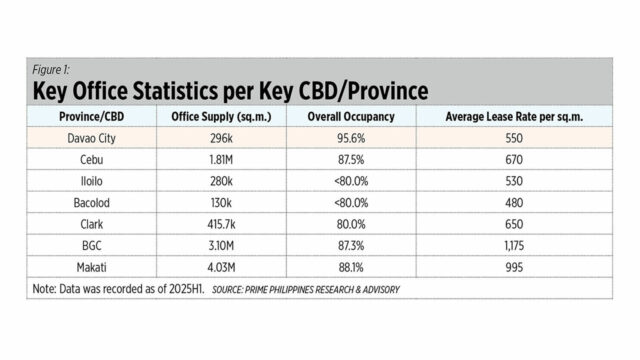
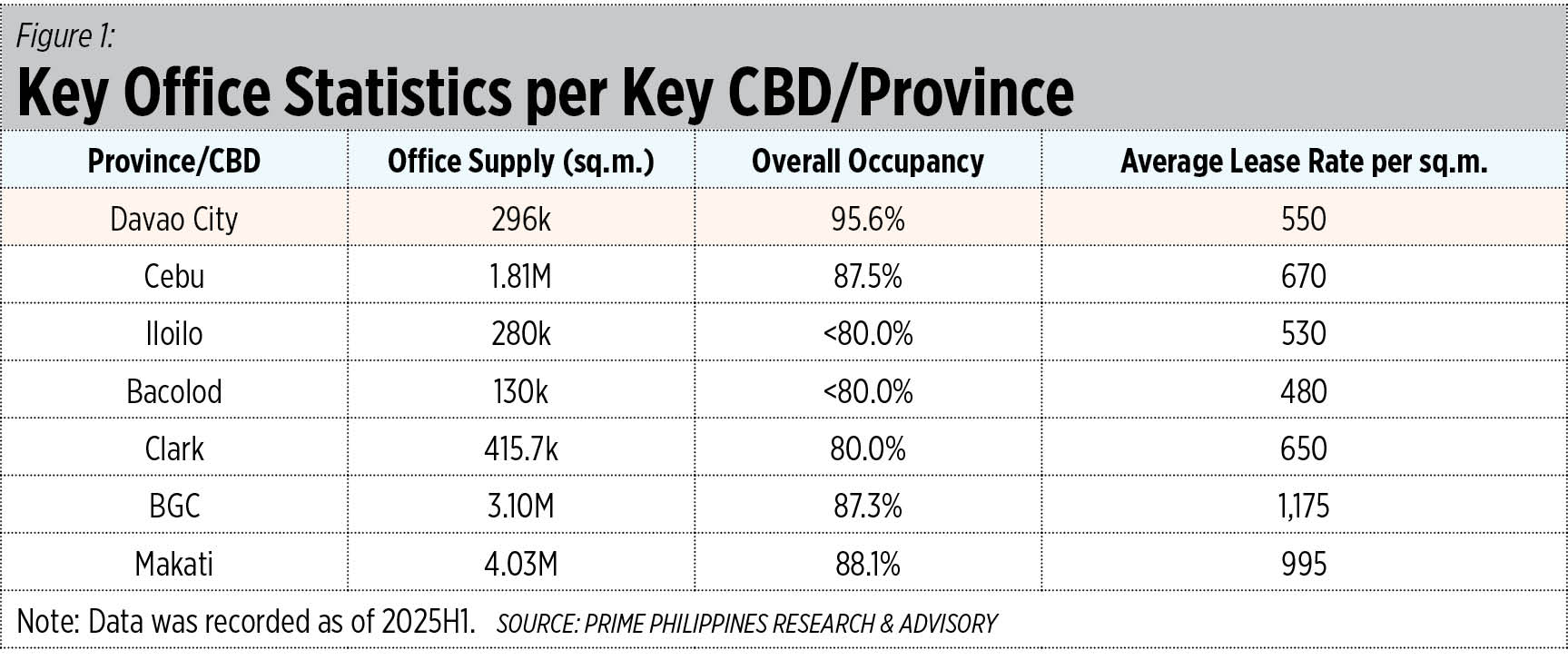
Given these solid fundamentals, statistically, Davao is positioned as a promising emerging office market with comparatively limited stock, yet it posts the highest overall occupancy (95.6%) among key Philippine office hubs. Furthermore, for Grade A buildings specifically, the vacancy level narrows to around 2-3%. Despite this state, Davao City’s average lease rates are still among the lowest, positioning Davao as an attractive market for tenants and leaving headroom for rental growth as additional supply comes online.

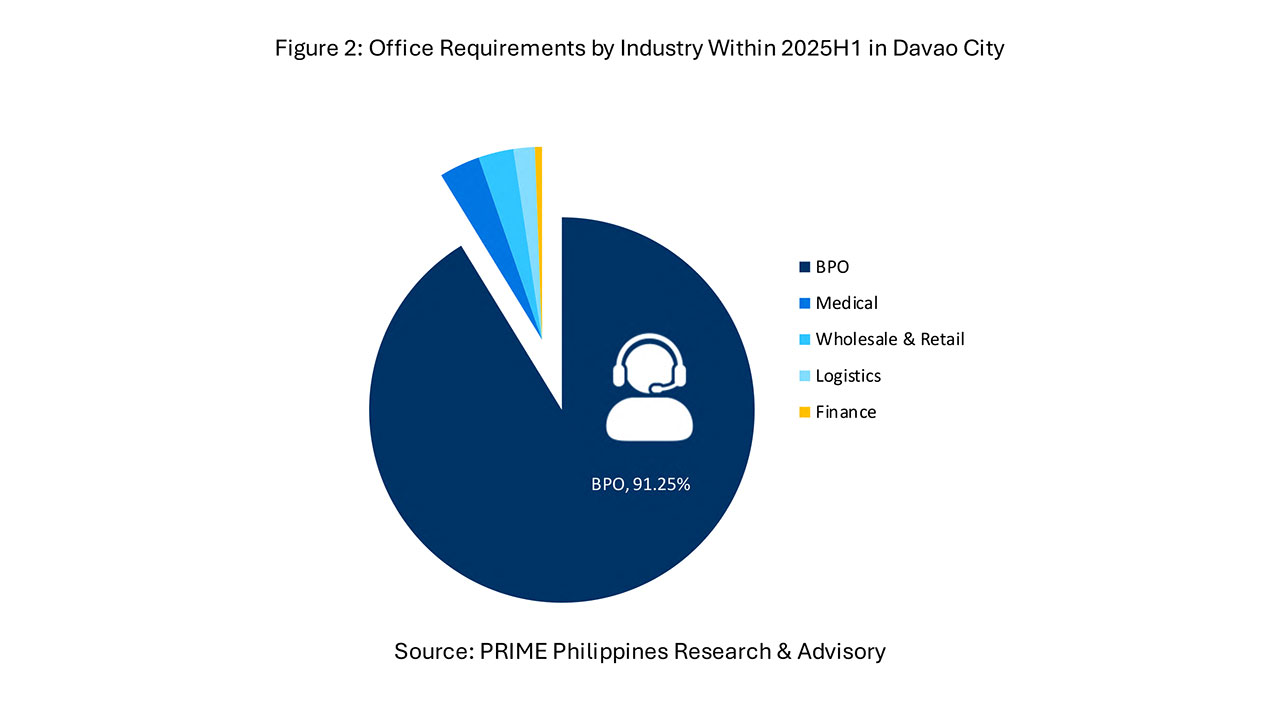
BPOS REMAIN THE PRIMARY OFFICE DEMAND DRIVER IN DAVAO, ACCOUNTING FOR ABOUT 91% OF H1 2025 REQUIREMENTS
Cumulatively, this has made Davao City an attractive market specifically for Information Technology and Business Process Management (IT-BPM) companies. According to the Davao City Investment Promotion Center, IT-BPM companies serve as one of the largest employers for the city, employing 75,000 individuals in 2023 and injecting around PHP 15-20 billion annually in the city’s economy. Given an annual growth rate of 8-10%, these companies which contribute to 70.4% of GDP derived from the services sector in Davao have become a cornerstone of the local economy.

Under IT-BPM, prominent Business Process Outsourcing (BPO) companies already maintain a substantial, multi-site presence in Davao. Alorica occupies multiple floors in Matina IT Park; VXI takes up nearly all of Felcris Centrale’s 1 building and operates additional sites in Robinsons Cybergate and SM City Davao; Concentrix anchors much of Abreeza Corporate Center and is also present in Damosa IT Park. IBEX Global’s remarkable expansion to a second site at Felcris Centrale in 2024 also stood out as one of the city’s major office movements of the year, setting the tone for continued growth into 2025, with PRIME Philippines guiding the expansion. With BPOs accounting for over 91% of first-half office requirements in 2025, these types of firms are expected to sustain the city’s leasing momentum and absorb a significant share of both new and existing spaces.

THE INFLUX OF BPO REQUIREMENTS HAS PUSHED DEVELOPERS TO CONSTRUCT GRADE A PEZA-ACCREDITED OFFICE BUILDINGS
Nonetheless, these companies have specific preferences. BPOs in Davao look for frictionless, 24/7 operations so they prioritize PEZA-accredited, Grade A buildings with large floor plates, reliable backup power, and telecom redundancy at fiber-optic levels. Their requirements or wants also go as deep as variable refrigerant flow (VRF) air-conditions, numerous high-speed elevators, secure turnstiles/CCTV, and more. Additionally, within Davao City, space is limited in the metro. Particularly, commercial hotspots such as JP Laurel Avenue, which traverses Bajada and Lanang, are very much in demand for tenants.

This trend is not being neglected by developers, with another wave of Grade A office supply lined up for 2027. Robinsons Land is kicking off the 9.6-hectare Victoria Plaza redevelopment with a nine-storey office tower on J.P. Laurel targeted for 1H 2027. Megaworld is doubling down in Lanang, signaling additional towers in and around Davao Park District. including an office tower behind SM Lanang by 2027, and another Grade A, PEZA-accredited building within the township. In parallel, SM is preparing an office expansion within SM Lanang Premier precinct.

FLIGHT-TO-QUALITY IS LIKELY TO TRIGGER UPON THE COMPLETION OF NEWER DEVELOPMENTS POSITIONED IN MIXED-USE ESTATES
All in all, premium additions from major developers are likely to grace the market blessed by high leasing velocity. Furthermore, combined with the continuous demand from BPO’s and other outsourcing firms, a surge in average rent is expected. However, these new additions will further accentuate the segmentation of lease rates between Grade A to Grade B and C buildings, tempering the lease rates for the latter. As a result, existing office inventory from Grade B and C developments will be encouraged to enhance their offerings and/or provide leasing flexibility to align with newer projects. Overall, tenants are expected to increasingly favor flexible, plug-and-play leasing options, and locations integrated in townships aside from typical Grade A office specifications.


Jet Yu is the founder and chief executive officer of PRIME Philippines, a commercial real estate advisory firm.

RLC opens second GBF tower in Bridgetowne

ROBINSONSLAND.COM

GOKONGWEI-LED Robinsons Land Corp. (RLC) has inaugurated its second GBF tower in Bridgetowne, Quezon City, adding about 2,800 square meters of flexible office space per floor two years after the opening of GBF Center 1.

The tower features touchless technology, including facial recognition-enabled turnstiles and advanced air filtration systems, the company said in a statement on Monday.

Each floor is designed to be customizable, allowing tenants to adapt spaces to their operational needs, it said.

“Every square meter of GBF Center 2 is designed to generate jobs, attract investment, and support the growth of dynamic businesses. From construction to tenancy, this building is a catalyst for economic activity, aligned with our mission to create opportunities for Filipinos,” RLC said.

GBF Center 2 is situated near major roads such as C5, Ortigas Avenue, and Amang Rodriguez Avenue, offering convenient access and visibility.

“This location reinforces Robinsons Offices’ pillar of accessibility, ensuring that businesses are connected to talent, transport, and opportunity,” the company said.

GBF Center 2 follows the first GBF tower, which opened in 2023, as part of the company’s multi-phase plan to expand office capacity in the Bridgetowne area and attract businesses looking for modern, flexible workspaces in Quezon City. — Alexandria Grace C. Magno

From animé to activism: How the One Piece pirate flag became the global emblem of Gen Z resistance

THE One Piece flag, which was seen in anti-corruption protests in Nepal and Indonesia, also flew in Luneta Park, Manila on Sept. 21. — PHILIPPINE STAR/JEAN MANGALUZ

FROM Paris and Rome to Jakarta, Indonesia, and New York, a curious banner has appeared in protest squares. With hollow cheeks, a broad grin and a straw hat with a red band, the figure is instantly recognizable and has been hoisted by young demonstrators calling for change. In Kathmandu, Nepal, where anger at the government boiled over in September, the flag became the defining image as flames spread through the gates of Singha Durbar, Nepal’s ornate palace complex and seat of power.

The image, usually adorning a flag with a black background, comes from One Piece, a much-beloved Japanese manga.

And what began as a fictional pirate crew’s emblem almost three decades ago has become a powerful symbol of youth-led resistance, appearing in demonstrations from Indonesia and Nepal to the Philippines and France.

As a scholar of media and democracy, I see the spread of the Jolly Roger of the Straw Hat Pirates — which has gone from manga pages to protest squares — as an example of how Gen Z is reshaping the cultural vocabulary of dissent.

POP CULTURE AS POLITICAL EXPRESSION
One Piece arrived at the birth of Gen Z, created in 1997 by Japanese manga artist Eiichiro Oda.

Since then, it has sold more than 500 million copies and has a Guinness World Record for its publishing success.

It has spawned a long-running TV series, live-action films and a more-than-$20-billion industry, with merchandise licensing alone generating about $720 million each year from Bandai Namco, the company best known for creating Pac-Man and Tekken.

At its core, One Piece follows Monkey D. Luffy and his crew, the Straw Hat Pirates, as they challenge a corrupt world government while seeking freedom and adventure.

For fans, the One Piece flag is not a casual decoration but an emblem of defiance and perseverance. Luffy’s ability to stretch beyond physical limits after consuming a magical fruit has become a powerful metaphor for resilience, while his unwavering quest for freedom against impossible odds resonates with young people navigating political environments marked by corruption, inequality and authoritarian excess.

When protesters adopt this flag, they are not simply importing an aesthetic from popular culture, but are drawing on a narrative already legible to millions.

The flag began cropping up in protests over the past few years. It was being waved at a “Free Palestine” protest in 2023 in Indonesia and in the same year in New York during a pro-Palestinian demonstration.

But it was in Indonesia in August this year that the flag’s political life truly took hold. There, protesters embraced it to voice frustration with government policies and mounting discontent over corruption and inequality. The timing coincided with government calls for patriotic displays during independence celebrations, sharpening the contrast between official nationalism and grassroots dissent.

The movement gained momentum when authorities responded with strong criticism of the flag’s use, inadvertently drawing more attention to the symbol. Government officials characterized the displays as threats to national unity, while protesters viewed them as legitimate expressions of political frustration.

WHY THE FLAG TRAVELS
The speed with which the One Piece Jolly Roger flag spread across borders reflects the digital upbringing of Gen Z. This is the first cohort to grow up fully online, immersed in memes, animé and global entertainment franchises. Their political communication relies on what scholars call “networked publics” — communities that form and act through digital platforms rather than formal organizations.

Solidarity in this setting does not require party membership or ideology. Instead, it depends on shared cultural references. A meme, gesture, or flag can instantly carry meaning across divides of language, religion, or geography. This form of connection is built on recognizable cultural codes that allow young people to identify with each other even when their political systems differ.

Social media gives this solidarity reach and speed. Videos of Indonesians waving the flag were clipped and reshared on TikTok and Instagram, reaching audiences far beyond their original context. By the time the symbol appeared in Kathmandu, the Nepalese capital, in September, it already carried the aura of youthful defiance.

Crucially, this was not simple imitation. In Nepal, the flag was tied to anger at youth unemployment and at the ostentatious wealth of political dynasties displayed online. In Indonesia, it reflected disillusionment with patriotic rituals that felt hollow against a backdrop of corruption. In both cases, the Jolly Roger flag worked like open-source code — adaptable locally but instantly legible elsewhere.

Part of the flag’s effectiveness comes from its ambiguity. Unlike a party logo, the One Piece Jolly Roger flag originates in popular culture, which makes it difficult for governments to suppress without appearing authoritarian. During the latest protests in Indonesia, authorities confiscated banners and labeled them treasonous. But such crackdowns only amplified public frustration.

FICTION AS REALITY
The One Piece flag is not alone in being reimagined as a symbol of resistance.

Across movements worldwide, pop culture and digital culture have become potent resources for activists. In Chile and Beirut, demonstrators wore Joker masks as a visual shorthand for anger at corruption and inequality. In Thailand, demonstrators turned to Hamtaro, a children’s animé about a hamster, parodying its theme song, and waving plush toys to lampoon political leaders.

This blending of politics, entertainment, and personal identity reflects a hybrid media environment in which symbols drawn from fandom gain power. They are easy to recognize, adapt and defend against state repression.

Yet cultural resonance alone does not explain the appeal. The One Piece flag caught on because it captured real-life grievances. In Nepal, where youth unemployment exceeds 20% and migration for work is common, protesters paired the emblem with slogans such as “Gen Z won’t be silent” and “Our future is not for sale.”

In Indonesia, some protesters argued that the national flag was “too sacred” to be flown in a corrupt system, using the pirate banner as a statement of disillusionment.

The spread of the flag also reflects a broader shift in how protest ideas move across borders. In the past, what tended to travel were tactics such as sit-ins, marches, or hunger strikes. Today, what circulates fastest are symbols, visual references from global culture that can be adapted to local struggles while remaining instantly recognizable elsewhere.

THE FLAG GOES GLOBAL
The flag’s journey from Asian streets to protests in France and Slovakia demonstrates how the grammar of dissent has gone global.

For today’s young activists, culture and politics are inseparable. Digital nativity has produced a generation that communicates grievances through memes, symbols, and cultural references that cross borders with ease.

When protesters in Jakarta, Kathmandu or Manila wave the One Piece Jolly Roger flag, they are not indulging in play-acting but transforming a cultural icon into a living emblem of defiance.


Nuurrianti Jalli is an assistant professor of Professional Practice, School of Media and Strategic Communications, at the Oklahoma State University. She is affiliated with the Institute for Southeast Asian Studies (ISEAS) Yusof Ishak Institute Singapore as a Non Residential Visiting Fellow for Media, Technology and Society Program.

Peso slides to fresh two-month low on Fed easing bets

BW FILE PHOTO

THE PESO sank to a fresh two-month low against the dollar on Monday as markets continued to reprice their bets on the US Federal Reserve’s policy path following the fresh batch of economic data released last week.

The local unit closed at P58.145 versus the greenback, dropping by 4.5 centavos from its P58.10 finish on Friday, Bankers Association of the Philippines data showed.

This was the peso’s weakest close in two months or since its P58.32-a-dollar finish on July 31.

The peso opened Monday’s session stronger at P58 versus the dollar. Its intraday high was at P57.945, while its worst showing was at P58.165 against the greenback.

Dollars exchanged rose to $1.47 billion on Monday from $1.38 billion on Friday.

The peso opened stronger against the dollar “because of the fewer dovish Fed expectations after US PCE (personal consumption expenditures) data came in as expected,” a trader said by phone.

Rizal Commercial Banking Corp. Chief Economist Michael L. Ricafort said in a Viber message that the PCE data and other reports released last week, as well as comments from Fed officials, have led markets to rethink their rate-cut expectations.

Market sentiment continued to be affected by the ongoing probe into alleged corruption in state flood-control and infrastructure projects at home involving several lawmakers and government officials, he added.

For Tuesday, the trader expects the peso to move between P57.90 and P58.40 per dollar, while Mr. Ricafort said it could range from P58 to P58.25.

US consumer spending, which accounts for more than two-thirds of economic activity, rose 0.6% in August, slightly higher than the 0.5% estimated by economists polled by Reuters.

The PCE price index, which is the Fed’s preferred inflation measure, rose 0.3% last month, in line with expectations, US Commerce department data showed.

The dollar dropped on Monday amid concerns over a potential government shutdown, with the yen outperforming the euro ahead of a batch of US economic releases that could offer further clues on the Federal Reserve’s policy path.

The greenback rose last week following economic data that prompted a pullback in expectations for Fed interest rate cuts.

Traders are currently pricing in 40 basis points (bps) of Fed easing by December and a total of 110 bps by the end of 2026, about 25 bps less than levels seen in mid-September.

The dollar index — a measure of its value relative to a basket of foreign currencies — was down 0.22% on Monday to 97.90, having risen 0.5% last week. — A.M.C. Sy with Reuters

On coal, industrialization, and GDP expansion

Three important energy events happened last Thursday, Sept. 25, that I want to comment on.

The first was the University of the Philippines-Los Baños (UPLB) “Enercon 2025” conference at Vivere Hotel in Muntinlupa City. The second was the signing of the PhilAtom law and the release of the Department of Energy (DoE) statement on nuclear energy. The third was the release of a statement from the Energy Regulatory Commission (ERC) on attacks by the renewable energy (RE) lobby, coupled with some frantic articles by climate activists against coal.

At the UPLB College of Economics’ roundtable discussion, the speaker was former National Power Corp. (NPC) president, Guido Delgado, and his presentation was about the “financialization” of the electricity sector. He blamed economists for the finance sophistication in the formula and attacked the ERC’s performance-based regulations (PBR). Weird.

I spoke briefly and pointed out, among others, that the levelized cost of electricity (LCOE) for intermittent solar and wind is not complete, it should consider the cost of ancillary services (AS) like batteries, or back-up diesel gensets, or hydro-pumped storage for use when the wind is not blowing and the sun is not shining. So LCOE plus AS equals the levelized full cost of electricity (LFCOE) — and this is not cheaper than coal or gas.

Then the DoE released a statement: “DoE hails signing of PhilATOM law.” In it Energy Secretary Sharon Garin said that, “The passage of RA 12305 strengthens the regulatory framework that will enable the safe and secure peaceful use of nuclear energy in the country.”

Days before that, on Sept. 19, the Philippines was elected to the Board of Governors of the International Atomic Energy Agency (IAEA) for the 2025-2027 term during the annual IAEA General Conference in Vienna, Austria. That is good news and I give my congratulations to Secretary Garin.

Then, during the weekly Open Meeting of the ERC, Chairperson Nino Juan took issue with the statement made by the Power for People Coalition (P4P) the other week. P4P Convenor Gerry Arances said in a Sept. 19 statement: “We are disappointed Chair Saturnino Juan’s first order of business as new ERC chief is to cede ground to power players, enabling them to raise prices as they please at the expense of ordinary Filipinos… Protecting consumer interests is not an optional duty for the ERC. It is its primary mandate — and part of that responsibility is scrutinizing these contracts to prevent abuses and ensure least-cost electricity.”

Mr. Juan aptly and correctly said that “the greatest shield against high prices is not the discretionary power of a regulator to cut a single contract, but the relentless, ongoing pressure of a competitive market where suppliers must constantly offer their best price to win a supply contract.”

I agree with him 100%. The most expensive electricity is no electricity, in other words, a blackout.

When power producers are constantly harassed by price controls, by the price dictatorship spurred by “People for Poverty” (my term for P4P) we will get what they want — electricity which is cheap but not available.

Several articles also came out again attacking coal as “dirty energy” and lambasting the local energy companies and conglomerates that have coal plants, calling themselves “investigative journalism.”

As I have pointed out many times in this column, the real “dirty energy” are candles and diesel gensets for lighting, and animal manure for cooking. When power is absent because the sun is covered by clouds and it rains, or when the wind does not blow for days, the poor are forced into using candles which can cause fires while the rich turn on their diesel gensets which are costly, polluting, and even noisy.

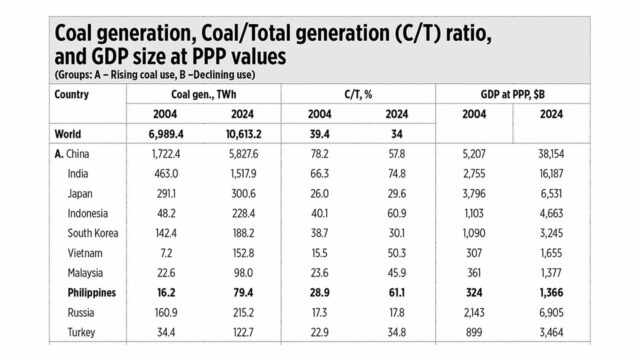
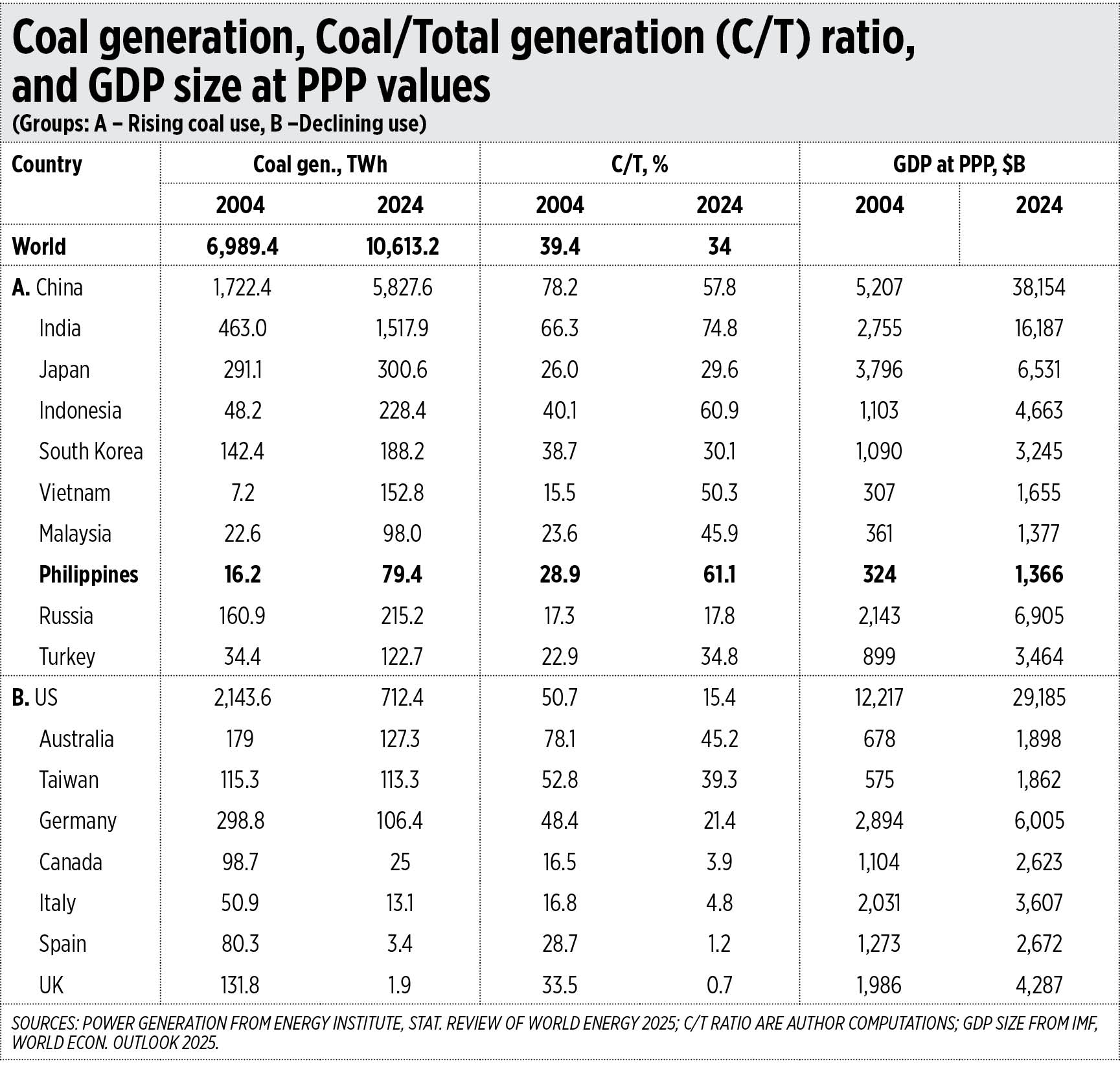
Papers that consistently attack coal as “dirty” are not investigative journalism, they are more “ideological journalism” pushing for global ecological central planning. See the global data in the table.

Many Asian countries that expand their coal use see their overall power generation increase, and their GDP size, valued in purchasing power parity (PPP), expanding significantly, creating more jobs, more industrialization, and more prosperity for their people.

In contrast, many European nations that deliberately cut their coal use have experienced an overall decline in power generation, like Germany, the UK, Spain, and Italy.

The anti-coal activists should aim their anger at China, the US, India, Australia, Japan, Russia, Indonesia, Turkey, South Korea, Taiwan, and Vietnam whose coal power generation are much larger than the Philippines’.

Two coal power projects that should proceed in order to reduce the persistent yellow alerts in Luzon and Visayas are the Atimonan 1 Energy (A1E), a 1,200-MW super-critical high efficiency low emission (HELE) project in Atimonan, Quezon, and the Therma Visayas, Inc. (TVI) expansion in Toledo, Cebu. Visayas has the thinnest power reserves among the three grids in the country — almost all the business organizations in Cebu support the coal expansion there.

I was one of the panel speakers in the opening session yesterday of the 12th Monitoring and Evaluation Network Forum, organized by the Department of Economy, Planning, and Development (DEPDev) and held at the Crowne Plaza Manila Galleria. There was a big crowd, with participants mostly from different government agencies. My co-speakers in the panel — “To retain, redesign, or retrench?” — were DEPDev Undersecretary Joseph “Dockoy” Capuno, Department of Budget and Management Director Mary Joy de Leon, and Asian Development Bank Principal Economist Ashish Narain. The moderator was UP School of Economics professor Karl Jandoc.

Among the things I discussed was the institutional gap in promoting the rule of law — the law applies equally to unequal people and sectors. Like environmental protection. Before the motto was “Plant trees to save the planet,” now it is “Kill trees, build more solar-wind farms to save the planet” and it is ugly.

Later this week, on Oct. 2-3, the “Philippine International Nuclear Supply Chain Forum 2025,” organized by the DoE, will be held at the Grand Hyatt Hotel at BGC in Taguig City. I will attend and write about it here.


Bienvenido S. Oplas, Jr. is the president of Bienvenido S. Oplas, Jr. Research Consultancy Services, and Minimal Government Thinkers. He is an international fellow of the Tholos Foundation.

minimalgovernment@gmail.com

Proptech gains ground as developers streamline operations

CLOVERLY.TECH

DEVELOPERS are increasingly adopting digital tools to streamline inventory management and buyer transactions, according to property technology (proptech) firm Cloverly.tech.

“[Property developers] view technology not just as a competitive edge but as a necessity to move faster and operate more efficiently, so there’s an increasing pressure to shorten sales cycles, improve coordination, and equip both agents and decision makers with better tools,” Cloverly.tech Co-Founder Nico Espinosa said in a video interview.

Launched early this year, Cloverly is a mobile application that aims to bridge the digitalization gap among property developers, brokers, and buyers.

“There was a clear digitalization gap, especially in how sales and buyer onboarding are handled. So, we saw that the industry could grow and compete more effectively by using technology,” Mr. Espinosa said.

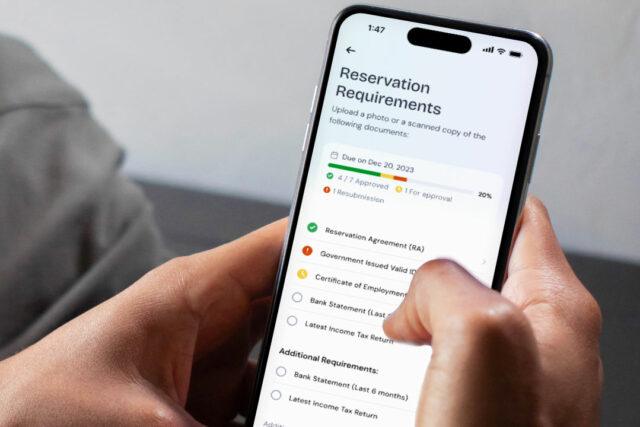
Cloverly streamlines the sales and reservation process for properties — from inventory management and unit reservations to buyer onboarding and document collection. Buyers may also receive updates and announcements via e-mail.

The company is seeking to onboard residential and horizontal developments nationwide into its platform.

“Imagine [Cloverly as] a control center for the property development team, and a portal for brokers, agents, and buyers,” Mr. Espinosa said. It also seeks to eliminate the hassle of siloed and paper-based requirements for property transactions.

Mr. Espinosa noted that the oversupply of condominium units in some parts of Metro Manila is pushing Cloverly to onboard properties outside the Philippine capital.

“Instead of just focusing on the market here in Manila, we also want to branch out and look for clients in Cebu, Davao, and all those places,” he added.

Data from property consultancy firm Colliers Philippines showed that about 30,500 ready-for-occupancy units remained unsold as of the second quarter. Of the total, 32% were in the lower middle-income segment. — Beatriz Marie D. Cruz

Japan-based fertility clinic opens at Filinvest One in Muntinlupa

Filinvest One — FILINVEST.COM

Fertility clinic Conceive IVF Manila has opened a new facility at Filinvest One in Muntinlupa City, expanding Filinvest REIT Corp.’s (FILRT) tenant mix into the healthcare sector.

“The presence of Kato Fertility Center at Filinvest One offers convenient access to high-quality reproductive health services, contributing to the growing healthcare landscape in the region,” FILRT told the stock exchange on Monday.

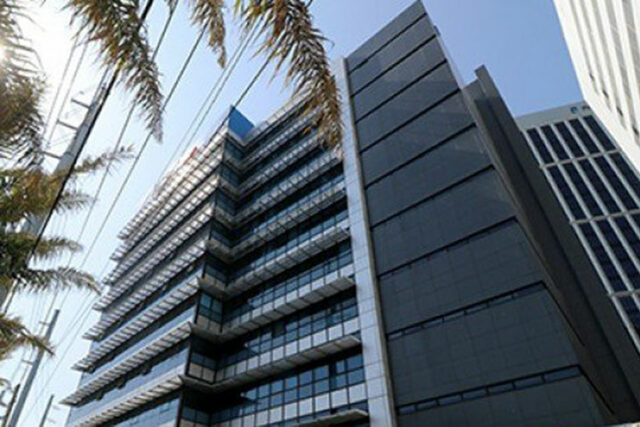
Filinvest One is one of FILRT’s 16 Grade A buildings in Northgate Cyberzone, Muntinlupa. Located along Alabang-Zapote Road, it has direct connectivity to major routes such as the Skyway and South Luzon Expressway.

The building is also EDGE (Excellence in Design for Greater Efficiencies) Zero Carbon-certified for its sustainability features.

“This marks a significant step in further expanding and diversifying our tenant portfolio to include the sphere of health and wellness,” FILRT President and Chief Executive Officer Maricel Brion-Lirio said.

“This collaboration also reflects our dedication to offering spaces that cater to the evolving needs of various industries.”

The entry of Conceive IVF also strengthens the Northgate Cyberzone area as a hub for diverse industries, FILRT added.

Conceive IVF Manila, known for its assisted reproductive technology (ART), is a member of Kato Medical Group Philippines.

The company, along with Kato Repro Biotech Center in Makati, aims to deliver fertility solutions to different patients through evidence-based protocols and advanced technologies.

“This new facility reinforces the global reputation of Japan’s Kato Ladies Clinic (KLC), a key entity within the TOWAKO Group, which boasts over 30 years of pioneering expertise in ART,” the Filinvest REIT unit said.

Conceive IVF Manila Managing Director Kenki Okumura said the center is expected to improve fertility care for individuals and families in the southern part of Metro Manila.

FILRT posted an 8.3% increase in first-half net income to P651 million, with revenue rising by 13% to P1.57 billion.

At the local bourse on Monday, FILRT shares inched up by 0.29% or one centavo to close at P3.41 apiece. — Beatriz Marie D. Cruz

Filipinos trapped in nightmare by online loan sharks

PHILSTAR FILE PHOTO

MANILA — Melissa thought her financial troubles would disappear with just a few clicks in a Philippines online lending app that promised “fast cash.”

Without access to loans from traditional banks to pay her bills, the working student tried an app last month and received money in a number of loans that were instantly approved.

“Because the repayment period was only seven days and the interest was very high, I wasn’t able to pay everything on time,” said the 25-year-old who lives in Pampanga province, northwest of the capital Manila.

Melissa, who like others interviewed for this article asked for her real name to be withheld, said she fell into a cycle of debt with eight other online lending apps.

“Out of fear, I started doing what they call ‘tapal-tapal’ — borrowing from one app to another to cover my debts,” she said.

Debt collectors bombarded her with aggressive texts filled with insults, warnings that they would “shoot to kill,” or threatening to post her picture and contact details online.

She said one online lender edited her picture into obscene images and sent it to the contacts in her phone.

“They also texted my contacts saying false and disgusting things about me, like that I was offering sex to pay my debts,” Melissa said.

“It was humiliating and traumatizing because they were not only attacking me, but also destroying my dignity and reputation,” said Melissa, who now owes more than P80,000 ($1,400), four times the Philippines’ average monthly earnings.

The companies she used are not on the list of registered online lending platforms in the Philippines.

In a country where around half the adult population does not have a bank account, a growing number are falling prey to unscrupulous or illegal online lenders and facing spiralling debt.

The Presidential Anti-Organized Crime Commission, a government body that investigates criminal syndicates, said that as of July, it was handling around 15,000 cases filed against online lending apps. It said many cases centered on allegations of harassment, threats and excessive interest rates.

A senator has also asked lawmakers to investigate unauthorized online lenders and their “unfair and abusive” debt collection practices, often targeting low-income Filipinos needing emergency cash to pay for essentials.

FROM ‘FAST CASH’ TO HARASSMENT
Melissa is now part of a user-created community on Reddit dedicated to victims of harassment by online lending apps.

The community of 40,000 members does not indicate whether it was created for users in the Philippines, but has been populated with posts by Filipinos since February last year.

Other members of the Reddit community said the short repayment periods and high interest had meant their debts had also snowballed.

Jane, 33, from southwest of Manila, said threats would arrive even before her bills were overdue.

One creditor e-mailed a picture of her, taken from the verification scan when she downloaded the app, edited into an obituary and threatened to send it to her friends and relatives.

Twenty-five-year-old Michelle works in a pharmaceutical company and first learned about online lending apps through a YouTube advertisement. She said some creditors inundated her with text messages and automated calls, and sent her fake summonses demanding she appear before officials or the courts.

“They have the right to ask us to pay our dues. But I think the way they reached out to us is very excessive and unreasonable,” Michelle said.

All three women said they had received threats of doxing or posting their personal details, photos, addresses and phone numbers online if they did not pay their bills.

They e-mailed complaints to the government’s Cybercrime Investigation and Coordinating Center (CICC), which said these threats may constitute a crime under Philippine laws.

No complaint, however, has so far progressed into a legal case, as formal charges need to be filed against the companies, said CICC acting executive director Renato Paraiso.

The sad thing was, said Mr. Paraiso, that many victims would lodge grievances, but would stop short of filing formal complaints “because of the tedious legal process. They just want the harassment to stop.”

LOW FINANCIAL INCLUSION
Around 37 million, or roughly half of Filipino adults, were unbanked in 2024, among the highest proportion globally, according to the United Nations.

Paraiso said that while online lending apps could help financial inclusion, illegal lenders and harassment had damaged the industry.

As of August, the government has listed 108 registered online lending apps and ordered the closure of seven unregistered online lending platforms.

Instead of government restriction, he said he advocates for self-regulation of the industry.

“But they should make no mistake about it. Whether legal or illegal, excessive collection methods and shaming of consumers violate certain laws, such as the Data Privacy Act. Those are cybercrimes that had nothing to do with collections,” the official said.

Melissa said it was important for consumers to keep screenshots and records of abusive messages and report such cases to authorities to help build legal cases.

“I know that I still have debts to settle, but I will not let these abusive companies destroy my mental health,” she said. “By reporting, I also feel that I am standing up not just for myself but also for other victims who might be too afraid to speak up.” — Thomson Reuters Foundation

AI hologram of Spider-Man creator Stan Lee debuts at LA Comic Con

DAVID NUSSBAUM, founder of Proto Hologram, with a holographic AI avatar of Stan Lee, at LA Comic Con 2025. — INSTAGRAM.COM/THENUZZY

LOS ANGELES — Wearing a green sweater and tan pants against a bright blue screen, Marvel comic book superhero creator Stan Lee returned to the Los Angeles (LA) Comic Con in holographic form to meet fans of his characters including Spider-Man, Hulk, Iron Man and Thor.

Fans could interact with a hologram of Mr. Lee, who died in 2018 at the age of 95, in an enclosed booth at the Los Angeles Convention Center.

“It was obviously sad for many of us when Stan passed,” said Chris DeMoulin, chief executive of Comikaze Entertainment, which operates Los Angeles Comic Con. “For the last couple of years, we’ve been talking about things we might be able to do to help extend Stan’s legacy.”

About six months ago, Mr. DeMoulin said he came up with the idea of creating an avatar of Mr. Lee to serve as an “entry point for fans, old and new, into the Marvel universe.”

The project was a collaboration of Proto Hologram, a company whose holographic technology has been used in malls to promote films such as The Conjuring and A Minecraft Movie, and Hyperreal, an artificial intelligence (AI) firm that creates realistic-looking digital humans.

The hologram was trained on Stan Lee’s myriad appearances on red carpets and at fan conventions. Fans who never met Mr. Lee in person might recognize him from his cameo appearances in every live-action Marvel movie made during his lifetime.

“This avatar will never say something that Stan didn’t say,” said Mr. DeMoulin. “It will never have a point of view about Marvel or the stories or Stan’s role in them that hasn’t come directly from something Stan has said.”

Mammoth Vision’s George Johnson said that they used technological guardrails to prevent Mr. Lee from saying something out of character.

“We take Stan Lee’s words and import them into the model and then we put rails on the side of it,” said Mr. Johnson, “So he doesn’t go off and talk about things that Stan wouldn’t have said.”

In a demonstration on Friday, holographic Mr. Lee talked about his love of fan conventions.

“My favorite thing about being at a comic convention is getting to meet all the amazing fans and hearing their stories about how Marvel has impacted their lives,” the Mr. Lee holograph said in the late comic creator’s voice.

Not everyone welcomed Mr. Lee’s posthumous appearance at the convention.

Some commenters on Reddit criticized the Stan Lee Experience.

“Even in death, they won’t let the guy rest,” wrote one commenter, posting under the name RGCBlade. “It’s all pretty dystopian.” — Reuters