Home Blog Page 93

Marcos: Reflect on Jesus’ sacrifice

PRIESTS and parishioners joined a Palm Sunday procession to the International Shrine of Our Lady of Peace and Good Voyage in Antipolo, Rizal as Catholics mark the beginning of Holy Week. — PHILIPPINE STAR/MIGUEL DE GUZMAN

PRESIDENT Ferdinand R. Marcos, Jr. called on Filipinos to reflect on sacrifice, service and courage during Holy Week, urging unity and faith amid challenges while emphasizing nation-building through “selfless service.”

In a statement on Sunday, the President said the solemn season is a time for “pause, rest and reflection,” as he emphasized the values of humility, perseverance and faith.

He pointed to the Passion and Resurrection of Christ as reminders that true greatness lies not in power, privilege and comfort, but in sacrifice, service and courage to bear the burdens of others.

Mr. Marcos encouraged Filipinos to renew their commitment to helping one another, highlighting the importance of compassion and solidarity in strengthening communities.

He added that the observance of Holy Week should reinforce efforts to build a nation “guided by faith, united in purpose, and inspired by selfless service.”

The Philippines, a predominantly Catholic nation, observes Holy Week annually to commemorate the Passion, Death and Resurrection of Jesus Christ, with millions of Filipinos taking part in religious rites, pilgrimages and community traditions.

Activities typically peak from Palm Sunday through Easter Sunday, including processions. — Chloe Mari A. Hufana

EV perks don’t need to mirror CARS program, DoJ says 

REUTERS

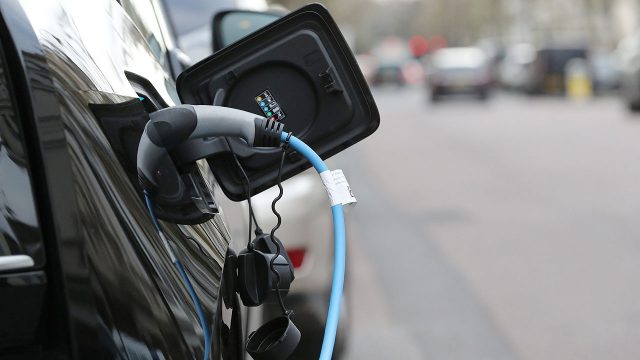
THE Department of Justice (DoJ) said that the government’s electric vehicle (EV) incentive strategy does not need to replicate an earlier automotive program in full, giving policymakers flexibility in crafting support measures for the sector.

In a legal opinion dated March 5, addressed to Board of Investments (BoI) managing head Ceferino S. Rodolfo, the Justice department said the Electric Vehicle Industry Development Act (EVIDA) only requires that the incentive framework be “similar” to the Comprehensive Automotive Resurgence Strategy (CARS) Program.

“The EV incentive strategy to be adopted under the EVIDA does not need to mirror the CARS Program in its entirety. Section 24 of the EVIDA only requires that the EV incentive strategy be similar, not identical to the CARS program,” Justice Secretary Fredderick A. Vida said.

The clarification was sought by the BoI, an attached agency of the Department of Trade and Industry, as it prepares an Electric Vehicle Incentive Strategy under Republic Act No. 11697. Officials had raised whether the EV incentives must strictly follow the structure of the CARS Program, which used a Tax Payment Certificate (TPC) system.

The DoJ said the law’s wording is clear and should be interpreted based on its plain meaning, noting that “similar” does not equate to “identical.”

It added that the EV strategy must instead be tailored to meet EVIDA’s specific goals, including narrowing the cost gap between EVs and conventional vehicles, attracting investments in manufacturing and components, and setting production targets. On incentives, Mr. Vida said the government is not limited to using TPCs.

“The EV incentive strategy… may use any legal incentive mechanism,” it said, including but not limited to tax credit certificates. — Erika Mae P. Sinaking

1.4 GW of RE, energy storage projects to come online next month — DoE

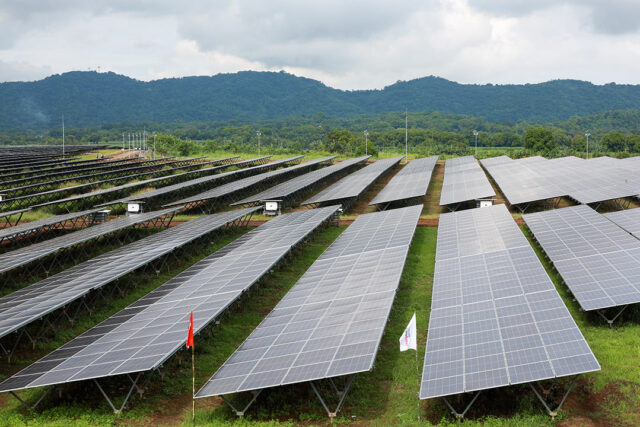
Solar panels are seen in Batangas in this file photo. — PHILIPPINE STAR/NOEL B. PABALATE

THE Philippines is expecting around 22 renewable energy (RE) and energy storage projects to come online next month that could feed 1,471 megawatts (MW) of additional capacity to the grid, according to the Department of Energy (DoE).

In a statement on Sunday, the DoE said these projects are already in advanced stages of construction or are undergoing final testing and commissioning.

Twelve solar projects represent approximately 1,284 MW, complemented by six hydroelectric plants with 48.23 MW, two biomass facilities with 38 MW, a wind project with 13.56 MW, and a 20-MW integrated renewable energy storage system.

These projects form part of the 200 power plants that President Ferdinand R. Marcos, Jr. directed the DoE last year to fast-track by 2028.

“At a time when the country must act with urgency and discipline to protect the integrity of the power system, the timely delivery of committed capacity is imperative,” said Energy Secretary Sharon S. Garin.

Building on this development, the DoE said that the recent observance of Earth Hour generated a total load reduction of 145.43 MW, bolstering push for sustained energy conservation amid the global market disruptions.

Luzon saw the largest drop with 75.25 MW, followed by the Visayas with 66.6 MW and Mindanao with 3.58 MW.

The total reduction is enough to power one million households with an average monthly consumption of 100 kilowatt hours.

“Simple actions, such as turning off unused lights, using energy-efficient appliances, and managing our energy consumption wisely can collectively strengthen our country’s energy resilience and help secure a more sustainable future,” Ms. Garin said. — Sheldeen Joy Talavera

IPOPHL seeks comments on draft trademark guidelines

THE Intellectual Property Office of the Philippines (IPOPHL) said it is seeking comment on the draft guidelines for the submission and examination of declarations of actual use in trademark applications and registrations.

The IPOPHL is accepting comments on the draft guidelines until April 17.

According to a draft copy, the Declaration of Actual Use (DAU) must be filed at specific intervals throughout the life of a trademark application or registration to confirm that the mark remains in genuine continuous commercial use in the Philippines.

A third-year DAU must be filed within three years from the filing date of the application, while a fifth-year DAU must be filed within one year from the fifth anniversary of the registration to verify continued use of the mark.

The renewal DAU must be filed within one year from the renewal date. It may also be filed within the six-month period before the expiration of the registration, provided that a request for renewal has been filed, it said.

“A DAU submitted after the expiration of the applicable period, without a duly filed and fully paid request for extension (for the Third Year DAU only), shall be refused outright and shall result in the refusal of the application or in the removal of the registration,” IPOPHL said.

Each DAU must be submitted under oath, and the form must contain information such as the full name and address of the applicant or registrant; a declaration that the mark is in actual use in the Philippines; and a list of the goods and/or services for which the mark is being used.

The application form must also indicate the names and complete addresses of the establishments or outlets where the goods are sold or the services are rendered, or the verifiable website or e-commerce address for goods sold online.

A Declaration of Non-Use (DNU) may be filed when the registrant or applicant is prevented from using the mark in commerce by circumstances arising independently of their will, IPOPHL said. — Beatriz Marie D. Cruz

Bill to ‘renationalize’ Petron pushed

PETRON

A GROUP of minority lawmakers on Sunday urged congressional leaders to fast-track the approval of a bill that would place a major fuel company under government control amid rising pump prices that threaten to stoke inflation and dampen economic growth.

The House of Representatives should immediately pass House Bill No. 8127 to “renationalize” Petron Corp., the country’s only oil refiner that was privatized in 1994 when the government was pushing to deregulate the domestic oil market.

“It is time to reclaim control over vital industries and ensure that oil, energy, and livelihoods are served — not the profits of a few,” Party-list Reps. Antonio L. Tinio, Sarah Jane D. Elago and Renee Louise M. Co said in a joint statement in Filipino.

A Petron Corp. representative did not immediately reply to a Viber message seeking comment. Its president and chief executive officer Ramon S. Ang last week said he was willing to sell the fuel company back to the government.

Efforts to rein in surging fuel prices have prompted lawmakers to push for sweeping reforms, including proposals to suspend fuel taxes and a review of a 1998 law that deregulated the oil industry.

Petron Corp.’s refinery in Bataan province west of the capital processes around 180,000 barrels per day and feeds roughly a third of the country’s fuel demand. — Kenneth Christiane L. Basilio

DLSU books first Final 4 berth

DLSU LADY SPIKERS VS UP FIGHTING MAROONS — UAAP/JOAQUI FLORES

In sweeping UP in Round 2 of UAAP women’s volleyball

Games on Sunday (April 5)
(UST Quadricentennial Pavilion)
9 a.m. – UST vs. UE (men)
11 a.m. – UST vs. UE (women)
3 p.m. – NU vs. ADU (men)
5 p.m. – NU vs ADU (women)

UNBEATEN De La Salle University (DLSU) can now head into a week-long break with one goal off of its checklist.

The mighty DLSU Lady Spikers clobbered the University of the Philippines (UP) Fighting Maroons, 25-15, 25-18, 25-20, and clinched the first Final Four ticket with still a slew of games left in the UAAP Season 88 women’s volleyball on Sunday at the UST Quadricentennial Pavilion.

La Salle needed only 84 minutes to achieve the feat, soaring to a 10-0 slate for now an inside track to a twice-to-beat incentive in the Final Four while staying on course to a two-round sweep for a possibility of clinching an automatic ticket in the best-of-three finals.

The power duo of Shevana Laput and Angel Canino connived once again with 16 and 15 points, respectively, as the Lady Spikers marched on to their 16th straight postseason appearance since 2009.

Middle Blocker Amie Provido backstopped them with 10 points on four swats while Shane Reterta and Lilay del Castillo contributed nine and eight points, respectively.

But La Salle is far from satisfied entering a UAAP pause in observance of the Holy Week, even with a steady drive so far to its redemption tour after a bridesmaid finish to back-to-back champion National University.

The Lady Spikers found no problem taking care of that business by pouncing on the UP Fighting Maroons with a 10-point margin in the first set. Not even UP’s stronger resistance mattered in the next two as La Salle’s experience was just too much to handle, running away from a 20-19 cushion on a fiery 5-1 closeout led by Ms. Canino.

La Salle also swept UP, 25-12, 25-15, 25-19, in the first round where it only lost a total of four sets. The Lady Spikers have dropped two sets so far this round, one each against Adamson University and University of Santo Tomas entering the last four games.

No player finished in double figures for UP, which surrendered five of its last six matches to lose steam in the Final Four race at 4-6.

Niña Ytang and Gelai Gajero were the lone bright spots with nine points each for the Fighting Maroons now in a scramble to catch up with Santo Tomas (5-4) and Adamson (6-4) for the last semifinal ticket.

La Salle tries to move closer to a 14-0 wipeout and an outright final berth against the formidable Far Eastern University (6-3) while UP spikes for a must-win match against the also-ran Ateneo de Manila University (1-9) on Wednesday (April 8) at the Mall of Asia Arena.

In the men’s division, Olayemi Raheem and Yoyong Mendoza scored 17 points each as La Salle tied Ateneo at No. 4 anew with similar 5-5 slates after a tough win against UP (3-7), 25-22, 25-23, 18-25, 26-24. — John Bryan Ulanday

Defending champ Sabalenka beats Coco Gauff in Miami Open final, completes ‘Sunshine Double’

ARYNA SABALENKA — FACEBOOK.COM/WTA

DEFENDING CHAMPION Aryna Sabalenka beat hometown favorite Coco Gauff 6-2, 4-6, 6-3 in the Miami Open final on Saturday to join an exclusive club by completing the coveted “Sunshine Double.”

World number one Sabalenka, who reached the final without dropping a set, won 73% of her first-serve points and faced just two break points en route to victory in a rematch of the 2025 French Open final won by Gauff.

Sabalenka is only the fifth woman to win the Indian Wells and Miami titles back-to-back, a feat known as the “Sunshine Double” given the tournaments’ respective locations in California and Florida.

“I want to start with (Coco). You’re a fighter and you also push me so hard to be a better player and I like our rivalry,” Sabalenka, who improved to 7-6 all-time versus Gauff, said during the trophy ceremony.

Sabalenka raced out to a 2-0 lead but Gauff, from nearby Delray Beach and appearing in her first Miami final, got on the board with a love hold and then repelled three break points in her next service game to get within 3-2.

But Sabalenka did not lose focus and eventually went up a double break on the world number four before closing out a dominant opening on her serve.

There was very little to separate the two players in the middle set which remained on serve until Gauff broke Sabalenka for the only time in the match to force a third set.

Sabalenka broke Gauff to open the decider, held at love in two consecutive service games to go 5-3 up and then sealed the victory with her fourth break of the match when Gauff sent a backhand wide.

Sabalenka is the first player to win back-to-back Miami titles since Ashleigh Barty in 2019 and 2021. The 2020 edition was canceled due to COVID-19.

The Belarusian joins Iga Swiatek (2022), Victoria Azarenka (2016), Kim Clijsters (2005) and Steffi Graf (1994, 1996) as the only women to complete the “Sunshine Double.”

Sabalenka also improved to 23-1 on the year, her only loss coming in the Australian Open final at the hands of Elena Rybakina, whom she went on to beat in the Indian Wells final and Miami semifinals.

“Aryna, congratulations. We’ve had many battles, many finals and, yeah, I think you push me to be a better player,” said Gauff. “You’re a great fighter and hopefully we can play many more. I think we will.” — Reuters

Atlanta Hawks retain NBA East No. 6 seed with win over struggling Sacramento Kings, 123-113

NICKEIL ALEXANDER-WALKER scored 27 points, Jalen Johnson added 26 points and 10 assists and the Atlanta Hawks held off the visiting Sacramento Kings for a 123-113 victory on Saturday.

CJ McCollum scored 22 points, while Jock Landale finished with 19 points and 13 rebounds for the Hawks (42-33), who won their 15th game in 17 tries. Zaccharie Risacher tallied 13 points and Mohamed Gueye chipped in 10 for Atlanta, which holds a half-game lead over Philadelphia for the East’s No. 6 seed — the last guaranteed playoff spot in each conference.

Hawks coach Quin Snyder collected his 500th career victory, becoming the sixth active NBA head coach and 41st in league history to reach the plateau.

DeMar DeRozan led Sacramento (19-56) with 22 points, followed by Maxime Raynaud’s 18 points and 10 boards. Precious Achiuwa had 16, DaQuan Jeffries scored 15 and Daeqwon Plowden had 14 for the Kings, who dropped their third straight. Malik Monk and Killian Hayes both scored 10 points.

Atlanta pushed its 12-point halftime lead to 16 on Gueye’s 3-pointer with 8:08 left in the third.

The Kings pulled within nine on DeRozan’s layup, before Atlanta extended the lead back to 13.

Sacramento closed the third on a 7-1 run — including Hayes’ buzzer-beating triple — to cut its deficit to 88-82 entering the fourth.

The Kings tied the game at 97 apiece on Plowden’s 3-pointer with 8:03 left. Johnson’s five straight points began an 11-0 run that gave the Hawks a 108-97 edge with 5:47 remaining.

The margin was pushed to 14 on Landale’s triple. After DeRozan and Plowden’s 3-pointers, McCollum’s trey sealed the Atlanta win.

Neither team took a lead larger than five in the first quarter, as Jeffries’ 3-pointer with 46 seconds left gave the Kings a 30-27 lead after 12 minutes.

Sacramento opened up a seven-point lead on Plowden’s dunk at the 9:05 mark of the second quarter.

After Monk’s hook shot put the Kings ahead by 2, Alexander-Walker’s triple and Gueye’s dunk stamped a 14-0 run to put the Hawks up 63-51.

McCollum beat the first-half buzzer with a mid-range jumper to give Atlanta a 66-54 lead. Alexander-Walker had 14 first-half points, while Achiuwa’s 12 led the Kings. — Reuters

Lakers star Luka Doncic suspended one game after 16th technical foul

LUKA DONCIC — NBA.COM

THE NBA suspended Los Angeles Lakers star Luka Doncic for one game without pay on Saturday for receiving his 16th technical foul this season, and he will miss Monday’s game against the visiting Washington Wizards.

Doncic, the league’s leading scorer, was assessed a technical along with Brooklyn forward Ziaire Williams when they jostled each other with 5:12 remaining in the third quarter of the host Lakers’ 116-99 victory on Friday.

An offensive foul was called seconds earlier on Doncic, and a video review showed him pushing Williams, with the Nets player retaliating by swiping at Doncic’s face.

The 16th technical triggered an automatic suspension, which will cost Doncic 1/174th of his annual salary, about $264,000, per ESPN. League rules stipulate that following the 16th technical, for every two additional technicals, the player will be suspended another game without pay.

The Lakers had successfully appealed Doncic’s most-recent technical for a yelling match with Orlando Magic center Goga Bitadze on March 21. The league rescinded the technicals.

Doncic, 27, is averaging 33.7 points, 8.2 assists and 7.8 rebounds for the Lakers (48-26), who are in third place in the Western Conference with eight games remaining in the regular season.

A six-time All-Star guard, Doncic has been selected All-NBA first team five times and was the 2018-19 NBA Rookie of the Year. — Reuters

Series of crafted exits

Tom Brady has long since conquered time, so now he negotiates with it. In another life, or perhaps simply another version of the one he has, he might already be preparing for yet another return to action in the National Football League. The impulse remains. Even now, he admits to having nudged at the boundary between what has been and what could still be. The answer, delivered with institutional firmness, was predictable: The league office “didn’t like that idea very much.” Ownership and participation, after all, are not meant to coexist. And so the thought experiment ended where it began: somewhere between curiosity and closure. Ever competitive, he has clearly not lost the urge; he has simply outlived its usefulness.

What lingers is not indecision but perspective. The same flag football cameo that briefly rekindled muscle memory for Brady also clarified its limits. He could still throw. He could still belong. That said, belonging at this stage is no longer about taking hits on a Sunday; it is about stewardship. Retirement is thus not an ending, but a reallocation of purpose that requires resisting the very instinct that made him great.

Across the American sporting landscape, LeBron James faces a similar negotiation with Father Time. The question is not whether he can continue (and evidence suggests he can), but where, and to what end. His stated preference to finish his career with the Lakers has, of late, carried a tone of intention rather than inevitability. If nothing else, the development is an acknowledgment that even icons must defer to the business side of the sport. Never mind that the surge of the purple and gold coincided with his complete acceptance of a redefined role. Forget that the subtle satisfaction that comes with still mattering also makes continuity a choice and not a compromise.

There is, of course, dignity in the deliberate narrowing of ambition. Once, James chased championships across geographies, calibrating legacy in rings and narratives. Now, the pursuit seems more contained, almost intimate: to end where he stands, provided the conditions remain ideal. It is the difference between proving greatness and inhabiting it.

Golf, meanwhile, offers the starkest reminder that age does not deal in good faith. The latest image is not of a leaderboard, but of an overturned vehicle on a narrow Florida road, with Tiger Woods again serving as an abject model of fragility. Authorities say he attempted to overtake a truck at speed, clipped its trailer, and rolled his SUV onto its side; he emerged without injury but was arrested on suspicion of impairment, with no alcohol detected and a refusal to undergo further testing. Significantly, the turn of events underscores an unsettling pattern: the 2021 crash that nearly cost him a leg, the earlier episode involving prescription medication, the long trail of physical and personal recoveries that have defined his later years.

In this light, Brady’s aborted comeback, James’ measured intent, and Woods’ latest ordeal are variations on the same theme. The modern athlete is no longer afforded a single ending. There are, instead, a series of crafted exits: some public, some private, all incomplete. The body may still comply, the mind may still wander, but the context inevitably concretizes. Rules intervene. Circumstances evolve. And sometimes, the margin for error is reduced to a moment.

And so the choice ultimately isn’t about whether to continue, but how to conclude: not abruptly, not indulgently, but with an awareness that even the greatest careers are, in the end, collaborative acts between player and league, between ambition and acceptance, between what is still possible and what is no longer permitted.

Brady asked the question and received an answer. James continues to shape one. Woods, once more, is forced to confront his. The circumstances unfold in between, with the final act not so much declared as understood.


Anthony L. Cuaycong has been writing Courtside since BusinessWorld introduced a Sports section in 1994. He is a consultant on strategic planning, operations and human resources management, corporate communications, and business development.

Oil-shock vulnerability blamed on deregulation

A worker prepares to fill an underground storage tank at a gas station in Quezon City, March 9, 2026. — REUTERS/LISA MARIE DAVID

By Sheldeen Joy Talavera, Reporter

THE deregulation of the Philippine fuel market made it vulnerable to the latest oil supply shock, leaving the economy at the mercy of disruptions in the Persian Gulf crude supply, analysts said.

“The Philippines was among the hardest hit precisely because it has the most deregulated oil market in Southeast Asia,” Noel M. Baga, co-convenor of think tank Center for Energy Research and Policy, told BusinessWorld.

“With no price controls, no strategic petroleum reserve, and near-total dependence on imported petroleum, every global price shock lands directly on Filipino consumers with no buffer,” he added.

Mr. Baga said state-run Philippine National Oil Co. (PNOC) must establish a strategic petroleum reserve — a government-held physical stockpile that can be deployed during future crises.

“The Philippines currently has none, which is the single most glaring structural gap exposed by this crisis,” he said.

The Philippines relies on commercial oil stockpiles held by private companies and imposes inadequate inventory requirements of 30 days of crude oil and 15 days of finished petroleum products.

As of March 20, the Philippine petroleum supply was equivalent to about 45 days.

This is higher than what is required but well below the recommended minimum by the International Energy Agency of 90 days, according to Jun Hao Ng, assistant economist for Asia Macro at global economic advisory firm Oxford Economics.

To ensure reliable fuel supply, Mr. Ng said the Philippines must expand its reserve infrastructure.

“The country could also consider diversifying import routes away from the Strait of Hormuz, potentially sourcing from exporters outside the Middle East, such as the US. But, this would increase costs and require adjustments for different crude oil grades,” he told BusinessWorld via e-mail.

The Philippines has been scrambling to find alternative suppliers of fuel as the conflict in the Middle East has disrupted exports from key oil-producing countries.

Aside from existing suppliers, Energy Secretary Sharon S. Garin has said the country is also seeing to arrange shipments from Malaysia, Brunei, and India. It is also considering sourcing from the US, Canada, Russia, or South America

Ms. Garin has said that oil companies are not being required to accumulate one year of inventory, which she said was “very expensive,” with available storage also limited.

On Friday, the Department of Energy (DoE) announced the arrival of the first shipment carrying 142,00 barrels of diesel, part of the 1.04 million barrels of diesel the government is seeking to import.

The DoE tasked the oil and gas exploration arm of PNOC to procure around two million barrels of fuel to boost reserves, giving it a budget of P20 billion.

A month into the Persian Gulf crisis, pump prices have hit historic levels, with diesel being priced as high as P140 per liter.

“While the Philippines’ initial response to the energy crisis has been swift, including cash handouts for the transport sector, the measures appear to be fiscally cautious and limited in scope,” Mr. Ng said.

Thailand, which similarly relies heavily on imported oil, has implemented a general fuel price cap that cushions citizens from rising prices, he said.

Mr. Ng said that suspending excise tax and value-added tax on fuel could help mitigate inflationary pressure.

However, both measures would reduce government revenue, effectively shifting the fiscal burden to the Philippine government, he said.

“The suspension of the fuel excise tax and the declaration of the national energy emergency are good first steps to further alleviate hardship but they hardly address the heart of the problem with our reliance on imported oil,” Gerry Arances, executive director of the Center for Energy, Ecology, and Development, told BusinessWorld.

He said the law which liberalized the downstream oil industry must be revisited, “with the long-term objective of eliminating fossil fuel reliance and ending the vulnerability of consumers to price shocks.”

Signed in 1998, Republic Act No. 8479, or the Downstream Oil Industry Deregulation Act, allows oil companies to set and adjust pump prices based on global oil price benchmarks and other market factors, instead of awaiting government approval.

Mr. Baga said the President can classify fuel as a prime commodity and impose the sort of price ceilings authorized by the Price Act.

Ms. Garin has said that the government is focused on addressing profiteering instead of imposing price caps on petroleum products.

Ang ayaw natin ay abusado ang kita. Kaya ‘yun ang binabantayan namin at ginagawan namin ng guidelines para ma-kontrol ‘yan (What we don’t want is unreasonable profits. That’s what we are monitoring and putting guidelines in place to control it),” she said in a radio interview last week.

PHL growth forecast cut to 4.5% — ING

PHILIPPINE STAR/MICHAEL VARCAS

ING BANK NV downgraded its economic growth projection for the Philippines to 4.5% in 2026 from 5.2% previously, as it expects higher oil prices to raise the country’s import bill and shave 80 basis points (bp) off growth.

In a commentary published by ING Bank’s Economic and Financial Analysis Division, Regional Head of Research for Asia-Pacific Deepali Bhargava said that crude shortages and surging pump prices are amplifying downside pressures on the economy.

“The ultimate economic impact will depend on how long the disruption persists, but the shortages are already amplifying existing weaknesses in domestic demand,” she said.

“The direct hit to gross domestic product (GDP) will come through a higher oil and gas import bill, which is currently about 4% of GDP. Indirect effects will stem from rising transportation and logistics costs, which will feed through to consumer prices,” she added.

As petroleum accounts for 46% of the country’s fuel consumption, in the base case scenario that Brent oil prices average $80-85 per barrel (bbl), the higher oil import bill alone could trim roughly 80 bp off GDP growth.

“Against this backdrop, we are revising down our 2026 GDP growth forecast to 4.5%, from 5.2% previously. The economy is entering this period of elevated energy costs from a position of vulnerability, following an already weak 2025 performance driven by a sharp contraction in government spending,” she added.

The Philippines is among the most oil-dependent countries in the Asia-Pacific, with over 95% of oil imports coming from the Persian Gulf, leaving it exposed to price swings and supply disruptions.

“The transportation sector is the largest consumer of oil products, meaning fuel costs feed directly through to logistics and household expenses,” she said.

“This vulnerability is further aggravated by limited domestic fuel reserves, with the energy secretary noting that the country has roughly 45 days of diesel supply remaining,” it added.

In response, the government has been trying to secure alternative supply sources, including a 700,000 barrel shipment from Russia.

“Yet with national consumption estimated at 450-487k barrels per day, this volume would cover only a few days of demand unless additional shipments are secured from Russia or China,” she said.

With retail fuel prices remaining fully market-linked, pump prices in the Philippines have more than doubled since the start of the Persian Gulf crisis.

As such, the government introduced targeted subsidy measures and passed a law that will permit the suspension or partial reduction of excise duties on selected petroleum products.

“While the fiscal cost is currently modest at around 0.07% of GDP, the Philippines’ relatively thin fiscal buffers mean that any significant expansion of support would increase pressure on government finances,” she said.

She said  despite having the room to extend fuel subsidies due to weaker spending in 2025, fiscal space remains limited.

“Any additional support would risk further delaying capital expenditure spending, which would in turn slow the broader growth recovery. Even if spending normalizes somewhat in 2026, the drag from tight fiscal conditions on confidence and economic activity will take time to fade,” she said.

“With consumer sentiment still weak, we expect the recovery to remain uneven. As a result, our 2026 growth forecast remains at 4.5%, with risks clearly tilted to the downside,” she added.

Meanwhile, she said that even prior to the war, labor market conditions had weakened, with the unemployment rate climbing to 5.8% in January 2026, the highest since the 6% posted in June 2022.

“Weaker government spending has now translated into softer private investment, job losses, and a slowdown in wage gains. These trends are likely to intensify as higher oil prices raise production costs, discourage hiring, and compress real incomes,” she added.

Ms. Bhargava said the weaker external balances are likely to drive the peso lower but said that the Bangko Sentral ng Pilipinas (BSP) may cut rates in April.

The BSP on Thursday said that it committed to “anchoring inflation expectations and taking a forward-looking approach amid the risk of second-round effects from rising oil prices.”

Citing precedents in 2022 and 2018, she said the BSP had hiked rates once inflation breached the upper end of its 4% target.

“With Brent crude prices up roughly 40% month on month in March, headline inflation is now likely to exceed the target band even under our base case. This implies that the consumer price index could breach 4% as early as March, raising the probability of a rate hike as early as April,” she said.

However, she said that unlike in 2022, the economy is struggling, as reduced government spending in 2025 has dragged down both business investment and household consumption.

“Given this weaker growth setting, and assuming the current conflict eases soon, our base case is that the BSP remains on hold in April. That said, if oil prices stay above $100/bbl in our longer-war scenario and with limited signs of de-escalation in the ongoing conflict, the BSP may be compelled to consider raising rates as soon as April,” she added. 

She said higher oil prices are likely to widen the Philippines’ current account deficit to 4% of GDP in the second quarter from 2.4% in the first quarter if oil prices are sustained above $100.

“The BSP’s recent guidance that it is not defending any specific exchange rate level and that intervention in the foreign exchange (FX) market remains modest suggests limited resistance to further currency weakness. While rate differentials matter, historical experience shows that FX performance is more closely driven by external balances,” she said.

“With the dollar supported by safe haven flows and the Federal Reserve unlikely to ease aggressively in the near term, domestic tightening alone is unlikely to materially shift the peso’s trajectory. A move beyond P61/dollar remains a clear risk,” she added.

On Friday, the peso hit a new record low, weakening by 32 centavos to close at P60.55, the Bankers Association of the Philippines reported.

Meanwhile, the BSP raised its inflation forecast for 2026 to 5.1% from 3.6% previously. If realized, the headline print would breach its 2%-4% target. — Justine Irish D. Tabile