COLLIN Morikawa displayed nerves of steel in the final round of the PGA Championship on Sunday where the young American fended off a slew of big names to grab his first major and ensure he will no longer fly under the radar.
In only his second career major start, the 23-year-old Morikawa was a model of precision at TPC Harding Park in San Francisco where he finally pulled away from a tight leaderboard with a remarkable drive that set up a late eagle.
“In the strokes-gained era, this is the first time a player has ever led in fairways hit, proximity to the hole and strokes-gained putting,” said Golf Channel analyst Brandel Chamblee.
“You put all that together and it’s just not fair that somebody after 29 events on the PGA Tour has all of those skills and has their whole career in front of them.”
Morikawa, who last month picked up his second career PGA Tour win, was not on anyone’s radar at the year’s first major until firing a 65 in the third round that left him two shots back of the leader.
In the final round he delivered the drive of his life at the par-four 16th which led to an eagle that all but clinched the Wanamaker Trophy and cemented his place among the cast of young standouts in the golfing world.
“There’s a maturity there that at 23, it shouldn’t exist,” former British Open champion Justin Leonard said of Morikawa. “The skillset that he has is a little different than what we see in a modern young player.”
PGA Championship runner-up Paul Casey, who finished two shots back, praised Morikawa’s maturity and said the previously unheralded American will remain a force.
“There’s always a lot of — there’s always kind of a new wave,” English Ryder Cup veteran Casey said.
“There’s always a bunch of guys that rock up on the scene, and he didn’t necessarily get the most publicity out of the group he was in, but you know, I can consider myself veteran; I’ve been around the block, so I know talent when I see it.”
Morikawa, who was 65th in the rankings at the end of 2019, shot up seven places to world number five after his win, is eager to relish the spotlight and anything but complacent after the biggest win of his career.
“When I woke up (on Sunday), I was like, this is meant to be. This is where I feel very comfortable. This is where I want to be, and I’m not scared from it,” said Morikawa.
“I think if I was scared from it, the last few holes would have been a little different, but you want to be in this position.
“It doesn’t stop here. I’ve got a very good taste of what this is like, what a major championship is like.” — Reuters
When plans for the National Basketball Association’s campus environment were being formulated, not a few quarters criticized the Suns’ inclusion in the mix. The concerns weren’t unfounded, to be sure; when the 2019-20 season was suspended in mid-March, stalwarts of the purple and orange were fresh off losses in five of their last seven contests. And, at 26 and 39, they faced the near-Sisyphean task of winning every single one of their eight seeding games just to move up from 13th in the conference and force sudden death for the last spot in the playoffs.
Fast forward a month into the league’s restart, and the Suns have clearly underscored that they belong in the bubble. They’re a perfect six of six heading into today’s match against the Sixers, with their run of success catapulting them past the now-eliminated Pelicans and Kings and putting them smack dab in the middle of a four-way battle for the final postseason berth. And, for all their failings prior to the shutdown, their recent string of triumphs is no fluke. They’ve been the best by far of the 22 teams quartered in Walt Disney World, no easy feat in light of the odds and the ease with which they could have instead coasted.
Considering the Suns’ scorching-hot showing, its no surprise that the naysayers have come and gone. Conventional wisdom pegged them as mere fodder, and an unnecessary one at worst — avoidable threats to health and safety protocols for a setup perennially in danger of being breached. Instead, they’ve emerged as first among equals of the tournament within a tournament. And, significantly, they remain as grounded as they were in the beginning. “We haven’t accomplished anything,” insisted head coach Monty Williams in the aftermath of their victory against the Thunder yesterday. “Everybody is trying to get to the playoffs, and we’ve just said we’re going to take it one step at a time.”
In short, the Suns are being smart first and foremost, pushing themselves to excel at factors they can control and not wasting time on those they can’t. Else, they would have been overwhelmed by the extent of the work facing them. Even now, there’s no guarantee they’ll be part of the play-in series; the Grizzlies, Blazers, and Spurs are lockstep with them in battle, bent on giving no quarters en route. Which is why they’re fine with any outcome for as long as they managed to do their best; there’s nothing else they can do but make the most of the opportunities given them.
Indeed, doing so has been a crucial ingredient to the Suns’ ascent. They’ve prevailed against handicapped opposition: the Wizards without Bradley Beal and Davis Bertrand; the Clippers without Montrezl Harrell; the Heat without Jimmy Butler and Goran Dragic; and the Thunder without Dennis Shroder, Shai Gilgeous-Alexander, Danilo Gallinari, and Steven Adams. And, today, they’ll be taking to the court versus the Joel Embiid- and Ben Simmons-less Sixers. Of course, being handed chances is one thing, and taking advantage of them is quite another.
At this point, it’s anybody’s guess as to where the Suns will be at the end of their 2019-20 campaign. How they’re finishing it is clear, in any case: with their heads held high and all too aware of their bright future.
Anthony L. Cuaycong has been writing Courtside since BusinessWorld introduced a Sports section in 1994. He is a consultant on strategic planning, operations and Human Resources management, corporate communications, and business development.
The world has 586 known unicorns—startups valued at more than US$1 billion—and the US and China account for 79% of them, according to Hurun Research Institute’s Global Unicorn Index 2020 released this August. The 586 unicorns are based in 29 countries and 145 cities. The total value of all known unicorns is US$1.9 trillion, close to Italy’s Gross Domestic Product (GDP).
“The US and China continue to dominate… despite representing only 40 percent of the world’s GDP and a quarter of the world’s population,” said Rupert Hoogewerf, chairman and chief researcher of Hurun Report, a luxury publishing group based in Shanghai, China. “The rest of the world needs to wake up to providing an ecosystem that allows unicorns to flourish.”
The Hurun Global Unicorn Index ranks the world’s startups founded in the 2000s, that are worth at least a billion dollars and are not yet listed on a public exchange. The valuations are a snapshot of March 31, 2020.
WHERE UNICORNS RESIDE The US leads China 233 to 227 in terms of number of unicorns per country, but China is home to four of the top five unicorns:
1. Alipay operator Ant Group, the digital financial services arm of Alibaba Group Holding, valued at US $150 billion
2. ByteDance, owner of video-sharing platform TikTok, valued at US$80 billion
4. Lufax Holding, which runs an online wealth management and peer-to-peer lending platform, valued at US $38billion
5. Space Exploration Technologies Corp, also known as SpaceX, valued at US$36 billion—SpaceX, owned by Elon Musk, is the lone unicorn in the top five that is based outside China (its headquarters are located in Hawthorne, California)
By city, Beijing is the world’s unicorn capital with 93, ahead of San Francisco’s 68 and followed by Shanghai (47), New York (33), Shenzhen (20), and Hangzhou (20). Nine of the top ten cities with unicorns are in China and the USA. London is the only other city in that top ten. “China and the USA dominating the world’s unicorn cities is significant because these unicorns create an ecosystem of talent and investors,” Mr. Hoogewerf said.
By region, Silicon Valley takes top spot as home to 122 or 21% of the world’s unicorns.
By continent, Asia leads North America (278 versus 236) as the continent creating the most unicorns in the world, both in terms of number of unicorns and in terms of total valuations of unicorns.
NUMBERS BY SECTOR Eighty percent of the world’s unicorns sell software and services, led by e-commerce and followed by fintech, artificial intelligence (AI), and Software as a Service (or SaaS, a licensing and delivery model in which software is licensed on a subscription basis and is centrally hosted). Twenty percent have a physical product as a core business offering, led by consumer goods, e-cars, and AI.
E-commerce was the sector with the most number of unicorns (89), followed by AI and fintech with 63 each. Others include SaaS (53), shared economy (33), and health tech (28).
The sectors most disrupted by unicorns are financial services, retail, media and entertainment, business management solutions, and healthcare. “Unicorns create value mostly by disrupting existing industries,” said Mr. Hoogewerf.
On the investor side, US-based Sequoia was the world’s most successful, investing in one in five of the world’s unicorns. Also successful at finding and investing in unicorns were China’s Tencent, Japan’s Softbank, and IDG (another US firm).
In spite of the big impact the coronavirus disease 2019 (COVID-19) pandemic had on the economy, the development of Suntrust Properties in Tanza, Cavite continues to serve as a vehicle of economic growth, constantly meeting the needs of its locators and sustaining its workforce.
Suntrust Ecotown Tanza (SET) is the first foray of holding company Alliance Global Group, Inc. (AGI) and parent company Megaworld in industrial park development. The biggest component of the township will be the industrial park, while the rest will be devoted to residential, commercial, office, entertainment and institutional components including government offices, school and hospital, among others.
It was launched in 2014 as a way of actively helping the government in nation-building, specifically in terms of generating around 120,000 direct jobs and 600,000 indirect jobs. The industrial project is registered under Philippine Economic Zone Authority (PEZA), offering fiscal and non-fiscal incentives while ensuring both foreign and local investors the “ease of doing business” as they invest here in the Philippines.
Suntrust Ecotown standard factory building
Strategically located right at the heart of the town of Tanza, SET takes full advantage of its location due to its close proximity to the Export Processing Zone in the neighboring town of Rosario, as well as major airports, seaports, and business districts in Manila.
The industrial hub is also at a place where various infrastructure projects have been thriving, creating more advantage to Suntrust’s booming development. These projects include the Cavite Gateway Terminal, a barge port just seven kilometers away from SET; LRT Line 1 Extension; Cavite-Laguna Expressway (CALAX); Sangley Point Airport; and the Bataan-Cavite Interlink Bridge.
For such perks, Suntrust Ecotown Tanza is seen to be the biggest investment generator in Cavite, as well as the biggest job generator for the province in the coming years.
The first phase of the development measures about 111.4 ha and has 109 industrial lots. At present, this phase is already sold-out, compelling Suntrust to open the second phase of development with a total of 41.51 ha. Currently, a total inventory of 20 ha remains available.
Pioneering locators for Suntrust Ecotown Tanza are both Japanese manufacturing companies. The first locator at Suntrust Ecotown Tanza was Philippine Toei Chemical Corp., which produces industrial rubber parts for the automotive industry since 2015. This was followed by Oakwave Philippines Corp., a wiring harness manufacturer.
TOEI Chemicals
At present, other facilities providers and manufacturing companies have joined the roster of operational businesses in the development. These facilities providers are CCMC Land, Inc., Marnaco Inc., Dyco Yang Jeong Realty Inc., ZhongYao, and Orient Goldcrest Realty. The manufacturing firms, meanwhile, include Korean companies Daegyoung Apparel Inc., VCTP Inc., and BLD Electronics Inc.; and Chinese companies Huading Industries Corp., Huadi Dress Philippines, and D and S Industries Philippines Corp.
Other manufacturing firms include Japanese companies Glory Facilities and Development Corp., Subiendo Corporation, O.M. Daizen Enterprises Corp., and N.T. Philippines Inc.; Chinese company South Tanvite Management Corp.; Taiwanese companies Rosario Fasteners and Contour Optik; and Filipino companies Ecopack Manufacturing, JBC Food Corp., Armak Holdings & Development Inc. and Emperador Distillers, Inc. Other facilities providers include Centereach Resources, Panorama Property Ventures, Inc., Atlantica Industrial Resources, Interzone Property Management Corp., and Ironcon Builders.
Active amid COVID-19
While Suntrust Ecotown Tanza has experienced a slowdown in terms of site development amid the COVID-19 crisis, its full service to operating locators and contractors never ceased during the lockdown period.
As the industrial park retains the jobs of its workforce during these trying times, security personnel, site maintenance, site engineers, and estate admin personnel gave their full time and dedication to retain smooth operations inside the park and to ensure all concerns of all its locators and contractors are immediately addressed.
As the economy gradually proceeds into the ‘new normal’, Suntrust Ecotown Tanza is now back to business and on the upswing in terms of construction and land development, focusing further on the expansion area.
Moreover, Suntrust Ecotown Tanza, its operating companies, and its contractors have cooperatively assumed initiative and full responsibility in curbing the spread of COVID-19 through strict and proper implementation of health and safety protocols such as social distancing and wearing face shield/mask, to name a few.
Safety officers are also assigned to ensure strict compliance of health and safety protocols and to closely monitor health conditions of employees. The industrial hub, as well as each company there, have allocated areas as testing and isolation facilities.
All these measures are diligently implemented by Suntrust Ecotown Tanza to safeguard the health of all the employees, other personnel, and guests, as well as to keep the economic zone COVID-free.
A place for well-balanced lifestyles
Aside from being an economic driver, Suntrust Ecotown Tanza is a sustainable township development that aims to serve as a live-work-play-learn community, as envisioned by AGI Chairman Dr. Andrew L. Tan.
From the name itself, Suntrust Ecotown Tanza has ecology-friendly-themed features that make it a fitting place for living a well-balanced lifestyle. To lessen carbon footprint within the premises, the industrial park only requires its operating companies to use electronic or Euro-4 compliant vehicles as a shuttle service to its employees. To maintain a lush of green spaces around the area, tree planting activities have been organized by the park.
Furthermore, the ecozone has a centralized Sewage Treatment Plant (STP) built for wastewater treatment. It intends to recycle water for irrigation, and it complies with Department of Environment and Natural Resources’ standards for environment-friendly water discharge.
Suntrust Ecotown firestation
Other amenities in SET would include 24/7 security, PEZA and Customs office, shuttle terminal, fire station, materials recovery facility, driving range and mini-golf, badminton and basketball courts, park, hotel, and chapel, among others.
The government has run out of resources for aid to poor families, and has to allow people to go back to work, presidential spokesman Harry Roque said Tuesday. Image via Reuters.
The Philippines will unlikely keep its capital and nearby areas under strict lockdown despite coronavirus infections rising by another daily record to over 136,000.
The government has run out of resources for aid to poor families, and has to allow people to go back to work, presidential spokesman Harry Roque said Tuesday. The two-week lockdown ending August 18 was declared to accommodate health workers who said hospitals were already getting overwhelmed, he said.
The Philippines is battling a virus outbreak that’s already the worst in the region, while trying to boost its economy that plunged into recession last quarter. — Bloomberg
The Philippines has a space agency. Not space as in land area, which might make more sense for a country that is among the densest and most populous in the world, but space as in the final frontier. “I know that some people ask, ‘Why should we even care about space?,’” said Joseph S. Marciano, Director-General of the Philippine Space Agency (PhilSA), a national body founded in August 2019 with an initial operating fund of P1 billion.
At a webinar held on August 6—the same day that Curiosity rover landed on Mars eight years ago—representatives from the Philippine space program outlined its projects.
Of interest is Diwata-2, a microsatellite equipped with a high-precision telescope, a space-borne multispectral imager, and enhanced resolution cameras. Images taken by these instruments are beneficial because of their large coverage, their spatial resolution, and their ability to capture daily, weekly, or monthly snapshots. Diwata-2 is one of three satellites the Philippines has in orbit.
It is through satellite imagery that earthbound humans are able to grasp the devastation wrought by typhoons such as Haiyan, which destroyed the Visayas in 2013, or by fires that are still raging in the Amazon rainforest.
Satellite images and data, along with data from thousands of sensors deployed all over the country, are processed and used by stakeholders such as the Armed Forces of the Philippines, the Department of Environment and Natural Resources, the Philippine Institute of Volcanology and Seismology, and the University of the Philippines-Los Baños, among others.
Flood mapping is the most common application of satellite data. Beyond that, data was used to evaluate the extent of the Taal Volcano’s ashfall when it erupted this January; to monitor the 2019 drought of Occidental Mindoro; and to detect damaged structures caused by the Battle of Marawi in 2017.
Optical imagery from Diwata-2 was also used to determine the relationship between:
• air quality and COVID-19 cases — cities in the National Capital Region with high levels of nitrogen dioxide, a gaseous pollutant from cars that burn fossil fuels, also had a high number of COVID-19 cases and deaths
• night lights and monitor economic growth — fewer night lights in the second quarter of the year coincided with the biggest drop in the country’s Gross Domestic Product since the 1980s.
Satellite imagery and spaceborne data, Mr. Marciano said, “can provide geospatial information in a timely and accurate fashion” for improving health systems improvement and food security, and enabling a digital government and economy. This spaceborne data is more relevant now given travel restrictions. And who knows, one day, PhilSA might send a Filipino to Mars (there will no shortage of volunteers). — Patricia B. Mirasol
The public can access the Philippine Space Agency’s space data at space.gov.ph/spacedata/login. The user name is spacedatademo and the password is space2020. The site is still in development. Expect data updates on traffic monitoring, air quality, water quality, and night lights.
President Rodrigo R. Duterte has accepted Russia’s offer of its coronavirus vaccine, volunteering to take the first shot as a gesture of trust and gratitude.
“When the vaccine arrives, I will have myself injected in public. Experiment on me first, that’s fine with me,” he said in a briefing Monday night. Mr. Duterte—who has called President Vladimir Putin his “idol” and who’s seeking to boost ties with Russia—added that Manila can assist Moscow in clinical trials and local production.
Russia is poised to allow a vaccine developed by Moscow’s Gamaleya Institute for civilian use even before clinical trials are completed, triggering safety warnings from pharmaceutical companies. Russia’s elite has been given the experimental vaccine as early as April.
The Philippines has 136,638 confirmed coronavirus cases, the highest in Southeast Asia. On Monday, it reported new 6,958 infections, the largest daily increase which the Department of Health attributed to an error in its database that failed to count earlier test results.
Mr. Duterte last month said he also asked Chinese President Xi Jinping to help the Philippines get priority access to a Covid-19 vaccine. — Bloomberg
THE Bangko Sentral ng Pilipinas (BSP) is not inclined to cut rates further at this time and will likely keep rates steady in the next quarters, BSP Governor Benjamin E. Diokno said on Monday.
“There is no compelling reason why the BSP has to move sooner on further policy cuts at this time. Monetary policy works with a lag so our reading is that our aggressive monetary policies have yet to be digested by the market,” Mr. Diokno said in an interview with ABS-CBN News Channel.
The Philippines plunged into recession for the first time since 1991 after gross domestic product (GDP) contracted by 16.5% in the second quarter. Economic activity collapsed as the government implemented one of the world’s strictest and longest lockdowns to curb the spread of the coronavirus disease 2019 (COVID-19).
The central bank already slashed rates by a total of 175 basis(bps) points this year, with the latest cut worth 50 bps unleashed at the June 24 Monetary Board (MB) policy meeting. This reduced the overnight reverse repurchase, lending, and deposit rates to record lows of 2.25%, 2.75%, and 1.75%, respectively.
Mr. Diokno said keeping rates unchanged for the rest of the year is “a possibility.”
“In fact, the current monetary policy stance will probably hold for the next few quarters because as I said, we have acted decisively in anticipation of the crisis,” he said.
Mr. Diokno was asked regarding the next policy action of the MB for its Aug. 20 meeting, given he has previously said the sharp contraction in the second-quarter GDP is temporary and will not hurt the country’s macroeconomic fundamentals.
“The 16.5% contraction of Q2 GDP does not mean that the Philippine economy is structurally weak. It is inappropriate to compare the Q2 performance of the economy with other crises in recent Philippine history,” Mr. Diokno said in a text message.
Mr. Diokno said the country used to belong to a select group called “heavily indebted countries” in the 1980s which is not similar to its standing today. The Philippine economy, he said, is backed by a strong peso, low interest rate environment, ample dollar reserves, and low debt-to-GDP ratio.
“The economy plunged because of the strict nationwide lockdown to save lives and to allow the buildup of health facilities and testing capacity due to the pandemic. It is not because the economy is weak,” he said.
The previous policy cut, which was “a pre-emptive anticipation of the steeper Q2 GDP contraction,” may have yet to work its way into the financial system, said Security Bank Corp. Chief Economist Robert Dan J. Roces.
“Probably the monetary authorities will seek to preserve its ammunition for the time being while confidence levels stay low and an adequate fiscal stimulus response is being discussed in Congress,” Mr. Roces said in a text message.
Meanwhile, Euben Paracuelles and Rangga Cipta, analysts at Nomura Global Markets Research, are pricing in further easing due to delays in enacting a sizable fiscal support package, as the government looks to be “placing higher priority on longer-term reforms.”
“Despite some indications from the governor that the BSP may ‘pause,’ we still forecast a 25bp policy rate cut to 2% in Q3, and add another 50bp in cuts in Q4, which would take the policy rate to 1.5% by year-end. We believe the Q2 growth outturn disappointing official forecasts and a weaker economic outlook, as reflected in the government’s downward revision of its 2020 GDP growth forecast range and the risk of a fiscal cliff in H2, should support further monetary easing by BSP,” Nomura analysts said in a report.
Emmanuel J. Lopez, economist and dean at the Colegio de San Juan de Letran Graduate School, said the central bank should continue its aggressive easing to boost market sentiment during the recession.
“I believe Mr. Diokno should employ further cuts in the policy rates to ease the effects of the recession, to attract borrowing and investment plus consumer spending,” Mr. Lopez said in a text message.
Data from the Philippine Statistics Authority showed household spending, which makes up 70% of the economy, slumped by 15.5% in Q2, a reversal from the 5.6% expansion a year ago. Meanwhile, private investment or capital formation plummeted by 53.5% which was its worst since the 54.6% decline in the first quarter of 1985.
RANDIE O. GALUPO, 37, has been trying to work on the side since mid-March after a building company where he used to work as a mason was shut down amid a coronavirus pandemic.
“I don’t have a choice but to leave everything to chance,” he said by telephone when asked about the risk of getting the virus. “If I’m jobless, there will be no food on the table.”
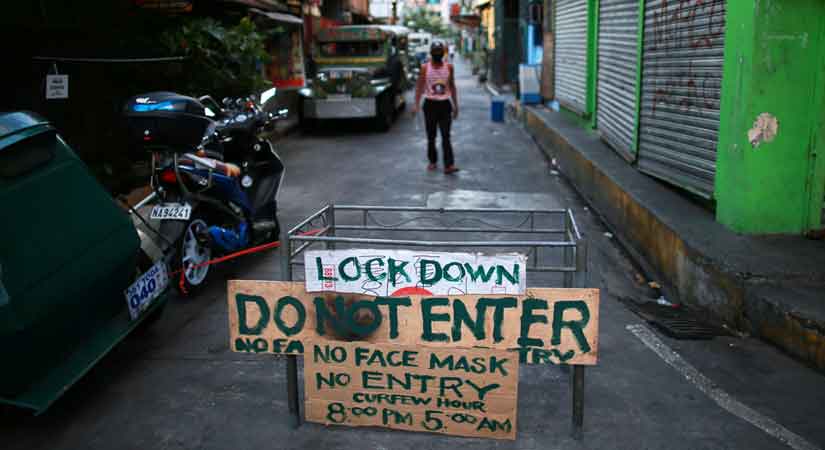
President Rodrigo R. Duterte locked down the entire Luzon island in mid-March, suspending work, classes and public transportation to contain the pandemic that has sickened about 127,000 and killed more than 2,200 people in the Philippines.
He has vowed to continue his government’s “Build, Build, Build” infrastructure program to stimulate an economy that has entered a recession after shrinking by 16.5% in the second quarter.
But construction companies continue to struggle as a number of workers have been unable to return to work because public transportation remained constricted.
EEI Corp., one of the country’s biggest construction companies that employs more than 24,000 workers, has resumed operations but with limited manpower.
“Some of our workers who went back to the provinces are still unable to return due to travel restrictions,” the company said in an e-mailed reply to questions last month.
“EEI remains cautious with its outlook, and keeps a keen eye toward possible changes that this crisis could further usher in not only for our business but for the economy as a whole,” it added.
Roland C. Roldan, 39, remained jobless because travel to the construction site that’s 25 kilometers away from his home in Novaliches City remained difficult, he said by telephone.
“I was forced to find jobs closer to home,” he said in Filipino. Medical requirements have also become stricter, with some companies requiring applicants to submit a certification that they are coronavirus-free, he added.
Mr. Roldan said he would rather spend the P2,000 on food than on getting tested. “During these times, you’d rather prioritize feeding your family.”
Roel D. Romano, a 48-year-old construction worker in the financial district of Makati City, said work protocols have become harsher. Strict social distancing is enforced at their site and they must submit a health declaration form daily.
“From 50 workers working at the same time before the pandemic, that’s down to eight,” he said in a Messenger chat.
Mr. Romano, who is from Binangonan in Rizal province, is one of the lucky ones because his company, Ethan International Corp. spent for their tests and provides transportation to and from the job site.
There was a time when he got worried about getting infected after his boss tested positive for the virus.
‘CHALLENGING’
“You can’t help but worry,” he said. “When I talked to my boss, I kept my distance although he has since recovered.”
About 400 workers at a building site in Taguig City had tested positive for the coronavirus last month, forcing the local government to declare a localized lockdown. All the workers have since recovered, according to the mayor.
The construction sector declined by 33.5% in the second quarter even after it was allowed to reopen in mid-May. The impact may be far worse, said Michael L. Ricafort, chief economist at Rizal Commercial Banking Corp.
“Construction accounts for at least 6% of Philippine gross domestic product, but its contribution to the economy could be more if the supply/value chain is considered,” he said in an e-mail last month.
Related sectors such as property and building suppliers have also been affected by the slowdown, Mr. Ricafort said.
The building industry faces another uphill battle after Mr. Duterte put Metro Manila and nearby provinces back under a strict lockdown amid surging infections. The modified enhanced community quarantine will last until Aug. 18.
“The stricter quarantine and resulting slowdown in construction, manufacturing, imports and overall business/economic activities could result in weaker GDP data for this quarter,” Mr. Ricafort said.
The level of decline would depend on the length of the strict lockdown “and ultimately how the spike in new COVID-19 cases would be managed,” he added.
D.M. Wenceslao & Associates, Inc. (DMW), which developed Aseana City along Manila Bay, has been trying to resume operations with a limited capacity.
“The year 2020 is definitely challenging,” DMW Chief Executive Officer Delfin Angelo C. Wenceslao said in a July 16 e-mail. “Absent a vaccine, all businesses are in a constant state of pivot and everyone is just trying to ride the pandemic out,” he added.
Aboitiz Construction, Inc. (ACI), which has three projects in Luzon affected by the lockdown, is also careful about its projections because it’s operating with reduced manpower.
“In the short and medium terms, a number of projects have been either deferred, delayed or canceled,” Aboitiz Construction President and Chief Executive Officer Alberto A. Ignacio, Jr. said in a July 16 e-mail.
The company expects revenue and profit to shrink this year until 2021.
Consumers will likely see lower electricity bills for August, Manila Electric Co. said on Monday. — PHILIPPINE STAR/MICHAEL VARCAS
ELECTRICITY RATES in Metro Manila slipped this month, with typical households likely to see a P41 cut in their total bills, according to Manila Electric Co. (Meralco).
The utility giant on Monday said August’s rate will decrease by P0.2055 per kilowatt-hour (kWh) to P8.4911 per kWh.
Power rates continued to dwindle for the fourth straight month on a relaxed supply contract due to the impact of the coronavirus pandemic.
Households consuming 300 kWh, 400 kWh, and 500 kWh could expect a decrease in their power bills by P61.65, P82.2, and P102.75, respectively.
Meralco’s generation charges fell for five straight months to P4.1241/kWh mainly brought by the lower prices at the Wholesale Electricity Spot Market (WESM) and natural gas repricing.
It bought supply from the spot market, which forms 15.5% of its requirements, at P1.1200/kWh. The lower charge is due to the improved supply situation in the Luzon grid with lower average plant capacity on outage.
The company also saw a P0.3284/kWh cut in the cost of power from independent power producers, which supply 33.9% of the utility’s needs. This was attributed to the decline in natural gas prices as part of quarterly repricing. It noted the price of its Malampaya gas supply reflected that of the significant reduction in crude oil prices globally.
Meralco said purchases from power contracts, which make up more than half of its total supply needs, inched up because of decreased average plant dispatch and a drop in force majeure claims. Its relaxed contract with First Gen Hydro Power Corp. led to a customer savings of P0.0285/kWh or about P82 million this month.
Since March, its total force majeure savings totaled around P1.9 billion.
Meanwhile, the utility noted a slight cut in transmission charges for its residential customers because of lower ancillary service charges.
Last week, the listed company said it will continue meter reading activities in its service areas under modified enhanced community quarantine, which runs from Aug. 4 to 18, to reflect its customers’ actual power usage in their upcoming bills.
Meralco’s controlling stakeholder, Beacon Electric Asset Holdings, Inc., is partly owned by PLDT Inc. Hastings Holdings, Inc., a unit of PLDT Beneficial Trust Fund subsidiary MediaQuest Holdings, Inc., has a stake in BusinessWorld through the Philippine Star Group, which it controls. — Adam J. Ang
THE House of Representatives on Monday gave final approval for the P162-billion fiscal stimulus measure, which includes providing much-needed financial aid for sectors hardest hit by the pandemic.
With 242 affirmative votes, six negative votes and zero abstention, the chamber approved on third reading House Bill No. 6953, or the “Bayanihan to Recover as One Act” (Bayanihan II).
The bill prioritizes support for the healthcare sector, small businesses, low-income households and unemployed individuals, including displaced overseas Filipino workers.
“We want Bayanihan II to be a living piece of legislation that will power our industries and revitalize sectors of society that have been decimated by this virus, or were otherwise forgotten and neglected in the past,” House Speaker Alan Peter S. Cayetano said during Monday’s session.
The P162 billion allotted under the House version is higher than the P145-billion standby fund under Senate Bill No. 1564.
Senate President Vicente C. Sotto III said he is in favor of increasing the funding, provided the government has resources.
“The House version is around P165 billion; but then I understand there was some amendments that were proposed in the budget supposed to be for the Department of Tourism, naalis (was removed),” he added.
Finance Secretary Carlos G. Dominguez III earlier said the government is ready to spend P140 billion for an economic stimulus plan this year, saying this would “keep our fiscal deficit in a manageable zone.”
Mr. Sotto noted the Bicameral Conference Committee that will reconcile the two versions may convene any time this week.
If enacted, President Duterte will be allowed to realign items in the 2019 and 2020 national budget as well as ease procurement processes for medical equipment and supplies among others. The bill will be in effect until Dec. 31, 2020.
The measure will also continue to grant the P5,000-8,000 subsidy for low-income households in areas under enhanced community quarantine.
Around P20 billion will be used to continue cash-for-work programs for displaced workers, and another P20 billion for the agriculture sector.
A total of P50 billion will also be provided as capital infusion to government financial institutions, which will support state-owned banks as well as fund credit guarantee program and lending programs to MSMEs.
The bill allocates P10 billion to the expanded testing and confinement of COVID-19 patients, and another P10 billion for healthcare workers.
Some P3 billion will be used to procure face masks and personal protective equipment and P4 billion for the construction of temporary medical isolation and quarantine facilities.
Mr. Cayetano said that while the Bayanihan II will boost various sectors hit by the Luzon-wide lockdown, the country will need a roadmap to address the coronavirus pandemic.
“It takes more than just a law to get things going. We need both a roadmap for the familiar places we need to go, and to blaze a trail out of the wilderness when we get lost,” he said. “We need a pragmatic plan that can be funded and implemented effectively.” — C.A.Tadalan
AFTER several years of not producing entertainment content and banking on sports and news for the network’s content, TV5 is poised for a comeback with a new setup: buying shows from producers such as APT Entertainment and having its pay TV sister channel Cignal TV block time in the network.
“We are looking for programs, not stars,” Percival “Perci” M. Intalan, programming head of TV5, told reporters in a digital briefing on Aug. 8 via Zoom.
This means that the network, instead of producing its own entertainment content, will be looking at show pitches from independent content producers which it can then buy (“if the price is right,” according to Mr. Intalan) and program into the network. This includes getting shows from Cignal TV which has its own library of content owing to its annual CineFilipino film festival and other productions.
Cignal will also handle the entertainment shows to be shown on TV5.
“With productions, we’re working with third parties who will create shows with Cignal talking with the producers. Cignal will define which programs will be shown but it should also pass Perci’s (Mr. Intalan’s) standards,” Robert P. Galang, president of both TV5 and Cignal TV, said in the same briefing.
APT Entertainment is the production company behind the longest-running noontime show in the country, Eat Bulaga, which has entered its 41st year. The show airs on GMA.
Mr. Intalan described the process as something similar to how networks in the US work where they buy shows from studios.
TV5, formerly known as ABC, is a TV network which has been on air since the 1960s. In 2010, the network was bought and operated by Philippine Long Distance Telephone Co., with the aim of becoming one of the top local channels. It was apparent since its early days as TV5 that the network’s strength lay in sports broadcasting, with the Philippine Basketball Association tourneys being among its top draws. In 2017, the network ceased producing entertainment shows and focused on sports and news.
But was TV5’s renewed interest in entertainment shows brought upon by the recent closure of TV giant ABS-CBN after it failed to renew its franchise? Not exactly, as Mr. Galang said TV5 had been planning to reintroduce entertainment shows since last year.
“I think we’ve never had a network that is in this position before. Before, it’s like a Hollywood studio, everything is [done] in-house and everything is created internally… but now TV5 is open, whoever wants to collaborate, we can,” Mr. Intalan said, before adding that is the beauty of the new setup.
Since ABS-CBN’s closure in early July, rumors have floated around saying several of the talents and production staff from the network were looking to move to TV5 and GMA, and Mr. Intalan confirmed that there are currently talks “in different levels” happening.
In a separate briefing, Manuel V. Pangilinan, chairman of the TV5 Network, Inc., confirmed that there are ongoing conversations with ABS-CBN talents.
“I think there are ongoing conversations with talents, but it’s not as expansive as one would assume because we are being careful with any contractual arrangements that these talents have with ABS-CBN, and we would like to respect that,” Mr. Pangilinan said in a separate briefing on July 6.
He added that they are looking to employ cameramen, directors, and “people behind the camera,” as they need more people to produce content.
THE NEW TV5 SHOWS
Starting Aug. 15, TV5 will be showing a mix of lifestyle programs and game shows “hosted by various artists with proven versatility and mass appeal,” according to a statement.
The new programs include a morning show called Chika, BESH! (Basta Everyday Super Happy), an APT Entertainment show hosted by Pokwang, Pauleen Luna, and Ria Atayde; a fitness show called Fit for Life hosted by Jessy Mendiola; a show focused on “intimate conversation and real life talk” called Usapang Real Life hosted by Luchi Cruz-Valdez; and two game shows — Bawal na Game Show hosted by Paolo Ballestereos and Wally Bayola, and Fill in the Bank hosted by Jose Manalo and Pokwang. Both game shows are produced by APT.
TV5 is also bringing back the talent show Talentadong Pinoy, to be hosted once again by Ryan Agoncillo. The new iteration is called Bangon Talentadong Pinoy which “aims to reflect the creativity of Filipino artists regardless of the current situation.” Talentadong Pinoy was on air from 2008 until 2014.
A show produced and hosted by Kris Aquino was also supposed to premiere in August but Mr. Intalan said that they had to delay its airing because of production issues.








 President Rodrigo R. Duterte locked down the entire Luzon island in mid-March, suspending work, classes and public transportation to contain the pandemic that has sickened about 127,000 and killed more than 2,200 people in the Philippines.