Home Blog Page 92

War in the Middle East: Cushioning the impact on the country’s medicine supply

STOCK PHOTO | Image by Gstudioimagen1 from Freepik

A war thousands of kilometers away can quietly determine whether a patient in the Philippines receives life-saving treatment on time.

The ongoing conflict involving Iran, the United States, and Israel is not only a geopolitical crisis, it is a global supply chain shock with direct implications for medicine availability, cost, and access. Disruptions in key trade routes, rising fuel prices, and constrained logistics capacity are reverberating across sectors, including healthcare.

As the war in the Middle East enters its fifth week, timely and coordinated action will be critical to safeguard the country’s medicine supply.

One of the foremost recommendations put forward by Dr. Diana Edralin, president of the Pharmaceutical and Healthcare Association of the Philippines (PHAP), is the shift to a six-month national inventory buffer for essential medicines. Given the 12- to 24-month manufacturing lead times for many pharmaceutical products, proactive and synchronized planning is essential to prevent stockouts.

Immediate and accurate forecasting enables both government and industry to anticipate demand for essential medicines and vaccines, and to place orders early, before supply chains become constrained. By doing so, it helps prevent stockouts during periods of global disruption. In a conflict scenario, where shipping routes may be affected and fuel costs may spike, countries with strong forecasting systems are better positioned to secure supply in advance, while others may be left competing for limited stocks. Toward this end, a formal joint forecasting process for biologics and vaccines for 2026 and 2027 should be prioritized. Strengthened government-private sector collaboration will be key to mitigating risks and ensuring supply continuity.

The government may also consider institutionalizing a National Medicines Logistics Command Center to enable real-time data sharing across agencies and industry stakeholders. Such a platform can support more responsive decision-making and equitable allocation of limited supply. Lessons from the COVID-19 pandemic have shown that coordinated, whole-of-system approaches are critical in managing large-scale disruptions.

To help manage rising logistics costs, green-lane prioritization for pharmaceutical shipments and expedited cargo processing can reduce delays and demurrage charges. Policy options such as targeted tax relief may also be explored to offset increases in war risk insurance and air freight premiums.

Ensuring sufficient fuel supply is likewise critical. Approximately 800,000 liters per month are required to sustain the nationwide distribution of medicines and vaccines across the archipelago. Without reliable fuel access, supply availability at ports and warehouses may not translate into timely access for patients.

Policy predictability will also be important in supporting affordability. Expanding Value-Added Tax (VAT) exemptions for medicines can help cushion patients from rising global cost pressures.

The Universal Health Care (UHC) Act provides an opportunity to further strengthen resilience through pooled procurement. By aggregating demand for 2026 and 2027, the country can achieve economies of scale and improve negotiating leverage, helping to offset higher importation and logistics costs. In times of uncertainty, forecasting and pooled procurement serve as critical shock absorbers against supply disruptions and price volatility.

Pooled procurement harnesses the strength of collective buying power by consolidating demand across purchasers. This enables bulk purchasing and strengthens negotiating leverage, ultimately helping to reduce medicine prices even amid global inflation. Evidence shows that pooled procurement can lower overall pharmaceutical costs. In a war scenario, this approach becomes even more critical, as it helps offset rising logistics and production costs.

Ultimately, maintaining a stable medicine supply chain is not just a health concern as it is an economic and national security imperative. Reliable access to medicines sustains workforce productivity, supports disease control programs, and reduces avoidable healthcare costs. Conversely, supply disruptions can lead to treatment delays, poorer health outcomes, and higher long-term expenditures.

The war in the Middle East underscores how deeply interconnected health security is with global events. In this environment, sustained collaboration between the government and the private sector is essential. By aligning policy, planning, and operational capabilities, the Philippines can build a more resilient system, one that protects access to life-saving essential medicines and vaccines even amid geopolitical uncertainty.


Teodoro B. Padilla is the executive director of Pharmaceutical and Healthcare Association of the Philippines, which represents the biopharmaceutical medicines and vaccines industry in the country. Its members are at the forefront of developing, investing and delivering innovative medicines, vaccines, and diagnostics for Filipinos to live healthier and more productive lives.

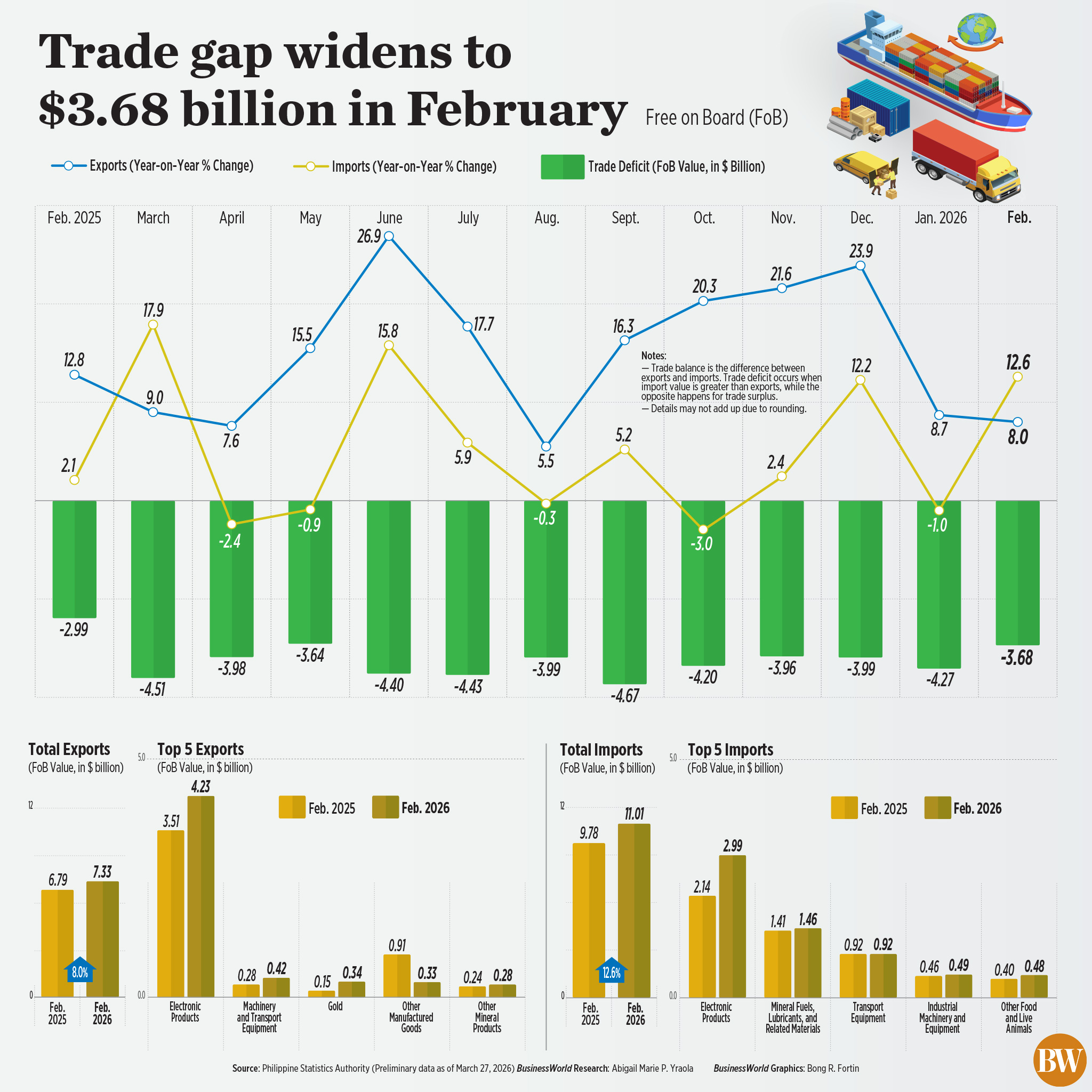
Trade gap widens to $3.68 billion in February

THE Philippines’ trade-in-goods deficit widened year on year in February as imports rose by double-digits while exports eased, the Philippine Statistics Authority (PSA) reported on Friday. Read the full story.

France to seek EU carbon tax suspension for fertilizer

A farmer prepares to use urea fertilizer in his cornfield in La Planche near Nantes, France, June 5, 2018. — REUTERS/STEPHANE MAHE

PARIS — France will ask the European Union (EU) to suspend the application of the bloc’s carbon border tax for fertilizers, in view of rising prices due to the Middle East war, Agriculture Minister Annie Genevard said.

Farmers around the world face rising fuel, gas and fertilizer prices due to supply disruptions caused by the month-old US-Israeli war on Iran. Growers in the EU blame the bloc’s carbon tax scheme, introduced in January, for further inflating fertilizer costs.

“On Monday I will be in Brussels to officially ask the (European) Commission to suspend the carbon tax on fertilizers, at least for the duration of this crisis,” Ms. Genevard told reporters during a visit to a farm in western France.

“This is not the time to increase fertilizer prices with the carbon tax.”

The EU’s agriculture ministers will hold a regular meeting on Monday.

The carbon border tax came into force on Jan. 1 and imposes CO2 emission fees on imports of steel, fertilizer and other goods to ensure they do not have an unfair advantage over products made in Europe.

The French government, which has faced regular protests from farmers in the past two years over grievances including red tape and declining farm income, had pushed the European Commission to exempt fertilizer from the carbon tax in January.

The EU has so far declined requests by France and other countries to suspend the levy on fertilizer. Member countries are negotiating an amendment that could allow temporary exemptions, though that process could take months.

European fertilizer producers oppose suspending the levy, arguing it helps protect local production from cheap imports.

France, the EU’s largest agricultural producer, earlier this week announced measures including loans and tax relief for farms struggling with mounting costs.

Ms. Genevard said further measures would be announced by the French government later Friday. — Reuters

BSP securities fetch higher rate

Bangko Sentral ng Pilipinas main office in Manila. — BW FILE PHOTO

THE BANGKO SENTRAL ng Pilipinas’ (BSP) short-term securities fetched a higher average yield on Friday, with the regulator capping its award even as the offer fetched ample demand.

The 28-day BSP bills drew P50.676 billion in bids, just above the P50-billion offering. This was also higher than the P42.501 billion in tenders for the P60 billion placed on the auction block on March 23.

This translated to a higher bid-to-cover ratio of 1.0135 times from 0.7084 previously.

However, the BSP accepted just P49.676 billion in tenders.

Accepted yields widened to the 4.3% to 4.6125% range from 4.4% to 4.6% in the previous auction. With this, the weighted average accepted rate of the 28-day bills increased by 3.35 basis points to 4.5191% from 4.4856%.

The BSP has not auctioned off the 56-day bills since Nov. 3.

The central bank uses the BSP securities and its term deposit facility to mop up excess liquidity in the financial system and to help guide short-term market yields towards its policy rate.

The BSP bills also contribute to improved price discovery for debt instruments while supporting monetary policy transmission.

The central bank began auctioning off short-term securities weekly in 2020, initially offering only a 28-day tenor and adding the 56-day bill in 2023.

BSP Deputy Governor Zeno Ronald R. Abenoja earlier said the central bank has reduced its issuance of short-term papers to enhance monetary policy transmission and encourage banks to better manage their liquidity.

As of mid-February, the central bank’s monetary operations have siphoned off P1.2 trillion in liquidity from the market. Of this, 28.5% was absorbed through BSP securities, while 44.4% were done through overnight reverse repurchase facility, and 9% from the term deposit facility. — Aaron Michael C. Sy

Easter finds

Celebrate Easter with these egg-citing finds.


Flying Tiger Copenhagen

FLYING TIGER Copenhagen’s Easter collection focuses on family gatherings, with a coordinated table framing the occasion, with matching mugs and bowls in soft pastels and a quirky fried-egg-inspired vase creating a playful yet polished centerpiece. For adults, creative moments unfold through decorating debossed eggs for display, while simple wreaths and subtle decorative accents add charm to the home. For kids, the fun continues with paint-your-own egg kits, water magic activity books, cheerful bunny bubbles, playful headbands, and cuddly plush companions. Meanwhile, its Spring collections are bursting with playful pastels, quirky details, and a touch of Danish charm. The Spring collection brings the freshness of the season with carefully designed ceramics, pastel mugs, charming cushions, and quirky little details. Set the scene with a spring grazing board for a slow brunch, a quick snack, or a relaxed evening with friends. Leaf-shaped dishes, small pastel bowls, scalloped serving bowls, tumbler glasses, fun mugs, spring napkins, and reusable pastel straws make the table spread look effortlessly chic. Pastels from the collection mix and match naturally when anchored by a primary color repeated across at least two items, balanced with a subtle accent shade. Consistent shapes, like flower plates paired with petal bowls or a leaf dish styled with small bowls, and repeated finishes such as gold-toned spoons help create a polished and cohesive setting. Tableware include side plates for snackers, serving bowls for hosts, or mugs for daily routines. In the Philippines, Flying Tiger Copenhagen is exclusively distributed by Stores Specialists, Inc., with branches in major malls around the country. Follow @flyingtigerph and @ssilifeph on Instagram and Facebook for more information.


Anko

ANKO has dropped a fresh Easter collection across its Metro Manila stores. The range brings together seasonal toys, egg hunt essentials, and hands-on craft kits. To keep kids busy before the hunt, there are Assorted Easter Wind Ups (P90), Assorted Easter Plush Toys (P240), and the Easter Fidget Egg (P240) — tactile, pocket-sized distractions for restless hands during the countdown to Sunday. For families planning their own egg hunts at home, Gold Look Hunt Eggs (P90), Novelty Hunt Eggs (P90), and Chick Hunt Eggs (P150) are available in a mix of styles that are easy to hide and fun to find. Parents can also grab Easter Bunny Loot Bags (P130) and Easter Hunt Gift Bag (P90) for stashing treats. The Egg Hunt Grabber (P150), a claw-style scoop, adds a fun physical challenge that keeps older kids just as entertained as the little ones. Beyond the hunt, set up a hands-on holiday crafter table where little artists can let their creativity shine with the Easter Craft Your Own Eggs (P150), design a lasting keepsake with the Easter Paint Your Own Mug (P150), and keep the festive momentum going all weekend long by filling up the Easter Activity Book (P240). This Easter collection is now available for a limited time only at Anko branches at Ayala Malls Glorietta 2, TriNoma, Alabang Town Center, Manila Bay, and Feliz. For more festive inspiration, follow @anko_philippines on Instagram and TikTok.

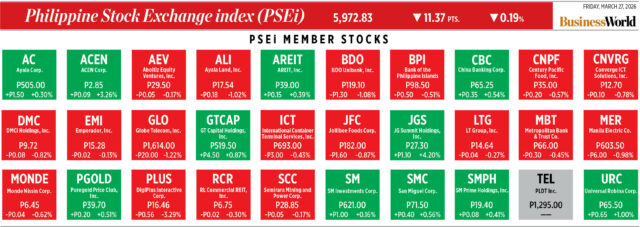
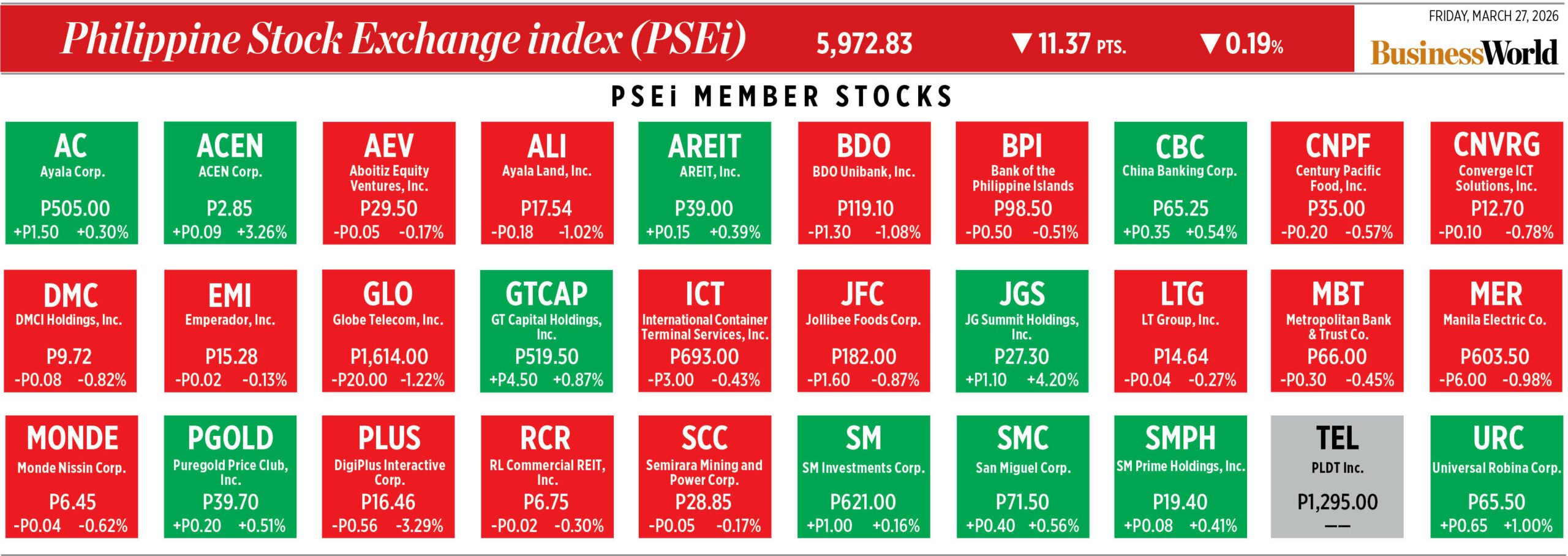
How PSEi member stocks performed — March 27, 2026

Here’s a quick glance at how PSEi stocks fared on Friday, March 27, 2026.


Stocks may drop further as market stays cautious

BW FILE PHOTO

PHILIPPINE SHARES may continue to move lower in the coming days as investors cautiously stay on the sidelines due to the Middle East conflict risks and the upcoming Holy Week break.

On Friday, the Philippine Stock Exchange index (PSEi) fell by 0.19% or 11.37 points to end at 5,972.83, while the broader all shares index went up by 0.05% or 1.75 points to close at 3,335.86.

Week on week, the PSEi went down by 45.79 points from its March 19 finish of 6,018.62.

“The PSEi slid 45 points to 5,972, breaking the psychological 6,000 support zone, as sentiment was locked on headlines in the Middle East. The BSP’s (Bangko Sentral ng Pilipinas) surprise off-cycle hawkish pause failed to soothe jitters surrounding the central bank’s revised 5.1% inflation outlook,” 2TradeAsia.com said in a market note.

“The local market extended its decline to a fourth straight week as worries over the US/Israel-Iran war continue to dominate sentiment,” Philstocks Financial, Inc. Research Manager Japhet Louis O. Tantiangco said in a Viber message. “Trading was also tepid last week, showing that many investors are staying on the sidelines while waiting for the uncertainties to dissipate. Since the start of the war, the local bourse has already lost 9.66%.”

The BSP’s policy-setting Monetary Board kept benchmark rates unchanged during a surprise off-cycle meeting last Thursday amid rising worries about the Middle East conflict’s economic toll.

They were scheduled to have the next regular review on April 23, but BSP Governor Eli M. Remolona, Jr. said they decided to hold a meeting as the economic situation has drastically changed since they last met on Feb. 19.

Mr. Remolona said they stood pat as adjusting their monetary settings would have limited effectiveness as the current inflation risks due to the war in the Middle East are largely supply-driven.

For this week, Mr. Tantiangco said the market is expected to remain bearish due to inflation pressures tied to the war in the Middle East.

“The elevated oil prices and the weak position of the peso are expected to continue weighing on market sentiment,” he added.

On Friday, the peso plunged to a new record low of P60.55 a dollar, down by 32 centavos from its P60.23 finish on Thursday.

Mr. Tantiangco said investors are likely to trade cautiously before the long weekend. Philippine financial markets are closed on April 2 and 3 for Holy Week.

“Chart-wise, last week, the market had a failed attempt in taking its 10-day exponential moving average and the 6,000 level, implying that both remain as strong resistance lines… The local market’s trading range is seen from 5,800 to 6,000.”

For its part, 2TradeAsia.com placed the PSEi’s immediate support at 5,800, resistance at 6,050, and secondary resistance at 6,300. — Alexandria Grace C. Magno

Philippines to take delivery of 1.04M barrels of diesel to boost fuel supply

A gas attendant is at work at a gasoline station in Manila in this file photo. — PHILIPPINE STAR/NOEL PABALATE

By Chloe Mari A. Hufana, Reporter

A GOVERNMENT‑BACKED shipment of 1.04 million barrels of diesel is set to arrive this week, bolstering the Philippines’ fuel buffers as global supply risks rise, the Presidential Palace said on Sunday.

In a statement, Executive Secretary Ralph G. Recto said the purchase is part of state efforts to stabilize fuel supply amid oil market volatility linked to the war in the Middle East.

The delivery adds to recent measures aimed at diversifying energy sources, including commitments from Indonesia to support coal supply and recent inflows of Russian crude oil.

President Ferdinand R. Marcos, Jr. has said the Philippines has sufficient fuel supply for 45 days and is procuring an additional one million barrels to strengthen buffer stocks.

Mr. Recto also pointed to expected output from new wells in the Malampaya gas field later this year, which he said would further support the country’s energy supply outlook.

The government is pairing supply measures with support for vulnerable sectors. Fuel subsidies are being expanded to cover about 250,000 public transport drivers, while additional assistance is being prepared for farmers and fishermen to limit inflation spillovers.

Authorities have also intensified fuel conservation efforts following the declaration of a national energy emergency. More than 1,000 government offices have been inspected, and restrictions have been imposed on nonessential fuel use, as the government deploys both supply‑ and demand‑side responses to rising energy costs.

REVISITING DEREGULATION
Meanwhile, an energy policy analyst said the Philippines needs a more durable energy security strategy that reduces exposure to oil price shocks and restores the government’s ability to manage fuel supply risks, as policymakers weigh possible changes to the Oil Deregulation Law amid surging prices.

Noel M. Baga, co‑convenor of the Center for Energy Research and Policy, said recurring spikes in pump prices reflect longstanding structural weaknesses rather than short‑term disruptions, leaving the economy highly vulnerable to swings in global oil markets.

“The Oil Deregulation Law is a symptom of a broader structural problem,” Mr. Baga said via Facebook Messenger. “We are entirely exposed to global price and supply shocks because we have surrendered every buffer in the name of deregulation.”

Mr. Marcos last week said amendments to the Downstream Oil Industry Deregulation Act of 1998, remain under consideration as war in the Middle East fuels higher oil prices and weaken the peso.

He cautioned, however, that revising the law would take time, even as households and businesses face immediate pressure from higher transport and energy costs.

“Nothing is being discounted, meaning we are discussing everything that can be done so that we can do something to help alleviate the impact of the war in the Middle East,” Mr. Marcos told reporters on March 27. “But what we are focused on now is immediate… amending the Oil Deregulation Law will be a long discussion. I don’t know when it will happen.”

The Philippines relies almost entirely on imported oil to power its economy, making it vulnerable to external supply disruptions and price swings intensified by the conflict involving Iran, which has pushed energy costs higher globally.

Mr. Baga said revisiting deregulation is unlikely to bring near‑term relief from rising fuel prices, but argued it remains necessary to address institutional gaps that leave the country exposed.

He pointed to the absence of a strategic petroleum reserve, limited domestic refining capacity and a diminished role for the Philippine National Oil Co. as key weaknesses.

He said a more active state role in fuel procurement and distribution could help cushion the economy during periods of geopolitical stress and severe market volatility.

Instead of focusing solely on legislative amendments, Mr. Baga said the government already has tools to moderate price increases using existing laws.

“The President already has the tools he needs: classify oil as a prime commodity and impose price ceilings under Sections 4 and 7 of the Price Act as amended by Republic Act No. 10623,” he said. “That requires no new legislation.”

Such measures could provide temporary relief for consumers, Mr. Baga said, though he warned they are not a substitute for deeper reforms needed to strengthen the country’s energy security.

Pressure is also building in Congress to reconsider deregulation. Senate President Vicente C. Sotto III filed Senate Bill No. 1984 on March 24 seeking to repeal the 28‑year‑old law, which allows oil companies to set pump prices based on market forces and limits direct government intervention.

Mr. Sotto said the surge in global oil prices has reopened debate over whether the state should reclaim authority to influence fuel pricing during periods of extreme volatility.

In the House of Representatives, the Makabayan bloc has likewise called for the repeal of the Oil Deregulation Law, arguing deregulation has left consumers exposed to international price shocks. The group has paired the proposal with calls to tax billionaires, saying the revenue could fund relief programs for rising fuel costs.

The administration has already invoked emergency measures. Mr. Marcos last week declared a one‑year national state of energy emergency as fuel prices surged and concerns grew over supply security.

Issued under Executive Order No. 110, the declaration applies specifically to the energy sector and is intended to give the government greater flexibility to respond to potential supply disruptions and price spikes.

The President formed an inter‑agency body, the Unified Package for Livelihoods, Industry, Food and Transport committee, or UPLIFT, to coordinate measures aimed at stabilizing fuel supply, sustaining economic activity and protecting vulnerable sectors from higher energy costs.

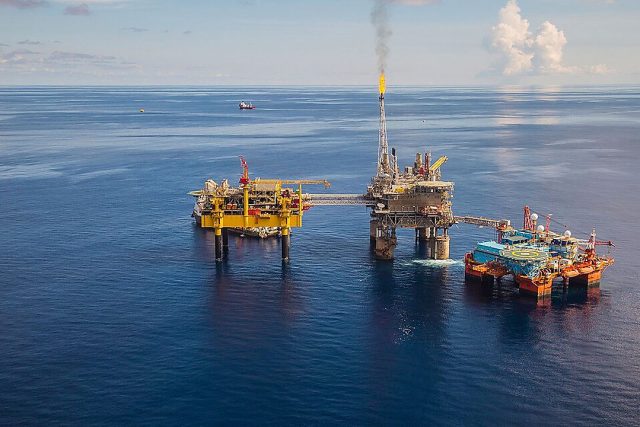
PHL and China discuss possible joint gas project

BW FILE PHOTO

By Kaela Patricia B. Gabriel

THE Philippines and China discussed the possibility of joint gas development during recent bilateral talks, signaling a potential revival of energy cooperation as Manila confronts tighter fuel supplies.

Initial exchanges on oil and gas exploration took place during the 24th Foreign Ministry Consultation and the 11th Bilateral Consultation Mechanism on the South China Sea, the Philippine Department of Foreign Affairs (DFA) said late on Saturday. The discussions were held alongside talks aimed at improving coordination between the two countries’ coast guards.

President Ferdinand R. Marcos, Jr. last week said he is open to restarting talks on joint energy exploration with China as the Philippines grapples with a fuel squeeze linked to the war in the Middle East.

China has also signaled willingness to resume negotiations. Shortly after Mr. Marcos’ remarks, Beijing said it is open to renewing discussions on joint energy development in the South China Sea.

Energy cooperation between the two countries has stalled in recent years. In 2023, the Philippine Supreme Court ruled unconstitutional a tripartite agreement among the Philippines, China and Vietnam to conduct marine seismic surveys in the disputed area, complicating efforts at joint resource exploration.

The latest talks were led by Philippine Foreign Affairs Undersecretary Leo M. Herrera‑Lim and Chinese Vice-Foreign Minister Sun Weidong. The delegations discussed political and security issues as well as potential cooperation in trade, agriculture and the energy sector, the DFA said.

The Philippines also raised recent incidents in contested waters that have affected Filipino personnel and fishermen, while reiterating its position on sovereignty based on the United Nations Convention on the Law of the Sea and the 2016 arbitral ruling that voided China’s expansive claims.

“Both sides continued to make progress on practical measures that are consistent with Philippine law and policy to increase confidence in the maritime domain,” the DFA said.

Beyond energy, the two countries discussed steps to deepen people‑to‑people ties through expanded tourism access, including visa facilitation and the opening of additional direct flight routes.

In January, the Philippines began allowing Chinese nationals to enter visa‑free for up to 14 days for tourism and business purposes, provided entry is through the Ninoy Aquino International Airport or Mactan‑Cebu International Airport.

Any move toward joint energy development would likely face legal and political scrutiny at home, given constitutional limits on foreign participation in resource extraction and heightened tensions in the South China Sea.

CHINESE ADVANTAGE
The Philippines could benefit from China’s technical capacity in offshore drilling if the two sides proceed with a joint oil and gas exploration in disputed areas of the South China Sea, provided Manila secures a formal agreement that safeguards its sovereignty, political analysts said.

While joint exploration could unlock much-needed energy resources for the Philippines, analysts cautioned that China would likely retain an advantage in any partnership due to its economic and technological clout.

“The Philippines does not have the capability to explore and make good use of available natural resources,” Edmund S. Tayao, president of Political Economic Elemental Researchers and Strategists, said in a Facebook Messenger call. “It will really require a partnership with a more capable country like China.”

Mr. Tayao noted that even if the potential exploration sites are within areas claimed by the Philippines, Manila would remain the lesser partner in such a venture. He stressed that the structure of any agreement would be crucial, particularly in defining resource-sharing terms and explicitly protecting Philippine sovereign rights.

“If the agreement includes control, sovereignty or ownership of the area, then we are clearly at a disadvantage,” he said, adding that negotiations should focus strictly on joint development.

Beyond economic considerations, a joint oil and gas project could also help ease diplomatic tensions and support broader confidence-building measures in the region. Amr Solon S. Sison, a Far Eastern University political science instructor, said cooperation on energy development could advance long-stalled talks on a code of conduct in the South China Sea.

“The Philippines does not have an established infrastructure to fully harness the energy sources from deep sea drilling besides natural gas,” Mr. Sison said in a Messenger chat, noting that the country has only one oil refinery and limited capacity for offshore drilling beyond natural gas extraction.

Mr. Tayao said Mr. Marcos’ openness about joint exploration is consistent with the administration’s foreign policy stance of being “a friend to all and an enemy to no one.”

Mr. Sison, however, views the potential revival of talks as a pragmatic response to rising global energy prices amid the war in the Middle East.

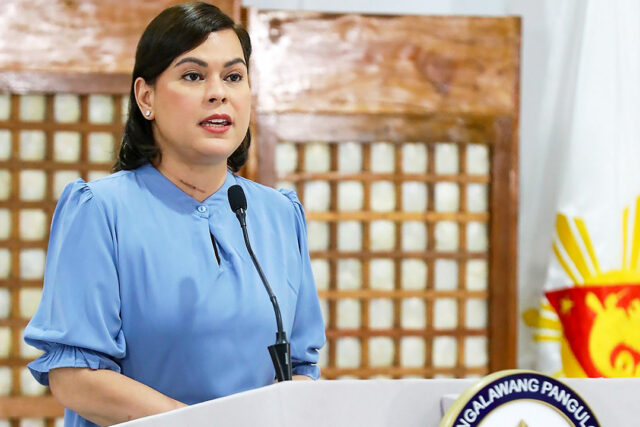
Impeachment threatens VP Sara’s 2028 presidential bid

VICE-PRESIDENT Sara Duterte-Carpio — OFFICE OF THE VICE PRESIDENT

By Kenneth Christiane L. Basilio, Reporter

IMPEACHMENT proceedings against Philippine Vice-President (VP) Sara Duterte-Carpio risk undercutting her position as a leading contender for the 2028 presidential election, with corruption allegations threatening to erode the political capital she has built since sweeping into office in 2022, political analysts said.

The move to unseat Ms. Duterte intensifies a high-stakes political standoff between her and President Ferdinand R. Marcos, Jr., once allies who ran together on a unity ticket but have since fallen out and emerged as rivals.

“The stakes are existential,” Ederson DT. Tapia, a political science professor at the University of Makati, said via Facebook Messenger. “For the Duterte camp, an acquittal strengthens their claim to enduring popular legitimacy.”

On the other hand, he said, a case that gains traction among voters would severely narrow her path back to executive power.

The House of Representatives’ Justice Committee last week began hearing multiple impeachment complaints filed against the Vice-President. The body is expected to conduct a series of televised hearings to determine whether there is sufficient evidence to advance the charges to a full vote in the chamber.

At least 106 lawmakers must vote in favor for the articles of impeachment to be sent to the Senate, which would then sit as an impeachment court. A Senate conviction would remove Ms. Duterte from office and permanently bar her from holding any public post.

The complaints accuse Ms. Duterte of misusing hundreds of millions of pesos in confidential funds allocated to the Office of the Vice-President and the Department of Education, which she headed.

Other allegations include amassing wealth disproportionate to her declared income, seeking to destabilize the government and plotting to assassinate Mr. Marcos, his wife and a former House speaker. Ms. Duterte has denied all accusations.

Taken together, the petitions charge her with graft, bribery, constitutional violations and betrayal of public trust — all impeachable offenses under the 1987 Constitution.

“If the House Justice Committee’s plan to scrutinize the evidence in public pushes through, Filipinos, including her supporters, may increasingly believe the allegations were true,” said Dennis C. Coronacion, chairman of the University of Santo Tomas’ Political Science Department. “That would not be good for her in terms of optics and could potentially damage her reputation as a political leader.”

Mr. Coronacion described the impeachment drive as a “political demolition job” aimed at blocking Ms. Duterte’s widely anticipated 2028 presidential bid. Pre-election surveys have consistently placed the Vice-President among the strongest potential candidates in the race. Mr. Marcos, constitutionally limited to a single six-year term, has yet to anoint a presidential bet.

While impeachment in the Philippines often hinges on arithmetic in Congress, analysts say public perception forged through televised proceedings could prove decisive.

“Impeachment is often framed as a numbers game, but the actual impact is shaped in the arena of public deliberation,” Arjan P. Aguirre, an assistant professor of political science at the Ateneo de Manila University, said in a Messenger chat.

If administration allies manage to control the narrative, he said, sustained allegations of wrongdoing could gradually weaken Ms. Duterte’s credibility and build momentum for conviction.

The process could also backfire. Aggressive questioning or procedural disruption by lawmakers allied with the Vice-President could reinforce her image as a political target of the Marcos camp, potentially galvanizing her base, Mr. Aguirre said.

Mr. Tapia noted that the strength of the financial evidence would be critical. “If supported by clear records and a coherent evidentiary chain, it reframes the issue from political contestation to questions of propriety and accountability,” he said. “That has real electoral consequences.”

San Juan Rep. Ysabel Maria J. Zamora said the complaints were bolstered by more evidence than earlier efforts. Ms. Duterte survived an impeachment attempt last year after the Supreme Court nullified the proceedings due to procedural flaws.

“There are more pieces of evidence now because additional attachments were included,” Ms. Zamora said. She added that the Justice committee is nearing the 60-day constitutional limit and expects to conclude deliberations by the end of May.

338 Filipinos to return to PHL

PRESIDENT Ferdinand R. Marcos, Jr. personally welcomed 343 Filipinos repatriated from the Middle East at Villamor Air Base on Monday. — PHILIPPINE STAR/RYAN BALDEMOR

THE Department of Migrant Workers (DMW) said that 338 repatriated Filipinos from the Middle East are expected to arrive in the Philippines on Sunday.

In a statement, the agency said the returning Filipinos were flown home on the government’s sixth chartered flight from the conflict-hit region.

The latest batch of repatriated Filipinos included 203 overseas Filipino workers (OFWs) and 125 of their family members. The remaining 10 were Filipinos who have been stranded since the war began.

The agency earlier reported that the fifth chartered flight from the United Arab Emirates arrived in the Philippines last Friday, 7 p.m. The flight included 222 OFWs and their 78 dependents, as well as 49 stranded Filipinos.

Migrant Workers Secretary Hans Leo J. Cacdac said last week that the agency is targeting to repatriate about 1,200 more Filipinos from the Middle East.

A total of 2,910 Filipinos from the Middle East have returned to the Philippines, according to data from the DMW. — Adrian H. Halili

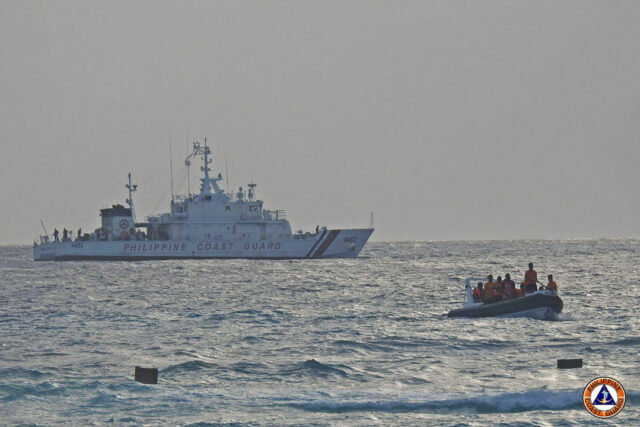
Sea code completion may be delayed

ORIGINAL PHOTO FROM THE PHILIPPINE COASTGUARD FACEBOOK ACCOUNT

A CODE of conduct (CoC) in the South China Sea is unlikely be completed this year, analysts said, as Manila prepares for a “bare-bones” Association of Southeast Asian Nations (ASEAN) summit focused on the fallout from the Iran war.

Chester B. Cabalza, founding president of Manila-based International Development and Security Cooperation, said that the completion of the code this year may remain “far-fetched.”

“With Manila’s early announcement of its vulnerability to energy security amid the Iran war and its planned bilateral reset with China, most likely the elusive CoC will be set aside in the agenda,” he said in a Facebook Messenger chat.

Mr. Cabalza said that the upcoming summits of the ASEAN must focus on the Middle East energy crisis, cybersecurity in the region, and peace and justice in the Cambodia-Thailand conflict.

He noted that the bloc must also reach a regional consensus to halt gray zone activities in the disputed sea.

The ASEAN and China agreed to craft a binding code of conduct in 2002, however, progress toward a binding framework has been repeatedly delayed by legal, political and strategic differences. Manila said earlier that it plans to complete the binding code by the end of the year.

Last week, President Ferdinand R. Marcos, Jr. said that ASEAN leaders came to a consensus to proceed with the meetings rather than delay them, with the summit mainly focused on urgent concerns of the regional bloc.

The President said that scheduled leadership meetings will now prioritize coordination on urgent issues such as energy, food security, and migrant workers amid the ongoing conflict in the Middle East.

Hansley A. Juliano, who teaches political science at the Ateneo de Manila University, said the Philippines, as this year’s chair, should emphasize independence on the Middle East conflict.

The US and Israel on Feb. 28 launched a coordinated strike at Iran aimed at crippling its nuclear weapons program. One month since, the war has further intensified placing a strain on global oil supply and prices with the closure of the Strait of Hormuz, a vital chokepoint that carries about 20 million barrels of oil per day.

“For the Philippines it is in fact an opportunity to argue for greater ASEAN interdependence and middle power independence,” he said in a Messenger chat.

However, Josue Raphael J. Cortez, a diplomacy lecturer at De La Salle-College of St. Benilde, said that the downsized summit may not delay completion of the CoC, but allow the bloc to pivot negotiations between Beijing and the ASEAN.

“Given how we are jointly devising strategies on how we can navigate these pressing times effectively — and the fact that China is among our key partners through ASEAN+3 — then this may lead to attitudinal dynamics which in a way or another may also positively affect how the continuous negotiations may unfold,” he said in a Messenger chat.

Mr. Cortez added that energy security and the welfare of migrant workers are still aligned with the Philippines’ chairship priorities.

“Regional security may also be understood from the lens of energy security, and on the other hand, migrant workers’ welfare is also mirrored in how we now try to explore ways on how we can ensure the safety of our migrant communities,” he said.

The South China Sea remains one of the region’s most volatile flashpoints. China has expanded its presence despite a 2016 ruling by a United Nations-backed arbitral tribunal that voided its sweeping claims over the waters, putting it at odds with claimants such as the Philippines, Vietnam, Malaysia, Brunei, Indonesia and Taiwan. — Adrian H. Halili