Home Blog Page 908

Tariffs weigh on US manufacturing in September; hiring remains subdued

REUTERS

WASHINGTON – US manufacturing activity edged up in September, though new orders and employment were subdued as factories grappled with the fallout from President Donald Trump’s sweeping tariffs.

The Institute for Supply Management (ISM) survey and other private-label data will assume greater importance among investors seeking to assess the health of the economy after the US government shut down at midnight on Tuesday, delaying the publication of key economic data, including the closely watched employment report for September that was due on Friday.

Import duties dominated responses in the ISM survey on Wednesday, with some manufacturers of miscellaneous goods complaining “steel tariffs are killing us.” Paperwork related to tariffs was also causing materials to be held up at borders.

Though some of the uncertainty surrounding trade policy had resolved as deals were made and the levies came into effect, Trump is not done with tariffs, unveiling more duties recently. Tariffs have cast a pall over the economy, and have combined with immigration raids to impede job growth.

Economists warned the 15th government shutdown since 1981, which will slow air travel, suspend scientific research, withhold pay from US troops and lead to the furlough of 750,000 federal workers at a daily cost of $400 million, would further muddy the economic outlook.

“Tariffs are a time bomb for the manufacturing industry which so far has a very long fuse but eventually it will go off and may well bring the entire economy down with it,” said Christopher Rupkey, chief economist at FWDBONDS.

The ISM said its manufacturing PMI increased to 49.1 last month from 48.7 in August. It was the seventh straight month that the PMI remained below a reading of 50, indicating contraction in manufacturing, which accounts for 10.1% of the economy. Economists polled by Reuters had forecast the PMI rising to 49.0.

Only five industries reported growth, including primary metals and textile mills. Among the 11 industries that contracted were wood products, machinery, electrical equipment, appliances and components, transportation equipment as well as computer and electronic products.

Some manufacturers of transportation equipment described business conditions as continuing to be “severely depressed.”

They noted “companies are starting to pass on tariffs via surcharges, raising prices up to 20%.

Others saw no benefit from interest rate cuts and tax reductions from Trump’s “One Big Beautiful Bill,” which passed in July, because “all capital projects are on hold until there is some level of certainty and customers start to place orders for new equipment again.”

Makers of electrical equipment, appliances and components said “customer orders are depressed for heavy machinery because tariffs are so impactful to high-end capital equipment.”

Similar sentiments were echoed by their counterparts in the computer and electronic products sector who said “our industry is at a low point right now.”

Trump, who recently announced a raft of duties including a 25% levy on heavy-duty trucks, has defended the tariffs as necessary to protect domestic manufacturing.

The ISM survey’s forward-looking new orders sub-index dropped to 48.9 from 51.4 in August. This measure has contracted in seven of the last eight months. Backlog orders remained subdued as did export orders. Delivery times lengthened further last month, keeping prices paid by factories for materials high.

The survey’s measure of factory employment rose to a still-depressed 45.3 from 43.8 in August. Some transportation equipment makers said they were “continuing to find ways to reduce overhead, which means letting go of experienced workers.”

Stocks on Wall Street were trading higher. The dollar was little changed against a basket of currencies. US Treasury yields fell.

UNCERTAINTY IS HURTING THE LABOR MARKET
The impact of uncertainty on the labor market was illustrated by the ADP National Employment Report, which showed private payrolls decreased by 32,000 jobs in September, the biggest drop since March 2023, after declining 3,000 in August. Economists had forecast private employment increasing 50,000.

The loss of jobs was almost across industries, with only education and health services, and information reporting gains.

But the ADP is not a true picture of the labor market’s health. The job market has stagnated, with low demand for labor amid weak hiring and the rise of artificial intelligence and a diminishing supply of workers because of immigration raids, creating what Fed Chair Jerome Powell has described as a “curious balance.”

Government data on Tuesday showed there were 0.98 job openings for every unemployed person in August compared to 1.0 in July. Economists expect the lackluster labor market will spur the Fed to cut interest rates again in October.

The US central bank resumed easing policy last month, cutting its benchmark overnight interest rate by 25 basis points to the 4.00%-4.25% range, to aid the labor market.

The ADP report, jointly developed with the Stanford Digital Economy Lab, has a poor record predicting the private payrolls in the Labor Department’s employment report. It will, however, take the spotlight in the absence of the monthly jobs report.

“Ordinarily, ADP’s estimate of monthly employment is of secondary importance to macroeconomic trainspotters,” said Bill Adams, chief economist at Comerica Bank. “It could have outsize influence on the next Fed decision, too, if the shutdown lasts long enough to keep the Fed from seeing the September (official) jobs report before their next decision on October 29.” — Reuters
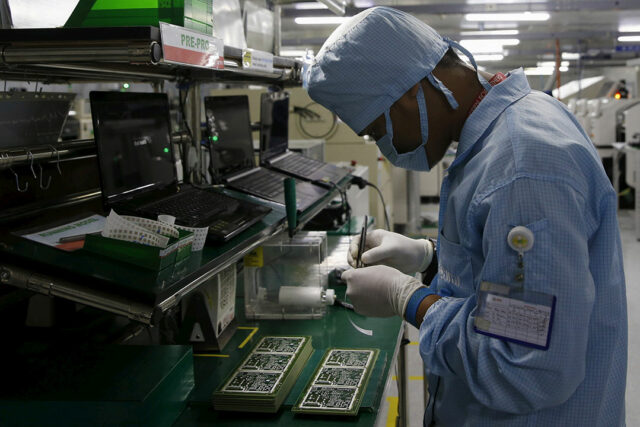
Factory activity shrinks in September

A worker is pictured at an electronics assembly line in Biñan, Laguna, April 20, 2016. — REUTERS/FILE PHOTO

By Aubrey Rose A. Inosante, Reporter

FACTORY ACTIVITY in the Philippines contracted for the first time in six months in September, as manufacturers saw a drop in output and new orders, S&P Global said on Wednesday.

The S&P Global Philippines Manufacturing Purchasing Managers’ Index (PMI) slipped to 49.9 in September from 50.8 in August.

A PMI reading below 50 shows a deterioration in operating conditions from the preceding month, while a reading above 50 denotes better operating conditions.

Manufacturing Purchasing Managers’ Index (PMI) of Select ASEAN Economies, September 2025This was the second contraction this year, or since the 49.4 reading in March, as manufacturers cut output amid uncertainty surrounding US tariff policies at the time.

“The Philippines PMI survey data showed the manufacturing sector moving into negative territory at the end of the third quarter which, despite indicating only a fractional decline, has been highly unusual in the sector’s post-pandemic history,” David Owen, a senior economist at S&P Global Market Intelligence, said.

According to S&P Global, this was only the third time in over four years that the Philippines’ manufacturing PMI fell below 50.

“New orders and output decreased slightly, as firms mentioned a fall in client numbers and a modest drop in production from the suspension of rice imports,” Mr. Owen said.

Based on S&P Global’s Association of Southeast Asian Nations (ASEAN) data, the Philippines and Malaysia (49.8) both saw a contraction in factory activity in September.

Thailand recorded the highest PMI reading (54.6), followed by Myanmar (53.1), Indonesia (50.4), and Vietnam (50.4).

The Philippines’ PMI reading was also below the 51.6 average for ASEAN in September.

S&P said Philippine manufacturing firms saw a decline in sales for the first time since March.

“Weaker operating conditions were mainly attributed to a renewed (albeit marginal) drop in new order intakes in September,” it said. “However, order books with foreign clients continued to improve, signaling that the downturn was mainly centered on the domestic market.”

Manufacturers had to scale back production in September, ending three straight months of expansion.

S&P noted that firms surveyed said that aside from weak demand, adverse weather conditions and a ban on rice imports negatively affected output.

Despite this, goods producers increased purchases of raw materials and other components in September, although the rate of growth was slower than August.

“In contrast, post-production inventories declined due to lower output as well as some efforts to reduce backlogs of work, which dropped for the first time since April,” it said.

The survey data also showed a “subdued jobs market” in September.

Firms also saw higher input costs in September, which prompted them to marginally increase selling prices.

Also, S&P noted the level of business confidence was the second highest since November 2024. Most firms were generally confident of an improvement in sales in the next 12 months.

“However, with overall sentiment in the year-ahead remaining upbeat in September, and purchasing quantities increasing, manufacturers appear hopeful that the dip in sector performance is temporary,” Mr. Owen said.

SUPPLY DISRUPTIONS
Analysts said the decline in manufacturing activity can be attributed to supply disruptions caused by heavy rains and floods in September.

“This was mainly due to weak demand, high input costs, and supply disruptions, including weather-related issues,” John Paolo R. Rivera, a senior research fellow at the Philippine Institute for Development Studies, said in a Viber message. “The sluggish factory orders and softer business sentiment reflect broader economic headwinds.”

Rizal Commercial Banking Corp. Chief Economist Michael L. Ricafort said manufacturing activity was affected by fewer working days due to bad weather, US tariffs and the so-called “ghost month.”

“(Higher tariffs) led to some wait-and-see attitude for some exports from the country and also exports in the global supply chains in terms of more cautious stance on their production and capacity,” he added.

‘TEMPORARY DIP’
S&P Global Marketing Intelligence Economics Associate Director Jingyu Pan said the decline in Philippine factory output in September is only a “temporary dip.”

She said new export orders remained steady even as the US implemented the 19% tariff on Philippine-made goods on Aug. 7.

“If we take just a little bit of a step back and look at all the other PMI that has been released for the Asian region so far, you are certainly getting quite a bit of mixed picture… It’s undeniable that we’re still seeing some of this frontloading across the APAC region,” Ms. Pan said.

Ms. Pan also noted that recent flooding was a more immediate drag on production than the government-wide probe into anomalous flood control projects.

While manufacturers remain optimistic about a recovery over the next 12 months, Ms. Pan warned that the recent earthquake could be a “big factor” and could weigh on output in the coming months.

“Cebu is a manufacturing hub as well, and electronics sector has been a key sector over there. That could actually dampen the picture going forward based on initial potential assessment here,” she said, but will depend on the extent of infrastructure damage in the region.

BSP sees September inflation at 1.5%-2.3%

A vendor sells fish at a market in Talisay, Batangas, July 11, 2025. — PHILIPPINE STAR/NOEL B PABALATE

PHILIPPINE INFLATION may have settled between 1.5% and 2.3% in September, amid higher prices of rice, fish and fuel, the Bangko Sentral ng Pilipinas (BSP) said.

At the lower end of the BSP’s forecast range, the headline inflation rate may have steadied month on month at 1.5%, the same as in August.

Inflation could have also picked up from the 1.9% print in September 2024.

The September print might also mark the first time in six months that the consumer price index (CPI) would have settled within the BSP’s 2-4% target range or since the 2.1% in February.

“Upward price pressures for the month are likely to arise from higher prices of rice and fish,” the central bank said in a statement on Wednesday. “Elevated domestic fuel costs likewise contribute to upside price pressures for the month.”

In August, rice inflation declined at a faster pace of -17% from -15.9% in July. Earlier, National Statistician Claire Dennis S. Mapa said that this might be the lowest for rice inflation this year.

Rice prices may have picked up in September, reflecting supply disruptions caused by bad weather and the 60-day ban on rice imports. The 60-day suspension on regular milled and well-milled rice imports took effect on Sept. 1.

At the same time, the BSP said lower costs of vegetables, meat and electricity may have partially tempered inflation in September.

Last month, the Manila Electric Co. lowered the overall electricity rate by P0.1852 per kilowatt-hour (kWh) to P13.0851 per kWh this month from P13.2703 per kWh in August.

“Going forward, the BSP will continue to monitor evolving domestic and international developments affecting the outlook for inflation and growth in line with its data-dependent approach to monetary policy formulation,” it said.

In a separate commentary on Wednesday, Aris D. Dacanay, HSBC economist for ASEAN (Association of Southeast Asian Nations) said inflation concerns, particularly on food, must be “on the table” in the Monetary Board’s next policy meeting.

“Accelerating to 2.7% y-o-y (from 2.3%), core inflation surprised to the upside in August, while inflationary pressures will likely persist from now until October as typhoons Ragasa (Nando) and Bualoi (Opong) likely took a toll on food supply,” he said.

Mr. Dacanay added that the extension of the rice import ban will add to the potential supply shock caused by typhoons.

However, he noted that the Monetary Board may be more cautious amid the peso’s weak performance against the United States’ dollar.

On Tuesday, the peso closed at P58.196 against the dollar, its weakest in two months or since the P58.32 per dollar seen on July 31.

HSBC expects the BSP to keep the benchmark rate at 5% at its next policy-setting meeting on Oct. 9.

“We think there is limited data to conclude with conviction that, indeed, the economy is slowing down,” Mr. Dacanay said. “While consumer vehicle purchases (are) falling and government capital spending (is) tightening, goods exports are still holding up.”

In August, the BSP trimmed its benchmark policy rate by 25 basis points (bps) for a third-straight meeting, bringing the rate to 5%. Since August last year, it has lowered borrowing costs by a total of 150 bps.

BSP Governor Eli M. Remolona, Jr. earlier said they could deliver a cut this month if the data show a slowdown in the economy. However, he noted at the Aug. 28 policy-setting meeting that the easing cycle is nearly over.

The Monetary Board has two policy-setting meetings left this year, on Oct. 9 and Dec. 11. — Katherine K. Chan

IMF trims Philippine growth outlook

Workers perform their duties at a shipyard in Subic, Zambales, Sept. 2. — PHILIPPINE STAR/NOEL B PABALATE

By Katherine K. Chan

PHILIPPINE ECONOMIC GROWTH is expected to moderate this year and in 2026 amid ongoing trade uncertainties and geopolitical tensions across the globe, the International Monetary Fund (IMF) said.

The IMF trimmed its Philippine growth forecast to 5.4% for this year, slightly lower than its 5.5% projection in July.

If realized, gross domestic product (GDP) growth will be at the low end of the National Government’s 5.5-6.5% target band this year.

For 2026, the IMF also cut its growth forecast to 5.7% from 5.9% previously. However, this is below the government’s 6-7% target for next year.

The IMF said the economy is expected to remain resilient, but downside risks warrant “close attention.”

“Risks to the growth outlook are tilted to the downside. The main external risks stem from prolonged global trade policy uncertainty, geopolitical tensions, and disruptive financial market corrections,” IMF Mission Head Elif Arbatli Saxegaard said at a briefing after the conclusion of the 2025 Article IV Consultation with the Philippines on Wednesday.

“On the domestic front, more frequent and intense climate shocks would cause notable macroeconomic losses. On the upside, accelerated implementation of structural and governance reforms would support investor confidence and the fiscal multiplier and raise potential growth. Risks around inflation are broadly balanced.”

Ms. Saxegaard said the growth outlook was revised to reflect the weaker-than-expected growth in the first half.

For the first half, GDP growth averaged 5.4%, slower than the 6.2% a year ago.

Ms. Saxegaard said growth will be affected by the higher tariffs imposed by the US on Philippine goods. The US began imposing a 19% tariff on goods from the Philippines on Aug. 7.

“It will weigh on exports and investment,” she said.

She also noted growth will be “supported by monetary easing and recent legislative measures to promote private investment.”

Meanwhile, the IMF sees inflation averaging 1.6% this year, before picking up to 2.6% next year.

“The pickup in inflation is expected to be driven by (the) food and transport crisis,” Ms. Saxegaard said. “And that reflects essentially the decline in negative base effects that have been dragging down inflation this year. So, as those base effects recede, we expect a pickup.”

She said core inflation is expected to “remain muted” at 2.5% in 2026.

“The BSP (Bangko Sentral ng Pilipinas) has room for a slightly more accommodative stance to help bring inflation back to the target faster and reduce economic slack amid elevated downside risks to growth,” Ms. Saxegaard said. “Policy will need to remain data dependent amidst prevailing uncertainties around the output gap and the neutral rate, and two-sided risks to inflation.”

On Aug. 28, the central bank slashed its key interest rate by 25 basis points (bps) for a third consecutive time to 5%. It has cut the benchmark by a total of 150 bps since August last year.

CORRUPTION
Asked about recent corruption scandals involving some government projects, Ms. Saxegaard said the IMF will continue to monitor the developments.

“It’s not yet clear whether and how these allegations will impact investor and private sector confidence, as well as their perceptions and behavior,” she said.

The IMF welcomed recent reforms to reduce infrastructure gaps and promote foreign direct investment, but effective implementation is key.

“Enhancing fiscal governance and the rule of law and reducing corruption vulnerabilities are critical for inclusive and sustainable growth,” Ms. Saxegaard said.

The IMF urged the Philippine government to continue implementing gradual fiscal consolidation “to replenish fiscal buffers and support external balance.”

“The authorities should consider implementing concrete and durable tax measures to limit the need for restraint in priority spending which tends to have a larger impact on growth and disproportionately impacts the vulnerable,” she said.

Ms. Saxegaard suggested several tax measures including monitoring the cost of tax incentives and improving the efficiency of the value-added tax (VAT).

“On the tax administration side, better or enhanced use of data analytics and compliance risk management would, in our view, help support revenue mobilization,” she said. “On tax policy options, there are several measures that would have positive benefits. We do think that also monitoring the cost of tax incentives would be desirable as well as enhancing the efficiency of the VAT.”

Meanwhile, Ms. Saxegaard said that risks to the country’s financial system remain moderate as the banking sector has strong capital and liquidity buffers.

“Nonetheless, vulnerabilities in the real estate sector, strong bank interconnectedness with complex conglomerate structures, and fast-growing consumer credit warrant close monitoring,” she added.

The IMF Staff Report will be released between November and early December this year.

BSP sees wider BoP, current account deficits until 2026

REUTERS

THE BANGKO SENTRAL ng Pilipinas (BSP) revised its balance of payments (BoP) and current account projections for this year and 2026, as global uncertainties persist. 

“The balance of payments is projected to remain in deficit over the next two years, driven by sustained pressures on the current account,” the BSP said in a statement on Wednesday.

The central bank said the overall BoP position is expected to end the year at a $6.9-billion deficit or -1.4% of gross domestic product (GDP), wider than its earlier forecast of a $6.3-billion deficit or -1.3% of GDP.

For 2026, the central bank expects the BoP deficit to widen to $3.4 billion or -0.6% of GDP from the previous projection of $2.8 billion or -0.5% of GDP. 

In the first eight months, the Philippines’ BoP position swung to a $5.397-billion deficit, a reversal from the $1.592-billion surplus seen in the same period in 2024.

At the same time, the BSP now sees the current account deficit widening to $16.4 billion or -3.3% of GDP this year, from its previous projection of $16.3 billion or -3.3% of GDP. 

For 2026, it expects a wider current account deficit of $15.5 billion or -2.9% of GDP from its previous projection of $13.6 billion or -2.5% of GDP.

“The current account shortfall is expected to stay at around 3% of GDP in 2025 and 2026. These reflect a widening trade-in-goods gap, subdued services receipts, and restrained capital inflows amid global uncertainty and shifting trade policies,” the BSP said.

The central bank also expects goods exports and imports to remain sluggish in the next two years, mainly due to “softening global demand, easing commodity prices, and tempered domestic growth momentum.”

Goods exports are projected to grow by 1% this year, a turnaround from the -1% decline previously expected. For 2026, goods exports are seen to expand by 1%, lower than the previous projection of 2%.

On the other hand, the BSP maintained the goods imports forecast to 1% this year but trimmed the growth projection for 2026 to 1% from 2% previously.

“Infrastructure investments, potential trade diversion, and efforts to diversify export and import partners may help cushion external shocks,” the BSP said. “However, structural constraints, such as logistical inefficiencies, skills mismatches, and elevated input costs, continue to weigh on export competitiveness.”

For services exports such as business process outsourcing (BPO) and tourism, the BSP sees slower growth for this year and next year “as the sector contends with uncertainties surrounding US reshoring policies and weakening inbound travel.”

It slashed services exports growth forecasts to 2% this year from 6% previously; and to 5% in 2026 from 8% previously.

However, the central bank retained its growth forecast for BPO revenues at 5% this year and for 2026.

The BSP cut growth projections for travel receipts this year to 1% from 10% previously. For next year, travel receipt growth is seen at 3% in 2026 from 11% previously.

For services imports, the BSP kept its 6% growth forecast for this year, but cut its 2026 forecast to 6% from 7% previously.

The BSP expects remittances to grow by 3% this year, a tad faster than its 2.8% previous forecast. It kept its forecast at 3% for 2026.

“Overseas Filipino remittances are expected to remain a resilient source of external support, underpinned by strong global labor demand and sustained confidence in formal transfer channels, despite the impending US tax on remittances,” it said.

On the other hand, foreign investment inflows may slightly soften amid “heightened global financial volatility and cautious investor behavior.”

“However, recent policy reforms — including amendments to the Investors’ Lease Act — are poised to improve the investment climate,” the BSP said.

Financial account outflows this year could hit $13.4 billion, slightly higher than the previous forecast of $12.9 billion. These outflows are expected to hit $14.4 billion next year, higher than the previous $13.2-billion forecast.

The central bank retained its forecasts for foreign direct investments (FDI) net inflows at $7.5 billion this year and $8 billion next year.

However, net inflows of foreign portfolio investments are projected to reach $6.2 billion by end-2025, slightly lower than the $6.8-billion previous projection. The BSP kept its forecast for 2026 at $5 billion.

Meanwhile, gross international reserves (GIR) are expected to hit $105 billion this year, a tad higher than the previous forecast of $104 billion. For 2026, the GIR is projected to reach $106 billion, slightly higher than the previous forecast of $105 billion.

“Gross international reserves are expected to remain adequate, providing a robust buffer against external liquidity needs even as global market conditions evolve,” the central bank said.

The BSP said it will continue to monitor emerging risks that might impact the external sector.

In a separate report, Bank of America (BofA) Global Research said the Philippines is the only country in the Association of Southeast Asian Nations (ASEAN) whose current account balance has been showing “a steady trend of wider deficits.”

“Despite the growing headwinds from external trade, current account balances across the region have remained in a manageable state, with only Philippines showing a steady trend of wider deficits, while other economies in the region remain rangebound,” it said.   

In terms of goods balances, BofA identified the Philippines as an “underperformer,” alongside Malaysia.

“Within ASEAN, goods balances are the biggest driver of current account balances, with again Malaysia and Philippines being the underperformers, while Vietnam and Indonesia showing a trend of steady improvement,” it said.

Meanwhile, BofA said the Philippines’ information technology (IT) service revenues may partly offset the country’s goods deficit.

It also noted that remittances growth has lagged behind nominal growth.

“The relative importance of remittances and primary transfers in current account balances is slowly declining, as remittances growth, especially in the Philippines has consistently run behind nominal growth, and for other economies, has been mixed,” BofA said. — Katherine K. Chan

Maynilad earns Green Equity label, lowers IPO price ceiling to P15 per share

MAYNILAD

The Securities and Exchange Commission (SEC) has granted Maynilad Water Services, Inc. the first Philippine Green Equity label, the regulator announced on Wednesday.

In a letter dated Sept. 26, the SEC’s Markets and Securities Regulation Department said that Maynilad meets the criteria, with all its revenue coming from water-related activities such as treatment and sanitation.

An external reviewer’s assessment submitted to the SEC showed that Maynilad earned 100% of its revenue from green activities, such as water supply, wastewater treatment, sanitation services, and new water service installations, surpassing the 50% requirement.  

Additionally, 95% of its capital expenditure and 87% of operating expenses supported green initiatives.

Maynilad reported no income from fossil fuel activities, remaining below the 5% limit.

The SEC said the company has one year to adjust its operations to comply with the Philippine Sustainable Finance Taxonomy Guidelines (SFTG) or the ASEAN Taxonomy for Sustainable Finance (ATSF) during this transition, ensuring its green projects support environmental goals and adhere to social safeguards.

The Green Equity label was granted ahead of Maynilad’s planned initial public offering (IPO) in November.

Meanwhile, the water utility concessionaire said it remains optimistic about its IPO and latest target listing date despite challenging market conditions.

“The market is bad, but we are putting in a very successful and incredible story,” Maynilad President and Chief Executive Officer Ramoncito S. Fernandez told reporters on the sidelines of a Shareholders’ Association of the Philippines (SharePHIL) event on Wednesday.

“The progress is promising, and we will file the final prospectus by this Friday,” he added.

IPO PRICE CEILING LOWERED
Maynilad has lowered the upper limit of its IPO price to P15 per share from P20 in response to institutional investors’ preference.

In its latest preliminary prospectus, Maynilad said the International Finance Corporation plans to invest up to $100 million as a key investor, purchasing shares at the new price.

The Asian Development Bank is also considering a similar investment of up to $145 million but is awaiting board approval.

In a disclosure to the Philippine Dealing and Exchange Corp. last Thursday, Maynilad said the target listing date was moved from Oct. 30 to no later than Nov. 7 to accommodate cornerstone investors and allow potential investors to better understand its business model.

The company is offering a total of 2.29 billion shares, including 1.66 billion new shares, 24.9 million new shares specifically for First Pacific Co., 354.7 million shares from existing shareholders, and an option for an additional 249.05 million shares.

Proceeds from the sale of new shares will be used mainly to support Maynilad’s capital projects through 2025 and 2026, focusing on water infrastructure, wastewater management, and customer service and information technology improvements. Some funds may also cover general corporate expenses. — Alexandria Grace C. Magno

SEC seeks to tighten nine-year limit for independent directors

FRANCISCO ED. LIM — THE SECURITIES AND EXCHANGE COMMISSION/BW FILE PHOTO

THE Securities and Exchange Commission (SEC) has issued for comment a draft memorandum circular that will impose a fixed three-year term for independent directors (IDs) and a maximum cumulative service limit of nine years, in line with international best practices.

The draft circular, released on Sept. 30, is open for comments until Oct. 15. It seeks to amend existing rules on director tenure to strengthen board independence and align with standards under the Revised Corporation Code of the Philippines.

Under the current system, independent directors are formally re-elected at each annual stockholders’ meeting, but their cumulative service is subject to a nine-year cap, although some have been allowed to exceed this limit through exemptive relief.

“We will do away with exemptive relief,” SEC Chairperson Francisco Ed. Lim told reporters on Wednesday.

“Basically, we will be strict on the nine-year limit. After three years, you can be re-elected. But maximum of nine years,” he added.

Under the proposed rules, an ID will be elected for a three-year fixed term, subject to disqualification provisions and the nine-year cap.

Companies will also be required to stagger the terms of their IDs to avoid all appointments expiring in the same year. For example, if a company has five IDs, it may initially assign terms of one, two, and three years to ensure that expirations occur in different years before all subsequent terms follow the three-year cycle.

Mr. Lim clarified that the new rules are not meant to question the independence of IDs, noting that other markets also impose varying director terms.

“We are benchmarking with other markets where directors are elected for varying terms, such as two or three years,” he said.

The nine-year cap has been in effect since 2012 through previous SEC memoranda.

Any fraction of a year served will count as a full year. Companies will also be required to disclose in their information statements any ID nominees who are at risk of breaching the maximum term.

IDs who reach the limit will be disqualified from serving again in the same capacity, although they may still be eligible for election as non-independent directors.

Covered companies that fail to comply may face penalties, including a basic fine of P1 million, plus monthly fines for continuing violations such as failure to vacate upon disqualification.

The SEC said incumbent IDs who have already served the maximum term may remain in their positions until their company’s 2026 annual stockholders’ meeting.

Mr. Lim said the commission is open to receiving feedback before finalizing the rules.

“It’s still just an exposure draft. We’re [still] waiting for comments from the public,” he said.

“I’m sure there will be issues, but we’re ready to face those issues.”

The circular is set to take effect on Jan. 1, 2026, once published in two national newspapers. — A.G.C. Magno

Manila Water completes takeover of Wawa bulk water supply project

PHILSTAR FILE PHOTO

EAST ZONE concessionaire Manila Water Co., Inc. has completed the takeover of the Wawa Bulk Water Supply from its parent firm Prime Infrastructure Capital, Inc. (Prime Infra) for P37.8 billion.

In a regulatory filing on Wednesday, Manila Water said the parties had met the conditions of the transaction, making operator WawaJVCo, Inc. a subsidiary of the water concessionaire.

Trident Water Company Holdings, Inc., a unit of Prime Infra, holds control of Manila Water.

WawaJVCo, a joint venture between Prime Infra and San Lorenzo Ruiz Builders & Developers Group, was established to develop, operate, and maintain the Wawa Bulk Water Supply Project in Rizal.

The project is a major raw water source infrastructure program intended to augment Metro Manila’s supply, which is currently dependent on the Angat Dam.

Prime Infra President and Chief Executive Officer Guillaume Lucci said the transaction underscores the company’s “strategic commitment to the water sector.”

“By consolidating our assets under Manila Water as our core water infrastructure platform, we are enhancing system integration, operational efficiency, and service delivery,” he said.

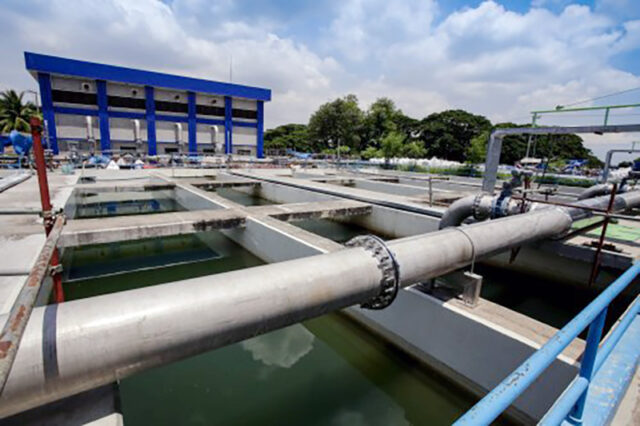
With the consolidation, Manila Water will operate both the Tayabasan Weir and the Upper Wawa Dam to ensure technical compatibility, system efficiency, and more flexible resource allocation.

The Tayabasan Weir has a capacity of 80 million liters per day (MLD) and has been operating since October 2022. The Upper Wawa Dam is set to begin commercial operations in December, with a capacity of up to 710 MLD.

NEW WATER FACILITY
Meanwhile, Manila Water said it is nearing the completion of its P3.9-billion Aglipay Sewage Treatment Plant (STP) in Mandaluyong, which is designed to treat up to 60 million liters of wastewater per day.

The Aglipay STP will be the company’s 42nd sewage treatment plant and one of its most expansive and advanced facilities.

The facility is undergoing testing and commissioning and is expected to benefit over 652,000 residents once fully operational.

Manila Water serves the east zone of Metro Manila, covering parts of Marikina, Pasig, Makati, Taguig, Pateros, Mandaluyong, San Juan, portions of Quezon City and Manila, and several towns in Rizal province. — Sheldeen Joy Talavera

Ayala-led IMI consolidates China operations

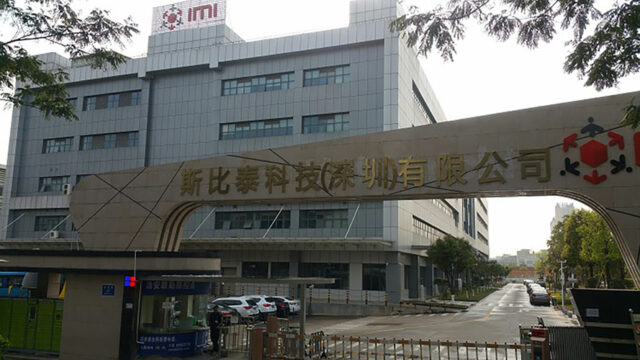
PINGSHAN SITE — GLOBAL-IMI.COM

AYALA-LED Integrated Micro-Electronics, Inc. (IMI) has completed the consolidation of its Kuichong operations into its Pingshan facility in Shenzhen, China, a move expected to streamline its presence in the country, improve efficiency, and increase capacity utilization.

In a disclosure on Wednesday, the company said final production activities at the Kuichong site ended on Sept. 30.

Integration of operations into Pingshan will continue in the coming weeks.

IMI said the transition aims to ensure business continuity and minimize disruption to customer accounts previously served by the Kuichong facility.

Established in 1980, IMI exports electronic assemblies, non-electronic products, and information technology services to industries such as automotive, medical, and consumer electronics.

Shares in IMI fell by 3.3% or six centavos to close at P1.76 apiece on Wednesday. — Alexandria Grace C. Magno

SM City Santa Rosa IT Center confirmed as IT ecozone

(FROM L-R) Sally S. So, vice-president for corporate tax of SM Investments Corp., Alexis Ortiga, vice-president and head of SM Offices of SM Prime Holdings, PEZA Director-General Tereso Panga, and PEZA Deputy Director-General for Policy and Planning Anidelle Alguso. — SM OFFICES

SM OFFICES, the office unit of SM Prime Holdings, Inc., has signed a registration agreement with the Philippine Economic Zone Authority (PEZA) confirming the SM City Santa Rosa IT Center in Laguna as an information technology (IT) economic zone.

As an accredited IT ecozone, the property will be entitled to fiscal and non-fiscal incentives, including income tax holidays, tax and duty exemptions, streamlined import and export procedures, and access to special non-immigrant visas, the company said in an e-mailed statement on Wednesday.

“The designation also ensures modern infrastructure and efficient government services, creating a strategic edge for registered IT enterprises in the Philippines,” it added.

President Ferdinand R. Marcos, Jr. signed Proclamation No. 944 in June, designating a part of SM City Santa Rosa as a special IT ecozone.

Located in Barangay Tagapo, the development includes the P1.6-billion, three-tower The Core Towers, which offer more than 27,000 square meters of office space.

The SM City Santa Rosa IT Center adds to SM Prime’s PEZA-accredited projects, such as the E-Com Centers at the Mall of Asia Complex in Pasay City and the SM North EDSA Towers in Quezon City.

The ecozone designation is expected to strengthen Laguna’s potential as an IT-BPM hub, attract investments, generate jobs, and spur economic growth, according to the company.

SM Prime earlier said it had allocated P6 billion this year for the development of new office towers and workspaces.

At the local bourse on Tuesday, SM Prime shares rose by 2% or 45 centavos to close at P22.90 apiece. — Beatriz Marie D. Cruz

TDF yields drop further

BW FILE PHOTO

YIELDS on the Bangko Sentral ng Pilipinas’ (BSP) term deposits dropped further on Wednesday as the offer was met with strong demand amid expectations that borrowing costs will continue to go down.

Bids for the central bank’s term deposit facility (TDF) amounted to P125.644 billion, above the P100 billion placed on the auction block and the P108.193 billion in bids for the P90 billion offered a week ago. The BSP made a full award of the papers.

Broken down, the seven-day deposits attracted P53.122 billion in bids, higher than the P50-billion offer but below the P58.145 billion in tenders for the P40 billion auctioned off last week.

Accepted rates for the one-week securities were from 5% to 5.09%, wider than the 5.05% to 5.09% margin a week earlier. With this, the weighted average accepted yield for the seven-day tenor declined by 1.13 basis points (bps) to 5.0634% from 5.0747% last week.

Meanwhile, tenders for the 14-day papers reached P72.522 billion, well above the P50 billion placed on the auction block and the P54.678 billion in bids recorded for the same offer volume last week.

The BSP accepted bids carrying yields from 4.98% to 5.1125%, lower than the 5% to 5.14% band last week. As a result, the average rate of the two-week tenor went down by 0.94 bp to 5.0918% from 5.1074% previously.

The BSP has not auctioned off 28-day term deposits for nearly five years to give way to its weekly offerings of securities with the same tenor.

Both the TDF and BSP bills are used by the central bank to mop up excess liquidity in the financial system and better guide market rates towards the policy rate.

Yields on term deposits continued to go down as both the BSP and the US Federal Reserve are expected to continue loosening their policy settings, Rizal Commercial Banking Corp. Chief Economist Michael L. Ricafort said in a Viber message.

“The series of BSP rate cuts in recent months and possible BSP and Fed rate cuts in the coming months led more investors to lock in yields before they go down further…,” he said.

The Monetary Board on Aug. 28 slashed borrowing costs by 25 bps for a third straight meeting to bring the policy rate to 5%. This brought cumulative cuts since August 2024 to 150 bps.

BSP Governor Eli M. Remolona, Jr. has said they could deliver one more cut this year — which would likely be its last reduction for this easing cycle — to support the economy and if inflation remains manageable.

Meanwhile, the Fed last month lowered its target rate by 25 bps to the 4%-4.25% range, which was its first cut since December. This brought its total reductions since September 2024 to 125 bps. Its “dot plot” showed projections of two more rate cuts this year.

Market volatility also led some funds to shift to other instruments, which likely contributed to the strong demand seen for the term deposits, Mr. Ricafort added.

JPMorgan Chase & Co.’s move to place the Philippines in its positive watchlist for its Government Bond Index for Emerging Markets (GBI-EM) series last month also supported sentiment, he said. This is the final review phase for potential inclusion in the bank’s GBI-EM Global Diversified Index. — A.M.C. Sy

Ayala, UAE’s Spinneys team up for PHL retail venture

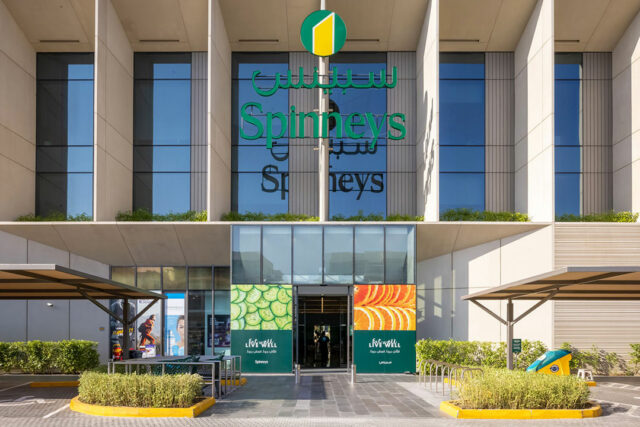
SPINNEYS.COM

LISTED Ayala Corp. and United Arab Emirates (UAE)-based supermarket chain Spinneys have entered into a partnership to open stores in the Philippines.

“We are honored to be the first partner of Spinneys as it ventures outside the GCC (Gulf Cooperation Council),” Ayala Corp. President and Chief Executive Officer Cezar P. Consing said in a statement on Wednesday.

Spinneys is owned by Al Seer Group, a UAE-based consumer holdings company with interests in food, retail, hospitality, shipyards, and construction across more than 20 countries.

Spinneys Chief Executive Officer Sunil Kumar said the Philippines offers long-term growth potential given its economic foundation, a rising number of affluent consumers, and increasing demand for quality products.

“Our partnership with Ayala combines their deep local knowledge with our operational expertise, providing a strong foundation to grow. As we enter this next phase, we’re delighted to be bringing our high-quality and fresh offering to a new region,” he added.

The partnership follows Ayala’s recent ventures with foreign retailers, including Thailand’s CP AXTRA for Makro stores and Australia’s Kmart for the Anko brand.

“We hope this investment will catalyze trade and investment between the Philippines and the GCC,” Mr. Consing said.

Shares in Ayala Corp. rose by 0.37% or P1.80 on Wednesday to close at P484.60 each. — Alexandria Grace C. Magno