Home Blog Page 9039

On hold: Quarantined tax assessments

(Part I)

After nearly two months under enhanced community quarantine (ECQ), Metro Manila is now looking to ease some of the restrictions without compromising public safety. In anticipation, local government units (LGUs) are preparing the guidelines to transition towards new normal. The call to adjust operations on an unprecedented scale is proving to be challenging to industries like the academe, among others.

Even government agencies have not been spared from the struggle. On the tax front, the Bureau of Internal Revenue’s (BIR) collection target for 2020, initially set at P2.58 trillion, was slashed to P2.26 trillion due to the slowdown in tax collections and the inability to conduct audits.

While under ECQ, the BIR issued revenue regulations (RR) and Revenue Memorandum Circulars (RMC) covering tax audits. RMC 31-2020 and RR 7-2020 as amended by RRs 10-2020 and 11-2020, extended the filing deadline of correspondences concerning tax assessments (e.g., replies to assessment notices and submission of documents for reinvestigations). RMC No. 34-2020 and the same RRs also suspended the running of the statute of limitations for tax assessments.

In this article, I’ll cover the implications of RMC 31-2020 and RR 11-2020 to taxpayers with existing tax audits. RMC 34-2020 will be covered next week.

To set the context, let’s revisit the Philippine tax audit process. It starts with the issuance of a Letter of Authority (LoA), allowing the BIR to conduct the audit. After the examination of the taxpayer’s records, the BIR will issue a Notice for Informal Conference (NIC), containing preliminary findings and the schedule for the conference with the revenue officers.

If the BIR does not find the explanations or documents submitted at the conference satisfactory, a Preliminary Assessment Notice (PAN) will be issued. The taxpayer will have 15 days to reply. If the findings remain unresolved, the BIR will issue a Formal Assessment Notice and a Formal Letter of Demand (FAN/FLD). Within 30 days, the taxpayer must file for reconsideration or reinvestigation as a form of protest. Otherwise, the assessment shall become final and executory. In case of a request for reinvestigation, the taxpayer is given an additional 60 days from the filing of the protest to submit supporting documents.

The BIR then has 180 days to decide on the protest and issue a Final Decision on Disputed Assessment (FDDA). If the taxpayer disagrees with the FDDA, an appeal may be filed with the Commissioner of Internal Revenue (CIR) or the Court of Tax Appeals (CTA) within 30 days.

Under RR 11-2020, the deadline for filing of the following documents or correspondences which fall due within the quarantine period starting 16 March 2020 until 30 days from the lifting of the ECQ, shall be extended for “30 days from the date of the lifting of the quarantine:”

1. protests/replies to the NIC, PAN, and FAN/FLD;

2. submission of relevant supporting documents for requests for reinvestigation;

3. appeal to the CIR on assessments which have reached the FDDA stage; and

4. other similar letters and correspondences with due dates.

While not explicitly mentioned, the deadline for submission of documents in response to an LoA may also be extended under Item No. 4 above. Effectively, all tax investigation deadlines at the BIR are extended — from replying to the LoA to appeals to the CIR.

Initially, the BIR under RMC 31-2020 only extended the deadlines to filings/responses falling due within the ECQ. However, RR 11-2020 has expanded this to cover taxpayers whose deadline to respond falls due within 30 days from the date of the lifting of the ECQ.

Moreover, RR 11-2020 clarified two relevant points, noting the restricted coverage of RMC 31-2020:

1) RMC 31-2020 limited the extension to taxpayers in Luzon and other jurisdictions, where the LGUs have adopted and implemented the ECQ or other similar measures. For simplicity, the RR modified this by applying the extension throughout the Philippines.

2) The RMC used the term “quarantine” to refer only to ECQ. The RR broadened the coverage to include any announcement by the National Government, resulting in limited operations and mobility. Thus, the term now includes, but is not limited to, “community quarantine,” “ECQ,” “modified community quarantine (MCQ),” and “general community quarantine (GCQ).”

These issuances are certainly a welcome development for taxpayers with existing tax audits, as it was a struggle to retrieve documents from previous years (on top of existing daily duties) even prior to the quarantine. Nonetheless, there are some aspects of the extension that raises some questions.

For one, the terms “Original Due Date” and “Extended Due Date” in RR 11-2020 may require further clarity. As mentioned, the extension also applies to taxpayers whose original deadline to respond falls within 30 days from the date of the lifting of the ECQ. The extended due date, on the other hand, is within 30 days from the date of the lifting of the quarantine. It is worth noting that the latter is broader in scope as it includes MCQ, community quarantine, and GCQ. Based on the government’s recent announcement, some areas will transition from ECQ to GCQ or Modified ECQ (MECQ) on May 16. Does this transition qualify as “lifting of the ECQ” and therefore the 30-day period from the “lifting of the ECQ”will start on May 16 regardless of whether the GCQ/MECQ period exceeds those 30 days? Or, since the MECQ may just be as restrictive as the ECQ, then the 30 days from the lifting of the ECQ will start when the MECQ is lifted?

Further, since all the extended deadlines are uniformly set to 30 days after the lifting of the quarantine, this may be disadvantageous to some taxpayers who are due to submit supporting documents in relation to a protest to FAN.

To illustrate, let’s assume that there are two taxpayers with existing tax audits. Taxpayer A filed its request for reinvestigation on Jan. 16, while Taxpayer B filed on March 15. Thus, the 60-day period to submit additional documents for Taxpayer A and B would be on March 16, and May 14, respectively. Since both deadlines fall due during the ECQ period, and assuming both are given a filing extension only until June 15, Taxpayer A would have an additional 90 days from its original deadline on March 16, while Taxpayer B would only have an additional 30 days from May 14. In case Taxpayer B is only able to operate and retrieve supporting documents after the lifting of the quarantine, effectively, it was unable to avail of the 60-day period it was allowed under the law since it only had 30 days to meet the deadline.

Considering that the extensions granted are unprecedented, the confusion arising from varied interpretations may be dispelled if there is another issuance providing sample scenarios on the application of the extension for further guidance.

In the meantime, it may be prudent for taxpayers who are due to file their protest letters with the BIR to file these the soonest, to avoid technical challenges from the BIR. As mentioned, the assessment is deemed final and executory if the protest letter is not timely submitted. In case of doubt, it is better to err on the side of caution than to take a regrettable risk.

The views or opinions expressed in this article are solely those of the author and do not necessarily represent those of Isla Lipana & Co. The content is for general information purposes only, and should not be used as a substitute for specific advice.


Kathrine Joy Capales is a manager at the Tax Services Department of Isla Lipana & Co., the Philippine member firm of the PwC network.

kathrine.joy.capales@pwc.com

DoH criticized for data errors as coronavirus cases reach 11,618

SENATORS on Wednesday hit the Department of Health (DoH) for errors in coronavirus tracking data, saying such “incompetence” endanger the lives of the public.

Lawmakers issued the criticism as the agency reported 268 more infections yesterday, bringing the total to 11,618.

The death toll rose to 772 after 21 more patients died, it said in a bulletin. One hundred forty-five more patients have gotten well, bringing the total recoveries to 2,251, it added.

“There is no room for officials who, because of sheer incompetence or corrupt thinking, will endanger our lives that we practically entrust to them,” Senator Panfilo M. Lacson said in a statement.

Experts from the University of the Philippines have cited “a number of alarming patient-level inconsistencies, if not gross errors” in tracking data such as gender, age and residence.

The lapses “may seem small” compared with the daily data updates, but these have significant implications on reliability of scientific analyses on the pandemic, they said.

The Health department in a statement said the “alarming” errors had not affected the overall data on COVID-19 cases, adding that it had addressed discrepancy issues.

“We assure the public that the issues raised are a nominal percentage of the whole data set, and does not prejudice the overall interpretation of data and decision making,” DoH said.

Senator Sherwin T. Gatchalian said the lapses could be reflected in measures crafted by Congress and the Executive department.

“Garbage in, garbage out,” he said in a statement. “If DoH is feeding garbage data to decision makers, expect garbage decisions from the government. Accurate data and information is fundamental in governance.”

Mr. Gatchalian said the law giving President Rodrigo R. Duterte special powers in dealing with the pandemic provides that buying medical equipment should be prioritized.

DoH could use technology to improve data collection, processing and analysis, he added.

DoH said it was coordinating with data engineers, scientists, specialists and other institutions in managing data.

“We acknowledge that the system is not perfect but we continue to improve our data collection and reporting systems,” it said. “DoH welcomes feedback as we respond to the information needs and the call for transparency from our fellow Filipinos in this national response against the COVID-19 pandemic,” it added.

It also said it would launch a digital epidemiological surveillance system developed with the World Health Organization that will automate data collection processes and minimize encoding errors.

Senate President Vicente C. Sotto III noted that while the errors might be small they have significant implications.

“Reliability of data is very important,” he said at an online news briefing.

In a policy note, published on May 8, the University of the Philippines COVID-19 pandemic response team flagged inconsistencies in official data between the DoH and local governments.

For example, DoH on May 3 reported seven deaths and 28 recoveries in Laguna, while the local government counted 22 deaths and 65 recoveries. The policy note also said 516 patients had their residences in a different city. — Charmaine A. Tadalan and Vann Marlo M. Villegas

Agents to probe police officer’s b-day festivities

THE National Bureau of Investigation (NBI) will probe the birthday celebration of a high-ranking police official amid a lockdown in Metro Manila because of a coronavirus pandemic, Justice Secretary Menardo I. Guevarra said on Wednesday.

“I will ask the NBI to look into this,” he said in a mobile-phone message, referring to Metro Manila police chief Debold M. Sinas’s birthday celebration last week, photos of which circulated online.

Mass gatherings are prohibited and physical distancing must be observed during the pandemic.

“There is already an existing order to the NBI to investigate violations of quarantine protocols,” Mr. Guevarra said.

He also said he has always advised state agents “to enforce the laws fairly and uniformly.”

Interior and Local Government Secretary Eduardo M. Año called the event “uncalled for,” adding that government officials should observe “delicadeza.”

Mr. Año, who supervises the police, said he would leave it up to the Philippine National Police (PNP) to investigate the event and find out if violations had been committed.

The PNP in a statement said police chief General Archie Francisco F. Gamboa had ordered the inspector general of the Internal Affairs Service to investigate alleged violations of quarantine protocols.

Mr. Sinas has issued an apology, saying it was a “traditional mañanita” conducted by some officers and the accommodation was done “with all cautiousness.”

“I apologize for what transpired during my birthday that caused anxiety to the public,” he said in a statement. “It was never my intention to disobey any existing protocols relative to the implementation of the enhanced community quarantine.” — Vann Marlo M. Villegas and Gillian M. Cortez

Typhoon Ambo intensifies into a severe tropical storm as it moves closer to land

HEAVY rainfall is expected in areas along the path of typhoon Ambo, which has strengthened into a severe tropical storm as of Wednesday with maximum sustained winds of 95 kilometers per hour (km/h) near the center and gustiness of up to 115 km/h. Based on weather bureau PAGASA’s 5 p.m. update, Ambo was located 315 km east of Borongan City, Eastern Samar and still moving west-northwest towards Camarines Sur. On Thursday, moderate to heavy rains are expected over the Eastern Visayas Region, and the provinces of Catanduanes, Albay, Sorsogon, and Masbate. By Friday afternoon, Ambo is forecasted to be 20 km north-northwest of Daet, Camarines Norte. “Flooding and rain-induced landslides may occur in highly to very highly susceptible areas during heavy or prolonged rainfall,” PAGASA warned. The Philippine Institute of Volcanology and Seismology (PHIVOLCS), meanwhile, warned of possible lahar flows in river channels around Mayon Volcano. “Prolonged and heavy rainfall may generate post-eruption lahars on major channels draining the Mayon Volcano edifice,” the agency said. Mayon erupted and was highly active in January-March 2018, leaving thick pyroclastic deposits and remnant ashfall along its slopes. PHIVOLCS said communities and local government units in these areas should prepare for evacuation.

Defense chief defends plan to buy attack helicopters

DEFENSE Secretary Delfin N. Lorenzana on Wednesday defended a military plan to buy P13 billion worth of attack helicopters in the fight against Maoist rebels amid a coronavirus disease 2019 (COVID-19) pandemic.

Leftist groups have criticized the plan, saying the money is better spent in the government’s anti-COVID-19 response.

Mr. Lorenzana told an online news briefing communist rebels should end their armed struggle so the government would stop buying weapons.

He said talks on the arms deal started three or four years ago, but the US State Department approved the sale only in April.

Mr. Lorenzana said the deal was for the purchase of six attack helicopters worth $2 billion, and the government only has a P13-billion budget now.

“If we were to buy attack helicopters for that price, we can only buy one or two,” he said. — Gillian M. Cortez

#COVID-19 Regional Updates (05/13/20)

No new COVID-19 case reported in Western Visayas as region gears up for end of lockdown

WESTERN Visayas did not have a new coronavirus disease 2019 (COVID-19) case reported on May 12 just as the region was declared among the areas with low transmission risk and can end lockdown measures by May 16.

Most local leaders in the region — which covers the provinces of Aklan, Antique, Capiz, Guimaras, Iloilo, and Negros Occidental and the independent cities of Iloilo and Bacolod — expressed readiness to lift lockdown rules as they prepared to release localized rules to ensure that the COVID-19 transmission threat will continue to be under control.

The Department of Health regional office has recorded 97 cases, with 39 recoveries and 10 deaths.

Of the active cases, 14 are in hospital, eight under home isolation, and 26 in government quarantine facilities.

NEGROS
Bacolod City Mayor Evelio R. Leonardia, who immediately called an inter agency meeting Tuesday, said a “unanimous decision” was reached to accept the national government’s pronouncement and end the lockdown.

“We will no longer appeal the decision,” he said in a streamed statement Tuesday evening.

In late April, local officials appealed the decision by the national task force to ease quarantine rules in the city by May 1.

The appeal was granted. Mr. Leonardia said the lifting of the quarantine rules will be a gradual transition.

“This will happen through a transitory executive order (then) for the Sangguniang Panlungsod (city council) to come up with ordinances to further strengthen our position.”

The executive order; which will contain detailed provisions on the transition phase, will be released “the soonest possible time.”

On the other hand, Negros Occidental Governor Eugenio Jose V. Lacson has

appealed to maintain the general community quarantine policy in the province until May 31.

In a letter to the national task force dated May 12, Mr. Lacson cited that the twoweek extension will give them time to complete the accreditation of its own laboratory for COVID-19 testing, which is already in the 4th of 5 assessment stages.

“While the Negrenses are all eager to revive the economy and shift to the ‘new normal’ at the soonest possible time, our enthusiasm is tempered by the lack of a testing center.”

Mr. Lacson said the local government intends to establish a protocol “that all persons entering Negros Occidental should be placed in a holding facility for 1 to 2 days while test are conducted, and until the test results are released from our own bio-lab.”

ILOILO
In Iloilo City, Mayor Jerry P. Treñas reiterated that they have been preparing for the resumption of economic activities and look forward to having businesses operating again.

“It is important for local businesses to resume operations so they can also offer employment,” he said in a media briefing.

Mr. Treñas said he was scheduled to have a series of meetings Tuesday afternoon with various sectors — business, transport, and health services — to iron out details of the transition plan.

Iloilo Gov. Arthur R. Defensor, Jr. also welcomed the classification as a low-risk area saying “it proves that the efforts of the provincial government bore fruit.”

In a statement, Mr: Defensor said he was set to meet with the governors of the other provinces to discuss border restrictions.

We cannot just let our guards down. We will not relax because the problem is not yet over. COVID is still in the country,” he said. — Marifi S. Jara

Maguindanao hospital reopens after 24 years, ready as COVID-19 facility

A HOSPITAL in Maguindanao province, which has been closed for 24 years, has been refurbished and now ready for use as a coronavirus-disease 2019 (COVID-19) facility.

Maguindanao Governor Bai Mariam Mangudadatu, who led the opening ceremony on May 12, said the revival of the Parang District Hospital is not just a response to the COVID-19 crisis but a means of improving health services.

“We need not to focus solely on the relief assistance. Relief goods are not the remedy for COVID-19,” Ms. Mangudadatu is quoted in a statement released Wednesday by the Bangsmoro Autonomous Region in Muslim Mindanao (BARMM).

“We are also looking forward into the future in which Parang District Hospital will also be a partner hospital in the Bangsamoro Government’s AMBAG program,” BARMM Cabinet Secretary Mohd Asnin Pendatun said.

AMBAG, or the Ayudang Medikal mula sa Bangsamoro Government, is a banner program of the regional government.

BARMM, which has been classified as a low-risk area and can start easing lockdown restrictions by May 16, has 12 recorded COVID-19 cases, with seven recoveries, one death, and one still under home quarantine. — MSJ

Nationwide round-up

1.5M ecozone jobs open for Balik Probinsya program — Escalada

JOB opportunities are available within special economic zones around the country for those who will enroll in the government’s Balik Probinsya program, which encourages people in Metro Manila and other urban areas to move back or relocate to the provinces. “I already plotted in our Philippine map what are the 400 economic zones in the country today. From shipbuilding, construction, manufacturing, semiconductor and all others. These are all spread all over the country,” National Housing Authority (NHA) General Manager Marcelino P. Escalada, Jr. said in an interview over radio DZBB on Wednesday. “Right now, the 400 locators all over the country can employ 1.5 million. These are opportunities in the countryside,” he added. The NHA will be offering available housing units under the program. Mr. Escalada also said beneficiaries of the Balik Probinsya program will be issued identification cards to facilitate their relocation and put them in a priority list of government agencies. “Once they are enrolled na sa (in) Balik Probinsya, we will be issuing IDs, coordinated with DPWH (Department of Public Works and Highways), with DoLE (Department of Labor and Employment). Once you present that you’re a Balik Probinsya (beneficiary), priority ka ng mga projects ng DPWH, ng mga facilitation ng Department of Labor,” he said. President Rodrigo R. Duterte institutionalized the program by signing an executive order that created the Balik Probinsya, Bagong Pag-asa Council, chaired by Executive Secretary Salvador C. Medialdea. — Genshen L. Espedido

Palace to issue memo for 2nd tranche of COVID-19 cash aid program

PHILSTAR/MIGUEL DE GUZMAN

THE Palace on Wednesday said a memorandum will be issued this week for the second tranche of the social amelioration program (SAP), the government’s cash aid distribution for low-income households amid the coronavirus disease 2019 (COVID-19) crisis. “Lalabas ang memo itong linggo na ‘to (The memo will be released this week),” Palace Spokesperson Harry L. Roque said in a briefing. Earlier this week, Department of Social Welfare and Development (DSWD) Secretary Rolando Bautista said they are waiting for the Palace to issue an order on the SAP second tranche before proceeding to finalize guidelines for its distribution, which is handled by local governments units (LGUs). The two-month subsidy that started in April aims to help 18 million families affected by the lockdown measures implemented to curb the spread of COVID-19. Problems arose in the distribution as LGUs faced logistical problems as well as disputes over the list of beneficiaries, prompting DSWD to extend its deadline for the third time on May 13. The first deadline was April 30 while the second was May 7. As of May 11, 16.3 million beneficiaries have received their subsidy. There have also been allegations of corruption over the SAP distribution. The Interior and Local Government chief has ordered the police to investigate and arrest local officials for anomalies relating to the cash subsidy. — Gillian M. Cortez

Start-ups and closures

I have yet to see data on how many businesses, particularly small and medium enterprises, in Metro Manila will not survive 2020 as a consequence of the COVID-19 pandemic. A few will probably start reopening by next week, some more perhaps by June 1. And of those that can resume by the second semester, I doubt very much if most will make it to the end of the year.

The most vulnerable, in my opinion, are freelancers, “professionals in general,” self-employed individuals, professionals working as consultants, small enterprises with limited cashflow, service enterprises with fewer than 10 employees, family-owned retail establishments, and small businesses run by families of overseas Filipino workers. Include on the list even small law firms, small medical and dental practices including neighborhood clinics, barbershops and salons, nail salons and spas, and small contractors and engineering firms. Small hotels and resorts and travel-related or travel-associated businesses, and travel-related transportation companies will also have much difficulty.

But while international travel and tourism may be dead in the water for now, I still see some opportunities in local or domestic tourism, particularly to destinations accessible by private land transport. Small families with private vehicles can still do weekends in private houses with pools or access to beaches; private lodges in cool climate destinations like Tagaytay and Baguio cities; and private farms with nature-related activities. It is a matter of how the owners of these private lodgings can strictly follow the required health and safety protocols.

But for many businesses that can still afford to restart, the concern is who can still afford to patronize them? A lot of people in the metropolis have lost their sources of income. Even those with some money tend to be more frugal in times of crisis. Business and consumer confidence are down. People are not ready to start spending for anything beyond basic necessities unless they are certain of surplus income in the medium to long term.

The Philippine Star has reported a recent survey by PwC Philippines indicating that less than 20% of start-ups in the country have enough cash to sustain their business operations for more than a year amid the impact of COVID-19. This was based on PwC-hosted discussions sometime last month with 90 start-up founders in the country. The survey showed only 19% of start-ups have cash good for over 12 months, while only 17% have the ability to sustain the business for more than 12 months if the enhanced community quarantine (ECQ) is extended, the Star reported. After May 15, Metro Manila, Laguna, and Cebu will be under modified enhanced community quarantine (ECQ) until May 31. It remains uncertain if this will be extended beyond May 31.

The Star also reported the survey showing that during the ECQ, 51% of start-ups have reduced their level of operations. One the bright side, 49% have also started offering a new product or service. My concern, however, is new offerings and the shift to the digital space is not enough to make up for what was lost and will be lost in the manufacturing, retail, and service industries.

Meanwhile, BusinessWorld reported that a survey last month by the Employers Confederation of the Philippines (ECoP) showed 67% of respondents said their companies postponed expansion or investment decisions because of COVID-19. The respondents were 148 large companies and 115 micro enterprises.

Only few respondents said they are observing normal operations, while 20% are on work-from-home setup. Another 26% said their business had to shut down due to the ECQ in Luzon, while 24% said they slowed down operations or maintained only a skeleton work force. Also, 22% saw a drop in demand for products and services; 19% said business dropped because of changes in work arrangements; and, 10% said they had difficulties paying salaries.

About 37% of respondents said they do not expect normal operations until after two to three months from ECQ lifting, while 14% said it would take them about six months from ECQ lifting to go back to normal. On the bright side, 38% said they expect operations to go “back to normal” a month after the lockdown ends.

Of the respondents, 34% also considered their companies poorly prepared to deal with the impact of COVID-19, while 28% said they do not have a written business continuity plan. Also, 64% have stopped hiring, while 9% said they laid off anywhere from 25% to 50% of their employees. For those who have kept their workers meantime, job cuts are expected in the future if the ECQ or the pandemic continue for another six months.

BusinessWorld also reported that Moody’s Investors Service already expects the country’s gross domestic product (GDP) to contract by as much as 2% this 2020. It quoted Moody’s as saying, “The rapid and widening spread of the coronavirus outbreak, deteriorating global economic outlook, falling oil prices, and financial market turmoil are creating a severe and extensive economic and financial shock.”

The Moody’s credit opinion shared with media on May 12 also noted, “As the ECQ will encompass much of the second quarter, we expect high-frequency data to continue to deteriorate despite the implementation of countercyclical policy stimulus, including handouts to vulnerable, low-income households.”

I take particular note of the comment of a Moody’s senior official, who reportedly e-mailed that the Philippine economic forecast was downgraded mainly due to the severity of the impact of the ECQ: “Given that we now expect the ECQ to last through most, if not all, of the second quarter, we are looking at an even larger contraction through the middle of the year.”

The official added, “Some of the key risks include the containment of the coronavirus outbreak itself, not just in the Philippines but also globally; an inability to contain the outbreak could lead to an even more prolonged imposition of measures that will weigh on economic activity.” But effective containment can result in “removal of restrictions on movement,” and this “will benefit consumption, allow people to return to work and alleviate the disruptions to the government’s infrastructure program.”

In a way, business under the COVID-19 environment is like pole-and-line fishing for tuna in open sea. The one with the longer line and stronger pole, as well as the patience and the determination to stay out in open water longer, can have better chances of catching fish. But, even the best pole and line, and bait, will be useless if the fish will simply not bite where you are. Or, there are just no fish to catch there. It all starts with knowing where to fish.


Marvin Tort is a former managing editor of BusinessWorld, and a former chairman of the Philippines Press Council.

matort@yahoo.com

Drug pricing in Asia and WHO assembly

As the COVID-19 global pandemic lingers, the search for new medicines and vaccines continues as existing treatments and medicines cannot cope with virus mutation. Public policies on the pricing of innovative, newly invented medicines and vaccines are among the important considerations, whether these new treatments will become available in certain countries or not.

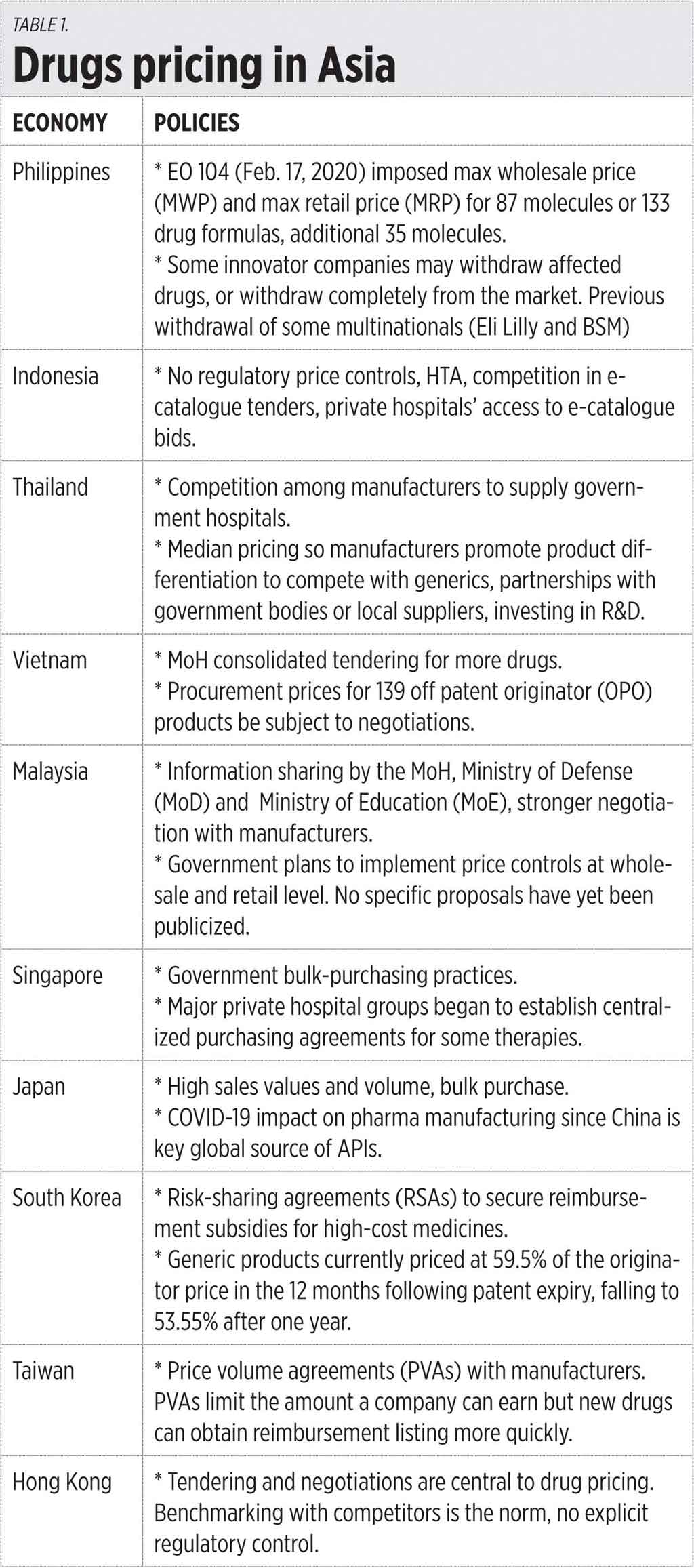
I checked the drug pricing policies of our neighbors in the ASEAN and developed Asia. A friend showed me a copy of the latest quarterly report of IQVIA (formerly IMS Health) as it is a by-subscription paper only. Only the Philippines instituted a new drug price control policy, Malaysia plans to have one but no details are available at the moment. The rest use mechanisms that are more market-oriented and not coercive (see Table 1).

February’s EO 104, which imposed a max wholesale price and a max retail price for certain drugs, is on top of drug price control under EO 821 (July 2009, Gloria Arroyo administration) which remains in effect until today.

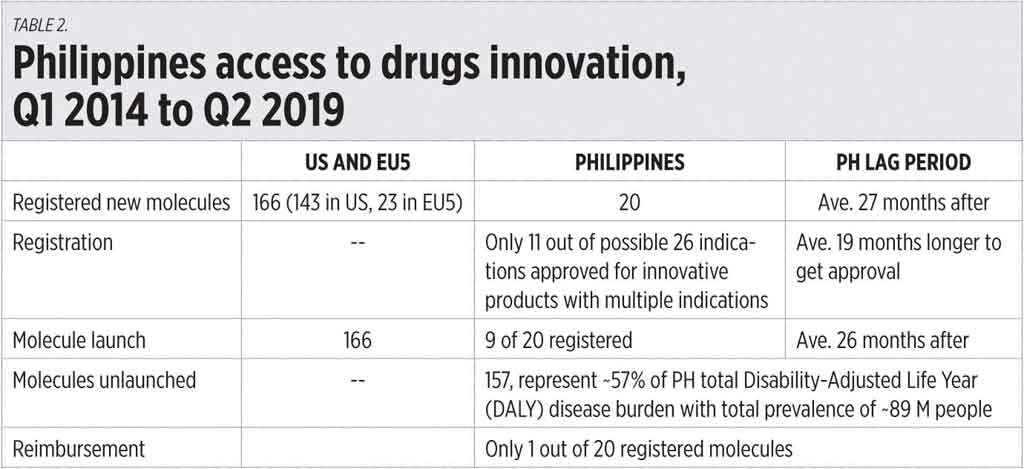
IQVIA also produced a country report on “Access to Innovation.” The main objective of the study is to understand the Philippines’ access to innovative medicines. I am thankful to another friend who shared with me that by subscription-only report.

The result is not good – so many new medicines, more disease-killing treatments are available in the developed world but are either not available in the Philippines, or made available only after more than two years (see Table 2).

The old EO 821 price control, threats of patent-confiscation via compulsory licensing, and endless attempts to have another round of drug price control, are among the factors why this thing happens.

There is a possibility — a danger — that when new treatments and vaccines are available against COVID-19 by early 2021, they may not be made available in the Philippines because of existing policies like price controls that penalize innovators.

President Rodrigo Duterte, Health Secretary Francisco Duque III, Senator Bong Go and other the other senators that pushed for price controls should be aware of the dangers of their policy. There are many mechanisms that government can take to have cheaper medicines like more competition among more innovators, negotiated pricing, bulk purchase, RSAs and PVAs, as shown in Table 1e.

On May 18, the member states of the World Health Organization (WHO) will gather in Geneva for the World Health Assembly and they will discuss new policies to fight the COVID-19 pandemic, among others.

That same day, a global coalition of 31 independent, non-government think tanks will release a new report, “A Joint Declaration on the Importance of Collaboration, Open Trade, and Innovation in Tackling COVID-19” (May 2020). Of these 31 think tanks, five are from the ASEAN: CIPS and Paramadina Institute (Indonesia), the Galen Center and KSO Institute (Malaysia), the Adam Smith Center (Singapore), and Minimal Government Thinkers (Philippines).

Our paper suggests seven simple measures that governments can make to save more lives now:

1. Abolish tariffs on medical supplies and medicines;

2. Reject export bans on medical supplies;

3. Reduce Customs red tape;

4. Enable the free flow of relevant health data across borders;

5. Maintain transparency in collecting and sharing epidemiological data;

6. Increase cooperation with other countries to speed up drug approval; and,

7. Support innovation, including intellectual property rights.

We hope that member-governments of WHO will consider these points. Private investments and research have a natural inclination to find new solutions to old and emerging problems, they just need to be unshackled from various restrictions, regulations, and high taxation by governments.


Bienvenido S. Oplas, Jr. is the president of Minimal Government Thinkers.

minimalgovernment@gmail.com

Working at home

By Tony Samson

A COMMON PLACE for work became the “new normal” after the industrial revolution in the western world of the 1800s. The then agricultural economy, that itself founded villages, went on to large scale manufacturing, drawing laborers from the rural population to work in the assembly lines to produce such items such as automobiles and steel bars. This development separated the home from the place of work. The subsequent revolutions like the Information Age, as well as the rise of the service sector, led to even larger office buildings and the introduction of cubicles.

The home then became just a living space with work and employment done somewhere else. The two sites were not necessarily near each other. There was a commute time between home and office, often longer than the lunch and coffee break combined. Working from home (WFH) due to the enhanced community quarantine (ECQ) is now trumpeted not as a solution to traffic congestion (remember telecommuting?) but as a new form of social distancing, known as the new normal.

Working at home is actually two centuries old. It can thus be classified as the very old normal. The blacksmith of that period lived above his shop and so technically worked at home. Monks too lived in the monastery where they grew vegetables. The haberdashers, morticians, and saloon keepers had both work and residence in one place.

Even in contemporary times, before the lockdowns, many productive individuals worked at home. The residence is referred to as the “home office,” as differentiated from this same phrase designating the headquarters of a multinational company. However, these home workers we refer to were not locked down and confined, as they were free to go out not just for groceries, but to dine out, go to the gym, or meet clients. They were not thrown down by the police for handcuffing in case they wandered out without a face mask and shirtless in their own driveways.

The home economy includes many in the food business. Didn’t we buy fruitcakes for Christmas gifts from a house in the neighborhood? These can also broaden their product offering to include lemon tarts and baked ham. Before long, customers picking up their orders get so numerous that the neighbors start complaining about clogged streets. So these home businesses evolved into restaurant chains… with a new commissary outside the home.

Writers too, not necessarily local ones, work at home. The disciplined ones, like Stephen King with 80 or so novels, devote a particular block of time to writing every day at home, except on designated holiday breaks. Some, like Desmond Morris, even dress up in a suit, to go downstairs to his home office to write. This attire draws the line between lounging around and working.

We know of a venture capitalist who works at home in his pajamas, cooking up deals and putting together funding and partnerships for acquisitions of hospitals and agribusiness ventures. Of course, he also goes out for lunch, to celebrate with his partners when a deal is done. And confers with lawyers when the pesky management of an acquired enterprise refuses to retire.

What about those who offer home services like extracting blood for lab tests on cholesterol levels, home massage complete with folding beds, and care-giving and sponge bathing for the elderly? These services are not necessarily offered by the same person.

The informal sector (sometimes referred to as the “underground economy”) is quite hospitable to personal services that don’t require an office, and the overhead that entails. We are only including in this category legitimate pursuits, or at least those not specifically illegitimate for which no warrant of arrest is necessary for apprehension or even outright elimination for resisting arrest, usually reported later as self-defense.

The home worker may eventually hire an accountant and pay some tax to avoid undue harassment. She can form a single person corporation (SPC) so she can legitimately deduct expenses for utilities and the renovations needed to accommodate proper ventilation.

The oldest profession, landscape architecture, is provided at the customer site, usually on a one-on-one basis. (Sir, do you want a rock garden?) This professional works from home and relies on word of mouth marketing and referrals, much like a dentist. For the home worker, the smartphone is an essential piece of equipment for taking orders. And if she wants to change her customer base, a new SIM card is all she needs — who is this please?


Tony Samson is Chairman and CEO, TOUCH xda.

ar.samson@yahoo.com

NBA gaining ‘momentum’ toward season resumption

FOLLOWING a Board of Governors call with commissioner Adam Silver on Tuesday, the National Basketball Association (NBA) is “increasingly positive about the league’s momentum” toward resuming the 2019-20 season, ESPN’s Adrian Wojnarowski reported.

Per the report, owners and executives were encouraged about the league’s steps toward returning safely amid the coronavirus pandemic and about positive conversations with the National Basketball Players Association (NBPA).

The report added that Silver emphasized that in order for a return to occur, all parties would need to accept that a single positive test for COVID-19 would not derail the season.

If a positive test would “shut us down, we probably shouldn’t go down this path,” Silver said, per Wojnarowski.

The report added that it remains unclear at what point numerous positive tests would impact the schedule.

Wojnarowski also reported that the format for the return play remains unknown, in terms of regular-season or playoff structure.

The NBA also reportedly continues to vet the possibility of holding all games in neutral sites, with Orlando and Las Vegas the leading candidates, in what Silver referred to as a “campus environment.”

Both Wojnarowski and The Athletic’s Shams Charania reported that the NBA aims to decide within two to four weeks whether to restart the season.

A potential roadblock to the proposed resumption is that the league doesn’t believe “rapid response testing” will be readily available inside of a month.

Earlier Tuesday, the NBPA informally polled players to gauge where they stand on restarting the season, Wojnarowski reported.

NBPA regional representatives began asking players to respond to a “yes or no” question about their desire to return to the court during the coronavirus pandemic, sources told Wojnarowski.

Some teams were asked the question in group texts, per the report, and names of the players and their individual responses will be kept confidential.

However, in a statement to The Athletic, the NBPA said it “is not engaging in and has not authorized any formal poll of its players.”

NBPA executive director Michele Roberts, executive committee members including president Chris Paul and other players held a conference call Friday with Silver to discuss various topics related to resuming play, chiefly health and finances.

Yahoo Sports’ Chris Haynes reported Paul held a private conference call with superstars across the league on Tuesday, with all wanting to resume the season at some point.

Per the report, LeBron James, Anthony Davis, Kevin Durant, Giannis Antetokounmpo, Kawhi Leonard, Stephen Curry, Damian Lillard and Russell Westbrook were all on the call, and “all parties were in agreement to take the court with proper safety measures” once that proves possible.

The NBA suspended the regular season on March 11 after Utah Jazz center Rudy Gobert tested positive for COVID-19. — Reuters

Challenges ahead for local football but stakeholders hopeful

PFF president Nonong Araneta

LOCAL FOOTBALL will have it challenging as long as the coronavirus disease 2019 (COVID-19) pandemic remains a going concern for the country. But stakeholders remain hopeful that in due time some semblance of normalcy can be achieved.

Speaking at the newly launched Heroes of Halftime with Audris Romualdez podcast last week, Philippine Football Federation (PFF) President Nonong Araneta and Stallion Laguna FC owner and coach Ernie Nierras said like everybody in the local sporting community, football has been made to adjust greatly in light of the episode with the highly contagious COVID-19.

While the current situation is unfortunate, they said, it is completely understandable that sporting affairs have to cease for now and allow more pressing concerns to be given priority.

“At the moment all sporting activities are cancelled. Sports are taking a backseat and they are the last priority,” admitted Mr. Araneta.

Messrs. Araneta and Nierras said given the cloud of uncertainty over COVID-19, it remains to be seen when the football machine can really be back in full throttle but from their end they said they are ready to go back and continue the sport’s push when conditions permit it.

The PFF, Mr. Araneta said, is committed to continue promoting football by way of the Philippines Football League (PFL) and grassroots programs and age-group tournaments they have lined up in different parts of the country.

The PFL was reset to commence this month, from an original schedule of March 21, but with the enhanced community quarantine still up on different areas, including the National Capital Region, it is set to be pushed back anew.

Mr. Araneta, however, said that if and when the PFL gets under way it will be without fans in the venues in compliance with the social-distancing guidelines of the government as a mitigating measure to help stop the spread of COVID-19.

The PFF president also said plans are also up to put a football academy in Carmona, Cavite, to further cultivate available talent.

For their part, Mr. Nierras said work continues for Stallion FC despite the delay in the start of the PFL.

“Myself and our team trainer we created a program even before the pandemic where the players can continue training. The players train on their own and they are obligated to video their training so we can track them and their progress,” said Mr. Nierras.

“It’s challenging but it’s not a problem. They are professionals and they know what to do. But definitely they miss playing. We are looking at this as a new opportunity not a problem,” he added.

As to what lies ahead, Messrs. Araneta and Nierras said it is important for the community to come and work together to set the football push back on track. Help from other sectors, too, would go a long way.

“Hopefully the government can come with the guidelines not only for football but sports in general to allow things to continue,” said Mr. Araneta.

It is something that Mr. Nierras shared while also highlighting there are no longer boundaries under the “new normal.”

“In the new normal there are no boundaries. There is no expertise specifically for one thing. People have to realize we have to work together, the business industry with the sports association and what have you. From a football perspective I like to believe things will only get better,” said the Stallion FC coach. — Michael Angelo S. Murillo